Home Blog Page 2138

When It’s Not a Good Idea to Be Finance Minister

0

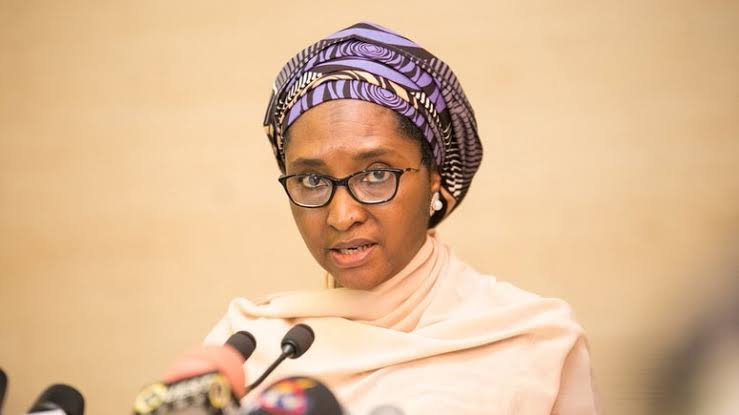
If, as some have suggested, facial expressions and body movements account for 60 to 65 percent of all communication, Mrs Zainab Ahmed’s plain public face says nothing about her current position as Minister of Finance, Budget, and National Planning.

The portfolio, as prestigious as it is, carries with it delicate responsibilities and high public expectations.

With the current economic challenges, the occupant of that office is the immediate recipient of blame for an economy gone wrong, and the seat must be hot enough to leave traces on her.

People with the gift of description, on the other hand, can only describe Ahmed’s public face as plain, serious, and emotionless at best.

Even though she was dubbed “Obirin Metta” in Yoruba, which means “powerful woman with a three-in-one portfolio,” she showed no signs of pride or exhaustion.

“You would have heard lawmakers accuse her of arrogance or even threaten her with arrest if she wears pride because of her important ministry,” one observer said.

Another test of her humility came when Godwin Obaseki, the governor of Edo State, accused the government of “economic rascality” for allegedly printing money for the Federation Account Allocation Committee to distribute among the government tiers.

Her response was cool and collected. “The issue raised by the Edo State Governor is very, very sad for me because it is not a fact,” she said. What we distribute at FAAC is generated revenue, and the distribution of that revenue is, in fact, public information. We publish and distribute revenue generated by FIRS, Customs, and the NNPC at FAAC. It is untrue to say that we printed money to distribute at FAAC.

Her portfolio’s weight, as well as the constant flow of high-level meetings she attends on a regular basis, should leave stress marks on her face, but none are visible. Even the national debt hasn’t been able to leave an imprint, and neither have her signature glasses.

She appeared to be unconcerned about her job for a long time, until she admitted she does, including one that causes her sleepless nights.

Asked by Poju Oyemade, senior pastor of Covenant Christian Centre, during “The Platform,” (an annual conference organised to mark Nigeria’s Independence anniversary), to list three things that keep her awake at night, the minister replied: “Number one is revenue, number two is revenue and three – I would say, is revenue.”

Ahmed’s availability for the event also attests to the modesty and accessibility of a minister who has also granted lengthy interviews to many mainstream newspapers.

Knowledge of the complexities of her portfolio should also equip her with the understanding that Nigeria’s lean revenue base, which has been further eroded by the socio-economic impact of the COVID-19 pandemic, offers scary scenarios to anybody who understands basic economics.

Even if one agrees with the minister that recent increases in oil prices are welcome, the joy is quickly overshadowed by the Federal Government’s burden of fuel subsidies.

One observer was recently ecstatic for her because oil prices had risen to over $70 per barrel, until the Group General Manager of the Nigerian National Petroleum Corporation, NNPC, Mele Kyari deflated him by explaining that higher oil prices were ironically bad news for the economy.

He compared the rising price of crude oil to a “chicken and egg” situation, expressing concern that prices had begun to stray from the NNPC’s “comfort zone” and had become a burden.

The global comfort zone, according to Kyari, is $58-$60 per barrel, with anything above that causing major distortions in the NNPC’s projections and adding to its problems.

Clearly an embarrassing irony, but a finance minister can only add the search for a balance to her job as a top member of a government that chooses socio-political stability at a high economic opportunity cost.

Ahmed also recognizes the country’s poor revenue match, despite her insistence that the country’s increasing debt burden is manageable.

“The Nigerian debt is still within sustainable limits,” she claims. What we need to do, as I’ve said several times, is improve our revenue in order to increase our capacity to service not only our debt, but also the day-to-day needs of running government. So, if you look at all the reports that you see from multilateral institutions, our debt, which is currently around 23 percent of GDP, is at a very sustainable level.”

Similarly, the Debt Management Office (DMO) reacted quickly to news that Nigeria had been classified as a high-risk debtor country by the World Bank.

Denying that Nigeria is a high-risk country, the DMO stated that Nigeria’s IDA debt stock was $11.7 billion as of June 30, 2021, explaining that IDA loans are one of the most advantageous borrowing options for countries like Nigeria and are also consistent with the Federal Government’s Medium Term Debt Management Strategy. The current debt-servicing burden, on the other hand, may be intimidating.

While it is comforting that a portion of the borrowed funds is used to fund infrastructure, one can only hope that the next government will not be wasteful or have a poor maintenance habit. The debt will continue to exist.

Ben Akabueze, the Director-General of the Federation Budget Office, recently added to the revenue debate by admitting that Nigeria’s federal budget, at 4.6 percent of GDP, is “too low in terms of number and socio-economic challenges.”

According to him, the country’s revenue to GDP is currently around 8%, just a percentage higher than Sudan, which is ranked last in the region. South Africa has 29% and Algeria has 33%, respectively, compared to a regional average of 22%.

The macro-economic indicators look promising, but could be better for a country in need of rapid development, with an inflation rate of 17.38 percent, down for three months; 82.9 million Nigerians adjudged to be living in poverty; a Gross Domestic Product of 152,32 trillion Naira in 2020; and an annual growth rate of 0.51 percent as of March, 2021.

The issue stems from the country’s low revenue base combined with an expanding expenditure profile.

An observer recently stated that whenever she hears of new payment approvals by the Federal Government, particularly for unions that should be aware of the state of the economy, she feels sorry for the Finance Minister and wonders if “Nigeria’s cloth is being cut according to size or material.”

“We have been trying to block and also enhance the cohesion of our people, especially within the revenue ecosystem,” Ahmed said, concerned about the trickling revenue stream. We’ve put money into an IT system and are attempting to collaborate and bring everything together,” Ahmed explained.

“Every month, we sit down and reconcile our revenues and tally the numbers,” she says. We’re working on connecting all of the IT systems so that we can see revenue in real time or near real time.

“The biggest challenge for me is generating revenue,” she said. “As a result, I’m directing my team to put in place some revenue growth strategies aimed at improving revenue performance by launching new initiatives.”

In addition, the minister established Tax Appeal Tribunals across the country to expedite the resolution of over 209 pending cases involving tax revenues totaling approximately $18.804 billion, N205.654 billion, and €0.821 million.

The expenditure plans of revenue-generating entities were reviewed for the introduction of more proactive revenue tracking and monitoring mechanisms in order to improve accountability and ultimately improve the performance of Government-owned Enterprises (GOEs).

The country has also restored its more business-friendly January-December budget year, thanks to better planning and a harmonious relationship with the legislature.

The African Banker Awards’ Finance Minister Prize winner for 2020 has been praised for “pushing through a series of difficult reforms as well as successfully engaging international partners to help the country navigate an extremely difficult economic environment.”

“The year 2020 was unlike any other year, particularly due to the impact of the COVID-19 pandemic,” she admitted last week. “Our three-year streak of GDP growth was halted in the second quarter of 2020 by the harsh economic impact of the global pandemic.”

The Ministry aided in guiding the economy through the tumultuous months of COVID-19, as well as putting it on a path of steady growth.

The Finance Act of 2019 was passed in record time before the 2020 budget under her watch. “Through the Finance Act, we have achieved the following:” she said, counting the benefits. Increase in the value added tax (VAT) rate from 5% to 7.5 percent, which took effect in February 2020; introduction of a N25 million threshold for SMEs to be eligible for VAT collection; reduction in tax rates for SMEs (0 percent and 20% respectively); administration of the Finance Act 2019; automation of the import duty exemption certificate (IDEC) and vehicle registration system

Read Also:  House of Representatives rejects the N1.3 trillion in projected revenue from customs in 2022

Since 2015, the government has repaid inherited debts and liabilities, including the $5.4 billion Paris Club debt over deductions, the $6.8 billion Joint Venture (JV) Cash Call arrears, the N1.9 trillion contractor/Export Expansion Grant, and the N488 billion road refund to states.

Despite her accomplishments, she still faces challenges, some as significant as the need to increase revenue streams and grow the economy quickly enough to effectively address poverty.
House of Representatives rejects the N1.3 trillion in projected revenue from customs in 2022

0

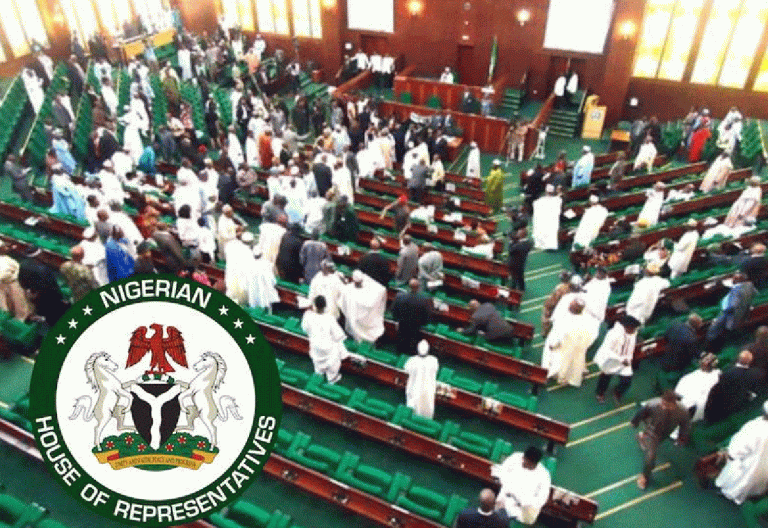
The House of Representatives Finance Committee on Monday rejected the N1.3 trillion revenue forecast by the Nigerian Customs Service (NCS) for the fiscal year 2022.

In his presentation at the ongoing public hearing on the 2022/2024 Medium Term Expenditure Framework and Fiscal Strategy Paper (MTEF/FSP), the Comptroller General of Customs, Mr Hameed Ali, revealed that the agency is projecting revenue of N1.33 trillion for 2022.

According to him, they came up with a figure that is attainable in the hopes of exceeding it.

“We came up with a figure that is attainable, and whatever comes after that, it is our hope that we will exceed that,” he said. In our proposal, we try to be as realistic as possible.”

However, lawmakers reacted by saying that the projection was too low for Nigerians.

Hon. Leke Abejide, a member of the Committee and Chairman of the House Committee on Customs, said the projection is absurd given the naira’s depreciation.

He predicted that the agency’s proposal would be in the N2.5 trillion range.

“This is ridiculous,” he says, noting that the naira has already been devalued. So, if you want to get the real value, you’ll see that the amount of money you’re getting isn’t improving. As a result, I expected the proposal to be in the N2.5 trillion range or higher. So, if you look at the value of the naira, it needs to be reviewed upward. Please note the parameters, as well as the fact that the Finance Act has been passed. There are so many ways we can increase revenue this year compared to last.”

Hon. Muktar Ahmed, another committee member, stated that the committee will not accept anything less than N3 trillion.

Hon. James Faleke, the Chairman of the Committee, stated in his ruling that the Budget Office examines the country’s expected revenue generation at the start of each year.

He explained that it is done to determine the gap in required funds and to make adequate borrowing preparations, noting that if more revenue is generated, the amount of money that must be borrowed will be reduced.

While confirming his colleagues’ assertions, he added that when the report is finally released, everyone will be pleased with it.

“CG, the issue is that the Budget Office works with the figures that are available to them on paper,” Falake explained. And, in order to achieve results, they’ll most likely look at what’s coming in at the start of the year. We say no, because your gross revenue generation is low, given all of the available opportunities, and when compared to your previous performance in 2020 and 2021. We as a finance committee will not accept the N1.3 trillion, but I am confident that by the time our report is released, you will be pleased.”

Meanwhile, lawmakers have summoned Mele Kyari, the Group Managing Director of the Nigerian National Petroleum Corporation (NNPC), to appear before them on Wednesday without fail.

The lawmakers have also summoned Mr. Sarki Auwalu, the Director of the Department of Petroleum Resources (DPR).

Kyari, who was scheduled to speak to lawmakers on Monday about revenue generation, was represented by the company’s Group General Manager, Corporate Planning and Strategy.

Hon. Leke Abejide, a member of the committee, expressed surprise at the development, saying, “I’m flabbergasted at how the NNPC GMD treats the National Assembly.”

Kyari’s behavior, he said, is demeaning to the legislature and should not be tolerated.

Read Also:  South Korea will work with Nigeria on security in the Gulf of Guinea

“We’re talking about revenue here, so where’s the GMD?” Abejide asked. He tries to stay away from the National Assembly at all costs. This is a disgrace to the National Assembly, and it does not bode well for him. He’s supposed to give us the figure himself, not send a representative, because we’re talking about how Nigeria can progress and solve the issue of taking loans. I propose that we excuse this representative and allow the GMD to speak to us directly.”

Alphonso Davies Shows His Support For The Paralympic Team Made Up Of Refugees

0

Ahead of this year’s Tokyo Summer Games, Canadian soccer star Alphonso Davies wrote a letter to the Refugee Paralympic team.

Davies, a 20-year-old Ghanaian refugee who moved to Edmonton and then Vancouver, has established himself as one of soccer’s brightest young stars.

In a statement posted to his Twitter page, Davies said, “I’ve read your stories and learned about the journeys you’ve all been through.” “Right now, you are the most courageous sports team on the planet.”

The Refugee Team debuted at the 2016 Summer Olympics in Rio, providing refugee athletes with a chance to compete despite their displacement under a unified Olympic flag.

After transferring from the MLS’s Vancouver Whitecaps in 2018, Davies now plays for Bayern Munich in Germany. He also works for UNHCR, the UN Refugee Agency, as a Global Goodwill Ambassador.

The following is the full text of Davies’ statement:

Tomorrow is the start of the greatest parasport event on the planet for the Refugee Paralympic Team. Congratulations on being in the thick of things. You’re probably nervous right now, but that’s to be expected. I get butterflies before every match when I play for FC Bayern Munich and Canada.

Read Also:  Cristiano Ronaldo has requested that he be benched by Juventus

Please keep in mind that you are not alone as you dive into the water, prepare to throw, or enter the arena. The entire world is behind you, including 82 million internally displaced people, 12 million of whom are disabled.

South Korea will work with Nigeria on security in the Gulf of Guinea

0

South Korea has stated that she is willing to work with Nigeria to ensure the security of the Gulf of Guinea.

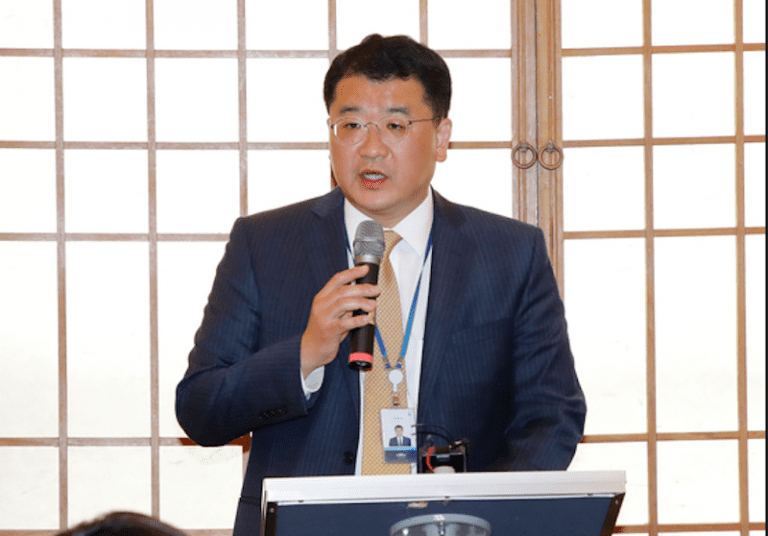
During a visit to Nigeria, Mr. Choi Jong Kun, the Republic of Korea’s 1st Vice Minister of Foreign Affairs, expressed his country’s interest.

He also expressed his country’s willingness to assist future leaders in Nigeria with training through people-to-people exchanges.

Kun made the revelations during a press conference with a select group of journalists in Abuja.

He lamented the unpalatable media coverage of the activities in the Gulf of Guinea.

Kun, who was in Nigeria for a one-day official visit and met with government officials including Minister of Transportation Rotimi Amaechi and Minister of State for Foreign Affairs Ambassador Zubairu Dada, said Korea was interested in expanding bilateral relations with Nigeria.

In terms of the economy, he stated that Nigeria provides South Korea with a large market, as Nigeria accounts for more than half of South Korea’s foreign construction sales in Africa.

He also stated that Korea was interested in construction because Nigeria is heavily involved in infrastructure projects, and that Korean construction companies with good and reliable builders would be well-positioned to benefit.

Kun went on to say that the current volume of trade between the two countries, which is around 400 to 500 million dollars, needed to be increased.

He went on to say that the second area of concern for South Korea and Nigeria was transnational security, particularly in the Gulf of Guinea.

He stated that when it comes to the word “Nigeria” in Korea, Koreans have a very positive association with the country.

Kun revealed that Nigeria also meant a lot of mysterious things from Africa, but that Nigerians have recently been hijacking a lot of ships in the Gulf of Guinea.

He explained that the situation in Nigeria had received a lot of negative press coverage in the South Korean press.

“As a result, we want to work with the Nigerian government to secure our fishing industry in the Gulf of Guinea. That is exactly what we will do,” Kun stated.
The third area of cooperation, according to Kun, is cultural exchanges such as people-to-people exchanges, which will include financing and educational exchanges between Korean and Nigerian universities.

“Nigeria provides Korean and East Asian people with a very meaningful African culture. As a result, the two are now collaborating. “As a hi-tech nation, we are also willing to provide training assistance to future leaders of this country, that is, people-to-people exchanges,” Kun added.

Read Also:  Buhari pays tribute to Victoria Aguiyi-Ironsi, the former First Lady of Nigeria

Concerning the COVID-19 pandemic in South Korea, Kun stated that the Republic of Korea had handled the situation successfully.
He claimed that, with a population of 53 million people, the country’s confirmed cases were small in comparison to other countries with similar populations.

Buhari pays tribute to Victoria Aguiyi-Ironsi, the former First Lady of Nigeria

0

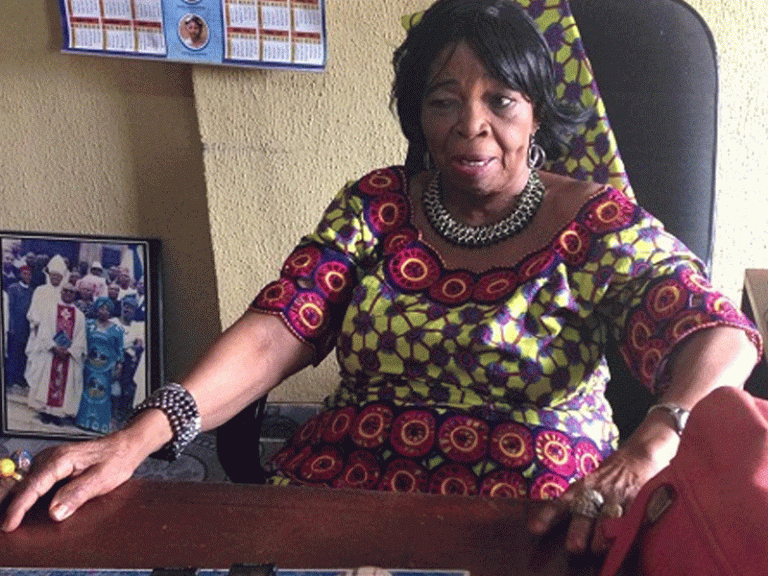
On the death of Chief Mrs Victoria Aguiyi-Ironsi, wife of the first military Head of State, Major General Johnson Thomas Aguiyi-Ironsi, President Muhammadu Buhari has expressed his condolences to the Aguiyi-Ironsi family, as well as the government and people of Abia State.
Lady Victoria’s incredible strength and exceptional courage during one of the darkest periods in Nigeria’s history, according to the President’s Media Adviser, Femi Adesina, portrayed her as a mother of the nation, God-fearing, and a foremost woman of valour.

He said the former First Lady will be remembered for laying the groundwork for women’s leadership in the executive branch and as a founding member of the Nigerian Army Officers’ Wives Association, where she passionately championed the welfare and well-being of military officers’ families.

Read Also:  Can Secondus Survive Wike’s Arsenal’s Onslaught in the PDP Crisis

The President acknowledged that Lady Victoria never stopped working for the greater good of Nigeria, as well as for peace, stability, healing, and reconciliation in the country, 55 years after General Aguiyi-death. Ironsi’s
President Buhari expressed his sincere hope that Lady Victoria’s contributions to the country would not be in vain, and he joined all Nigerians in praying for the souls of the departed and comfort for those in mourning.

We Were Denied Entry, So We Forced Our Way In, EFCC Responds To Dorathy’s Charges

0

The EFCC has confirmed that its operatives broke into Dorathy Bachor’s home following her outburst on her Instagram page about how EFCC officials allegedly broke into her house, claiming they were looking for a suspected internet fraudster.

The EFCC said in a statement on Monday that its agents broke into the house because the residents refused to open the door.

”The Commission can confirm that on Monday, August 23, 2021, operatives from the Commission’s Lagos Command, acting on verified intelligence, executed a Search Warrant at a block of flats located in the Lekki area of Lagos, during which nine internet fraud suspects were arrested,” the statement read.

One of the flats in the building happened to be Ms. Bachor’s. EFCC agents had knocked on her door, identifying themselves as members of the Commission on a mission to carry out a search warrant. Bachor’s sister, however, refused them entry for several minutes. The operatives had no choice but to force their way in, lest suspects flee or vital evidence be destroyed.

”It is critical to emphasize that law-abiding citizens have no reason to refuse to comply with a validly obtained Search Warrant. Ms. Bachor was not present during the operation, contrary to social media reports, and the anti-EFCC stories about her emerging half-naked and other fantastical details appear to have been made up to fit the pattern she and other internet-fueled celebrities so desperately want to push about the EFCC.

Read Also:  Cristiano Ronaldo has requested that he be benched by Juventus

”It is important to emphasize that nine alleged internet fraud suspects were apprehended in the block of flats where Ms. Bachor’s apartment is located,” according to the statement.

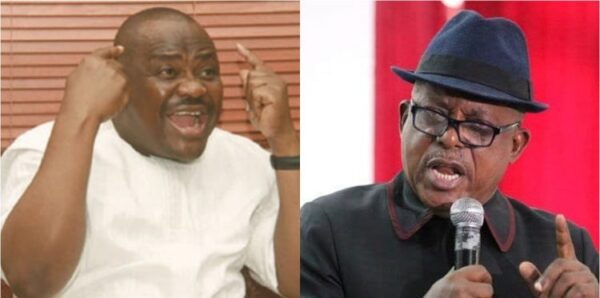
Can Secondus Survive Wike’s Arsenal’s Onslaught in the PDP Crisis

0

Those who sought power by riding the tiger’s back ended up on the inside.” — Former President of the United States, John F. Kennedy

Prince Uche Secondus and Governor Nyesom Wike of Rivers state were best friends prior to the Peoples Democratic Party’s (PDP) national convention in December 2017. Secondus usually resumes at the Rivers State Government House in the morning, following the governor to all his outings, and then retires to his home at night, according to those familiar with the duo’s relationship.

Unbeknownst to many, Secondus was desperate for Wike’s support in his bid to become the PDP’s national chairman. To many, there was nothing wrong with that because Secondus had also used his influence as the PDP’s Deputy National Chairman and then Acting National Chairman to help Wike achieve his dream of becoming Rivers state governor, despite stiff opposition from the APC led by Rotimi Amaechi, Wike’s predecessor who is now the Minister of Transportation.
Secondus, who took over as acting national chairman of the PDP in May 2015 after Adamu Mu’azu resigned, believes that having risen to the highest position in the party, he has the necessary experience to stabilize the party, which is still reeling from its defeat to the APC. He was said to have informed Governor Wike of his ambitions, and the governor backed him completely. After allocating the position of national chairman to the South, it was widely assumed that the South-West would be the next to claim it. However, the region’s leaders aided Secondus and his supporters by failing to produce a consensus candidate and refusing to step down for one another.

The entire South-West PDP was in disarray just days before the convention, while the South-South, led by Wike, rallied behind Secondus. Wike received support from some Northern governors, who asked their delegates to vote en masse for him, thanks to Wike’s efforts. The Chairman of the electoral committee and former Benue state governor, Gabriel Suswam, announced at the conclusion of the convention held at Eagles Square Abuja that Secondus had received 2,000 votes out of a total vote tally of 2,296, making him the chairman. Prof. Tunde Adeniran, the former Minister of Education, received 231 votes, while Chief Raymond Dokpesi, the former Chairman of the AIT, received 66 votes.

The Origins of Conflict

Trouble began to appear as soon as Secondus was elected as the PDP’s national chairman. Secondus understood the power he wields as the party’s number one man, and he believed that as the party’s national chairman, he could no longer be subjected to the whims and caprices of Governor Wike, who is now one of his members. On the other hand, the governor, who has a domineering personality, believed that by installing the national chairman, he would be able to exert unrestricted control over him and force him to do whatever he wanted whenever he wanted.

Read Also:  Fuel prices remain unchanged until the FG and labor reach an agreement – PPPRA

Secondus, a smart and experienced politician who understood the man he was dealing with, quickly wormed his way into the hearts of many stakeholders in the party, particularly in the north. When Governor Wike came to dethrone him the same way he installed him, this proved to be a wise move because the majority of them rallied around him.

Ugwuanyi evacuates 135 Enugu students from UNIJOS during the Jos crisis

0

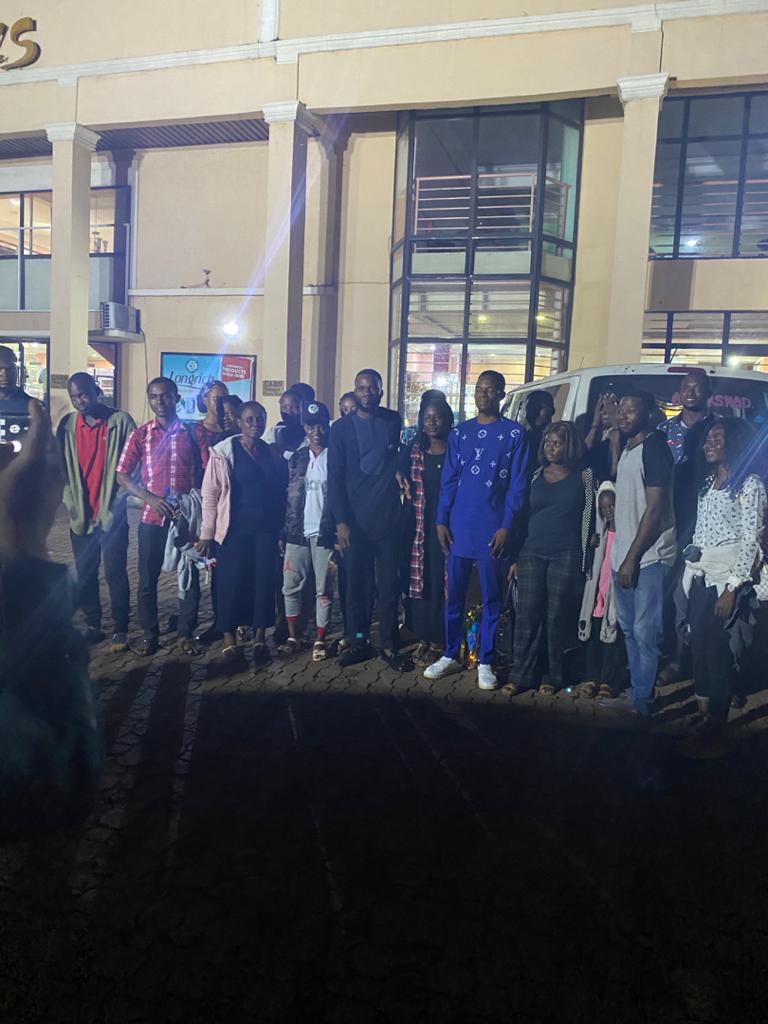
Following the recent crisis in Jos, Plateau State capital, the administration of Governor Ifeanyi Ugwuanyi of Enugu State has safely evacuated 135 indigenes of the state who are students at the University of Jos (UNIJOS) from the school to their respective homes and destinations.

According to a statement issued by Hon. Chidi Ilogebe, Special Adviser to Gov. Ugwuanyi on Students Affairs, 37 evacuated students returned safely to Enugu yesterday, 28 were transported to Abuja to rejoin their loved ones, and others were taken to their various homes within Plateau and surrounding areas based on their requests, all amid tight security.

Following the Jos crisis, Gov. Ugwuanyi directed his Special Assistant on Students Affairs, Hon. Ilogebe, to take immediate steps to ensure that Enugu students at UNIJOS were evacuated to their various states of residence for safety reasons.
Hon. Ilogede said he led a delegation to receive students from UNIJOS who returned to Enugu at about 10 p.m. yesterday, describing Gov. Ugwuanyi as a “welfarist and proactive leader.”

One of the UNIJOS students who returned to Enugu State, Anthony Chinedu Onah, a 200-level History and International Studies student, expressed gratitude to Gov. Ugwuanyi for his proactiveness, concern, and commitment to the welfare, safety, and security of all indigenes of the state, regardless of where they live.

Onah revealed that Gov. Ugwuanyi’s proactive action prompted other governors in the South East to dispatch rescue teams to UNIJOS to evacuate their citizens.

“We express our gratitude to our Governor (Rt. Hon. Ifeanyi Ugwuanyi) and his SA (on Students Affairs) for their support and prompt action, which not only assisted us in evacuating, but also encouraged other states to do so. UNIJOS is proud of you (Ugwuanyi) for the fatherly role you played,” he said.

Read Also:  My election triumphs in court was miracles says Akeredolu

Olivia Nebeokike, a 300-level Marketing student, also spoke up, expressing her surprise at the governor’s gesture, stating that they couldn’t believe their state government would come looking for them at a time when they were in distress.

My election triumphs in court was miracles says Akeredolu

0

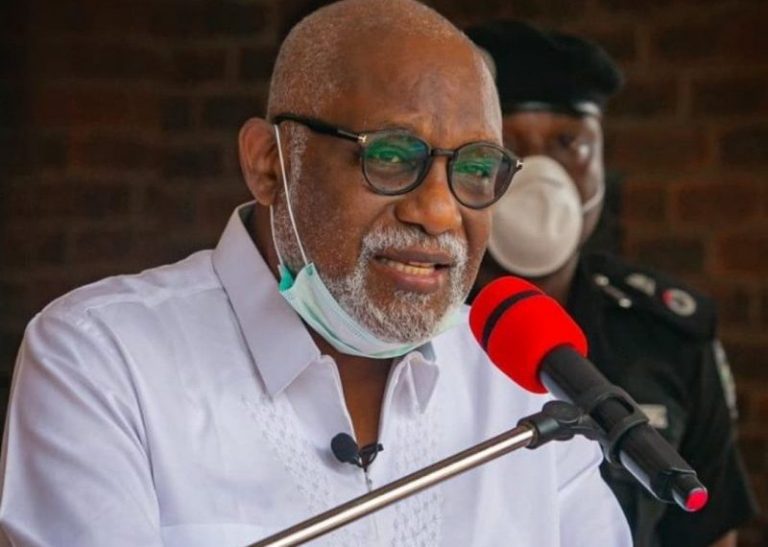
Mr Rotimi Akeredolu, the governor of Ondo State, has hailed his successes in court, from the Election Petition Tribunal to the Supreme Court, as one of many God-given miracles in his life.

From the tribunal to the apex court, Akeredolu, the All Progressive Congress’s governorship candidate, defeated Mr Eyitayo Jegede, the Peoples Democratic Party’s candidate.

The governor said he owed his win at the apex court to God Almighty alone while speaking at a special thanksgiving ceremony held at the Cathedral Church of St. Andrew’s Anglican Communion in Imola, Owo, his hometown, on Sunday.

“Now is the most essential time to thank God,” he continued. Nobody except God could have made it happen. We prevailed before the Tribunal, the Court of Appeal, and the Supreme Court as well. Thanking God is a good thing.”

He praised his legal staff for their efforts and promised to continue his development projects around the state.

Read Also:  Fuel prices remain unchanged until the FG and labor reach an agreement – PPPRA

Bishop Stephen Fagbemi of the Owo Anglican Diocese remarked in his sermon that only God can save individuals in any condition.

“Who can be against us if God is on our side?” All technicalities are dwarfed by God. Mr. Governor and Mr. Chancellor, I’m not sure how you earned this undeserved favor, but I do know that God has made a covenant of compassion and mercy with your family. The cleric remarked, “But for God, this judgment may have gone the other way.”

Are you in agreement? Nigeria Is Becoming A ‘Cow Republic Under Presidency – Ortom

0

President Muhammadu Buhari’s approval to review grazing reserves in 25 states in the country has been criticised by Benue State Governor Samuel Ortom.

This was said in a statement signed by Terver Akase, the governor’s chief press secretary, on Friday.

Governor Ortom stated that the decision appeared to be the President’s attempt to turn Nigeria into a “cow republic.”

“We were shocked and disappointed to read a statement from the Presidency indicating that President Muhammadu Buhari has approved recommendations from a committee to review 368 grazing sites across 25 states in the country “with dispatch,” to determine the levels of encroachment,” the statement read in part.

“In a country where insecurity is at an all-time high, with hundreds of people killed by armed herders, bandits, and other terrorists, the Presidency is only concerned about the safety of animals and is using all government machinery and arsenals to impose grazing reserves and cattle routes on Nigerians. This is inexcusable!” he exclaimed.

The governor went on to accuse the Buhari administration of “turning a blind eye to the inconceivable amounts of livestock incursion on Nigerians’ lands.”

Read Also:  Nigeria lost $50 billion as a result of the PIB’s delay – Buhari

“Mr. President has never spoken out against herdsmen’s actions or the attacks they perpetrate on innocent people. The only time the President is heard discussing the herders’ atrocities is when he defends them. The Presidency has made it apparent that it wants to plunge the country into an avoidable crisis. Otherwise, what justifies President Buhari’s insistence on the establishment of grazing reserves across the country when Nigerians have openly defied the program and embraced ranching instead of open grazing?”