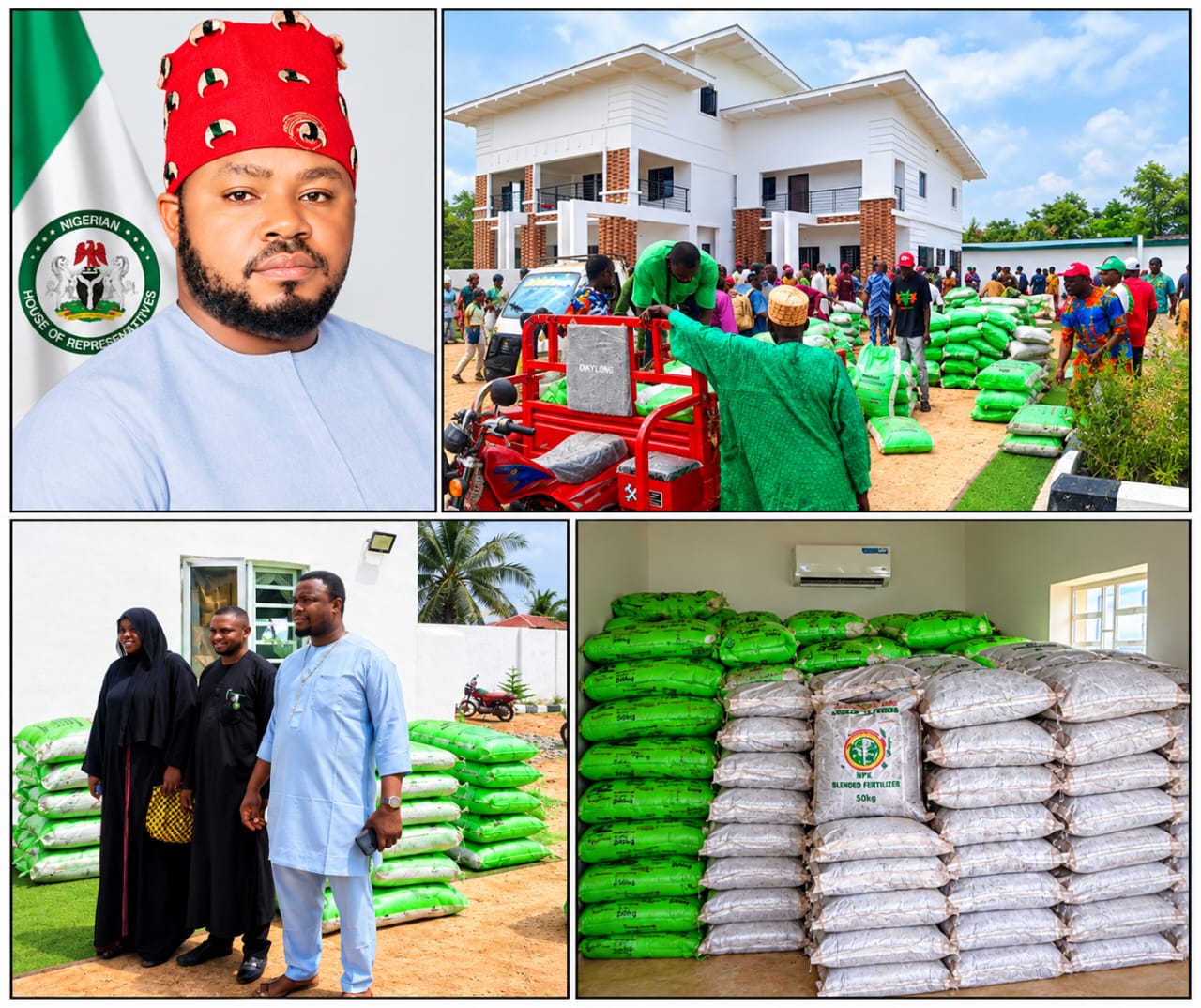
Chief Philip Agbese’s distribution of 5,000 bags of 50kg fertilizer to farmers in Ado, Okpokwu and Ogbadibo Federal Constituency has renewed attention on grassroots agricultural support and the importance of empowering farmers in Benue State.
For farmers in Ado, Okpokwu and Ogbadibo Federal Constituency, the distribution of 5,000 bags of 50kg fertilizer by Chief Philip Agbese represents more than the provision of agricultural inputs.
It is a gesture directed at people whose daily work sustains families, supplies food to communities and keeps Benue’s agricultural economy active.
Benue is widely recognised for its agricultural potential, but behind every farm is a farmer confronting rising input costs, unpredictable weather conditions and broader economic pressures.
Despite these challenges, farmers continue to cultivate the land, plant seeds and hope for a productive harvest.
For such farmers, fertilizer is not simply an agricultural input. It can mean the opportunity to improve crop yields, strengthen household income and support the education and welfare of family members.
5,000 Bags of Fertilizer for Farmers
The distribution of 5,000 bags of 50kg fertilizer is significant because agricultural interventions have their greatest impact when they reach farmers at the grassroots.
Chief Philip Agbese’s agricultural interventions have previously included fertilizer distribution, agrochemical sprayers and other forms of support aimed at rural farmers.
A publicly circulated compendium of his constituency interventions has also listed agricultural training and the distribution of 15,000 live birds to rural dwellers.
Beyond the statistics, however, are individual farmers and families whose livelihoods depend on agriculture.
There is the elderly farmer who has spent decades working the land, the young farmer seeking a sustainable livelihood, the mother whose farm income contributes to her children’s education and the household relying on agriculture for food and income.
For these people, timely agricultural support can provide renewed confidence at a critical point in the farming cycle.
Agriculture and the People of Benue
Agriculture is more than an economic activity in Benue. It is deeply connected to the identity and livelihoods of communities across the state, including Enone and surrounding areas.
The farmer is therefore not simply a beneficiary of development programmes but an important partner in community development.
When farmers increase production, communities can benefit from greater food availability and improved economic activity. Increased agricultural productivity can also create opportunities for rural households and encourage young people to view farming as a viable enterprise.
This makes interventions targeted at farmers particularly important.
The soil receives the efforts of everyone who cultivates it, whether an elderly farmer, young entrepreneur, widow, graduate or family struggling to make ends meet. With the right support, that labour can translate into food, income and dignity.
From Political Representation to Grassroots Responsiveness
Representation is commonly associated with legislation, parliamentary debates, oversight and constituency projects.
However, representation also has a grassroots dimension.
For many constituents, the effectiveness of representation is experienced through interventions that respond to everyday challenges.
Chief Philip Agbese has publicly described constituency development as involving legislation, oversight and interventions aimed at improving people’s lives. His constituency activities have also included agricultural and empowerment initiatives.
Against this background, the fertilizer distribution adds to the broader discussion about how elected representatives can connect parliamentary responsibilities with the economic realities facing constituents.
For a farmer, representation becomes tangible when agricultural assistance reaches the farm.
For a household dependent on farming, it becomes meaningful when such support helps sustain its livelihood.
For young people, agricultural empowerment can provide an avenue for economic participation and enterprise.
The Human Story Behind 5,000 Bags
Five thousand bags of fertilizer can easily become just another statistic.
But behind that number are farmers preparing their land, planting crops and planning for harvest.
The real impact of agricultural support will ultimately be seen beyond the distribution exercise—in the farms where the fertilizer is used, the crops that are cultivated, the produce that reaches markets and the income generated by farming households.
The significance of the intervention, therefore, cannot be measured solely by the number of bags distributed.
It can also be considered through the opportunities those inputs may create for farmers and their families.
A Message of Hope to Benue Farmers
For farmers receiving the fertilizer support, the intervention carries a simple message: their work matters.
Food on Nigerian tables begins with farmers who cultivate the land, often under difficult economic and environmental conditions.
Every seed planted requires investment and confidence. Every cultivated field represents labour. Every harvest represents perseverance.
Agricultural interventions that help farmers access essential inputs can therefore serve as investments in household livelihoods and the wider food system.
What Farmers May Remember
Political and public leaders are often remembered through their offices, policies and major projects.
At the grassroots, however, people can also remember leadership through direct experiences—who listened, who responded and who provided assistance when it was needed.
For beneficiaries of the fertilizer distribution, the lasting memory may not simply be the 5,000 bags.
It may be what the agricultural support helps them achieve: stronger farms, improved harvests, increased income, better household welfare and renewed confidence.
That is where the human dimension of grassroots leadership becomes visible.
When Leadership Returns to the People
Chief Philip Agbese’s fertilizer intervention provides an opportunity to reflect on the relationship between leadership, agriculture and grassroots development in Benue State.
A bag of fertilizer may appear ordinary from a distance. To a farmer preparing for a new planting season, however, it can represent an opportunity to improve production.
For a farming household, it can contribute to income and food security.
For a community, stronger agricultural productivity can support economic activity.
Ultimately, the deeper meaning of grassroots leadership is found not simply in political positions but in how development initiatives affect ordinary people.
When support reaches the farmer, leadership touches the soil.
And when the soil produces a better harvest, the benefits can extend beyond the individual farmer to families, markets and communities.
The distribution of 5,000 bags of 50kg fertilizer by Chief Philip Agbese is therefore not only an agricultural intervention. It is also a story about farmers, livelihoods, community development and hope.
For in the hands of a farmer, fertilizer is more than an input.
It is a seed of possibility.
It is a promise of tomorrow.
It is hope waiting to grow.