Home Blog Page 2612

Armed robber raped me using polythene bag as protection, teacher tells court

0

A teacher (name withheld) of a Catholic Secondary School in Lagos has narrated before an Ikeja Sexual Offences and Domestic Violence Court how a suspected armed robber raped her in her home using a polythene bag as protection.

The News Agency of Nigeria (NAN) reports that the teacher made the revelation on Tuesday while giving evidence during the trial of two men in their 20’s- Babatunde Oluwaleke and Daniel Ojo – over the alleged rape and armed robbery.

While being led in evidence by Akin George, the lead prosecuting counsel for the state, the teacher gave a harrowing account of how she was raped in her home by Mr Oluwaleke on March 6, 2018.

She told the court that between 2 a.m. and 3 a.m. while asleep in her bedroom, she was awoken by some noise and she saw two males, a tall one (Ojo) and a short one (Oluwaleke) both dark in complexion, ordering her to get up.

She said: “I told them I had no money and the first defendant (Oluwaleke) said I must produce money or he will kill me. I was pleading and the second defendant (Ojo) told him that they should go because that is not what they came for.

“I was tying a wrapper and the first defendant asked me to lie on the bed, I was pleading and he pushed me back on the bed, I begged that he should not rape me that I don’t have money but he took my Automated Teller Machine (ATM) card, mobile phones and all that I have.

“He brought out a knife, placed the tip on my stomach and threatened to stab me if I did not cooperate. When he opened my wrapper, he saw I was menstruating and I didn’t know from where he produced a polybag.

“He tied the polybag on his penis and inserted his penis into my vagina. I was pleading that I could be his sister but he ignored me, asking me to shut up. Much later, he removed the polybag and raped me using nothing.

“When the first defendant was done, the second defendant was telling him that was not what they came for and that they needed to go.”

She said after they left, terrified, she prayed, hoping that the other members of her household were unharmed.

The teacher said when she went to check on members of her family, she realised that they had all slept through her ordeal.

“My mother and her friend were still sleeping in the sitting room. Things were scattered and the contents of their handbags were emptied on the floor. I woke them up and told them what happened.

“We stay in a one-storey building, we went downstairs where my younger brother stays and we noticed the armed robbers used a rope to tie the door of the mosquito net which is attached to a spring so that it does not make noise.

“My younger brother was also still asleep with his friend, we woke them up and I told them what happened and we took an inventory of all the property that was stolen,” she said.

The teacher said members of her family immediately reported the crime to the authorities and she was taken to the hospital that morning for medical examination and counselling.

She said on that day, she was also taken to the Afonka Police Station, Alimosho, Lagos, where four recently apprehended armed robbery suspects were shown to her and she was asked if any of the suspects had raped and robbed her.

“Immediately I saw the first defendant, I recognised him, even with my eyes closed, I can identify him.


BREAKING: SENATOR OMO-AGEGE IS THE NEW DEPUTY SENATE PRESIDENT

Party supremacy may have prevailed in the senate as Senator Ovie Omo-Agege representing Delta Central trounced Senator Ike Ekweremadu of the APC to emerge as deputy to Senator Ahmed Lawan whom was earlier elected as senate president by the senators-elect.

Senator Omo-Agege of the APC polled a total number of 68 votes to emerge as deputy senate president.

At the end of counting, the national Chairman of APC, Adams Oshiomhole and other APC governors went forward to congratulate the new Senate President and his deputy respectively.


MORE DETAILS LATER….

Erastus Akingbola’s money laundering trial resumes June 13

0

A Federal High Court in Lagos on Tuesday adjourned until June 13, the money laundering trial of a Managing Director of the defunct Intercontinental Bank Plc., Erastus Akingbola.

Mr Akingbola was charged by the Economic and Financial Crimes Commission (EFCC) on an amended 22 counts bordering on money laundering.

He was re-arraigned in March and pleaded not guilty to the charge.

The case, which was slated for continuation of trial on Tuesday, could not proceed as the judge was said to be on another official assignment.

The EFCC accused the defendant of converting an aggregate sums of 1.3 million dollars and 8.5 million dollars taken from the bank’s GBP NOSTRO account at Deutsche Bank in London.

The sums were said to have been remitted into the account of Fuglers Solicitors with the Royal Bank of Scotland in London, to purchase property in the name of Life Boat Settlement Trust allegedly set up by the defendant.

According to the prosecution, the defendant knew that the sums represented proceeds of crime.

The alleged offences contravene the provisions of Sections 105(1) and 105(a) of the Investment and Securities Act, 2007.

They also contravene the provisions of Sections 13 (1), 15(1)(a), and 28(3) of the Banks and Other Financial Institutions Act, Cap B3, Laws of the Federation, 2004.

One of the offences also contravenes the provisions of Sections 14(1) of the Money Laundering Prohibition Act, 2004.

Court fixes June 28 for Fayose’s re-arraignment of N6.9bn fraud

0

A Federal High Court in Lagos has fixed June 28, for the re-arraignment of former Governor of Ekiti, Ayodele Fayose, who is facing charges of N6.9billion fraud.

Fayose was arraigned on October 22 2018, before Justice Mojisola Olatotegun, alongside a company, Spotless Investment Ltd, on 11 counts bordering on fraud and money laundering offences.

He is being prosecuted by the Economic and Financial Crimes Commission.

He had pleaded not guilty to the charge and was granted bail on October 24, 2018, in the sum of N50 million with sureties in like sum.

The prosecution had opened trial on November 19, 2018, and had so far called 13 witnesses out of the 15 listed.

However, the Chief Judge of the Federal High Court, Hon. Justice Adamu Abdu-Kafarati had transferred the case from Olatoregun to a new judge, Justice Chukwujekwu Aneke, following a petition by the EFCC seeking a transfer of the case.

A new date of June 28 has now been fixed for the re-arraignment of Fayose before Aneke.

The CJ’s letter of transfer had read as follows:

“I refer to the petition of EFCC on this case and your Lordship’s comments thereto.

“It is apparent that the prosecution has lost confidence in the judge trying this case and justice must not only be done but must be seen to have been done, I hereby transfer this case to Hon. Justice C. J. Aneke for hearing.”

20-year-old allegedly robs motorcyclist at gunpoint

0

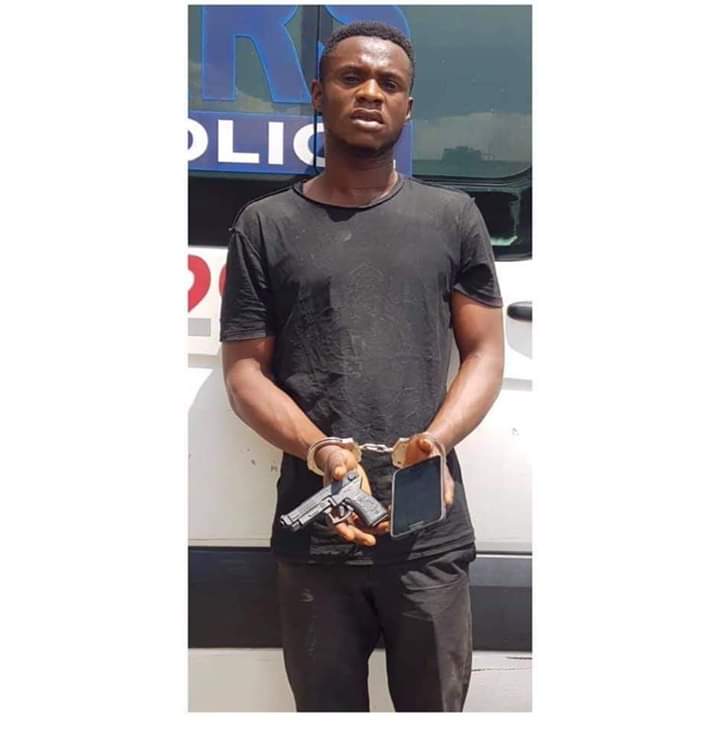
A Badagry Chief Magistrates’ Court in Lagos State on Tuesday remanded a 20-year-old man, Babangida Sanni, who allegedly robbed a motorcyclist at gunpoint.

The Chief Magistrate, Mr Lazarus Hotepo, ordered that Sanni should be kept at the  Badagry Prison.

The court could not take the plea of the defendant as Hotepo said he needed advice from the state director of public prosecutions.

The chief magistrate adjourned the case until July 10, for mention.

The prosecutor, ASP Clement Okoisemo, had told the court that Sanni conspired with some others at large and robbed one Mr Aweda Ismaila of a Bajaj motorcycle with registration number AYE 708 WP valued at N230, 000.

Okoisemo said that Sanni and the others committed the offences on May 1 at 9.00p.m. at Ikoga Road in Badagry.

He alleged that Sanni was armed with a cut-to-size gun and one cartridge.

The prosecutor noted that armed robbery contravened Section 297 of the Criminal Law of Lagos State, 2015.

BREAKING: SENATOR AHMED LAWAN EMERGES SENATE PRESIDENT

0

Senator Ahmed Lawan defeated his closest rival, Senator Ali Ndume, with 79 votes to 28 votes of Ali Ndume’s to emerge as president of the 9th assembly.

Ahmed Lawan has been the anointed candidate of the ruling APC to succeed Senator Bukola Saraki.

at the end of the counting, the clerk declared Ahmed Lawan as senate president of the ninth senate.


MORE DETAILS LATER….

Commotion at 9th Senate inauguration over standing rules

There was an uproar in the Senate on Tuesday over the method to be adopted for the election of principal officers of the Ninth Assembly.
The Clerk of the Senate, Mohammed Sani, after reading President Muhammadu Buhari’s proclamation letter to members of the Senate, announced that open ballot will be used for voting exercise.
This led to an uproar as Senators opposing the use of the open ballot engaged those in support of the method in a shouting match.

After reading the proclamation letter of President Muhammadu Buhari for the inauguration of the 9th National Assembly, the Clerk of the National Assembly, Mohammed Sani-Omolori, said the modalities of the day were “clearly spelt out in our Standing Orders 2, 3, 4, 5, 6 and 7 of the Senate Standing Order 2015 as amended as the case may be.”

Sani-Omolori said he would, therefore, proceed to the roll call by the Clerk of the Senate, Nelson Ayewoh.

But before Ayewoh could begin the roll call, several of the newly elected members of the new Senate protested, saying a court had set aside the 2015 standing rules in place of the 2011 rules.

The High Court of the Federal Capital Territory, Abuja, sitting in Bwari, by an ex parte order, on Monday, had struck down the Standing Orders 2015, through which Senator Bukola Saraki became the President of the eighth Senate in 2015.

The 2011 standing rules called for an open ballot system in the election to the top Senate offices, while 2015 allowed for a secret ballot system.

Sani-Omolori resorted to using the gavel several times to restore order.

He said, “I need to remind (you) that the only business of today is the election and oath-taking. And by virtue of the fact, no question is entertained. No motion shall be made. However, as a mark of respect, I think your question is whether I received any court order and my answer is no.”

When the rowdiness continued, Sani-Omolori added, “Distinguished senators-elect, may I remind all of you that we are here in furtherance of a fundamental constitutional duty over and above all of us. And we all must abide by the constitution.

“I have answered your question: I have heard it; I have not received it. I do not have a reason not to comply with court orders if I receive them and that should suffice. And like I said, I only answered this question out of respect to you. I will therefore not entertain any question further. Clerk, please go ahead.”

With that, the inauguration continued without further protests by senators-elect.

The silver lining to Trump’s incompetence

0

Commentators have been sounding the alarm almost on a daily basis, warning that President Donald Trump’s words harm national security and weaken our standing in the world. They are largely wrong. In many cases, foreign leaders and citizens of the world alike have likely “priced in” Trump’s erratic behavior and sidelined his pronouncements. If so, the result is a neutered presidency and an America that is safer because Trump is often not taken seriously.

For decades, Presidents have played critical roles in international affairs — from Richard Nixon’s détente with China to Ronald Reagan’s force of will that toppled communism to Jimmy Carter’s brokered peace between Anwar Sadat and Menachem Begin. In these and countless other examples, past Presidents advanced American interests and inspired the world by wielding both formal constitutional powers, as well as the authority granted by foreign leaders who accepted their statements as US policy.
This isn’t the case with Trump, whose words foreign leaders can no longer take at face value. Fortunately, President Trump’s incompetence in foreign relations, while not a cure-all, can moderate the damage that he might otherwise cause. The more exposure the world has to this President, the less he matters. After all, communication is a two-way street, and the audience plays a significant role in determining whether someone’s words are accurate, meaningful, and safe to rely on.
Take, for example, Trump’s rhetoric on North Korea. While the President recently said he is not bothered by new North Korean missile tests — conflicting with the view of intelligence agencies — he previously threatened nuclear attack (in his own way of course, by claiming that his button is bigger than Kim’s).
In any prior administration, words such as these from the American President would place us at the precipice of war. But as norm-busting as they may be, we have become conditioned to view them as just the latest in an unbroken string of overheated comments. His words aren’t newsworthy because they will all have real world consequences but because in many instances they won’t — despite being uttered by the leader of the free world, they are heavily discounted by the world just the same.
So, how should foreign nations react if Trump renews his threats to pull out of NATO, makes further statements that praise leaders of corrupt regimes, such as Russia’s Vladimir Putin, or makes some other jaw-dropping pronouncement? Unless these leaders haven’t been paying attention, they should temper any initial alarm by weighing these statements against often-contradictory commentary from other senior American officials, the State Department and the CIA. His track record shows that impulsive words may not result in action. Ultimately, despite Trump’s rhetoric, the US has not pulled out of NATO, and it has levied sanctions on Russia.
Moreover, routine rebukes of Trump’s comments from foreign leaders reveal an international band of adults who are ready to sideline the US President.
Of course, as oddly comforting as Trump’s lack of global credibility may be, it reflects a sorry state of affairs. This administration has luckily not faced an acute national security crisis, such as a 9/11-style terrorist attack or an imminent threat of war. As has been the case throughout our history, when such circumstances arise, America needs a reliable and respected leader to guide the nation. And the way in which the President acts in moments such as these could determine the course of human history.
President John F. Kennedy’s approach to the Cuban missile crisis likely averted war. Conversely, President George W. Bush’s fixation on weapons of mass destruction (which were never found) led to war with Iraq, resulting in the deaths of thousands of US service members and a power vacuum filled by al Qaeda, the group from which ISIS was later formed.
If faced with a national security crisis, Trump’s incompetence could pose serious problems. The void of US leadership could also damage the US’ global standing and push fledgling nations, such as Libya, to take their cues from Russia and China rather than from the United States. And then there’s Trump’s command over the nuclear arsenal, which is scary, given his penchant for tantrums. In a crisis, it’s hard to know where Trump’s impulses would lead the nation.
What’s more, there have been instances when President Trump’s words have foretold real policy movements with real-world consequences, such as his use of tariffs as an international trade tool with China and his threats of tariffs on Mexican goods in an effort to advance immigration-related ends.
But recognizing that he can cause damage does not mean that every oddball comment he makes will have a lasting impact. We are, for the time being, stuck with Trump and, fortunately, his incompetence has helped moderate what could otherwise be calamitous by spurring foreign leaders to ignore him.
What if foreign leaders are inclined to take him seriously and react as if his words had meaning? It is both my belief and continued hope that President Trump’s journey to irrelevancy on the world stage advances by the tweet, continuing to take further root so that we will soon see the day when it will not only be reasonable for world leaders to ignore Trump but it will be the only rational thing for them to do.
On the international stage, the one constant in modern history is that the American President is taken seriously. This is one norm that we should all be thankful Trump has broken. And hopefully, it is a norm that can be quickly restored once he is out of office.

Iran to release Lebanese US resident convicted of spying

0

Iran’s judiciary has approved the conditional release of a Lebanese businessman imprisoned on charges of spying for the United States.

Judiciary spokesman Gholamhossein Esmaili said Nizar Zakka, who has US permanent residency, would be handed over to the Lebanese authorities.

The information technology expert was arrested while visiting Iran in 2015.

Lebanese media reported that Zakka had been pardoned at the request of Lebanon’s President, Michel Aoun.

But Iranian newspaper Sobh-e No asserted that his release was secured only following the intervention of Hassan Nasrallah, the leader of the Iran-backed Lebanese militant group Hezbollah.

Iran’s semi-official Fars news agency meanwhile said Zakka would be handed over to representatives of Hezbollah on Tuesday, rather than the top Lebanese security official who flew to Tehran earlier this week.

Botswana scraps gay sex laws, big victory for LGBTQ rights in Africa

0

Botswana’s High Court has overturned a colonial-era law criminalizing consensual same-sex relations in a landmark victory for Africa’s LGBTQ movements.

The ruling comes just a month after Kenya’s high court upheld its laws criminalizing homosexuality.
Under section 164 of Botswana’s Penal Code, “carnal knowledge of any person against the order of nature,” was an offense that carried a maximum sentence of seven years imprisonment. Section 167 made “acts of gross indecency” — whether in public or private — a punishable offense, with up to two years in prison.
The case was brought to court in March by Letsweletse Motshidiemang, a 21-year-old student at the University of Botswana, who argued that society had changed and that homosexuality was more widely accepted, local media reported.
While homophobic attitudes continue to prevail in parts of the country, Botswana’s LGBTQ activists and supporters have marked some victories for the movement in recent years. The 2010 Employment Act made it illegal for employers to terminate contracts on the basis of sexual orientation, and two landmark rulings in October and December 2017 laid the foundation for trans people to more easily change their official gender on identity documents.
Following a brutal attack on a transgender woman last November, Botswana’s President Mokgweetsi Masisi signaled his support for LGBTI people, saying “there are many people in same sex relationships in this country who have been violated and have also suffered in silence for fear of being discriminated. […] Just like other citizens, they deserve to have their rights protected.”
Tuesdays’ historic ruling is win for LGBTQ activists and supporters in a country — and region — where homosexuality remains largely taboo.
Out of 54 African countries, at least 32 of them have enacted laws making it illegal to have gay sex, according to the International Lesbian, Gay, Bisexual, Trans and Intersex Association (ILGA).
In parts of Nigeria and Somalia, and in Sudan, it is punishable by death; in Mauritania the death penalty is a possible punishment. In Tanzania, being convicted of having same-sex relations can result in life sentences.