Home Blog Page 2142

Constituents lament the fate of 14 Edo legislators-elect two years later

0

People in the electorates of the 14 members-elect of the Edo State House of Assembly have complained about the lawmakers’ ongoing delay in being sworn in.

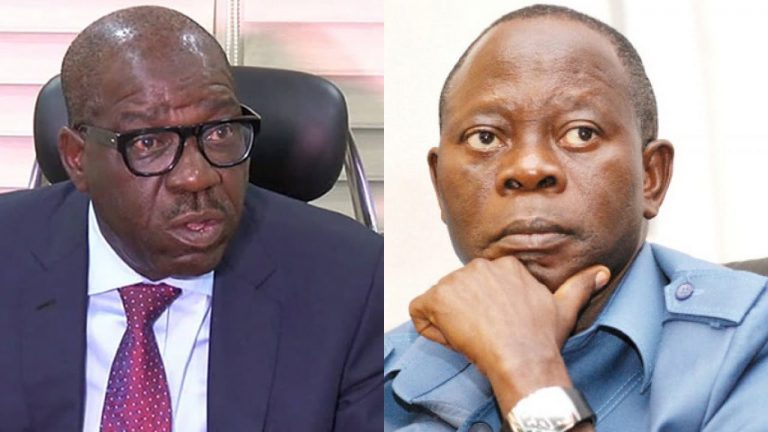
Governor Godwin Obaseki’s political spat with his erstwhile godfather, Adams Oshiomhole, has been blamed for the prolonged delay in the inauguration of 14 members-elect two years after the state legislature was inaugurated.

The leadership of the house declared the seats of the 14 members-elect empty on December 14, 2019. Victor Edoror (Esan Central), Washington Osifo (Uhunmwonde), Vincent Uwadiae (Ovia North East 2), Ugiagbe Dumez (Ovia North East 1), and Sunday Aghedo are among those who have been affected (Ovia South West).

Crosby Eribo (Egor), Chris Okaeben (Oredo West), Kingsley Ugabi (Etsako East), Ganiyu Audu (Etsako West 1), Seidu Oshiomhole (Etsako West 2), Oshomah Ahmed (Etsako Central), and Michael Ohio-Ezomo (Etsako Central) are among the others (Owan West).

Uyi Ekhosuehi (Oredo East) and Henry Okaka (Owan East) are also affected, as they were sworn in but could not meet the 181-day sitting minimum for a member in a calendar year.

While some sections of the public blame Obaseki for the House situation, others believe the members-elect should not have listened to their godfathers.

Mr. John Igbinovia, one of the participants, stated that the members-elect should have attended the inauguration in June 2019.

“It’s impossible to fight from the outside. They were duped by their godfathers, who promised them heaven on earth, and now they are fighting to get to the house,” he explained.

He stated that legislators were elected to make legislation for the benefit of their constituents.

“Rather than listening to godfathers, they should have considered the interests of their citizens. Two other members-elect arrived after the initial inauguration and were also inaugurated,” he continued.

Dada Ayokha, for one, condemned the development as disappointing, claiming that political intrigues between two political gladiators had prevented them from being represented.

“The constituency is losing so much because it doesn’t have representation in the House of Assembly, and I hope it doesn’t reach to the point where the people make laws,” he said.

Another citizen, identified only as Mr. Odion, said the Edo Assembly tragedy was a wake-up call for the country’s judicial reforms.

“The members-elect have been in court for about three years. The lawsuit is still pending, and by the time it is resolved, the four-year period will have passed,” he stated.

Meanwhile, Washington Osifo, the member representing Uhunmwode Constituency, has stated that the case is still pending in court and that the case will be pursued to its logical conclusion because the political solution has failed.

“We explored political solutions even when we were in the same party. Party leaders, governors, and the president intervened, but he stated, “I don’t understand why people who don’t want us to represent our constituents are so hell-bent on keeping us out of the assembly.”

He claimed that their removal from the House has caused a significant void in governance in the state, citing the docile nature of the House as a result of their absence.

Read Also:  Federal Executive Council approved N16.7 billion for the Yobe Airport and other projects

“When the house is finished, it will reflect in terms of quality contributions, discussion, and monitoring roles, as well as pressuring the executive to do what will benefit the state. “In Edo, the legislative arm exists to present an alternate voice and reasoning to the executive,” he remarked.

Our correspondent was unable to obtain a comment from the state government since Governor Godwin Obaseki has yet to designate a media aide since his re-election.

However, the PDP claims that the state of Assembly’s declaration of the 14 legislators’ seats as vacant stands.

Chris Nehikhare, the party’s media secretary, stated that the Independent National Electoral Commission (INEC) is responsible for holding a by-election to fill the vacant seats.

Chris Azebamwan, the APC’s state publicity secretary, said the case is in court.

The 14 legislators have battled a number of legal fights to force the assembly’s leadership to swear them in.

In January 2020, a Federal High Court in Abuja barred the Independent National Electoral Commission (INEC) from holding by-elections to fill 14 Edo State House of Assembly seats that had been declared vacant in December.

This came after counsel for the lawmakers, all of whom are Obaseki allies, filed an ex parte plea to halt the election to replace them in the legislature.

The lawmakers also got a restraining order from the Federal High Court in Abuja in August 2019 to stop both the Senate and the House of Representatives from taking over the legislative functions of the Edo State House of Assembly.

Delta CP Deploys 1,000 Policemen for Olu of Warri Coronation

0

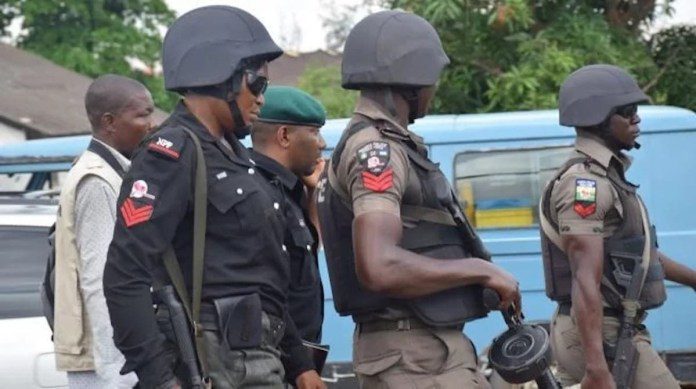
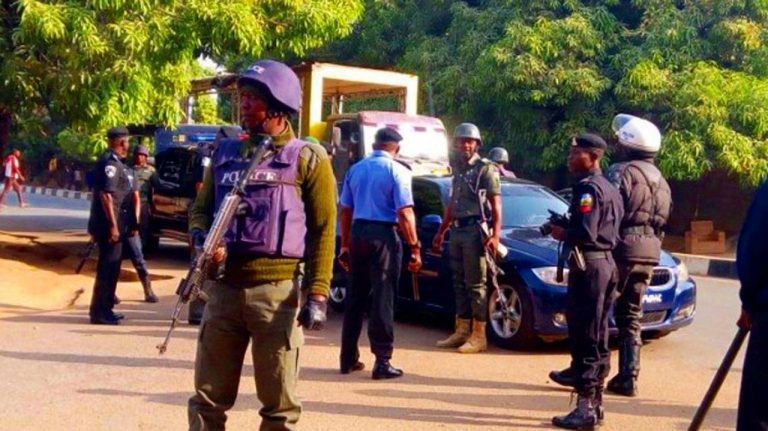
Ari Mohammed Ali, the Delta State Commissioner of Police, has deployed 1,000 officers to ensure adequate security prior to, during, and following the coronation ceremony on August 21, 2021.

Two bomb squads have been deployed to report 48 hours before the coronation day in order to sweep the venue and ensure it is completely safe, according to a statement signed by the acting Police Public Relations Officer (PPRO), Delta State Command, DSP Bright Edafe.

Two units of mobile police officers and conventional police officers, including traffic officers, have also been deployed in Warri to ensure watertight security, according to the statement.

“The CP warns mischief makers to stay away from the coronation as the police command is more than ready to deal decisively with anyone who tries to disrupt or cause any form of mischief,” the statement reads.

Read also: Federal Executive Council approved N16.7 billion for the Yobe Airport and other projects

“Everything that needs to be done to ensure that the event is itch-free and free of violence has been done. To that end, the CP has directed the Warri Area Commander, Divisional Police Officers, and Command Tactical Operations Officers to leave no stone unturned in ensuring thorough supervision of personnel deployed to ensure peace and tranquility during and after the coronation ceremony in Warri.”

‘Amosun was never Okupe’s campaign coordinator,’ says one source.

0

Mr. Francis Gbenga Adenmosun, a former Secretary of the Peoples Democratic Party (PDP), Ogun Central Elders Caucus, and Campaign Coordinator for Senator Ibikunle Amosun during his Senatorial Campaign between 2001 and 2003, has refuted Dr. Doyin Okupe’s claim that Amosun was his campaign coordinator.

Former presidential aide, while appearing on ARISE NEWS’ Morning Show a few days ago, claimed that Senato Amosun, the former Governor of Ogun State and two-term Senator of the Federal Republic of Nigeria, was his (Okupe’s) campaign coordinator in the Ogun Central Senatorial District during the run-up to the 2003 gubernatorial election.

However, Adenmosun refuted that claim, saying he was taken aback by Okupe’s strange claims made in a public forum.

“It is on record that I was the Secretary of the PDP, Ogun Central Elders Caucus, and Campaign Coordinator for Senator Ibikunle Amosun during his Senatorial Campaign between 2001 and 2003, and I can confidently state that Senator Amosun was not the campaign coordinator for Okupe. Indeed, as a candidate, he (Amosun) would not have been able to serve as Okupe’s or any other candidate’s campaign coordinator,” he said in a statement.

According to him, if any of the 2003 Ogun State gubernatorial candidates received Amosun’s overt and covert support, it was Otunba Gbenga Daniel, whom Amosun openly identified with and supported during the run-up to the gubernatorial election.

“Of course, I am aware that Amosun, like many of the other aspirants and candidates, financially supported Okupe’s governorship bid, but he was never his coordinator in Ogun Central or anywhere else in the state,” Adenmosun said.

Gauging the Forex Market

0

The Central Bank of Nigeria has been suspending forex allocation to bureau de change operators and adopting weekly supply to commercial banks for more than two weeks in order to save the naira’s value and maintain its integrity. Using customer experience to gauge the forex market shows how well the apex bank has done in achieving the system’s desired goals and objectives. Kunle Aderinokun contributes to this report.

Customers have been turning to commercial banks to meet their forex needs after the Central Bank of Nigeria suspended forex allocation to bureau de change (BDC) operators for more than two weeks.

The apex bank released $200 million to commercial banks as soon as it cut off supply to the BDCs and has continued to provide them with weekly forex liquidity. This was part of an effort to meet legitimate end-user dollar demand in the country.

With the CBN’s mandate to accept cash deposits of foreign exchange from customers, banks have already taken on more responsibilities to open forex desks in their branches across the country to serve end-users.

As business picked up, however, some banks began to break forex rules by actively conspiring with unscrupulous customers to defraud the system. Customers and banks in this group have been warned to stop engaging in such nefarious behavior or face stiff penalties from the banking regulator.

Following the 357th Bankers Committee meeting, which took place virtually last Thursday, bank CEOs stated that they would use digital means to detect fraud in the forex system, citing unwholesome practices by some customers.

On behalf of the banks, Yemisi Edun, Managing Director of First City Monument Bank (FCMB), and Segun Agbaje, Group Managing Director of Guaranty Trust Holding Company (GTCO), spoke.

Customers who visited the banking hall to obtain forex for various needs under the new forex regime have a mixed bag of stories to tell.

Mr. Tope Fasua, Chief Executive Officer, Global Analytics Derivatives, described his experience as a bank customer, saying, “All banks have implemented the policy to create FX tellers, and initially queues have disappeared.” On Monday, I was in a bank and saw people depositing dollars into their DOM accounts, which is a sign of trust in the system.”

“As someone who uses forex so much for my business, because I import gold and other jewelry, this CBN suspension of forex to the BDCs has only made it more difficult for me to access dollars at a reasonable rate,” another bank customer, who requested anonymity, said. As can be seen, the price has risen since the suspension; from the N420 I used to get to N515-N520 today. That’s not right!

“The CBN’s policy has only served to frighten the market, making the dollar far more expensive than it was prior to the new directive.

“So, what’s the advantage now?” When you go to the bank, they tell you that they don’t have any dollars, but if you don’t mind, they can arrange some other options for you; which always leads to the Mallam on the street selling dollar.

“With BDCs, the business was always direct, easier, and less expensive, plus you could get it at any time. They have their own offices and are members of an organization called ABCON or something similar.

“So, if I have a problem with one of their members, I know who to call and where to go without all the red tape and jargon that banks used to use when you complained to them. Why can’t the CBN simply collaborate with that body to resolve the issue?”

Furthermore, a bank customer in Lagos, Mr. Jide Thomas, suggested that the CBN collaborate with the BDCs group to effectively regulate and refine their operations by developing guidelines for them to follow.

The apex bank, according to Thomas, has the authority to discipline erring members of the forex traders’ body, as well as to impose sanctions on the association if its members commit infractions that endanger the system. Suspending allocation to BDCs, he believes, is not the answer. The way to go is to work with the BDCs association to reduce their excesses.

For some, the CBN’s decision to suspend allocations to bureau de change (BDC) operators was a welcome development, while for others, it was a rude awakening. The CBN’s intended consequence, however, is to save the naira, the national currency, regardless of how it is taken or viewed, even though, as with any decision, there are unintended consequences.

The Central Bank cited a number of regulatory violations and other unethical practices as reasons for ending the forex sale to BDCs.

Following the decision, which was announced by the apex bank’s Governor, Mr. Godwin Emefiele, the apex bank stated that it would no longer process or issue new BDC licenses, and that all current licenses, regardless of their stage of processing, would be suspended. He stated that the CBN would channel weekly BDC allocations to commercial banks.

These measures, according to the apex bank, were taken to enable it to carry out its mandates more effectively and efficiently, as well as to ensure the preservation of the commonwealth and the hard-won financial system stability for the benefit of Nigerians.

As a result of the panic caused by the policy change, the naira-dollar exchange rate on the parallel market rose to N525/$1 from N495/$1 twenty-four hours after the announcement. But that did not last long, as the naira rose after the greenback was exchanged for N510. The naira, on the other hand, remained under pressure as manufacturers and forex end-users maintained their demands.

The BDC operators assured their customers and the general public that they were still in business as soon as the CBN announced its decision. The Association of Bureau de Change Operators of Nigeria (ABCON), which represents BDCs, said in a statement that they were still providing foreign exchange services.

The assurance was given by ABCON’s President, Dr. Aminu Gwadabe, who stated that the recent CBN pronouncement did not prevent BDCs from providing foreign exchange services as permitted by their operating licenses and operating guidelines.

Since then, the CBN has been supplying commercial banks with foreign currency. The value of the naira improved as a result of the CBN’s intervention, but the national currency has remained under pressure, losing N5 on the parallel market last Tuesday as the dollar, which exchanged for N505, rose N510 in the face of rising volatility.

While most analysts agreed that the CBN made the right decision, some said the new policy direction left a lot to be desired.

Prof Uche Uwaleke, an economist and Professor of Capital Markets at Nassarawa State University, Keffi, believes the parallel market’s forex rate will fall in the long run as long as the CBN ensures forex liquidity at the official end of the market. He emphasized that, in light of other anticipated developments, the CBN’s ability to intervene in the forex market would be strengthened.

“As a matter of fact, the downward journey of the parallel market rate has commenced,” Uwaleke, a former commissioner for finance, believes. Speculators betting that the CBN will not be able to match the level of forex demand now redirected to Commercial Banks are to blame for the current volatility in that market.

“However, I believe they will be disappointed, given the recent gradual accretion of external reserves, particularly since the suspension took effect, the FG’s plan to issue Eurobonds on the international capital market, and the prospect of crude oil prices remaining strong in the near-to-medium term.”

Mr. Abiodun Sopitan, a retired CBN director in charge of commercial banking, believes that the CBN should work with the BDCs association to manage their affairs by monitoring their activities and ensuring that the BDCs complete proper documentation.

“Since the policy decision, the market has calmed a bit,” Fasua said. The naira has strengthened to around N510 per dollar, down from N525 previously, with promises of further cooling as the policy takes hold.”

“BDC operators are coming together to contemplate the future and organise themselves for mergers where necessary,” he said, adding that “the ‘Mallams’ on the road as we know them are doing business as usual because the banks cannot match their speed of service delivery and the drive thru advantage.”

“It’s also worth noting that some bank CEOs have expressed confidence in the policy and forecast further naira strength. Mr. Rewane, one of Nigeria’s leading economists, echoed this sentiment yesterday (Wednesday). As a result, the future appears to be promising. “At this time, all invisible trade transactions are being met seamlessly,” he added.

Dr. Obadiah Mailafia, the former CBN Deputy Governor, has a different viewpoint. According to him, the new CBN forex policy may depreciate the naira. He also warned the apex bank against entrusting dollars to commercial banks.

“If we are not careful, that decision will actually depreciate the naira because you can normally walk into any BDC, anywhere, and they will attend to you within five minutes, but with banks, you have to drive to your nearest bank and queue the majority of the time.

“The CBN hasn’t told us the rate; banks will want to make a profit over the official rate; we don’t know whether they will make a decent profit or profiteer,” he said, adding that “bankers were the biggest experts in round-tripping.” I don’t believe old habits change. Leopards aren’t known for changing their spots.”

Read also: Kaduna government has ordered JSS 3 students to return to class

Mailafia also cautioned the CBN against entrusting forex allocations for customers to banks. “How can you put your faith in these commercial banks when most of them want to corner the dollar for themselves and then share whatever is left with the market at whatever rate they want?

“On the naira, it is not just the underlying economic fundamentals that matter, such as interest rate, inflation, and so on, these things matter, and the level of debt affects it, but there are also non-quantifiable elements like violence, instability, rural banditry, and terrorism, which undermine the economy’s productive capacity,” he added. They also deplete social capital, or the trust that binds a community together in order to conduct business.”
Federal Executive Council approved N16.7 billion for the Yobe Airport and other projects

0

The Federal Executive Council (FEC) has approved four memoranda totaling N16, 697,742,839 for the Ministry of Aviation.

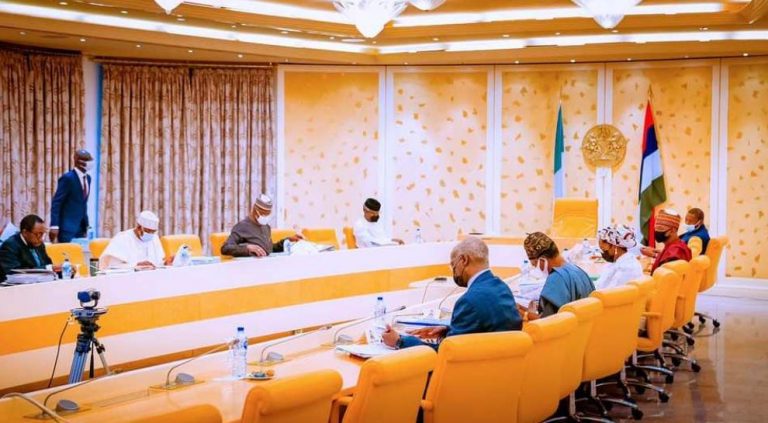
Senator Hadi Sirika, the Minister of Aviation, made the announcement while briefing State House reporters after President Muhammadu Buhari presided over a virtual FEC meeting at the Presidential Villa in Abuja on Wednesday.

Construction of Wachakal Airport in Yobe State at a cost of N6.3 billion; post-construction services for the same airport at a cost of N219.8 million; procurement of eight airport rescue and firefighting vehicles at a cost of N9.5 billion; and a contract for the deployment of sniffer dogs to the Lagos and Abuja international airports at a cost of N9.5 billion are among the projects to be carried out under the contracts, he said.

Read also: Nigeria-Benin Relations in Ambassador Buratai’s Era: An Opportunity for Economic Boom

“We found this airport and many others that are coming across the country useful in our drive to develop the sector and ensure connectivity within our region, as well as improve our security architecture and attend to the various needs of civilization.

“The second was a post-Consultancy Service for the construction of the same airport, Wachakal Air Stripe in Yobe State, which is very close to Nguru. As a result, Kafe Engineering is awarded the first Consultancy Services contract for the sum of N219,782,500. This will include a 7.5 percent VAT, according to the minister.

Kaduna government has ordered JSS 3 students to return to class

0

Students in Junior Secondary School 3 in the state have been ordered to resume classes in preparation for their Basic Education Certificate Examinations, according to the state government (BECE).

The BECE will begin in schools across the state on August 23.

Dr. Shehu Muhammad, the Commissioner for Education, issued the directive yesterday in a statement in Kaduna.

Last month, Governor Nasir El-Rufai ordered the closure of schools due to the state’s growing insecurity.

Read also: Nigeria’s U-20 team qualifies for the Mixed 4x400m final at the World Athletics Championships

“The Kaduna State Ministry of Education has approved the resumption of JSS III students scheduled to write the 2021 National Examination Council’s BECE between August 23 and September 6, 2021,” according to the statement.

“With effect from August 18, Secondary Schools are hereby directed to resume operations, but only for JSS III students.”

Students should dress in mufti in schools, according to Muhammad.

12 kidnapped victims in the state have been rescued by police operatives

0

The state police spokesman, Mohammed Shehu, said one of those rescued was the Chief Security Officer (CSO) of the College of Health Technology in the Tsafe local government area of the state, according to a statement released yesterday in Gusau.

“On August 12, 2021, the Zamfara State Police Command received a report of 11 persons being abducted by a group of hoodlums suspected to be bandits at Yarkofoji village in Bakura LGA,” the statement read.

“In its ongoing search and rescue operations across the state, the command was successful in rescuing 11 victims who were kidnapped on August 12,” according to the statement.

“The command was also successful in rescuing the Chief Security Officer of the College of Health Technology, Tsafe, unconditionally. His kidnapping was reported to the police in the early hours of August 18, 2021, when a gang of hoodlums went to his house and abducted him around 0040 hours.

Read also: Orientation: NYSC will continue to prosecute fake graduates – DG

“A police search and rescue team was dispatched to the scene and began searching the surrounding forest. Fortunately, the victim was rescued without injury.

“The search and rescue strategies used by Zamfara State Command Commissioner of Police, Ayuba N. Elkana, resulted in the successful rescue of the abducted victims with no ransom paid by the victims’ relatives.

“The Commissioner of Police congratulated the victims on regaining their liberty and urged them to always be aware of their security and report any suspicious persons to the police or any nearby security outfit for prompt response,” reads the statement.

Also read: Plateau killings: Lalong relaxes Jos North’s 24-hour curfew

Obasanjo: I’ve been managing diabetes for 35 years

0

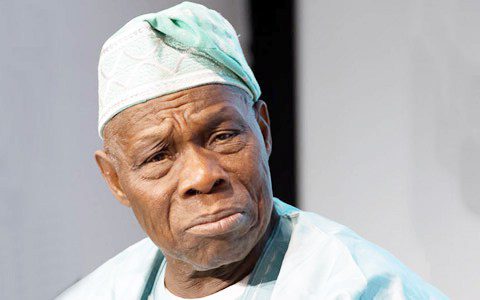
Former President Olusegun Obasanjo has been battling diabetes for over 35 years, according to him.

Obasanjo, who made the announcement at the Ogun State Diabetes Youth Development Camp in Abeokuta yesterday, claimed, however, that he has successfully managed the disease, which has claimed the lives of 1.5 million people worldwide as of 2019.

“I’m still doing many things that many people my age can’t do,” he said. A number of my friends have died since I was diagnosed with diabetes, and the reason for their deaths is that they did not manage their diabetes properly.

Obasanjo emphasized that the disease has no cure and can only be effectively managed by leading a healthy lifestyle.

Read also: Orientation: NYSC will continue to prosecute fake graduates – DG

“There is no cure for diabetes,” the ex-President continued. “Perhaps there will be a cure before I die, but I pray that there will be a cure before you die.”

“Don’t forget to take your medications, in your case, your insulin injection. I carry my medications with me wherever I go, and I monitor my blood sugar levels on a regular basis. Don’t let anyone scare you; diabetes has no cure at the moment, but it can be managed.”

Igboho: Malami is fined N50,000 by the court

0

The order prohibiting the Department of State Services from arresting Yoruba Nation activist Chief Sunday Adeyemo aka Sunday Igboho, issued by an Oyo State High Court in Ibadan, has been extended.

Justice Ladiran Akintola, who issued the order on August 4 at the resumed hearing yesterday, also awarded N50,000 in costs to the Attorney General of the Federal Republic, Abubakar Malami (SAN), who is the first respondent in Igboho’s lawsuit.

He was fined for filing his response to Igboho’s lawsuit after the deadline had passed.

Igboho, who had beefed up his legal team with two more Senior Advocates of Nigeria: Adekola Olawoye and Oladipo Olasope, had requested a cost of N250,000 against Malami, but the court only granted N50,000.

The AGF, who was represented in court on Wednesday by Abdullahi Abubakar, prayed for the restraining order to be lifted.

He also asked the court to dismiss Igboho’s case because the court lacked jurisdiction to hear the case.

Read also: Nigeria-Benin Relations in Ambassador Buratai’s Era: An Opportunity for Economic Boom

T. A. Nurudeen, Counsel for the DSS, and T. A. Nurudeen, State Director of the DSS, are the second and third respondents who support Malami’s position.

In a notice of preliminary objection to the suit filed by Igboho through his counsel, Chief Yomi Alliyu, the AGF made the request (SAN).

Malami argued in his preliminary objection that Igboho’s claims of unlawful killing, trespassing, assault, and battery could not be brought under the Fundamental Rights (Enforcement Procedure) Rules 2009.

He also stated that affidavit evidence could not resolve claims for damages for invasion of privacy, unlawful killing, trespass, assault, battery, and discrimination and secessionist allegations without calling witnesses, tendering documents, and possibly visiting the scene.

The DSS had the right to block Igboho’s accounts, according to Malami, but the action could only be challenged before a Federal High Court under Section 251 (r) of the 1999 Constitution (As Amended).

The decision on Malami’s application has been postponed until August 30 by Justice Akintola.

On July 1, the DSS raided the Igboho residence in Ibadan, killing two people.

They also detained 12 of his aides, claiming to have recovered firearms and other weapons from the residence. Igboho, on the other hand, has refuted the claims.

After escaping the bloody raid, he went underground and was apprehended on July 19 in Cotono while attempting to travel to Germany.

In Benin Republic, Igboho is still on trial.

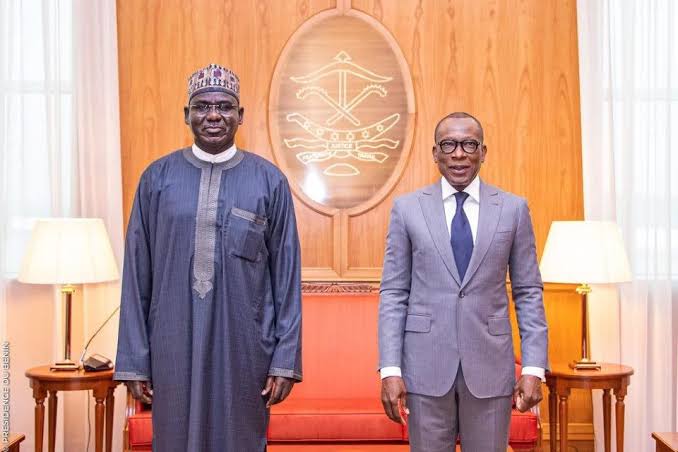
Nigeria-Benin Relations in Ambassador Buratai’s Era: An Opportunity for Economic Boom

0


By Rotimi Johnson

When he served, as Nigeria’s Chief of Army Staff (COAS) and leader of the counter-insurgency operations, His Excellency, Ambassador Lt. Gen. Tukur Yusuf Buratai (rtd) stretched his last energies, to save his country, from the twinges of insurgencies and insurrections. He donated his life and strength to the cause of liberating humanity to the best of his capacity and conscience for six years in leading the battle in the trenches.

But life has mixed experiences; some pleasant and others unpleasant. So, Amb. Buratai has been publicly arbitrated maliciously or accurately eulogized based on who holds the other end of the stick, as ennobled by his personal perceptions.

Nonetheless, he is not exhausted yet. There are still a lot of treasures embedded in Gen. Buratai (rtd) unknown to many Nigerians. He is a mystique of some sort, with multilayered ingeniousness. Its easy to describe him as a soldier of the trenches or a warmonger of the finest breed. And it’s also very appealing to denote Gen. Buratai as an administrator of rare configuration in military circles. His service records yawns with uncommon accomplishments.

But these are just the elementary understanding of Nigeria’s envoy to the Republic of Benin, His Excellency, Amb. Tukur Y. Buratai. He created wonderous impacts and made indelible imprints in Nigeria’s battles with Boko Haram terrorism. In just 5 years, he set unimaginable records in the anti-terrorism combats in the country. His shadows while he served his fatherland in the warfront were acknowledged by national and international bodies/ world leaders.

President Muhmmadu Buhari’s appointment of Gen. Buratai (rtd) and his posting to the Republic of Benin was for strategic reasons. Fighting and defeating terrorism requires more than just having a properly trained army and warfare weapons. It transcends such basic considerations. It needs international alliances, collaboration and partnership with other foreign nations.

Benin Republic is strategic to Nigeria for several reasons. As a nation which shares a major commercial border with Nigeria- the Seme border, the country has come with its enough blessings on the economic front; and much as the concomitant burden. Both legitimate and illicit trade transactions occur on the border. The Seme border’s most terrifying nightmare to Nigeria includes, trans-border crimes such as smuggling of firearms and contraband goods into the country.

While smuggled weapons have exacerbated insecurity in Nigeria; smuggled goods deny the Nigerian Government of its essential revenue or tax levies on imported goods. Importation of banned items also destroys the local economy and kills productivity. Nigeria has battled with these malaises for years.

Angered by the danger posed by such sabotaging acts, President Buhari closed Nigerian borders, including the Seme border in August 2019, to curb smuggling of goods and weapons by these economic criminals.

Nigeria’s greatest problem on insecurity is battling banditry and terrorism, which has lasted for over 10 years. Much as the country has attempted to weaken terrorists and bandits operations within, they resurge from time to time, exalting more powers through smuggled weapons into the country.

Through subtle talks and persuasions, Benin Republic joined the Multi-National Joint Task Force (MNJTF), a regional security outfit set up to confront the madness of terrorism in the West African sub-region. The original countries in this arrangement are Nigeria, Niger and Chad republics. But the needed cooperation for better gains has to be constantly activated or renewed by Nigeria.

And there is a bright hope to end these tribulations with Gen. Buratai (rtd), a soldier who demonstrated his zeal, passion and determination to see to the greater security and peace for humanity, especially in Nigeria, now serving as a bridge between Nigeria and Benin, one of the countries which greases the problem. It is therefore right to say, from the trenches, Gen. Buratai (rtd) has taken up the battle against terrorism and banditry on the diplomatic plane.

Considering that the international community is focal in the fight against armed gangs, in addressing the security challenges in Nigeria, the posting of Amb. Buratai to the Republic of Benin has countless blessings. He is in a better position and more experienced to search for diplomatic solutions to Nigeria’s porous borders which facilitate smuggled weapons from that axis by striking a mutual understanding with the country to checkmate the trend.

Not everything is achieved through brute force or laws. So, diplomacy and international relations on smooth template comes handy in resolving certain problems. Negotiations and dialogue between nations have solved knotty problems which years of wars or conflicts have failed to resolve.

Therefore, Lt. Gen Tukur Buratai’s (rtd) ambassadorial mission in Benin republic will harvest and sustain multilateral ties with the West African country. As attested by his impeccable credentials in public service, Buratai is trusted to galvanize international support from this country in the final defeat the Boko Haram insurgency and allied insurgencies in Nigeria.

Gen. Buratai is famed for his passion for multiple approaches in fighting terrorism. While in the service of the Nigerian Military, he was a consistent exponent of the adoption of non-kinetic weapons in fighting terrorism in the country. His service now as Nigeria’s ambassador to Benin republic is a good icing on the cake, hence a standard platform has been raised for him to utilize his competence on embalming the multi-dimensional security issues afflicting Nigeria for peace, progress and security of the country.

Nigerians who know the worth and treasures in Gen. Buratai, applauded his diplomatic sojourn to Benin Republic jubilantly. The timing is also auspicious. Due to sustained pressures, the Federal Government of Nigeria reopened its closed borders in December 2020, after it nearly broke international relations between the two countries. By implication, while Government is desirous to encourage legitimate or authentic trans-border trade and commerce, it must also necessarily confine the operations within the prisms of approved international laws.

Consequently, Amb. Buratai’s first duty or challenge in this direction is how to renew the broken trade relations between Nigeria and Benin in terms profitable to both countries, in accordance with prescriptions of the ECOWAS Protocols. No magic can work better, rather than diplomatic engagements, which Amb. Buratai is poised to vigorously pursue.

Again, Amb. Buratai has started working round the clock to promote national security through the Nigeria/Benin border. Topmost on his agenda is how to curb smuggling of arms and other dangerous weapons into Nigeria through the Benin border. It is a germane issue and uppermost on the minds of Nigerians. His initial steps are commendable in less than two months in office.

Amb. Buratai has also engaged the Government of Benin Republic on ways to curb the large scale smuggling of goods into the country. It is a practice orchestrated by economic wolves and saboteurs’ which has deprived Nigeria of critical revenue in billions of naira annually for the development of public infrastructure. With these loopholes blocked, it would open the sure path to a greater and more rapid development of Nigeria under the Buhari Presidency. Individuals engaged in the business of importation will also have robust transactions in a competitive and protected environment.

Gen. Buratai performed incredibly, as Nigeria’s Chief of Army Staff (COAS) in the very few months of his resumption of duty. He is again replicating the same feat in Benin. Nigerians are looking forward to more of such exploits in his mission in Benin Republic. And the quick wins have started trickling into Nigeria, evident in the curtailing of the flow of smuggled weapons into the country. The reduced tempo in acts of terror or banditry. The series of surrenders by terrorists and armed gangs to the Nigerian Army is an apt indication of their suffocation in various ways, including weapons supply.

Amb. Buratai has hit the ground running in his usual fashion. And as a friendly and likeable leader, the Nigerian Embassy staff in Benin Republic are in high spirits to work with him. They are excited with his vision of service and willing to actively assist him to re-energize his foreign mission in that country. Gen. Buratai’s (rtd) reign will definitely birth prosperity for both nations.

With Amb. Buratai at the helms of affairs, Nigeria is bound to see a new form of healthier bilateral engagements with Benin. He has already set modalities in motion to entrench a culture of mutual benefits of the trans-border trade between the two countries. Amb. Buratai is ensuring that not only Benin Republic’s Cotonou smiles in the long run; but Lagos and indeed, Nigeria count multiple gains from the business interactions.

Rotimi is a Nigerian development expert writing from Cotonou.