Home Blog Page 2114

Insecurity and Communication Issues in Nigeria

0

On Wednesday, October 20, 2021, reports in Nigerian media claimed that the Nigerian Armed Forces have yet to fully deploy the A-29 Super Tucano fighter jets purchased from the United States against bandits in the North-West due to an agreement that requires Nigeria to only use the jets against terrorists and insurgents. Surprisingly, the following day, Thursday, October 21, 2021, so-called bandits detonated explosives on the Abuja-Kaduna rail line and attacked a passenger train, forcing the suspension of Abuja-Kaduna train services for nearly 48 hours. The Economist magazine of London published a damning report titled ‘Insurgency, secessionism, and banditry threaten Nigeria’ on Saturday, October 23, 2021.

According to The Economist’s report, which is essentially editorial opinion, the Nigerian army is overstressed and only “mighty on paper,” officers stole weapons and “sold to insurgents,” police are “understaffed, demoralized, and poorly trained,” and they “supplement their low pay by robbing the public.” It concluded by recommending that Nigeria ‘bolster its police,’ with a call to recruit more cops, pointing out that Niger State ‘has only 4,000 officers to protect 24 million people.’ Niger State has a population of about 4 million people. This blunder, however, does not negate the fact that Nigeria is overpoliced. The Economists’ woolgathering nature could have been to blame for such avoidable error.

It is not only the error in presenting the population of Niger State, but the magazine has lost almost all objectivity in analyzing the country’s security challenges. The so-called report was reduced to arguing that the purchase of A-29 Super Tucano jets is wasteful spending because ‘local cops would be better at stopping kidnappings and solving crimes than the current federal force, which is frequently sent charging from one trouble spot to the next.’ Money could be saved by reducing wasteful military spending on jet fighters, which are useless for guarding schools. Britain and the United States, which assist in the training of Nigeria’s army, could also train detectives. Better policing may allow the army to withdraw from areas where it is stoking secessionist fires.’ According to The Economist, what is needed to put an end to banditry and protect schools in the North-West is more police officers, not ‘wasteful’ spending on jets.

Read Also:  NYSC trust fund will lift 100m Nigerians out of poverty – CSO

Mallam Mahmud Jega reminded The Economist magazine on Monday, October 25, 2021, in his weekly article titled Mighty Armies on Paper, how the’mighty’ US army spent over $6 trillion in 20 years fighting the Talibans in Afghanistan only to lose the battle. Similarly, until the signing of the Good Friday Accord in 1992, the’mighty’ British army was unable to defeat the Irish Republican Army (IRA) and bring an end to ‘The Troubles.’ Mallam Jega emphasized that all “conventional armies in this world have difficulty fighting asymmetric warfare, primarily because they are not trained for it.” This is perhaps one of the most important aspects of Nigeria’s insecurity problem: resolving it will necessitate unconventional strategies.

It is shocking that much attention has been paid to the question of whether the Nigerian Armed Forces should deploy newly acquired A-29 Tucano jets to combat insecurity in the country against bandits, insurgents, or terrorists. Isn’t it true that the jets have already been deployed in the North-West, in Zamfara, Kaduna, and Katsina states, and that they have had some notable successes against the bandits? Is it true that Nigeria has an agreement with the US government that forbids it from using jets against bandits? Will the US government actually take steps to prevent the Nigerian Armed Forces and the Nigerian government from using newly acquired A-29 Super Tucano jets to combat bandits in the North-West?

The entire speculation about the ostensibly agreed-upon agreement between Nigeria and the US government to use A-29 Super Tucano jets is insulting to both the Nigerian and US governments. The speculation about the so-called agreement between the Nigerian and US governments on how the A-29 Super Tucano jets will be used, the attack on the Abuja-Kaduna train, and the report in The Economist are all fascinating coincidences. It’s as if someone, somewhere wants to discourage Nigerian Armed Forces from fighting bandits in the North-West, thereby halting any progress made. Recent public debate in the country appears to be aimed at demoralizing Nigerian Armed Forces in their fight against bandits in the North-West, and the attack on the Abuja-Kaduna train is being used to highlight the sophistication of the bandits. If there is one thing that proves bandits are terrorists, it is the attack on the Abuja-Kaduna train. After all, aren’t terrorists people who endanger the lives of ordinary citizens? What could be more dangerous than the activities of these bandits in the North West?

Read Also:  Why Nigeria Loses Over $2.9bn Per Year From Tax Breaks for Multinational Corporations – CISLAC Executive

Interestingly, apologists and self-appointed counsellors to the Bandits, such as Sheikh Ahmed Gumi, are growing more confident and irresponsibly mobilizing opposition to declaring the Bandits terrorists. All studies on insecurity and banditry in Nigeria have only confirmed that the bandits operating in the North-West and North-Central have all of the characteristics of terrorist organizations. For example, a study titled, I am a Bandit – A Decade of Research in Zamfara State Bandit’s Den, presented at the 15th Usman Danfodio University, Sokoto Seminar Series, on Thursday, September 9, 2021, reported that bandits are armed groups with ‘contacts across the Sahel, particularly Libya and Mali,’ ‘huge capital,’ ‘in possession of more than 500 AK 47 guns,’ and ‘ According to the report, “over 60,000 weapons are in circulation” in the North-West alone.

Any discussion of the challenges of insecurity and banditry in Nigeria that ignores this reality is simply uninformed and thus unhelpful. The Economist’s arrogance, which led them to believe they could condemn the Nigerian Armed Forces and Government based on some uninformed sentiments, reflects the old ideological mindset that was used in the 1980s to impose Structural Adjustment Programmes, resulting in the destruction of education and health sectors in most African countries, including Nigeria. In fact, the current problems of insecurity and banditry in Nigeria are a direct result of the country’s educational system collapsing, which is why it is estimated that over 12 million Nigerian children are out of school.

Read Also:  Aspirant Demands That Lagos APC Congress Be Cancelled

Many recent studies have highlighted the objective reality of Nigeria’s security challenges, on the basis of which good recommendations for addressing the challenges have been made. One such study was the presentation of an international consulting firm, Nextier SPD (Security, Peace, and Development), titled Stemming the Tears – A Pragmatic Approach to Solving Nigeria’s Security Challenge, to the 27th Nigerian Economic Summit in October 2021. According to the study, “in the twelve months leading up to September 2021, Nigeria recorded 890 violent incidents resulting in 3,787 deaths, 340 injured persons, and 2,542 kidnapped persons…” Banditry is currently the leading conflict type in Nigeria in terms of number of incidents (606 or 68.1 percent), number of deaths (2,470 or 65.2 percent), number of injured (211 or 62.1 percent), and number of persons kidnapped (2,487 or 97.8 percent).’

The Nextier study demonstrated that banditry is the most serious security challenge confronting Nigeria today. Every day, at least six innocent people are killed by bandits. Nextier acknowledges that the recent escalation of the fight against bandits prompted authorities in Katsina, Sokoto, and Zamfara states to impose a communications blackout in several communities in the states in order to prevent communication between bandits and their informants. There has also been a reduction in fuel and food supplies to armed gangs’ hideouts in forests and other areas. Furthermore, cattle movement has been restricted, as have the opening hours of local markets in the worst-affected areas by banditry. Those smuggled fuel to bandits have been apprehended. Since early September, hundreds of ground and air troops have been carrying out an offensive to halt a surge in mass abductions, community raids, and sexual violence in the North-West. The governments of Zamfara, Sokoto, Kebbi, Kaduna, Niger, Katsina, and Nasarawa states have agreed to recruit 3,000 special vigilantes in the troubled regions to boost military efforts aimed at halting violence in both the North-West and North-Central.

Read Also:  Gbajabiamila Still Hasn’t Sworn In Taraba Rep, One Month After Court Order

The point is that, more than ever before, Nigerian Armed Forces have been achieving successes in fighting bandits in the North-West since July 2021, when the recently acquired A-29 Super Tucano jets arrived and were deployed. As a result of their successes, Nextier observed that bandits are migrating and launching attacks in formerly peaceful areas, which may explain in part the recent attack on the Abuja-Kaduna rail line and train services on Thursday, October 21. A major challenge is the need to foster trust in order to strengthen collaboration between the Nigerian Armed Forces and citizens in order to put an end to banditry. According to Nextier’s submission, “the military needs to win “hearts and minds” and build trust with the community in order to access the information.” Given the current state of the relationship, this strategy will necessitate significant effort and patience on the part of the military.’

These challenges are easily reduced to commentaries and opinion analysis. Those who want to take advantage of Ni’s security challenges

Aspirant Demands That Lagos APC Congress Be Cancelled

0

The controversy surrounding the All Progressives Congress (APC) congress in Lagos State took another turn yesterday when a chairmanship aspirant called for the congress to be canceled.

Mr. Fouad Oki, chairman of the APC Democrats, a major bloc in the party, said the congress should be canceled because it was held under a balkanized Local Government system that was not recognized by the 1999 constitution.

Read Also:  The Economist And Its Misadventure On The Nigerian Army

Oki claimed that despite purchasing a nomination form, he was denied entry to the congress held at Mobolaji Johnson Arena.

Oki told reporters yesterday that the congress violated Section 3 (2) and Part 1 of the First Schedule of the 1999 constitution, Section 156 of the Electoral Act, and Article 33 I of the APC constitution, 2014, as well as the APC Guidelines for State Congresses.

Read Also:  Gbajabiamila Still Hasn’t Sworn In Taraba Rep, One Month After Court Order

In his response, the party’s Publicity Secretary, Mr. Seye Oladejo, stated that the congress followed “in totality the guidelines stipulated by the national caretaker committee,” claiming that Oki failed in the same mission three years ago.

Gbajabiamila Still Hasn’t Sworn In Taraba Rep, One Month After Court Order

0

One month after a Federal High Court ordered his inauguration as the member representing Taraba State’s Bali/Gassol Federal Constituency, Garba Hamanjurde Chede has yet to be sworn in by the Speaker of the House of Representatives, Femi Gbajabiamila.

It should be noted that the court, presided over by Justice Simon Akpah Amobeda, sacked Mubarak Gembo, the member representing the constituency in the National Assembly, in its September ruling.

It also ordered that the Certificate of Return issued by the Independent National Electoral Commission (INEC) to the sacked lawmaker be withdrawn and issued to Chede.

Meanwhile, a letter to the Speaker dated September 28, 2021 and signed by Abdulhamid Mohammed, Chede’s lawyer, urged the speaker to follow the court’s decision to reinstate the lawmaker.

Read Also:  PDP Convention  jeopardy as the court rules on Secondus’ lawsuit today

Chede said yesterday that his lawyers were planning to file a contempt of court action against Gbajabiamila for failing to comply with the court’s ruling.

“Despite all the advice he has received, the speaker is adamant about swearing me in, citing someone in the Villa as the stumbling block.”

“The speaker also stated that it is the House’s culture to protect its members even if a court judgment is issued.” “I believe this is an extremely unfair and unjust posture, particularly for a legislative organ of the government,” he said.

The APC chieftain, who represented the constituency from 2015 to 2019, called the alleged refusal of the speaker to swear him in an affront to democracy.

Read Also:  In Kano, police apprehend 59 people and recover arms

When contacted, Benjamin Kalu (APC, Abia), spokesman for the House, said, “if the said person has received a certificate of return, the necessary steps will be taken when the House resumes plenary.”

Why Nigeria Loses Over $2.9bn Per Year From Tax Breaks for Multinational Corporations – CISLAC Executive

0

According to the Civil Society Legislative Advocacy Centre (CISLAC), Nigeria loses $2.9 billion per year as a result of tax breaks granted to multinational corporations.

Auwal Musa Rafsanjani, Executive Director of CISLAC, stated at the Pan African Conference on Combating Illicit Financial Flows (IFFs) to Bridge the Widening Inequality Gap in Abuja that Africa has lost up to $1 trillion due to IFFs, with US$50 billion lost annually over the last 50 years.

Rafsanjani emphasized that, despite the huge loss from tax waivers, the government increased value-added taxes (VAT), which disproportionately impacted the poor, from 5% to 7.5%, adding that crime and tax evasion were growing concerns that reduced government revenue for financing long-term development.
“The International Monetary Fund and World Bank have all expressed concerns about the likely sharp increase in inequality and poverty as a result of the pandemic,” he said.

“According to estimates, 42.1 percent of the sub-region will be pushed into extreme poverty.”

Read Also:  VAT: Gov. Wike formally establishes the state Tax Appeal Commission

“Worse, the World Bank indicated that reversing the poverty increase could take more than a decade, effectively erasing all hope of countries meeting their national development plan targets to reduce poverty and inequality by 2030.”

“On the other hand, the region’s wealthiest people fare differently, with the three wealthiest men in the region, all of whom are based in Nigeria, seeing their wealth grow from US$16.8 billion in March 2020 to US$23.2 billion by July 2021.”

The Executive Director of CISLAC also revealed that the amount lost to IFFs in Africa is roughly equivalent to all of Africa’s official development assistance (ODA) received during the same time period, though he cautioned that the estimates may fall short of reality due to inaccurate data for all African countries.
In his remarks, Garba Abubakar, the Registrar-General of the Corporate Affairs Commission (CAC), stated that the Pandora Papers revelation demonstrated that poverty, inequality, a lack of infrastructure, and good governance were not adequately addressed.

Read Also:  VAT collection can only be done at the national level, not at the state level, according to FIRS

“Public Beneficial Ownership Registers are important tools for advancing the fight against corruption, tax evasion, asset shielding, and illicit financial flows, among other things.”

“Registers of beneficial owners, on the other hand, are assisting in no small measure to expose corruption orchestrated by ultimate beneficial owners who ore individuals who ultimately own, control, or benefit from registered corporate entities,” he said.

Tensions rise as farmer shot dead in FCT

0

Tensions are rising in the Dobi community of the Gwagwalada Area Council of the FCT following the shooting death of a farmer, Sule Motunye Dabena.

Yakubu Dabena, Sule’s brother, stated that the incident occurred on Wednesday afternoon while Sule was working on his farm.

“The family called him on his phone to find out why he was stuck on the farm until 6:30 p.m.,” he explained, “but his phone, which rang, went unanswered.”

So we, the family, gathered vigilantes and marched to the farm, where we discovered his body in a pool of his blood.”

Read Also:  FCTA raids criminal hideouts in Gwarimpa, arresting 49 suspects

While directing security agents to find those responsible for the killing, Gwagwalada Chairman Alhaji Adamu Mustapha Danze said security in the community had been beefed up to avoid retaliation and a breakdown in law and order.

DSP Adeh Josephine, a spokesperson for the FCT Police Command, did not respond to an SMS inquiry about the incident.

For stealing shirts, a student receives a 16-month sentence.

Rotgak Audu, a student from Jos, Plateau State, was sentenced to 16 months in prison on Thursday by an upper area court in Kasuwan Nama, Jos.

Audu was sentenced by Judge Lawal Suleiman after pleading guilty to criminal trespass and theft and begging for mercy.

Read Also:  Police arrest 70-year-old man, two others in the FCT for kidnapping and armed robbery

Mr Suleiman, on the other hand, gave the convict the option of paying a N10,000 fine in addition to compensating the complainant with N22,000 in cash.

Earlier, Sgt Daniel Longwal of the prosecution told the court that Longji David reported the case to the Anglo Police Station on October 18.

The prosecutor also told the court that during the investigation, the convict pleaded guilty and the t-shirts and jerseys were recovered from him, but the iPhone and N1,000 were not.

PDP Convention  jeopardy as the court rules on Secondus’ lawsuit today

0

The Peoples Democratic Party (PDP) convention scheduled for tomorrow is in jeopardy following the Court of Appeal’s decision today to rule on an appeal filed by Prince Uche Secondus, the party’s suspended national chairman.

An Appeal Court in Port Harcourt, Rivers State, reserved judgment in the case between Secondus and six PDP members for today.

Secondus, in his CA/PH/339 appeal, asks the court to prevent the PDP from holding its national convention on October 30 and 31, 2021.

Following his feud with Rivers State Governor Nyesom Wike, the embattled former chairman was pushed out. Delegates from across the country have arrived in Abuja for the convention.

Secondus had petitioned the court, through his lawyer, Payo Oyetubo, to suspend the convention and grant him the right to preside over the exercise.

Read Also:  NYSC trust fund will lift 100m Nigerians out of poverty – CSO

When the case was heard in court on Tuesday, six PDP members who had joined the case informed the judge of their application for joinder, which was not opposed by counsel for Secondus.

The three-man appeal panel granted the party members permission to join.

After hearing arguments from both parties, the appeal panel, led by Justice Haruna Simon Isammani, directed the plaintiff’s counsel to serve the process on the defendant’s counsel within 24 hours.

Previously, counsel for the PDP, S.I. Ameh, had opposed Secondus’ counsel’s application and urged the court to dismiss the case on the grounds that the counsel sought the suspension of the convention.

After adopting the written address from the legal counsel for Secondus, Tayo Oyetibi, and 11 respondents, Justice Haruna adjourned the case until today. The development has heightened tensions within the country’s main opposition party.

When contacted, the party’s chairman of the Board of Trustees (BoT), Sen Walid Jibrin, stated that the suit does not pose a threat to the convention.

“Despite the adjournment,” Senator Jibrin said, “the PDP is not threatened and is hopeful that the convention will take place on Saturday.”

Meanwhile, the chairman of the convention’s organizing committee, Adamawa State Governor Ahmadu Umaru Fintiri, declared yesterday that the ruling All Progressives Congress (APC) will cease to exist following the conclusion of the PDP convention.

In addition, four PDP governors met yesterday with Olusegun Mimiko, a former governor of Ondo State, to discuss his proposed move to join the party.

Read Also:  In Kano, police apprehend 59 people and recover arms

Governors Seyi Makinde (Oyo), Aminu Tambuwal (Sokoto), Nyesom Wike (Rivers), and Okezie Ikpeazu (Abia) met with Mimiko behind closed doors in Akure.

At the conclusion of the meeting, Tambuwal, speaking on behalf of the governors, stated that they were in Ondo to re-unite Mimiko with the PDP.

He stated that they had a thorough meeting with Mimiko and that he was confident he would join them.

In Kano, police apprehend 59 people and recover arms

0

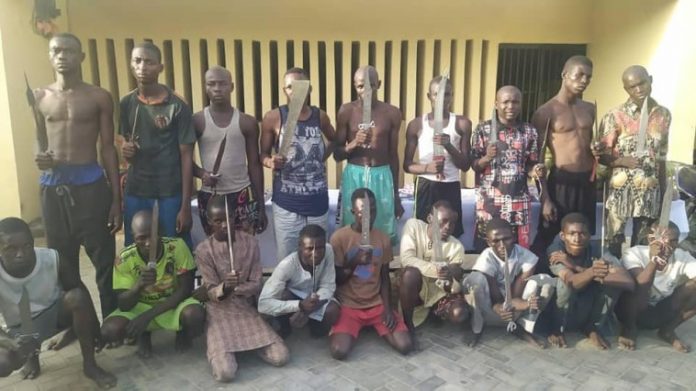
Kano State police have apprehended 59 suspected criminals and recovered weapons and illegal drugs from them.

This was despite the fact that the state’s Commissioner of Police, Sumaila Shuaibu Dikko, stated that the fight against drug dealers and thugs (yan daba) would be maintained with vigour.

DSP Abdullahi Haruna Kiyawa, the command’s spokesman, revealed this on Thursday in a statement, noting that the suspects arrested between “19/10/2021 and 27/10/2021” included those suspected of robbery, theft, and drug dealing.

Read Also:  NYSC trust fund will lift 100m Nigerians out of poverty – CSO

He stated that all of the suspects from various addresses in Kano were apprehended with weapons and stolen property.

NYSC trust fund will lift 100m Nigerians out of poverty – CSO

0

A civil society organisation, The Abuja Grassroots Advocacy Project, has drummed support for the establishment of a Trust Fund for the NYSC.

According to the group, the establishment of the Fund will effectively complement the Federal Government’s efforts in moving 100 million Nigerians out of poverty.

The chief advocate of the CSO, Comrade Yunusa Ahmadu Yusuf, disclosed this on Wednesday while speaking at a symposium organised by NYSC on the imperative of establishing a Trust Fund for the scheme in Abuja.

Yusuf commended the NYSC management for the idea of the Trust Fund while also calling on all and sundry to support its establishment as it will empower the scheme to effectively confront the emerging economic challenges of the 21st century.

He also commended the scheme for providing a platform that would engender greater appreciation of the imperative for the NYSC Trust Fund and generate ideas that would facilitate its actualisation.

According to him, resolutions reached at the symposium have the capacity to change the narratives of not only the NYSC scheme, but the teeming Nigerian youths.

He called on the NYSC management to sustain and expand the scope of advocacy for the establishment of the fund.

It was also agreed that to achieve the desired objectives for the establishment of the Trust Fund, it must have clear objectives to promote transparency and beneficiaries must be identified based on gender, geopolitical representation and other relevant demographies.

“The NYSC Trust Fund the realisation of the NYSC Trust Fund will effectively complement the Federal Government’s efforts in moving 100 million Nigerians out of poverty as those expected to benefit from the fund would be Corps members who have been trainedthrough the NYSC Skill Acquisition and Entrepreneurship Development Programme are expected to train and empower no fewer than five persons from their host Community,” he added.

He said that the recommendation adopted during the NYSC symposium was laudable and should be supported by members of the National Assembly when the Bill for the establishment of the Fund would be presented to them for approval.

“We also want to appeal to President Muhammad to make the bill an Executive Bill when presented to the National Assembly. Because if passed into law, many Nigerians will benefit from it greatly,” he stated.

We didn’t advocate $200m loan for malaria nets — NPHCDA

0

The National Primary Health Care Development Agency (NPHCDA) has rubbished reports that it demanded a $200 million loan for the importation and local production of mosquito nets in the country.

In a statement through Mohammad Ohitoto, Head, Public Relations Unit, today, the agency said its Chief Executive Officer, Dr. Faisal Shuaib, never discussed nor granted an interview on the malaria programme.

Recall that the Senate Committee on Local and Foreign Loans had yesterday rejected the proposal by the Federal Ministry of Health to borrow $200m under the Malaria Programme to buy mosquito nets in the 2022 budget.

The Permanent Secretary in the Ministry, Mahmuda Mamman, had justified the proposal before the panel.

He said, “The loan , if approved by the National Assembly and accessed, will be used to medically fight malaria in the 13 orphan states which cover 208 local government Councils and 3, 536 primary health care centres “,

But Senator Ibrahim Oloriegbe and other lawmakers rejected the proposal.

In reaction, the NPHCDA said it has no business with the malaria programme, noting that it is the responsibility of the National Malaria Elimination Programme (FMOH).

“The attention of the National Primary Health Care Development Agency has been drawn to an online publication quoting the ED/CEO NPHCDA, Dr. Faisal Shuaib as advocating for a $200 million loan for the importation and local production of mosquito nets in the country,” the statement said.

“This is to inform Nigerians that this statement is not only untrue, it is a figment of the imagination of the writer as the CEO never discussed the malaria programme nor granted any interview on the malaria programme.

“It is pertinent to state that the Malaria programme is the responsibility of the National Malaria Elimination Programme (FMOH). Therefore, the NPHCDA Chief Executive has no reason whatsoever to discuss or advocate for funding for such intervention. This news is outrightly unfounded and fake and should be disregarded by all well meaning Nigerians”.

Ambassador TY Buratai and echoes of truth on insurgency

0

By Linus Ojoko

“ (Military) is not only the force that should be used, what about the non-kinetic approach? What about development? So many places don’t have roads, several places don’t have schools. There is low level of education, high illiteracy. These are what breed insecurity and criminality”- Gen. TY Buratai (rtd) in an interview with ThisDay and Arise TV in Maiduguri, February, 2020

Nigeria, like other countries of the world has been enmeshed in multi-dimensional terrorism for years. The nation has incurred unimaginable losses in precious human lives, destructions, waste of critical national resources on curbing insecurities and the overall instability it has birthed in the country. The pains, sorrows and agonies terrorists inflict on the people is another pain in the neck.

And in Nigeria’s efforts to contain the plague of terrorism, the country has adopted multiple measures, at different times, including anointing crack and seasoned Military Generals to lead the counter-insurgency operations. But the army officer who has demonstrated the clearest vision and discerns the matrix of insurgency deeply, is Lt. Gen. Tukur Yusuf Buratai (rtd). He is now Nigeria’s Ambassador to Benin Republic. He broke new grounds, set global records in battling terrorism and recorded countless success stories while he led counter-insurgency operations in Nigeria.

Even in his diplomatic assignment, His Excellency, Ambassador TY Buratai has continued to trumpet his convictions and perceptions on how best to tackle terrorism, which is now domiciled its tentacles in the West African sub-region, Africa and a nagging nightmare to the entire globe. While still in active Military service, Ambassador Buratai sermonized on the inadequacy of Nigeria’s over reliance on kinetic approaches to resolve the terrorism conflagrations.Some people maliciously classified him a prophet of doom. But reality and truth and unchangeable human phenomenon.

However, Buratai never relented in preaching the adoption of wholistic and collective efforts to tackle Boko Haram terrorism, armed banditry and its numerous variations or mutations. He canvassed for the use of the non-kinetic approaches in blighting terrorism fires in the country. Ultimately, Ambassador Buratai believes that terrorism will not just disappear from Nigeria simply because armed soldiers engage insurgents in brutally crippling combats in the war trenches or fighter jets drop missiles on terrorists camps, exterminating them in numbers.

But Gen. Buratai (rtd) keenly studied and grasped the sociological and psychological character of Boko Haram terrorists; their recruitment styles and baits in luring innocent Nigerian youths into the sect as footsoldiers. The youths easily subscribe to Boko Haram ideology because it assures them of ending an existential ennui.

Mainly, Buratai believes gross underdevelopment, awful deficits in infrastructures, near zero empowerment of Nigeria’s productive population, festers Boko Haram terrorism and also frustrates or impedes the needed Military actions to completely blight operations of the sect, especially in the Northeast region.

Ambassador Buratai has remained appalled at the level of underdevelopment of the Northeast region, the hotbed of Boko Haram terrorists campaigns. Its unbelievable, but some Local Government Areas in the Northeast are inaccessible by road. But they receive monthly allocations from the federation account.

A few days back, His Excellency, Ambassador Buratai again drummed the same message at Yola, Adamawa state, when he spoke as the Guest Lecturer at the of the 24th, 25th and 26th combined convocation lecture of Modibbo Adama University. He bemoaned loudly that the Northeast lacks development and it is incredibly fuelling insurgency and insecurities in the geopolitical region.

Ambassador Buratai pricked the conscience of leaders and the influential, as he declared; “ Any country that does not ensure the development of its people would have security challenges. We should not rely on the military option as the only way to resolve our security challenges. We must address the ideological, economic, social, and political factors. My recent diplomatic foray has further sharpened my views on the urgent need for military, as well as non-military solution to the lingering and needless conflict.”


Gen. Buratai (rtd) has lived with this mindset even while he was in active Military service and actually took profound steps, by using the platform of the Nigerian Army to berth desperately needed succour Thus, while he rendered patriotic service to his country, Gen. Buratai (rtd) manifested in policies and actions that embraced both the kinetic and non-kinetic measures to battle Boko Haram terrorism. He introduced the “stick and carrot” approach; and activated the Nigerian Army’s Corporate Social Responsibility (CSR) component in host communities.

The CSR initiative, which was the first ever in the history of the Nigerian Army, funded from its meagre budget, impactfully bridged development gulfs in all Army host communities’ or anywhere soldiers conducted special Internal Security (IS) operations. It to the credit of the Nigerian Army and the excitement of Nigerians who are beneficiaries of the Army’s CSR projects in roads construction, bridges, water supply, health, agriculture, education , electricity and many others. The Army through the CSR platform, even reached communities which have never experienced the presence of government in the history of their existence.

By his recent outbursts and emphasis on the poor development base of the Northeast, Ambassador Buratai for the umpteenth time, has persuaded a synergic approach to this challenge. He has persuaded the commitment of government at all tiers, as well as the needed actions from political leaders, traditional rulers, religious leaders, individuals and all stakeholders to assist the Military in ending the terrorism conflict in the Northeast through development initiatives.

The singular dependence on the Military and weapons alone would only momentarily blight the fires of terrorism. The people must be lifted from their gross underdevelopment, poverty and penury to embolden them to abandon the allures of terrorism. Very often, Boko Haram recruiters brainwash the people into believing, the sect can offer a better alternative to existence, as they encounsed such preachments government’s visible neglect. Today again, leaders are tasked to change this narrative by consciously re-doubling fresh energies and resources to the issues of development in the region.

A consistent frank talker, Gen. Buratai (rtd) once told a select team of media executives at the Nigerian Army Day Celebration (NADCEL) 2020, observed in Faskari, Katsina State that; “ But, overall, we must see criminality as a collective responsibility. It is a collective burden and it requires collective solutions. We are doing our own kinetic aspect and the civil authorities at the local level, at the state level need to do their own and of course, we must support the kinetic actions of the security agencies…,”

Truth is constant, but not easy to voice out by most people. But Ambassador Buratai has wittingly developed himself into a great human resource to Nigeria on counter-terrorism and knows where the problem of terrorism is nourished. So, he does not dread telling the truth he knows.

If only leaders can listen to him and apply his ideas, Nigeria would be finally extricated from the fangs of terrorism. As a nation, Nigerians must wake up to take his sermons very seriously. It is not too late to rejig the narrativd. He spoke and has always spewed the gospel truth, regardless of who hates or is angered by it. But only truth can set anyone free.


President Muhammadu Buhari and international donors deserve special commendation for their numerous efforts in the rebuilding and reconstruction of the Northeast in the post-insurgency era. But these efforts must be complemented by the natives, whether low or mighty. The burden is heavier on their necks than anyone else.

Truthfully, the Northeast has no reason to be confoundingly underdeveloped as known today. The Northeast is a region which is also home to many wealthy Nigerians. It is the ancestral place of some of Nigeria’s topmost millionaires and billionaires. They must partner and synergise to tackle the issue of underdevelopment to end the bait of easy recruitment of footsoldiers or support for Boko Haram terrorists.

Ojoko PhD wrote this article from
Modibbo Adama University of Technology, Yola.