Home Blog Page 2083

Jonathan travels to Kenya to attend an African Union high-level retreat on mediation: media aide

0

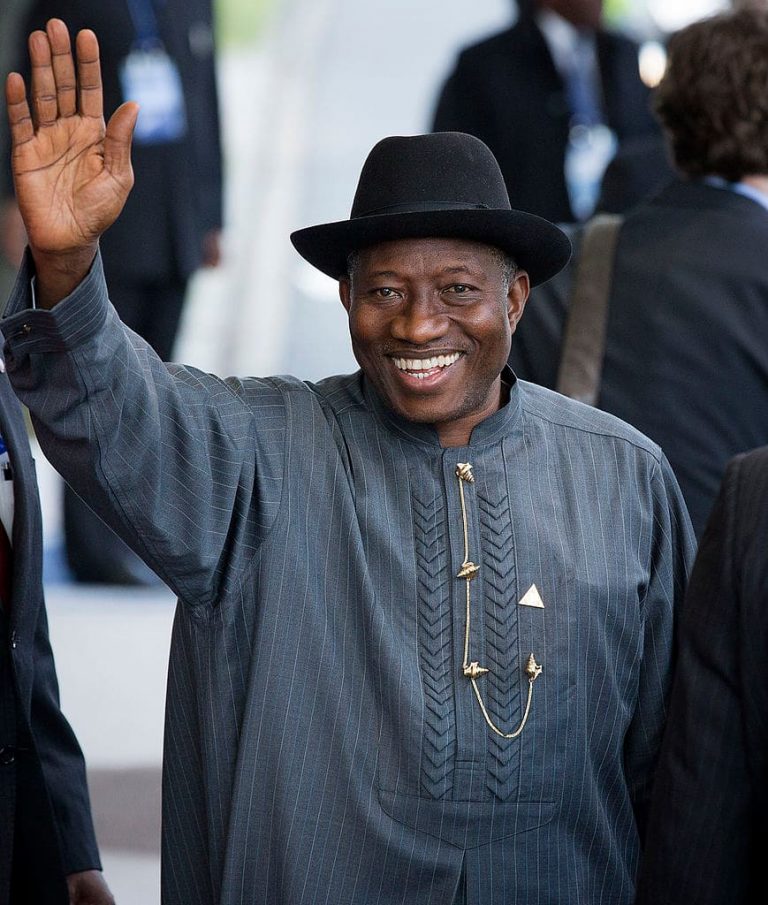
Former President Goodluck Ebele Jonathan will fly from Abuja to Nairobi, Kenya’s capital, on Saturday to attend the African Union’s (AU) 12th High-Level Retreat on the promotion of peace, security, and stability in Africa.

Mr Ikechukwu Eze, Jonathan’s Special Adviser on Media, made the announcement in Abuja on Friday.

Jonathan would attend the three-day event, which was intended for High Representatives, Special Envoys, and Special Representatives of the Commission’s Chairperson, according to Eze (SRCC).

He explained that the goal of the event was for participants to brainstorm ways to improve the impact of ongoing mediation efforts across Africa.

Jonathan is the Special Envoy for Mali for the Economic Community of West African States (ECOWAS), as well as the Chairman of the ECOWAS Council of the Wise.

According to the invitation signed by AU’s Commissioner for Political Affairs, Peace and Security, Amb. Bankole Adeoye, the retreat’s theme is “Improved Coordination and Harmonization for Impactful Mediation.”

Read also: 2023: Governors and elders are upbeat as the PDP holds its convention

The Chairperson of the Commission, senior Kenyan government officials, as well as representatives from AU member states, regional organizations, international agencies, and AU organs, will attend the retreat, according to Eze.

“It will also give participants the chance to reflect, take stock, and review ongoing mediation efforts in the evolving conflict context on the continent, with the goal of improving coherence for longer-term impact.”

“In addition, mediation practitioners will provide insights and exchanges on emerging policy and practice as it relates to inclusivity, particularly of women, youth, and civil society,” Eze said.

The annual high-level retreat, he noted, is one of the key continental body’s initiatives for improving impact in addressing conflict situations in Africa, according to background information provided by the AU.

The retreat, which began in 2010 during Africa’s Year of Peace and Security, has evolved into the premier gathering place for Special Envoys, High Representatives, and Special Representatives of the Chairperson of the Commission (SRCCs).

“And African mediators to share experiences and best practices in conflict prevention, peacebuilding, and peacemaking,” Eze said.

He went on to say that the retreat had strategically engaged with timely, contextual, and challenging issues over the years, with a focus on building mediation capacity and collaboration on the continent.

“The future of mediation in Africa: Towards silencing the Guns: Lessons and Opportunities from the COVID-19 Pandemic,” Eze said of the 2020 retreat.

The High-Level Retreat focused on the impact of the COVID-19 pandemic on the African continent, as well as the implications for peacemaking and peacebuilding, in accordance with the theme.

Titi Jeje’s film academy is set to change the narrative of Nollywood

0

According to the actor, writer, and filmmaker, Nollywood is facing a slew of issues, including a lack of professionalism, poor storylines, subpar production, distribution, and a poor projection of the Nigerian image, necessitating the establishment of a quality film academy.

Titi stated that the academy, whose goal is to develop outstanding film professionals, arose from his desire to educate film enthusiasts who would stand tall in the industry.

Read also: Soldiers kill fighter during an attack on army post in Abia by the Biafra National Guard

In terms of Hills Media Film Academy’s affordability, Titi stated that, unlike others, it would be quite affordable. “At our academy, you get more bang for your buck.” Our commitment is to make a difference in people’s lives. One of the characteristics that distinguishes our graduates and trainees is that they will be trained by industry A-listers, ensuring that the knowledge they receive comes directly from the source. They will also become team members rather than just graduates.”

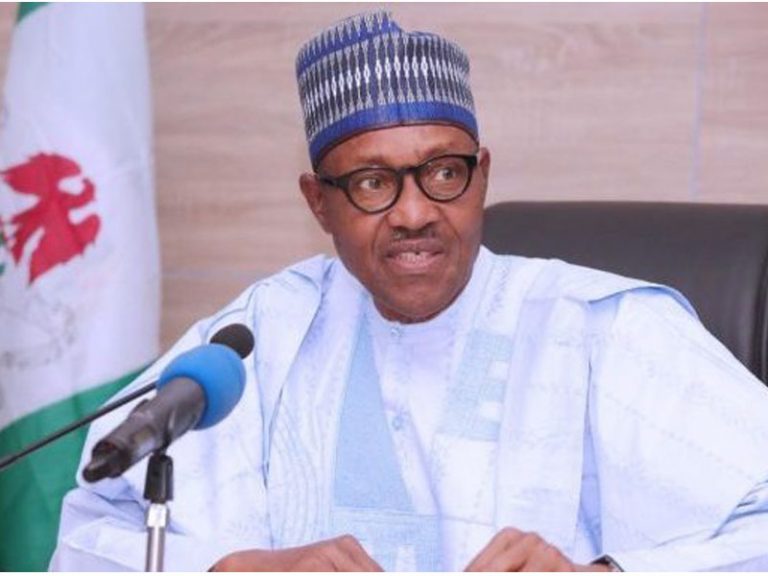
Buhari: Forget about extending my term; I’m leaving in 2023

0

President Muhammadu Buhari on Friday expressed tacit support for the country’s technology-driven electoral process, claiming that it leaves no room for tampering.


The President, who spoke in Makkah during a meeting with a select group of Saudi Arabia-based Nigerians, also warned those planning to campaign for an extension of his tenure to stop, saying he had sworn to God that he would not stay past May 29, 2023.

Furthermore, the Presidential Spokesman, Femi Adesina, has refuted reports that the plane on which President Muhammadu Buhari recently flew to the United States developed a fault in mid-flight.

Adesina described the reports published on some online platforms as an example of fake news, which has become a major vice and threat to the country’s information dissemination.

When asked about his confidence in the effectiveness of technology in the electoral process, President Buhari recalled that his presidential victory droughts ended after three outings when technology was eventually involved.

After being denied victory in three previous elections, he claimed that the introduction of the card reader and electronic register was God’s answer to his prayers.

“After the third so-called defeat,” he explained, “I said to God, dey dey dey dey dey dey dey dey dey dey dey (there is God). My opponents mocked me, but God answered my prayers by bringing technology into the picture. Nobody can steal or buy their votes at that point.”

President Buhari assured Nigerians in a statement issued by his Senior Special Assistant on Media and Publicity, Mallam Garba Shehu, that he would not violate his oath to the holy Qur’an by which he had sworn to only serve the terms permitted by the 1999 Constitution.

“By the Holy Qur’an, I swore that I would serve in accordance with the constitution and leave when my time was up.” There will be no’Tazarce’ (tenure extension). I don’t want anyone discussing or campaigning for unconstitutional extension. That is not acceptable to me.”

President Buhari, who concluded his visit to the Kingdom with Friday prayers at the Grand Mosque in Makkah, stated that he would continue to uphold the constitution in all of its ramifications and would supervise and deal with his ministers on the same basis at all times.

During the meeting, he promised that in the remaining “eighteen months or so of my time, whatever I can do to improve the lives of Nigerians, I will do it for the country.”

The President praised diaspora Nigerians in the Kingdom for representing the country well and projecting a positive image of the country.

He also used the occasion to urge Nigerians to be fair to his administration at all times, challenging his critics to compare the security situations in the Northeast and South-South in 2015 and how they have improved since then.

“My issue is the Northwest, where people are murdering and stealing from one another.” “I had to be very tough on them, and I will continue to be tough on them until we get them in line and restore order,” he said.

President Buhari urged Nigerians living in the country to respect the law, remain law-abiding, and do nothing to jeopardize the two countries’ many years of friendly and mutually beneficial relations.

Dr. Abdulkadir Maikudi, a community leader who spoke on behalf of the group, asked the President to help the privately run Nigerian International School in the Kingdom by equipping it to provide science and technical education.

The Nigerian Ambassador to Saudi Arabia, Yahaya Lawal, and the Consul-General in Jeddah, Ambassador Abdulkarim Mansur, both attested to the good behavior of the nearly 1.5 million Nigerians living in the country.

“Nigerian professionals are doing well and projecting a good image for our country,” they say.

Buhari was not involved in the air mishap, according to Adesina.

However, President Muhammadu Buhari’s spokesman, Femi Adesina, has refuted reports that the plane on which he recently traveled to the United States developed a fault mid-flight.

Adesina described the reports published on some online platforms as an example of fake news, which has become a major vice and threat to the country’s information dissemination.

“It didn’t happen,” Adesina said. I was a passenger on that flight. We took off from New York and flew straight to Santa Maria, Portugal, to refuel. We took to the skies and flew straight to Nigeria.

“Where is the blunder?” It’s a sham. It didn’t happen… Do you know how many people have been misled by this fake news?

“Fake news is a problem that affects the entire world, not just Nigeria.” Traditional media should be wary of fake news, because we need a country first before we can use digital media.

Read also: CBN assures users that e-Naira is safe and reliable

“We must not allow digital media to destroy our country.” “Digital media is good, but it contains evil.”

The presidential spokesman, who admitted to being a victim of fake news on numerous occasions, spoke yesterday in Abuja at the public presentation of a book, “101 Fake News on EndSARS,” a PRNigeria publication authored by journalist Dahiru Lawal.

Adesina expressed disappointment that members of the Yoruba group, Afenifere, were misled by fake news about his recent comparison of Buhari to some past political leaders, citing instances where his views were misrepresented by purveyors of fake news.

He advised traditional media and professional journalists to be more cautious, as digital media appears to be dictating the pace, while traditional media is now reliant on them.

Adesina, who noted that fake news played a role in the EndSARS protest and the massive destruction witnessed, predicted that the problem would worsen as the 2023 general elections approached.

Dr. Umar Gwandu, media aide to Attorney General of the Federation and Minister of Justice Abubakar Malami, also spoke, noting that fake news is always intended to cause harm.

Gwandu urged professional journalists not to let quacks take the lead and dictate the pace of information dissemination, as this would be detrimental to the country.

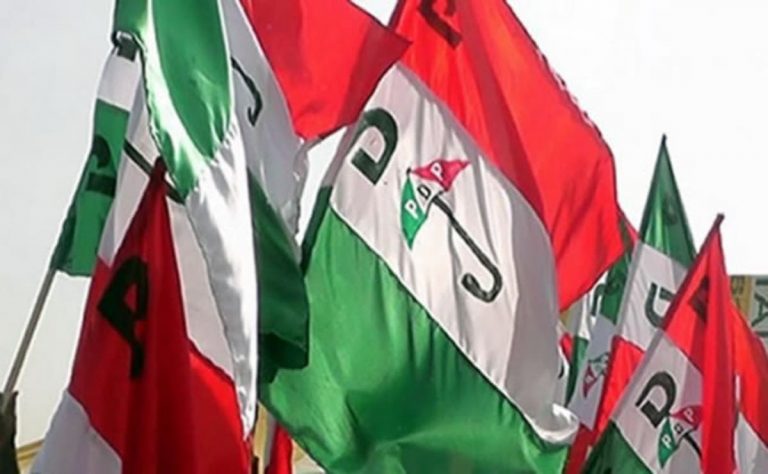
2023: Governors and elders are upbeat as the PDP holds its convention

0

Governors, elders, and other top leaders of the Peoples Democratic Party (PDP) are optimistic as members of the National Working Committee (NWC) are elected today to lead the main opposition party into the 2023 general elections.

Yesterday, the coast was clear for the party to hold its national convention after a Court of Appeal sitting in Port Harcourt dismissed the appeal of the party’s embattled former national chairman, Prince Uche Secondus, seeking to halt the exercise.

In a unanimous decision on the application in the suit marked CA/PH/339/2021, the three-man appeal panel headed by Justice Haruna Simon Tsammani held that the application by Secondus was only aimed at distracting the party from continuing with the convention, emphasizing that the application lacks locus standi.

“The appellant’s (Secondus) motion fails and is hereby dismissed,” said Justice Gabriel Kolawole, who read the ruling. The sixth respondent (PDP) has the authority to hold its convention without interference.”

18 candidates unopposed, 3 for election  

With the stage set for the party, Adamawa State Governor Ahmadu Umaru Fintiri, chairman of the convention organizing committee, announced that 18 of the 21 positions would be filled through affirmation.

Read also: Rural Women Suffer from Poverty and Neglect

He stated that the positions of deputy national chairman, South; national auditor; and national youth leader would be up for grabs at the convention.

Fintiri stated that 3,600 delegates would attend the convention, which is set to take place today and tomorrow at Eagle Square in Abuja.

Despite the general adoption of the consensus option for the emergence of candidates, he stated that the convention committee would abide by the court ruling on the delegates list from Ekiti State. He also stated that open secret ballots would be used to cast votes.

Some stakeholders attribute the party’s relatively smooth path to convention to the work of a reconciliation committee chaired by former Senate President Bukola Saraki in uniting the party.

Former Senate President Anyim Pius Anyim, former governors Liyel Imoke, Ibrahim Shema, and Ibrahim Dankwambo, and former House of Representatives leader Hon Mulikat Akande-Adeola are also on the panel.

The committee, which was formed late last year at a time when the party was in crisis, traveled around the country to reassure party members that the solution is not to leave, but to stay and resolve all outstanding issues.


How governors produced Ayu, Anyanwu  

Apart from those from states controlled by the All Progressives Congress (APC), where former governors and other critical stakeholders were allowed to take control, the party’s governors influenced the emergence of some of the candidates for the 21 available positions.

Dr Iyorchia Ayu and Senator Samuel Anyanwu, who had been crowned as national chairman and national secretary, respectively, were said to be governors’ candidates out of the 18 contenders who emerged through consensus.

We’re set to sack APC in 2023 – Waziri, Olujimi, George  

Elders of the party yesterday said that the party was set to sack the ruling APC come 2023.  

A former Minister of Police Affairs, Adamu Maina Waziri, urged the leadership of the APC to be ready to concede defeat in 2023.  

“Just like we conceded in 2015, we expect the APC to concede massive defeat in 2023. The PDP will come to rebuild the country by providing the basic ingredients to government, which is security to lives and property, as well as infrastructural development. But above all, the leaders are being elected, the PDP is correcting the division the government of APC has tried to permanent and make a feature of the Nigerian polity, which is very unfortunate,”  he said.

Also speaking, a ranking senator, Biodun Olujimi (PDP, Ekiti), said the coast was clear for the PDP to bounce back in 2023. 

“We have come together to see that the people who have taken us into penury are washed away from the fabric of this country. They have impoverished us. Everything has been done to ensure that the ordinary people are suffering. We will not take that any longer. We are going to reposition our country. We are going to reposition our polity, and they know,” she said. 

On his part, a former deputy national chairman of the party, Chief Bode George, expressed joy over the Court of Appeal judgement.

George said the convention would be a carnival, which the outcome would reposition the party to defeat the incumbent.

He said, “I prayed and believe God is on our side to have a wonderful convention. It will be a carnival.

“When you see us in our different dresses with our flags, dancing, that is the joy of it, unlike the last one. So I am looking forward to a very healthy, heart-warming relationship on the field. The platform that has been wobbling will be stabilised and the party can now launch its campaign against the opposition.”

Also speaking with our correspondent, a former chairman of the party in Lagos, Captain Tunji Shelle, said the convention would be a good omen for the party.  

They can’t make it – APC 

When contacted for comments, the APC deputy national publicity secretary, Yekini Nabena, told our correspondent in a telephone chat last night that the PDP convention would not determine the outcome of the 2023 general elections. 

“The PDP convention will not determine it; only the votes of Nigerians will determine the outcome of the 2023 general polls.

“What they PDP has said is not possible. They cannot make it. The PDP will not have the number of governors they had in the 2019 general elections. 

“After the convention, a lot of PDP members will defect to the APC. Many PDP members are political freelancers and vultures looking for a place to feed. So many of them will defect before 2023,” he said.   

Pressure on Oyinlola to step down   

Pressure is being mounted on a former governor of Osun State, Olagunsoye Oyinlola, to step down for Prof Wale Oladipo, a former national secretary of the party, to emerge as deputy national chairman (South).  

Both Oyinlola and Oladipo are from Osun State, where the position is zoned to.  

Our correspondent gathered that many leaders in the South-West were unhappy that the party is not always united when it comes to nominating officers for national offices zoned to the region.  

A party leader who spoke to our correspondent yesterday said, “We are trying everything possible to prevail on Oyinlola to allow Prof Oladipo to emerge. It is really not good to see that we are about the only region going for election.”  

The argument by those prevailing on Oyinlola is that the former governor has seen it all and he should allow fresh minds to be in charge of the party.  

“Don’t forget that he was a national secretary of the party and a former governor. Why is he insisting on becoming the deputy national chairman?”  

Many South West delegates are, however, hoping that one of the aspirants would step down.  

Speaking on the controversy over who becomes the deputy national chairman of the party, Chief Bode George said, “There are two people contesting for that. It is very tight. It doesn’t portend a unified zonal chapter. All the zones have sorted themselves, why can’t we do it?  

“This is the same thing that happened the last time I was contesting. With all the resources we put into it, we were not united in the zone, and that was why I withdrew from the race.  

“It is very disheartening that this is happening. What are we fighting for? A divided house is a defeated house. Let’s do it by consensus. Sometimes you win, some you lose.”  

Crisis between Kwankwaso, Wali over zonal position unresolved   

The dispute over North-West zonal vice chairmanship position of the party has not been resolved.   

Sources said election of the North-West zonal executives of the party had been put on hold following the dispute between the camp of a former governor of Kano State, Rabiu Musa Kwankwaso and that of Ambassador Aminu Wali, over the zonal vice chairmanship position.  

The position, has been zoned to Kano State; hence the battle between the two camps.  The situation has forced the leadership of the party to constitute a caretaker committee for the zone. 

The camps want to grab the position to brighten their chances ahead of the 2023 elections, thus the feud.  

 “We are hopeful that the dispute would be resolved after the convention,” a source said.    

The 17 zonal positions, including seven ex-officio members, are to be shared among the states in the zone—Jigawa, Kaduna, Katsina, Kano Kebbi, Sokoto and Zamfara.  


Legal battle not over – Secondus’ lawyer 

While the party proceeds with the convention today, counsel to Secondus, Tayo Oyetibo, a Senior Advocate of Nigeria (SAN), said the dismissal of his client’s application was not the end of it as the instructions of the appeal were still alive.

“The court has directed that the PDP can continue with the national convention. However, the instruction is that the appeal continues, and depending on the outcome of the appeal if it succeeds, it has the impact on whatever decision taken on the national convention, so it is not over,” he said.

He said there was an appeal pending before the court, adding, “It is the outcome that would determine the validity or otherwise of the convention.”

Rural Women Suffer from Poverty and Neglect

0

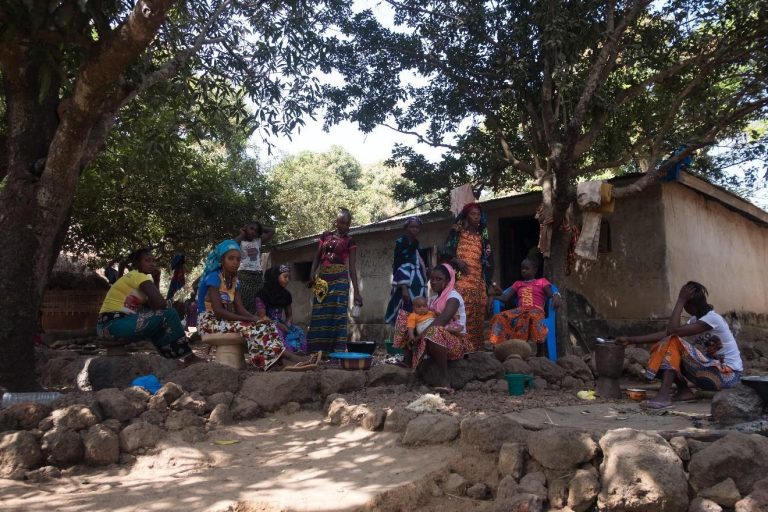
Malam Musa, a resident of Mai’Adua village in Katsina State, appeared dazed. He lost his wife while she was giving birth. It was the couple’s second child. She died because there was no clinic in the village where they lived. During complications, most women must rely on local birth attendants and herbs.

“We lost her because we couldn’t get her to town for treatment.” At the same time that the baby’s legs were emerging, she was bleeding. The local child attendants did everything they could, including administering several local herbs, but it was all for naught. “We lost both the mother and the child,” Musa explained.

These are some of the common scenarios that rural women face in communities across the country.

Nigeria’s Maternal Mortality Ratio (MMR) ranges from 447 to 578 deaths per 100,000 live births, according to the 2018 National Demographic Health Survey (NDHS).

According to UNICEF, Nigeria’s 40 million women of childbearing age (aged 15 to 49) face a disproportionately high number of health issues related to childbirth due to a lack of access to healthcare services.

Despite accounting for only 2.4% of the global population, the country currently accounts for 10% of all maternal deaths.

According to the World Health Organization (WHO), Nigeria’s MMR in 2020 was 814 deaths (per 100,000 live births).

A Nigerian woman’s lifetime risk of dying during pregnancy, childbirth, postpartum, or post-abortion is one in 22, compared to a lifetime risk of one in 4,900 in developed countries.

Inadequate primary healthcare facilities and health personnel in rural areas, as well as poverty, bad roads, and banditry, are among the factors contributing to rising maternal and infant mortality rates.

The theme of this year’s International Day of Rural Women, celebrated on October 15, was “Rural Women Cultivating Good Food for All.”

The United Nations (UN) General Assembly established the day in its resolution 62/136 on December 18, 2007, to recognize “the critical role and contribution of rural women, including indigenous women, in enhancing agricultural and rural development, improving food security, and eradicating rural poverty.”

Read also: Bandits kill five people and injure many more in Katsina

This year’s theme emphasized the critical role that rural women and girls play in the world’s food systems.

From production of crops to processing; preparation and distribution of  foods, women’s labour – paid and unpaid – feed their families, communities and the world; yet, they do not wield equal power with men, and as a result, they earn less income and experience higher food insecurity.

In Nigeria, rural women are the worst hit by security challenges, ranging from banditry, terrorism and secession agitation in the country. In most rural areas, basic amenities are almost non-existent, thereby compounding the challenges faced by the women.

In Bayelsa State, women living in the rural communities have decried lack of social amenities, such as health facilities and potable water.

They also chided governments at all levels for not paying attention to the plight of women living in the rural communities.

Our correspondent who visited some of the riverine communities in Bayelsa State observed that aside the fact that health facilities are not readily available; the issue of potable water is a big challenge, as many of them still drink from the river.

 Daily Trust Saturday reports that rural women still face challenges in having access to healthcare services and other social amenities despite billions of naira released to the Niger Delta Development Commission (NDDC) to carry out interventions in provisions of social amenities in communities in the Niger Delta region. 

In the same vein, there are worries that successive governments in the state have not done enough in bettering the lots of rural dwellers despite billions of naira that have accrued to the state over the years.

It was also learnt that about 80 per cent of communities in the state are without health facilities, while general hospitals are lacking at the local government headquarters.

Most of the medical facilities are in Yenagoa, the state capital, which makes it difficult for aged rural women to access them when needed.

At Ayama-Ijaw community in Southern Ijaw Local Government Area, a rural dweller, Madam Roseline Timi, said the plight of women living in the rural communities was enormous and needed prompt attention by the government.

 “The issue of health care is our major problem here. A woman in labour in this community pays her way to the Federal Medical Centre, a specialist hospital or any private hospital in Yenagoa before she can give birth. This means that if there is complication, the risk of death is high because of the distance to the health facilities.

“We have had issues where labour started at night, and considering our terrain and how communities are surrounded by river, we could not access any health facility. This has forced us to approach traditional birth attendants. So, I think the government should act fast and ensure that there is at least, a health centre in this area”, she said.

In Abia State, Daily Trust Saturday learnt that the absence of functional and accessible public health facilities is a major contributor to child and maternal mortality in many communities.

Read also: Osinbajo and Tinubu meet in Abuja

The absence of a primary health care centre in Obuohia Obi-Ibere community since the inception of the community about 100 years ago has left residents frustrated. Many of those who spoke with our correspondent expressed dissatisfaction with government’s inability to meet their health needs.

Accessing the community is also difficult, especially during the rainy season, as the road leading to it is in a very bad shape.

A resident of the community, Mrs Stella Onuoha, said the only thing the government established for them was an ill-equipped primary school, while other amenities were sponsored by members of the community.

Also, Mrs Amarachi Chukwuemeka Atuma, said that during labour, pregnant women in the community often travelled on motorcycles for about one hour to the nearest village where there is a private hospital.

Lady Ijeoma Oriaku said that because of the situation, some women would give birth on the road before making it to the hospital.

A woman fetches water from a dirty pond

Kaduna women seek empowerment

Kyauta Samuel, a resident of Kakau community in Chikun Local Government Area of Kaduna State never had the opportunity to go to school, even though she had always wanted to be a big-time entrepreneur. Her dreams were shattered due to her parent’s inability to provide her basic education. 

Due to family pressure and lack of opportunities, Kyauta was pressured into marriage at the age of 20 as the fourth wife of her husband, who her family felt would be an asset in taking the family out of poverty.

While in her matrimonial home in Sabon Gero community in the same local government area, Kyauta struggled to make ends meet by working in various homes as a domestic help, as well as engage in farming during the rainy season. She said, “During the rainy season, I and my co-wives, with the supervision of our husband, plant and harvest what the family will eat for the year.

“After the harvest, our husband will divide the grains amongst us. How we cook the food is up to us. That’s how it has been for the six years that I came into the family. And this is why women need to be empowered because, they are left to endure so much for the survival of the family,” she said.  

She told our correspondent that she had not given up her dream of owning a business. “I struggle a lot and do many odd jobs, including working as a domestic help. I also engage in laundry and farming,” she said.

Asked if she knew about the International Day of the Rural Woman, she said she had never heard of it.  

It is a similar situation for Miracle Sunday, who said the choice of becoming a domestic help was not hers. She had to do it to fend for herself. She said that after she lost her father at the age of two, she and her siblings had to go into the labour market to put food on the table.

She said. “All my life, l have been struggling, and it has not been easy. I always watch girls going to school with envy and wonder what my life would have been if I had gone to school.”

She hopes to send her own children to school so that they would not experience the hardship she is going through. 

In Niger State, rural women decry access to health care services due to poverty and distance of facilities from their various villages.

Zainab Ibrahim, a resident of Lemu, Gbako Local Government Area of the state said, “Pregnant women in rural areas face a lot of challenges in accessing health care services, even during childbirth.

“Most of our husbands don’t have any means of transportation. Also, we find it difficult to meet up with health care expenses because most of us are not into any business. We rely on our husbands to provide for us.”

She appealed to the government to empower rural women to make them self-reliant, adding that most rural women engage in rigorous farming activities with their men to help provide for their families.

Another woman, Fatima Ibrahim also said the rate of poverty among rural women had increased due to the current economic hardship in the country. “We don’t do anything. We wait for our husbands to help us. And our husbands too are not finding it easy to survive and provide for the family. If the government can help us with jobs, we will appreciate it,” she said.

Daily Trust Saturday reports that though, the Federal Government had at some point rolled out various agricultural interventions such as FADAMA and APPEALS projects aimed at supporting farmers, rural women hardly benefit from such interventions.

For Rasheedat Alabi, a rural farmer from Olorunshogo, Bode Saadu in Moro Local Government Area of Kwara State, rural life had not been easy, especially in this age of modernisation.

“I and my husband are farmers. We grow cassava, maize, beans and tomatoes, among other crops. This is what we depend on to feed and train our four children. And we cannot afford to send them to better schools outside our community.

“In this age of the so-called globalisation, we are still in need of the basic necessities of life, like good roads, pipe borne water, stable electricity, among others,” she said.

She said women in rural areas most times relied on traditional methods of food preservation, adding, “We still practice crude farming methods. I and my husband spend N400 daily to the farm because of the state of the road.”  

She lamented that despite promises, they still bought fertilizers and other farm inputs from the little they make. She appealed to the government to address challenges in the rural areas instead of focusing on cities.

For Mrs Marotana AbdulKareem, a resident of Asa Local Government Area, accessibility to health care has been a major issue for them as rural residents.

“Unlike those in the urban areas where there is proximity to hospitals and other health centres, our lifestyle here in the rural area is very tedious. We also lack access to basic health care,” she said.

She called on various state governments to provide basic amenities for rural dwellers.

“Ordinarily, we are supposed to be enjoying the best form of living because of our closeness to nature, but that is not the case. We should not be talking about the high cost of food, but other amenities. This has led to a rise in the cost of living in the rural areas”, she said.

Plateau women lament lack of empowerment, electricity

In Plateau State, the situation is not better.  Our correspondent reports that life is very difficult for women in the rural areas, who lack access to basic social amenities.

Blessing Emmanuel, a resident of Lalin village of Mikang Local Government Area, told our correspondent that life has been difficult for women.

She said, “Women are not into businesses because they don’t have money. Life has become very difficult for them and nobody is there to help. When they look for work, they hardly get it.”

On access to social amenities, she said, “We are not enjoying that in our village. We have a health care facility, but it is not well equipped. There are no drugs, and if you have a serious illness, the health workers would always refer you to another hospital located in the city.

“Also, we are living in darkness because there has not been electricity in the village for many years. Potable water, which is also very essential, is nowhere to be found. In fact, in the entire village, we have only one borehole,” she said.


Women poorly taken care of in Kano

In Kano, rural women have been serving as catalyst for development, but they are usually poorly taken care of. 

Findings show that they have been overburdened with responsibilities that supersede them.

Malama Maryam Kabiru, a 38-year-old mother of eight children from Warawa Local Government Area, said a typical day of a rural woman began with domestic chores. She has to do extra work, either as a trader or service provider to others to earn extra income for family upkeep.

“My husband will provide the grain, but it is up to me to find the means through which it will be converted to food. That is why I have to take the threshing job, while my grown up female children hawk on market days,” she said.

 Daily Trust Saturday also gathered that many rural women in most remote areas do not attend antenatal care during pregnancy due to either the unavailability of health facilities or financial constraints, as well as distance of health facilities.

Our correspondent reliably gathered that rural women in the state hardly finish school as they are mostly married off as soon as they get suitors.

Jamila Bello, a 20-year-old mother of three, told our correspondent that she wished she had completed her primary school before she was married off. 

She explained that she aspired to go to secondary school but was married off, and now, she is a young mother toiling to raise three children.


In Katsina, banditry takes tolls on rural women 

In Katsina, apart from the general living condition of rural women, which is almost the same across the country, they are largely enterprising.

However, insecurity has caused untold hardship, particularly in the frontline local government areas mostly hit by banditry, kidnapping and cattle rustling.

Malama Rabi, a resident of Batsari Local Government Area, who is now taking refuge in Katsina town, said, “The living condition in rural areas cannot in any way be compared with that of city dwellers. Most of us were into small-scale businesses, such as local groundnut oil milling, selling of groundnut, cooked cassava, pap and akara (beans cake) and many other things.

“Some of us used the proceeds from these businesses to keep some domestic animals, which we usually sell and the money generated will be used to marry off our daughters. Some of us were into farming, but unfortunately, all that is gone with this problem of insecurity.”

Another rural dweller, Malama Hadiza Hussaini, said, “All our goats and sheep have been carted away by bandits. Some of our husbands used to travel to other parts of the country in search of money while we utilise what we have at hand to do one or two things that would fetch us some profit, but the thieves have shattered everything now.”  

The situation is the same in almost all the rural communities bedevilled by banditry and kidnapping for ransom.

Responding, the Katsina State Government said it had done a lot in ameliorating the suffering of the rural women through different empowerment programmes.

Abdulkadir Mamman Nasir, the special adviser to Governor Masari on Empowerment, said, “Right from the inception of this administration in 2015, the governor has prioritised women empowerment through the 60:40 ratio sharing formula, in which 60 per cent of all empowerment programmes is given to women while 40 per cent is given to other groups.

Reacting to the issue, Chief Executive Officer, Nigerian Women Trust Fund (NWTF), Ms. Mufuliat Fijabi, said the challenge of access for women in health, education and other facets of human endeavours has been there for a very long time, saying, there was urgent need for the government to take steps in addressing them.

“It is not good for Nigeria as a country 61 years after independence. The government should step up action on the SDGs so the impact can be felt in all parts of the country,” Fijabi said.

On her part, the President, Women in Politics Forum (WIPF), Mrs Ebere Ifendu, attributed the precarious situation of rural women to failure of leadership.

“I feel sad that in this 21st Century, we still have high maternal mortality and morbidity; a country blessed by God with human and natural resources. Our politicians have failed us; shamelessly, they will still come back with excuses on why we should vote for them again.

“My advice is that we should reject them and ensure that only good women and men are elected. Our problem again is that women are not given an opportunity to bring in their expertise in governance. As long as political parties and leaders, side-line women, I am afraid the country will not make any tangible progress,” Ifendu.

Osinbajo and Tinubu meet in Abuja

0

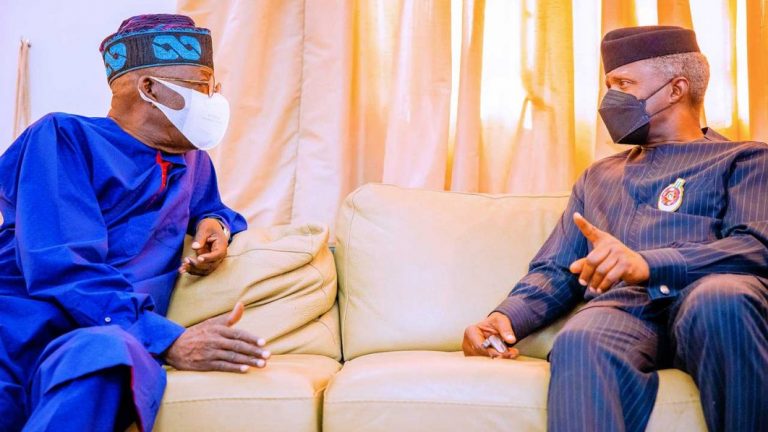
Vice President Yemi Osinbajo paid a visit to the National Leader of the All Progressives Congress (APC), Bola Ahmed Tinubu, at his Asokoro residence in Abuja yesterday, putting an end to rumors of a feud between them over their alleged presidential ambitions in 2023.

Photos of the meeting released by the media offices of both the vice president and the APC leader show hugs and both walking out together after the meeting.

According to a source at the venue, both leaders had a good meeting after Tinubu had been away on medical leave for a long time.

Read also: Utomi, Teriba, and others chart path to peaceful nation

According to the source, “Ashiwaju was overjoyed to see the vice president, and the vice president was overjoyed to see him.” It was a one-on-one meeting, and by all accounts, it was a very good meeting.”

The Speaker of the House of Representatives, Femi Gbajabiamila, was said to have joined the duo during the meeting.

Utomi, Teriba, and others chart path to peaceful nation

0

Nigerians have been charged with banding together and reducing the insecurity that is ravaging the country in order to pave the way for peace and economic prosperity.

This comes as experts have expressed concern about how the media has been portraying some of the country’s problems, warning that if Nigerians do not respect their differences and work together, they will be held responsible in the end.

The experts established a link between peace and economic prosperity during a webinar on ‘The Imperative of Peace for a Successful Economy’ organized by the American Business Council Nigeria, warning that the current wave of insecurity was slowing the country’s progress.

Dipo Faulkner, President of the American Business Council, stated in his welcome remarks at the webinar: “There is an intricate link between peace and economic prosperity.” The prevalence of insecurity in Nigeria casts a large cloud of doubt over investors’ confidence in the country. This can be seen in the drop in quarterly foreign direct investments from 251 million in the fourth quarter of 2020 to around 154 million in the first quarter of 2021. And, more recently, when looking at the figures for the second quarter of 2021, it has dropped to 77.9 million. According to the American Business Council’s economic impact survey on US companies, insecurity is a major concern for US investors in Nigeria.

“The webinar was organized with the goal of shedding light on the importance of private sector participation in maintaining peace, bridging the gap between the government and the public for the good of all, and finding solutions to Nigeria’s insecurity.”

Read also: Ortom: We Rejected RUGA in Order to Protect Benue People’s Lives

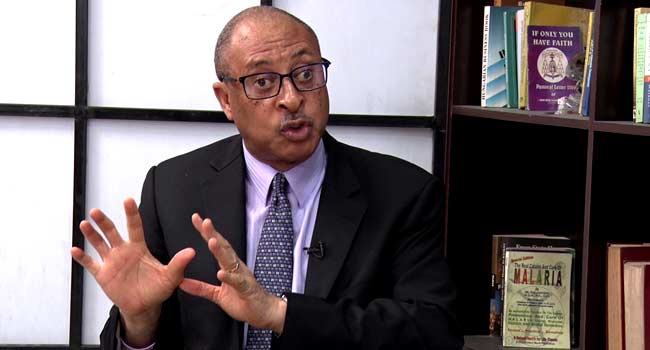
Prof. Pat Utomi, founder of the Centre for Values in Leadership and moderator of the webinar, stated that Nigerians could become guilty by omission and get into deeper trouble, noting that the country’s current state of affairs was a serious challenge.

“If we do not tap into what is known about the challenges we face and the need for peace and goodwill,” he said, “we may be in much deeper trouble than we appear to be today.”

Dr. Garba Abari, Director General of the National Orientation Agency (NOA), who spoke on the topic ‘Rather Than Violence, All Hands on Deck,’ stated that a country as large as Nigeria, with vast human and material resources, could not afford not to have peace as a sine qua non for achieving its national development goals.

He blamed the country’s current state of affairs on the abandonment of the foundation laid by its founding fathers. “Over the years, we have actually jettisoned everything that our forefathers did to bring about a functioning country,” Abari said. Our forefathers worked hard to establish governance standards. Despite the fact that their methods and tactics were clearly different, they clearly succeeded in constructing a functional society. We missed the bars along the way in the course of nation building, and the reasons for missing the bars had already been adduced by many scholars in many fora and studies. The truth is that we are paying for abandoning what the nation’s founding fathers left to us. As a result, our development goals have been derailed, and we have lost focus in our governmental processes and procedures.

“As a result, all hands should be on deck.” We must be seen to be guided by the rule of law, because no society can progress unless the basic tenets of the rule of law are adhered to. We must work together to reach an agreement.”

“The government has the constitutional responsibility of ensuring the security and welfare of Nigerians, as well as promoting a peaceful environment,” he added. The government should promote inclusive governance, ensure equitable resource distribution to give every segment a sense of belonging, address the problem of hate speech and fake news through appropriate legislation and sanctions, and most importantly, the government should not allow any gaps in its information dissemination to citizens.

“The government should investigate the proliferation of small arms and light weapons as soon as possible through effective border control and sanctions against violators.” The government should address intergenerational relations by empowering youth to participate in governance, economy, and enterprise; political parties can play an important role in this, and then support the establishment of structures for peace, justice, and integration.”

In his remarks, Dr. Ayo Teriba, Chief Executive Officer (CEO) of Economic Associates, argued that the country’s economic stagnation was to blame for the country’s current security challenges.

“I looked at the topic, which seemed to imply that peace is a prerequisite for economic progress, and I take the opposing view that economic progress is a prerequisite for peace; it’s not the other way around,” he says.

Read also: Ortom: We Rejected RUGA in Order to Protect Benue People’s Lives

“By the way, Nigeria is at peace; it is not at war.” We are in a period of peace, but there is a risk that it will be broken. We enjoy peace, but our economic stagnation is the source of our fear of anarchy. And I’m concerned when I listen to public figures.

“Nigeria and Africa are the last to realize that it is not about the ends you seek; it is about the means by which you seek the ends.” We make a never-ending list of things we need to do, but we never ask ourselves where we will get the resources to do them. Whatever you want to do, money is the answer, and our Nigerian mentality is to assume that the money will be available. We make budgets that we don’t follow through on because there isn’t enough money. As a result, various groups in Nigeria are losing faith in the republic due to economic reasons. It’s as if, because we didn’t bake a large enough national cake, we’ve been boxed into a corner where different groups are fighting for a piece of a shrinking national cake.

“What we need is agreement on how to find the resources to maintain socio-political harmony.” It’s all about the money. Looking at China, they made a U-turn from being a staunch communist country to welcoming foreign investment in search of money. They are not saying what they intend to do with the money, but they are outrunning everyone in order to obtain any type of money from the global scene. China is either first or second in terms of FDI, export revenue, or diaspora remittances. The same is true for India. Since 1991, India’s economic policy has been one of liberalisation, privatisation, and globalisation (LPG). These three words describe how to obtain funds from abroad. They realized that money is the answer to everything.”

“So, when you talk about insurgency and insecurity, do you know that the great wall of China was built to prevent miscreants from simply crossing and invading China?” Teriba continued. You will continue to claim that bandits are from neighboring West African countries unless you have the funds to build a similar wall. There will be no progress in any economy that is not threatened by marauders, whether they are states or individuals. If you are truly wealthy, you must be able to save some money to protect your wealth. So, let us concentrate on how Nigeria will obtain funds to address its never-ending list of issues. Nigeria will advance the day we get that right.”

Alhaji Garba Bello Kankarofi, for one, expressed dissatisfaction with the way the media portrays the country’s problems, particularly when influenced by politicians. He urged regulatory authorities to impose appropriate penalties on defaulting media organizations.

“Let us examine the role of the media in this country critically.” Listening to radio stations in Kano, Kaduna, or Maiduguri, all you hear is politicians trying to stir up trouble. What exactly is the NBC doing? Why aren’t they using the regulatory powers bestowed upon them, as well as the tools at their disposal? Do we continue to allow the media to incite Nigerians? Who will put a stop to this? “As a result, I have a problem with that,” Kankarofi stated.

Bandits kill five people and injure many more in Katsina

0

Suspected bandits killed five people and injured several others in Katsina State’s Dangaze community, Batsari local council.
The incident occurred last Thursday around 12 p.m., while members of the community were buying and selling goods at a local market.

It was discovered that the market is open every Thursday and that several people from neighboring communities had gathered to watch it open.

According to a source familiar with the incident, suspected bandits stormed the area while they were waiting for the market to begin.

The bandits, according to the source, used sophisticated weapons and rode motorcycles when they stormed the area.

“They shot sporadically, and people scurried for cover.” Five people were killed by the bandits, and several others were injured.

Read also: Ortom: We Rejected RUGA in Order to Protect Benue People’s Lives

“Some of the injured are currently receiving treatment at Batsari General Hospital, while some community members have fled their homes in fear of another attack,” an eyewitness said.

SP Gambo Isah, the state Police Command’s spokesperson, had yet to respond to inquiries about the incident as of the time of this report.

Meanwhile, security operatives in Kaduna State killed several bandits yesterday. According to a statement issued by the state’s Commissioner for Internal Security and Home Affairs, Samuel Aruwan, the bandits were killed and their camps were destroyed during clearance operations in the Igabi and Chikun local council areas.

Aruwan stated that clearance operations were carried out in the general areas of Faka, Katuka, Barebari, and Maguzawa, spanning the Chikun and Igabi local councils.

According to the statement, an unconfirmed number of bandits were spotted on the high ground across the Maguzawa river. “They were engaged and neutralized by a NAF attack helicopter,” he said.

“Furthermore, the security forces conducted clearance patrols to Katuka, about nine kilometers from Kangon Kadi in Chikun local council,” Aruwan added. During the camp destruction, a fleeing bandit was apprehended and the following items were recovered: one motorcycle, one AK-47 rifle, and 30 rounds of ammunition.

“One Rabi Hajiya Karime, the wife of a notorious bandit Zubairu, was apprehended during a subsequent clearance operation to Kangon Kadi and Barebari areas.” Malam Idris Audu, the bandits’ spiritual leader, was also apprehended, as were Abdulrasheed Gambo Na Halima and Abubakar Idris Na Halima, suspected collaborators.

“Similarly, after dislodging and razing some bandit camps in the Udawa general area of Chikun LGA, some bandit items were recovered.” They include motorcycles, an AK-47 rifle, AK-47 magazines, ammunition, and drugs.”

Read also: NAF will carry out the recommendations of the Committee on Armed Forces Reform

He mentioned that Governor Nasir El-Rufai was pleased with the reports and praised the security forces for a successful operation.

“He expressed gratitude to the troops for their unwavering efforts and urged security agencies to conduct thorough investigations into the individuals apprehended.” “Clearance patrols will continue in these and other designated areas,” he added.

Ighalo included in Rohr’s World Cup qualifying squad

0

Gernot Rohr, the coach of the Super Eagles, has named Al Shabab striker Odion Ighalo to his 40-man provisional list for next month’s 2022 World Cup qualifiers against Liberia and Cape Verde.

The Franco-German coach is a huge fan of the former Manchester United striker, who finished top scorer at the 2019 Africa Cup of Nations before retiring from international football.

In a recent Instagram post, Nigeria Football Federation president Amaju Pinnick hinted that talks for Ighalo’s return to the national team were already underway.

Read Also:  Super Eagles’ flight to Qatar 2022 kicks off with Lone Star in Lagos

“I had a lengthy conversation with Odion Ighalo; personally, I believe we require experience in our attack to complement our energetically youthful Osinmeh, Onuachu, Kelechi, and others.” “Odion’s body language is extremely positive,” Pinnick observed.

In an interview with Elegbete TV, Rohr revealed that the former Nigeria U-20 captain was included in his 40-man provisional list for the games against Liberia and Cape Verde, but it is unclear whether the striker has given his word to return to the team.

“Ighalo is a very important man, and I hope he can return.” I’ve added him to the 40-man provisional list for the FIFA World Cup qualifiers, and we’re in contact. He’s doing very well at his club, and he still wants to help his country. We have a lot of good strikers like Awoniyi, Moffi, Onuachu, and Osimhen, but no one like Ighalo.

Read Also:  Onyema inspires confidence in Super Eagles by promising N20 million if they beat Cape Verde

“Ighalo is unique. He’s a unique player who sees everything. Our team now lacks maturity and experience, and this is where he could assist us, as we miss his leadership, experience, and goals. He was the leading scorer in both the previous AFCON and the qualifiers. I believe we have a lot of young players, but they could learn a lot from such a good player.”

Ighalo, who scored 16 goals in 35 appearances for the Eagles between 2015 and 2019, has been in excellent form for his club, scoring eight goals in nine league games.

He was named to the Saudi League’s Team of the Week for their games in week nine.

Ortom: We Rejected RUGA in Order to Protect Benue People’s Lives

0

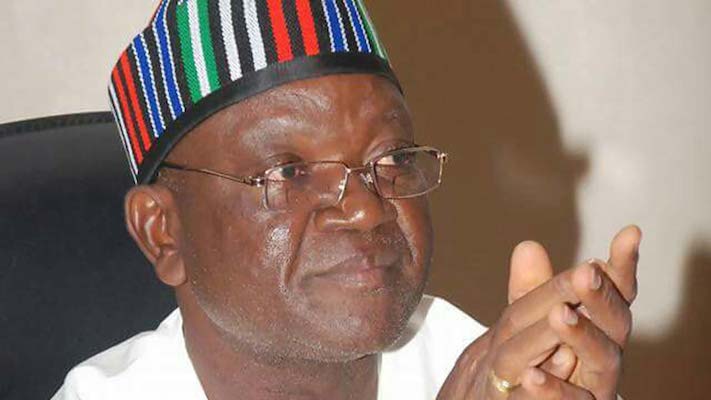
The Benue State Government stated on Thursday that it rejects the federal government’s plans to establish Cattle Colonies, Rural Grazing Area (RUGA) settlements, and Grazing Reserves, as well as any other plans to secure the lives of the people of the state.

Governor Samuel Ortom, in a press statement issued by his Chief Press Secretary, Mr. Nath Ikyur, reiterated Benue’s position on the matter.

He stated that the state government only agreed to the National Livestock Transformation Programme (NLTP) because the National Economic Council (NEC), which includes the 36 state governors, approved it after a series of engagements and incorporated suggestions from state stakeholders.

The governor stated that under the NLTP, states were free to adopt and implement aspects of the plan that suited their unique circumstances, adding that “unfortunately, the Presidency rejected this but would rather continue to dribble Nigerians.”

Read Also:  NAF will carry out the recommendations of the Committee on Armed Forces Reform

“In Benue State, we have a ranching law, and our competitive advantages in livestock farming include indigenous cattle, piggery, goats, and fisheries, among other things.” All of this is reflected in the plan, and Benue State has agreed to its implementation on these terms.”

Ortom also dismissed as false a statement attributed to a former presidential aide, Laureta Onochie, that he supported the RUGA plan, claiming that the state government was listed as one of the states that applied for federal funds for the purpose of establishing ranches.

“We read in the media that a former presidential aide, Laureta Onochie, tried to spin a false narrative about Governor Samuel Ortom of Benue State’s position on the implementation of the National Livestock Transformation Plan” (NLTP).

“Onochie made false allegations, painting the picture that Governor Ortom supports RUGA, because the state government was listed as one of the states that applied for federal funds to establish ranches.”

Read Also:   Defense Headquarters will hold joint operations planning exercise

“However, it is clear that Onochie is unwilling to change her ways, which is why the Senate unanimously rejected her nomination as a Federal INEC Commissioner.”

Ortom said it was devious for Onochie to drag him into an argument about which she had no knowledge, and that if the former presidential aide “has any modicum of decency remaining in her tainted pedigree, she should rather commend Governor Ortom for insisting on ranching as the win-win solution to herdsmen attacks on farming communities, which has now been embraced by other states and the federal government.”