Home Blog Page 1387

Ombugadu donates N20m to community for youth Project

0

As Christians across the globe celebrate the death and resurrection of Jesus Christ, 2023 guber candidate of the people’s Democratic party PDP in Nasarawa State, Dr David Emmanuel Ombugadu

By David Odama

As Christians across the globe celebrate the death and resurrection of Jesus Christ, 2023 guber candidate of the people’s Democratic party PDP in Nasarawa State, Dr David Emmanuel Ombugadu has tasked residents of the state and Nigerians on peace, unity in order to over come the challenges confronting the Nation.

This is even as he has donated N20 million to Wangibi Community to build and furnish ICT centre within the community to help train the youths as well as various
gift items to others

National growth LS

Ombugadu while identifying with the community as they rolled out their drums to celebrate their cultural day at Agwa kuya ikka wangibi electoral ward, enjoined all Nigerians irrespective of their affiliations be it religious, political, ethnic or other persuasions to embrace peace, unity as well leave aside bitterness and be patriotic citizens of Nigeria.

He added that the donation was in the spirit of Easter being observed by the Christian community and the project which impact would be lo g lasting, felt within the state and beyond.

The former federal lawmaker equally admonished Christians to use the period for sober reflection by exhibiting sacrifice, love, and support for one another, especially to the less privileged ones in the society as exhibited by Jesus Christ.

He called on Christians to use the period to intensify prayers for the nation and its leadership, stressing the need for citizens to have faith in God and the Government as according to him challenges are part of human existence facing the country at the moment.

While describing the cultural festival which coincide with the Easter celebration as unique and special, the PDP 2023 guber candidate noted with appreciation where Christians are ending the 40 days fasting of lent and Muslims are also at the last segment of the holy month of the Ramadan fasting respectively.

The former lawmaker, however, pledged to support the wangibi project with a whopping sum of 20,000,000 twenty million and also thanked wangibi Nation for supporting his aspiration.

NDLEA seizes consignment of psychoactive substances hidden in noodles in Bayelsa

0

The National Drug Law Enforcement Agency (NDLEA) has arrested three men aged between 27 years and 44 years in Bayelsa for trafficking in psychoactive substances hidden in noodles.

Mr Femi Babafemi, spokesman of the agency, stated in Abuja on Sunday that two of the three men were arrested at Swali Jetty, Yenagoa, on March 27.

He added that psychoactive drugs recovered from them were 73.425kg of codeine, molly, tramadol and diazepam.

“The third suspect was nabbed at Amasoma, Yenagoa in a follow up operation. The drugs were concealed in jumbo sacks and conveyed to Swali Jetty in a tricycle,’’ he stated.

National growth LS

The NDLEA also arrested two suspects at Orile Imo, Ogun, on March, 29 and they were in possession of 137 blocks of weeds suspected to be Indian hemp weighing 71kg.

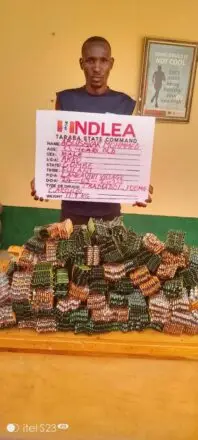
Babafemi stated also that in Taraba, NDLEA recovered 39,980 pills of tramadol from a 33-year-old suspect in Lankaviri village, while its operatives arrested a 29-year-old man in Wukari on March 28 with 131kg of Indian hemp.

“In Abia, NDLEA operatives arrested a 28-year-old man on Friday, March 29 at Akara Ahuba, in Isikwuato Local Government Area.

“Recovered from him were 46.65kg of Indian hemp and different quantities of tramadol, methamphetamine and Rohypnol as well as N71,500 monetary exhibit,’’ Babafemi added. (NAN) (www.nannews.ng)

By Ibironke Ariyo

Kaduna State Political Theatrics, By Salihu Moh. Lukman

0

At a Town Hall Meeting in Kaduna, on Saturday, March 30, 2024, Mallam Uba Sani, Governor of Kaduna State raised the alarm that he inherited huge debt of $587 million, N85 billion, and 115 contractual liabilities from the administration of Mallam Nasir El-Rufai. Because of this huge burden, out of N10 billion due the State from Federal Allocation, N7 billion was deducted, which leave only N3 billion. With such reality, the State is finding it difficult to honour its monthly salary obligation of N5.2 billion to its workers.

Acknowledging that this is certainly a very challenging reality, it is important that this issue is not reduced to the politics of blame game and loud noise making with praise singers on both side defending their benefactors. In the first place, the issue of the huge debt burden of Kaduna State is public secret. It is a matter that is very known to His Excellency Uba Sani. Although there could new insight that he must have encountered after taking over as Governor, I want to believe that he came well prepared and ready to deal with the challenges and move Kaduna State forward from where Mallam Nasir left it. Part of the objective of the Town Hall could as well be to mobilise the people of Kaduna State to support the initiatives of Kaduna State government under the leadership of Mallam Uba Sani.

Unfortunately, as it is, the report seems to be sensationalised, suggesting the reality of strong disagreement and breakdown of relationship between Mallam Nasir El-Rufai and Mallam Uba Sani, which could as well be the case. I make this point cautiously having practically lost contact with both Mallam Nasir El-Rufai and Mallam Uba Sani since my resignation as National Vice Chairman (North-West) in July 2023. I was only privileged to meet Mallam Uba once and there after couldn’t speak with him in any form. I only encountered Mallam Nasir once during the birthday reception of Chief Bisi Akande at the Presidential Villa and we only greeted and moved on.

This notwithstanding, I can’t claim ignorance about some of the dynamics playing out in Kaduna State. I am aware of the growing animosity between Mallam Nasir and Mallam Uba, or at least I hear some of it from sources close to both of them. However, given the reality that I am not close to both Mallam Nasir and Mallam Uba, I opted to keep my distance and not meddle into a dispute between two very close friends. My expectation was that they will resolve the matter. Sadly, this doesn’t appear to be the case. I think, people close to Mallam Nasir and Mallam Uba are also not helping matters.

National growth LS

Perhaps, in making this intervention, I need to clarify that even before my resignation from the leadership of APC, my relationship with both Mallam Nasir and Mallam Uba is that of mutual respect, which did not translate into a strong political relationship back in Kaduna State. Having expressed my disagreement with Mallam Nasir back in 2014 to the extent of aspiring against his ambition to contest for Governor, I was never recognised as a stakeholder in the APC in Kaduna State. Perhaps, the only exception was when I became the National Vice Chairman (North-West). The dynamics that made that possible had to do with my role in many of the campaigns to reform the APC at National level, which pitted me against some party leaders and Governors, and my subsequent resignation as the Director General of Progressive Governors Forum (PGF). During those campaigns, I will say I am lucky to be on the same side with Mallam Nasir.

It is to the credit of Mallam Nasir that he was able to see beyond our differences and in March 2022 nominated me to contest for the position of National Vice Chairman (North-West). I make this clarification largely in response to many of the views held by many party leaders that Mallam Nasir is my sponsor. While it is true that especially with reference to reforming the party at national level, we seem to agree, when it comes to issues back in Kaduna State, we have strong disagreement. In fact, if the truth is to be told, most of the problems of the party at National level are also committed by the party in Kaduna, if not worse, under the leadership of Mallam Nasir. The hard truth also is that Mallam Uba was one of his strongest collaborators in Kaduna State.

The reality was that everything Mallam Nasir did during his eight (8) year tenure was endorsed and supported by Mallam Uba. Certainly, the decision of Mallam Nasir to anoint Mallam Uba as his successor must have been informed by the consideration of their strong personal relationship. That shortly after taking over, the two friends are falling apart is most unfortunate and only reminds one about what played out between Alh. Ahmed Mohammed Makarfi and Arc. Namadi Sambo between 2007 and 2010. These were very close friends and business partners, on account of which Alh. Makarfi anointed Arc. Sambo to emerged as his successor in 2007. Till today, the relationship between the two is still very bad.

Across the country, similar reality is replicated virtually across all the states in the country. All the challenges that create worsened relationship between predecessors and successors highlight either the complete absence or very weak party structures in the determination of successors. Across all parties in Nigeria, serving Governors exercise monopoly in producing their successors. This is one area that highlight the complete failure of APC as an envisioned progressive party. And as it is, beyond Kaduna State, there are similar dynamics playing our in many APC States, and at best, the party leadership at National level is simply behaving as a distant observer. Check what is going on in Benue, Ebonyi and Cross River. This shouldn’t be the case.

Ideally, party leaders at both the state and national level should have the capacity to intervene to resolve the challenge. At the minimum, they should be able to intervene to strengthen the capacity to State governments to manage challenges of governance, which is the main highlight of Mallam Uba’s presentation at the Town Hall meeting. Certainly, Mallam Uba’s submission would have come with some indications of how the state government intends to resolve the challenge of huge debt burden. Somehow, the media reports have not emphasised that. Consequently, and predictably, supporters of Mallam Nasir have started responding and if care is not taken the matter will be reduced to public debate between supporters of Mallam Nasir and supporters of Mallam Uba, and in the circumstance the whole issue of what needs to be done to address the problem of Kaduna State huge debt will be left unattended to.

Without any excuse, all of us in APC in Kaduna must take responsibility for the bad situation facing the State. In taking responsibility, we must appeal to Mallam Uba Sani to take every necessary step to undertake inventory of the debt of the state and how it was utilised. Part of what is needed now very urgently is to assess whether there are cases of diversion, which if established should be recovered.

More substantively, there is the need to come up with new initiatives towards mobilising new resources for the state. Resolving the challenge of today’s huge debt burden require new initiatives beyond what is currently being undertaken. Mallam Uba needs to setup a committee to review current challenges and recommend what needs to be done both in the short, medium, and long term. This more about producing a blueprint that will guide initiatives of government across all sectors to address the challenge. For instance, being a largely agrarian state that is riddled with insecurity, boosting agricultural production is contingent on securing the farms. Already, one of the steps taken by the young administration of Mallam Uba is to recruit additional 7,000 personnel into the Kaduna State Viginlance Service (KADVIS). This certainly would have increased the salary bill of the State Government. Shouldn’t it be possible to explore partnership between the State Government and Farmers and deplore the services of KADVIS personnel towards protecting farmlands in the state?

The details of the partnership between the state government and farmers could be negotiated, which should include what needs to be done to mobilise funding for the scheme. Integral to initiatives to protect farmlands are issues of extension services provided by Kaduna State Ministry of Agriculture to farmers. It has been on the decline over the years. Related to this is the whole question of reviewing some of the loans taken to boost agriculture production in the state. Without going into details, there are clearly some of the loans running into hundreds of million of Dollars. The state government must take steps to evaluate these loans and deal with all factors that must have worked against achieving the objectives earmarked for the loans.

The point is, we need to move away from noise making to substantive issues of strengthening governance. Without prejudice to all the initiatives being taken by the government of Mallam Uba, the debate about the huge debt profile of Kaduna state must be about strengthening the capacity of government to resolve the challenge. It is not simply about Mallam Nasir Vs Mallam Uba. Already, I have seen young people jumping into the debate in a very disrespectful manner. We must caution that as much as everyone is welcomed to make contribution, such contribution must be about what needs to be done to resolve the challenge, which is a function of knowledge. Afterall, we pride ourselves in Kaduna State as a Centre of Learning. Being a Centre of Learning requires that our politics should be about application of knowledge.

My final appeal to Mallam Uba and all our leaders both in Kaduna State and at National level is that we must summon the courage to admit our failure as a political party. Whatever could have been the shortcomings of Mallam Nasir as a Governor of Kaduna State between 2015 and 2023 would have been strengthened by the absence of a strong functional party structure, which could have checked or at the least moderated the excesses of Mallam Nasir. Those realities are still there today and if allowed to continue could lead Mallam Uba also in a wrong direction, whose implication may only become another subject of contestation between him and his successor.

The truth is democracy is as bad as any dictatorship so long as political parties continue to behave as shadow participants or observers to the business of governance. Like Mallam Nasir once thought he was incontrovertible, if care is not taken, all the current issues about Kaduna State huge debt profile may end up only making Mallam Uba to also assume similar incontrovertible outlook. Praise singers must not be allowed to take over a critical debate which is about the future of the state. Such a debate must not be reduced to the political theatrics of determining the future of the state in terms of only who is right or wrong between a predecessor and successor. Such an approach only stagnated the state in the past. In fact, it only holds actors at standstill. Just check where Alh. Makarfi and Arc. Sambo today are politically!

Salihu Moh. Lukman
Kaduna

NDLEA intercepts Qatar-bound illicit drugs concealed in cassava cuts; shun N5m bribe

0

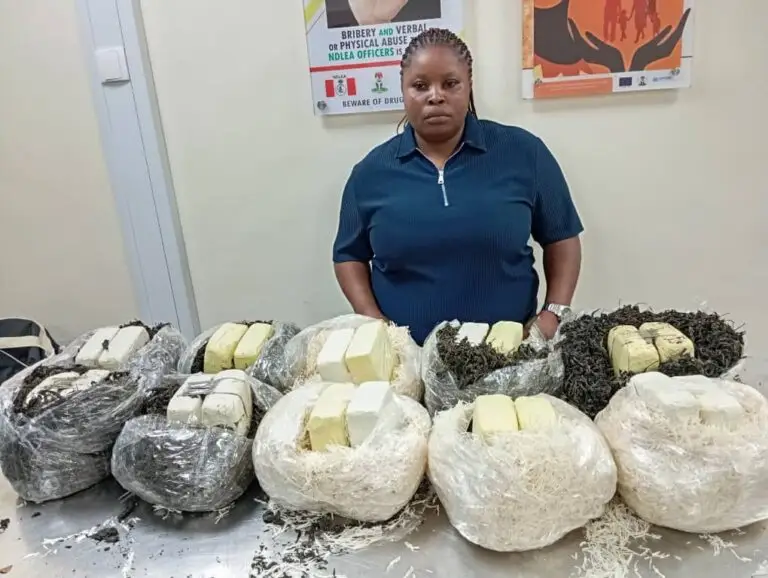
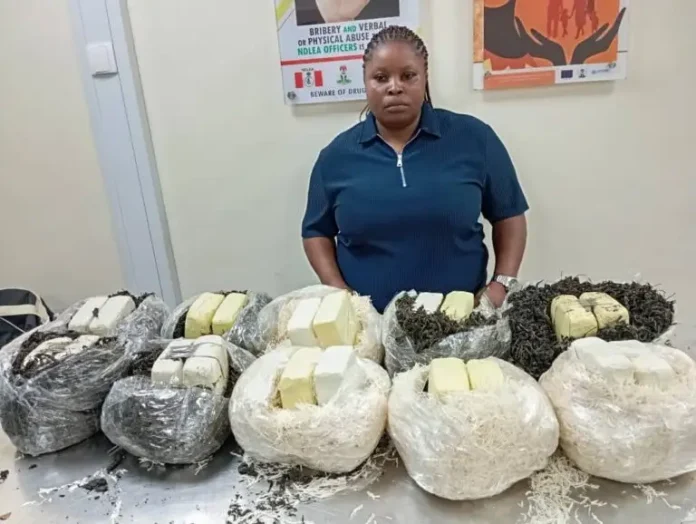
The National Drug Law Enforcement Agency (NDLEA) has arrested a 35-year-old Qatar-based lady who attempted to smuggle Indian hemp to the Arabian country.

Spokesman of the agency, Mr Femi Babafemi stated on Sunday in Abuja that the lady was caught at the Murtala Muhammed International Airport, Ikeja.

He explained that she hid 20 parcels of the weed in “African salad’’ (cassava cuts and vegetables), but was intercepted at the airport on Thursday in collaboration with men of the Department of State Services.

Babafemi stated that preliminary investigation showed that the lady returned to Nigeria in December 2023 for end-of-year celebrations.

National growth LS

“She said that preparatory to her return to Doha, she was lodged at Club Dice Hotel in Ikotun area of Lagos where the consignment was handed over to her for trafficking to the Arabian country,’’ he stated.

In another development, NDLEA also arrested two men at Iwaya, Yaba and Agege areas of Lagos on March 26.

Babafemi stated that that the agency recovered 842,560 psychoactive pills, particularly tramadol, in addition to 15 litres of codeine syrup and 596gms of Molly from the duo.

“NDLEA operatives rebuffed an offer of N5 million bribe from one of them and the money was documented as part of exhibits to prosecute the suspects,’’ he added. (NAN)

By Ibironke Ariyo

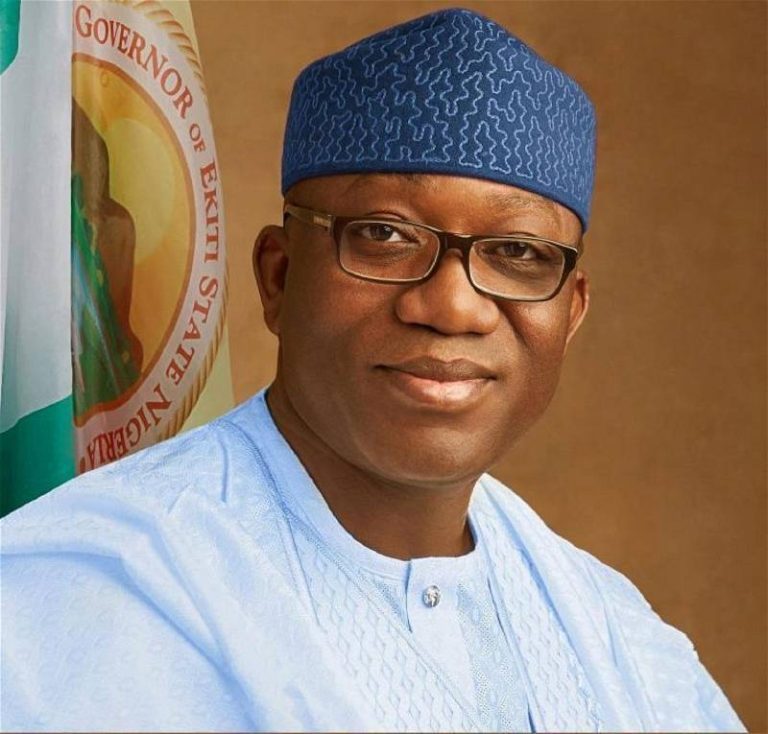
Fayemi, the scholar-politician who wants to change Africa

0

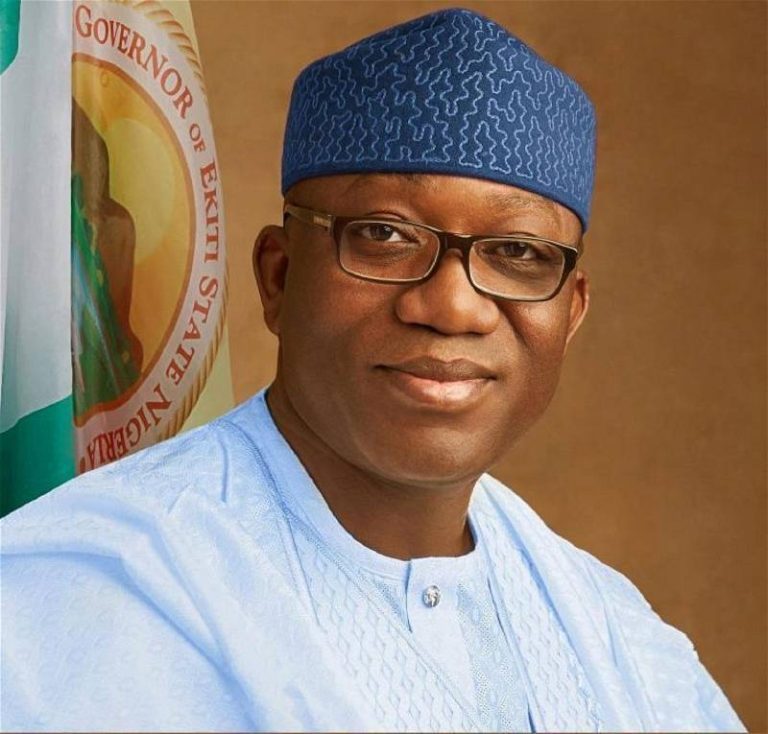
On this Wednesday afternoon, in the study of his Abuja home, was Kayode Fayemi, the former governor of Ekiti State. He looked relaxed in a multicoloured cotton shirt and black trousers. His midsized study was packed full of magazines and books on governance, leadership, diplomacy, war, and any subject you can imagine. It is obvious Fayemi is an avid reader, and since leaving office 16 months ago as Ekiti governor and chairman of the governors’ collective, he has immersed himself in books.

This afternoon, in Abuja, Fayemi, or JKF as he is best known by his associates and friends, was almost carefree, as if a burden had been lifted off him. But, if one were to be truthful, he has always been unruffled, almost too easy-going for a Nigerian politician. However, as a governor, beneath that façade of calm, one would sense urgency and notice the involuntary frown now and then and how he hurried a conversation or appointment to get back to the business of governing.

But today, JKF was genial and said life outside the Ekiti government house ‘’has been very peaceful.’’ He was quick to point out that he had been very busy. Since leaving office as governor, he has been appointed as the inaugural President of the Forum of the Regions of Africa (FORAF), a platform for subnational entities in Africa that seeks a broader distribution of power that favours regional and local governments. He has also taken up a professorial chair at the African Leadership Centre at King’s College in London.

Besides, Fayemi said: “And I’ve also not been totally disconnected from my local front. Yes, we have a new governor in office, but the governor is from my party. He was Secretary to the state government when I was governor. And to a large extent, I played a critical role in his coming to office. So, I’ve been involved in some of the developmental work that was carried over from my period in office. Not in micromanaging or even directly administering any of the projects, but some of them were things that I initiated. So, the government naturally felt that they needed to consult or engage me in some way to reach some of our partners on this.’’

National growth LS

That he is still involved in some form with the government of Ekiti State is atypical of Nigerian politics, where bad blood often flows between incumbents and their predecessors after only a few months. Nothing exemplifies this better than the cat-and-mouse relationship between Governor Sim Fubara of Rivers State and his predecessor, Nyesom Wike, who is now the FCT minister. The conflict between the two politicians has polarized the state, increased tension, and even led to the burning down of the State Assembly building. Although Fubara and Wike have agreed to some sort of peace, it is apparent that the conflict is still simmering beneath the surface amid the constant hurling of insults by their followers.

Not so for Fayemi and his successor, Governor Biodun Oyebanji. It appears the relationship between the two politicians is rooted in genuine friendship and commitment to the development of Ekiti State. Fayemi explained: ‘’For me, I am not a slave to office. Leadership is not the office. Leadership is also not the title of Mr. Governor. Leadership for me is service. It is a sacrifice. Governor Oyebanji is there and if he asks me for whatever reason to do anything for him and it is within my powers to do, I will but I will not necessarily poke my nose into what is going on in Ekiti unless I’m asked. That is my philosophy and I believe that has also helped. I don’t reside in Ekiti. I’m often in Ekiti and I am still actively involved in the party work in Ekiti but I really don’t get involved in the minutiae of governance in Ekiti.’’

Fayemi is modest. He should get some credit for the lack of political tension and rancour in Ekiti State. Because, apart from his warm relationship with his successor, he also has a good rapport with Ayo Fayose, his predecessor and political rival. He is perhaps the only former Nigerian governor who maintains this sort of relationship with both his immediate successor and predecessor. That must be a marker of his character and his live-and-let-live outlook on life.

Of Fayose, he said, ’My philosophy is always to seek out the good in every human being. Governor Fayose and I are not enemies. We disagreed primarily on an ideological basis. He is a populist and people-pleasing politician. I am a bit different. I am seen as an intellectual in politics. I am not a social animal and I take things maybe a little bit too seriously but we found a middle ground in the sense that what unites us is Ekiti. What binds us is Ekiti and the progress of the state is one that I believe we are all committed to, whether you talk of Governor Adebayo, Fayose, myself, or the current government. One critical success factor that I can also maybe attribute it to is the fact that we all respect the position of the office (of the governor) and when you respect the office you respect the personality occupying it regardless of whether you played any role in the person coming to office.’’

Fayemi’s confession about being a little too serious should not come as a surprise. Nothing about him typifies the average Nigerian politician. In a society that thrives on retail politics, where political actors have to dance on the street, eat roast corn publicly, and essentially ‘dumb down’ to connect with the masses, Fayemi, with his PhD in War Studies, is the professorial type, who speaks in a magisterial style.

Fayemi’s political life is a storied one, full of ups and downs. And up again! It was in 2007 that he first contested the Ekiti gubernatorial election. The electoral commission declared Segun Oni, his PDP rival, the winner, and Fayemi had to resort to the court, reclaiming victory after a three-year legal battle. Since then, he has been in and out of power, regardless, playing a central role in Nigerian politics and conversations about the devolution of power.

However, since he stepped down for Bola Tinubu during the presidential race and left office as governor, Fayemi has been unusually quiet, except for the occasional press statements from his media team. It would appear that since 2007, this is the first time that he has not been active in Nigerian politics, leading the FORAF and teaching at King’s College. Has he quit active politics? ‘’The short answer is no,’’ he said. “I am still an active member of the All Progressives Congress. My party is in office, nationally and in my state. I regularly engage with the leaders of the party, right from our pioneer Chair, Chief Akande to the current Chairman of the party, Dr. Ganduje. I am still an active member of the All Progressives Congress. So really, I’m not taking any sabbatical from politics. If the party needs me to do anything, they know that I’m just a phone call away even though I am busy on other assignments which are not connected to party politics.’’

If Fayemi is not as active in Nigerian politics as one would expect, it may be because he has always maintained a broader vision of politics from a Nigeria-only perspective to a pan-African one, investing his time and mind in the challenges confronting the continent and what we need to do to overcome them. When asked about what he considers the most pressing challenge facing the continent, Fayemi became more animated – his eyes lit up, hands moved more – as he provided a thesis on Africa’s problems and how to solve them. It was a sort of mini-lecture, and it was Fayemi in his element.

A summary of that ‘lecture’ will suffice here: Africa has long been at a disadvantage in the global political interplay, often treated as a pawn or site of struggle between major powers rather than an equal partner setting its own agenda. Despite goals like the Africa 2063 agenda and the Continental Free Trade Agreement, Africa has struggled to define and pursue its best interests collectively. This is partly due to the Westphalian notion of sovereignty that pits African nations against each other rather than allowing them to unite.

However, Africa has a major demographic advantage that it should leverage. By 2050, one in five people worldwide will be African, and half the global workforce. With a median age of just 18 compared to ageing populations elsewhere, Africa has a demographic dividend it could harness through aggressive investment in functional education and healthcare relevant to the future of work. Doing so could allow Africans to earn resources without feeling inferior while allowing Africa to be an equal rule-maker rather than a pawn as multipolarity replaces U.S. unipolarity in the shifting global order. This period of transition presents an opportunity for Africa to finally take its rightful seat at the table.

His proposition makes sense, but on the surface, it appears to fit into the thinking of some of Africa’s intellectuals to blame outsiders or external forces for the continent’s woes while neglecting the ‘internal’ issues around capacity, institutional weakness, as well as the lack of transparency and corruption of government.

Among the seven continents of the world, Africa comes in last on all socio-economic indicators. Compared to Asia, for example, as of 2020, the poverty rate in Sub-Saharan Africa was estimated to be around 41 percent, compared to around 7.4 percent in East Asia and the Pacific region, according to the World Bank.

According to the Fragile States Index by the Fund for Peace, several African countries rank among the most fragile states globally, including Somalia, South Sudan, and the Central African Republic. While Asia has its share of political challenges, including authoritarian regimes and ethnic conflicts, the overall stability and governance in many Asian countries tend to be stronger compared to some African nations. Africa experiences a higher prevalence of armed conflict and internal unrest compared to Asia.

Can Africa, with adept diplomacy, stand toe to toe with the leading countries of a multipolar world without overcoming its internal challenges and contradictions? Would China have become the global leader it is today without first overcoming its economic and sociopolitical problems and lifting almost half a billion people out of poverty?

Fayemi explained that the two issues can go together; that in the new world, Africa cannot avoid collaboration with other countries, but it must do so on its terms, and not as a subservient or junior partner, despite its problems. The sense one gets from his postulation is that Africa can work towards solving its internal issues on the one hand and, on the other hand, become more assertive in its relationship with the world, by seeking equality at the table of nation-states and multilateral institutions.

It is a tough and audacious task, no doubt. One that requires long-term planning and a shift in thinking on the continent that is comfortable going plate in hand to the capitals of even middle powers for grants and aid. Fayemi is confident it can be done and revealed that he is establishing a continent-wide institute with this kind of challenge in mind.

“I’m actually establishing an institute – a policy and leadership advancement institute, to really look at it on a continent-wide basis. Find a way to support our policymakers to focus on the right things. So that when they get the opportunity to sit at that table, they are asking relevant questions. They’re proffering relevant solutions in the interest of Africa, not in the interest of those who are paying the bills. Just as Kwame Nkrumah said to us, ‘If you like, take from the West. If you like, take from the East. But what’s important is to face forward.’ Know where you’re going. The reality of the world is that we must collaborate, we must partner with other nations, but not to the detriment of our own overarching framework, our own agenda. But first, we must define that agenda,’’ he said.

He is sure that a confident and sprightly Africa can emerge in time, and his proposed institute would play a significant role in its emergence. He stated, “For me, the reason why I decided that I want to focus on a continent-wide initiative, taking advantage of the resources available – yes, there may be people doing many things around – but I am not aware of any that is fully concentrated on utilizing available resources in a wide range of sectors, to develop and provide the necessary tools that would strengthen the capacity of a successor generation.

‘’Many people get into positions of authority in Africa, even here in our country. I was talking about this yesterday at my lecture at the Abuja Leadership Centre. They get into these positions without the foggiest idea of what the big picture is, of why they are even in that office, of what they can do that is above even themselves, of the plan, of a team, of the capacity, that would enable them to even have peer-level conversations on trade, on migration – the big ticket items of the moment – on security, and the place of regional integration in all of this.”

Fayemi hopes to succeed where nations and multilateral institutions such as the African Union and the Ecowas have come short. But if there is one man with the social capital, intellectual resources, global network, political experience, and drive to take on Africa’s problems, it must be Fayemi. Fate, it appears, has led him here – where one person has to take on the intractable challenges of a continent. Yet, he is positive and confident about making a difference. ‘’Oh yes. I am very confident in the future (of Africa). I am very confident,’’ he said.
NDLEA burns over 3 tonnes of cannabis in Edo forests

0

Not less than 3,065.255kg of cannabis sativa (Indian hemp) substances were razed on two farms at Amahor waterside forest in Igueben area of Edo state, says the National Drug Law Enforcement Agency (NDLEA).

Mr. Femi Babafemi, the NDLEA spokesman, disclosed this in a statement issued on Sunday in Abuja.

Babafemi said that three suspects: James Thankgod; Wisdom James and Akpa Festus were arrested on Thursday, March 28, in connection with the farms.

Meanwhile, 278kg of same substance going to Idoani in Ondo state was recovered during a raid on Oloma-Okpe forest, Akoko-Edo Local Government Area (LGA), Edo State.

National growth LS

Also, at least, 127.5kg of cannabis, loaded in a Volkswagen Vento saloon car marked, NTT 215 AA, was recovered along Isua/Kabba road, Idoani area of Ose LGA, Ondo State.

In another development, Babafemi said that a 30-year-old female suspect, Chinasa Christopher, was arrested with 400 bottles of codeine syrup in Sabon Gari area of Kano.

Babafemi said that the owner of a consignment of illicit drugs intercepted along Zaria-Kano road, Bakura Goni, was arrested at Mile 2 market in Lagos on Tuesday, March 26.

He said that Goni, caught during a follow up operation, had been flown to Kano to face charges.

“The consignment, consisting of cannabis and tramadol, weighing 73.8kg, was earlier seized in a truck conveying it from Lagos to Kano,“ he said. (NAN) 

By Ibironke Ariyo

New National Minimum Living Wage for Beginners

0

“A just wage for the worker is the ultimate test of whether any economic system is functioning justly.”
— Pope John Paul 11

As the National tripartite negotiation is under way for a new Nationa Minimum Wage, “Minimum Wage” (MW) has regrettably assumed notoriety as a frequently misused concept. The point cannot be overstated; Minimum wage is a technical labour market concept. The International Labor Organization (ILO) is the oldest specialized agency of United Nations (UN). Established in 1919, ILO’s primary mandate “promotes social justice and internationally recognized human and labour rights” in the world of work. It was not accidental that ILO was created exactly two years after the great 1917 Bolshevik socialist revolution in Russia led by Vladimir Lenin. ILO was established to curb the spectra of social upheavals as inevitable fall-outs of the ancient regimes of indecent work and slave labour. The goal is globalization of minimum labour standards, that include minimum wage, minimum working age (there was once gruesome labour regime of child labor that oiled the mills of the first industrial revolution). ILO sets to moderate the hitherto primitive labour market which through primitive exploitation of workers and accumulation of capital invariably pushed labour into “dangerous” and “subversive” political ideas of revolutions. Hence ILO’s founding mission of promotion of labour peace through just and fair conditions of work as indispensable success factor for global prosperity. Since it’s formation, it has initiated a number of conventions and recommendations for its 187 member states on wages and wage administration. They include Protection of Wages Convention, 1949 (No. 95), Minimum Wage Fixing Convention, 1970 (Protection of Workers’ Claims (Employer’s Insolvency) Convention, 1992: Equal Remuneration Convention, 1951 among others.

What then is Minimum Wage? The Committee of experts of the Governing Body of ILO at its 168th Session had concluded that the minimum wage (MN) “represents the lowest level of remuneration permitted, in law” paid hourly, daily or monthly. The subsisting National Minimum Wage Act of 2019, defines the minimum amount of money an employer of labour is required to pay the lowest paid worker monthly as N30,000. No other forms of wages are so legally protected, which differentiates minimum wage from any other wage awards or wage agreements. The recent commendable and responsive presidential N35,000 wage award by President Bola Tinubu for 6 months in the wake of the labour protests that trailed fuel subsidy removal remains a wage award for the federal employees. Presidential wage award is NOT a national minimum wage precisely because it is not legally supported and not earned by all workers of the Federation. National Minimum wage (MW) is the legally permissible pay below which no private or public employer should pay or bellow which no private sector or public sector worker should earn. Of course employers can and ( even encouraged) to pay above legally permissible minimum. Edo and Lagos states already pay as much as N42,000. Federal employees earn above the legal minimum while most private employers through collective bargaining for living (as distinct from minimum) pay already exceed the legal minimum. It is self evident that, the purpose of minimum wage is to protect the most vulnerable workers, often in precarious work.

National Minimum wage (MW) often impacts positivity on mass of unorganized work force. It protects workers in unorganized sectors against unacceptable miserable low pay. Every business, small or big is established to maximize profits, by minimizing costs, the significant component of which is wages. We are living in an (un)interesting times of economic crisis occasioned by collapse of the real economy and wholesale financialization in which, banks, some oil and gas companies, nonetheless still post huge profits amidst mass income poverty. Without legally permissible minimum wage, some of these employers would still pay slave wages any way. Many employers still do have them: workers whose pay can hardly make them live basic subsistence lives! Hence the need for legally permissible minimum pay. National Minimum wage (MW) is also a constitutional issue. Both 1979 and 1999 constitutions of Nigeria put labour, just like capital and financial matters, on the exclusive Federal list. 1999 constitution emphasizes that the State shall direct its policy towards ensuring “the promotion of a planned and balanced economic development; and that a reasonable national minimum living wage, old age care and pensions, and unemployment, sick benefits and welfare of the disabled are provided for all citizens”. Federal and state governments must therefore realize that they are not just employers of public employees, but they have the constitutional responsibility to protect the vulnerable workforce through enforcement of MW Act. It is unacceptable and clearly illegal that some state governments and private employers that employ not less than 50 workers to default on the subsistence pay. Indeed prompt compliance and improvement on legally permissible must be a critical success factor for good governance. The hope is that the new tripartite negotiation will ensure effective monitoring and enforcement of the minimum wage Act with respect to sanctions for non-compliance.
Definition only explains it, it however doesn’t tame Minimum wage (MN) as a concept. MN has different features in different occupations and different countries. The labour movement at regional levels had long struggled for region wide minimum wages as it was in the Western region in the 50s. Indeed some progressive politicians of social democratic persuasion during the first and second Republics had audaciously campaigned for decent work that involved minimum pay below which no worker would earn. Such as late Chief Obafemi Awolowo, the premier of the defunct Western region. Such as late Alhaji Abubakar Rimi and and Alhaji Balarabe Musa, Second Republic first democratically elected governors of Kano and Kaduna respectively. However the first national minimum wage as we know it today was in 1981 under the late President Shehu Shagari.

National growth LS

Precisely because yours comradely has been involved (apology to Odumegu Ojukwu), in the past decades, I bear witness that the on-going tripartite National Minimum Wage negotiation is the 6th of such since independence of the Federal Republic. Apart from 1990 minimum wage adjustment under the military regime of General Badamasi Babangida, all NMW reviews took place under democratic governments using the time tested instrumentality of tripartism. Five Tripartite Committees on National Minimum Wage (TCNMCs) took place in democratic dispensations (1981: President Shehu Shagari, 2000:President Olusegun Obasanjo, 2011: President GoodLuck Jonathan, 2018: President Muhammadu Buhari and 2024: President Bola Ahmed Tinubu). Minimum wage tripartite negotiations often involve bargaining, social dialogue and compromises on affordability and ability to pay by employers and employees alike. Negotiation is a democratic value that thrives where there’s constitutionalism, freedoms of association and assembly. Only democratic dispensation guarantees unfettered negotiations. Military dictatorships of various hues once repressed Nigeria’s labour market with respect to minimum wage through obnoxious wage freeze, wage deflation policies as subsidy removal and Naira devaluation. Thus all tripartite stakeholders must reaffirm commitment to democracy for sustainable wage improvement through social dialogue, not arbitrary non- negotiated “wage awards”, or “wage reviews”. Minimum wage also assumes stable national macro economics of secured employment, single digit inflation and stable exchange rate. Volatility in macro economic variables, had long devalued minimum pay that is “high” in nominal terms but miserable slave pay in real terms in the wake of Naira value collapse and stag inflation. There was once a Nigeria in which MW once guaranteed minimum working and (even living) life given the macro economic stability. N125 minimum wage of 1981 was some $250 dollars (N375,000) . The current N30000, in real terms sums up to party sum $25. With January 2024, headline inflation rate at 29.90% (the highest level of inflation recorded in 28 years!) food inflation at all time high of 39.54 percent, virtually all wage earners have lost purchasing power. 2024 tripartite minimum wage committee faces the naughty task of passing the acid test of first restoring the collapsed minimum wage and at the same time ensure new rate that will make earners survive and live. The five year cycle negotiation is outdated in an era of volatility and uncertainty in macroeconomic variables. United Kingdom (UK) introduced minimum wage a decade after Nigeria started in 1981. But UK now parades a statutory Low Pay Commission (LPC) that adjusts minimum age every April 1st of the year. From April 1st 2024, for instance, Britain’s minimum wage for workers aged 21 and over rises to 11.44 pounds ($14.45) an hour “one of the highest among advanced economies”. President Bola Ahmed Tinubu should upgrade the existing National Salaries, Incomes, and Wages Commission (NSIWC) to an independent public body that should among others advise the Government on the rates of the National Minimum Wage (NMW), including the National Living Wage (NLW). NSIWC should retain its independence and identity and not merged with any agency as being proposed in the Orasanye report. At times like this, many working women and men can hardly afford three meals a day for selves, their spouses and children. Many trek to work, in the wake of transport fares hike, some even sleep at workplaces to augment transport, following fuel subsidy removal. Not few could pay for dignified abode, given prohibitive rent for the family of four. Treatments for basic ailments are unaffordable with little or nothing-out-of empty-pockets. Children are out of paying schools, no thanks to low pay. Millions of workers constitute the new working poor: workers who are getting poorer precisely because the pay for work done cannot meet their survival needs.

Happily there are enough quotable quotes on minimum and living pay attributable to President Bola Ahmed Tinubu more than any President. At the town hall meeting with organized Labour in Abuja on 19th December 2023 ahead of the 2023 Presidential election in Nigeria, he was loud and clear to say his “..government has a cardinal responsibility to work not only with business but also with labour to ensure that all constituent parts of our society are afforded their fair share of rewards without taking on undue hardship”. In his 2023 May Day speech, Tinubu also disclosed that “In the Nigeria I shall have the honour and privilege to lead from May 29, workers will have more than a minimum wage. You will have a living wage to have a decent life and provide for your families.” Organized labour through social dialogue and collective bargaining has a worthy ally on President Tinubu for a new National Minimum Living wage. ( NMLW).

Comrade Issa Aremu mni
Director General, Michael Imoudu National Institute for Labour Studies (MINILS) Ilorin

Fayemi preaches love, empathy, forgiveness

0

Dr Kayode Fayemi, former Governor of Ekiti State and Chairman of the Nigerian Governors Forum (NGF), has extended heartfelt greetings to Christians in Nigeria on Easter.

In a statement issued by his media office, Fayemi stated that Easter is central to the Christian faith and urged Christians across the country to mark the occasion by embodying Christ-like values such as love, forgiveness, sacrifice, and empathy in their daily lives.

“The sacrifice of Jesus Christ teaches us invaluable lessons,” he stated. “It symbolizes selflessness, forgiveness, resilience in the face of adversity, and the triumph of good over evil. Just as Jesus overcame his torment through faith, we can overcome our challenges and hardships with perseverance and unwavering conviction.

Fayemi also stated that Jesus Christ’s death and resurrection exemplify selfless sacrifice for the greater good, reminding us of the importance of putting the needs of others ahead of our own, particularly during difficult times.

National growth LS

“As we navigate our country’s challenges, let us be inspired by this act of sacrificial love and reach out to those in need,” Fayemi urged.

He continued, “Easter is a time of spiritual renewal and rebirth, giving us the opportunity to reflect on our lives and strive for personal growth. We, too, can experience physical and spiritual renewal, just as the resurrected Jesus was renewed and transformed. Let us use this opportunity to let go of the burdens of the past, embrace forgiveness and reconciliation, and embark on a journey to a better future.”

Fayemi concluded by urging Nigerians to commit to being their brothers’ and sisters’ keepers and to show empathy to those in need.

“This way, we can create a more just, peaceful, and united Nigeria for all,” Fayemi stated.

By Chimezie Godfrey

ACF wishes Christians Happy Easter celebrations

0

The Arewa Consultative Forum (ACF) has felicitated with Nigerian and worldwide Christian brethren on the celebration of the 2024 Easter Season, signalling the end of the 40-day Lent Period, and one of sacrifice, involving fasting, devotion, compassion, goodwill and sacred sober reflections on the pains of Crucifixion and the magic of Resurrection for the human race.

A statement signed by Prof. T. A. Muhammad-Baba, the National Publicity Secretary said ACF rejoices in solidarity with all on the Holy Season, one of God’s Grace and Mercies.

ACF noted that the celebrations are coming at a challenging time for all Nigerians as they reel under daunting economic, social and political challenges, insecurity and related existential challenges. Even under the best of times, communities face dire socioeconomic conditions, disappointing political representation, corruption, nepotism, etc., egregious ingredients for tough lives for Northern communities specifically.

“While it is easy to send arms flailing up in agony, people cannot and should not lose hope or surrender to despair. The occasion of the remembrance of the life and times of Jesus Christ, the Prince of Peace and Hope, provides reason to look up to God Almighty, for emancipation from humankind’s tribulations and trials.

National growth LS

“In the Spirit of the Season, ACF therefore calls on the Christian Ecclesia to pray for:
” Peace, security and economic recovery for Nigeria;
” God’s intercession so that Nigeria’s leaders are re-endowed with faith, strength, Divine Love and Wisdom as they pilot Nigeria’s affairs with righteousness in intentions and deeds;
“God to guide and bestow the security agencies with the needed strength and bold resolve with which to crush all agents of criminality, insecurity and social and political destabilisation in Nigeria;

“That the fear of God Almighty enters the evil minds of terrorists and other criminals that they repent and reject, in totality their culture of criminality, sin and social profanity; “That God Almighty comes to the aid of any and all innocent citizens being held captive in the criminals’ dens so that they are released unharmed without further delay; and

” God Almighty to restore hope for a better and more hospitable world on the pedestal sustainable prosperity, justice, equity as opposed to the current culture of despair and hopelessness so that humanity rises again from the ashes,” the statement said, concluding, “God bless Nigeria, our One and Only Republic!”

Adeleke’s Spokesperson Says Governor focused on Selfless Service

0

Governor Ademola Adeleke is administering Osun state with a people centric approach and with an eye on good legacies rather than material acquisition, his Spokesperson, Mallam Olawale Rasheed has declared.

Speaking on Diamond FM programme, Enun Onikan, Mallam Rasheed debunked what he called “several lies and untruths being peddled by the opposition in the state”, declaring that “Mr Governor is delivering so well across the sectors.

“ The opposition APC and their operatives are simply overwhelmed by the superlative performance of Mr Governor, hence their resorting to bare faced lies and untruths . Unfortunately, the more the lies, the more the unpopularity of the opposition among the people.

“ Let me point out that no member of the Adeleke family is a contractor with the Osun State Government. Neither our revered leader, Dr Deji Adeleke nor the global music icon, David Adeleke, is involved in the Osun contract. It is a lie from the pit of hell to say Pacific Holding is involved in the borehole project in Osun.

National growth LS

“ The companies handling major projects in Osun have been published and nowhere is any Adeleke owned company listed as a contractor. If only those agents of fake news know how much God has materially blessed the Adeleke family, they will not dare level such evil, baseless allegations”, Mr Rasheed said in response to questions.

Speaking on several attacks from the opposition on ongoing infrastructure programmes of the state government, Mallam Rasheed posited that the opposition is pained that Governor Adeleke is succeeding where it failed, stressing that “ whatever the discomfiture the opposition may be experiencing, Mr Governor is delivering good governance in Osun State.

“ As of today in Osun, Mr. Governor is delivering on physical and stomach infrastructure. Food distribution has commenced statewide. Infrastructure projects are ongoing statewide. Like the CEO of the News Agency of Nigeria recently put it, Osun is a huge construction site.

“ Complete renovation of several schools, primary healthcare centres and construction of flyover bridges as well as road dualisation are ongoing. Despite the high cost of construction materials, the administration innovates to construct without disruption.

“ Mr Governor at the same time is continuing the payment of half salary and pension debt inherited from the previous government. The administration is paying salary as at when due while wage award is going on at the same time. The opposition is dazed with this speedy delivery by Mr Governor, hence recent rantings and tantrums.

“ But the good thing is that Osun is a very enlightened society. Our people know that the current government is doing its best, delivering where the previous government failed. Our people know lies from the truth.

“ The public also have their own approval rating of Mr. Governor. We all know no government in the world can have a 100 percent approval rating. People claimed Mr Governor’s approval rating is 90 percent but our review is around 80 percent. The 20 percent is an area Mr Governor is working to attend to

On reports that boreholes sunk in phase one of the infra plan are no longer working, Mallam Rasheed debunked the claims, clarifying that there is a ward management committee managing each borehole and that the boreholes are working statewide.

On the issue of food inflation and food security, Mallam Rasheed told the audience that Mr Governor through the Ministry of Agriculture is implementing measures to support farmers ahead of the raining season, listing plans on cocoa and cashew revitalization plan, access to tractors and security steps to secure farms for farming activities.

On the issue of Youth unemployment, Mallam Rasheed described it as a national problem on which both the state and the Federal Government are working to improve ease of doing business to deepen the capacity of the private sector to employ.

On food inflation, he listed the expected report of the food security committee as containing many measures to curb local food inflation even as he noted that the inflationary crisis is a national task which is receiving attention from the Federal Government.

Mallam Rasheed repeated the Easter message of Mr Governor in which the Governor highlighted his resolve to forge ahead with delivery of good governance within the context of rule of law and fear of God.