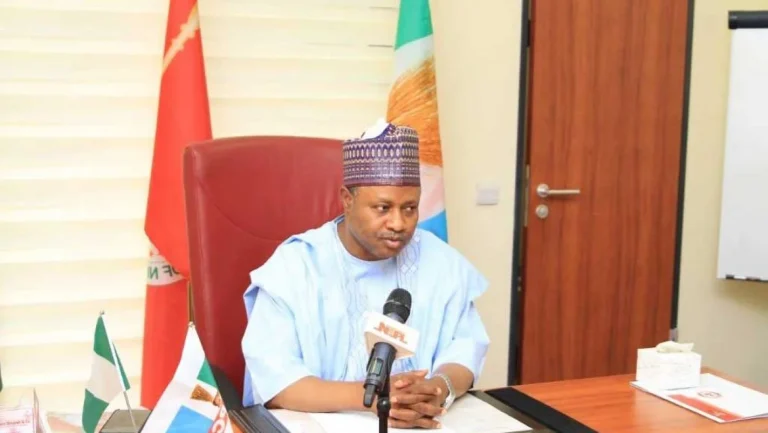
Governor Uba Sani has ordered the release of 110 convicts as part of his administrative powers and to mark the 2024 June 12 Democracy Day.
Senator Uba Sani, Governor of Kaduna State, in a statement paying tribute to the late Chief Gani Fawehinmi, SAN, GCON (of blessed memory), who devoted his boundless energy and legal skills to advocating for reform of the penal system, further expressed concern about overcrowding in correctional facilities and the fact that many citizens are languishing in such facilities due to their social and economic conditions.
“There are many citizens in such centers due to their inability to pay small fines. Some were also convicted because they could not afford a lawyer. We live in a society where the underprivileged do not have the financial wherewithal to vigorously pursue justice.
“Our administration is anchored on justice and fairness. We are committed to bringing succor to the poor, vulnerable, and underserved in Kaduna State. We have zero tolerance for discrimination. We strongly believe in the inherent goodness of every person. Everyone deserves a second chance. Persons in custodial centers can turn over a new leaf and contribute to the growth and development of our state,” he said.
Governor Uba Sani urged released inmates to reciprocate the government’s gesture by displaying good character.
“I encourage them to acquire one or two skills. Our administration is eager and willing to assist them in acquiring skills. It is not too late for them to be useful to themselves, their families, and society.
“As part of our interventions to support the operations of the Kaduna Custodial Centre, I have directed the installation of solar-powered streetlights and provision of operational vehicles. I have also instructed the Attorney General and Commissioner of Justice to collaborate with the Controller on other areas of need,” he added.
June 12: Governor Uba Sani orders release of 110 inmates
June 12: Governor Uba Sani orders release of 110 inmates
June 12: Stakeholders canvas strengthening of LGs, citizen participation
As Nigeria marks Democracy Day on Wednesday, stakeholders have called for the strengthening of local government administration to promote good governance and ensure effective and accountable democracy.
The call was made during a virtual event with the theme “June 12 Democracy Dialogue,” organized by The Office of the Citizen (OOTC), an initiative stemming from Pillar One of the #FixPolitics Initiative.
Speakers at the event included Obiageli Ezekwesili, former minister Frank Nweke II, Convener of Chess in Slums Africa Tunde Onakoya, founder of BudgIT Seun Onigbinde and founder of Community Life Project, Ngozi Iwere.
Other participants were Nigerian spoken word and performance poetry artist and author, Dike Chukwumerije, Sam Amadi of the Centre for Public Policy and Research, Sesugh Akume of Advocate for Good Governance, Anthony Ubani, the founder of Talkademy Joyce Daniels, and the Executive Chairman of Igbogbo-Baiyeku Local Council Development Area, Lagos, Olusesan Daini.
In his speech, the Chairman of the #FixPolitics Initiative, Mr Frank Nweke Junior, said Nigerians have the collective responsibility to understand how they are governed and to help those who don’t understand the system.
Nweke emphasized the need to increase funding to local governments and hold the system accountable.
Speaking at the event, former Minister of Education Obiageli Ezekwesili noted that Nigeria is facing structural challenges in its democracy and governance.
According to her, Nigeria’s democracy will not bring development unless structural solutions are found for its dysfunctional system.
“We have to correct the structure. We have to make sure that the local government is at the center of the structural reform in Nigeria,” she said.
One of the panelists, Aisha Yesufu, suggested that it is important for people to understand that the office of the citizen is the highest office in the land, calling for citizenship enlightenment and empowerment.
Yesufu maintained that people, especially at the grassroots, have the right to make demands and ask questions about governance in their local areas.
She also stressed the need to grant financial autonomy to local governments.
“There should be full autonomy. Funds should be sent directly to the Local Governments, and not tampered with.”
Answering questions during one of the sessions, Olusesan Daini highlighted some of the functions and responsibilities of local governments, including the preservation of natural resources, provisions of primary health care, education, infrastructure, and roads.
Daini highlighted the problems of local governments, including poor funding and limited administrative capacity, among others.
He noted that citizenship participation at the grassroots is key, lamenting that people at the local government level were not engaging but rather patronizing their leaders.
Also speaking in one of the sessions, Ngozi Iwere suggested that local governments should be allowed to conduct their own elections.
She, however, stressed that elections for local governments must still be transparent, even if managed by a centralized body.
“It is not much about if it’s a centralized body. It still has to be transparent and have integrity,” Iwere said.
She also noted that citizens should demand that their votes count in every situation.
Oluseun Onigbinde also spoke, highlighting the need for data at the grassroots, while Sesugh Akume discussed best practices for local governments.
Akume emphasised the rule of law, decentralization, and autonomy for local governments.
He noted that local governments weren’t allowed to function effectively due to too much control.
June 12: Stakeholders canvas strengthening of LGs, citizen participation
Nigerian Army declares four suspected bandits wanted in Taraba
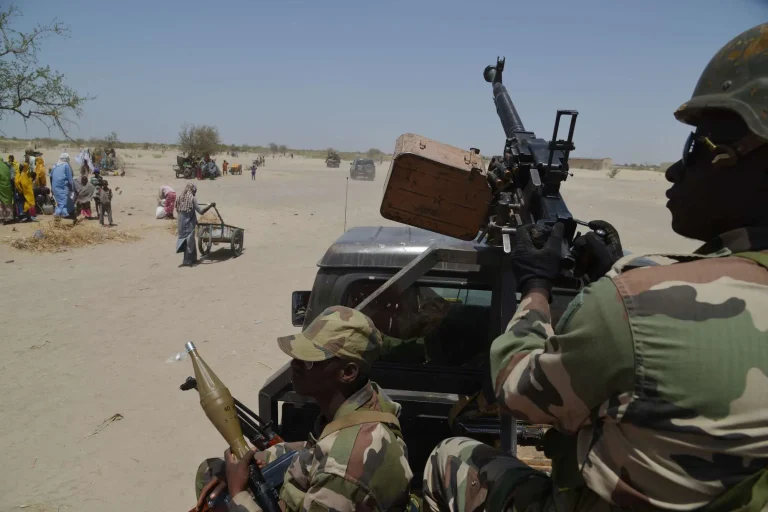
Troops of the 6 Brigade Nigerian Army/Sector 3 Operation WHIRL STROKE (OPWS) have declared four suspected bandits wanted in Taraba State.
The suspects, identified by the troops on the army’s X handle, are Isah, Shagari, Dogo and Teller.
The army also announced a recent successful operation in the state, which led to the dismantling of a bandit camp located in the Chinkai Forest of Wukari Local Government Area of Taraba.
Valuable items, including 12 mobile phones, 3 international passports, and various mystical charms utilized by the criminals, were recovered from the bandit camp.
The operation, which took place on Tuesday, was successful due to actionable information provided by some good Samaritans.
“Acting on actionable intelligence reports detailing the continuous criminal activities by terrorist groups sheltering in the Chinkai Forest, troops of the 93 Battalion Sub-Sector 3B OPWS launched the clearance operation.
The troops meticulously combed through the dense forest areas notorious for harboring kidnappers’ camps, prompting the terrorists to flee upon sighting the advancing troops.
The operation led to the destruction of several makeshift structures linked to wanted kidnapping kingpins such as Isah, Shagari, Dogo, and Teller,” the communication reads.
The successful clearance operation, according to the army, demonstrates the unwavering commitment of the 6 Brigade Nigerian Army/Sector 3 OPWS to confront insecurity head-on in Taraba State.
They urged the public to remain vigilant and cooperate with security agencies by promptly reporting any suspicious activities within their communities.
“The Nigerian Army continues to prioritize the safety and security of all citizens, and operations such as this reaffirm our dedication to eradicating criminal elements that threaten the peace and stability of Taraba State and its environs,” it added.
Nigerian Army declares four suspected bandits wanted in Taraba
N80bn fraud: Shame us – EFCC accuses ministers, colleagues, others of shielding Yahaya Bello
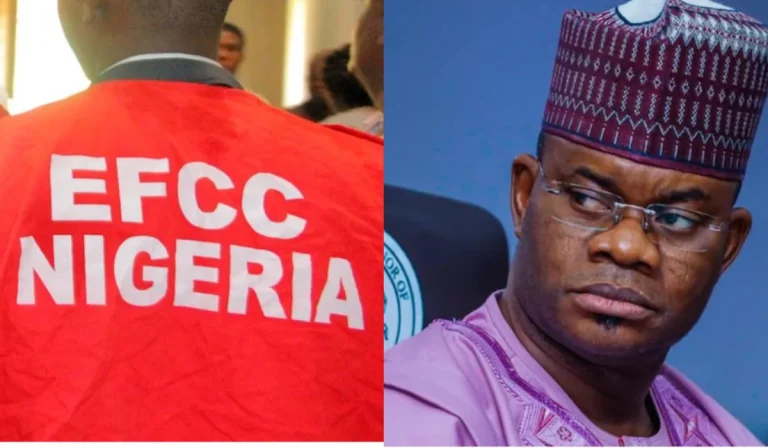
The Economic and Financial Crimes Commission (EFCC) on Wednesday alleged that some powerful Nigerian politicians are shielding the former governor of Kogi State, Yahaya Bello, who was accused of N80.2bn fraud.
TVN recalls that the anti-graft agency had declared Yahaya Bello wanted following his inability to honor its invitation.
He was declared wanted after a failed attempt to arrest him and his repeated absence from court for arraignment.
The Nigerian Immigration Service also placed the former governor on a watchlist.
When asked why the EFCC had yet to arrest Bello weeks after he was declared wanted, an EFCC official claimed that the ex-governor was being shielded by the system.
“That politically-exposed Yahaya Bello, whose crime has been traced to him by allegation and has been invited by the EFCC to come and explain, and for months he is acting drama and we are all here wanting to ask questions! The shame is our own shame!
“Can’t we catch him? We can, but do we go all out to catch him? Do we need to do that when he has his masters? Can’t they call him and tell him, ‘You are disgracing Nigeria’? What are you telling the world? Tell him to go and explain himself like others have done.
“Where are the ministers? Where are Yahaya Bello’s colleagues, even in his hiding? So, Nigerians can’t tell him ‘This is not fair, go and report; they are not going to kill you’? But people are still eating and dining with him.”
Bello is, however, expected to submit himself to the court today.
N80bn fraud: Shame us – EFCC accuses ministers, colleagues, others of shielding Yahaya Bello
Democracy Day: Review of Nigeria’s constitution long overdue – Rights group
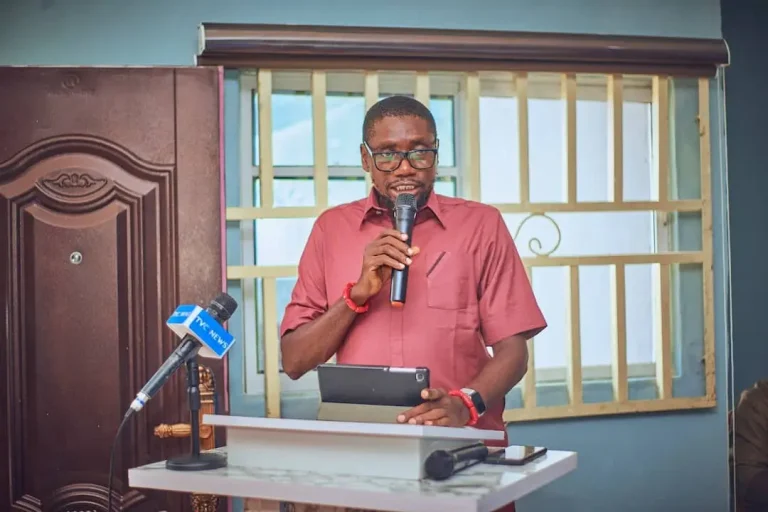
A human rights organisation, Centre for Human Rights and Accountability Network (CHRAN), said the review or overhaul of the 1999 constitution to accommodate the current realities in Nigeria is long overdue.
The Director of CHRAN, Otuekong Franklyn Isong, speaking in Uyo on Wednesday during a symposium to mark the 2024 Democracy Day in Nigeria with the theme “Civil Society as the Pivot of Good Governance in a Democratic Setting,” stated that the current Nigerian democracy “is founded on a constitution that the General Abdulsalami Abubakar-led military junta hurriedly packaged and imposed on Nigerians using Decree No. 24 of 1999.”
He observed that the constitution, which is now twenty-five years in existence, has not effectively addressed Nigeria’s multifarious problems and challenges, saying, “There is no doubt that the extant constitution requires a fundamental review, if not a complete overhaul.”
Enumerating the lapses of the 1999 constitution, the director noted, “Section 2(2) of the Constitution of the Federal Republic of Nigeria, 1999 (as amended), states that Nigeria shall be a federation consisting of states and a Federal Capital Territory. It excludes the local government areas as part of the federation, thus impeding grassroots development in Nigeria.
“In Section 7(1) of the Nigerian Constitution, the system of local government by democratically elected local government councils is guaranteed. But the funding of the local government areas is tied to the apron strings and control of the state governments in Section 162(6) of the Constitution, which states that each state shall maintain a special account to be called ‘State Joint Local Government Account’ into which shall be paid all allocations to the local government councils of the state from the Federation Account and from the government of the state.
“Again, the State Independent Electoral Commissions (SIECs) are provided for in Section 197(1)(b) of the Constitution while their funding is in the hands of state governments, making the SIECs an appendage of the state governors.”
He, however, commended Governor Umo Eno for allowing the funds of the local government councils to get to them, saying, “This information was verified during the just concluded tour of the 31 local government councils by the Akwa Ibom State House of Assembly Committee on Local Government and Chieftaincy Affairs, with the CHRAN as a part of the team.”
Isong also noted that for the 25 years of uninterrupted democracy in Nigeria, the country is still searching for capable leaders and true democrats at the helm of affairs, stressing, “leaders who would enact the aspirations of the presumed winner of the June 12, 1993 Presidential Election, Chief Moshood Abiola.”
While wishing President Bola Tinubu success in his administration, the director urged him, as one of the frontline June 12 activists, to implement the ethos of democracy and make his government people-centric.
He urged him to revisit the policy on the fuel subsidy and reverse it in line with the popular opinion of Nigerians, as the policy has failed to achieve its desired intention.
“I believe that Mr. President has good intentions for this country. He has demonstrated the capacity to provide good governance to Nigerians. I wish he listened to the plea of Nigerians by reversing the fuel subsidy removal. The strength of character of a good leader is when the leader listens to his followers and makes amends. Surely, Nigeria shall be great again!” he stated.
Democracy Day: Review of Nigeria’s constitution long overdue – Rights group
Zamfara Govt moves to tackle adverse effects of climate change
The Zamfara State Government has procured six thousand tree seeds for planting as part of its efforts to mitigate the adverse effects of climate change.
This was contained in a statement issued by the spokesman for the State Ministry of Environment and Natural Resources, Mallam Abubakar Aliyu, and made available to newsmen in Gusau, the state capital.
The statement explained that the Commissioner of the Ministry, Muhammad Dantawasa, who spoke through his Permanent Secretary, Alhaji Garba Altine, disclosed this during the 2024 World Environment Day celebration held in Gusau.
“Dantawasa emphasized the importance of tree planting in combating desertification, erosion, and other environmental challenges facing the state, and also highlighted the need for collective action and community involvement in environmental conservation efforts,” the statement added.
“Various species of tree seedlings provided by the state government were Neem, Gum, and Mahogany, which are known for their environmental benefits and ability to adapt to the local climate and soil conditions.”
The commissioner called on residents of the state to take advantage of the opportunity to plant trees in their communities, schools, and public spaces to enhance the beauty and sustainability of the environment.
He further appealed to relevant stakeholders, including non-governmental organizations (NGOs), community groups and development partners, to support the state government’s tree planting initiative and contribute to the overall goal of a healthier environment for all.
Also speaking at the occasion, the Emir of Gusau, Ibrahim Bello, who was represented by the Senior District Head of Gusau, Alhaji Bashir Kabir Dan Baba, commended the state government on its efforts in promoting environmental conservation and sustainable development in the state.
“It is hoped that the seedlings provided will be well cared for and contribute to a more resilient and prosperous environment for future generations,” he said.
In his speech, the Project Coordinator of the ACRESAL Project, Malan Nasirudden Bello Gusau, said the project specifically focused on land restoration, desertification, and drought resilience in the state.
He also highlighted the urgent need to address these environmental challenges in the state.
“Desertification, land degradation, and drought are serious threats to agricultural productivity, food security, and livelihoods in arid and semi-arid regions like Zamfara State, but by promoting land restoration practices, building resilience to drought, and combating desertification,” he added.
Zamfara Govt moves to tackle adverse effects of climate change
Top 10 stories from across Nigerian Newspapers, Thursday, June 13, 2024
Here are the top 10 stories making headlines across the country.
1. NLC insists on N250K minimum wage
The Nigeria Labour Congress (NLC) on Wednesday vowed to continue with the push for N250,000 minimum wage in the country.Read more
2. Rivers AG clarifies court judgment, says Amaewhule not declared Speaker
Rivers State Attorney-General and Commissioner for Justice, Dagogo Iboroma, has set the record straight on a recent court judgment, stating that the court did not declare Martin Amaewhule as the Speaker of the House of Assembly nor affirmed him and 26 others as members of the Peoples Democratic Party (PDP).Read more
3. ‘He is not a superhuman,’ Presidency reacts to Tinubu’s slip at Democracy Day parade
The presidency has reacted to an incident involving President Bola Tinubu during the Democracy Day event in Abuja.Read more
4. ‘Ongoing reforms will fix economy, not intended to hurt Nigerians’- Tinubu
In his second democracy day address to Nigerians on Wednesday, June 12, 2024, President Bola Tinubu has assured that the ongoing national reforms were not intended to inflict pain, but to “fix” the economy.Read more
5. Obi urges Nigerians to defend democracy
The Labour Party’s presidential candidate in the 2023 election, Peter Obi, on Wednesday, urged the country’s political leaders and the citizens to protect democracy jealously and uphold its tenets.Read more
READ ALSO:Top 10 stories from across Nigerian Newspapers, Wednesday, June 12, 2024
6. Labour Party charges Tinubu to make public offices unattractive
The Labour Party on Wednesday urged President Bola Tinubu to make public offices unattractive to promote the delivery of democratic dividends in the country.Read more
7. Fidelity Bank leads trading as Nigeria’s equities market gains N324b
Fidelity Bank was the most active stock on the Nigeria capital market on Monday as a strong positive sentiment led the bourse to gain N324 billion in the week’s first trading session.Read more
8. Four dead, 10 injured in Enugu auto crash
At least four persons died in a ghastly auto accident along the Enugu-Onitsha Federal Highway on Tuesday.Read more
9. Police kills two suspected IPOB members in Enugu
Police operatives in Enugu on Wednesday killed two suspected members of the Indigenous Peoples of Biafra (IPOB) during a raid on the group’s alleged camp in a forest in Igbo-Etiti local government area of the state.Read more
10. Messi to end career at Inter Miami but not retiring yet
Argentina superstar Lionel Messi has again expressed his profound love for the game of football, saying he is not retiring just yet.Read more
The post Top 10 stories from across Nigerian Newspapers, Thursday, June 13, 2024 appeared first on Latest Nigeria News | Top Stories from TVN.
Concerns over unresolved corruption probes in Nigeria, millions spent without convictions
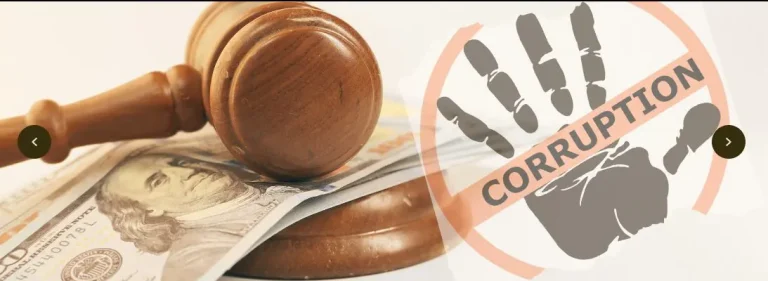
Unresolved corruption probes in Nigeria have remained a significant concern, begging the question of why millions of public funds are allocated to probes when there are no plans to convict offenders.
In Nigeria, probes come with a lot of theatrics: first the announcement of investigative panels, then the media rounds, photo ops, and press outings, with long-winding sessions running into months and years but never ending in indictments or prosecutions.
Not forgetting the huge sitting allowances often allocated to such probe panels, another avenue for graft and appeasing political allies—a case of “the more you look, the less you see.”
Some of the high-profile corruption cases involving top politicians and government officials, mostly initiated at the National Assembly, remain unresolved, leading to public frustration and distrust in the government.
Social critics believe that corruption probes are merely a means of appeasing aggrieved citizens. However, for many Nigerians, justice would mean seeing corrupt officials sent to jail.
A report recently released by the Centre for Fiscal Transparency and Public Integrity (CFTPI) through its Probes Monitor Portal showed that a total of 614 grand corruption probes were initiated by various administrations between 1999 and 2023. However, only three of these have been brought to a logical conclusion.
This huge gap, according to the centre, highlights the lack of accountability and transparency by successive governments, much to the detriment of the public good.
For instance, in the Petroleum Subsidy Scandal of 2012, billions of dollars were allegedly embezzled through fraudulent fuel subsidy claims. Investigations and arrests were initiated, but many did not lead to convictions.
In the Dasuki Gate scandal of 2020, former National Security Adviser Sambo Dasuki was prosecuted by the Economic and Financial Crimes Commission (EFCC) over a $2 billion arms fraud. The conclusion of this probe is yet to be seen.
Also, recall the probe of over N1.8 trillion in federal government interventions in the power sector since its privatization from 2012 to date by the Senate, the probe of the Nigeria Social Insurance Trust Fund (NSITF) over the spending of N17.16 billion ($40 million) in 2013, the investigation of the alleged diversion of N525 billion by a former Abia State Governor by the EFCC, and the probe of former minister Stella Oduah over the N255 million armored car scandal by the House of Representatives, among many others.
The challenge, according to Umar Yakubu, the Executive Director of CFTPI, is not only that these probes are never completed, but also that Nigerians are never informed of their status even when decisions are made.
Yakubu worries that by abandoning these probes and leaving the public in the dark, the government gives the impression that these actions are mere political theatre designed to placate the masses temporarily. He asserts that transparency and accountability are the cornerstones of any democratic society.
Without these principles, the very foundation of democracy is at risk. The lack of transparency in publishing the findings of these probes allows corruption to continue unchecked, as those who engage in corrupt practices feel emboldened by the lack of consequences.
Currently, Nigeria is gravely paying the price for corruption with a persistent economic downturn, unemployment, social injustice, poverty, and underdevelopment.
This is because funds that would have been utilized for the general good have found their way into private pockets.
Dr Otive Igbuzor of the African Centre for Leadership, Strategy and Development, insisted that corruption may never be overcome unless proactive steps are taken to entrench sanctions, sincere probes, sentences, and convictions.
He said, “The media has a great role to play in holding the government to account and promoting social justice, transparency, and accountability in society.”
“The challenge before us is what should be done to ensure that the probes are completed and acted upon and ultimately reduce corruption in Nigeria. I suggest citizen engagement and advocacy, media activism, developmentalist coalitions, participation in politics, and movements for change.”
He advocated sincere legislative oversights to ensure allocated funds are properly utilized, systems that expose corruption, and internal checks for every organization handling government money.
Although analysts attribute unresolved probes to judicial inefficiencies, political interference, lack of political will, or failure of anti-graft institutions, Prof Okey Ikechukwu of the Development Spec Academy warns that they are also forms of corruption.
He noted that the government must also begin to check the misapplication of public funds and the wrong prioritization of projects where funds are deployed to areas that do not address the immediate needs of society.
“For example, spending public money to deploy computers in a school where no teacher is computer literate or building a bridge in a community where only three people have motorcycles,” he said.
He described such situations as procurement corruption involving political allies.
Prof Ikechukwu also cautioned against the glamorization of corruption and ill-gotten wealth, warning that young people would always emulate what society prioritizes.
While Nigerians demand that agencies fighting corruption in the country wake up to their responsibilities, they await a time when probes will be completed and sanctions meted out to offenders.
Concerns over unresolved corruption probes in Nigeria, millions spent without convictions
June 12: Experts call for urgent reforms in Nigerian democracy, decry neo-liberal economic policies
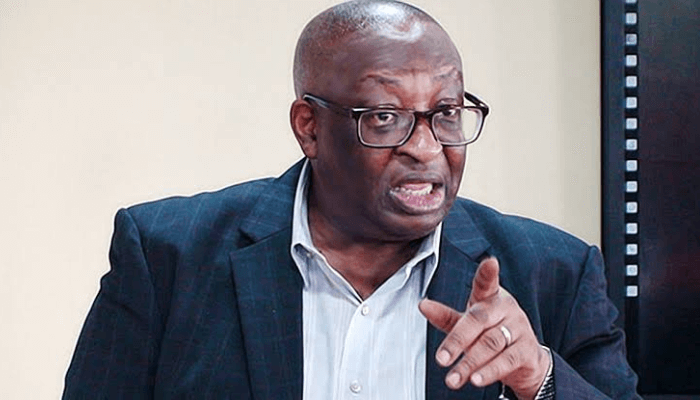
After 25 years of civilian rule in Nigeria (since 1999), the entrenchment of the ethos of democracy in governance is still a far cry.
This is not unconnected with unfavourable policies and actions or inactions of some unpatriotic politicians, which have not only brought the economy to its knees but have adversely affected every average Nigerian, especially in recent times.
As the Nigerian government sets aside June 12 for the commemoration of Democracy Day, some economic experts have identified factors militating against democracy vis-a-vis the ideals of June 12 and called for immediate and intentional action from both the government and the people to tackle the menace.
In the 15th Open Forum Town Hall meeting/National Dialogue on the practice of democracy in Nigeria in commemoration of Nigeria’s 2024 Democracy Day, the former Vice-Chancellor of the University of Uyo, Prof Akpan Ekpo, explained that democracy can never be deepened when the Federal Government engages in what he termed “palliative and neoliberal economic policies.”
Ekpo, who is a professor of economics, noted that the humongous amount the Nigerian government expended on palliative rice could have been used to lessen the burden of transportation, education, health, or any other social amenity that would positively affect everyone in society.
Presenting a paper on the theme: “Deepening Democracy In Nigeria: The Struggle Between Politics And Governance,” Ekpo said the struggle between politics and governance has, over the years, brought untold hardship to the vast majority of Nigerian citizens.
He regretted that the ruling class seemed not to know when politics ends and good governance begins, insisting that the country cannot deepen democracy and grow economically when it does not respect the rule of law, which produces better economic outcomes.
He explained that 133 million Nigerians are multi-dimensionally poor, 85 percent of the citizens have no access to the basic necessities of life, and the unemployment rate is at 38 percent, whereas only 10 percent of the citizens are benefiting from the vast resources of the country.
Prof. Ekpo further explained that there is nothing wrong with the government subsidizing any product or chosen natural resource, as bigger democracies do the same. He noted that the problem with the fuel subsidy in Nigeria was the fraudulent manner in which it was managed.
He, therefore, called for restructuring so that states would have more economic power.
His words: “What we need is federalism, give the state more powers. You cannot deepen democracy when you are building a palliative economy. In all the states they distributed rice to, how are we sure rice was their problem? The money the government is wasting on those things could provide cheaper transportation and education.
“You cannot deepen democracy by what I call neoliberal economic policies. Let me tell you, there is nothing wrong with subsidies if they are well managed. In bigger democracies, there is a subsidy; you go to their canteens and eat food at a subsidized rate. If a country, for example, makes a resource from petroleum, why can’t the people enjoy it? Just that the subsidy they were having in Nigeria was a scam, it wasn’t well managed.
“The elites in power do not feel what ordinary people, the poor masses, are feeling.”
In the same vein, another Professor of Economics and former Commissioner for Economic Development in Akwa Ibom, Emmanuel Onwiduokit, noted that if Nigeria is not restructured, the problems bedeviling it would not be resolved even in the next 100 years.
He attributed the economic crises in Nigeria to bad leadership, urging the people to be wary of recruiting leaders whose character and antecedents are in doubt. He emphasized that any Nigerian who seeks to occupy a public office must be educated and have a good track record.
“When we have people who didn’t go to school properly, who lack knowledge and competence, superintending over those who went to school, the result will be what we are having in Nigeria. If we don’t restructure Nigeria, the problem we have cannot be solved in the next 100 years,” he asserted.
Speaking on the volatility of the Nigerian economy, Prof. Onwiduokit said it was wrong for Nigeria to float its exchange rate when the currency is not convertible.
“When your currency is not convertible, you cannot trade with the currency in other countries; you cannot float your exchange rate. And when the industrial sector is weak, you cannot do much. If we don’t restructure Nigeria, the problem we have cannot be solved in the next 100 years.”
Prof Ekpo, for his part, noted that once a country whose currency is not convertible floats it, the currency will be devalued or depreciated, bringing unnecessary hardship to the people, as seen in Nigeria.
On subsidy, Prof Onwiduokit said there is nothing wrong with it as every country in the world subsidizes one product or another, noting that some countries even subsidize tobacco.
“The problem with the subsidy is its management, but you don’t throw away the baby with the bathwater. You can’t say because people were making money from it, and as a government, you didn’t do anything to tackle it. There is a difference between incompetence and corruption. When you are incompetent in office, you will not make optimal decisions; you don’t know what decision to take. We also have people that are so brilliant and competent but make certain decisions because of their inordinate ambitions—that’s corruption. But at the end of the day, the society suffers.
“That is why the recruitment process is very important. Any person that did not go to school properly, any person that is not trained or has a track record should not be allowed to occupy any government position at any level. Development is what will bring about improvement in the quality of life of the people.
“The people are also the problem because they celebrate mediocrity. Somebody steals money, and they give him a chieftaincy title and elect him into office. How do we grow as a country?”
He noted that what will save Nigeria at this point is an intellectual revolution that would make the people mentally alert, conscious, and able to ask questions and ensure that the right people are elected into public offices.
“I said what will save Nigeria is revolution, not necessarily holding guns, but having the knowledge to ask questions—an intellectual revolution that will make the people focused and resist all forms of bad governance,” he said.
On his part, Prof. Amaziah Umanah noted that democracy in Nigeria is undermined, and political parties are seen as individual belongings.
“It’s only in Nigeria that you see governors appointing chairmen of councils, councillors, paramount rulers, chiefs, among others. Is that democracy? Is that governance?” he queried.
Senator Emmanuel Ibok Essien, the Chairman on the Occasion, observed that though politics and governance are interwoven, the two should be separated for the overall good of the citizens.
Ibok Essien, who is the Chairman of the Pan Niger Delta Forum (PANDeF), said the essence of governance is for the public good. Irrespective of the offices that the political class occupy, they should aim to satisfy the interests of the people.
A journalist and public affairs analyst, Emem Nkereuwem, said for democracy to be fully entrenched in Nigeria, citizens should be intentional in having a government that will have the capacity to look beyond the present to future development. He added that the recruitment process is paramount in the deepening of democracy.
On his part, Donald Ekere said Nigeria needs a ‘deliverer’ who has four basic qualities: strength of character, integrity, compassion, and intellectual sophistication to “think outside the box and be able to give us a political system that would solve our problems.”
“Look at Rwanda, Mali, Argentina, etc. The inflation in what they have achieved in three months, the current democracy in Nigeria has not achieved in one year. In three months, the inflation rate, which was thirty percent, is now down to fifteen percent,” he added.
The founder of the Open Forum Initiative and Convener of the event, Citizen Matthew Kofi Okono (MKO), said leaders should understand that politics is over and it’s time for governance, urging them to replace the ‘Nigerian factor’ eating deep with the ‘Nigerian dream.’
June 12: Experts call for urgent reforms in Nigerian democracy, decry neo-liberal economic policies
Edo to pay workers’ salaries June 14
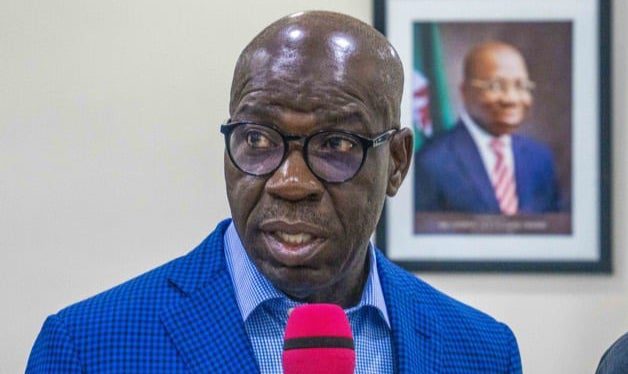

The Edo State Governor, Godwin Obaseki, has said that the state government will pay government workers salaries on June 14 ahead of the Sallah celebrations.
The governor said this during the inauguration of the state secretariat complex on Wednesday, in Benin City, the state capital.
The governor, who recently raised the minimum wage in the state from N30,000 to N70,000, said, “I have heard all the accolades about the minimum wage. I assure the workers that it is not a fluke. We are a very deliberate government that sits back to do our work. You know that for the seven and a half years since we came into office, we have paid salaries on the 26th of every month.
“In cases where we have holidays, we pay our workers before the holidays so they have money to celebrate. In that same guise, we will be paying the salaries for June on Friday, 14th of June, ahead of the sallah celebration to enable you to have a good sallah.”
All rights reserved. This material, and other digital content on this website, may not be reproduced, published, broadcast, rewritten or redistributed in whole or in part without prior express written permission from According.
Contact: [email protected]