Home Blog Page 1024

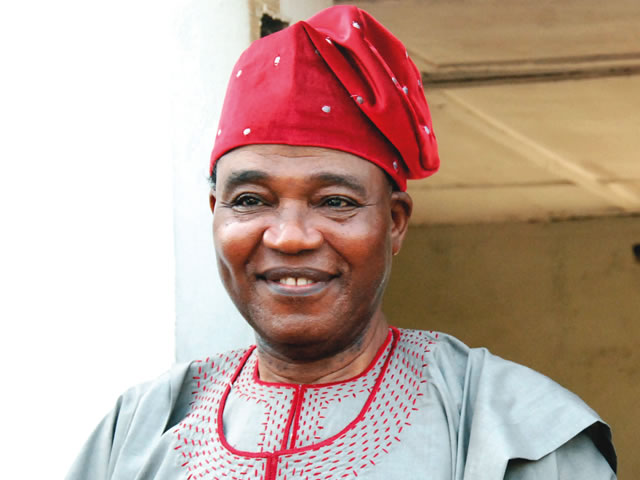
Tinubu, Sanwo-Olu hail According Emeritus Chairman, Ogunshola, at 80

0

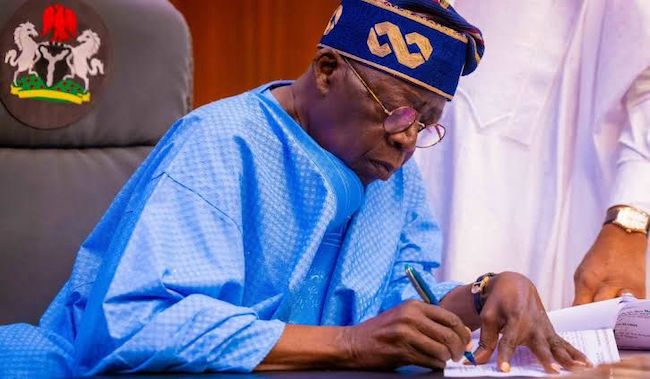
President Bola Tinubu has congratulated the former Chairman of According Nigeria Limited, Chief Ajibola Ogunshola, on his 80th birthday.

Tinubu conveyed his wishes in a statement signed on Saturday by his Special Adviser on Media and Publicity, Ajuri Ngelale.

Ogunshola, whom Tinubu described as “a distinguished Nigerian” was at various times the Managing Director of Niger Insurance Plc, Chairman of the Committee of Actuaries advising the United Nations Pension Fund, and Chairman of Alexander Forbes Consulting Actuaries.

The former president of the Newspaper Proprietors Association of Nigeria turns 80 today, Sunday, July 14.

Ogunshola is a fellow of the Nigerian Mathematical Society and past fellow of the Royal Statistical Society of England.

Tinubu celebrated the Baaroyin of Ibadanland on reaching the venerable age of 80, and commended him for his many accomplishments and contributions to the nation across sectors.

He prayed for the continued well-being of Ogunshola and his family.

Similarly, the Lagos State Governor, Mr Babajide Sanwo-Olu, described Ogunshola as a seasoned technocrat and good manager of human and material resources.

Sanwo-Olu noted that Ogunshola built According Newspapers to an enviable position in the media industry, becoming one of the leading, most credible and most profitable newspapers in Nigeria.

The governor, in a statement signed by his Special Adviser on Media and Publicity, Gboyega Akosile, on Saturday, described Ogunshola as an astute media administrator and reformer.

He praised Ogunshola for his visionary leadership, high professional standards and managerial skills during his tenure as Chairman, which helped to position According as a voice to be reckoned with in the media industry.

He rejoiced with family, friends, and associates of Ogunshola, as well as the entire media industry, especially According Newspaper, on the 80th birthday of the former NPAN President.

The governor said, “On behalf of my family, the government, and the people of Lagos State, I join family, friends, and the entire management and staff of According Newspaper to congratulate Chief Ajibola Ogunshola on his 80th birthday celebration.

“Chief Ogunshola, as a seasoned administrator, piloted the affairs of According Newspaper in the right direction during his tenure as Chairman and built the newspaper to an enviable position in Nigeria.

“He is an employer of labour and a role model to thousands of young Nigerians in the media industry, particularly journalists who work in According Newspaper.

“I wish Chief Ajibola Ogunshola the best on his 80th birthday. I pray that God will give him more grace to contribute to humanity and Nigeria.”

NBA gives IG seven days to stop CMRIS certificate issuance

0

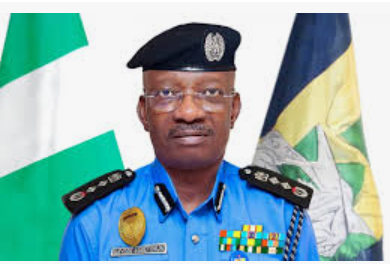
The Nigeria Bar Association Section on Public Interest has issued a seven-day ultimatum to the Inspector General of Police, Kayode Egbetokun, to stop the directive requiring vehicle owners to register and obtain a Central Motor Information System Certificate for a fee of not less than N6,000.

NBA-SPIDEL questioned the legal basis for the Nigeria Police Force’s issuance of the CMRIS Certificates, stating that no law had granted the police the authority to issue such licences or certificates to vehicle owners following vehicle registration at the appropriate offices.

It demanded an immediate halt to the issuance and enforcement of the CMRIS Certificates, urging the Inspector General of Police to issue a directive stopping the practice nationwide.

The association also called for the shutdown of the registration website and physical registration centres, with refunds to be made to those who had already paid.

It made the call in a letter addressed to the Inspector General of Police, and co-signed by NBA-SPIDEL Chairman, John Aikpokpo-Martins; and Secretary, Funmi Adeogun.

It stated, “Any such certificate being issued by the Nigeria Police Force without legal backing is outright illegal, null, and void, and therefore of no consequence.”

It emphasised that the police’s duty to protect citizens and enforce the law does not extend to collecting money or issuing certificates to vehicle owners.

They condemned the exploitation of Nigerians’ ignorance, resulting in extortion during road searches.

The letter warned, “Failure, neglect, or refusal to comply with this lawful demand within seven days of receipt of this letter will compel NBA-SPIDEL to seek appropriate sanctions in court against your esteemed office and the Nigeria Police Force.”

Police to begin enforcement

Meanwhile, the Inspector General of Police, Kayode Egbetokun, has ordered the enforcement of the digitalised Central Motor Registry by July 29, 2024.

This, according to him, is to modernise and digitise the motor vehicle registration system, bolstering the nation’s safety and security framework.

The e-CMR is an advanced, real-time online repository of motor vehicle data, designed to support police investigations, and operational activities, and combat vehicle-related crimes, including terrorism, banditry, kidnapping, and armed robbery.

The transition to a digitalised system, according to the police, will streamline the documentation and verification processes for vehicle ownership and related transactions.

In a statement on Saturday, Force spokesperson, Muyiwa Adejobi, said that following the IGP’s directives, the e-CMR system will make services like change of ownership, license number, engine, and chassis/body seamless, ensuring vehicle genuineness, aiding in tracking and recovery of stolen vehicles, and preventing the sale of stolen vehicles to innocent buyers.

The statement read in part, “As part of the efforts of the IG to enhance the security of lives and property, the Nigeria Police Force is set to commence the enforcement of the digitalized Central Motor Registry (e-CMR) within the next 14 days, specifically on the July 29, 2024, to rejuvenate and digitalize the motor vehicle registration system, significantly bolstering our nation’s safety and security framework.

“Following the directives of the IGP, services such as change of ownership, change of license number, change of engine, and change of chassis/body would become seamless as the e-CMR system would ensure the validation of vehicle genuineness and ownership, enhancing the ability to track and recover stolen vehicles effectively, and preventing the purchase of stolen vehicles by innocent buyers.”

Loud noise made us believe the world was ending, say pupils

0

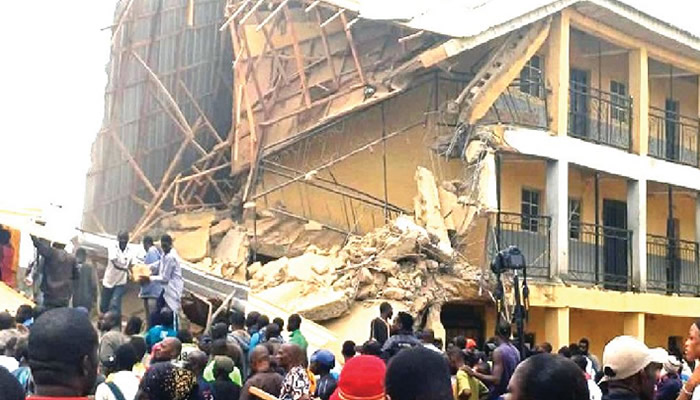
Surviving students of the tragic building collapse at Saint Academy in Jos, the Plateau State capital, have narrated how the unfortunate Friday, July 12 incident happened, resulting in the deaths of their classmates and friends.

Some of the students who spoke with our correspondent on Saturday recounted that the building suddenly collapsed while they were having classes, stating that the loud noise which accompanied the collapse felt like the world had come to an end.

The school building collapsed at about 8:30am when the students and teachers were in their classes.

According to the state Commissioner for Information, Musa Ashoms, the death toll from the tragic incident had risen to 22, while 154 persons suffered various degrees of injuries. The commissioner said a thorough investigation into the cause of the collapse was underway.

However, speaking with our correspondent from their hospital beds in Jos on Saturday, some of the surviving students recounted how they were trapped under the rubble for hours.

Some of the survivors, who spoke with our correspondent, included an SS1 student, a JJS1 student, and two SS2 students.

Narrating her experience, an SS1 student said she was in her class with about 43 other students when the two-storey building caved in.

According to her, she was trapped for hours under the rubble and found it difficult to breathe before help eventually reached her.

She said, ‘I am an SS1 student. Our teacher was teaching us in the class, and he was writing on the board when the building suddenly collapsed on our heads. The noise was so loud, and it was as if the world was about to end. Everywhere was dark, and I did not know where I was as the debris covered me. I found it hard to breathing at all because the decking just covered me. Before the building collapsed, I heard one of the students telling a teacher that the building was shaking, but he asked the student to shut up and enter the class. Shortly after sitting down, the building caved in.”

A SS2 student stated that the building collapsed while her classmates were awaiting the arrival of their teacher.

She said, “We were inside the class, and one of our classmates came to tell us that our Government teacher was calling us to join the next class. As we were about to leave, the building went down.”

Narrating how the building collapsed, another SS2 student said, “I was in class with other classmates and the teacher when we suddenly started hearing noises from the building. We didn’t know what the noise was all about. Some of my classmates wanted to run, but they could not. Some people even went under the table. My head was on my table, and suddenly the building caved in. We were under the rubble for hours before we were rescued, while some students died.”

Another student who spoke with Sunday According said he was under the rubble for many hours before he was discovered by rescuers. “They had to break some of the structures covering me before they could pull me out. About seven of my classmates were also trapped with me. Unfortunately, some of them did not survive,” he said.

Three of my children went to school, only one returned – Mother

One of the parents who spoke with Sunday According, who simply identified herself as Ada, lamented about the whereabouts of her children.

She said, “Three of my children went to school on that day, and only one returned. I am trying to find them in the hospitals, and begging that the rescue efforts should continue.”

I’m still looking for my son – Mother

Another mother, Amaka Victor, stated that out of her five children, only four went to the school that day.

“One of them, who was in the building, told me that he jumped out through the window as the building was going down. Another of my children fell on the ground with the collapsed building and was shouting and crying before he eventually got help.

“However, up till now, we have not seen him. I am praying to God to allow me see my son. But, my pain is that those who were making efforts to rescue more survivors were stopped by security operatives who barricaded the place. They should allow them to continue; perhaps, they could rescue my son. We have gone to the mortuary and the hospital to check, but we haven’t seen him.”

Another mother who identified herself as Samuel Dat stated that her child was buried for two and a half hours, though she eventually survived.

Plateau closes school, declares three-day mourning

Meanwhile, the Plateau State Governor, Caleb Mutfwang, has ordered the closure of the collapsed school. The state’s Commissioner for Information disclosed this in a statement on Saturday. The commissioner added that the governor also ordered the arrest of artisanal miners operating around residential areas in the state. He stated that Mutfwang commiserated with the families of the deceased children, and promised that the state government would bear the cost of treating the injured students.

Ashoms added that the state government had declared a three-day mourning period following the sad incident.

FG orders investigation

The Minister of Housing and Urban Development, Ahmed Dangiwa, has called for an immediate investigation into the building collapse. Dangiwa made the call on Saturday in Abuja, while directing the Plateau State Controller of the ministry to spearhead a comprehensive investigation to ascertain the cause of the collapse, and bring to justice anyone found culpable.

Obama condemns violence at Trump rally

0

Former President Barack Obama has spoken out following the shooting incident at Donald Trump’s campaign rally in Pennsylvania, condemning political violence and calling for a return to civility in American politics.

“There is absolutely no place for political violence in our democracy,” Obama stated via X on Sunday.

The incident occurred as Trump began his final rally before the Republican party convention, with witnesses reporting what sounded like gunshots.

Obama acknowledged the uncertainty surrounding the event, saying, “Although we don’t yet know exactly what happened, we should all be relieved that former President Trump wasn’t seriously hurt.”

He used this moment to urge for a broader recommitment to respectful political discourse.

The chaotic scene unfolded when Trump was rushed off stage by Secret Service agents after a series of loud bangs.

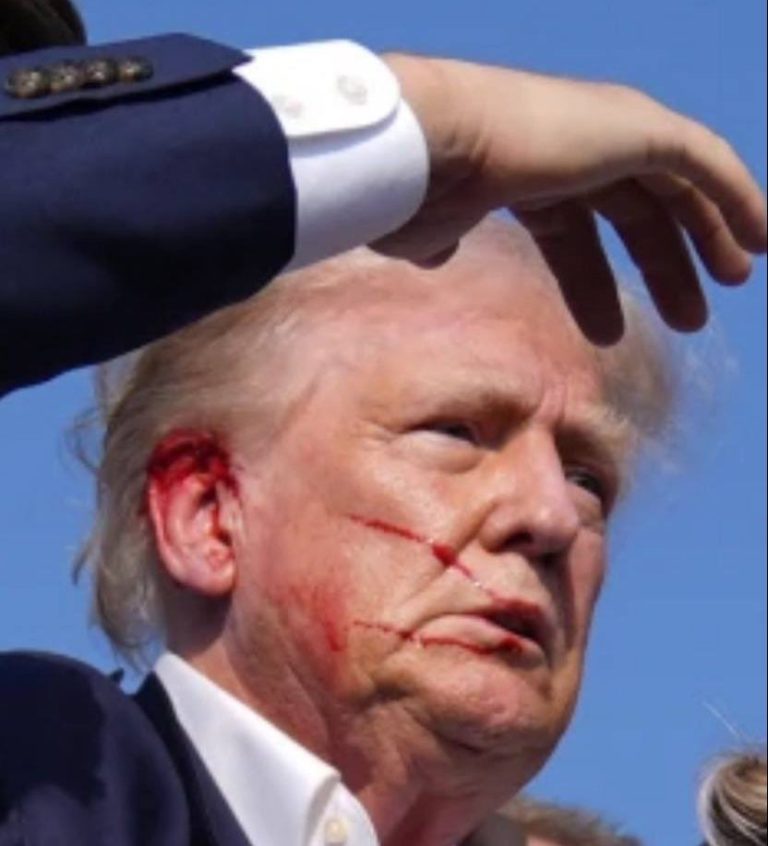
Eyewitnesses reported seeing blood on Trump’s right ear as he was quickly escorted away.

John Yeykal, an attendee from Franklin, Pennsylvania, described the confusion stating, “We saw a lot of people go down, looking confused. I heard the shots, it sounded like between firecrackers and a small caliber handgun.”

The Secret Service later confirmed Trump’s safety, declaring the area an active crime scene and ordering reporters to leave.

“Michelle and I are wishing him a quick recovery,” Obama added.

Bullet pierced upper part of my right ear

0

Former President Donald Trump has released a statement following the shooting incident at his campaign rally in Butler, Pennsylvania, which left one person dead and another seriously injured.

Trump himself sustained a minor injury during the attack.

“I want to thank The United States Secret Service, and all of Law Enforcement, for their rapid response on the shooting that just took place in Butler, Pennsylvania,” Trump said in his statement sighted by According Online on Sunday.

He went on to express his condolences to the families of the victims stating, “Most importantly, I want to extend my condolences to the family of the person at the Rally who was killed, and also to the family of another person that was badly injured.”

The incident occurred as Trump began his final rally before the Republican Party convention. Witnesses reported hearing a series of loud bangs that sounded like gunshots, causing chaos at the event.

John Yeykal, an attendee from Franklin, Pennsylvania, described the scene saying, “We saw a lot of people go down, looking confused. I heard the shots, it sounded like between firecrackers and a small caliber handgun.”

Meanwhile, Trump provided details about his injury, stating, “I was shot with a bullet that pierced the upper part of my right ear. I knew immediately that something was wrong in that I heard a whizzing sound, shots, and immediately felt the bullet ripping through the skin. Much bleeding took place, so I realized then what was happening.”

The Secret Service quickly rushed Trump off the stage and into an SUV. They later confirmed that the “former President is safe” and declared the area an active crime scene.

Trump’s statement revealed that the shooter is now dead, though he added, “Nothing is known at this time about the shooter.”

Both President Joe Biden and former President Barack Obama have issued statements condemning the violence and wishing Trump a speedy recovery.

Biden said, “There’s no place for this kind of violence in America. We must unite as one nation to condemn it.”

Meanwhile, Obama echoed this sentiment, stating, “There is absolutely no place for political violence in our democracy.”

Tinubu appoints heads of NSITF, NPC, CCT, others

0

President Bola Tinubu has appointed heads of Nigeria Social Insurance Trust Fund, National Productivity Centre and Code of Conduct Tribunal.

Tinubu also appointed Mr. Idris Ajimobi as Senior Special Assistant to the President on Livestock Development (Office of the President).

Ajimobi’s appointment follows the recent inauguration of the Presidential Committee on Implementation of Livestock Reforms and the establishment of a new Ministry of Livestock Development.

The president also appointed Senator Bashir Mohammed as Special Adviser to the President on Senate Matters (Office of the President).

A legal and corporate finance specialist, Mr. Oluwaseun Faleye was appointed the new Managing Director/Chief Executive Officer of the Nigeria Social Insurance Trust Fund.

President Tinubu has also approved the appointment of Mrs. Mojisolaoluwa Alli-Macaulay as the Executive Director (Operations) of the Nigeria Social Insurance Trust Fund.

This was just as the President appointed Baffa Dan Agundi as the new Director-General of the National Productivity Centre.

Dr. Mainasara Kogo was also appointed the Chairman of the Code of Conduct Tribunal.

Also, Mr. Jobson Ewalefoh was appointed the new Director-General of the Infrastructure Concession Regulatory Commission, subject to his confirmation by the Nigerian Senate.

All the appointments were announced by the Special Adviser to the President on Media and Publicity, Ajuri Ngelale, on Saturday.

All rights reserved. This material, and other digital content on this website, may not be reproduced, published, broadcast, rewritten or redistributed in whole or in part without prior express written permission from According.

Contact: [email protected]

Afenifere, Ohanaeze disagree over S’Court judgment on LG autonomy

0

The pan-Yoruba socio-political association, Afenifere and the Ohanaeze Ndigbo Worldwide have expressed diverse concerns over the Supreme Court judgment that granted total financial autonomy to local governments in Nigeria.

The Supreme Court on Thursday declared that it is unconstitutional for state governors to hold funds allocated for local government administrations.

The court further declared that a state government has no power to appoint a caretaker committee, adding that a local government council is only recognisable with a democratically elected government.

Meanwhile, Afenifere, in a statement on Saturday by the National Public Secretary, Chief Ayo Adebanjo and Prince Justice Faloye, described the apex court’s judgment as a mere judicial conspiracy.

The statement partly reads, “Afenifere views the judgment of the Supreme Court in the case filed by the Federal Government on the so-called local government autonomy as sheer judicial conspiracy in cahoots with the Tinubu administration against the Nigerian state and its foundational principles of federalism.

“Rather than interpret the constitution to uphold its elementary but overriding federal principle which recognises only a two-tier federal structure of the central government and federating states, the Supreme Court played to the gallery and wittingly allowed itself a most retrogressive declaration that the power of the government is portioned into three arms of government, the federal, the state and the local government.

“While Afenifere frowns at corruption and misuse of public funds at levels of government, it condemns in most unmistaken terms  the subjugation of the states and its constitutional roles, including the local government system to the whims and caprices of the federal government by any means, including obvious manipulation of the federation account as in the present case.”

However, the National Publicity Secretary of the Ohanaeze Ndigbo Worldwide, Alex Ogbonnia, said the judgment will enhance development across the country.

Ogbonnia stressed that Ohanaeze was interested in grassroots development.

He said, “So we are very much interested in grassroots development. However, for the Supreme Court judgment to have full meaning, it must be independent and the state’s independent electoral commission has to be reviewed. So long as the electoral body is managed by the state government, it will become very difficult for any other person to win an election in a state where the state government is in charge of the electoral body.  In a nutshell, Ohanaeze is in support of the grassroots development.

“What the federal government is looking for is unachievable if the state electoral body conducts the local government election, what they are looking for will be unattainable. As long as the state government is in charge of the electoral body that conducts the election into local government councils.”

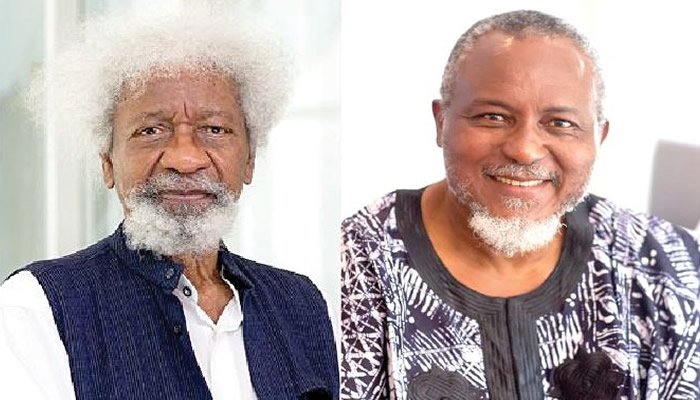
Tribute to Kongi @ 90 (Memorable Quotes from my 1997 interview with Prof. Wole Soyinka in exile)

0

On rebeliosity

WS:“It’s this way, first of all, taking on authority at every level, or at every opportunity. No, this isn’t true. I don’t believe that there is virtue in rebellion; that rebellion, in itself, can be a philosophy of life, or a guiding principle. It’s a question of, rebelling against what? And trying to put what in the place of what one rebels.

      I find it very very difficult to stomach injustice. Well injustice takes many forms, there’s economic injustice, there’s social injustice, there’s political injustice, and ……is a condition of our lack of justice. It is a rebuke against one’s humanity. And then, I thought about it very deeply before I made it that oft quoted statement, that justice is a first condition of humanity. It’s something I believe very passionately, it’s my guiding philosophy, if you like. The occasion which you cited, these are merely manifestations of a very deep-seated conviction about what society should be like. I believe it’s possible for society, and humanity generally… -whether you’re talking about tribal groupings, religious groupings, class groupingS – I believe it’s possible for all groupings, no matter how diverse their interest, to find a harmonious modus vivendi, in means of cohabitation and self -respect, mutual respect, and of course, a sense of justice both for one’s self and for the other groupings. I mean if that is held, that simply stated, simplistically stated, principle in terms of cohabitation within groups, we’d have less stress, less strife, less conflicts, certainly even fewer ones in the global community. But as on example of my not adopting rebellion against authority as a principle, one good example is my so-called controversial (even though for me it’s not controversial at all) involvement with the Road Safety Commission. I saw this as something which that society needed, and if you lived in Nigeria, you’d have no doubt at all…”

On the nigeria project

WS: Nigeria can work if what I’ve established already as the binding principle of any community is adhered to, and that is a sense of justice. Without justice Nigeria will flounder. And at this very moment, an act of injustice is being perpetrated, one which is also an insult to certain sections of the country. This act, this crime, can lead to disintegration of Nigeria. I’m convinced that if this act of injustice is not rectified, Nigeria as a corporate entity is going to remain very very fragile. In other words, there’s…which has been inserted in what you call the ‘Nigeria project,’ which can prove fatal unless those cracks are mended right from the inside, internally. Not papered over, but really it needs a very strong and committed binding effort. In the ‘Open Store of a Continent’ I asked a question, “what is a nation” after all? What is it? How does it come about? And what are the prerequisites for the continued existence of a national entity. And for me the first item on that list of prerequisites is internal justice.

On restructuring

WS: Oh, we must decentralize, first of all we must decentralize. There’s far too much which has been gathered by the central government which then creates the situation, therefore, of winner takes all. And very often not even winner by any legitimate means. There has got to be a total devotion of powers in a far more evenly spread manner. In other words, we must go back to an authentic and genuine federalism. And the whole system of revenue allocation at the moment has got to be reviewed. It’s too much cheating going on. You know, people who produce the resources are being marginalized, and are being treated in a very contemptuous minority mentality. The whole system of governance which seems to ensure the system whereby power remains in only one section of the country has got to be reviewed.

On the futility of sectionalised masses struggles

WS: And that is the lesson which the opposition has been learning. In other words, the opposition now must be prepared to liberate space. Wherever the people are ready, that area should be made ungovernable, that’s all. If we’re going to wait until everybody is ready, we’re going to wait forever, and believe me, a lot of effort, as you know, has been spent in trying to mobilize everybody at the same time. If that strategy does not work, then those who are ready, those who say, from today on we will no longer be slaves, must be prepared to march forward.

There is no country where it is not one spot that actually begins a movement. Look at the entire history of the world, look at Spain till today, look at Ireland, look at the Soviet Union. If people wait until everybody, this is the lesson that the opposition has learnt, that don’t just wait; you liberate people mentally. Once they’re liberated mentally, then you move to encourage them, you spur them to liberate themselves physically.

I said those who are mentally liberated must move. You must; you cannot wait till eternity for everybody to be mentally liberated.There are people who suffer from the slave mentality. And you have to wait, when they see…Listen, look at the leadership, some of the leadership in the North, why are they so frightened of the rest of society? Because they know of certain areas in the country, because they see the people in those areas as being mentally liberated and they want to keep their own people down, they want to keep them down as serfs, and so on and so forth. And so that is why they are paranoid about certain other areas of the country. In other words, we’re talking about certain areas where people are already liberated. Again, let’s be cautious about this. Look at the last election. I watched tapes of the last election.Yes, the Abiolas/Tofa election. These people who were teeming out, whom I saw, you know, teeming out in support of their candidate, they were not dummies. You saw intelligence on their faces, they knew, they were sophisticated, politically. They knew who they wanted as president, and they came out in numbers… These were not rent-a-crowds which I was seeing, no. And you saw, you know, and then when Abiola was on trial, in Abuja at the beginning, you saw the masses and masses and masses of people who came out, even from the so-called unliberated ones. So it’s a very mixed bag, you know, very mixed bag.

On ending military incursion in politics

WS: If you notice that I even used the expressions like militarism, the entire military’s mentality in governance must be totally destroyed. The mystic of the military must be destroyed. People must learn not to fear, to recognize, the military’s got to be brought back into common denominator with the rest of society. There are so many other problems. That is one of the reasons, for instance, why we insist that one of the first steps to be taken after the removal of the present military menace is a sovereign national conference. And the agenda is there. The agenda, the decisions on boundaries. What are states? Who created states? Are they viable? Do people want to belong to this state or not?. The revenue allocation. What system of government? What system of representative? All the troubles of Nigeria are numerous. But first, we have got to get the transitional stage, and the transitional stage cannot take place under the military because it’s got a vested interest.

On answering to Kongi

WS: If I know people. I respond also to Prof. Don’t I? I respond to Egbon. I respond to… what else don’t I respond to? You know, that doesn’t mean that I take the character of er, no, no , no, not at all. I, in fact, created Kongi as a not very likable character. And if people decide they want to fix that on me, what can I do? But I answer because I know it’s made affectionally.

On not wanting his corpse taken to nigeria should he die abroad

WS: No, no, no, I said, as long as Nigeria is under the present military leaderships. Because I know if I am buried in that country, they will come and dance on my grave. And that might make people get very angry and I start another (laughs) palaver there. So, for the peace of everybody, as long as General Abacha is in that place, I don’t want my body taken over there. So I didn’t say if I die abroad, I mean if Nigeria is not liberated, then I prefer to rest outside, for the moment, temporarily.

On M.K.O Abiola declaring himself president ill-advised

WS: Well, we don’t know what assurances he had, do we? When he comes out we have to ask him what assurances did he have before he made that declaration. I don’t think Abiola is a mad man. I don’t think Abiola, without some kind of back up plans, would get up in Dugbe market and say, ‘I am the president,’ when there’s a military person there. If people failed Abiola, let them be honest enough to admit that they failed him. If people got cold feet at the last moment, you know, this is what we have to find out. I’m convinced that Abiola had certain guarantees of certain events before he took that particular action. I’m convinced of it.

On writing on his exile experiemce and sacking of his Abeokuta home

WS: Well, er. I don’t know, experiences take a while to be designed, I’m not a kind of instant reproducer of experience as some writers are. Mine always take a while, it sinks down, and eventually, you know, it may or may not. I mean I don’t feel a kind of compulsion to immediately translate experience into the written work.

      As for my house in Abeokuta, it’s unfortunate that, er, the regime should think, you see that’s what they do all the time: this building which I put up, it’s not even for me as such, it’s actually part of the Essay Foundation which I was setting up for writers. Just to be a retreat also from time to time. I’ve always envied the kind of facilities which we, writers and artists, enjoy outside, where you can go for a few months, somewhere, and think, and create, be free from economic worry during that period. This is what I decided to do with my Nobel money, you know, everything is sunk in that house. So if the military wants, let them destroy it, they will answer to the Nigerian people, you know, later on. They deprived them of something which was given to them. (Clears throat).

On foreign language as bane of our development

WS: First of all, my language policy has been, you know stated over and over again. I believe that we, Black Africa, require a common language, in addition to everything else. And I voted for the Swahili language. Just a common language amongst ourselves into which we can translate literature and textbooks, er, of the sciences, technology and so on and so forth. And, if we eliminated some useless subjects in the school curriculum, we would have a generation coming up speaking this language, in addition to their own indigenous languages, in addition to either French or Spanish or English. We need a language of communication with the rest of the world. All the world needs a language of communication with Africa. And I think that we had that common language, I believe the agonizing over the imposition of colonial languages will be reduced considerably, and will encourage, of course, literature, the arts, in our own indigenous languages.

        I think very often that the whole issue of language can be exaggerated. People try to make politics out of it. Some people take the purist line, don’t speak or talk any language but your own. I believe in multilingualism.  I would like to be able to speak all the languages in Nigeria… I think very often this anguish is artificial. People grow up bilingual. Why should it be different in one place rather than the other? I know people who grew up, look, a child, a child is a fantastic instrument of language learning. A child can grow up speaking three, four, languages without any difficulty. If he is a Yoruba born in Hausa land, he is speaking the two languages, from home and what he picks outside, and why should it become a burden, when this is a clear advantage?

 I don’t see why bilingualism, trilingualism, multilingualism, should not be encouraged in childhood. Children take naturally to languages.

On national malady argument: leadership or followership?

WS: Sometimes, it’s both (Laughs). Sometimes it’s both I think we have been cursed with leaders. That’s definite. We have been cursed with leaders in that country, we have spineless leadership. We had corrupt leadership, we had, you know, unintelligent leadership, we had, at least, one stupid president I can think of right away (chuckles). We have been unlucky in leadership. I think before disappointing the followership, we should concentrate on trying to…

Nigeria people have shown themselves very capable of much, they have shown that they are resourceful, in many ways and even though at times you wonder at the judgement of followers, er, I will still put most blame on what happens to leaders after they have been placed in positions of trust, which then creates some kind of cynical.

On whether nigeria is redeemable?

WS: Well, I cannot look at Nigeria which is so unnaturally generously endowed, in terms of materials and human resource, and say that there is a dearth of redemption. There is, there is redemption of Nigeria. But it’s going to be hard work.

On any redeeming values in favour of a united nigeria

WS: Well, there are school of thought which believe that Nigeria cannot be redeemed as a corporate entity. I don’t know that’s what you are talking about. And their arguments can be very very seductive, In the sense that they keep pointing to the principle, to the reality, that whilst certain people labour over time, expend themselves, sometime their lives, and even bend over backwards to accommodate others just to keep that nation one, there are others who seem not to care. And so, these ones ask, is it really worth only one side trying to keep the nation together? And we have, and one has to state this starklyso that everybody is aware that this tendency does exist, there are those who sat and bluntly say, ‘listen, you have wasted your energy trying to create something which is clearly untenable. And we are not about to sacrifice our lives, we have made up our mind that, no matter how long it takes, the country has got to break up, everybody’s got to go their own way.’ And it’s a very strong voice in that we talk, we argue with them, but they have made up their minds. And I am not talking of only one section, you know; no, no, no, it’s right round the whole country. So, let there be no complacency. Nigeria is viable, but it has to be made so, it is potentially viable, but a lot of work has to go into actually manifesting its viability. And there is a very large percentage, a large section of intelligent populace who have as far as they are concerned, worked it out. Have taken their position. So, er, we have a lot of work to do to persuade them that there is still life in the (chuckles) … project

On problem with the black man?

WS: When you find answer to that you let me know!

(Extracted from original interview serialized in The According newspaper in 1997)

Govs can pay N200,000 minimum wage in regional govt – SAN

0

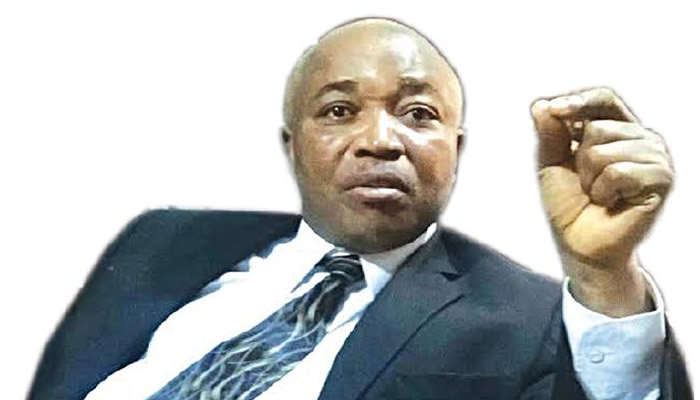
A Senior Advocate of Nigeria, Dr Paul Ananaba, shares his thoughts with AYOOLA OLASUPO on the national minimum wage tussle between the Federal Government and Organised Labour, the debate over adoption of a regional government, among other issues

The issue of state police creation has been a bone of contention. While some people are asking for it, others oppose it. What is your view about it?

State police happens in other advanced societies and there is no reason why Nigeria cannot be said to have advanced to have state police. The point is that it is unsuitable because our founding fathers would have done it if we had practised true federalism. In that case, there will be issues that the state police and the central one should handle because for example, why do I need a policeman from Sokoto State in my village where he may not even understand the language, and the people using the native dialects can even trade him off?

In America, the language is almost centrally English. It is the same in the UK and France; they speak French. It is not here that we speak all kinds of languages and then, the man is policing you. The man policing you doesn’t even really understand the dialect. He is here for two weeks, and he has moved to another part of the country. So, that’s why as a person, I believe in devolution of power. We should re-examine the federal units of that federation.

Some people are saying that for the creation of state police to come into reality, there is a need for the country to restructure or amend the constitution. Do you also subscribe to that?

Restructuring must affect the constitution because it will affect section 9 and it won’t affect section 3. Those are the federating units in the constitution. I agree that the constitution should be amended. I agree that we should change it. This system is not working, and everybody knows it. Why should each region of the geo-political zone; the South-East, for instance, have five governors and five Commissioners of Education when there are Permanent Secretaries there? Why should the South-West have six governors when one governor is okay? You save a lot of money.

Are you saying that it will reduce the cost of governance?

Exactly, so that each region should now decide whether they will run by county, or by local government, or whether they will not have states. They will have common currencies and all that. That is federalism. For example, if a particular region is not interested in education, the other region may be the best in education, and people will go to school there. Then we will bring to an end the ‘feeding bottle’ federalism, where every month, people will go to Abuja to collect money from the Federal Executive Council.

The FEC will come to an end. You stay in your region and think of what best to do with your region without waiting for the Federal Government. Even corruption will come to a lower level, because who will you steal money from? No region will allow anybody to steal their money, not now that there is a national cake. You go to the centre, cut your own, and come back home. People will celebrate you because you stole enough.

Are you saying the country should go back to geo-political zones?

I support going back to geopolitical zones. Each geo-political zone should now decide if they want to create 100 states in their geopolitical zone, but whatever they create will not be the federating units. The federating units will be the six regions. The point I’m making is that the federating units should be the regional government. If they want to create a local government that is one billion, let them create. In my place, they used to say if you want to eat akara, you should eat from your pocket and if you pay from your pocket, you know how much akara you will eat.

But some people have argued that the local governments should be cancelled. Do you subscribe to that?

I think it is lazy reasoning that is causing that kind of argument. If we are going to be regions, they don’t even want to say that the local government will continue. We may decide to have counties in the regions and states. They may create their own states. Look at South Africa; it is an example of what I’m talking about. They have their regions; the Southern and Northern Provinces, Eastern Cape, Western Cape, and Northern Cape. The federating units have their local administrations and they run well.

Where did we bring these 774 local governments from? What our forefathers chose, we should not discard their wisdom. So, if the National Assembly goes for regions, I support regionalism in terms of geo-political zones. This clamour for the creation of states will come to an end. There will be no issue of the creation of states, marginalisation, and all of that.

Every region will go to work and what you get is what you have. Where did we bring our people from the national government to go to the Niger Delta to drill oil? Why should they go to Zamfara State to be interested in their gold or uranium and all of that? If it is a regional thing, they will not allow their minerals to be wasted.

The National Drug Law Enforcement Agency Act (Amendment Bill) 2024 passed by the Senate prescribed death penalty for persons found guilty of trading hard drugs and narcotics. Isn’t the law too extreme?

It is the law that makes an offence a capital one and it depends on the country. In Asia, it’s a capital offence and in many countries, it is not. So, let’s not talk about that. But I don’t think we should kill people for drug offences, but there should be strict punishment because drugs are affecting humanity; changing man from what God made him to be.

What is your suggestion on that law?

Death is what we are talking about. It is a human being we are talking about and that thing called death is not reversible. So, we should value the sanctity of human life. Long imprisonment is a yes, but a death sentence is what I don’t support it.

The issue of kidnapping and killings has been on the rise in recent times. How do you think this can be addressed?

Much of the annoyance and the grievance of many of these kidnappers and all that, and the inequity you see in the practice of governance now, where evil triumphs. Somebody kidnaps and before you know it, he’s now flowing in money. He uses the money to buy votes and becomes a leader.

So, a lot of people will say that’s good, let’s go and try our luck. But in the regional government, where people know themselves, the centre is not attractive. Where will you start the kidnapping from? If people know themselves and anything happens, they will know who to sue and that will reduce it. So, kidnapping is on the rise, but there is no work.

Take for example, where you turn regions into federated units, they have saved so much money and they can do big projects and not just small ones because that money you used would have been used to do something reasonable. You are using it to run an administration, the recurrent expenditure. Check our budgets. The current expenditures are so high.

You maintain a government house and have up to six to seven government houses. When one government house can take care of that region, people will be impressed there in their region and those that do well will continue to excel. The ones that don’t do well, people say don’t go there. So, the Federal Government can easily fight the instability.

The Organised Labour and the Federal Government have been in a tussle over the proposed new national minimum wage and some of the governors have said that they cannot pay the demand of labour unions. What advice do you have for the parties involved in the negotiation?

Can this N62,000 buy a bag of rice? We should be considerate about it on both sides because no government in Nigeria can pay N250,000. Labour knows that one clearly; so, maybe not N62,000. We should agree on how to go. From N30,000, let’s not go beyond N90,000. I mean between N70,000 and N90,000.

There should be an agreement, and for governors who are saying they can’t pay that money, that is why I told you that the state can’t run this thing. So, we have to go back to the regions. Rather than seven Ministries of Education, you have one. In that case, you can pay up to N200,000.

You will have quality and productive workers and not just employ people as political compensation. You can pay N100,000 or more than that because you don’t have duplication of ministries in one region. So, no region will say they can’t pay Labour in a regional government.

There are reports that some state governments have yet to start paying the current N30,000 and that some are still paying N8,000, N15,000 minimum wage for their workers. How will you react to this situation?

It is because they have no respect for Labour. Check; it is part of the money they use to do all the irrelevant things. No state government should say it cannot pay that money. It’s just that they didn’t want to pay because it is their priority.

Despite the state allocations which have increased significantly since the removal of fuel subsidy, some of the governors claim not to have the funds, saying they cannot pay the new minimum wage if approved. Will you suggest that they should be compelled to pay the N30,000 minimum wage salary arrears for their workers?

The workers will now have the basis to demand their rights. They will demand it based on the law now and remember that there is a difference between minimum wage and salary. What we are talking about is salary increment, not wage. Wages are being paid in hours. So, if we want to talk about minimum wage, we should be talking about hours.

How do you think governors can be compelled to implement the new minimum wage if signed into law?

The law has ways of compelling people to obey the law. Let the law first come into existence. Remember that the governors are also politicians. It will reduce the amount of money they will have to spend. So, they may say, ‘No; I won’t pay it’. But when the law says they should pay, it becomes the basis to demand the payment.

There are cases of suspects being abandoned and trapped in prisons without trials. What can be done to ensure that such people don’t suffer such ill fate, especially before their cases are determined in court?

Well, there is a law about prison reforms. My friend and others are engaged in prison reforms. Some reforms are coming up, and there is an improvement now. It is the socio-political problems and the economy and others that are increasing the crime rates.

Let us solve these and isolate the criminals, know them, and know what to do with them. Let us do the prison reforms. I propose that we should have courts in the prisons or courts move to sit in the prisons sometimes. That helps to decongest prisons and to give justice to inmates.

The issue of jailbreaks has also been a recurring event in Nigeria in the last 10 years. How do you think such an issue can be addressed?

In some countries in this world of today, prisons are being closed down, but I heard that our government is planning to build more prisons. Most of the existing prisons, when were they built? Many of them are from the early 1900s and they still keep human beings there without proper hygiene and ventilation.

However, the question is, are those not inside the prisons enjoying it? How many times does the government give light inside the prisons? Are you considering the type of life they live there? If we have determined efforts, and we’re building the country in such a way that we should, we should be closing down prisons because we will have little or no crime.

Is the building of prisons, which the Federal Government has embarked on in recent times, the best move to solve the problem of overcrowding?

I have heard of many countries that are shutting down their prisons. I prefer we run a country where there is no need to be building more prisons. We can renovate the ones we have and gradually close them down because we don’t need to encourage people to go to prison.

Are you suggesting that the government should focus on improving the prison infrastructure rather than building more? 

The reason why there is an increase in crime is what we should solve first, and not building more prisons. If more people continue to come, how many prisons will we end up building?

2027 presidency and North’s strange desire for power

0

The meeting of some northern bigwigs within the past few months has raised suspicion among political observers that the region is spoiling for a fight to wrestle power from President Bola Tinubu, writes OLUFEMI ADEDIRAN

Although the next presidential election is in less than three years, recent political developments are proving to be indications that President Bola Tinubu may face a complex political battle. The current ploy to unseat him is gathering more momentum and this has not gone unnoticed by some political observers,

The road to Tinubu’s re-election is fraught with challenges, particularly from northern factions seeking to reclaim the presidency. The alleged scheming by northern factions to work against Tinubu’s re-election started with the realignment and meetings among notable northern politicians.

The prediction is that these prominent politicians may be forming strategic alliances. These alliances aim to present a united front and a viable alternative to President Tinubu in the 2027 elections.

While some people have described the move by the northerners as too early and selfish, given the fact that former President Muhammadu Buhari, a northerner served eight years without interruption, others think that Tinubu does not deserve to return as President, having betrayed the North that helped him into power.

Those backing the proposal for the return of power to the North by 2027 based their arguments on the alleged maltreatment of northern politicians on whose support Tinubu rode to power.

Several political figures and groups in the North have expressed dissatisfaction with Tinubu’s administration, citing a range of issues from perceived neglect of northern interests to broader concerns about governance and security. Leading the move against Tinubu’s re-election is a prominent northern socio-cultural and political group, the Northern Elders’ Forum.

A member of the group, Prof. Usman Yusuf, had said the North regretted supporting Tinubu during the 2023 general election, and described the past one year of Tinubu’s administration as nothing but “deception, destitution, and hopelessness”.

“People have lost hope. It pains me to see our people lining up to collect cups of palliatives. Renewed Hope has turned into hopelessness. People have lost hope”, Yusuf said.

Also, the spokesman for NEF, Abdulaziz Sulaiman, was quoted to have said that the North made a mistake in voting Tinubu to the presidency in 2023 and that it was unlikely that they would repeat the same error in 2027.

Sulaiman said the North had learnt from their past “misstep” and would strive to select a candidate who could unite the country and govern in the best interests of all Nigerians.

Another attack on Tinubu’s government from the North came from the North-East Governors’ Forum which accused the Federal Government of neglecting the region in the provision of capital projects.

The forum’s chairman who is also the Borno State Governor, Babagana Zulum, alleged that road and rail connections between the South-East and North-East had been abandoned. He also bemoaned the blackout in the region.

The northerners, who pride themselves as the powerhouse of Nigeria when it comes to voting, also accused Tinubu of appointing mostly southerners into key government positions.

According to political analysts, the perceived fallout of the former governor of Kaduna State, Mallam Nasir El-Rufai, with Tinubu’s administration is another major reason why the North is angry with Tinubu.

The alleged northern gang-up against Tinubu became more pronounced after the meeting between El-Rufai and the candidate of the New Nigeria People’s Party in last year’s presidential election, Rabiu Kwankwaso; and the visit of the former governor of Sokoto state and a serving senator, Aminu Tambuwal, led by a former Vice President, Atiku Abubakar, to former President Muhammadu Buhari in his Daura country home in Katsina State.

Although, Atiku said he visited Buhari to pay him Sallah homage, the visit has, however, reignited the discourse that Atiku, a foremost and formidable opposition figure in the country, was not relenting in pursuing his presidential ambition and might have reopened his 2027 presidential race.

El-Rufai is yet to openly declare war against Tinubu’s government, but his son, Bashir, in a cryptic message to Tinubu, said, “Nobody is too big to be voted out of office by the people. It will happen and wallahi, nothing will happen. So, forget all this intimidation flying up and down. Let us be patient.”

Bashir, who posted the message on his X (formerly Twitter) handle, added, “Even IMF (International Monetary Fund) and World Bank no go save una that time. Political strategist; that one na for Lagos” (sic).

Commenting on the issue, a professor of Comparative Politics, Usman Dan Fodiyo University, Sokoto, T.K. Baba, described the alleged scheming of the North as a wakeup call for Tinubu and his government to buckle up and win back the hearts of the people.

Baba said, “What is happening can positively impact the government. It could strengthen the present government, but negatively, it will distract the government and force the government to abandon governance.

“It may help the government to refocus and strengthen itself to deliver good governance so that its scorecard could be that decent enough for them to reach out to the public and advance its campaign.”

He described the move by the North as “a coalition of oppositions – those who were injured in the movement and those who are in the opposition are now regrouping to see what they can do; this is similar to what the APC did in 2015.

“When you see Kwankwaso with El-Rufai and you see Atiku with Buhari, it is only right to say that something fishy is happening, and what is happening, nobody knows. We have also seen Tambuwal visiting Buhari, but it is too early now to jump to the conclusion that there is scheming for power to return to the North.

“These talks are going on and it all depends on what the government does in the next two years and who remains in the government, who falls out with the government, who gets included into the government. Northern politicians cannot do it alone; no politician from any part of the country can ever do it alone.

“It is not only in the North that this is happening, even politicians from other parts of the country are also thinking of how they can wrestle power in 2027. One of the greatest surprises in the last election was the Labour Party and the Peter Obi movement.

The movement is not dead yet, and he is making a lot of vibes and nerves across the country; he is making a series of comments and also offering his thoughts about how this government is organised and how this government runs itself, what are the shortcomings of this government. That is also something that should also be discussed,” Baba said.

Also giving his thoughts on the issue, Prof. Emmanuel Ojo of the Department of Political Science at the University of Ilorin, said although the move by some northerners for power to return to the North in 2027 was neither illegal nor unconstitutional, “in the interest of national integration and to assuage the feeling of marginalisation by sections of the country, it was better to allow power to be domicile in the South for eight years”.

He said if the North argued that Tinubu was not performing, another candidate from southern extraction should rather be backed instead of calling for power to return to the North.

“To ever contemplate that power should go back to the North will not assist Nigeria’s effort at national integration, neither will it assist Nigeria’s effort at democratic sustenance and eventual consolidation of democracy. So, informal power-sharing should be allowed the way it is.

“If the President from the South is not performing or eventually could not perform, then another political party who might have nominated a candidate from the South can also get it. The North should allow the presidency to be domiciled in the South for a minimum of eight years.

“The North no doubt supported Tinubu, and they even initiated the power shift. It was El-Rufai who mobilised as many as 10 northern governors and they issued a statement that power must go to the South for national integration, and power came to the South. They were sitting governors; they had influence. All those northern elements talking now are spent forces they are not forces to be reckoned with in terms of grassroots politicking.

“Talking on the pages of newspapers, radio and television does not make any impact, and northern Nigeria cannot be mobilised by those that do not have economic power and even political power. Those who referred to themselves as northern elements were not the ones who did it in 2023. It was the northern governors; the likes of El-Rufai and Abdullahi Ganduje who believed that in the interest of the nation, power should move down to the South, and people voted.

“There should be no political fear in terms of the people that are talking in the North, people will always be talking; it is normal, but that talking when assessed politically, how much influence can their comments make? Are they opinion moulders on the streets of Kano, Nassarawa, and Gombe? That is the way it should be”, Ojo said.

Ojo, a former Secretary to Oyo State Government, described the claim by some northerners that Tinubu had marginalised the region as false, insisting that the North still had the highest number of political office holders in Tinubu’s government.

Meanwhile, the pan-Yoruba socio-cultural and political group, Afenifere, and the Arewa Youths Consultative Forum described the ongoing battle for the presidency as too early and a distraction to Tinubu’s government and good governance.

The National Publicity Secretary of Afenifere, Jare Ajayi, said the focus of all Nigerians now should be the revival of the economy, provision of good governance, and end to insecurity.

He said, “Nigeria is presently facing a lot of challenges that require all hands to be on the deck. The present administration is just about one year in office. It inherited a lot of challenges just as some others have cropped up within its one year in office. What ought to be of concern for our politicians should be how to tackle these challenges, ensure that they do not keep occurring and, of course, set the country on the path to sustainable development.”

Speaking on the allegation by the spokesman for NEF, Sulaiman Abdulazeez, that the North is marginalised, Ajayi said the submission could be regarded as a wakeup call on the government to double its efforts in tackling insecurity and enhance the economy across the country.

“There is no doubt that Nigeria is facing a lot of security and economic challenges at the moment. Of course, many of these challenges were inherited from previous administrations. However, the challenges are not peculiar to a particular section of the country. Rather, they could be seen in various forms across the nation,” Ajayi added.

The Afenifere spokesman said that since the problems the country is facing are cut across various zones, it may not be correct or proper to say that a particular section is deliberately targeted for marginalisation.

“Reports of insecurity, inflation, and sundry economic downturns filter out every day from every zone. In that wise, the onus on us is to keep calling the attention of those concerned to the challenges people are facing to get these challenges promptly and properly attended to,” Ajayi said.

He added that Afenifere was consistently pushing for restructuring to address an area that Abdulazeez is talking about – regional marginalisation.

“If the country is restructured and constituent entities in the country have more powers to determine and control their affairs, the issue of marginalisation will no longer be there,” he emphasised.

On his part, the President General of AYCF, Yerima Shettima, called for caution on the part of northern politicians and urged them to prioritise the overall interest of the country above regional considerations.

Shettima said, “This accusation has sparked a debate among the political circles in Nigeria not only in the North, with some supporting the claim and others dismissing it as baseless.

“One of the main arguments put forward by those who accused Tinubu of marginalising the rest of the country is his alleged favoritism towards the South-West region, where he hails from. They claim that he has been appointing more people from the South-West to key positions in government while neglecting the other sections. This has led to feelings of resentment and alienation among other regions, who feel that they are being sidelined in the decision-making process.

“However, it is important to note that there is no concrete evidence to support these allegations. While it is true that Tinubu has a strong base of support in the South-West, it does not necessarily mean that he is deliberately marginalising the rest of the country.”

“The North, in particular, has been hard hit by the Boko Haram insurgency and other forms of violence, leading to widespread disillusionment with the government’s ability to address these issues. Tinubu will need to convince voters in the North that he has a credible plan to tackle these challenges and improve their lives if he hopes to win their support.

“Ultimately, the question of whether the North is willing to back Tinubu’s re-election bid will depend on a variety of factors, including the political dynamics within the APC, the state of the economy and security situation in the country, and Tinubu’s ability to build alliances and mobilise support across different regions.

“While Tinubu has proven himself to be a skilled politician with a track record of success, he will need to navigate these challenges carefully if he hopes to secure the presidency in 2027. Only time will tell whether he can win the support of the North and emerge victorious in the upcoming election.”

Meanwhile, a former senator who represented Kaduna Central Senatorial District in the 8th National Assembly, Shehu Sani, declared that those behind the plot to unseat Tinubu in 2027 would fail. Sani urged northerners to reject the faces and their plot to unseat the President come 2027 while noting that they had nothing to offer.

Also coming in Tinubu’s defence is the Minister of State for Defence, Bello Matawalle, who criticised those behind the plot, describing them as “unpatriotic politicians”.

Matawalle, a former governor of Zamfara State accused the plotters of lacking grassroots support and having an “entitlement mentality.”

In all, analysts believe that Tinubu’s performance in the next three years will be a major determinant of Tinubu’s return to power in 2027.