The Minister of Budget and Economic Planning, Senator Abubakar Bagudu, has urged journalists to thoroughly investigate alleged unlawful budget insertions before reaching conclusions about the provisions contained in Nigeria’s national budget.
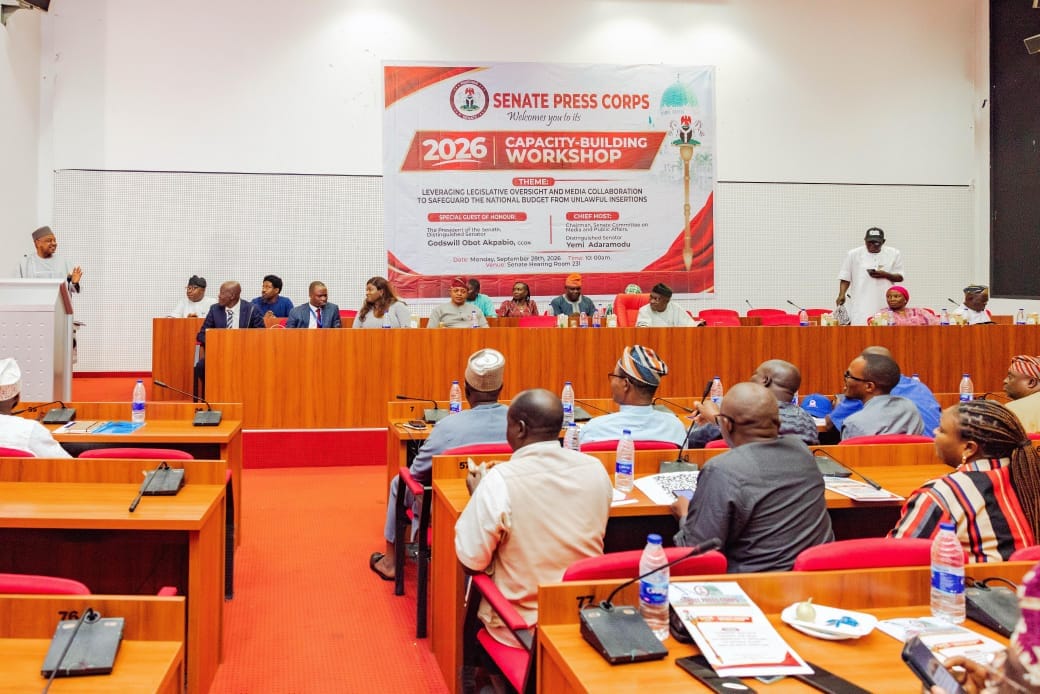
Bagudu spoke at the Senate Press Corps Capacity-Building Workshop, organised around the theme, “Leveraging Legislative Oversight and Media Collaboration to Safeguard the National Budget from Unlawful Insertion.”
The minister said the media has an important responsibility to scrutinise the budget and ensure that public officials are held accountable. However, he cautioned that responsible scrutiny must be based on adequate information and an understanding of the circumstances surrounding individual allocations.
According to Bagudu, journalists should investigate the origin of a budget provision, its purpose and its intended beneficiaries before describing it as unlawful or irregular.
He argued that some provisions could appear unusual when viewed outside their local or developmental context.
The minister cited water infrastructure in underserved communities and equipment for fishing communities as examples of allocations that could be misunderstood if journalists did not investigate the specific needs they were designed to address.
Bagudu stressed that the need for context should not be interpreted as an argument against scrutiny.
Rather, he said vigilance remained necessary because budget preparation and implementation involved human processes in which errors could occur.
He therefore called on both the media and legislative oversight bodies to remain vigilant throughout the budget cycle.
The minister also encouraged journalists to broaden their coverage of the national budget by explaining the constitutional processes involved in its preparation, consideration and approval.
He said Nigerians need to understand not only what is contained in the budget but also why government and lawmakers make particular fiscal choices.
Bagudu said the national budget conversation should begin with a fundamental question about what the budget should look like in relation to Nigeria’s population and development requirements.
He noted that the country has limited fiscal space and significant demands for infrastructure, education, healthcare, security and human development.
This, he said, makes it necessary for Nigerians to engage more seriously with the question of how government can mobilise additional resources.
Bagudu connected the issue to the Renewed Hope Agenda of President Bola Tinubu and Agenda 2050, as well as the administration’s ambition to build a $1 trillion economy.
He said achieving such an ambition would require difficult decisions about revenue mobilisation, public expenditure and borrowing.
The minister also highlighted the importance of public confidence in fiscal policy.
He said citizens’ understanding and support would be important to the ability of the executive and National Assembly to take major decisions affecting revenue and expenditure.
Bagudu further urged the media to explain the National Assembly’s constitutional role in the budget process and the relationship between lawmakers and the executive.
On budget transparency, he called for balance where the disclosure of certain information could affect national security or strategic interests.
He also challenged the view that capital expenditure was always more important than recurrent spending.
According to him, expenditure on security, education, healthcare, human capital and public-sector personnel can produce direct developmental benefits.
He added that meeting debt-service obligations was also important because failure to do so could affect borrowing costs and private-sector operators.
Bagudu ultimately urged journalists to maintain rigorous oversight while keeping Nigeria’s wider development needs in view.
He said the media could contribute to economic transformation by helping citizens understand difficult fiscal choices and ensuring that budget discussions remain informed and focused on the country’s development objectives.