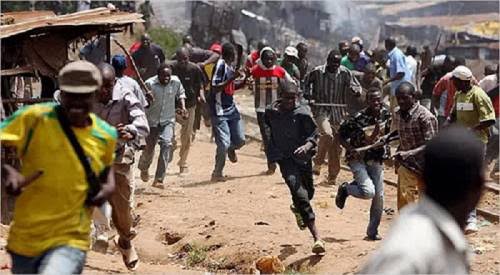
In Nigeria, cases of jungle justice have exploded every week with some citizens taking the law into their own hands to punish individuals suspected of committing crimes.
Suspects are subjected to torture, dehumanization, public humiliation and, in some cases, extrajudicial killing, causing severe physical and emotional trauma to a number of Nigerians.
Jungle justice often springs from allegations of theft, fraud, witchcraft, wrongful transactions and other perceived offenses in many parts of the country. In many cases, angry mobs take justice into their own hands and punish suspects without giving them the opportunity to defend themselves or prove their innocence.
One of the most disturbing aspects of the trend is the killing of innocent citizens on the charge of blasphemy.
Sometimes mere accusations that emanate as rumors are enough to trigger violent mob attacks, with victims losing their lives before the allegations against them could be properly investigated or tried in the court.
The situation has continued to cause concern about the rule of law, public safety and the need for citizens to allow law enforcement agencies and the courts to investigate and determine cases of alleged criminality.
Many of these incidents are still largely underreported, but those that have happened in the public domain have caused widespread concern.
Amnesty International said at least 363 cases of mob violence have been recorded in the last decade across Nigeria, leading to the death of nearly 100 people.
It was recalled that a national tragedy occurred on March 28, 2025 when about 16 northern hunters traveling from Port Harcourt, Rivers State to Kano State to celebrate Sallah, Eid al-Fitr were murdered in suspicion that they were terrorists.
There have been a number of mob attacks and killings recorded in 2026, with disturbing video clips capturing suspects being subjected to severe humiliation, dehumanization and other forms of abuse after being accused of stealing from members of the public.
Some video clips showed suspects being tortured and forced to sing and dance for the mob and for social media content, which in turn damages the reputation of the victims.
Oyo mob lynching
The Oyo State Police on July 9 arrested at least four suspects in the Strabag area of Ojoo, Ibadan, after a mob action turned into a violent public disturbance.
The crisis started on 7 July after four young men allegedly attempted to rob a Point of Sale, POS operator of his mobile phone while pretending to buy mobile data.
One of the suspects, Abeeb Olajide, was caught by a mob while the remaining three escaped.
Police say the suspect was brutally assaulted before officers rescued him and rushed him to a medical facility where he later died.
The Police Command disclosed that the incident sparked tension in the community as aggrieved groups allegedly mobilized for reprisal attacks, leading to breakdown of law and order in parts of the Strabag axis with no fewer than two others confirmed dead.
Motorcycle thief lynched in Abuja (Source)
On 19th of March, Haruna Yahuza, a suspected motorcycle thief otherwise known as “Gwaska” was lynched by a mob along the Dafara-Gaube road in the Kuje Area Council of the FCT.
Eyewitnesses said the suspect tried to escape with a motorcycle he allegedly snatched near the community.
The suspect and an accomplice had blocked the road and stabbed a cyclist before escaping with the stolen bike. The attack, however, at once drew the attention of an increasing mob.
Reports say that the owner of the bike, who was left in a pool of his blood, was able to identify the main suspect, who was given a hot chase and later killed by the mob.
Kaduna: Three persons killed
On June 21, 2026, Ummulkhair Muhammad, an Islamic teacher, was lynched in Mararaban Jos, a community along the Kaduna-Zaria highway, after being falsely accused of attempting to kidnap children, an allegation Amnesty International described as a growing violence “becoming the norm nationwide.”
Mrs Muhammad was reportedly taken to a police division in the community before she was killed, where a mob demanded she be handed over to them.
The husband of the deceased, Aliyu Muhammad, alleged in an interview with BBC Hausa that the Divisional Police Officer, DPO handed his wife to the mob who later killed her.
Later it was gathered that the deceased, who was on her way for a meeting in the area, missed her direction and was seeking help from residents when the mob attacked her.
In the same vein, two innocent travelers who were mistaken as kidnappers by a mob in Gidan Kalu Village, Birnin Yero, few kilometers to Maraban Jos in Igabi Local Government Area of Kaduna State were killed.
The victims identified as Muhammadu Sani and Aliyu Mohammed both from Umar Village in Igabi LGA were traveling on a motorcycle to Tudun Wada, Zaria, on July 1 to visit their ailing uncle when they were attacked and killed by a mob.
Police said residents grew suspicious when they saw the pair on a new motorcycle and raised the alarm, shouting “thieves”.
UNIJOS graduate tortured to death
On 26 July, a model based in Jos and a graduate of the University of Jos, Ibrahim Mbaya popularly known as “Ibee” was killed in Jos, the Plateau State capital, after a mob beat him over alleged phone theft.
Recent still and motion pictures of the assault circulated on all social media platforms.
The Plateau State Police Command says about five persons have been arrested for their various roles in the extrajudicial killing.
The command was contacted at the weekend, the Police Public Relations Officer of the command, Alfred Alabo said other suspects were still at large.
When asked what was the update on those arrested and those still on the run, Alabo simply said “if there is any update, we will make it available via our Facebook page”.
False alerts
Reports suggest that some victims of mob violence have been later found to be innocent of the charges made against them.
Earlier this year, a woman was attacked by a mob at the International Market in Abakaliki, the Ebonyi State capital, after a false alarm.
She was accused of abducting three children and was beaten savagely by the mob.
But later preliminary investigations showed that the children are her neighbors.
In an interview on Sunday, Mrs Alice Oche, an Abuja resident who escaped a mob attack in July this year, recounted how she was nearly lynched after being accused of making a fake bank transfer.
“I went to the Bwari market on July 18 and I was busy buying things,” she said.
“You know how busy the market is especially on market days. Only for someone to tap me on the back and start screaming and making allegations.
“I thot it was a hoax. She said I bought something for about N31,000 from her and that I made a fake transfer. She was talking and shouting and before you knew it, people started gathering.
“I tried to let this woman know that I wasn’t the one. Actually, I hadn’t been to that market for a very long time so it was definitely not me. Again, I usually go with cash because not everybody accepts transfers, so it couldn’t have been me.
“While I was explaining, she was dragging me and calling me a thief. The bike people were already gathering up so I got frightened. Some were already yelling ‘thief thief’.
“At that point, there was nothing I could do. Thank God I just entered the market and I had about N50,000 in my bag.
I asked her how much the money was out of fear and she said N31,000. I had to give her that money and get out of the market at once.
That was God’s way of rescuing me. But what if I had used the money that I had in my bag. And what if there was nothing on me? “Maybe I’d have been lynched.
Analyst: Corruption, slow justice behind jungle justice
Public affairs analyst, Mr Damion Uko, said the ugly trend was the consequence of systemic corruption which allowed suspects to escape justice after allegedly bribing people in authority.
Damion says “nobody chooses jungle justice just because violence is a good thing, no. They do it out of frustration, fear and a belief that the system won’t give them justice.
“Nigerians have lost confidence in the security agencies and even the court.
Read Also: Adeleke Alleges Oyetola Plans to Rig Osun Governorship Election
“Imagine that a criminal raped your daughter and you went and reported the case to the police, the rapist was arrested only for you to see him walking freely in the street the following month.
“I am sure Nigerians have not forgotten the case of the 13-year-old girl, Ochanya Ogbanje, who was allegedly raped by a lecturer and his son in Benue State, until she died.
“The two suspects are roaming free in the society as we speak. You think Ochanya’s family is happy about it? The system let them down.
The next time they have a suspect, they will do justice themselves. That is what we are dealing with.
“There was one politician behind Ochanya’s alleged rapists who allegedly got them released. Just imagine! A young girl with a promising future. Her life was cut short and everyone just moved on.
“The issue came up again at some point last year, but then what? Those calling for justice using their own voice may have been compromised again.”
Until accountability improved in the country, he said, the pressure to “do it ourselves” would stay high.
What the law permits
Activist lawyer, Nkereuwm Akpan, Esq., said the Nigerian Constitution only permits self-defense where a suspect was armed and posed an immediate threat to the lives of people around him.
“There is nothing in the Constitution of the Federal Republic of Nigeria 1999 (as amended), the Criminal Code, the Penal Code or any other Law for the time being in force allowing for jungle justice to be visited on persons apprehended by the public on the allegations of having committed a crime, even where such a person is caught in the act”, he said.
He said the law allowed “for such suspected felons to be turned over immediately to the appropriate law enforcement agencies for further investigation and possible prosecution.
“There are provisions in our laws now relating to self defense when an attacker is armed with dangerous weapons and it is on those occasions that the law allows someone who is attacked to use such reasonable force and available means to defend himself or herself.”