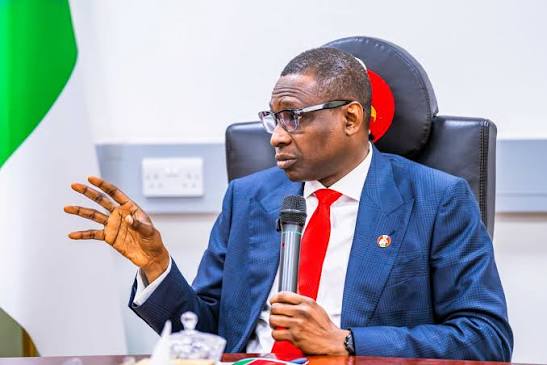
The Economic and Financial Crimes Commission, EFCC, has formally changed its strategy in the war against financial crimes from tracing stolen funds after the event to blocking suspicious transactions just before the money disappears.
This was disclosed by the Chairman of the anti-graft agency, Ola Olukoyede, on Monday in Abuja during an interactive session with newsmen to mark his third year at the helm of the commission.
Rather than allow complex criminal cases to take years to resolve while assets disappear, the EFCC boss said the agency has set up a special unit, called the Fraud Risk Assessment and Control Department (FRAC), to track, flag and freeze suspicious accounts within 72 hours.
Olukoyede, explaining the reason for the sudden change in approach, asked why it is always the public purse that is emptied before action is taken.
“Why do we have to be waiting for money to be stolen? We intervene and freeze when we see suspicious money flows. He asked: “We ask where is this money going, pending 72 hours?”
He pointed to examples of public funds being rapidly wired from local government accounts to corporate accounts, only to land in cryptocurrency wallets within 24 hours.
Olukoyede regretted that corrupt public officials in the country now recruit young tech-savvy persons to convert the looted public funds into virtual assets, making recovery difficult.
“With the push of a button, you can collapse the entire banking industry in Nigeria. “The problem with most of the data that we are looking at now is that there are no physical assets that you can trace to it,” he said.
In a bid to stem the rising trend of virtual asset laundering, Olukoyede disclosed that approximately 40 digital asset platforms have been licensed in Nigeria and that the EFCC now possesses the technical ability to trace registered wallets.
Additionally, the commission, with presidential consent, worked with security agencies to create a national confiscation wallet for all seized cryptocurrencies.
“One of the issues we used to have was where do you put the confiscated virtual assets? We have a national wallet that we put them into today,” Olukoyede added.
On legal tactics, the EFCC boss said the agency is focusing on civil asset forfeiture under Section 17 of the Advance Fee Fraud Act, rather than getting itself entangled in endless criminal litigation.
“This is swifter and quicker than a criminal trial. “We don’t have to wait 10, 15 years when witnesses die and assets are dissipated,” he said.
Read Also: Troops Rescue Abducted NYSC Members And Six Others In Kogi
Under the civil forfeiture process, the commission files a direct suit against the suspicious asset itself, shifting the burden of proof to anyone claiming ownership to explain the genuine source of the money used to acquire it. “This strategy has already delivered huge results in a number of high-profile cases involving former public officeholders,” he added.
To clear the air on the handling of seized items, Olukoyede stressed that the commission no longer directly manages forfeited properties, strictly adhering to the Proceeds of Crime Act (POCA) 2022.
Instead, a dedicated Process and Proceeds Management (PCM) directorate now assigns experts, estate managers for real estate, stock market professionals for financial assets and broadcast experts for media outfits, to run the properties efficiently.
He also said that properties that are rapidly depreciating and are caught up in court litigation are being auctioned off and the proceeds are being deposited into secure escrow accounts pending final judicial determination.
The EFCC boss confirmed that new management teams have taken over high-profile hotels recently forfeited in Lagos and that commercial banks have been directed to remit all operational income directly to the commission.
Olukoyede ended with an appeal to the media and civil society organizations to return to their role as active watchdogs, emphasizing that institutional reforms and systemic leak-blocking are far more effective than law enforcement alone.
“Law enforcement is not the most effective system. “It is the policy regime, institutional reforms that plug leakages,” the EFCC Chairman said.