
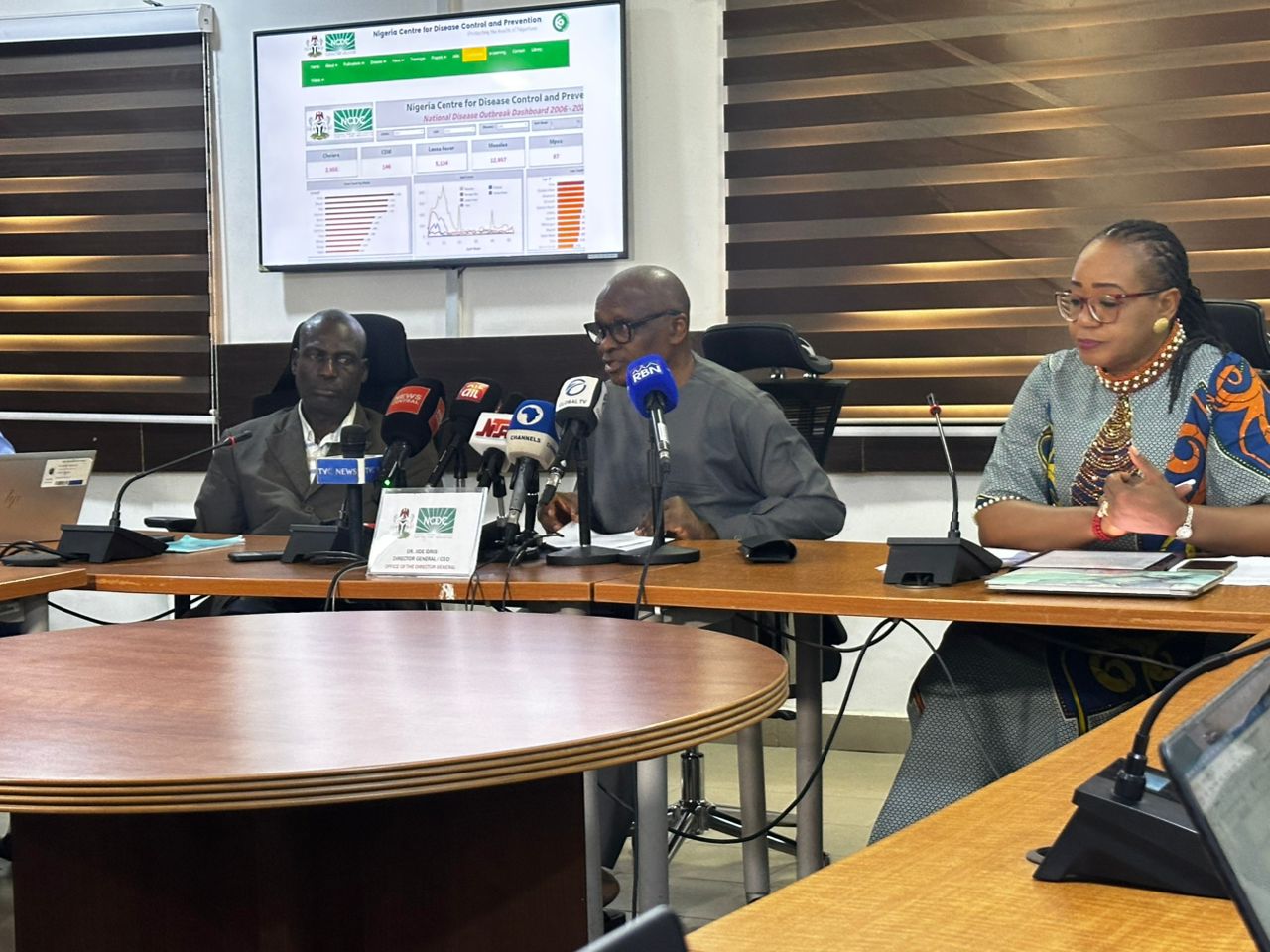
The Nigeria Center for Disease Control and Prevention (NCDC) has warned that cholera transmission remains active across the country, urging continued efforts to prevent more infections and deaths.
The warning was given by the Director-General of NCDC, Dr Jide Idris, in Abuja during a press briefing on the current situation, response and measures needed to contain the cholera and diphtheria outbreaks.
He said this year, more than 65,000 suspected cases of cholera have been recorded in 35 States and about 195 Local Government Areas in Nigeria.
He said the weekly number of cholera cases had dropped significantly from the peak recorded earlier this season and the proportion of cases that resulted in death was far lower than in the same period last year, but the situation required sustained response.
“This is a big step forward. But I want to be very clear, the outbreak is not over,” NCDC Director General warned.
Experience in the last few years had shown that cholera transmission could peak between late August and October, while the ongoing rainy season and the risk of flooding could contaminate water sources and overwhelm sanitation systems, he said.
“We are especially concerned about conditions that continue to expose communities to cholera like unsafe water, open defecation, damaged water distribution systems, poor hygiene infrastructure and inadequate sanitation in schools, markets and other public institutions,” Idris said.
“Treatment saves lives but we cannot treat our way out of cholera,” he insisted, urging sustained action on water, sanitation, hygiene, environmental health and community behavior.
One of the clearest lessons from the current outbreak was early access to treatment, said the NCDC chief, especially in Borno State where most of this year’s cases had been reported.
He said better outcomes had been recorded where treatment was brought closer to affected communities and people sought care early.
Diphtheria is still a Worry
The NCDC also reported that more than 10,000 confirmed cases of diphtheria have been recorded in Nigeria this year.
While the disease remains a major health concern, the Director-General noted a significant improvement in the proportion of confirmed cases that have resulted in death, which has decreased substantially compared with the same period last year.
However, he said most of the confirmed cases are still concentrated in a few states, notably Kano, Borno and Bauchi.
Low vaccination coverage is another concern, the NCDC said, with too many children not vaccinated or incompletely vaccinated.
Vaccine hesitancy, insecurity, hard-to-reach communities, displacement and population movement have also made it more difficult to reach every child who needs protection, he said.
“The importance of vaccination cannot be over-emphasised. Diphtheria is preventable with vaccines. We must ensure we improve vaccination coverage and work to ensure that no eligible child is left behind in receiving their vaccination,” the Director General of NCDC said.
NCDC Steps Up Response
NCDC said it continues to coordinate the public health response to both outbreaks with State Governments and partners, providing technical support where it is most needed.
It said surveillance and laboratory capacity are being strengthened and healthcare workers are being supported on case management, infection prevention and control. Affected communities are also being engaged with information on prevention and early care seeking.
The agency said National Rapid Response Teams have been deployed to impacted States to assist with investigation and response activities.
The cholera response emphasizes ensuring early access to treatment and addressing the water, sanitation and hygiene conditions driving transmission.
Teams from Borno and the NCDC have looked into sources of transmission and examined water supply points to determine deficiencies in water quality, sanitation and chlorination.
In Bauchi, the agency collaborated with the State Government to establish oral rehydration points, enhanced treatment capacity and intensified active case searches.
Oral cholera vaccination has also been introduced in high-burden areas, in addition to water chlorination, rehabilitation of water sources and hygiene promotion.
For diphtheria, the response focuses on scaling up vaccination, and rapid case detection and management.
Reactive vaccination is being implemented in affected areas and essential treatment and laboratory commodities continue to be provided.
States urged to do more
Alone, Federal action is not enough to control the outbreaks, the NCDC Director-General said, stressing that many of the interventions that will make the biggest difference have to occur at the State, Local Government, health facility, community and household levels.
He therefore urged State and Local Governments to identify the most vulnerable communities, to fill critical gaps and to deploy available resources and response capacity where they are most needed.
For cholera, he called on governments to improve access to safe water and sanitation, strengthen water-quality monitoring, repair critical water infrastructure, address open defecation, and ensure that high-risk Local Government Areas have functional treatment and rapid-response capacity.
Read Also: Trump Says U.S. Will Take Control of Venezuela’s Oil Resources
In diphtheria, he called for better vaccination coverage, particularly in affected, hard-hit and underserved communities, alongside increased routine and targeted immunization.
Healthcare Workers, Nigerians Advised to Act
The NCDC also advised health care workers to maintain a high index of suspicion for both diseases, ensure early recognition and reporting, and observe standard infection prevention and control precautions.
For cholera cases, the agency said dehydration should be quickly assessed and appropriate treatment initiated without delay.
“It’s dehydration that kills,” the NCDC Director-General told healthcare workers, highlighting the necessity of prompt management.
He appealed to health facility managers to make sure health care workers had functional triage and isolation systems, appropriate personal protective equipment, hand-hygiene facilities and systems for prompt notification and referral of suspected cases.
The NCDC also called on traditional and religious leaders, community leaders and civil society organizations to assist in disseminating correct information, promoting preventive measures, encouraging early seeking of care and combating misinformation.
To prevent cholera, Nigerians were advised to take care of safe drinking water, to keep the environment clean, to use proper toilets and avoid open defecation and practice regular handwashing with soap and clean running water.
The agency also advised that people who develop frequent watery diarrhea with or without vomiting should immediately start oral rehydration solution and seek care at the nearest health facility.
Parents and caregivers were urged to ensure that their children are fully vaccinated against diphtheria, while those who missed recommended doses should be taken to the nearest health facility to complete their vaccination.
The NCDC said diphtheria vaccines were safe, effective and available free of charge through routine immunization services and vaccination campaigns.
Media Called To Aid Response
The NCDC also urged the media to support the public health response through providing accurate, actionable information that can help protect communities and save lives.
The Director-General urged journalists to stress the importance of safe water and sanitation, oral rehydration and early treatment in preventing deaths from cholera, while helping parents and caregivers understand the importance of vaccination against diphtheria.
He stressed that the outbreak is not over, even if cases of cholera are declining, and that diphtheria remains vaccine-preventable.
The NCDC said there was need for sustained action by the Federal, State and Local Governments, healthcare workers, traditional and religious leaders, partners, communities, families and individuals to prevent further infections and bring the two outbreaks under control.