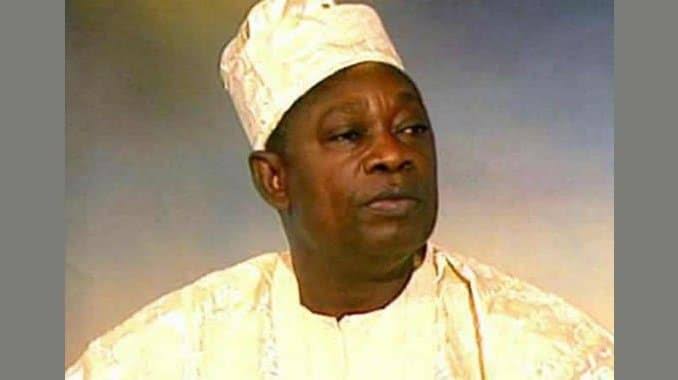
Chief M. K.O. Abiola declared himself president on June 12, 1994 based on the June 12, 1993 presidential election which he won fair and square.
He was arrested by the military junta of General Sani Abacha and charged with treasonable felony at the Federal High Court. Chief Abiola was subjected to horrendous psychological and mental torture while he was held incommunicado in a military custody for 4 years. Despite the serious health challenges of Chief Abiola, the maximum dictator refused to give him medical care.
Archbishop Desmond Tutu who visited Nigeria at the instance of President Nelson Mandela and met with the imprisoned Chief Abiola confirmed his parlous meical state on April 27, 1998. The revered priest said Abiola’s health and living condition were deteriorating rapidly and called for his immediate release to attend to his failing health. The military regime disregarded the call.
After the controversial death of Abacha on June 8, 1998, he was succeeded by his Chief of Defense Staff, General Abdusalami Abubakar as Head of State and Commander-in-Chief of the Armed Forces of Nigeria. The new military junta ordered the immediate release of all political prisoners from prison including General Obasanjo (rtd) and other convicted coup-plotters. Abubakar refused to release the detained Abiola saying he would not renounce his claim to the presidency. The news that Abiola died during a brief meeting with the American delegation on July 7, 1998, shocked Nigerians.
The Chukwudifu Oputa Panel set up by the administration of President Olusegun Obasanjo to probe the egregious human rights abuse that characterized military rule in Nigeria investigated the death of Chief Abiola. Abubakar had refused to give an account of his role in the whole saga as demanded by the Oputa Panel because he did not want to be cross examined by lawyers. In his autobiography, “Call of Duty,” about 28 years later, the former military ruler dismissed claims that Abiola was poisoned, insisting that an autopsy carried out by foreign pathologists had ascribed his death to natural causes.
In dismissing the allegation that Chief Abiola was poisoned, Abubakar did not respond to the evidence presented to the Oputa Panel that there are poisons that cannot be detected by autopsy. Abubakar, washing his hands like Pontius Pilate, said: “Way back in 1994 when he was arrested by the Abacha Administration for declaring himself President, it was a public knowledge that Abiola was managing certain medical conditions which could seriously affect the quality of life of any human being.
Abubakar also mentioned the transcript of Thomas Pickering’s press conference and the report of Susan Rice in her memoir, “Tough Love: My Story of the Things Worth Fighting For.” She denied that Abiola had been poisoned but conceded that he had been neglected medically. She said she noticed that “Abiola’s ankles were swollen and that about five minutes into their conversation, Abiola started to cough, at first mildly and intermittently, and then wrackingly with consistency.”
Abubakar also cited a radiological report by Colonel (Dr) O. Awofeso, then Chief Consultant Radiologist at the Nigerian Army Defense Hospital, Sokoto, on September 28, 1994, which found that Abiola’s heart was enlarged with “right ventricular preponderance” consistent with hypertensive cardiac disease. “it was common knowledge that Abiola was managing certain medical conditions which could adversely affect the quality of life of any human being,” Abubakar argued.
General Abubakar, knowing that Chief Abiola’s health was endangered during his 4-year dehumanizing incarceration by the maximum ruler, Abacha, deliberately refused to accede to the request to allow him to attend to his health. His personal physician, Dr. Ore Falomo, was equally refused when he wanted to come and see him. As if that was not enough, Abubakar also subjected Abiola to undeserved mental torture to make him dump his claim to the presidency.
Following abortive meetings between Abiola and the service Chiefs on the mandate, Abubakar decided to involve the so-called international community to resolve the political logjam. To persuade Abiola to renounce his mandate, the then Secretary General of the United Nations, Mr. Kofi Annan, and the Secretary General of the Commonwealth of Nations, Chief Emeka Anyaoku, were flown in. In their separate meetings with Chief Abiola, they pled with him to trade the June 12 mandate for his release from custody.
Both diplomats, while refusing the offer of conditional release, hinted in their press statements that he had agreed to give up the mandate. In a letter dated July 6 1998 addressed to Chief Gani Fawehinmi SAN, Abiola denied both diplomats’ claim. “True, both Annan and Anyaoku (apparently working together, although I saw them separately), wanted me to sign a statement that I will not, once again, demand my mandate, once released… he said, Both diplomats talked of arranging my UNCONDITIONAL release. “Any release obtained on that basis would be the worst form of “capitulation” with the demand for such a statement which would make me “a deserter
“I have read the history of June 12. I told them that at the very beginning, in July 1994, Obasanjo came to me with 26 traditional rulers to make a similar statement. He was given a stern telling off in the presence of the retinue of traditional fathers, after I had explained that the issue is one of God versus a few ‘powerful elements’. “The voice of the people is the voice of God, ‘Vox Populi Vox Dei’ a popular maxim long before Jesus Christ arrived.”
It is noteworthy that the aborted efforts of Annan and Anyaoku to persuade Chief Abiola to relinquish his mandate led to the invitation of the Americans by Abubakar. Having regard to the facts and circumstances of the suspicious death of Abiola, Abubakar could not justify while allowing the American delegation to breach the prison regulations of both Nigeria and the United States during the visit.
Under the Federal Bureau of Prisons (BOP) and state prison systems, visitors are prohibited from bringing any food or beverages, including tea, into prisons in the United States. The rule is designed to stop the smuggling of contraband, narcotics and poisons into prisons. All meals and beverages in a correctional facility, therefore, are provided by the institution only or purchased thru the secure prison commissary.
In Nigeria, visitors are allowed to bring food or water from outside to inmates or detainees in police stations, correctional centers and other detention facilities. But visitors are absolutely required to taste the food or water in the presence of the officers on duty before serving it to the prisoners or detainees. Visitors should taste the food or water to ensure that it has not been poisoned or adulterated to harm the prison inmates or detainees in custody of the government.
In the United States, visitors to prisoners are strictly forbidden from bringing, serving, or passing anything outside of food or beverages—like tea, for example. But the Abubakar military junta allowed American visitors to bring a tea flask to the detention facility when they visited the detention facility of Abiola, who was visited on July 7, 1998. A member of the delegation, Ms. Susan Rice, who served the tea to the detainee, did not taste it before giving it to him, which was in total violation of the rules of the Nigerian correctional center.
ACP Zadok who was the guard to Chief Abiola from 1996-1998 testified before the Chukwudifu Oputa Panel. In his testimony, the police officer said that in strict compliance with prison regulations, he tasted the food, water or tea prepared for Abiola before passing same to the detainee. But on the fateful day, Zadok said he was removed from his duty post by Major A. S. Aliyu, Chief Security Officer to the head of the military junta.
Aliyu had forsaken his own primary duty of protecting the head of state to attend to the American delegation. Major Aliyu in his oral testimony before the Oputa Panel, confirmed that Susan Rice did not taste the tea before serving it to Abiola. Zadok agreed. This was the first and only time that a foreign visitor had been permitted to serve tea to a detainee in the government’s custody.
Major Aliyu turned round to say that the tea in question was prepared by a villa staff, but he could not name the staff during his highly misleading testimony. By the end of his proceedings it was crystal clear that Aliyu had set out to cover up the actual cause of Abiola’s death. So, he could not tell why Zadok was ejected from the Akinola Aguda house and why he assumed charge of Chief Abiola’s security when the American delegation visited him.
In his memoir, “Interventions (A Life in War and Peace)”, the late Kofi Annan disclosed that he had told Abubakar, “Abiola had to be released if he was to gain international goodwill and mine. Here Abubakar hesitated a little. He promised that he was prepared to release Abiola immediately but on the condition that he did not try to wrest the presidency back.”
Equally, Mr. Kofi Annan said that although the foreign pathologists had established that “it was the result of heart condition, and there was no foul play- other than the fact, I thot that Abiola had been denied adequate medical care throughout his incarceration. Either way, he was just another victim of the systematic violations of a whole host of human rights which are inevitable under personalized and oppressive regimes.”
Before then, the Oputa Panel had, after a critical review of the evidence presented before it, stated thus, “In the case of Chief Moshood Abiola, we are of the view that the government of the day knows much more than it has admitted. We believe that the denial of Chief Moshood Abiola’s mandate was a breach of the rights of Nigerians to choose their leaders freely. We regard this as a grave violation.”
The Oputa Panel thus concluded that “Chief Moshood Abiola’s death was a consequence of his incarceration and denial of access to adequate medical attention. The evidence of the Chief Security Officer to the then Head of State, General Abdulsalami Abubakar, was replete with contradictions. “From the evidence before us, Chief Abiola died in suspicious circumstances. The Commission therefore recommends that a thorough investigation be carried out to throw light to and inform the Nigerian people on what killed Chief Moshood Abiola.
The Federal Government should without further delay, reopen investigation into the suspicious death of Abiola, in view of the denial of Abubakar and the members of the American delegation of any involvement in the matter. As the Oputa Panel opined, the fresh investigation will “throw light to and inform the Nigerian people on what killed Chief Moshood Abiola” in the custody of the Abubakar military junta.