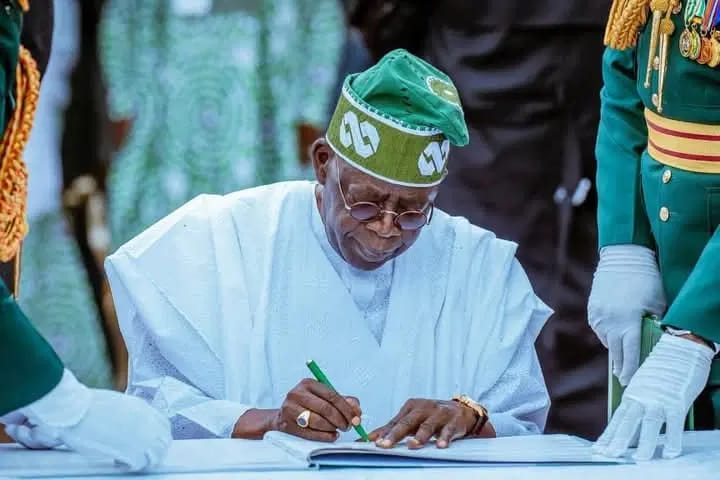
In order to protect and increase oil and gas earnings for the Federation, reduce unnecessary expenditures, do rid of redundant systems in this vital area of the national economy, and reallocate funds for the benefit of Nigerians, President Bola Tinubu has issued an executive order.
In accordance with Section 5 of the Federal Republic of Nigeria (as modified) Constitution, the President signed the EO.
Section 44(3) of the Constitution, which gives the Government of the Federation ownership, control, and derivative rights over all minerals, mineral oils, and natural gas in, under, and upon any land in Nigeria, including its territorial waters and Exclusive Economic Zone, serves as the foundation for the Executive Order.
The goal of the order is to reinstate the federal, state, and local governments’ constitutional revenue entitlements that were taken away by the Petroleum Industry Act (PIA) in 2021. Significant Federation revenues are lost as a result of deductions, various charges, and fees that were established by the PIA through legal and structural mechanisms.
As a management charge on profit oil and profit gas from production sharing contracts, profit sharing contracts, and risk service contracts, NNPC Limited keeps 30% of the Federation’s oil profits under the existing PIA structure.
Furthermore, 20% of the company’s profits are kept for working capital and future developments.
The Federal Government deems the additional 30% management fee unwarranted given the current 20% retention, since the retained earnings are already adequate to fund the operations NNPCL carries out under these contracts.
According to sections 9(4) and (5) of the PIA, NNPC Limited additionally keeps an additional 30% of its oil and gas profits under the production sharing, profit sharing, and risk service contracts as the Frontier Exploration Fund. At a time when government resources are desperately needed for core national priorities like security, education, healthcare, and energy transition investments, a fund this size dedicated to speculative exploration runs the risk of building up sizable idle cash balances that would encourage inefficient exploration spending.
Additionally, under Section 52(7)(d) PIA, there is the Midstream and Downstream Gas Infrastructure Fund (MDGIF), which is financed by the money collected from gas flaring fines under Section 104. The money will be used to help host communities affected by gas flaring and to promote environmental cleanup. But a special Environmental Remediation Fund, run by NUPRC, has already been created under section 103 of the PIA to pay for the restoration of areas that have been adversely affected by upstream petroleum activities, such as gas flaring. Moreover, lessees are already required by Section 103 to pay a charge to contribute to this fund specifically for this purpose.
Over two-thirds of possible remittances are effectively diverted to the Federation Account by all of these deductions, which greatly beyond international standards. These deductions, along with the fragmented control under the present PIA architecture, are substantially responsible for the ongoing fall in net oil revenue inflows.
By removing redundant and overlapping provisions across all pertinent laws and regulatory instruments under the PIA framework and NNPC Limited’s governing structure, the Executive Order seeks to address a number of issues, including the duplicative 30% deduction for profit-sharing arrangements. The goal is to do rid of unnecessary layers of deductions that reduce the amount of money that should flow into the Federation Account so that the three levels of government can focus on important national goals.
The President has noted that there are fundamental issues with NNPC Limited’s continuous concessionaire status under the terms of the Production Sharing Contract. According to the PIA, the company’s transition into a completely commercial operator is hampered by the current framework, which permits it to affect operating costs while still acting as a commercial organization.
Therefore, in order to protect the Federation’s interests, the Executive Order imposes immediate actions to stop leaks, improve transparency, get rid of redundant structures, and reposition NNPC Limited as a completely commercial concern.
The President reaffirmed in issuing the directive that the reforms are urgently needed in the country because of their effects on national budgeting, debt sustainability, economic stability, and Nigerians’ general well-being.
In order to resolve the budgetary and structural irregularities that have been uncovered, President Tinubu stated that his administration will also conduct a thorough review of the Petroleum Industry Act in cooperation with pertinent parties.
In accordance with the legally gazetted Presidential Executive Order, NNPC Limited would no longer be responsible for collecting and managing the 30% Frontier Exploration Fund. The 30% oil and gas production sharing, profit sharing, and risk service contract profits that are currently designated for the frontier exploration fund will be moved to the Federation Account going forward thanks to NNPC Limited.
Additionally, NNPC Limited will no longer be eligible for the 30% management fee on oil and gas profits that ought to be deposited into the federal account.
Likewise, as of February 13, 2026, the date of the Executive Order, all operators/contractors of oil and gas assets held under a production sharing contract are required to pay Royalty Oil, Tax Oil, Profit Oil, Profit Gas, and any other interest that may be owed to the Federation Government directly to the Federation Account.
Additionally, Gas Flare Penalty payments into the Midstream and Downstream Gas Infrastructure Fund have been halted by President Tinubu. Starting on the date of the Executive Order, the Commission will stop paying the money collected from operators who are fined for flaring gas into the Midstream and Downstream Gas Infrastructure Fund (MDGIF) and instead transfer the money to the Federation Account. All MDGIF spending must adhere to current public procurement rules, procedures, and regulations.
A collaborative project team has been established by President Tinubu to carry out integrated petroleum operations. In cases where upstream and midstream petroleum operations are completely integrated, the Commission will act as the liaison between licensees and lessees.
An Implementation Committee was established by President Tinubu to supervise and guarantee the executive order’s efficient, well-coordinated execution. The Attorney-General of the Federation, the Minister of Justice, the Minister of Budget and National Planning, the Minister of State, Petroleum Resources (Oil), the Minister of Finance, and the Coordinating Minister of the Economy are among the committee members. Other members of the Committee include the Director-General of the Federation’s Budget Office, the Chairman of the Nigeria Revenue Service, a representative from the Ministry of Justice, and the Special Adviser to the President on Energy. According to a statement by presidential spokesperson Bayo Onanuga, the latter will supply the committee with a secretariat.
Join Television Nigerian Whatsapp Now
Join Television Nigerian Facebook Now
Join Television Nigerian Twitter Now
Join Television Nigerian YouTUbe Now