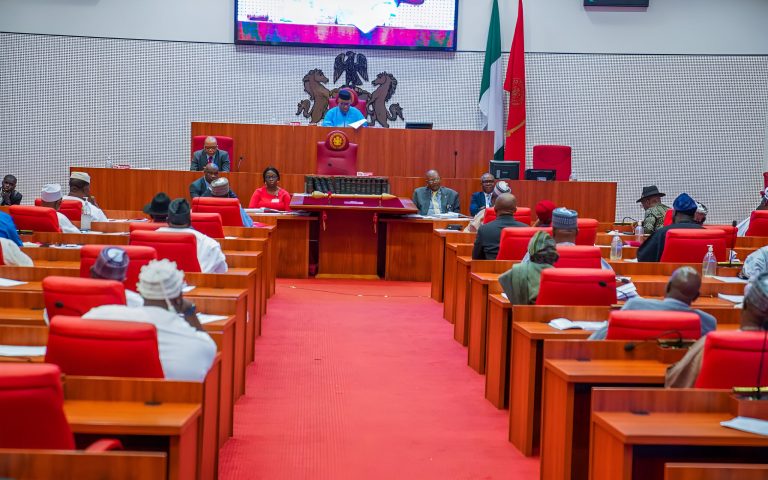
A high-stakes battle that could change the country’s fiscal direction and political accountability has been sparked by Nigeria’s N58.47 trillion 2026 budget, which has deepened tensions between the Senate and the federal government’s economic team over assumptions about oil revenue, mounting debt, and persistent capital implementation failures. Aborisade reports on Sundays.
The yearly allocation ceremony is frequently cloaked in hope amid Nigeria’s unstable fiscal environment. Forecasts of growth shine. Benchmarks for oil look boldly to the future. Rather of being presented as goals, revenue objectives are presented as inevitable. However, the script suffered a severe setback at the National Assembly on Thursday.
An ordinary meeting between the Senate Committee on Appropriations and the federal government’s economic managers descended into a heated argument on political accountability, realism, and legitimacy.
The N58.472 trillion 2026 Appropriations Bill, the biggest in the nation’s history, was at issue.
The committee chairman, Senator Olamilekan Adeola, spearheaded the legislative effort. Wale Edun, the Minister of Finance and Coordinating Minister of the Economy, was seated across from Atiku Bagudu, the Minister of Budget and Economic Planning; Doris Uzoka-Anite, the Minister of State for Finance; Zacch Adedeji, the Chairman of the Nigeria Revenue Service; and Shamsedeen Babatunde Ogunjimi, the Federation’s Accountant General.
President Bola Tinubu’s economic reform plan and the question of whether the administration’s lofty fiscal estimates are based on sound or optimistic math loomed large over the exchange.
The Senate made a clear and uncompromising complaint: Nigeria cannot keep passing large budgets based on revenue estimates that consistently fall short of expectations.
Adeola reminded the economic team that the government, not the legislature, was the original author of the 2026 budget proposal. Since the oil benchmarks, income projections, and assumptions were executive proposals, they must stand up to scrutiny.
He brought up concerning discrepancies in recent fiscal cycles’ performance. The performance of oil revenue fell to roughly 18 percent in a single year.
It was 36.5% in another, well below the estimates that had supported preparations for large expenditures. For legislators, these figures were more than just numbers. They were proof of systematic overestimation.
“How do we account for such poor performance?” Adeola posed a pointed question. “Should we cut this budget or keep it in place?”
The question echoed around the room. It was not theater of rhetoric. If the government cannot offer more robust assurances of revenue realities, the Senate is actively considering cutting the N58.47 trillion budget.
The benchmark of 1.84 million barrels of oil per day, which is part of the 2026 proposal, is at the heart of the disagreement. Edun called it a “stretch target,” contending that challenging standards promote greater achievement as opposed to complacency. He insisted that fiscal stability would be maintained as long as the government did not spend more than it brought in.
“It is a stretch target so that authorities do not settle for lower output, but as long as we do not spend what we do not have, we are within safe limits,” Edun stated.
Senators, however, are still cautious. Theft, pipeline vandalism, inefficient operations, and fluctuations in world oil prices have all been problems for Nigeria’s oil industry. Without matching structural guarantees, a stretch objective could become a financial mirage for lawmakers.
The Senate focused on a more politically sensitive topic—implementation failures—than estimates.
Budgets are passed each year with large capital expenditure components intended to finance development, social services, and infrastructure. Capital releases to Ministries, Departments, and Agencies have not been sufficient year after year.
Adeola asked the economic team what would happen to the capital components for 2024 and 2025. What caused initiatives to stall? What caused the contractors to be delayed? Why did releases not match the allocations?
The committee was not entirely satisfied with Edun’s initial statement, which said that funding for the capital components was continuing. Uzoka-Anite provided stronger guarantees. She announced that MDAs had been instructed to upload their funding plans for 2025 in order to facilitate timely disbursement, and that payments for unfinished 2024 capital projects were starting right away.
“The financial management system is operational again. The MDAs need to finish their documentation requirements, but we are prepared to begin,” she promised.
She made a firm promise that the 2024 and 2025 capital components would be fully implemented by March 31, 2026.
The commitment was appreciated by a legislature weary of constant delays, but it will be evaluated based on implementation rather than intent.
An intriguing development was that Adedeji, the head of the NRS, agreed in general with the Senate’s concerns over revenue realism. “Effective budgeting is about what can be done, not how big the appropriation is,” he remarked.
“If we plan with 100 naira in mind and think we have 10 naira, we will cause ourselves problems,” he cautioned.
His actions highlighted a fundamental change in Nigeria’s system of oil revenue.
He clarified that the Nigerian National Petroleum Company is currently a limited liability company in accordance with the Petroleum Industry Act.
He asserts that taxes and royalties, not direct crude sales, are the main sources of government revenue from oil production, and that the government’s net take decreases if production costs increase or operational efficiency falls.
According to forecasts, roughly 47% of oil firm output is converted into government revenue under the current arrangements, Adedeji revealed.
Lawmakers pointed out that ratio highlights the necessity of strict expense control and realistic income forecasts.
Spending on security introduced an additional level of complication. Edun maintained that the 2026 plan had made security a top priority and that emergency funds had been regularly made available for important military purchases, including those made abroad. He clarified that while some of these expenses might not be readily apparent under traditional categories, they were nonetheless within authorized Federation Account limitations.
Such expenditure is politically inevitable in a country that is struggling with insurgency and pervasive insecurity. However, it competes for limited financial resources with social welfare, health, education, and infrastructure.
Senators understand that trade-offs become more severe when debt servicing increases.
Adeola estimated Nigeria’s debt stock at over N152 trillion and made the audacious suggestion to sell off assets in order to reduce the debt portfolio and future borrowing expenses.
He contended that lowering the principal might lessen long-term financial strain.
Edun retorted that the high cost of debt on global markets, rather than Nigeria’s debt-to-GDP ratio, is the country’s main problem.
He maintained that high interest rates disproportionately increase borrowing costs in developing nations. He revealed that Nigeria is now serving as the chair of a G24 technical group meeting where the main topics of conversation are pricing distortions and debt sustainability.
However, senators seemed skeptical that domestic fiscal difficulty can be explained solely by global injustices. To prevent repeating cycles of poor performance, they are advocating for stricter budgetary restraint and more cautious forecasts.
Edun gave a cautiously upbeat assessment of the economy. According to him, growth is about 4%. The tendency for inflation is declining. Foreign reserves are increasing. The stability of the exchange rate is growing. He referenced a reported $20 billion contribution from Shell and restored investor confidence as proof of reform progress.
The administration’s overarching goal is to increase investment to 30% of GDP and accelerate yearly growth to 7%, which could significantly lower poverty and increase opportunity.
Edun stated that increased private sector involvement in infrastructure would relieve strain on governmental borrowing.
Legislative skepticism is still present, though. Senators argue that macroeconomic metrics need to be translated into real improvements, such as finished roads, completed projects, paid salaries, and low household market inflation.
The interaction moved behind closed doors after over two hours of public discussions. The ultimate structure of the 2026 Appropriations Bill may be influenced by what happened there.
Will the executive reevaluate its benchmarks for oil? Will estimates of revenue be tempered? Will there be stricter oversight and ring-fencing of capital implementation? Or will the Senate finally approve the stretch goals while enforcing more stringent oversight procedures?
One thing is for sure: the National Assembly is resolutely claiming its constitutional jurisdiction over the purse power.
In addition to being a financial document, the 2026 budget serves as a political yardstick for the legitimacy of the Tinubu administration’s reforms.
Nigeria finds itself at a precarious financial juncture. Despite uncertainty, oil is still crucial. Although substantial, debt is controllable with self-control. The reform process is under progress but not yet complete.
Can ambition outstrip arithmetic? This fundamental challenge was crystallized by the showdown in the Senate chamber.
The N58.47 trillion proposal will either be strengthened and refined, or it will be reduced in the interest of realism, when parliamentarians examine the figures in the coming weeks. Nigeria’s fiscal destiny and the fate of a budget are both at stake in that choice.