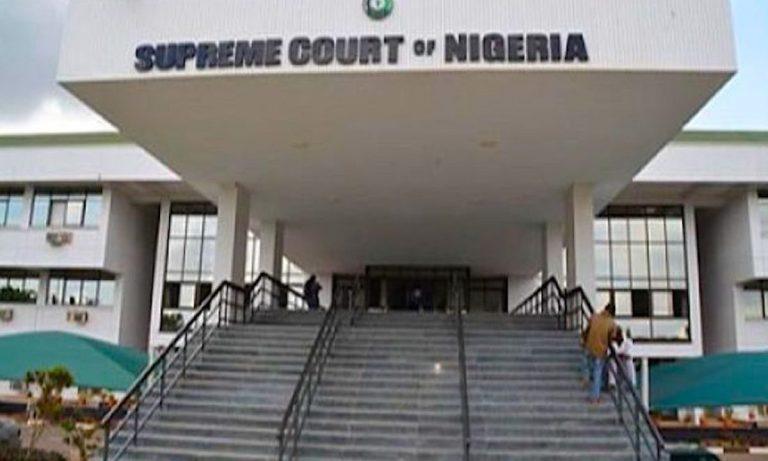
The Nigerian Supreme Court ruled on Monday that a sitting president has the authority to suspend democratically elected officials and declare a state of emergency in any state of the federation in an effort to prevent a breakdown in law and order or a plunge into chaos or anarchy.
The ruling concerned a lawsuit brought by Adamawa and ten other states led by the People’s Democratic Party contesting the legality of President Bola Tinubu’s declaration of a state of emergency in Rivers State, which resulted in the six-month suspension of elected state officials including Governor Siminalaye Fubara.
In a lead majority ruling, Justice Mohammed Idris ruled that when emergency rule is declared, the president may use exceptional measures to restore normalcy under Section 305 of the Constitution.
Furthermore, in a six-to-one split ruling, the Supreme Court upheld the president’s authority to suspend democratically elected officials during an emergency, but it maintained that these suspensions must be temporary.
According to Justice Idris, the president has discretion over how to proceed because Section 305 is vague concerning the type of extraordinary measures.
The Attorney General of the Federation and the National Assembly, the two defendants, had already submitted preliminary objections to the suit’s competence, but Justice Idris had upheld them.
Justice Idris upheld the objections, ruling that the plaintiffs (the 11 PDP states) had not established a cause of action that could activate the apex court’s original jurisdiction.
As a result, the jurist dismissed the lawsuit after striking it out for lack of necessary jurisdiction and deciding the matter on its merits.
However, Justice Obande Ogbuinya found in a dissenting opinion that the case was partially successful.
Among other things, Justice Ogbuinya declared that while the president might declare a state of emergency, elected state officials, such as governors, deputy governors, and members of parliament, could not be suspended using this authority.
Recall that after President Bola Tinubu declared a state of emergency in Rivers State on March 18, governors elected on the PDP platform went to the Supreme Court to seek compensation.
The lawsuit specifically contested President Tinubu’s declaration of an emergency in Rivers State.
In court proceedings, the PDP governors—which included leaders from the states of Bauchi, Adamawa, Bayelsa, Enugu, Osun, Plateau, and Zamfara—argued that the president lacked the constitutional authority to suspend a democratically elected governor and deputy governor.
The plaintiffs in the lawsuit sought a ruling that the president’s acts violated Sections 1(2), 5(2), and 305 of the 1999 Constitution (as amended).
They requested that the Supreme Court issue an order declaring Vice Admiral Ibok-Ete Ibas’ appointment as the only administrator to be illegal and in flagrant violation of the constitution.
The governors also asked the court to prevent the president from attempting to suspend other governors or interfere with their constitutional responsibilities in the future.
Under the pretense of or in accordance with the declaration of a state of emergency, they contended, the president had “no powers whatsoever or vires to suspend a democratically elected governor and deputy governor of a state in the federation of Nigeria.”
The PDP governors further argued that the emergency proclamation did not comply with Section 305 of the Constitution in their court submission.
The governors said that “the proclamation was made for reasons beyond those specified in the said constitutional provision and failed to meet the stipulated conditions and procedures for such a declaration.”
The governors stated that they are pursuing the case to establish a legal precedent even though they are not directly impacted by the emergency regulation.
Furthermore, the PDP governors argued that the appointment of a single administrator was illegal and hence void.
Furthermore, the governors insisted that the National Assembly’s use of a voice vote to authorize the state of emergency was “unconstitutional” and informed the Supreme Court of this.
They proposed that a two-thirds majority vote from all members of each parliamentary house was required by the Constitution to grant such consent.
On March 18, 2025, Governor Siminayi Fubara, his deputy, Ngozi Odu, and every member of the state House of Assembly were suspended for six months due to the emergency rule.
The only person designated as the state’s administrator was Vice-Admiral Ibok-Ete Ibas (rtd.).
PDP warns that a court ruling could set a dangerous precedent.
In the meantime, the Peoples Democratic Party (PDP) has voiced serious concerns about the Supreme Court’s decision regarding the president’s authority to proclaim a state of emergency in a federation.
In the lawsuit brought by the Attorney General of Adamawa State and others against the Attorney General of the Federation and the National Assembly (SC/CV/329/2025), the Supreme Court rendered a divided ruling (6-1).
The lawsuit questioned whether President Bola Tinubu could suspend democratically elected officials like the governor and deputy governor or legislative bodies like the Rivers State House of Assembly. It also contested the constitutionality of President Tinubu’s earlier declaration of a state of emergency in Rivers State.
In a statement released on Monday in Abuja, the PDP’s National Publicity Secretary, Comrade Ini Ememobong, accepted the supreme court’s authority but cautioned that Nigeria’s democratic and federal structures are seriously threatened by the reasoning behind the ruling.
The statement states, “Our concern is based on the clear constitutional position that no person or institution, other than the state House of Assembly or a court of law, is empowered to remove a governor from office during their constitutional term, and the long-standing legal principle that the express mention of one thing excludes others.”
The PDP issued a warning that the ruling’s interpretation would establish a precedent that would enable the president to use emergency powers to force political conformity from state governments with the backing of the National Assembly.
The party also cautioned that similar arguments might eventually be used to support the suspension of other constitutional institutions, such as the judiciary.
In order to clarify and restrict the scope of presidential emergency powers, the statement urged the National Assembly to immediately enact constitutional and legislative safeguards.
Additionally, the PDP called on Nigerians, civil society organizations, the media, and the global democratic community to continue being vigilant in their defense of federalism, constitutionalism, and the integrity of electoral mandates.
In order to guarantee justice, democracy, and long-term national stability, the party concluded by expressing optimism that the Supreme Court would explain the constitutional limits of emergency powers at the next chance.