Home Blog Page 931

Malaria: Too much talk, no action

0

THE newly established advisory board on malaria elimination and a ministerial task force by the Federal Government are a commendable initiative. Yet, it is hard to shake off a sense of déjà vu. Since 2020, there has been a series of ambitious plans and declarations to eradicate this deadly disease, but tangible progress remains elusive.

The statistics paint a grim picture: malaria continues to ravage the population, with Nigeria bearing a disproportionate share of the global burden.

Malaria is a life-threatening disease caused by parasites transmitted to humans through the bites of infected female Anopheles mosquitoes. In Nigeria, it is a constant and deadly presence.

According to the WHO, Nigeria had nearly 67 million malaria cases in 2022, accounting for 27 per cent of the global malaria burden. The country accounted for 31 per cent of global malaria deaths and 38 per cent of deaths in children under five. These are not just numbers; they represent the untold suffering and losses experienced by families nationwide.

The human and economic toll of malaria is staggering. It leads to high mortality and morbidity rates, significant loss of work hours, and substantial out-of-pocket expenses for families. Moreover, the government invests heavily in treatments and interventions, straining already limited resources.

Despite being preventable and treatable, malaria remains a major challenge. The past few years have seen a parade of initiatives, each promising to entrench a malaria-free Nigeria. In 2020, the National Malaria Elimination Programme launched the ‘Malaria Control to Malaria Elimination’ campaign to reduce malaria prevalence to less than 10 per cent by 2025.

In 2022, the government announced innovative tools such as the malaria vaccine and insecticide-treated nets to bolster the fight against malaria. The year 2023 saw the introduction of the ‘Zero Malaria Starts with Me’ campaign, a grassroots initiative aimed at engaging communities in malaria prevention efforts.

While these initiatives are laudable on paper, the reality on the ground tells a different story. Despite the flurry of plans and campaigns, malaria cases and deaths remain alarmingly high. The gap between policy and practice, between talk and action, is still too wide.

Undoubtedly, Nigeria needs concrete, sustained action to tackle the disease. This requires a multi-faceted approach that addresses the root causes of malaria and leverages the strengths of various stakeholders.

First, there is an urgent need to strengthen the healthcare infrastructure. Many Nigerians still lack access to basic healthcare services, particularly in rural areas. Investing in healthcare facilities, ensuring the availability of diagnostic tools and treatments, and training healthcare workers are critical steps in making malaria prevention and treatment accessible to all.

Second, the government must prioritise community engagement and education. The success of any malaria elimination effort depends on the active participation of the communities most affected by the disease. This means not only distributing ITNs and promoting their use but also educating people about the importance of early diagnosis and treatment. Community health workers play a vital role in this regard and should be supported and empowered to carry out their work effectively.

Third, addressing the environmental factors that contribute to the spread of malaria is essential. Poor sanitation, stagnant water, and inadequate housing are breeding grounds for mosquitoes.

While Nigeria struggles with malaria, there are success stories from other African countries to learn from. Algeria and Mauritius have successfully eliminated malaria, demonstrating that it is indeed possible.

The fight against malaria cannot be won by the government alone. The private sector and development partners have a crucial role to play.

It is imperative to move beyond rhetoric and focus on action. The newly established advisory board and ministerial task force on malaria elimination must translate their mandates into measurable outcomes. This means setting clear targets, establishing accountability mechanisms, and regularly monitoring and evaluating progress.

Suspect arrested over death of missing Rivers boat driver

0

The Rivers State Police Command has confirmed the arrest of a suspect in connection with the discovery of the body of the missing boat driver identified as Owei Ibolo days after he was declared missing in the Bakana Waterway in Degema Local Government Area of the state.

According Metro learnt that Ibolo, aged 47, a native of Southern Ijaw Local Government of Bayelsa State, was allegedly forced by gunmen who entered his boat at the Bakana Jetty after shooting sporadically and ordering him to drive on Sunday.

It was gathered that several hours afterwards, nothing was heard of him forcing his colleagues in the boat union and family to begin a search.

A relative of the deceased, Lolo Dokubo, who revealed his identity while speaking with newsmen in Port Harcourt on Wednesday, said Ibolo’s body was found at the Bakana Sand-field while his boat was still missing.

He alleged that the boat driver was killed by the four armed men who were shooting indiscriminately before moving towards the waterside where they entered his boat.

But while speaking with our correspondent on Wednesday, the spokesperson for the state Police Command, Grace Iringe-Koko, confirmed the incident and the arrest of a suspect.

Iringe-Koko said, “Yes I can confirm that the man was shot. One suspect has been arrested in connection with the incident and an investigation is ongoing.”

Earlier, while noting that a suspect had already been handed over to the Marine Police in Abonema for investigation, Lolo appealed to the Bakana community to assist in ensuring that the perpetrators were apprehended and made to face justice as well as recover the victim’s boat.

He said, “About four boys came out from the Bakana community with rifles and began to shoot. They didn’t use boats. They just came out from the community, entered the boat and drove away with him (Ibolo).

“Yesterday at about 4 pm, a call came from one of the drivers of a passenger boat travelling from Bakana to Port Harcourt, that they saw a corpse at the Bakana Sandfield and that we should go and check. So, we went there and saw that it was our brother. What we want is for justice to be done.”

Our correspondent recalls that the Bakana waterway was blocked a few days ago by members of the Bakana Boat Union following the killing of the boat driver. The aggrieved boat drivers called on the police to increase security surveillance on the waterways and arrest the suspects.

Let the third tier breathe

0

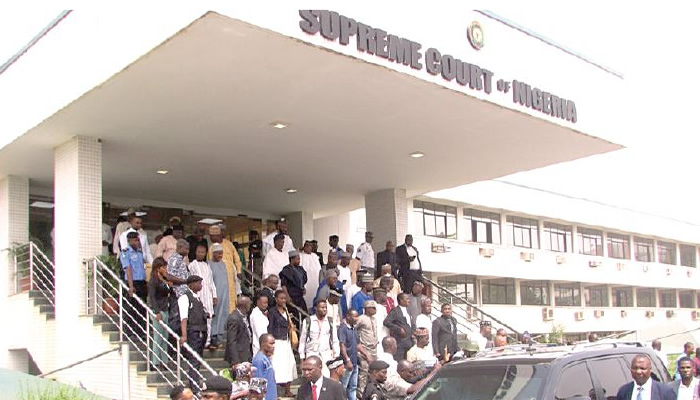
The It was perhaps the most remarkable judgment ever delivered by the apex court in recent times, as it used its power to interpret the law to give a different meaning to Section 162 of the 1999 Constitution. on July 11, granting financial autonomy to the 774 local councils and recognising them as the third tier of Nigeria’s governance architecture, was truly historic. It was perhaps the most remarkable judgment ever delivered by the apex court in recent times, as it used its power to interpret the law to give a different meaning to Section 162 of the 1999 Constitution.

Since 1999, governors have used this section to withhold and tamper with the funds federally allocated to the councils, using a joint account that has proven to be a honeypot of abuse.

Last Thursday, the Supreme Court described the payment of the allocations to the account as gross misconduct and scolded the governors for dissolving democratically elected councils and setting up caretaker committees. The court ruled that caretaker committees are illegal and that councils run by them should not receive the federal allocation. Henceforth, the court ruled that the allocations should go directly to the accounts of the 774 local councils.

Justice Emmanuel Agim, who read the lead judgment, said Nigeria runs a three-tier governance structure, where no one tier is subject to the whims and caprices of the other. He criticised the governors and the state Assemblies for almost allowing the councils to go into extinction with their treatment of them. The judgment was generally well received by Nigerians. According to reports, the verdict ignited jubilation by workers in some local councils as they sang the praises of the Tinubu administration.

However, some Nigerians have criticised it as an ‘assault’ on Nigeria’s federalism as it has rewritten Section 162. My simple response to this school of thought is: Must we allow the law to stand still while the local councils die? The Supreme Court also said as much: Since the governors were using the section to perpetuate unconstitutional acts, the court must ensure that the constitution is not applied in a manner that supports its destruction.

In acknowledging the verdict’s import, former Vice-President Atiku Abubakar described it as a win for the people. In a post on X, Atiku wrote: “The court’s ruling is a step in the right direction and a major corrective action in greasing the wheels of national development across the country… The court’s verdict is in tandem with the core functions of the Supreme Court as an arbitration court between and among governments.”

President Bola Tinubu, whose government instituted the case, welcomed the Supreme Court decision, affirming the spirit, intent, and purpose of the constitution regarding the statutory rights of local governments.

“My administration instituted this suit because of our unwavering belief that our people must have relief, and today’s judgment will ensure that only those local officials elected by the people will control the resources of the people. This judgment is a resounding affirmation that we can use legitimate means of redress to restructure our country and economy to make Nigeria a better place to live in and a fairer society for all of our people.”

Tinubu noted that the provision of some essential amenities and public goods, such as the construction and maintenance of roads, streets, street lights, drains, parks, gardens, open spaces, and other residual responsibilities, including community security, has been abandoned owing to the emasculation of local governments. He said the court’s decision to grant financial autonomy to the councils and restate other constitutional principles reinforced the effort to enhance Nigeria’s true federal fabric for the development of the entire nation.

Tinubu and his administration deserved the praise. President Tinubu has earned double appreciation as a defender of the local councils. As governor of Lagos, he sought the intervention of the same Supreme Court to establish the right of states to create councils in compliance with the provisions of the constitution. In a reverse role, as president, he has succeeded in seeking another intervention of the apex court to establish the right of the councils to survive and perform the role envisaged by the constitution.

Former President Muhammadu Buhari had sought to rescue the councils from the governors’ vice grip by using Executive Order 10, which he signed on May 22, 2020, to direct funds straight to the councils, the state legislature, and the judiciary. But the governors challenged his authority in a case filed at the Supreme Court. In a split judgment in 2022, the Supreme Court said Buhari overreached his powers.

In his lamentation, while signing the Executive Order, Buhari had said:  “If the money from the Federation Account to the state is about N100 million, N50 million will be sent to the chairman (of local government), but he (the chairman) will sign that he received N100 million. The governor will pocket the balance and share it with whoever he wants to share it with. Then, the chairman of the local government must pay salaries. Go to hell with development. When he pays salaries, he will put the balance in his pocket. This is what’s happening in Nigeria.”

Tinubu, his successor, sought to combat the problem constitutionally by suing the governors. The Attorney General and Justice Minister, Lateef Fagbemi (SAN), approached the Supreme Court in May, seeking to compel the governors of the 36 federating states to grant full autonomy to local governments in their domains in a suit marked SC/CV/343/2024. The suit, anchored on 27 grounds, accused the state governors of gross misconduct and abuse of power. He prayed that the Supreme Court would make an order stating that funds standing to the credit of local governments from the Federation Account should be paid directly to the local governments rather than through the state governments.

The justice minister also requested an order restraining governors, their agents, and privies from receiving, spending, or tampering with funds released from the Federation Account for the benefit of local governments when no democratically elected local government system is in place in the states. The court granted his prayers in the landmark ruling of July 11.

President Tinubu has always been concerned about the lack of governance at the grassroots. He believes that without fixing the problems at the councils, the objective of developing the country and spreading prosperity to the 200 million people will never be achieved. After all, the councils where the 200 million people live have been financially handicapped by the governors. He made the point clearly when he met in Abuja with the leaders of the Arewa Consultative Forum on May 30, about the same period when Fagbemi approached the Supreme Court for the correct interpretation of Section 162.

Tinubu, responding to the ACF’s demands for more roles by the Federal Government, urged the leaders to summon the governors. He said Nigeria, as a constitutional democracy, has not allowed the councils where we all live, to flourish, citing the absurdity of politicians going to the locals for votes only to abandon them and leave for the capitals and Abuja after winning their votes.

As Nigerians celebrate the historic judgment, it is clear that some work still needs to be done to bring life back to the councils. One issue being raised is how to ensure that the council elections are truly competitive and not predetermined by the governors and the State Independent Electoral Commissions. To solve this, some Nigerians have urged the National Assembly to pass a law that will require only the Independent National Electoral Commission to conduct council elections.

The other problematic issue is the fear that governors will not allow the Supreme Court ruling to affect their domains, as they can always order the councils to send the money received from the Federal Accounts Allocation Committee back to the state coffers. Again, a solution to this possible abuse has been proffered. The Economic and Financial Crimes Commission, Independent Corrupt Practices and Other Related Offenses Commission, and the Nigerian Financial Intelligence Unit should prevent this by monitoring the councils’ accounts. While the governors enjoy immunity to cover their actions, the council chairmen and councillors do not have such cover as they can be arrested, tried, and jailed. The threat of arrest and prosecution can deter local political actors from collaborating with the governors.

In conclusion, while Nigerians await the full implementation of the Supreme Court verdict, one needs to appeal to the powerful governors to allow the councils to breathe. It is in the interest of the states to allow the blossoming of the third tier of government as it was before 1999.

Here are some of the benefits that the states should not let slip away: First, local governments will now have more control over their finances, which could lead to improved service delivery and governance at the grassroots level. Second, with greater financial autonomy, local governments can provide better services to their constituents, such as healthcare, education, and infrastructure development. This will reduce the pressure on the state government from the people expecting such minimal provisions. Third, the judgment could lead to greater accountability and transparency in local government administration.

As President Tinubu remarked after the landmark ruling, “The onus is now on local council leaders to ensure that the broad spectrum of Nigerians living at that level are satisfied that they are benefiting from people-oriented service delivery.

“The Renewed Hope Agenda is about the people of this country, at all levels, irrespective of faith, tribe, gender, political affiliation, or any other artificial line they say exists between us. This country belongs to all of us. By this judgment, our people, especially the poor, can hold their local leaders accountable for their actions and inactions. What is sent to local government accounts will be known, and services must now be provided without excuses.”

  • Onanuga is Special Adviser on Information and Strategy to President Bola Tinubu

Family of slain 26-year-old man fears cover-up, seeks IG’s intervention

0

The family of Felix Nnadozie Jr., who was allegedly fatally beaten by six men in the Sibiri Ojo area of Lagos State, is urging the Inspector General of Police, Kayode Egbetokun, and Governor Babajide Sanwo-Olu to intervene and ensure the perpetrators are held accountable.

Following a fight between Felix’s mother and her female neighbour, our correspondent learnt from the bereaved family that the deceased was allegedly gang-beaten with planks and stones by the six suspects on July 3, which ultimately led to his death on July 6, 2024.

They informed our correspondent that while the six male suspects were beating Felix on the head with planks and stones, the three children of the neighbour, who allegedly encouraged the attack, closed the house’s gate to prevent others from entering the compound.

In a telephone interview with our correspondent on Tuesday, the grieving father, Felix Nnadozie Sr., said some of the suspects in his son’s death had been released by the police because they were under 18, which he said led him to believe that the police were trying to cover up the case.

Nnadozie Snr recounted, “Two of them are sons of serving police officers. My wife was cooking when one of our neighbours came down to pour water on the cooking pot she was using.

“My wife asked them what gave them the effrontery to come to our apartment and pour water on her cooking pot. This led to a confrontation between the neighbour and my son, who was present during the argument.

“The woman brought out a knife, and my son was able to take the knife from her. We thought the problem was over until the next day when the daughter of the woman brought boys to the compound to beat my son. One of them held him down while the others were hitting him with planks and stones.”

According to the distraught father, Felix seemed alright after the incident until hours later when his head began to swell and he started complaining of excruciating pain.

He continued, “We took him to the hospital where the doctor told us that he had blood clots and that he was going to be referred to another hospital at Igando.

“When we got to the Ìgandò General Hospital, the hospital further referred us to another hospital in Ikeja. It was while we were going to the Ikeja hospital that we observed that he was no longer breathing. Two of the people who killed my son are the children of a police officer. This is why I suspect the police do not want to arrest them.”

The victim’s mother, Faith, who expressed shock over her son’s death, made a plea to well-meaning Nigerians to support the family in their quest for justice and make sure the perpetrators did not escape punishment.

She said, “It is very painful and sad. We went to Panti last Wednesday. After making a report, right there in the presence of these people who caused the death of my son, the police said they were likely to release them on that day.

“I could not believe it. The woman, her children, and the boys that they brought to the house to beat my son to death are all supposed to be answering some questions now. I want the governor to come to my aid.

“I appeal to well-meaning Nigerians to help me. The police are not doing enough to arrest the two prime suspects because they are sons of a police officer.

 “They have already released those who went to call them to beat my son because they said they are teenagers. Nobody can wish this kind of painful and gruesome death on anyone. Nigerians should fight for justice for me and my family.”

Meanwhile, the spokesperson for the Force Criminal Investigation Department in Lagos, Aminat Mayegun, on Tuesday, directed our correspondent to speak with the state command’s public relations officer, Benjamin Hundeyin, for details on the incident.

“Please contact PPRO Lagos. I’m certain that a diligent investigation will be conducted, ensuring impartiality,” Mayegun stated.

Hundeyin had not replied to our correspondent’s inquiries into the incident as of the time this report was filed.

UI students protest 10-hour electricity rationing, tuition hike

0

Students of the University of Ibadan, on Wednesday, staged a protest to express their grievances following the schedule of a 10-hour electricity supply on campus and a hike in tuition by the university management.

According Metro gathered that the students were provoked by the announced 10-hour power supply, incessant tuition, and introduction of what they termed “outrageous fees” by the authorities.

The protest started in the late hours of Tuesday and continued on Wednesday with the students carrying placards at the front of the university gate.

Our correspondent learnt that an internal memo addressed to the Chief Engineer (Electrical), by the Director of Works and Maintenance Department, O.A Adetolu, that electricity should be rationed and made available to students for 10 hours daily was issued on Tuesday.

 “Effective immediately; the Vice Chancellor has approved a 10-hour daily electricity supply on campus as follows: Day time: 8 am – 2 pm; Night time: 10 pm-2 am. Kindly adhere to the approved schedule.”

The Students’ Union President, Aweda Bolaji, in a voice clip obtained by our correspondent, described the recent policies by the management as “not satisfactory” and termed them “an inconsiderate action.”

He said,” The injustice that has been meted upon us as students of the University of Ibadan is getting too much. The university cannot ration electricity to students in this 21st century. On this basis, if you are a student, join students massively as we demonstrate peacefully against the injustice being meted out by both the miserable government and unconscionable management.”

Bolaji in a statement later also sought the reversal of the new electricity schedule and tuition increment.

“There will be neither lecture nor transportation within the school premises on July 17, 2024. The mass action will continue on July 17 starting from 5 am. The union officials will make available all our resources, including the Aluta Jet and Public Address System, and the Student Union officials must be present to join the mobilisation effort towards this.

 “The school authority in association with maintenance must withdraw the memo on electricity rationing, dated July 16, 2024, and in addition, there must be constant power supply within the school effective immediately.

 “There must be a total reversal of all fees and not a reduction. Those who have paid must be refunded

“The Students’ Union condemns the ongoing victimisation of three students of the University of lbadan; Aduwo Ayodele, Olamide Gbadegesin and Nice Linus, who embarked on a peaceful protest on May 13, 2024, and as such, call for an end to the victimisation,” Bolaji said.

Police hunt ‘area boys’ for killing final-year Bayelsa varsity student over N150 levy

0

There is outrage in Amassoma, Southern Ijaw Local Government Area of Bayelsa State following the stabbing to death on Monday of a final-year student of the Niger Delta University.

Community sources who spoke to our correspondent on Wednesday said the victim, Francis Palowei, was at the Sand Dump, a popular spot among the students for relaxation and socialising when some youths in the area stabbed him to death when he failed to give them N150.

Palowei, who hailed from Obrigbene community in the Ekeremor Local Government Area of Bayelsa State, was expected to graduate on Wednesday, July 24, 2024, when the university would hold its next convocation.

According Metro gathered that men of the Nigeria Police Force had gone to the community and started searching for the perpetrators.

According to one source, who pleaded anonymity, students of the institution have also joined in the search for the perpetrators while the shock of the incident has made some students shun classes, with a greater majority attending classes.

The Public Relations Officer of the university, Indoni Engezi, who confirmed the incident, told According Metro that the incident did not affect academic activities as “the university is a different community.”

Engezi said the issue affected the host community, Amassoma, and that the police were already on top of the situation.

“The owner of the sand dump does not charge any fees for using the premises, but some youths usually charge N150 from anyone who wants to use the premises”, he said.

The Police Public Relations Officer, Musa Mohammed, said the Commissioner of Police, Francis Idu, had deployed additional manpower to the community to maintain the peace.

Mohammed said the police had launched a manhunt for the killers.

Praises, knocks for outgoing CJN Ariwoola

0

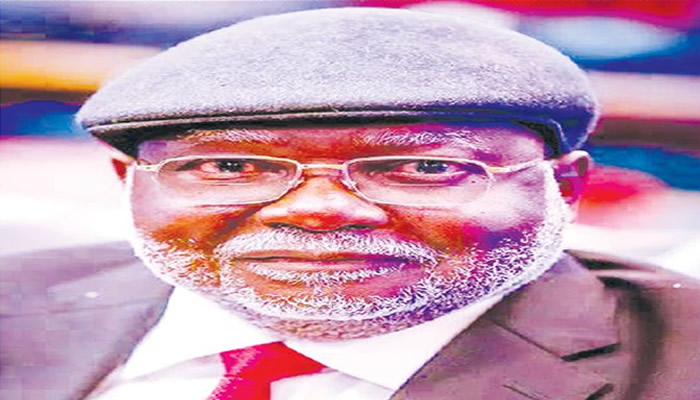
Legal practitioners reflect on the tenure of the outgoing Chief Justice of Nigeria, Olukayode Ariwoola, who is set to retire on August 22, 2024, writes ONOZURE DANIA

On August 22, 2024, the Chief Justice of Nigeria, Olukayode Ariwoola, will retire on his 70th birthday, marking the end of his tenure.

By convention, he will be succeeded in an acting capacity by Justice Kudirat Kekere-Ekun, the most senior Justice of the Supreme Court of Nigeria. The National Judicial Council will then recommend a substantive CJN to the President, who will then nominate the recommended candidate to the Senate for confirmation.

Justice Ariwoola began his educational journey in the Iseyin Local Government of Oyo State. He graduated from the then University of Ife (now Obafemi Awolowo University), with a Bachelor’s degree in law in July 1980.

Justice Ariwoola was called to the Nigerian bar in July 1981. His early career saw him working as a Counsel in-Chambers of Chief Ladosu Ladapo (SAN) before establishing his law firm in Oyo town. In November 1992, he was appointed a Judge of the Oyo State Judiciary, marking the start of his judicial career.

Ariwoola was elevated to the Court of Appeal in November 2005 and subsequently to the Supreme Court of Nigeria in November 2011. His appointment as CJN came on September 21, 2022, following the resignation of his predecessor, Justice Tanko Muhammad.

Speaking on Ariwoola’s tenure, Prof. Edoba Omoregie (SAN) commended his ability to stabilise the judiciary during a period of low morale. Omoregie spoke of Ariwwola’s glorious career as a jurist, adding that his appointment as CJN about two years ago came at a time of low morale in the judiciary, including the Supreme Court bench.

“There were many embarrassing episodes involving the judiciary prior to his assumption of office as CJN. Justice Ariwoola appears to have ably dealt with the issues, especially those which had caused anxiety among stakeholders in the justice sector,” Omoregie said.

He highlighted the Supreme Court’s landmark judgments under Ariwoola, such as the handling of the naira redesign policy and endorsement of financial autonomy for local governments, as significant achievements.

“I daresay that the deft management of those issues by His Lordship ensured that fizzled out of the public glare. Worthy of mention is that during the last two years, the Supreme Court under Justice Ariwoola rose to the occasion in the exercise of its policy jurisdiction.

“The court’s handling of the naira redesign dispute, and its recent decision endorsing the financial autonomy of local government councils in the management of fiscal transfers from the Federation Account, has marked a watershed in the constitutional system of this country,” he said.

Also commending Ariwoola’s tenure is Prof. Damilola  Olawuyi, (SAN), who acknowledged improvements in judicial camaraderie and efficiency.

Olawuyi stated, “The swearing-in of 11 new justices of the Supreme Court is a commendable achievement that finally enabled the court to attain its full complement of 21 justices after many years of inexplicable delays.

“We have also seen other appointments across the judiciary without the usual delays of the past.”

Notwithstanding the successes recorded during Ariwoola’s tenure, Olawuyi however stated that the proliferation of conflicting judgments by courts, especially over the last months in Rivers, Kano and Plateau states, have severely damaged the reputation of the judiciary, and will require time and concerted efforts to repair.

Olawuyi also mentioned that there have been heightened public concerns about potential conflicts of interest and nepotism in judicial appointments, stating that some of those concerns emanated from the lack of transparent and clear communication on the measures taken by the NJC to address such potential conflicts of interest. He advised that the remaining challenges must be tackled head-on by the incoming CJN in order to improve the transparency and reputation of the judiciary.

As for Prof. Sam Erugo (SAN), Ariwoola “brought some measure of stability in the system. Except for the perennial issue of the opaque process of appointment of judicial officers for which he cannot be singled out for blame, his tenure has seen much less controversy.”

Erugo went on to say, “Much of other criticisms stem from public misconceptions of the judiciary. We must admit that his tenure has witnessed tremendous improvement in the judiciary, including the record appointment of a full complement of Justices of the Supreme Court and the improved welfare of judicial officers. Probably, he was lucky to serve partly under an administration that found an opportunity to impress where its predecessor failed by taking action in critical areas for the judicial arm.

“He is definitely leaving the judiciary much better than he met it and without controversy. I congratulate him on his achievements and wish him well in retirement.”

On his part, Dr Joseph Nwobike (SAN) emphasised Ariwoola’s commitment to upholding judicial integrity, stating that his tenure “ensured that vacancies in the various levels of the Judiciary are filled with despatch and generally improved on the welfare of judicial officers.”

Another Senior Advocate of Nigeria, Wahab Shittu, added that the CJN’s tenure has been marked by a commitment to integrity, fairness, and justice, which has earned him admiration and respect within and beyond the legal community.

“Justice Ariwoola’s tenure saw significant judicial reforms and efforts to combat corruption. His administration was notable for its role in overseeing the most keenly contested election since Nigeria’s return to democratic governance in 1999,” Shittu noted, stating that “during his tenure, there were remarkable efforts in the fight against corruption, particularly in the public sector.”

However, Shittu said, “Critics argue that there still exist different levels of administrative incompetence and poor adroitness in the judiciary.” They also point out that efforts to protect the judiciary from political influence, particularly from the executive branch, were insufficient.”

The SAN also pointed out that the judiciary struggled with internal issues despite Ariwoola’s efforts to address corruption and financial crimes.

“People may argue that these efforts were barely significant or noticeable as corruption is still very much rampant and even prevalent in the judiciary itself,” Shittu said.

In his final legal year speech in November 2023, Ariwoola highlighted the judiciary’s achievements under his leadership.

“The ICPC was able to successfully secure 10 convictions, while the EFCC secured 1,094 convictions within the same period,” Ariwoola said.

The CJN also stated that the Supreme Court presided over 1,271 cases, comprising motions and appeals, and delivered a total of 251 judgments between September 2022 and July 2023. “We heard 388 political appeals, 215 criminal appeals, and 464 civil appeals,” Ariwoola noted, emphasising the significant workload handled by the Supreme Court.

But Prof. Gbenga Bamodu criticised the early part of Ariwwola’s term for its perceived fraternisation with the Executive branch.

Bamodu stated, “Early on, he could have done better to demonstrate more clearly the independence of the judiciary, and its separateness from other arms of government. Rather, the early part of his assumption of office evinced a fraternisation with the Executive and the political class in a manner that was not particularly healthy.”

Speaking of Ariwoola’s contribution, Bamodu said, “At least, latterly he sought to address the issue of conflicting injunctions from courts of co-ordinate jurisdictions, though even that has not been properly resolved.”

However, Prof. Chidi Odinkalu differed in his assessment of Awriwoola’s tenure, labelling his legacy as “diabolical,” and asserting that he “compiled almost assuredly the most dreadful and toxic legacy of any previous occupant of that position.”

Similarly, Joseph Otteh, a lawyer, said, “The tenure of Nigeria’s outgoing CJN would be regarded by many as probably the darkest period of Nigeria’s judiciary, and the lowest it has ever plumbed in terms of its public image.”

Stating that the “judiciary was at a very low point when the CJN came into the office,” Otteh said “Ariwoola was also part of the Supreme Court conclave that demonstrated against his predecessor, Tanko Muhammad, accusing him of lacking leadership, unresponsiveness, nepotism and maladministration in overseeing the business and welfare of the Supreme Court and its Justices.

“You would expect a CJN who came into office under these circumstances to move heaven and earth to restore the stature of Nigeria’s judiciary, and redeem, as much as possible, the image of Nigeria’s judiciary, which had been bumping along the bottom for so many years. Unfortunately, this has not been so.

“With all respect to His Lordship, he plunged the judiciary into a more withering, more desperate crisis of public confidence, and in the eyes of many, he will be leaving the judiciary much weaker, fractured, nepotistic, politicised and with far less esteem in the eyes of the public.”

Otteh further stated, “The incoming CJN faces the formidable task of rebuilding trust and ensuring that the judiciary operates with integrity, fairness, and accountability. The future of Nigeria’s legal system depends on a decisive shift in leadership and vision, one that will restore faith in the rule of law and justice for all.”
Motorists groan over Asaba-Onitsha expressway gridlock, demand highway repairs

0

Motorists plying the Asaba-Onitsha Expressway have been groaning over the deplorable condition of the ever-busy highway, especially at the Asaba axis.

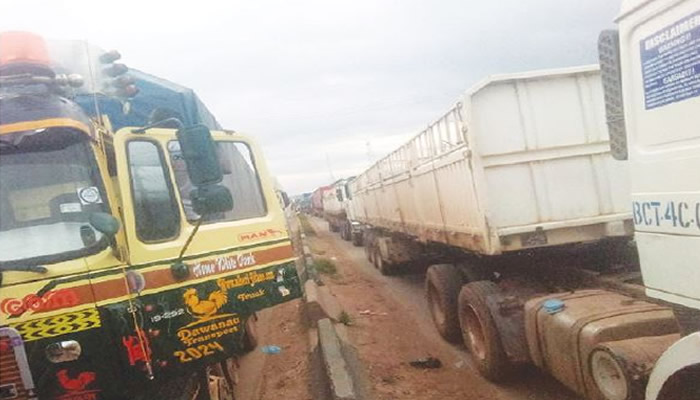
For over a month, there had been gridlock on the highway, especially at the Asaba axis due to the failed portions of the road.

When South-South According visited the area on Tuesday, it observed a stretch of gridlock, which occurs daily, frustrating travellers and hindering them from arriving at their destination earlier than planned.

Several portions of the road has become dilapidated to the extent that travellers are held up at different locations for hours in the owing to the  gridlock.

The failed portions include Bonsac by Ezenei junction, Okwe General Hospital by Abraka junction, and Summit area, among others.

Most of the drivers, especially travellers from Abuja, Lagos and Benin were stranded while trying to navigate through inside town to en route Onitsha, but still got trapped before Asaba toll gate due to the failed portions.

Narrating his ordeal, a commercial driver, simply identified as Agu, told our correspondent that he was trapped in the gridlock for over five hours before he could navigate his way out of the failed sections of the road.

He said, “This traffic gridlock started as earlier as 6am till night every day, in most cases, you come out the next morning, the traffic is still there. Some will spend two day before getting to Onitsha.”

Agu appealed to relevant government authorities to rehabilitate the failed portions of the road to “save travellers along this corridor from undue hardship.”

When contacted, the Federal Controller of Works, Delta State, Mr Ogar, said that the entire stretch of the road is under contract.

He said, “We are aware of the plight of the motorists, the entire stretch of that road is on contract, but the contractor started work at the boundary between Delta and Edo states.

“I have drawn the contractor’s attention to the portions, very soon, we will start fixing the failed spots in Asaba, especially, the Summit area, Ezenei and the Abraka area.

“As I speak to you now, I’m in Abakiliki for National Council of Works meeting; when I come back I will mount pressure on the contractor to move to the failed areas.”

FERMA begins rehabilitation of failed roads in Rivers

0

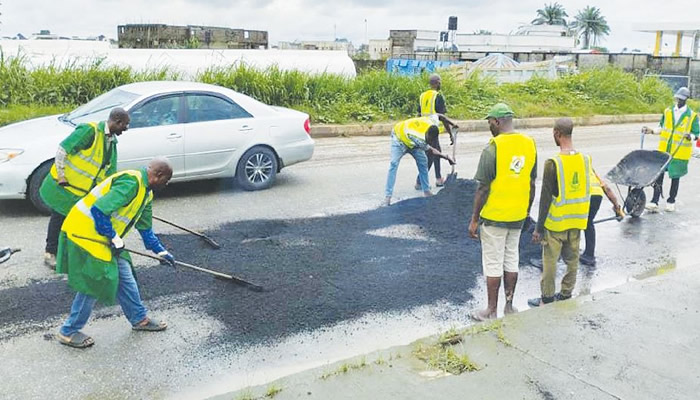
The Federal Roads Maintenance Agency has expressed its dedication to the systematic recovery of failed sections of federal roads in Rivers State.

The engineer in charge of FERMA’s Rivers State Field Office, Engr. Adoga Asikhia stated during the inspection of the ongoing road maintenance project of the new airport link road in Obio/Akpor and Ikwerre local government areas of the state on Tuesday.

Asikhia said, “Our major focus is the systematic recovery of the roads by patching the potholes and reinstating failed sections. Later on, we’ll embark on pavement strengthening of the roads, vegetation control and desilting of carriageways and shoulders.”

He added the agency aims to sustain the project which started last year to ensure that the road is always in good condition while cautioning motorists to shun bad driving habits and adhere to safety rules to avoid accidents.

He added, “This is definitely a continuous process. We started this thing last year. So the agency is truly working to ensure that the road, this particular road, at all times is in good riding condition for motorists.

“We want to advise motorists that the speed limit which the road safety has encouraged everybody to use, should be maintained, because this is not a major highway, that the speed should be cut down. Just this morning, an accident and a car overturned because of high speed and we have lots of bends around here.

“So we’re hoping that the motorists will exercise caution in seeing that whenever they are using the road, they ensure that their speed limit goes according to what is prescribed on the roads.”

On funding, he acknowledged that while funding remains a general problem in the county, the agency is doing well as the management ensures that funds are made available to the field office to carry out the maintenance.

Asikhia, however, decried the drainage on the road which he described as inadequate and one of the causes of road failures and major challenge affecting the project.

He added, “The poor drainage condition of the road has affected the road. The way the road is designed, there was no provision for drainages, so water does not find easy access, so the water now ponds on the roads, thereby resulting in the failure of the roads.”

He called on the state government to pay attention to the drainage situation saying, “We pray that the state will look into going into drainage facilities, providing drainage infrastructures on this road, because it’s going to be an extensive work.

“I don’t really know why no drainage was provided in the first place. Not that there are no drainages, it’s just that it is not properly done to adequately cater to the flow of water on the road. There are drainages, but it’s inadequate to cater for the road.”

The FERMA project in the state covers Port Harcourt-Isiokpo-Elele-Omerelu-Imo State border road and the Airport link road.

Sterling Bank, Lagos partner on ‘Ilera Eko’ health initiative

0

Sterling Bank Limited has partnered with the Lagos State Government through the Lagos State Health Management Agency to launch the Ilera Eko healthcare booths.

A statement from the bank on Wednesday said the initiative was launched by the Governor of Lagos State, Babajide Sanwo-Olu.

At the launch, which was held on Tuesday, Sanwo-Olu said, “Today signifies a major leap in our efforts to make healthcare both accessible and affordable. The Ilera Eko booths symbolise our dedication to bringing vital services closer to our people. This partnership with Sterling Bank showcases the power of public-private collaborations in driving transformative community changes. We envision a future where no Lagosian is deprived of basic healthcare.”

The Ilera Eko booths are designed to provide basic medical care, and telemedicine services, enroll residents in the LASHMA insurance scheme and serve as agency banks, enabling residents to carry out daily transactions and essential banking services.

The Chief Executive Officer of Sterling Bank, Abubakar Suleiman, represented by the bank’s Head of Government Fulfilment, Adewale Adebowale, expressed the bank’s continued commitment to its HEART strategy, which has seen the bank make extensive investments in the health, education, agriculture, renewable energy, and transportation sectors across states nationwide.

Suleiman said, “Our HEART strategy is central to our mission, focusing on health, education, agriculture, renewable energy, and transportation. The Ilera Eko booths embody our commitment to uplifting communities by integrating health and financial services. By making healthcare more accessible and affordable, we aim to enhance the quality of life for all Lagosians.”

The Permanent Secretary of LASHMA, Dr Emmanuela Zamba, stated that the first of five booths were currently operational across Lagos and located in Yaba, Epe, Ketu, and Ikorodu.

Zamba said that plans were at advanced stages to roll out 300 booths across the state for increased