A Federal High Court in Abuja yesterday threw out an application by state Attorneys- General seeking to be made a party to a Federal Government suit seeking to block the redemption of promissory notes issued to some consultants/contractors in relation to the Paris Club refunds dispute.
The consultants/contractors had claimed to have been engaged by the Nigeria Governors’ Forum (NGF) and the Association of Local Governments of Nigeria (ALGON) to retrieve their shares of the Paris Club refunds. They got judgments against the states to pay them about $418 million.
Listed as defendants by the government are FSDH Merchant Bank Limited, Ned Munir Nwoko, Gregory Lar, Riok Nigeria Ltd, Orji Orizu, Olaitan Bello, Ted Edwards, and Panic Alert Security System Limited who make up the consultants/contractors.
In the suit marked FHC/ABJ/CS/896/2023, the Federal Government joined the Attorney-General of the Federation (AGF), the Minister of Finance, Budget and National Planning, and the Accountant General of the Federation as co-plaintiffs.
Justice Inyang Ekwo held that the Attorneys-General were not necessary parties to the suit.
He described the application as defective and affirmed that the suit could be effectively determined by the court without their involvement.
Ekwo however adjourned till October 22 for the hearing of the preliminary objection raised by the defendants against the competence of the suit.
The Attorneys-General had argued that being representatives of their states whose funds would be affected by the promissory notes, they ought to be heard by the court.
The Federal Government had while initiating the suit last year faulted the procedure for the issuance of 62 promissory notes in 2021 and urged the court to invalidate them.
It also asked the court to issue a perpetual order restraining the defendants and their agents “from exercising any proprietary rights” over the promissory notes.
READ ALSO: Court adjourns Emefiele’s case over $53m Paris Club debt
The 62 promissory notes, valued at $418,953,668 were issued to the defendants on September 27, 2021, by the Debt Management Office (DMO), following judgments and orders of mandamus obtained against the Federal Government and the Finance Ministry.
The government contended among others, that the promissory notes were invalid, having been wrongly issued in violation of relevant laws.
It however noted that although the promissory notes were executed by the Finance, Budget, and National Planning Ministry and the DMO, the notes were not signed as required.
“The promissory notes in issue were wrongly and unlawfully changed on the assets and revenues of the federation instead of the assets and revenues of the states and local governments, who incurred the applicable loans/debts,” the government argued.
A senior official of the Federal Ministry of Justice, Mr. Oyinlade Koleosho stated, in a supporting affidavit, that the promissory notes were wrongly and invalidly issued against the assets of the federation.
He stated that Sections 314 and 317 of the Constitution have separated the assets of a state or Local Government Council from the assets of the Federal Government.
Koleosho added that the promissory notes were charged on the assets of the government, which is not indebted to any of the contractors/consultants.
He said: “The debts upon which the promissory notes were issued were not incurred by the Federal Government of Nigeria or the Federation.
“The promissory notes charged against the assets of the Federal Government of Nigeria are only issued in respect of loans taken by it and not by the State Government or Local Government Councils.
“The promissory notes of the Federal Government of Nigeria can only be issued to offset Federal Government-owned debts.”
According to court documents, FSDH Merchant Bank Limited was issued 10 promissory notes valued at $67,925,661 at the rate of $6,499,561. per note (allegedly for the benefit of Nwoko)
Lar, who is described as Nwoko’s agent, was issued two promissory notes “for the account/ benefit of Nwoko for a total value of $732,511 at the rate of $366,256.00 per note.
Riok Nigeria Ltd was issued 10 Federal Government promissory notes worth $142,028, 941 at the rate of $14,202,895 per note. Orizu had 10 promissory notes for a total value of $1,219,440.00 at the rate of $121,944.00 per note.
Bello is said to have been issued eight promissory notes for a total value of $215,195 at $21,524 per note. Edwards got 10 notes for the value of $159,000,000 at the rate of $15,900,000.00 per one.
Panic Alert Security System Limited was also issued 10 promissory notes for the value of $47,831,920 valued at $4,783,192.00 per one.
The post PARIS CLUB REFUNDS: Court rejects state Attorneys’ request to join FG’s suit on $418m payments appeared first on Latest Nigeria News | Top Stories from TVN.
PARIS CLUB REFUNDS: Court rejects state Attorneys’ request to join FG’s suit on $418m payments
FG votes N2tn for Lagos-Calabar, others


The National Assembly has passed the N6.2tn budget amendment bill for the third reading, as the Federal Government is to spend about N2tn on the Lagos-Calabar highway and other road projects.
The bill was passed after the Chairman of the Senate Committee on Appropriation, Olamilekan Adeola (APC, Ogun West), presented his committee’s report on the 2024 Appropriation (Amendment) Bill.
On July 17, 2024, President Bola Tinubu transmitted to the Senate a bill for an Act to amend the Appropriation Act, 2024 to provide for the sum of N6.2tn with N3.2tn for capital expenditure and N3tn for recurrent expenditure.
The document showed that N700bn would be used for the country’s coastal road that would run from Lagos to Calabar, traversing Lagos, Ogun, Ondo, Delta, Bayelsa, Port Harcourt, Akwa Ibom, and Cross River states.
The Port-Harcourt to Maiduguri railway line would gulp N530bn, as the line would pass through Abia, Enugu, Ebonyi, Anambra, Benue, Nasarawa, Plateau, Kaduna, Bauchi, Gombe, Yobe and Borno.
The appropriation would also take care of the Badagry to Tin Can Port, Lekki Port, Ijebu Ode, and Kajola.
Also, the African Trans-Sahara Highway (to traverse Benue, Kogi, Nasarawa, Abuja), is to take the sum of N200bn.
Another component in the bill also stated that the water, irrigation, and dam development project, among others, would take N349bn. The Livestock Development Programme was awarded N75bn.
During the presentation of the bill, Olamilekan said, “The bill was read the first and second time and referred to the Committee on Appropriations for further legislative action.
“The Senate may also recall that the 2024 Appropriation Bill was passed into law by the National Assembly in the sum of N28.7tn and was subsequently assented to by the President on January 1, 2024.”
He added that “the 2024 Appropriation Act (Amendment) Bill seeks to among others, make available additional funds for Renewed Hope Infrastructure Development Projects, to be undertaken across the country and to meet other recurrent expenditure requirements, such as the minimum wage increase necessary for effective governance of the federation.”
He said because the committee was mandated to report back to the Senate on the bill within one week, it consulted widely with its leadership and other critical stakeholders.
Olamilekan said, “The committee met and deliberated with the Minister of Budget and Economic Planning and deliberated on the scope of the bill, as well as, its source of funding the projects.
“Subsequently, the committee processed the bill together with its House counterpart in line with relevant rules of legislative practice and procedures. I, therefore, present this harmonised report on the Amendment Bill, 2024 for consideration and passage of the Senate.”
The bill was thereafter passed for the third reading after a voice vote by the Senate President.
Other highlights of the amended budget, as presented by Olanilekan and adopted by the Senate include N1.742tn for statutory transfers and N8.27tn for debt service.
Reps approve N35.06tn
The House of Representatives has passed the supplementary bill seeking to increase the 2024 Appropriation Act from N28.7tn to N35.06tn.
On July 17, 2024, the House passed the N6.2tn extra-budgetary proposal by President Tinubu. On Tuesday, the bill scaled the third reading with clauses 1 to 13 considered and approved at the Committee of Supply.
A breakdown of the proposed N35.06tn for the 2024 fiscal year showed that the sum of N1.74tn is earmarked for statutory transfers; N8.27tn for debt service; N11.2tn for recurrent expenditure while the sum of N13.77tn is slated as a contribution to the Development Fund for capital expenditure for the year ending December 31, 2024.
Leading the debate on the general principle of the bill, the Chairman of the House Committee on Appropriation, Abubakar Bichi, who presented the harmonised joint Senate and House report on the budget, pleaded for the adoption of the recommendations of the Committee.
Addressing journalists shortly after the passage of the budget, Bichi said, “As you can see, we have passed the N6.2tn budget of Mr President, the budget of renewed hope.
“N3.2tn is for capital expenditure while about N3tn will go to the current. And as I said last time, the Lagos-Calabar coastal highway is a critical road infrastructure that Mr President wants to actualise.
“The Lagos-Calabar highway covers about nine states, which is about 700km of road projects. Also, the Sokoto-Badagry highway is critical, covering about seven states. It covers about 1,000km. We have another one from Ebonyi, all the way from Abuja, from the Trans-Saharan section. We need some funding to execute these important projects,” he said.
He also added that strategic rail projects passing through Abuja, Katsina, Kaduna, Kano, and Katsina up to Maradi in Niger Republic would be funded from the budget.
He pledged the readiness of the parliament to engage the various Ministries, Departments, and Agencies to ensure the full implementation of the budget.
He said, “We engaged both the Minister of Budget and the implementation agencies – Minister of Transport, Minister of Works, and Minister of Water Resources. They promised that as long as we pass this budget, the implementation will be 100 per cent.
“We had an engagement with the Minister of Budget and National Planning and she confirmed that the funding is there and the projects will commence.”
On whether the sum of N3tn approved for the payment of the N70,000 minimum is enough, Bichi said, “Absolutely, we did our calculations. We got the data from the Accountant-General of the Federation’s office before we applied this figure.
“We know that the money is enough from now till December 31 to take care of the N70,000 minimum wage. Nigeria should be expecting dividends of democracy.”
Tinubu committed to South-East development – Ex-lawmaker Onuigbo

Ex-lawmaker, Sam Onuigbo, says that the establishment of the South East Development Commission, SEDC, was a demonstration of President Bola Tinubu’s commitment to inclusive development of post-civil war South East.
Onuigbo who was a member of the House of Representatives, was reacting to Tinubu’s signing of the South East Development Commission Bill into law.
In a statement issued in Abuja on Wednesday, Onuigbo hailed the Deputy Speaker of House of Representatives, Rep. Benjamin Kalu, for ensuring that the bill was passed.
He said that the commission would be charged with overseeing the holistic growth and development of the region.
The member representing South East in the North East Development Commission also commended House members from the South East for co-sponsoring the bill.
He further said that the move represented a genuine commitment towards addressing not only the insecurity in the region but also the infrastructure decay that had plagued the region.
He commended Kalu for his exemplary leadership and unparalleled commitment towards the development of the South East.
This, he said, first manifested in the inauguration and implementation of the Peace in the South East Project, PISE-P.
Onuigbo also commended Tinubu for showing commitment to a united and prosperous Nigeria where no region is left behind.
Recall that the South East Development Commission, SEDC, Establishment Bill was co-sponsored by Kalu and other South East representatives at the House of Reps.
It is intended to receive funding from the federation account for the development of the SouthEast region.
Tinubu committed to South-East development – Ex-lawmaker Onuigbo
Labour plans talks with govs as N’Assembly okays N70,000 wage


Labour unions in the country say they will schedule meetings with state governments as part of efforts to ensure that they comply with the 2024 National Minimum Wage Amendment Act Bill, which on Tuesday empowered Nigerian workers to earn at least N70,000 on a monthly basis.
The Senate on Tuesday at plenary passed the 2024 National Minimum Wage Amendment Act Bill after President Bola Tinubu had transmitted the new wage bill to both chambers of the National Assembly, seeking expeditious support of the lawmakers for its passage.
The Senate and House of Representatives passed the new minimum wage bill.
The bill passed the first (President Tinubu’s request), second (debate on general principles) and third readings on Tuesday — all within an hour — in the upper and lower legislative chambers.
The new bill replaces the National Minimum Wage Act, No. 8, 2019 which approved N30,000 minimum wage with five years to negotiate a new wage. The new wage review period has now been reduced to three years following Tuesday’s legislation.
While leading a debate on the bill, Opeyemi Bamidele, Majority Leader of the Senate, said N70,000 was agreed upon by all the parties after negotiations.
“This is part of the Federal Government’s short term measure to mitigate the situation in the country,” Bamidele said.
Chief Whip of the Senate, Tahir Monguno, said there was the need to review the minimum wage to align with economic realities.
“The review of the minimum wage used to be after every five years. It is now every three years,” Monguno said.
No Senator opposed the Bill during its consideration by the Committee of the Whole.
The Senators also unanimously approved that the Bill be read for the third time and passed when it was put to voice vote by Senate President Godswill Akpabio.
The legislation gives legal backing to the N70,000 minimum wage recently approved by the President after weeks of a face-off with labour unions over a new minimum wage.
The Nigeria Labour Congress and the Trade Union Congress had both threatened a nationwide strike in the event of the failure of the Federal Government to approve a new wage for workers.
The NLC and TUC proposed N494,000 as the new monthly national minimum wage, citing inflation and the prevailing economic hardship in the country.
The unions in several statements lamented the hardship in the country, fueled by the removal of subsidy from the Premium Motor Spirit, also known as petrol, and the rising cost of goods and services.
But the unions later reduced the amount to N250,000 after several meetings with the Presidency.
On June 7, the Federal Government increased its offer for the new minimum wage for workers from N60,000 to N62,000 but the unions insisted on N250,000.
On July 11, the labour leaders again met with President Tinubu at the Presidential Villa over the new minimum wage before eventually accepting N70,000 as the new minimum wage for workers last week.
At Tuesday’s plenary, the bill was speedily passed through the first and second reading stages, leading to the consideration of the report and final passage to pave the way for the immediate implementation of the new minimum wage.
After the bill passage on Tuesday, the Trade Union Congress warned states against delay in the implementation of the new minimum wage. The TUC noted that no delay should be allowed due to the biting economic conditions in the country.
The National Vice President, TUC, Tommy Etim, made this known in an interview with our correspondent.
Etim said, “We are happy that the Senate was able to pass the National Minimum Wage Bill promptly. It’s now for the President to sign it into law and for the implementation to commence immediately.
“Moreover, the states should not delay in the implementation because of the socioeconomic challenges and the need to address hunger in the land.”
The NLC also urged state governments to replicate the move by the Federal Government to hastily pass the new minimum wage bill into law. The Congress also advised states to implement the new minimum wage to the letter.
“We are delighted by the gesture of the Senate because it suggests sensitivity to the plight of our members. The 2019 law expired in April 2024. This means we are already in arrears. The states should not only obey the law to the hilt but timeously too,” the Head of Public Relations of the NLC, Benson Upah, told one of our correspondents in Abuja.
Ekiti, Osun pledge to pay
Meanwhile, The Kwara State Governor, Mallam AbdulRaman AbdulRazaq, on Tuesday forwarded a bill seeking the revised Supplementary Budget of the state by N201bn to the State House of Assembly for approval, as states begin moves to pay the new wage.
Though, the Governor did not state the reason for the budget in his letter to the Assembly, it was learnt it might not be unconnected with the recent enaqctment of the new wage bill.
In the letter, which was read at plenary by the Speaker, Yakubu Danladi-Salihu, the Governor sought consideration and approval for the 2024 Revised/Supplementary Estimate.
The Speaker stated, “The total budget size after review is now N493,449,372,429.00 as against the 2024 approved estimates of N292,741,292,132.30, representing 69 per cent increase.
“The bill, however, passed through first reading and thereafter the Clerk of the House was directed to circulate clean copies of the bill to the Honourable members and the bill was referred to the House Committee on Rules and Business to slate it for second reading at the next legislative day.”
Ekiti State Governor, Biodun Oyebanji, on Tuesday assured workers in the state that he would not disappoint them on the new minimum wage for workers.
Oyebanji, who spoke in Ado Ekiti, the Ekiti State capital, during the presentation of N1bn gratuity cheques to retirees, expressed hope that he would offset all outstanding pension arrears before the end of the year.
The governor said, “On minimum wage, once it becomes law, when the President signs it into law, all will be well. The only thing I know, I am here to serve you. Let us wait, at the appropriate time, all will be well. One thing I know is that I am not going to disappoint you.”
Also, Osun State Commissioner for Information and Public Enlightenment, Kolapo Alimi, said the state government would pay the new minimum wage, adding that the welfare of workers remained a priority of the present administration.
Alimi, who admitted that the new wage would strain the state’s finances, added that since the FG’s decision to pay the N70,000 minimum wage to workers was backed by law, Osun would not be found wanting.
“We will pay, but if the Federal Government is willing to give us more money, we will definitely be interested in collecting it. It is a question of law. Once they say an amount is the minimum wage and it is backed up by law, it is not negotiable.
“In Osun, the number one in the five-point agenda of the governor is workers’ welfare. If we can be paying arrears of salaries and pensions, we are going to pay the minimum wage. It is an obligation. I told you before now that whatever agreed upon as minimum wage, Osun will not be found wanting. It’s an additional burden but that notwithstanding, our government is committed to the welfare of the workers. We are going to pay,” Alimi said.
Rescued Chibok girl narrates ordeal in Boko Haram den: Married 8 times, pregnant again
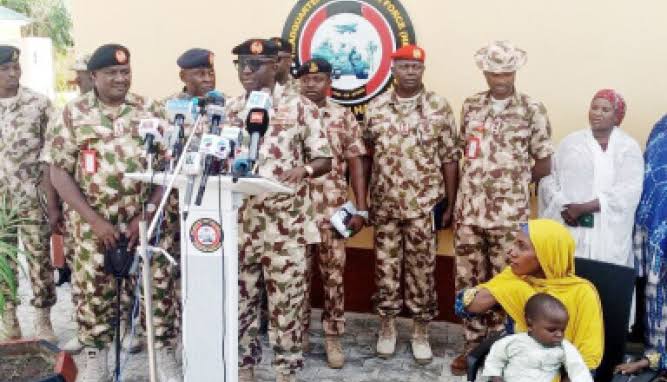
Eyi Abdul, one of the young women abducted from the Chibok Girls’ school in April 2014, has regained her freedom after nearly ten years in Boko Haram captivity.
Her account offers a harrowing glimpse into the experiences of the hostages, particularly the use of forced marriage as a tool of control by the insurgents.
At a presentation at Maimalari Cantonment in Maiduguri on Tuesday, the Theatre Commander of Operation Hadin Kai, Maj-Gen. Waheed Shuaibu, said Ehi, who is three months pregnant, was rescued on June 23, 2024, along with her two children in Sambisa Forest.
Briefing journalists at the headquarters of Operation Hadin Kai Theater Command, at Maimalari barracks Maiduguri on Tuesday, Ehi, now 27, stated that she was compelled to marry eight different Boko Haram fighters during her ordeal. She is currently three months pregnant and has two young children, all fathered by her captors.
Read Also: Ex-commissioner denies hand in attack on dep gov Shaibu, Okpebholo’s convoy
She said, “I trekked for days before getting to a military checkpoint in Nigeria where they took me and my children in.
“I married eight men and gave birth to three children for different husbands. I did not escape all the while because I did not want to escape earlier until now.
“We the Chibok girls are not kept in the same camp, and I don’t know why they are still in captivity but those of us have chosen to remain in Sambisa, while others have not had the chance to escape.”
Her release comes alongside 332 others, including 110 women and 220 children, rescued from the Bama-Pulka axis of the Sambisa Forest during a recent operation by the Joint Task Force, Operation Hadin Kai.
However, her comments suggest a more complex situation regarding the remaining hostages.
She claims the Chibok girls were not held together and implies a potential element of choice in her delayed escape.
The Borno State government has assumed responsibility for the rehabilitation of Abdul and the other rescued individuals. However, her future remains uncertain. Abdul expressed doubt about resuming her education, highlighting the long-term psychological and social impact of her captivity.
Eyi Abdul’s story serves as a potent reminder of the ongoing trauma endured by the Chibok girls and the challenges they face in reintegrating into society. It also underscores the need for continued efforts to secure the release of those still held captive.
The post Rescued Chibok girl narrates ordeal in Boko Haram den: Married 8 times, pregnant again appeared first on Latest Nigeria News | Top Stories from TVN.
Inflation: Nigeria heading to direction of Zimbabwe, Venezuela – Adebajo warns
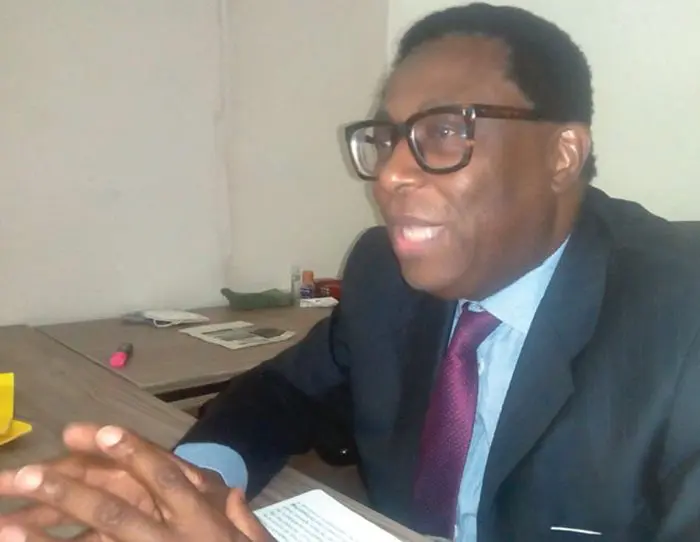
Adetilewa Adebajo, Chief Executive Officer of CFG Advisory, says Nigeria risks going in the direction of Zimbabwe and Venezuela if inflation is not curtailed.
Adebajo emphasized the importance of addressing inflation, stressing that the current economic management in the country is very critical.
He made this known on Wednesday while fielding questions on Arise Television’s Morning Show program.
While answering questions on the implications of the Central Bank of Nigeria’s (CBN) new interest rate on small businesses, Adebajo said it is necessary to increase the interest rate in the short term.
He said: “Let me explain it to you in purely practical terms. We want to buy things, and suddenly we cannot stretch our Naira. The same Naira that used to buy one bag of garri cannot buy it now. I think I am an exponent of the ‘sachet economy.’
“We have become a sachet economy; even alcohol is now being sold in sachets in Nigeria. That is because we can no longer stretch our Naira. So every Naira we get, we can’t buy as much garri as we used to before.
“So, what are we going to do to ensure that the one Naira we have can buy more garri for us? If inflation continues to rise, one Naira can’t buy more garri for you. The way we can reduce inflation to get your one Naira to buy more garri for you is to increase the interest rate in the short term. And I told you, don’t get me wrong, in 2011 we have done it before.
“It’s not rocket science; it’s something that has happened in Nigeria before. It didn’t happen in another country. Check 2011 and 2014, inflation rate was 9 to 11 percent, interest rate was at an optimal rate of 10 to 13 percent or thereabouts. So what we are saying is let’s get our economy back to that period.
“Productivity issues will come into play, but if you don’t control inflation, your productivity will continue to be nonexistent. And if you don’t control the inflation, do you know the direction we are going? We are going in the direction of Zimbabwe and Venezuela.
“That is the flip side of that; you now have hyperinflation because you don’t want to face the reality of it. It’s important that we look at inflation because the economic management in this country today is very critical. And that is why this Dangote refinery issue is a distraction. The success of that very project can help to reduce inflation.”
Inflation: Nigeria heading to direction of Zimbabwe, Venezuela – Adebajo warns
How Blockchain Enhances Security in 2024


In 2024, blockchain technology will continue to revolutionize various sectors by providing robust security measures. Blockchain, a decentralized ledger system, ensures data integrity and transparency, making it a preferred choice for secure transactions. As the digital landscape evolves, the importance of blockchain security becomes paramount. Enhancing security protocols and adopting new innovations are critical to protecting data and assets from cyber threats. This article delves into the key trends and innovations that are shaping blockchain security in 2024, providing a comprehensive overview of how blockchain technology is bolstering security across different industries.
The Role of Blockchain Security in Modern Systems
Blockchain security is fundamental in maintaining the trust and integrity of digital systems. It ensures that data cannot be altered or tampered with, providing a secure environment for transactions and data storage. The decentralized nature of blockchain reduces the risk of a single point of failure, making it more resilient against cyber attacks. According to IBM, blockchain security is achieved through a combination of cryptographic techniques, consensus mechanisms, and smart contracts. These elements work together to create a secure and transparent system that is difficult for malicious actors to penetrate, thus ensuring the reliability of blockchain-based applications in modern digital systems.
Innovations in Blockchain Security
In 2024, several innovative approaches are enhancing blockchain security. For instance, advancements in encryption techniques and the development of more robust consensus algorithms are significantly improving security. Additionally, integrating artificial intelligence (AI) and machine learning (ML) into blockchain security protocols is providing proactive threat detection and mitigation. Katherine Phillips, an experienced educator and career advisor, emphasizes the importance of staying updated with these innovations. For a deeper understanding of these security advancements, readers can explore further insights here.
Key Trends in Blockchain Security for 2024
2024 is witnessing several key trends that are shaping the future of blockchain security. These trends include the adoption of AI-driven security solutions, the implementation of zero-knowledge proofs, and the development of more secure blockchain protocols. These trends are not only enhancing the security of blockchain systems but also making them more efficient and scalable. The use of advanced technologies such as AI and ML is particularly noteworthy, as they provide enhanced security features and allow for real-time threat detection and response.
AI-Driven Security Solutions
AI-driven security solutions are revolutionizing blockchain security by providing advanced threat detection and mitigation capabilities. AI algorithms can analyze vast amounts of data to identify patterns and anomalies that may indicate a security breach. This proactive approach to security helps in identifying and addressing threats before they can cause significant damage. A table comparing traditional security solutions with AI-driven ones highlights the superiority of AI in terms of efficiency and accuracy.
Zero-Knowledge Proofs
Zero-knowledge proofs (ZKPs) are another significant trend in blockchain security. ZKPs allow one party to prove to another that a statement is true without revealing any information beyond the validity of the statement itself. This ensures the privacy and security of transactions while maintaining transparency. The benefits of ZKPs include enhanced privacy, reduced risk of data leakage, and improved security. A bulleted list of key advantages of ZKPs includes privacy preservation, security enhancement, and efficiency improvement.
Innovations in Blockchain Security Protocols
New security protocols are being developed to address the evolving security challenges in blockchain systems. These protocols are designed to enhance the security, efficiency, and scalability of blockchain networks. Chainalysis, a leading blockchain analysis firm, provides insights into these emerging protocols and their potential impact on blockchain security.
Secure Multi-Party Computation
Secure Multi-Party Computation (SMPC) is a cryptographic protocol that allows multiple parties to collaboratively compute a function over their inputs while keeping those inputs private. This protocol enhances blockchain security by ensuring that sensitive data remains confidential throughout the computation process. A numbered list of implementation steps for SMPC includes establishing secure channels, distributing computation tasks, and aggregating results securely.
Homomorphic Encryption
Homomorphic encryption is a powerful technique that allows computations to be performed on encrypted data without decrypting it. This ensures that data remains secure even during processing. The significance of homomorphic encryption lies in its ability to provide robust security without compromising functionality. A table withthe pros and cons of homomorphic encryption highlights its advantages in maintaining data privacy and its challenges related to computational complexity.
Addressing Security Challenges in Blockchain
While blockchain technology offers robust security features, it also faces several challenges. These challenges include scalability issues, interoperability problems, and the need for improved user awareness and education. Addressing these challenges is crucial for the continued growth and adoption of blockchain technology.
Scalability Issues
Scalability is one of the primary challenges in blockchain security. As the number of transactions on a blockchain network increases, the system must be able to handle the increased load without compromising security. Solutions to scalability issues include implementing sharding, optimizing consensus algorithms, and enhancing network infrastructure. A numbered list of strategies to address scalability issues includes partitioning the blockchain, improving consensus efficiency, and upgrading network protocols.
Interoperability Problems
Interoperability between different blockchain networks is another significant challenge. Ensuring that different blockchains can communicate and transact with each other securely is essential for the broader adoption of blockchain technology. Methods to address interoperability issues include developing standardized protocols, using cross-chain communication techniques, and implementing blockchain bridges. A table comparing different interoperability solutions highlights their advantages and limitations.
Future Outlook on Blockchain Security
The future of blockchain security looks promising, with continued advancements in technology and increased focus on addressing existing challenges. As blockchain technology evolves, it is expected to become more secure, efficient, and scalable. Key predictions for the future of blockchain security include the widespread adoption of advanced cryptographic techniques, increased use of AI and ML for security purposes, and the development of more robust security protocols. Staying updated on these trends and innovations is crucial for individuals and organizations relying on blockchain technology to secure their digital assets.
Veterinary doctors demand payment of accumulated arrears in Kogi

Veterinary doctors in Kogi State have appealed to Governor Ahmed Usman Ododo to pay all accumulated arrears owed to them by the state government.
The Kogi State Chairman of the Nigeria Veterinary Medical Association (NVMA), Dr Tolu Omotugba, made the appeal on Wednesday in Lokoja at a press conference.
He said, “We extend our profound gratitude to the Executive Governor of Kogi State, His Excellency Alhaji Usman Ahmed Ododo, for his approval and prompt implementation of the 2021 Revised Consolidated Medical Salary Structure (CONMESS) for our members within the Kogi State Civil Service.
“This gesture underscores His Excellency’s unwavering commitment to the welfare of Kogi State workers and his recognition of the pivotal role the veterinary profession plays in the state’s economic prosperity.
“This approval has motivated us to carry out our duties with renewed enthusiasm and the highest level of dedication. We respectfully urge His Excellency to utilize his esteemed office to ensure the prompt payment of the accumulated arrears since the salary structure’s implementation in January 2021.”
“An approval was given for the payment of these arrears. We appeal to Governor Ododo to speedily implement these arrears for 30 veterinary doctors. We are not asking for too much.”
He called on Governor Ododo to leverage the newly created Ministry of Livestock Development by President Bola Ahmed Tinubu’s administration to establish a similar ministry in Kogi State and appoint a credible veterinarian as its commissioner.
“We have many herders in Kogi State. This ministry will go a long way in ensuring peace among herders and farmers. The ministry should be headed by a veterinary doctor,” Omotugba added.
Omotugba admonished Governor Ododo to continue with the exemplary work he has initiated in Kogi State while the civil servants prepare to lead his reelection campaign in 2027
Veterinary doctors demand payment of accumulated arrears in Kogi
Tesla reports profit drop on price cuts, lower vehicle sales


Tesla reported a hefty drop in second-quarter profits Tuesday due to the effect of price cuts while spending aggressively on autonomous driving and other technology.
Elon Musk’s electric vehicle company reported profits of $1.5 billion, down 45 per cent, on revenues of $25.5 billion, which were up two per cent behind an increase in its energy generation and storage business.
Tesla’s earnings per share missed analyst expectations, while revenues exceeded them.
The results are the latest in a rough patch for Musk’s EV titan as it contends with rising competitive pressures that prompted a string of price cuts across leading markets.
Tesla laid off 10 per cent of its global staff this year — about 14,000 workers — as part of a push to cull expenses to finance major new investments.
That reorganization also resulted in one-time expenses of $622 million in the second quarter due to severance and other costs, said Chief Financial Officer Vaibhav Taneja.
While vehicle sales fell compared to the year-ago period, they rose from the level in the first quarter as “overall consumer sentiment improved,” Tesla said in its earnings presentation.
Although Tesla reaffirmed its expectation that vehicle volume growth may be “notably lower” than last year’s, it said new, more affordable models are set to begin production in the first half of 2025.
Musk announced the accelerated timeframe in April, winning cheers from Wall Street which had sought fresh offerings.
However, he declined on Tuesday to offer new details, saying the topic would be covered in a product launch event.
Tesla said its iconoclastic Cybertruck vehicle remains on track for profitability by the end of 2024 as it ramps up production.
– Robotaxi –
Tesla vowed to press on with technological pushes in artificial intelligence and autonomous driving.
The company postponed this month a much-anticipated robotaxi event planned for August until October.
While the “timing of robotaxi deployment depends on technological advancement and regulatory approval, we are working vigorously on this opportunity given the outsized potential value,” Tesla said.
Musk told a conference call that “moving it back a few months allowed us to improve the robotaxi as well as add in a couple other things for the product unveil” now set for October 10.
The outspoken Musk has a history of making bold predictions about the prospects for autonomous vehicles, saying conventional autos will one day be as obsolete as a horse and buggy.
But Musk has fallen short of projections about the timeframe for self-driving technology, after previously predicting the company would achieve the breakthrough by 2018.
Musk acknowledged his “overly optimistic” prior forecasts but said he expects the robotaxi could achieve full autonomy by the end of 2024, adding “I would be shocked if we cannot do it next year.”
– Political uncertainty –
The results come as Musk has lately deepened his commitment to electoral politics, coming out loudly for Donald Trump in the 2024 presidential election despite the former president’s longstanding denial of climate change — which has been a professed Musk priority.
Musk formally endorsed Trump on July 13 shortly after a shock assassination attempt on the Republican presidential nominee.
Musk has agreed to donate $45 million monthly to America PAC, a fund focused on electing Trump, starting in July, the Wall Street Journal reported this month.
But the Tesla chief acknowledged that a Trump victory might affect a plan announced in March 2023 to build a new Gigafactory in Mexico, given that the Republican candidate has vowed “heavy” tariffs on Mexican goods.
“I think we need to see just where things stand after the election,” Musk said.
Heading into Tuesday’s earnings announcement, Tesla shares were essentially flat for 2024.
CFRA analyst Garrett Nelson downgraded Tesla to “hold” after previously urging a purchase of shares. While still a believer in the “long-term story” around Tesla, Nelson cited a dearth of “near-term catalysts” due to the delay of the robotaxi event.
“We move to the sidelines on valuation and pending greater clarity on intermediate-term growth drivers,” Nelson said, alluding to a run-up in shares in recent weeks.
Shares of Tesla fell 7.8 per cent in after-hours trading.
AFP
Nasarawa govt raises alarm over plot to cause mayhem
The Nasarawa State government has raised the alarm over alleged plans by certain elements to perpetrate mayhem and breach the peace in the state.
The government stated this through a statement issued by Yusuf Musa, the Permanent Secretary of the Ministry of Information, Culture, and Tourism, saying that the plot was uncovered by security agencies.
The syndicate allegedly plans to target high-profile personalities in the state, using their aides as victims.
“Intelligence reports reaching the State Government through the Ministry of Information, Culture, and Tourism indicate that though the syndicate’s main targets are some prominent personalities from the state, soft targets such as persons close to those personalities and several other unsuspecting citizens are at risk of falling victim to the criminals,” the statement read.
The state government urged citizens to remain vigilant and report any suspicious activities or unknown persons to security agencies.
The statement also pointed out that the Nasarawa State Government, in collaboration with the Nigeria Police, Department of State Security Service (DSS), Nigeria Army, Nigeria Security and Civil Defence Corps (NSCDC), and other security operatives, has implemented measures to apprehend the syndicate members and their sponsors.
“Already, security agencies have made advanced efforts at botching their plans and those of other criminals and have advised citizens to be calm, go about their lawful businesses, but to reach out to them on any suspicious persons or activities,” the statement added.
Citizens have also been advised to be on the lookout for two fair-skinned, medium-height women who are usually dressed in black from head to toe.
The Perm sec also said that the Governor Abdullahi Sule-led administration has reiterated its commitment to upholding its covenant with the people by continuing the aggressive implementation of policies and programs that have placed the state on a path of growth and development.
“His Excellency Engr. Abdullahi A. Sule, the executive governor of Nasarawa State, has assured his commitment and resolve to continue to work around the clock to ensure the protection of lives and property of the citizens,” the statement added.
Nasarawa govt raises alarm over plot to cause mayhem