Home Blog Page 790

LG caretaker chairman stops NDDC project in Rivers

0

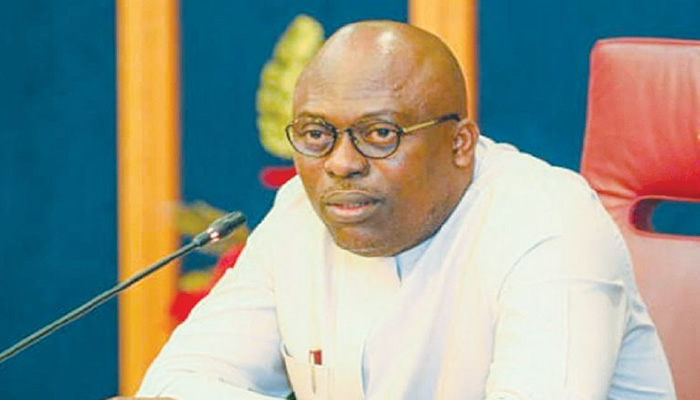
The Chairman of the Caretaker Committee of Ogu-Bolo Local Government Area of Rivers State, Evans Bipi, has ordered the immediate stoppage of the construction of a multi-purpose town due to alleged violations of the area’s development master plan.

The project was initiated by the Executive Director, Finance and Administration of the Niger Delta Development Commission, Chief Boma Iyaye.

However, Bipi insisted that the developer did not obtain approval from the local government council before initiating the project.

During an on-the-spot assessment of some projects in Ogu-Bolo LGA, Bipi stated that the project was sited at the wrong location, noting that the land belongs to the community.

“This land belongs to the community. As the CTC Chairman of Ogu-Bolu local government area, I am also the Chief Security Officer. All lands are in my custody in trust for the people according to the bylaws that regulate customary land. This is the only land we have in this new layout, a new sand-filled area which is fast developing. We don’t have any other playground.”

This area in the allocation is green. It is an open area for a recreational centre for ceremonies and all that. But as the Chief Security Officer, I am not aware of the project. I am also not aware that this is the site for the project. Looking at the edifice, this land cannot befit that project,” Bipi stated.

He, however, mentioned that the council is open to discussions with the developer to move the project to the appropriate location by the development master plan of the area.

All rights reserved. This material, and other digital content on this website, may not be reproduced, published, broadcast, rewritten or redistributed in whole or in part without prior express written permission from According.

Contact: [email protected]

Rivers ex-LG chairmen threaten to resume office

0

Former local government chairmen in Rivers State have threatened to resume office in the councils if the state Governor, Siminalayi Fubara, refuses to obey the recent Supreme Court judgment outlawing the use of caretaker committees to run councils’ affairs.

The former chairmen loyal to the Minister of Federal Capital Territory, Nyesom Wike, issued the threat during a news briefing in Port Harcourt on Friday.

Speaking, the former Chairman of Emohua LGA, Dr Chidi Lloyd, said they had remained patient all these while expecting the governor to comply with the court judgment, adding that he had continued to work with the caretaker committee members in the 23 LG councils of the state.

Lloyd alleged that the governor’s actions were capable of causing a breach of the peace in the state and called on the police authority at the national level to take necessary actions to stop the activities of Fubara’s CTC chairmen.

He stated, “The Governor of Rivers State has continued to act as if the state is parallel. The essence of this conference is to say that we are not cowards; if this continues, we will go back to our local government and force ourselves into the councils.

“We have kept quiet because of the kind of leader we have who continues from time to time to preach the path of peace. We are still the same ones that elected him into office as governor when his local government produced less than 5000 votes. If this continues, we will exacerbate the already exacerbated situation.”

 Our correspondent reports that the state Police Command had taken over the LG headquarters of the 23 LGs in the wake of the crisis over the tenure of the LG chairmen, even as the Inspector General of Police, Kayode Egbetokun, later insisted that the police would continue to occupy the councils until a court of competent jurisdiction ruled on the matter.

All rights reserved. This material, and other digital content on this website, may not be reproduced, published, broadcast, rewritten or redistributed in whole or in part without prior express written permission from According.

Contact: [email protected]

Fuel queues resurface in Abuja, Ogun, others as minister begs for calm

0

Filling stations in Abuja and neighbouring states of Niger, Nasarawa, and Kogi, were shut on Friday as oil marketers expressed worry over the planned nationwide protest.

Retail outlets, including those operated by the Nigerian National Petroleum Company Limited in Kubwa, Salbas Oil, Eterna, and Gegu Oil, among others located on the Kubwa-Zuba expressway, stopped dispensing fuel.

The same scene was also witnessed inside Abuja and parts of Niger and Nasarawa states.

Oil marketers told our correspondent that filling stations in Lokoja, the Kogi State capital, were also shut.

The development led to fuel queues resurfacing in outlets dispensing fuel like AYM Shafa in the Dei-Dei end of the Kubwa-Zuba expressway, Abuja, and the NNPC in Zuba, Niger State.

Also, several filling stations in some parts of Lagos State were closed on Friday, creating fears of impending fuel scarcity.

Our correspondents, who went around, noticed that most filling stations were not dispensing, while the few that attended to customers sold at N800 per litre.

Although some oil marketers said the closure of some retail outlets on Friday was due to the unavailability of fuel, others attributed it to apprehension over the planned nationwide protest.

Long queues in Ogun

In Ogun State, the situation at filling stations has reached a crisis point as motorists face long queues amid looming fuel scarcity.

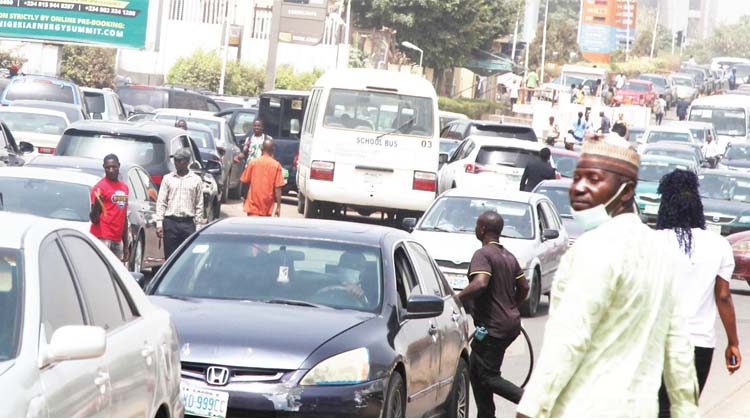
Our correspondent visited the Magboro and Ibafo areas along the Lagos-Ibadan Expressway, where a chaotic scene unfolded as vehicles including motorcycles, cars, and commercial buses, lined up for petrol.

At Quest Filling Station in Magboro, the sight was alarming as the queue snaked for over a hundred meters, with motorists struggling for their turn to purchase fuel.

Of the three petrol pumps available, only one was operational, exacerbating the delay for those waiting.

Saheed, a commercial bus driver en route to Ibadan, expressed his frustration after spending over an hour in the line.

“I have been here for more than one hour. I didn’t know I would meet such a long queue. Although one of our drivers mentioned a smaller queue earlier, I didn’t anticipate this. My passengers are already complaining, but there’s nothing I can do. I can’t use my urine to drive them to Ibadan. We just have to wait for our turn,” he lamented.

The situation at NIPCO Filling Station in Magboro was also alarming. Diesel was priced at N1,200 per litre, while petrol cost N675 per litre. Out of the five available petrol pumps, four were operational.

Meanwhile, the Minister of State for Petroleum Resources (Oil), Heineken Lokpobiri, has called for calm.

He also urged Nigerians to avoid participating in the proposed protest.

Speaking on the closure of retail outlets in parts of the country, the Secretary of the Independent Petroleum Marketers Association of Nigeria, Abuja-Suleja, Mohammed Shuaibu, said, “Some of them may not have products to dispense due to unavailability.

“However, many marketers are worried about the proposed protest and are already taking measures to prevent losses. Closing shops is one of such measures and this, of course, is going to cause queues in such locations because the number of stations selling petrol would be reduced.

“I am in Lokoja now, and many stations are not dispensing petrol. This is not a good thing because we only recovered from the fuel queues recently in major cities across the country, though that situation was due to a drop in supply from NNPC.”

Commenting further, the minister in a statement issued in Abuja on Friday by his media aide, Nneamaka Okafor, pleaded with Nigerians to shelve the planned protest.

He stated, “Senator Heineken Lokpobiri, the Minister of State for Petroleum Resources, is calling on Nigerians, especially the youth in the Niger Delta, to remain calm and avoid participating in the proposed nationwide protest.

“We understand the frustrations and challenges faced by many Nigerians, but it is essential to approach these issues constructively.

“President Bola Tinubu is dedicated to revitalizing our economy and bringing renewed hope through well-thought-out policies and programmes.”

Lokpobiri underscored the importance of unity and patience as the FG works to address the nation’s diverse issues.

“Now more than ever, we need to stand together and support the initiatives being put in place. Our collective efforts will pave the way for a more prosperous Nigeria.”

Acknowledging the role of protests in a democracy, the minister warned against those who might exploit the protest for malicious purposes.

“Certain groups are looking to use this protest to incite violence and crime. We must not let non-state actors disrupt our peace and stability,” he cautioned.

Lokpobiri also called for constructive engagement and dialogue over any action that could unsettle the nation, saying, “While protesting is your democratic right, consider the broader implications on our national stability and progress. Dialogue and collaboration are far more effective solutions.”

The minister reassured Nigerians of Tinubu’s commitment to their well-being, adding, “President Tinubu is a true democrat who listens to the people. He is already implementing measures to address our nation’s challenges.”

Lokpobiri urged the youth and all Nigerians to support the government’s efforts, saying, “Let us work together to achieve the progress we all desire. Avoid actions that could jeopardize our collective future.”

No queues at Kwara petrol stations

As fuel queues resurface in some states in the country, Saturday According reports that no queue was observed at petrol stations in Ilorin, the Kwara State capital.

It was also noted that petrol was sold between N600 and N800 per litre.

AP filling station at Murtala Mohammed road, a major commercial area in Ilorin, was selling at N620 per litre on Monday, Conoil, N650; MJK, N800, while MRS, located on Unity road, sold at N600 per litre.

Also, Shafa filling station sold at N700 per litre, Rain oil at Asa Dam road, and Lao selling at N70 per litre. Meanwhile, the Tigress at Odota sold at N750 per litre while Bovas sold at N670 per litre in all its stations located in various parts of the metropolis.

Reps begin probe of imported fuel, others

In another development, the House of Representatives said it had commenced a full-scale investigation into the crude oil supply chain and quality of petroleum products imported and refined in the country.

The Green Chamber of the National Assembly said the move was to ensure transparency and accountability, as well as the security of the nation’s petroleum sector.

The Chairman, House Committee on Petroleum Resources, Downstream, Ikenga Ugochinyere, disclosed this on Thursday at the opening of its 2024 Midstream and Downstream Retreat, held in Port Harcourt.

The retreat, jointly organised by the House Committee on Petroleum Resources Midstream and Downstream, is themed, ‘Enhancing Regulatory Frameworks, Promoting Transparency, and Fostering Sustainable Development in Nigeria’s Oil and Gas Sector’.

The lawmaker explained the retreat is aimed at providing strategic insights into the nation’s petroleum sector.

The petroleum sector, according to him, is the backbone of the nation’s economy, adding that it is the duty of the legislative arm of the government to ensure its transparency.

Ugochinyere disclosed that the House had mandated both committees of the petroleum resource to open an investigation into the crude oil supply chain, noting that it was important for the nation’s economic recovery.

He said, “The committee will undertake detailed laboratory investigation at all local refineries, marketers, importers, and regulatory agency labs like NMDPRA.

“We will visit various filling stations, depots, and tank farms to verify the quality of imported petroleum products and assess the testing capacity of all refineries.

“The collection of these samples will be four spacemen and will be transparently done with all the key stakeholders.

“Zonal interaction committees will be constituted in order to ensure smooth movement to all the zones of the country for the purpose of taking samples from the depots, tank farms, and refineries for immediate analysis.”

He added, “We urge all those to be invited to provide full cooperation and support by providing all necessary documents, facts, and insights that would aid our investigation.

“Our investigation will proceed in phases beginning with the examination of standards of petroleum products that are imported into the country and the crude oil supply chain.

“This investigation that the House has ordered is the main reason we are at this retreat to brainstorm on how to proceed, and this investigation is crucial for restoring trust and ensuring the security and quality of Nigeria’s petroleum sector in line with the renewed hope agenda of the President.

“We are committed to accountability and transparency and thoroughness, and that we will do throughout the process. The investigation aims to identify and resolve the issues plaguing Nigeria’s petroleum sector.

“Our interaction with stakeholders in the Midstream and Downstream sectors is crucial. It is through this interaction that we will gain a comprehensive understanding of the challenges faced by our industry and collaboratively decide ways to ensure growth and sustainability.

“We are going to address allegations concerning the alleged importation of substandard petroleum products, the alleged production of substandard petroleum products, the non-availability of crude oil to domestic refineries, and other critical issues.”

Meanwhile, the Speaker of the House of Representatives, Hon. Tajudeen Abbas, in his keynote address, said the retreat was germane as it provides the opportunity for continued conversation and dialogue initiative by the Green Chamber on strengthening and enhancing the regulatory framework of the oil and gas sector.

The lawmaker, who was represented by Hon. Sada Soli, representing Kaita/Jibia Federal Constituency at the National Assembly, said over the years, there have been debates over regulatory, transparency, sustainable, and development of the sector even after the passage and coming into force of the Petroleum Industry Act (PIA) in the 9th Assembly.

He said the retreat was another opportunity to reflect on the issues once again.

Additional reports by Tunde Oyekola, Daniel Ayantoye and Lawal Muhammed
Nigeria flared 148.7mscf gas in six months, says minister

0

The Minister of State for Environment, Dr Iziaq Salako, has said indicators from the National Gas Flare Tracker shows that Nigeria flared 148.7 million standard cubic feet of gas in the first six months of 2024 which is about seven per cent above the level for the same period in 2023.

Salako, who disclosed this in an interview with Saturday According, said Nigeria’s commitment to achieving a “just transition” to net-zero emissions had garnered significant attention on the global stage.

He noted that the commitment was evidenced by the establishment of frontline advocacy initiatives following the signing of the Just Transition Declaration and the announcement of the ambitious 2060 net-zero goal in 2021 at the United Nations Climate Change Conference of Parties (COP 26) held in Glasgow.

Following this declaration, Nigeria launched its Energy Transition Plan on August 24, 2022, establishing the country’s strategy to reach a net-zero emissions energy system by 2060.

He said, “Gas flaring has been a common practice in the Nigerian oil and gas industry due to the absence of infrastructure to capture and utilise the associated gas. As a result, gas has been continuously burnt in oil fields, leading to the release of harmful pollutants into the atmosphere.

“Despite regulatory efforts, enforcing regulations has been challenging, and many operators still flare gas due to insufficient penalties and the high costs of gas capture and utilization technologies.

“As of today, Nigeria remains one of the top ten countries in the world in terms of gas flaring volumes. The Nigerian National Petroleum Corporation reports that approximately 324 billion cubic feet (bcf) of gas were flared in 2023, translating to significant economic losses and environmental damage.

The minister lamented that most international oil companies were not responding to the government’s gas flare transparency and accountability.

He stated that operators in the Nigerian oil and gas sector had a responsibility to lead from the front to support the vision of Nigeria to end gas flaring.

“The Federal Ministry of Environment through its relevant departments and agencies is determined to work with other stakeholders through policy and regulatory strengthening, investment drive, technology transfer, and private sector mobilisation, capacity building, community engagement and other measures to turn the tide and put our country on a firm footing to end gas flaring as early as possible but not later than 2030.”

Court jails 125 Boko Haram terrorists, financiers

0

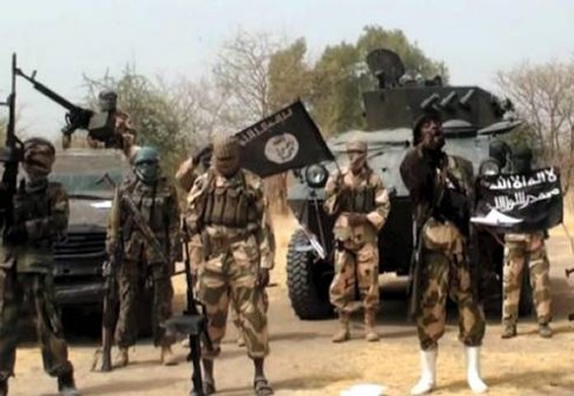
The Federal Government on Friday disclosed that 125 Boko Haram terrorists and financiers were convicted in the resumed mass trial held over two days in Kainji, Niger State.

The Attorney General of the Federation and Minister of Justice, Lateef Fagbemi (SAN) in a statement by the Special Adviser to the President on Communication & Publicity, office of the AGF, Kamarudeen Ogundele, noted that the convicts were tried on charges bordering on terrorism, terrorism financing, rendering material support, and cases relating to International Criminal Court criminality.

He said the trials were held under Giwa Project Kanji Phase Five, between Tuesday and Wednesday, before five Federal High Court judges led by Justice Binta Nyako.

Others are Justices Joyce Abdulmalik, Emeka Nwite, Obiora Egwuatu, and Mobolaji Olajuwon.

He added that all 125 of the Boko Haram members were found guilty not the charges brought against them.

The statement read in part “the Attorney-General of the Federation and Minister of Justice, Prince Lateef Fagbemi (SAN), is superintending over the trial in conjunction with the Office of the National Security Adviser.

“The prosecution team was led by the Director of Public Prosecution of the Federation, Mohammed Babadoko Abubakar, while the defence team was led by Mr Abdulfatai Bakre from the Legal Aids Council” the statement disclosed.

“Others in attendance as international observers are the National Human Rights Commission, the Nigerian Bar Association, and the United Nations Office on Drugs and Crimes among others.

“The courts convicted 85 persons for terrorism financing, 22 for ICC related crimes while others were convicted for terrorism. They were sentenced to various jail terms.

“It is also noteworthy that 400 defendants who have completed their sentence have also been moved to Operation Safe Corridor in Gombe State for rehabilitation, deradicalisation and subsequent reintegration”.

Actors’ creativity not tied to religion — Lawyers

0

Entertainment lawyers have said that actors have the creative liberty to express themselves and tell stories as they deem fit.

They noted that the actors could function independently of any religious bearing and should not be sanctioned by any religion.

They made this known on the heels of the outrage that followed a movie poster shared by Nancy Isime on Thursday.

The poster depicts two women wearing black burqa while wielding guns and a man wearing a balaclava and holding two men hostage in a bank heist.

In another photo, Isime was wearing a hijab while posing with a gun.

However, the poster was met with heavy criticism by some religious people who believed that she was desecrating Islam and portraying it in a bad light.

Following the post, an Islamic group, Muslim Rights Concern, called for the ban of the yet-to-be-released film.

MURIC added that the movie was satanic, adding that it took Islamophobia to the highest level.

In a statement, the executive director of MURIC, Ishaq Akintola, urged the National Film and Video Censors Board to take swift action against the film.

He added, “It aims to portray Muslim women as criminals, potentially inciting violence and discrimination against them.”

However, entertainment lawyers disagree with the stand of MURIC declaring that actors had creative licences and it was not dependent on any religion.

Olumide Sonupe, the principal partner of Sonupe Law Firm stated that because we live in a secular country, actors have creative liberty.

He added that the religious morality of any religion is different from what is obtainable in the law.

He said, “It is funny because morality and the law are so confused and put together in such a way that it creates confusion.

“When we are talking about morality, the morality of the Islamic religion and their belief is very distinct from what the law says. Being a secular society, some people are not religious and that doesn’t stop them from doing things that might be against the morals of any religion. The only thing you can do to such a person is to tell them they are banished from the religious society.”

“If they are acting out a moving that portrays Islam in a bad light, the worst you can do is to tell the followers not to watch the movie. It is called acting, it is not the reality of things. It may be the reality of things.”

Interpreting this section, he noted that the movie is not an insult to any religion in his opinion. “To me, I don’t find that act inciting. That is the reality of what is happening in Nigeria.”

Another entertainment lawyer, Femi Njoku noted that movies mirror what happens in society.

Meanwhile, the National Film and Video Censors Board intervened in the situation.

In a statement by its Director General, Shaibu Husseini late Thursday said contact had been made with the producers to address the contentious issue with the producers.

Uniform minimum wage may lead to job losses, SAN warns

0

A Senior Advocate of Nigeria, Yusuf Ali, has called for the autonomy of states in negotiating wages with their employees, aligning this with the principles of federalism.

He stated this against the backdrop of the newly approved minimum wage of N70,000 by President Bola Tinubu which was also passed into law on Tuesday by the National Assembly.

Ali argued that the current system of a uniform national minimum wage did not account for the economic disparities between states, which could lead to adverse outcomes such as job losses and financial strain on less affluent states.

Recall that the Southern Governors’ Forum, for instance, has expressed a desire for states to negotiate wages independently, a position that highlights the ongoing tension between regional autonomy and national cohesion in Nigeria’s federal system.

Labour unions, on the other hand, staunchly opposed this move, arguing that it could lead to disparities in workers’ pay and conditions across different states.

The Head of Information and Public Affairs of the Nigeria Labour Congress, Benson Upah, in a statement titled, ‘Governors cannot dictate what to pay’, said governors’ demand to independently set the minimum wage in their respective states undermines the principle of a minimum wage and poses a threat to the welfare of workers as well as the stability of the national economy.

He stated, “Ensuring a fair minimum wage is not only a matter of economic justice but also a fundamental aspect of maintaining social stability and national cohesion. Nigerian workers should not be reduced to beggars.

“It is unfortunate that workers’ salaries are often seen as charity rather than the hard-earned income of hardworking Nigerians. It is equally painful that some of these governors fail to realise that workers’ salaries substantially drive the economy. Not surprisingly, they prioritise their greed over the needs of ordinary citizens.”

Meanwhile, the SAN, in an interview with Saturday According, emphasised the importance of aligning wage negotiations with the federal structure of the country.

He highlighted that each tier of government employed its workers and should have the flexibility to set wages according to their financial capabilities.

He said, “We have to consider the type of government we run. We all claim that we are running a federal system. In a truly federal system, the parts should have the liberty to negotiate with their workers.

“Capabilities to pay salary are influenced by various factors, including the economy and state priorities. We must find a solution that is workable, sustainable, and that does not lead to job losses.”

Brazil admit Falcons difficulty in Bordeaux win

0

Brazil agree Thursday’s Women’s Football Tournament Group C opener against Nigeria was a difficult match despite securing a 1-0 win over the African giants, According Sports Extra reports.

Gabi Nunes, who scored the decisive goal, and goalkeeper Lorena made the observation while reflecting on the nail-biting encounter at Stade de la Beaujoire in a chat with FIFA.com.

“I am very, very happy with this game. It was a difficult game, but this team is amazing; we trained a lot to play a good game. I’m happy with the goal, to be able to help our team, and now we have to rest and enjoy this moment,” said Nunes.

This was corroborated by Lorena, who seized the occasion to extol the virtues of the team, saying, “Brazil is very prepared. Arthur is doing an excellent job, and we are very prepared. We could all see today how strong the group is, and Nigeria is a difficult team, but we deserved to win. Our squad is united, and we will always battle for the first place.”

Brazil opened the scoring in the 37th minute, when Marta, just moments after having a goal ruled out for offside, played a sumptuous reverse ball to Nunes, who took two touches and rifled the ball into the net. While the evergreen Marta struck the post in the second half, Brazil held on to secure all three points.

Nigeria have now lost thrice in as many encounters with Brazil, having slumped to a 4-3 defeat to the South Americans at the quarterfinals of the 1999 FIFA Women’s World Cup and 3-1 at the 2008 Olympic Games in Beijing 2008.

The Super Falcons were not disappointing in Thursday’s match, but the loss puts a huge burden on Randy Waldrum’s charges in their quest to qualify from the group also housing world champions Spain and Asian heavyweights Japan.

They will take on Spain for the second match on Sunday, July 28 at the at the Stade de la Beaujoire in Nantes and round off group assignment with another tough tie against Japan on Wednesday, July 31 at the same venue.

Nigeria not second choice, Mikel tells foreign players

0

Former Super Eagles skipper Mikel John Obi has seriously kicked against some foreign-born players, using Nigeria as a second option when considering which country to represent at the senior international level.

Speaking on ESPN Africa on Friday, the Chelsea legend urged them to be proud of their Nigerian roots and not wait until age has taken a toll on them before using the country as a last resort.

He said, “They want to play for England, France, whatever it is, and then they wait. When they get to 25 or 26 and they don’t get a call up from England, then they call Nigeria. We shouldn’t be treated as a second option. You should be proud of your African roots. You should be proud to represent your African country.

“If you decide you want to play for England, stick to it. Sit and wait, but don’t wait till 29 or 30, you have passed your best, then you are like, ‘Oh Nigeria FA, I’m ready to play for you now’. No, f…k off, mate.”

Mikel has every right to address this issue, having served Nigeria with every fibre in him, representing the country at U17, U20, and U23 levels before graduating to the senior level, playing 91 matches from 2005 to 2019, and serving as captain of the Super Eagles for several years.

Some of the players who resorted to Nigeria after failed bids to play for their countries of birth, especially England, include Shola Ameobi, a striker overlooked by England after representing the country at the U20 level. He beckoned on Nigeria at age 32 and ended up scoring twice in 10 appearances from 2012 to 2014.

There is also Reuben Agboola, who didn’t consider Nigeria while making waves in the Premier League as ‘Agboola the Rock’. After being ignored by England, the then-right-back decided to play for Nigeria at 29 and earned nine caps from 1991 to 1993.

Prominent on this list is striker Dickson Etuhu, who turned to Nigeria at 25 and ended up with 19 caps from 2007 to 2011.

On the contrary, John Chodozie is a name that still resonates among Nigerians for opting to represent Nigeria at 21, when he was a consistent top-draw performer for Tottenham Hotspur. The then-right winger played nine matches for Nigeria, scoring twice, making his debut in
1981.

Electoral fairness will build people’s confidence in democracy – Agbaje

0

The Managing Partner of Agbaje, Agbaje & Co, Akeem Agbaje, was recently conferred with the ‘Most Distinguished Ibadan Indigene’ award by the Central Council of Ibadan Indigenes. In this interview, he speaks with GABRIEL OSHOKHA about the recognition and other matters of interest.

What were your achievements as the Chairman of the Oyo State Branch of the Nigeria Bar Association in 2016?

It is the Ibadan Branch of the Nigeria Bar Association. We don’t operate a state branch system here in Nigeria. First and foremost, when I assumed office as the chairman, I observed that we didn’t have a functional office. We had a building donated by the legendary Are Babalola, a Senior Advocate of Nigeria. He donated the building to the bar, and I discovered that it was not functioning as a proper secretariat should. So, we set out to revamp it and make sure it was functional. We equipped and furnished it. To date, it’s operational and that has increased activities at the Bar Centre.

The Bar Centre has about two halls, which were often in use, but the administrative arm of the bar was not functioning, so we did the renovation. We also focused on the discipline of legal practitioners, so we set up two disciplinary committees to handle all petitions or complaints brought against lawyers. Before we got there, complaints were piling up, so we had to set up two panels to make sure this was done expeditiously. Sometime during the Idiagbon regime, they cancelled the pupillage system of the Nigeria legal practice. Before that time, once you graduated from Law School, you had to be attached to a law firm where you were trained for a number of years. But the Buhari-Idiagbon regime, in a bid to address the issue of unemployment, scrapped that. And we observed that a lot of lawyers did not have proper pupillage or training that would equip them for the challenges of modern-day practice. We also observed that there were new areas of practice that were emerging that we needed to expose young lawyers to. So, we started the weekly training for lawyers, which we ensured took place throughout the two years of my tenure as the chairman. My focus has always been on the foundational things that you can use to lay a foundation for a better tomorrow. One was the secretariat, and today we are proud of what we have. Successive chairmen have improved the quality of the furnishings and the ambience over time. The training has been active since 2016, and 2018, and when I left, they continued with the training. Those are the things I would consider fundamental that we did in my time. I didn’t do it alone; I had a very supportive Exco and we collectively worked together to lay the foundation of what the bar is doing today.

In what ways have you impacted the less privileged as a legal practitioner?

Well, for the less privileged in society, it’s a daunting situation. There’s unlawful oppression in almost every sphere of life. They get oppressed by the security agencies and they have no means to defend themselves. That’s why you see that prisons are congested. On the private side of life, you have different kinds of abusive situations. In domestic issues, you see a lot of abuse—people are assaulted and they have no remedy; people are arrested till today without any lawful justification. So, for me, I try to offer legal services when they can’t afford it. But in the society we live in, you find out that it is the people you’re trying to assist or support that will come around to say, “Lawyer let’s leave them alone,” that “the pressure is too much,” or “I don’t want to die,” among other reasons. So in terms of percentages of efforts and success, it’s very low. Not for lack of effort, but it’s the societal situation and you find out that people would follow the due legal processes, which is some kind of burden to them.

How would you assess the brand of Nigerian politics compared with what is obtainable in other countries?

In terms of comparison, you can’t be specific. Here, we say politics is local ultimately. Now, the major concern in the Nigerian situation is that oftentimes, you will see that there’s an absence of fairness. Our democracy is still growing, and then, we need to be patient with it. But, when we are talking of patience, it’s not idle patience. We should work towards ensuring fairness in the electoral system within the party and during the general election. It is this fairness that can build the confidence of the people—both in democracy and in the eventual government that emerges.

You have contested twice as a gubernatorial candidate under the APC in 2019 and 2023. Is this political fire still burning in you?

Essentially, I participated in the internal selection process of APC to be the party’s flagbearer for the governorship election in 2019 and 2023. By the grace of God, in the ongoing process for 2027, I will be part of it. And I pray I succeed this time.

You are from a renowned family in Ibadan—the Agbaje family. How has this background shaped your growing-up years?

Well, like I tell people, it’s a borrowed name for me, and I became a member of the family, the name had not been damaged. So, it’s always at the back of my mind that I must not do anything that would stain the name. This makes me cautious in anything that I do, so as not to bring disrepute or a stain on the name. Significantly, the name has earned the respect of the Ibadan people, and it has opened doors for me. I had an interesting encounter. I was doing business outside Ibadan, and I was having a bit of a challenge. Then the Speaker at the time, Dr. Akin Onigbide, now a SAN, called and said, “Look Akeem, nobody knows you in all these places you’re operating; if you come to Ibadan, doors will be open for you.” But, it wasn’t just about the name opening doors, he described me as a needle with a thread. And that means that people will trust me because they know where I come from. And in case they have any issue with me, they know how to pull me back to behave well, and I found that to be true.

The Central Council of Ibadan Indigenes recently conferred on you the Most Distinguished Ibadan Indigene Award. What does this mean to you?

It’s my World Cup. It’s a significant achievement. There is a proverb that says, “They made the fourth to the king in the town, and if you complain, they will ask you, are there only four people in the town?” So, it’s a privilege to be given this award. I appreciate it and I’m grateful to Almighty Allah for it, and I treasure it.

What do you think are the gaps in the conduct of LG elections?

It’s a dicey situation, to be honest with you. I believe that in the true interpretation of the constitution, the local governments are on the residual list, which means that their affairs should be superintended or regulated by the state, including their elections. Now, it’s like throwing the baby out with the bathwater. We should be courageous enough as a country to ensure that we have free and fair credible elections at the local government level. We should think of appointing people of integrity into the chairmanship position, and limit the involvement of the governors in the financing and administration of local government elections. But, in the absence of that, a safer option might be to have INEC conduct the election. But, if you have INEC conducting the election, and the government at the centre has a preference for their party, then we will be back in the same situation. But, the ideal thing would be to have a process that insulates the state electoral commissioners from interference by the government. But that can only be achieved if you have people of integrity who have principles as state independent electoral commission chairmen.