Home Blog Page 776

Why we disguise as alfas, pastors, seek spiritual protection — Yahoo boys

0

In a bid to evade strategies deployed by law enforcement agencies to end their illegal activities, fraudsters, commonly known as ‘Yahoo boys’, who primarily exploit digital cyberspace to defraud unsuspecting members of the public of their hard-earned money, now resort to various shady means, including seeking spiritual protection to hide their identities, Victor Ayeni writes

The EFCC officials, acting on a tip-off about some suspected fraudsters residing in an estate in the Lugbe area, invaded their compound and in the process, caused a commotion that woke the 26-year-old, making his heart pound rapidly.

Confused and disoriented, Marcel peeked through his curtains, saw an EFCC van parked outside and heard the law enforcement officials moving into his neighbour’s apartment.

With a sense of urgency, the Imo State indigene picked up the phone he had been using for over two years to scam unsuspecting people and rushed to the restroom.

“My hands were shaking but my brain was working like a clock. An idea came into my head to wrap my phone in a nylon bag and that’s what I quickly did. A voice in my mind told me to hide the phone in the toilet tank, but another voice told me they would find it and I would be busted.

“I decided to dip the phone in the toilet bowl and shove it in the connecting pipe. That phone is what I used for ‘bombing and grinding’ and if EFCC finds it, I’m done,” Marcel confessed to Saturday According.

In Nigeria, Internet fraudsters, aka Yahoo boys or G-boys, are known to make a living by defrauding people online and offline.

Two of the slogans used by members of this criminal network are “bombing” which means finding a victim online and “grinding” which refers to chatting with a victim. These victims are often called “clients” or “magas.”

Before Marcel could fully comprehend what was happening to his neighbour – whom he claimed to be a G-boy – the door to his room was flung open with a force that sent it slamming against the wall.

Several EFCC officers stormed in, their flashlights sliced through the darkness that permeated Marcel’s room. One of the officers stepped forward, and with a stern expression, he said, “We are EFCC, stay where you are.”

As the young man sat there, frozen in a mixture of fear and bewilderment, the officers began their meticulous search. They rifled through his drawers, upended his mattress, and scattered his belongings across the floor.

“Show me your phone,” one of the officers shouted, his tone brooking no argument. Marcel told our correspondent that he denied having a phone as he had recently lost it.

He said, “I don’t think they believed my lie. One of them quickly pointed at my charger which was still plugged into an electric socket and told me ‘Is that not the charger to your phone? What are you charging with it?’

“As I tried to lie, I felt a slap across my face which made me see stars and planets. I started to cry, begging them that I was not a Yahoo boy and that I was just a shoemaker. I showed them the set of sandals I recently made, and they took it and flung it to a corner of the room. It was then I knew it was over for me.

“They started to rummage through my room, searched my drawers, and threw down all the boxes on top of my wardrobe. My room looked like a tornado had swept through it. Then one of them went into the restroom. From where I was seated, I could see him looking through the toilet tank and checking the toilet bowl but didn’t see my phone. Eventually, they all left my room.”

After an hour, when the EFCC enforcement officers had left, Marcel borrowed a phone from one of his neighbours and called his mother, Bridget, who resided in Lagos.

Bridget, a fervent member of a popular Pentecostal church is aware of her son’s involvement in Internet fraud. She had been functioning as a spiritual adviser who prayed for Marcel’s protection from the authorities.

Marcel added, “My mother was almost weeping on the phone. She thought I had been arrested because she had a dream earlier that month that EFCC arrested me and she warned me. She prays for me and I believe so much in her prayers. I believe it was what saved me from being arrested on that day.

“Most of the G-guys living in our flat and estate were arrested, they even arrested some innocent people. One teenage boy who came to stay temporarily with his aunt was one of those arrested. I’m very sure that if they had seen my phone, I would have been caught because it is my hustle pack.”

‘Nigerian princes’

In the early 2000s, a phrase known as ‘Yahoo boys’ was coined to describe young, financially driven persons who utilised Yahoo.com’s email accounts to execute phishing scams, also known as ‘Yahoo Yahoo’ or ‘419 fraud’ in the Nigerian slogan.

According to Infosecurity Magazine, Internet fraudsters are the original ‘Nigerian Princes,’ who have shifted in recent years to conduct elderly fraud, fake job scams, and romance scams.

Meta clampdown

In its Q1 2024 Adversarial Threat Report on Wednesday, Meta Platforms Incorporated, the parent company of Facebook, Instagram, and WhatsApp, announced that it removed 63,000 accounts associated with the notorious ‘Yahoo boys’ scammers.

The accounts, deleted over the past few weeks, were used for financial sextortion scams and distribution of blackmail scripts.

Meta reported that a smaller network of 2,500 accounts, linked to around 20 individuals, primarily targeted adult men in the United States using fake identities.

Findings by Saturday According showed that Nigerian Internet fraudsters operate in different ways ranging from fake job scams to business email compromise and transnational fraudulent schemes.

A notable example is 40-year-old Ramon Abbas, also known by his Instagram handle, Ray Hushpuppi, who was sentenced to 135 months in United States federal prison sometime in November 2022.

A prolific international fraudster, Abbas laundered tens of millions of dollars through a series of online scams and flaunted his luxurious, crime-funded lifestyle on social media till his arrest in Dubai, United Arab Emirates, in June 2020.

 Tainted luxury life

In Nigeria, G-boys are often known to flaunt their luxurious, crime-funded lifestyles on social media. They often show off their luxury cars, posh houses, sultry mistresses, and dainty feasts in expensive hotels, clubs, or resorts.

They are mostly bejewelled from head to toe, adorned in designer clothes, and spend money lavishly with their friends – an activity that is called “balling” within their circles.

Other slang used by Internet fraudsters include ‘gbenusi,’ a Yoruba word that is used to connote celebrating or throwing a big party after a successful deal, ‘sana wole’ which means beginning a party with fireworks, and ‘picker,’ a code-word for someone who helps in opening foreign bank accounts and receive money, then helps them forward such money to Nigeria.

EFCC incessant raids

Earlier this month, the EFCC Chairman, Ola Olukoyede, disclosed that several international companies had shut down their Nigerian operations following massive theft of their finances through local wire fraud.

According to a statement by the commission’s Head of Media and Publicity, Dele Oyewale, the EFCC chairman noted that in 2022, over $500m was lost due to the activities of Internet fraudsters.

He said, “The alarming statistics continued with Nigerian banks losing over N8bn to electronic transfer fraud in the first nine months of 2022.”

Acting based on intelligence reports of Yahoo boys who lodge in hotels and lavish money at nightclubs, EFCC operatives have been raiding hotels to arrest cybercrime suspects.

In June, EFCC officers, in the early hours of Saturday, raided two hotels and event centres located in the Alagbaka area of Akure, the Ondo State capital, and arrested over 50 suspects including a soon-to-be groom who was celebrating his bachelor’s eve at one of the targeted clubs.

The anti-corruption agency also allegedly seized numerous vehicles, laptops, high-end smart phones, and other items during the operation.

On March 11, operatives of the Lagos Zonal Command of EFCC also arrested 45 suspected Internet fraudsters in the Ikorodu area of Lagos, following an intelligence report on the activities of an organised cybercrime syndicate network, operating in that axis of the state.

Items recovered from them at the point of arrest included exotic vehicles, sophisticated mobile devices, and laptops.

Similarly, in February this year, EFCC operatives arrested 36 suspected Internet fraudsters in the Gbokoniyin and Yetedo areas of Abeokuta, Ogun State.

In the same month, officials of the anti-graft agency also arrested 14 suspected fraudsters at a ‘Yahoo Academy’ (believed to be a training centre for soon-to-be Internet fraudsters) in Makurdi, Benue State.

Similarly, in July 2021, about 30 suspects were also arrested by EFCC operatives during a raid on the Parktonian Hotel in the Lekki area of Lagos State.

Concealing identities

However, to hide from the eagle eyes of the anti-cybercrime institution, our correspondent gathered that many suspected Yahoo boys have resorted to adopting different tactics to conceal their illegal professional identities.

Some tactics include modifying their public appearances and living a modest lifestyle, a strategy at variance with the stereotypical ways of affluence funded with the proceeds from their fraudulent activities.

When our correspondent reached out to several suspected G-boys, all except a few vehemently declined to speak about their involvement for fear of being hunted down by the EFCC.

Deceitful tactics

During a conversation with a suspected fraudster, identified simply as Olalekan at an eatery in Ibadan, Oyo State, this reporter observed that he looked nothing like the stereotypical image of a Yahoo boy.

The graduate of a public university in Kwara State, who was dressed in a grey flowing robe known as Jalabiya, sported a punk hairstyle and a full-grown beard, while a silver wristwatch adorned his wrist.

A string of prayer beads hung awkwardly from Olalekan’s pocket, and he clutched an Android phone.

“I have to be careful now,” he told our correspondent as he munched on his food. “I was arrested four years ago whilst still in school. I was in my finals but had joined the G-boys because the peer pressure was too much. EFCC officials raided our off-campus hostels one early morning and I was among the G-boys they arrested.

“They seized all our cars, gadgets, and phones and packed all of us to their station. It wasn’t easy there at all. They looked into all of our phones and e-wallets to see something incriminating to link us with cybercrimes.

“They caught me red-handed and I was charged to court and had my photo posted on the EFCC’s Instagram account. They seized my car and laptops and I paid a fine of N800,000.”

After his release, Olalekan said he stayed away from cyber fraud for a while, but according to him, he could not adjust to living as a common citizen.

“Now I dress like a Muslim cleric and use my clean phone when I go out during the day and that protects me from the watch of suspicious security operatives. They all know how we typically look, so I disguise myself so I don’t end up in their net again,” he said.

Fraudulent doctor

In the case of an Ogun State-based suspected Yahoo boy who preferred to be identified as Isaiah, he was introduced to cyber fraud in 2019.

He said, “The street is not smiling; you hustle so your charger doesn’t blow. Most of my neighbours here are not aware of what I do. I hang a lab coat in my car when I go out and I have an ID card to present, so everyone calls me a doctor. But that is a format and only my guys know the update.”

Narrating the ordeal of one of his friends, Isaiah suggested that some compromised security operatives help them recover their seized property but only under the condition of parting with a humongous sum of money.

Isaiah recounted, “One of my close friends, a confirmed G-guy, came in from Kenya in 2022. He rented an apartment here in Ogun State and the house was furnished with N15m. He lived with his sister and grandmother.

“When these EFCC guys came for him, they dried him up of almost N58m, he was reduced to zero. We had to contribute money for him to return to Kenya. He felt insecure because some policemen also raided his house.

“He did a shady deal with them so they didn’t take him to the office and they released him. He returned to Kenya last year and since then we have not heard from him.”

Isaiah further stated that some cybercrime suspects posed as movie producers and set up foundations, and non-governmental organisations that they used as fronts for money laundering.

“When the EFCC asks for the details, they will point to this and that projects in so and so place and tell them that these are where they make their money, but it’s all a format,” he added.

Hiding in plain sight

An Abuja-based cybercrime suspect who gave his name as Charles, in a voice note sent to Saturday According, narrated how he was arrested by EFCC operatives in 2022.

He said, “I served here in Abuja and rented an apartment at Lugbe. The choice of this location was deliberate because the word on the streets is that the EFCC usually raids the big areas like Maitama, Asokoro, and Katampe, among other areas where flashy G-boys live.

“The day these guys busted me, they seized my car and everything I had, including all my home gadgets. They asked for the receipt of all these things. I can’t lie to you my brother, a total of N21m was taken from me.

“When I was released, my bank account was reduced to zero, including my Bitcoins wallet. But I found a way to liaise with them to get my vehicle back. They have informants. I know who gave them information about my moves and I was able to track him. It was my landlord’s son who is also a Yahoo guy. They’ve nabbed him too.”

Explaining how Internet fraudsters disguise to evade being detected by the EFCC, Charles said some of the fraudulent suspects secured government employment to conceal their criminal identities.

He said, “Some guys hide under the guise of having government jobs, especially the type of work that enables them to wear uniforms. Some are into big business ventures and some pass them off as family businesses.

“We are in a country where the system doesn’t challenge you for the source of the income you use in starting a business. So you can create a business as a front to protect yourself. Some guys also hide under forex trading and they will tell you they are into crypto.

“Some of these guys parading themselves as tech guys are in our community. And I’m not talking about those boys collecting gift cards or into romance scams, I’m referring to the higher levels like hacking mail, spamming, rendering fake services, and fake investments. They will approach you as investors and insurance gurus and from there they swindle you.

“Some pose as content creators to the public. You will also find big men and children from wealthy homes in the circle too, and there are times you will need their help when you get caught because they have connections. There are different updates involved in this game.”

Cryptocurrency fraudsters

In an interview with Saturday According, a Crypto trader, Damilola Afolayan, lamented how cyber fraudsters adopted crypto trading as a disguise for their illicit activities.

He said, “They pose as legitimate traders of crypto coins on social media, claiming to buy Bitcoins and other coins at attractive rates. This deceptive behaviour is meant to present them not as Yahoo boys but as crypto traders.

“While the allure of quick gains through cybercrime may seem enticing, the risks and consequences associated with such activities can have lasting repercussions on individuals and society.

“Instead of falling prey to the temptations of fraudulent schemes, I urge these individuals to consider redirecting their skills and ingenuity towards the world of cryptocurrency.”

Afolayan said cryptocurrency offers a decentralised and transparent financial ecosystem where innovation and creativity are celebrated.

“By leveraging their technical prowess and entrepreneurial spirit in the crypto space, former Internet fraudsters can find a legitimate outlet for their ambitions and aspirations,” he added.

Rites for protection

Our correspondent, while carrying out discrete investigations, also discovered that many Yahoo boys seek solace in personal prayers, and protection rites performed by their parents, girlfriends, wives, or religious clerics, who are well aware of their source of income.

Several sources who confided in our correspondent revealed that while physical associations of Yahoo boys exist, there are also virtual ones, whose parents created groups on WhatsApp.

“In these groups, you find parents of G-Boys who call themselves Iya awon omo ologo, meaning parents of glorious children, and they all come together to seek spiritual assistance, strategise, and organise parties to support their children involved in cybercrimes,” a source told Saturday According.

Also speaking, Michael Hassan, who was acquainted with several cyber criminals, pointed out that most of these Yahoo guys are either involved in voodoo themselves or have their mothers or wives performing the rituals for them.

He added, “I used to have a friend who has been a G-boy since 2012 and he shuttles between Malaysia and Nigeria. One day in 2017, he came around and I visited him in his family house.

“That day we held a welcome party for him and I handled the cooking for the party. While in the market, his mother called to inform me that they had bought chicken for him and that I should just get pepper and other things.

“At home, he was called into the room by his mother while gisting with us and after a while, I wanted to ask him for the chicken his mother was talking about and to also charge my phone in his room.

“As I approached the room, I just felt the urge to peek through and I saw his mum circling the chicken around his head while he knelt. I was surprised. His mother killed the chicken and brought it to me in the kitchen. They eventually served everyone except me. I made up an excuse not to eat it.”

An economist, Oluwaseun Wusu, told our correspondent that economic hardship and the desire for a fast life pushed many youths into cybercrime.

Wusu said, “The major reason for the increase in fraudulent practices is unemployment. I know a guy who stayed for three or four years without a job and resorted to becoming a Yahoo boy. Again, there is economic hardship.

“For instance, during Goodluck Jonathan’s administration, one dollar was N140, but as of 2022, it was N162. Now we have a dollar at N1,520. Additionally, most of our guys don’t want to start small; they want to use the iPhone 14 Promax. Some celebrities are also involved and they use ladies for money laundering.”

Worship centres fingered

Highlighting the influence of religion, Wusu said, “Many Yahoo boys tend to flock to white garment churches, but it should be pointed out that these churches are owned by individuals and are not often officially registered.

“The same applies to these non-uniformed churches and many of them incorporate African traditional rites into their worship. As a member of Cherubim and Seraphim Church, we have strict rules and regulations and these tend to curb the influx of Yahoo boys into our gatherings.”

A member of a white garment church, Sola Omilani, while speaking with Saturday According, said the claim that G-boys love attending white garment churches is true.

He said, “Many of our clerics perform certain rituals for these guys. Although I think most of these clerics are simply scamming the scammers. I also believe that these clerics merely exploit the desperation of these G-boys and give them fake soaps. These guys inherently believe in voodoo, so they are easily exploited.

“Many of these G-boys perform rituals for protection, yet they still get arrested by the EFCC. Additionally, some G-boys use fetish soaps and flaunt spiritual objects that they believe would protect them from the authorities. I know this because I have friends who are into Internet fraud.”

However, a Lagos-based white garment prophet, Taiwo Lasisi, told our correspondent that the claim that G-boys frequent the church cannot be substantiated.

He said, “There are different people who come to the church and one can’t easily tell who they are. You can’t be going to each member to start asking their occupation. In the church, we will see good and bad people and we embrace all. Our church is not judgemental.

“What usually influences people to join our church is our white garment; the way we sing, and dance, and how we love to be adorned with jewellery. Some people might not be Yahoo boys but with the way they are attired and spend money to fund God’s work, some people would tend to insinuate that they are Yahoo boys.

“We don’t encourage unethical actions, but we welcome people as long as they are our brothers in the faith. We must not alienate people even if they are not clean because they came to meet God for salvation.”

The EFCC spokesman, Mr Dele Oyewale in a phone interview with Saturday According, noted that the strategies deployed by Internet fraudsters are well known to the agency.

“These disguising tactics by Yahoo boys are well known. It is impersonation and identity theft. That is why they are charged in court.

“This is why if you read many of the charges against them in court, you will find, impersonation, identity theft, and obtaining money under pretenses as part of the charges levied against them. Some of them will pose as engineers, but they will be secretly involved in cyber fraud,” Oyewale said.

LG caretaker chairman stops NDDC project in Rivers

0

The Chairman of the Caretaker Committee of Ogu-Bolo Local Government Area of Rivers State, Evans Bipi, has ordered the immediate stoppage of the construction of a multi-purpose town due to alleged violations of the area’s development master plan.

The project was initiated by the Executive Director, Finance and Administration of the Niger Delta Development Commission, Chief Boma Iyaye.

However, Bipi insisted that the developer did not obtain approval from the local government council before initiating the project.

During an on-the-spot assessment of some projects in Ogu-Bolo LGA, Bipi stated that the project was sited at the wrong location, noting that the land belongs to the community.

“This land belongs to the community. As the CTC Chairman of Ogu-Bolu local government area, I am also the Chief Security Officer. All lands are in my custody in trust for the people according to the bylaws that regulate customary land. This is the only land we have in this new layout, a new sand-filled area which is fast developing. We don’t have any other playground.”

This area in the allocation is green. It is an open area for a recreational centre for ceremonies and all that. But as the Chief Security Officer, I am not aware of the project. I am also not aware that this is the site for the project. Looking at the edifice, this land cannot befit that project,” Bipi stated.

He, however, mentioned that the council is open to discussions with the developer to move the project to the appropriate location by the development master plan of the area.

All rights reserved. This material, and other digital content on this website, may not be reproduced, published, broadcast, rewritten or redistributed in whole or in part without prior express written permission from According.

Contact: [email protected]

Rivers ex-LG chairmen threaten to resume office

0

Former local government chairmen in Rivers State have threatened to resume office in the councils if the state Governor, Siminalayi Fubara, refuses to obey the recent Supreme Court judgment outlawing the use of caretaker committees to run councils’ affairs.

The former chairmen loyal to the Minister of Federal Capital Territory, Nyesom Wike, issued the threat during a news briefing in Port Harcourt on Friday.

Speaking, the former Chairman of Emohua LGA, Dr Chidi Lloyd, said they had remained patient all these while expecting the governor to comply with the court judgment, adding that he had continued to work with the caretaker committee members in the 23 LG councils of the state.

Lloyd alleged that the governor’s actions were capable of causing a breach of the peace in the state and called on the police authority at the national level to take necessary actions to stop the activities of Fubara’s CTC chairmen.

He stated, “The Governor of Rivers State has continued to act as if the state is parallel. The essence of this conference is to say that we are not cowards; if this continues, we will go back to our local government and force ourselves into the councils.

“We have kept quiet because of the kind of leader we have who continues from time to time to preach the path of peace. We are still the same ones that elected him into office as governor when his local government produced less than 5000 votes. If this continues, we will exacerbate the already exacerbated situation.”

 Our correspondent reports that the state Police Command had taken over the LG headquarters of the 23 LGs in the wake of the crisis over the tenure of the LG chairmen, even as the Inspector General of Police, Kayode Egbetokun, later insisted that the police would continue to occupy the councils until a court of competent jurisdiction ruled on the matter.

All rights reserved. This material, and other digital content on this website, may not be reproduced, published, broadcast, rewritten or redistributed in whole or in part without prior express written permission from According.

Contact: [email protected]

Fuel queues resurface in Abuja, Ogun, others as minister begs for calm

0

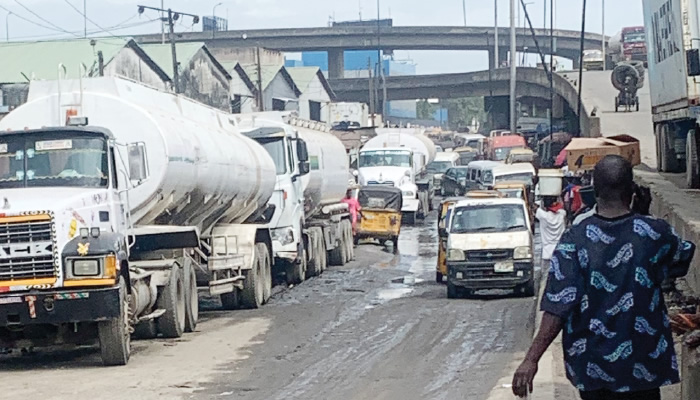
Filling stations in Abuja and neighbouring states of Niger, Nasarawa, and Kogi, were shut on Friday as oil marketers expressed worry over the planned nationwide protest.

Retail outlets, including those operated by the Nigerian National Petroleum Company Limited in Kubwa, Salbas Oil, Eterna, and Gegu Oil, among others located on the Kubwa-Zuba expressway, stopped dispensing fuel.

The same scene was also witnessed inside Abuja and parts of Niger and Nasarawa states.

Oil marketers told our correspondent that filling stations in Lokoja, the Kogi State capital, were also shut.

The development led to fuel queues resurfacing in outlets dispensing fuel like AYM Shafa in the Dei-Dei end of the Kubwa-Zuba expressway, Abuja, and the NNPC in Zuba, Niger State.

Also, several filling stations in some parts of Lagos State were closed on Friday, creating fears of impending fuel scarcity.

Our correspondents, who went around, noticed that most filling stations were not dispensing, while the few that attended to customers sold at N800 per litre.

Although some oil marketers said the closure of some retail outlets on Friday was due to the unavailability of fuel, others attributed it to apprehension over the planned nationwide protest.

Long queues in Ogun

In Ogun State, the situation at filling stations has reached a crisis point as motorists face long queues amid looming fuel scarcity.

Our correspondent visited the Magboro and Ibafo areas along the Lagos-Ibadan Expressway, where a chaotic scene unfolded as vehicles including motorcycles, cars, and commercial buses, lined up for petrol.

At Quest Filling Station in Magboro, the sight was alarming as the queue snaked for over a hundred meters, with motorists struggling for their turn to purchase fuel.

Of the three petrol pumps available, only one was operational, exacerbating the delay for those waiting.

Saheed, a commercial bus driver en route to Ibadan, expressed his frustration after spending over an hour in the line.

“I have been here for more than one hour. I didn’t know I would meet such a long queue. Although one of our drivers mentioned a smaller queue earlier, I didn’t anticipate this. My passengers are already complaining, but there’s nothing I can do. I can’t use my urine to drive them to Ibadan. We just have to wait for our turn,” he lamented.

The situation at NIPCO Filling Station in Magboro was also alarming. Diesel was priced at N1,200 per litre, while petrol cost N675 per litre. Out of the five available petrol pumps, four were operational.

Meanwhile, the Minister of State for Petroleum Resources (Oil), Heineken Lokpobiri, has called for calm.

He also urged Nigerians to avoid participating in the proposed protest.

Speaking on the closure of retail outlets in parts of the country, the Secretary of the Independent Petroleum Marketers Association of Nigeria, Abuja-Suleja, Mohammed Shuaibu, said, “Some of them may not have products to dispense due to unavailability.

“However, many marketers are worried about the proposed protest and are already taking measures to prevent losses. Closing shops is one of such measures and this, of course, is going to cause queues in such locations because the number of stations selling petrol would be reduced.

“I am in Lokoja now, and many stations are not dispensing petrol. This is not a good thing because we only recovered from the fuel queues recently in major cities across the country, though that situation was due to a drop in supply from NNPC.”

Commenting further, the minister in a statement issued in Abuja on Friday by his media aide, Nneamaka Okafor, pleaded with Nigerians to shelve the planned protest.

He stated, “Senator Heineken Lokpobiri, the Minister of State for Petroleum Resources, is calling on Nigerians, especially the youth in the Niger Delta, to remain calm and avoid participating in the proposed nationwide protest.

“We understand the frustrations and challenges faced by many Nigerians, but it is essential to approach these issues constructively.

“President Bola Tinubu is dedicated to revitalizing our economy and bringing renewed hope through well-thought-out policies and programmes.”

Lokpobiri underscored the importance of unity and patience as the FG works to address the nation’s diverse issues.

“Now more than ever, we need to stand together and support the initiatives being put in place. Our collective efforts will pave the way for a more prosperous Nigeria.”

Acknowledging the role of protests in a democracy, the minister warned against those who might exploit the protest for malicious purposes.

“Certain groups are looking to use this protest to incite violence and crime. We must not let non-state actors disrupt our peace and stability,” he cautioned.

Lokpobiri also called for constructive engagement and dialogue over any action that could unsettle the nation, saying, “While protesting is your democratic right, consider the broader implications on our national stability and progress. Dialogue and collaboration are far more effective solutions.”

The minister reassured Nigerians of Tinubu’s commitment to their well-being, adding, “President Tinubu is a true democrat who listens to the people. He is already implementing measures to address our nation’s challenges.”

Lokpobiri urged the youth and all Nigerians to support the government’s efforts, saying, “Let us work together to achieve the progress we all desire. Avoid actions that could jeopardize our collective future.”

No queues at Kwara petrol stations

As fuel queues resurface in some states in the country, Saturday According reports that no queue was observed at petrol stations in Ilorin, the Kwara State capital.

It was also noted that petrol was sold between N600 and N800 per litre.

AP filling station at Murtala Mohammed road, a major commercial area in Ilorin, was selling at N620 per litre on Monday, Conoil, N650; MJK, N800, while MRS, located on Unity road, sold at N600 per litre.

Also, Shafa filling station sold at N700 per litre, Rain oil at Asa Dam road, and Lao selling at N70 per litre. Meanwhile, the Tigress at Odota sold at N750 per litre while Bovas sold at N670 per litre in all its stations located in various parts of the metropolis.

Reps begin probe of imported fuel, others

In another development, the House of Representatives said it had commenced a full-scale investigation into the crude oil supply chain and quality of petroleum products imported and refined in the country.

The Green Chamber of the National Assembly said the move was to ensure transparency and accountability, as well as the security of the nation’s petroleum sector.

The Chairman, House Committee on Petroleum Resources, Downstream, Ikenga Ugochinyere, disclosed this on Thursday at the opening of its 2024 Midstream and Downstream Retreat, held in Port Harcourt.

The retreat, jointly organised by the House Committee on Petroleum Resources Midstream and Downstream, is themed, ‘Enhancing Regulatory Frameworks, Promoting Transparency, and Fostering Sustainable Development in Nigeria’s Oil and Gas Sector’.

The lawmaker explained the retreat is aimed at providing strategic insights into the nation’s petroleum sector.

The petroleum sector, according to him, is the backbone of the nation’s economy, adding that it is the duty of the legislative arm of the government to ensure its transparency.

Ugochinyere disclosed that the House had mandated both committees of the petroleum resource to open an investigation into the crude oil supply chain, noting that it was important for the nation’s economic recovery.

He said, “The committee will undertake detailed laboratory investigation at all local refineries, marketers, importers, and regulatory agency labs like NMDPRA.

“We will visit various filling stations, depots, and tank farms to verify the quality of imported petroleum products and assess the testing capacity of all refineries.

“The collection of these samples will be four spacemen and will be transparently done with all the key stakeholders.

“Zonal interaction committees will be constituted in order to ensure smooth movement to all the zones of the country for the purpose of taking samples from the depots, tank farms, and refineries for immediate analysis.”

He added, “We urge all those to be invited to provide full cooperation and support by providing all necessary documents, facts, and insights that would aid our investigation.

“Our investigation will proceed in phases beginning with the examination of standards of petroleum products that are imported into the country and the crude oil supply chain.

“This investigation that the House has ordered is the main reason we are at this retreat to brainstorm on how to proceed, and this investigation is crucial for restoring trust and ensuring the security and quality of Nigeria’s petroleum sector in line with the renewed hope agenda of the President.

“We are committed to accountability and transparency and thoroughness, and that we will do throughout the process. The investigation aims to identify and resolve the issues plaguing Nigeria’s petroleum sector.

“Our interaction with stakeholders in the Midstream and Downstream sectors is crucial. It is through this interaction that we will gain a comprehensive understanding of the challenges faced by our industry and collaboratively decide ways to ensure growth and sustainability.

“We are going to address allegations concerning the alleged importation of substandard petroleum products, the alleged production of substandard petroleum products, the non-availability of crude oil to domestic refineries, and other critical issues.”

Meanwhile, the Speaker of the House of Representatives, Hon. Tajudeen Abbas, in his keynote address, said the retreat was germane as it provides the opportunity for continued conversation and dialogue initiative by the Green Chamber on strengthening and enhancing the regulatory framework of the oil and gas sector.

The lawmaker, who was represented by Hon. Sada Soli, representing Kaita/Jibia Federal Constituency at the National Assembly, said over the years, there have been debates over regulatory, transparency, sustainable, and development of the sector even after the passage and coming into force of the Petroleum Industry Act (PIA) in the 9th Assembly.

He said the retreat was another opportunity to reflect on the issues once again.

Additional reports by Tunde Oyekola, Daniel Ayantoye and Lawal Muhammed

Nigeria flared 148.7mscf gas in six months, says minister

0

The Minister of State for Environment, Dr Iziaq Salako, has said indicators from the National Gas Flare Tracker shows that Nigeria flared 148.7 million standard cubic feet of gas in the first six months of 2024 which is about seven per cent above the level for the same period in 2023.

Salako, who disclosed this in an interview with Saturday According, said Nigeria’s commitment to achieving a “just transition” to net-zero emissions had garnered significant attention on the global stage.

He noted that the commitment was evidenced by the establishment of frontline advocacy initiatives following the signing of the Just Transition Declaration and the announcement of the ambitious 2060 net-zero goal in 2021 at the United Nations Climate Change Conference of Parties (COP 26) held in Glasgow.

Following this declaration, Nigeria launched its Energy Transition Plan on August 24, 2022, establishing the country’s strategy to reach a net-zero emissions energy system by 2060.

He said, “Gas flaring has been a common practice in the Nigerian oil and gas industry due to the absence of infrastructure to capture and utilise the associated gas. As a result, gas has been continuously burnt in oil fields, leading to the release of harmful pollutants into the atmosphere.

“Despite regulatory efforts, enforcing regulations has been challenging, and many operators still flare gas due to insufficient penalties and the high costs of gas capture and utilization technologies.

“As of today, Nigeria remains one of the top ten countries in the world in terms of gas flaring volumes. The Nigerian National Petroleum Corporation reports that approximately 324 billion cubic feet (bcf) of gas were flared in 2023, translating to significant economic losses and environmental damage.

The minister lamented that most international oil companies were not responding to the government’s gas flare transparency and accountability.

He stated that operators in the Nigerian oil and gas sector had a responsibility to lead from the front to support the vision of Nigeria to end gas flaring.

“The Federal Ministry of Environment through its relevant departments and agencies is determined to work with other stakeholders through policy and regulatory strengthening, investment drive, technology transfer, and private sector mobilisation, capacity building, community engagement and other measures to turn the tide and put our country on a firm footing to end gas flaring as early as possible but not later than 2030.”

Court jails 125 Boko Haram terrorists, financiers

0

The Federal Government on Friday disclosed that 125 Boko Haram terrorists and financiers were convicted in the resumed mass trial held over two days in Kainji, Niger State.

The Attorney General of the Federation and Minister of Justice, Lateef Fagbemi (SAN) in a statement by the Special Adviser to the President on Communication & Publicity, office of the AGF, Kamarudeen Ogundele, noted that the convicts were tried on charges bordering on terrorism, terrorism financing, rendering material support, and cases relating to International Criminal Court criminality.

He said the trials were held under Giwa Project Kanji Phase Five, between Tuesday and Wednesday, before five Federal High Court judges led by Justice Binta Nyako.

Others are Justices Joyce Abdulmalik, Emeka Nwite, Obiora Egwuatu, and Mobolaji Olajuwon.

He added that all 125 of the Boko Haram members were found guilty not the charges brought against them.

The statement read in part “the Attorney-General of the Federation and Minister of Justice, Prince Lateef Fagbemi (SAN), is superintending over the trial in conjunction with the Office of the National Security Adviser.

“The prosecution team was led by the Director of Public Prosecution of the Federation, Mohammed Babadoko Abubakar, while the defence team was led by Mr Abdulfatai Bakre from the Legal Aids Council” the statement disclosed.

“Others in attendance as international observers are the National Human Rights Commission, the Nigerian Bar Association, and the United Nations Office on Drugs and Crimes among others.

“The courts convicted 85 persons for terrorism financing, 22 for ICC related crimes while others were convicted for terrorism. They were sentenced to various jail terms.

“It is also noteworthy that 400 defendants who have completed their sentence have also been moved to Operation Safe Corridor in Gombe State for rehabilitation, deradicalisation and subsequent reintegration”.

Actors’ creativity not tied to religion — Lawyers

0

Entertainment lawyers have said that actors have the creative liberty to express themselves and tell stories as they deem fit.

They noted that the actors could function independently of any religious bearing and should not be sanctioned by any religion.

They made this known on the heels of the outrage that followed a movie poster shared by Nancy Isime on Thursday.

The poster depicts two women wearing black burqa while wielding guns and a man wearing a balaclava and holding two men hostage in a bank heist.

In another photo, Isime was wearing a hijab while posing with a gun.

However, the poster was met with heavy criticism by some religious people who believed that she was desecrating Islam and portraying it in a bad light.

Following the post, an Islamic group, Muslim Rights Concern, called for the ban of the yet-to-be-released film.

MURIC added that the movie was satanic, adding that it took Islamophobia to the highest level.

In a statement, the executive director of MURIC, Ishaq Akintola, urged the National Film and Video Censors Board to take swift action against the film.

He added, “It aims to portray Muslim women as criminals, potentially inciting violence and discrimination against them.”

However, entertainment lawyers disagree with the stand of MURIC declaring that actors had creative licences and it was not dependent on any religion.

Olumide Sonupe, the principal partner of Sonupe Law Firm stated that because we live in a secular country, actors have creative liberty.

He added that the religious morality of any religion is different from what is obtainable in the law.

He said, “It is funny because morality and the law are so confused and put together in such a way that it creates confusion.

“When we are talking about morality, the morality of the Islamic religion and their belief is very distinct from what the law says. Being a secular society, some people are not religious and that doesn’t stop them from doing things that might be against the morals of any religion. The only thing you can do to such a person is to tell them they are banished from the religious society.”

“If they are acting out a moving that portrays Islam in a bad light, the worst you can do is to tell the followers not to watch the movie. It is called acting, it is not the reality of things. It may be the reality of things.”

Interpreting this section, he noted that the movie is not an insult to any religion in his opinion. “To me, I don’t find that act inciting. That is the reality of what is happening in Nigeria.”

Another entertainment lawyer, Femi Njoku noted that movies mirror what happens in society.

Meanwhile, the National Film and Video Censors Board intervened in the situation.

In a statement by its Director General, Shaibu Husseini late Thursday said contact had been made with the producers to address the contentious issue with the producers.

Uniform minimum wage may lead to job losses, SAN warns

0

A Senior Advocate of Nigeria, Yusuf Ali, has called for the autonomy of states in negotiating wages with their employees, aligning this with the principles of federalism.

He stated this against the backdrop of the newly approved minimum wage of N70,000 by President Bola Tinubu which was also passed into law on Tuesday by the National Assembly.

Ali argued that the current system of a uniform national minimum wage did not account for the economic disparities between states, which could lead to adverse outcomes such as job losses and financial strain on less affluent states.

Recall that the Southern Governors’ Forum, for instance, has expressed a desire for states to negotiate wages independently, a position that highlights the ongoing tension between regional autonomy and national cohesion in Nigeria’s federal system.

Labour unions, on the other hand, staunchly opposed this move, arguing that it could lead to disparities in workers’ pay and conditions across different states.

The Head of Information and Public Affairs of the Nigeria Labour Congress, Benson Upah, in a statement titled, ‘Governors cannot dictate what to pay’, said governors’ demand to independently set the minimum wage in their respective states undermines the principle of a minimum wage and poses a threat to the welfare of workers as well as the stability of the national economy.

He stated, “Ensuring a fair minimum wage is not only a matter of economic justice but also a fundamental aspect of maintaining social stability and national cohesion. Nigerian workers should not be reduced to beggars.

“It is unfortunate that workers’ salaries are often seen as charity rather than the hard-earned income of hardworking Nigerians. It is equally painful that some of these governors fail to realise that workers’ salaries substantially drive the economy. Not surprisingly, they prioritise their greed over the needs of ordinary citizens.”

Meanwhile, the SAN, in an interview with Saturday According, emphasised the importance of aligning wage negotiations with the federal structure of the country.

He highlighted that each tier of government employed its workers and should have the flexibility to set wages according to their financial capabilities.

He said, “We have to consider the type of government we run. We all claim that we are running a federal system. In a truly federal system, the parts should have the liberty to negotiate with their workers.

“Capabilities to pay salary are influenced by various factors, including the economy and state priorities. We must find a solution that is workable, sustainable, and that does not lead to job losses.”

Brazil admit Falcons difficulty in Bordeaux win

0

Brazil agree Thursday’s Women’s Football Tournament Group C opener against Nigeria was a difficult match despite securing a 1-0 win over the African giants, According Sports Extra reports.

Gabi Nunes, who scored the decisive goal, and goalkeeper Lorena made the observation while reflecting on the nail-biting encounter at Stade de la Beaujoire in a chat with FIFA.com.

“I am very, very happy with this game. It was a difficult game, but this team is amazing; we trained a lot to play a good game. I’m happy with the goal, to be able to help our team, and now we have to rest and enjoy this moment,” said Nunes.

This was corroborated by Lorena, who seized the occasion to extol the virtues of the team, saying, “Brazil is very prepared. Arthur is doing an excellent job, and we are very prepared. We could all see today how strong the group is, and Nigeria is a difficult team, but we deserved to win. Our squad is united, and we will always battle for the first place.”

Brazil opened the scoring in the 37th minute, when Marta, just moments after having a goal ruled out for offside, played a sumptuous reverse ball to Nunes, who took two touches and rifled the ball into the net. While the evergreen Marta struck the post in the second half, Brazil held on to secure all three points.

Nigeria have now lost thrice in as many encounters with Brazil, having slumped to a 4-3 defeat to the South Americans at the quarterfinals of the 1999 FIFA Women’s World Cup and 3-1 at the 2008 Olympic Games in Beijing 2008.

The Super Falcons were not disappointing in Thursday’s match, but the loss puts a huge burden on Randy Waldrum’s charges in their quest to qualify from the group also housing world champions Spain and Asian heavyweights Japan.

They will take on Spain for the second match on Sunday, July 28 at the at the Stade de la Beaujoire in Nantes and round off group assignment with another tough tie against Japan on Wednesday, July 31 at the same venue.

Nigeria not second choice, Mikel tells foreign players

0

Former Super Eagles skipper Mikel John Obi has seriously kicked against some foreign-born players, using Nigeria as a second option when considering which country to represent at the senior international level.

Speaking on ESPN Africa on Friday, the Chelsea legend urged them to be proud of their Nigerian roots and not wait until age has taken a toll on them before using the country as a last resort.

He said, “They want to play for England, France, whatever it is, and then they wait. When they get to 25 or 26 and they don’t get a call up from England, then they call Nigeria. We shouldn’t be treated as a second option. You should be proud of your African roots. You should be proud to represent your African country.

“If you decide you want to play for England, stick to it. Sit and wait, but don’t wait till 29 or 30, you have passed your best, then you are like, ‘Oh Nigeria FA, I’m ready to play for you now’. No, f…k off, mate.”

Mikel has every right to address this issue, having served Nigeria with every fibre in him, representing the country at U17, U20, and U23 levels before graduating to the senior level, playing 91 matches from 2005 to 2019, and serving as captain of the Super Eagles for several years.

Some of the players who resorted to Nigeria after failed bids to play for their countries of birth, especially England, include Shola Ameobi, a striker overlooked by England after representing the country at the U20 level. He beckoned on Nigeria at age 32 and ended up scoring twice in 10 appearances from 2012 to 2014.

There is also Reuben Agboola, who didn’t consider Nigeria while making waves in the Premier League as ‘Agboola the Rock’. After being ignored by England, the then-right-back decided to play for Nigeria at 29 and earned nine caps from 1991 to 1993.

Prominent on this list is striker Dickson Etuhu, who turned to Nigeria at 25 and ended up with 19 caps from 2007 to 2011.

On the contrary, John Chodozie is a name that still resonates among Nigerians for opting to represent Nigeria at 21, when he was a consistent top-draw performer for Tottenham Hotspur. The then-right winger played nine matches for Nigeria, scoring twice, making his debut in
1981.