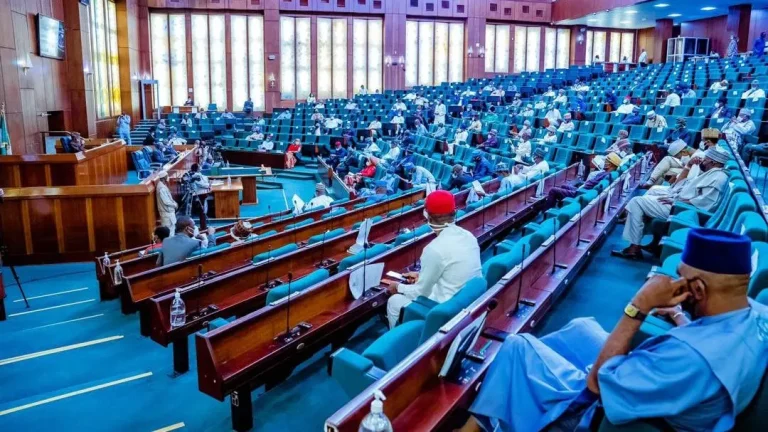
A clash of interests among members of the House of Representatives has forced the leadership of the House to dissolve the current ad-hoc Joint Downstream and Midstream Committee.
Initially, the joint committee initially was investigating the importation of adulterated petroleum products, the non-availability of crude oil for domestic refineries, and other critical energy security issues.
But following the decision of the lawmakers to engage in media war to protect their interest, the House leadership decided that the committee would be succeeded by a newly constituted ad-hoc committee with the same mandate.
TVN reports that the Deputy Spokesperson of the House, Philip Agbese, recently asked President Bola Tinubu to immediately dismiss the Group Chief Executive Officer of the Nigerian National Petroleum Company Ltd (NNPCL), Mele Kyar and the Chief Executive of the Nigeria Midstream and Downstream Petroleum Regulatory Authority (NMDPRA), Farouk Ahmed, for allegedly stifling the economy’s growth due to the oil sector crisis.
Also, the Special Joint Committee set up by the House led by Ikenga Ugochinyere last Wednesday directed NNPCL to halt the mortgage of future crude oil for loan from foreign creditors, pending the outcome of the ongoing forensic audit of various transactions carried out so far.
However, 50 members of the House of Representatives kicked against the call for the sack of Kyari and Ahmed, describing it as premature.
The lawmakers led by Billy Osawaru while addressing a press conference last Thursday in Abuja said the call for the sacking of Kyari when an investigation was currently being carried out was premature, and made in bad taste.
But the spokesperson of the House, Akin Rotimi in a statement issued on Monday, said to ensure the efficacy and independence of the investigation, the new committee would consist of lawmakers selected for their expertise, competence and integrity.
“The House remains committed to addressing these vital issues and ensuring thorough oversight. Further details on the new committee’s operations will be provided in due course,” he said.
Clash of interests: Reps to reconstitute ad-hoc oil & gas investigative committee
Clash of interests: Reps to reconstitute ad-hoc oil & gas investigative committee
Bitcoin drops to $52,000 in market sell-off


The world’s largest cryptocurrency by market cap, Bitcoin, dropped to $52,000 amid a market sell-off on Monday.
The price of the digital asset dropped significantly by 13 per cent in 24 hours.
The cryptocurrency dipped from $60,752 on August 4, to $52,312 on August 5, according to CoinMarketCap, a price-tracking website for crypto assets.
Similarly, the price of other cryptocurrencies also experienced a downswing. The price of Ethereum fell from $2,905 on August 4 to $2,261 on August 5 — a decline of 22.46 per cent in 24 hours.
CoinMarketCap also said the global cryptocurrency market cap shrank to $1.85 trillion, after recording a reduction of over $184.39 billion or 14.06 per cent in the last 24 hours.
Bitcoin, the world’s largest cryptocurrency by market cap, dropped to $52,000 amid a market sell-off on Monday.
The price of the digital asset fell by 13 per cent in just 24 hours.
Bitcoin declined from $60,752 on August 4 to $52,312 on August 5, according to CoinMarketCap, a price-tracking website for crypto assets.
Similarly, other cryptocurrencies experienced a downswing. The price of Ethereum fell from $2,905 on August 4 to $2,261 on August 5, a decline of 22.46 per cent in 24 hours.
CoinMarketCap also reported that the global cryptocurrency market cap shrank to $1.85 trillion, losing over $184.39 billion, or 14.06 per cent, in the last 24 hours.
A report by the Economic Times stated that the dramatic drop was attributed to a hasty sell-off by investors due to geopolitical tensions, fears of a U.S. recession, and the global impact of the Yen’s appreciation following the Bank of Japan’s decision to raise interest rates to 0.25 per cent and reduce bond purchases.
On March 19, Standard Chartered Plc raised its 2024 forecast for Bitcoin (BTC) from $100,000 to $150,000.
Standard Chartered also predicted that BTC would reach an all-time high of $250,000 by 2025 before settling around $200,000.
On March 11, Bitcoin crossed $71,000 for the first time in two years.
Bitcoin dips below $50k as global crypto market bleeds

The price of Bitcoin plunged below $50,000 on Monday, reaching lows not seen in over six months.
The dip in the value of the digital assets followed a widespread global market sell-off.
Bitcoin dropped as much as 20% to around $49,000 before rebounding slightly to trade above $50,000 again.
The steep decline coincided with crashing stock markets worldwide, fueled by recession fears.
The overall Bitcoin market cap shed nearly $200 billion over the weekend.
READ ALSO:Bitcoin hits new highs
The $50,000 level is seen as an important support area for Bitcoin. The latest Bitcoin crash exemplifies the asset’s volatility and correlation with speculative equities. But Bitcoin has rebounded from previous sell-offs before resuming its long-term uptrend.
The United States exchange-traded funds for Bitcoin suffered their largest outflows in about three months on August 2.
One question is whether the products will attract dip buyers when they resume trading, or witness a deeper efflux.
Similarly, Ether shed over a fifth of its value before paring some of the slide to change hands at $2,342. Most major coins also nursed losses.
By: Babajide Okeowo
The post Bitcoin dips below $50k as global crypto market bleeds appeared first on Latest Nigeria News | Top Stories from TVN.
Nigeria will soon overcome food inflation, shortage
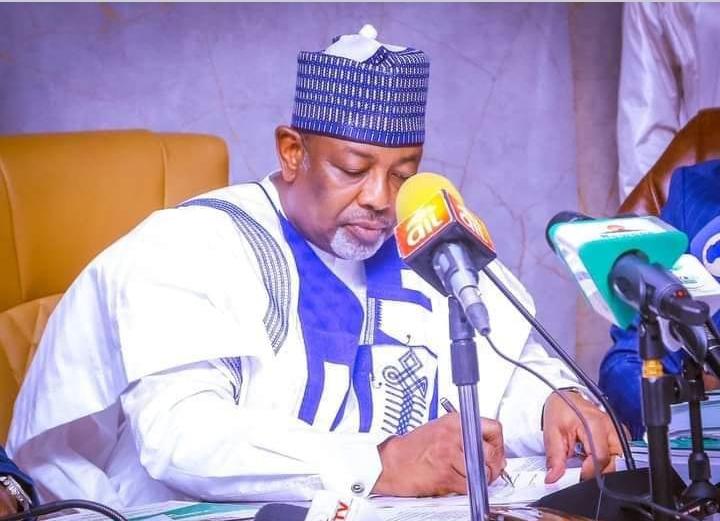

The Federal Government has said the country will soon overcome its present food shortage and inflation, which has reached 40 per cent, according to data from the National Bureau of Statistics.
The Minister of Agriculture and Food Security, Abubakar Kyari, stated this on Sunday during an interview on Channels Television’s Sunday Politics.
Kyari revealed that the Bola Tinubu government has measures in place to address the present food inflation and increase food production in the country, saying that the country is expecting a bumper harvest before year-end.
The minister added that some of the reasons for the acute food shortage in the country are seasonal reasons, reduced landmass, flooding, and others.
He said, “It [bumper harvest] is about October-November this year. That’s when we are going to have the harvest. We are expecting a bumper harvest barring any natural issues. Well, I am just giving you the assurance that we will have a bumper harvest.
“The season we have here is a critical issue we have in agriculture. This is what we call the lean season, and this is between June and July and the next harvest.
“The shrinkage of land mass for agric, flooding, habitation problems, and insecurity…An ageing farming population; younger people are not going into agriculture now.”
Kyari said the federal government is further ramping up moves for mechanised farming with the distribution of fertilizers to farmers and efforts to purchase tractors.
He added, “We have ordered. It’s not like chewing gum; you can’t buy it off the shelf. I went to Belarus and ordered 200 tractors and 9,000 other implements,” the minister said on the current affairs show.
“The basic implement for farming in Nigeria is a hoe, which is archaic and antique. That’s why we are talking mechanisation.”
Protesters occupy Kaduna, insist Tinubu must step down

A large crowd of protesters, supported by various groups from different parts of the Kaduna metropolis, has demanded President Bola Tinubu step down from office.
The protesters, observed by The According, initially assembled at the Stadium Roundabout within the Kaduna metropolis.

The large protest procession began at 10:15 am on Monday, marching along Junction Road towards Ahmadu Bello Road, chanting, “Tinubu ze soka’ kaa’sa,” loosely translating to “Tinubu must step down.”
Our correspondent witnessed the protesters sharing banners, flags in Nigerian green-white-green colours, and placards bearing inscriptions such as “#End Hunger in Nigeria.” They gathered around the Stadium Roundabout before commencing their march.
The protesters, insisting that President Tinubu must step down, hailed every military van they encountered, shouting, jumping, and chanting, “Tinubu yaa’so’ka, mu’na so soja,” meaning “Tinubu step down, we want soldiers.”

Approximately six police vans carrying anti-riot policemen were seen blaring sirens as they drove around the metropolis to manage the swelling crowd of protesters. Additional security agents stood guard at strategic points on Ahmadu Bello Road to the Central Market.
As the protest progressed at 10:45 am, more protesters joined the group, coming from areas such as Constitution Road, Saudana Crescent, Katuru Road, Offa Road, and Abuja Road within the Kaduna metropolis, increasing the crowd heading towards the Central Market.

A few protesters were flying a flag resembling the Russian flag.
The protesters chanted in Hausa, “Bama so,” meaning “We don’t want hunger.”
A more desperate faction of the group was seen burning and tearing the Nigerian flag.
Although the police detachments manning different parts of the city made efforts to calm the protesters and urged them to vacate the roads, the adamant protesters insisted on heading to the Government House. This move agitated the security personnel, who hurriedly called for reinforcements as the protesters’ ranks continued to swell.
Hunger protest: Northern Elders Forum faults Tinubu’s address
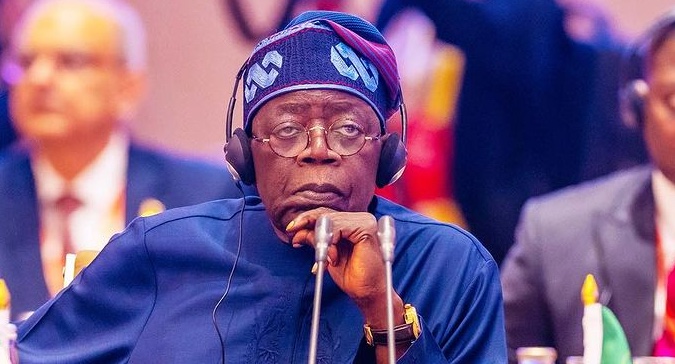
The Northern Elders Forum (NEF), has expressed concern over President Bola Tinubu’s national address on the ongoing hunger protests.
The NEF said the President was silent on the severe security situation in the North-West and other parts of the North.
In a statement released on Monday by its Director of Publicity and Advocacy, Abdul-Azeez Suleiman, the NEF lamented the escalating issues of banditry, kidnapping, rape and other criminal activities in the region that have caused widespread fear and insecurity.
The Forum equally noted that there are challenges in policing northern communities, where criminal elements continue to cause harm, resulting in abandoned farmlands, closed schools and destroyed livelihoods.
The NEF expressed disappointment that the President’s speech did not address these pressing issues or offer reassurance to affected communities.
It regretted that despite choosing not to comment on the ongoing protests in the country — thereby remaining committed to peace and national stability — the Forum had hoped for the President’s acknowledgment of the North-West’s struggles and other affected regions.
“They anticipated words of encouragement and an assurance of concrete steps being taken to alleviate the security challenges faced by these communities. The NEF had high hopes for the President’s speech, expecting that he would address the dire humanitarian disaster that criminal activities have brought upon our nation.”
According to the NEF, the scale of the crisis is immense, with millions of the citizens displaced internally, and hundreds of thousands of orphans facing hunger and malnourishment. The Forum described the challenges as new and alarming realities that were previously unknown in the land.
The Forum added that it is essential that the magnitude of the challenge is not underestimated, and expressed the belief that dealing with the humanitarian disaster in the North will require a level of political will and administrative competence that goes beyond what is needed to defeat criminal gangs.
It added, “The simultaneous challenges of combating insurgency and banditry, rehabilitating IDPs, and rebuilding lives, communities, and infrastructure must all be top priorities for the government. We expected the President to acknowledge the gravity of the situation and outline concrete plans for addressing these critical issues.”
The group opined that the focus should have been on finding sustainable solutions to the crisis, prioritizing the needs of the affected communities, and ensuring that necessary resources are allocated to support them.
The Northern elders in the same vein pointed out that it is vital that the government demonstrates a strong commitment to addressing the humanitarian disaster and shows that it has the capability to lead the nation through challenging times.
Hunger protest: Northern Elders Forum faults Tinubu’s address
You’ve not brought the ‘renewed hope’ you promised – Catholic Bishops knock Tinubu

The Catholic Bishops of Owerri Ecclesiastical Province have said the reforms initiated by President Bola Tinubu have not brought the promised renewed hope to Nigerians.
The Bishops noted that the reforms have rather brought high inflation, hunger and anger.
This is contained in the communiqué issued over the weekend at the end of their two-day meeting, held at Sacred Heart Pastoral/Retreat Centre, Orlu, signed by the Chairman and Secretary, Most Rev. Lucius Ugorji and Most Rev. Augustine Echema, respectively.
According to the Bishops, “Our nation, Nigeria, continues to face many social and economic challenges that are bringing untold hardship to our people.
“The reforms that were introduced at the inception of the current administration have not brought the renewed hope promised. Instead, inflation continues to skyrocket and hunger and anger continue to grow.
“Despite calls by the government for the people to sacrifice and bear patiently the hard times, there seems to be no corresponding example of prudent spending on the part of the leaders at all levels of government.
Speaking on the ongoing national hunger protest, the Catholic Bishops said that the youths are right to be angered by the worsening state of the nation.
The Bishops said that good governance and socio-economic stability will continue to elude Nigerians if there is no collective effort to strengthen the political institutions.
They urged Nigerian citizens to make adjustments in the context of the hard times facing everybody, stressing that adjustment will include saying no to all corrupt practices, among others.
You’ve not brought the ‘renewed hope’ you promised – Catholic Bishops knock Tinubu
Freed Russian dissident Orlov vows to continue activism
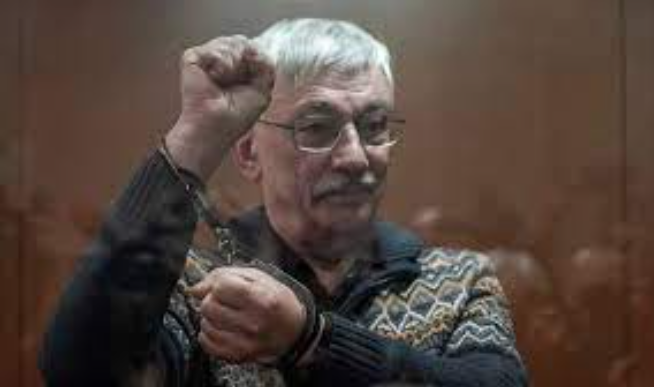

Russian human rights advocate Oleg Orlov, freed as part of a prisoner swap between Russia and Western countries, on Monday vowed to pursue his activism by seeking the release of other political prisoners.
The veteran campaigner is a key figure in the non-governmental organisation Memorial and a co-winner of the 2022 Nobel Peace Prize.
Now in Germany, he spoke to supporters in a video published by Memorial.
“For me, freedom will above all be about working for Memorial,” the dissident said, adding that he would focus on campaigning for the release of political prisoners.
The 71-year-old was sentenced to two-and-a-half years in prison in February over his repeated criticism of Russia’s campaign in Ukraine.
Earlier in his activist career, Orlov had campaigned against the Soviet invasion of Afghanistan.
Unlike many other government critics, Orlov chose to stay in Russia despite the risk of imprisonment.
Memorial investigates human rights violations, aids political prisoners and works to preserve the memory of victims of Soviet repression.
It was formally dissolved by a Russian court in 2021 as part of a widespread crackdown on dissent.
Like other Russian political prisoners released in last week’s exchange, Orlov said he was happy to be free but also bitter about no longer being in Russia to continue his struggle, he told Channel Meduza in an interview on Saturday.
Russia has 765 political prisoners, according to Memorial.
Thousands more people have been threatened or sanctioned for their opposition to the war in Ukraine or the Russian government.
AFP
EFCC to scrutinise local government activities for accountability


The Economic and Financial Crimes Commission has pledged to closely monitor local government activities to ensure good governance, accountability, and transparency.
This follows the recent Supreme Court judgement granting financial autonomy to local governments.
It disclosed this at a national dialogue organised by Agora Policy, themed “Enthroning Accountability in Local Government in Nigeria”, in Abuja on Monday.
A representative of the EFCC Chairman, Friday Ebelo, said, “Good governance encompasses three essential elements: accountability, transparency, and citizen participation. For these elements to be effective, we need dedicated and development-minded individuals to manage local government administrations.”
The EFCC emphasised its commitment to scrutinising local government activities, stating, “We must make a deliberate effort to bring the presence of governance to our people, ensuring that citizens feel the impact of governance in their daily lives, particularly in areas such as healthcare, education, and infrastructure development.”
The commission warned that “business as usual” would not be tolerated, indicating a renewed focus on ensuring local governments are held accountable for their actions.
Agora Policy founder, Waziri Adio, emphasised the need for reform in rural government areas, stating, “Local government areas are the least trusted, least capacitated, and least interesting to the public.”
Adio noted that despite being expected to perform crucial functions, local government areas are failing to meet expectations.
“Only 28 per cent of citizens trusted local government administration, down from 58 per cent in 2000,” he cited from Afrobarometer’s 2008 survey.
He advocated for increased awareness, engagement, and accountability, saying, “We need to fix the broken representative government by involving people directly in decision-making.”
Adio added, “We need to increase awareness, engagement, and accountability. This requires vertical, horizontal, and diagonal accountability mechanisms.”
Africa Director of the MacArthur Foundation, Kole Shettima emphasised the need for local governance reform, citing a conversation where a villager expected President Buhari to fix a local water issue.
He noted, “This shows the mentality of our people, expecting the president to fix all problems.”
Shettima commended the Agora Policy Center for promoting policy conversations and acknowledged local government efforts to involve citizens in decision-making.
Protest: Distance yourself from sycophants – Obi advises Tinubu over ‘disconnected address’
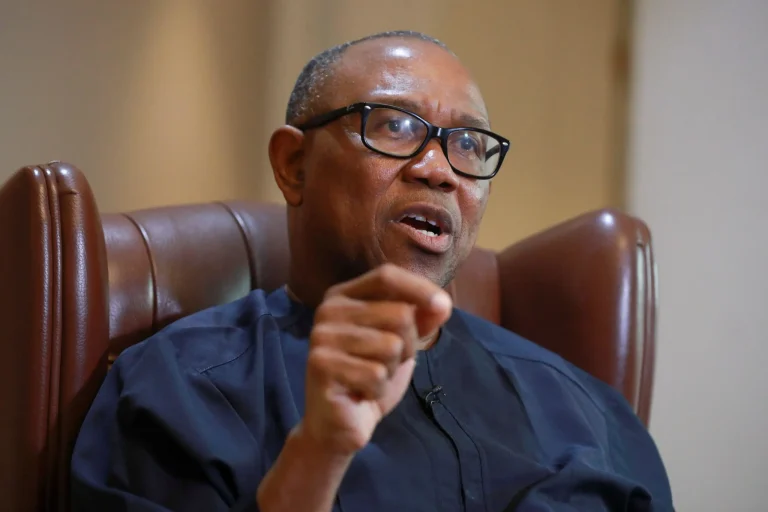
Former presidential candidate of the Labour Party, LP, Mr Peter Obi has expressed disappointment over President Bola Tinubu’s Sunday broadcast to Nigerians concerning the ongoing nationwide protests.
Obi said Tinubu’s address appeared disconnected from the harsh realities faced by the people and failed to address critical issues that initially triggered the protest.
According to him, the speech either reflects a lack of awareness among his advisers regarding the scale of anger, hunger, and hardship in the country, or a deliberate choice to disregard it.
The former Anambra State Governor in a post on his X handle on Monday strongly advised the President to distance himself from sycophants and surround himself with individuals who will present the unvarnished truth.
In the statement titled, ‘My Response to the President’s Address’, Obi said, “Having led the call for the President to address the nation and respond to the demands of the people, and having listened to the belated speech, I needed to delay my response to see if my understanding of the address was aligned with others. I hesitated to respond immediately, as I felt it could have been perceived as another attempt by Peter Obi to sway public opinion, especially since I was initially accused of sponsoring the protest.
“However, I must begin by thanking the President for finally addressing the people, albeit belatedly, which might have prevented the unnecessary loss of innocent lives, including those of our security agents.
“While I had hoped that, in consoling the families of those who lost their loved ones in the protest, he would also show some empathy towards those who were injured, arrested, and detained due to the overzealous and unprofessional conduct of some security operatives, this was unfortunately not the case. It is the responsibility of the government to identify criminal elements attempting to disrupt the protest through looting and other unlawful behaviours and to protect those genuinely exercising their democratic rights.
“Nigeria must embrace all tenets of democracy, including the right to protest, without selective adherence. I also appreciate his condemnation of the ethnic bigotry being propagated by some individuals against other ethnic groups.
“However, I had hoped for more decisive action, such as the immediate arrest and prosecution of those responsible, to demonstrate that such intolerance will not be tolerated in today’s Nigeria.
“The President’s address regrettably appeared disconnected from the harsh realities faced by the people and failed to address critical issues that initially triggered the protest. It either reflects a lack of awareness among his advisers regarding the scale of anger, hunger, and hardship in the country, or a deliberate choice to disregard it. At this point, I strongly advise the President to distance himself from sycophants and surround himself with individuals who will present the unvarnished truth.
“While the President’s speech focused on the past, the people are concerned with the present and the future. He should begin by addressing pressing issues such as the exorbitant cost of governance, measures to tackle corruption, the high cost of living, and directing resources effectively towards critical areas like health, education, and poverty alleviation. I respectfully reiterate that the President should declare a war on insecurity, the economy, poverty, unemployment, and the power sector.
“Persistent issues of corruption and mismanagement of public funds must be addressed decisively. As is done in other nations during such times, regular briefings, whether quarterly or biannually, from the President are essential to clearly communicate the visible and verifiable measures being taken to revive the nation from its current state of hopelessness, restore hope, and rebuild trust in our country.
“I also humbly request that the President reduce the repetition of how dire the situation is; every Nigerian is already aware of the extent of the problems. Mr President, you and your team were elected not just to witness the protests but to alleviate the suffering of the people.
“Nigerians do not expect the President to solve the nation’s problems overnight, but we do expect a concerted effort to address the mismanagement of public resources, reduce the high cost of governance, and tackle issues like insecurity, corruption, electricity, agriculture, and productivity to set the country on a path to recovery and growth. By doing so, the President can restore hope and rekindle the people’s faith in our dear country Nigeria. A new Nigeria is Possible.”
Protest: Distance yourself from sycophants – Obi advises Tinubu over ‘disconnected address’