Home Blog Page 43

Senate Decision: Manual Backup Retained Despite Clause 60 Proviso Opposition

0

After a heated plenary session in which 15 senators opposed the contentious clause in Clause 60 of the Electoral Act (Repeal and Re-Enactment) Bill, 2026, the Senate on Tuesday once again approved the electronic transmission of election results, but kept manual collation as a backup.

After a contentious floor vote, 55 senators voted in favor of keeping the manual fallback mechanism in place, while 14 senators, including Senator Enyinnaya Abaribe of ADC/Abia South, opposed it.

After new concerns were raised regarding inconsistencies in a number of clauses and the timing of the 2027 general elections announced by the Independent National Electoral Commission, the upper chamber, which had previously passed the bill, was forced to recant its decision and recommit it to the Committee of the Whole.

Clause 60, which addresses the transmission and compilation of election results, was the subject of a renewed dispute that dominated Tuesday’s plenary.

When the proceedings restarted, Abaribe demanded a division on the section, which led to a boisterous session. A similar attempt had been attempted by the Abia South lawmaker during last week’s emergency plenary, but he withdrew under pressure, causing a stir in the chamber and public outrage.

Opeyemi Bamidele, the Senate leader, intervened and advised composure.

Abaribe has the right to demand it regardless of whether he has done it previously. “Let’s let him,” Bamidele remarked.

Abaribe’s prior unsuccessful candidacy was brought up to parliamentarians by Senate President Godswill Akpabio.

Akpabio stated that the prior demand had been retracted and that “people were mocking you on social media.”

Senators from the opposition immediately protested, claiming that the Senate should have been the appropriate forum for the issue.

Citing Senate Standing Order Order 52(6), Deputy Senate President Barau Jibrin contended that it would be improper to review a provision that has already been decided. Sen. Sunday Karimi briefly addressed Abaribe as a result of the additional commotion caused by his submission.

Bamidele, however, reminded colleagues that previous rulings on the bill were no longer enforceable because he had properly moved a motion for rescission. He insisted that such motion was compatible with Abaribe’s request for a split.

The majority prevails, 55 vs. 15.
Akpabio put the issue to a vote after contentious discussions.

Senators were invited to raise their hands in support of Clause 60(3)’s manual backup proviso. Lere Oyewunmi, the Senate Deputy Minority Leader, was among the fifty-five members who supported the measure.

Abaribe and fourteen other people rejected it, preferring real-time electronic communication without a manual fallback.

The manual backup clause was kept in place when the majority decided to do so.

In cases when network or communication issues prevent electronic transmission, the manually filled-out and signed Form EC8A will be the main source of information used for results compilation and declaration under the modified clause.

The results of polling units must be electronically transferred to INEC’s Result Viewing Portal (IReV), although in the event that technology malfunctions, manual documentation is still legally binding.

Revocation Regarding the Election Date in 2027, Inconsistencies
Before the division, the Senate had recommitted the bill for further review after reversing its previous passage.

Bamidele moved to revoke the Electoral Act (Repeal and Re-Enactment) Bill, 2026 and send it back to the Committee of the Whole in accordance with Order 52(6).

He clarified that the motion was made in response to INEC’s announcement that the general elections for 2027 will be held in February of that year. Stakeholders expressed worries that the date would interfere with legislative timelines and impact inclusivity, he said.

Additionally, Bamidele cautioned that elections held during Ramadan may have a detrimental effect on logistics, voter turnout, and legitimacy in general.

He also mentioned inconsistencies in the bill’s Long Title and other sections that influence internal consistency, numbering, cross-referencing, and reference, such as sections 6, 9, 10, 22, 23, 28, 29, 32, 42, 47, 51, 60, 62, 64, 65, 73, 77, 86, 87, 89, 93, and 143.

The Senate was given the opportunity to begin anew after the rescission revoked all previous legislative acts on the bill. Nevertheless, the result regarding electronic transmission did not alter in spite of the clause-by-clause review.

Some irate MPs left plenary when the minority bloc was defeated.

The fresh approval after a week of heavy public pressure, protests, and condemnation from opposition politicians, youth movements, and civil society organizations who had accused lawmakers of trying to undermine democratic safeguards in advance of the 2027 elections.

Despite restoring electronic communication, the Senate refrained from requiring real-time uploads.

After voting and documentation, presiding officers must upload the polling unit results to IReV. The manually filled out Form EC8A will be the official basis for collation in cases where network issues prevent electronic transmission.

Both sides were praised by Akpabio following the split.

Let me express my gratitude to the esteemed senators for their demonstration of democracy and patriotism.

“Those in the majority made sure that the Form EC8A remains the primary mode of election results, while those in the minority displayed bravery by opposing the proviso.” He stated that polling places, not polling stations, are where elections are won and lost.

“Electronic transmission is a historic innovation that enables election monitors, including foreign observers, to track results without physically visiting Nigeria’s over 176,000 polling units,” he said.

Akpabio remained silent when asked if the 2027 presidential election would take place on January 13 instead of February 20. This fueled rumors in political circles.

Occupy the National Assembly protesters persisted in their demonstrations at the National Assembly complex, cautioning lawmakers against any action that would jeopardize the legitimacy of the 2027 elections.

Senate Seeks Explanation from IST Over N16m Fumigation Bill

0

The Investments and Securities Tribunal (IST) management was questioned by the Senate on Tuesday regarding their 2025 office cleaning and fumigation expenditure of N16 million, which the Senate described as dubious during a period of severe economic hardship.

Members of the Senate Committee on Capital Market questioned the tribunal’s 2026 budget defense, pointing out what they saw as misaligned objectives in the agency’s spending pattern.

Established by the Investments and Securities Act of 2007 and most recently updated in 2025, the IST is a specialized fast-track civil court that decides capital market issues. Appeals are heard at the Court of Appeal.

In the course of the interrogation, Senator Osita Izunaso (APC, Imo West), the committee chairman, demanded explanations for the N16 million spent on cleaning and fumigation out of the N30 million allocated for the item in the 2025 budget.

Despite the tribunal’s operations being little known to investors and market participants, Izunaso questioned why such a large sum was allocated to cleaning services while crucial measures like public awareness and outreach were underfunded.

Aminu Junaidu, the tribunal’s chairman, justified the expense by stating that each quarter, fumigation is done to protect confidential documents from rodents and other pests.

“Cleaning services were outsourced across the zonal offices of the tribunal, which contributed to the cost,” he added.

“Our documents must be safeguarded. It is imperative that our confidential documents not be destroyed. Regular fumigation is carried out for this reason,” he informed the committee.

Nonetheless, legislators insisted that agencies must exercise caution and match expenditures to public expectations during a time of financial restraint.

Despite growing calls for government operations to be more digitally streamlined, the committee also criticized the tribunal’s ongoing reliance on stationery and consumables.

The tribunal should use digital procedures to reduce expenses, Senator Ogoshi Onawo of Nasarawa South said, criticizing what he called exorbitant office supply spending.

Office supplies and computer consumables cost the IST N6.134 million, according to the 2025 budget performance report that was sent to the committee.

The job of the tribunal necessitates a great deal of documentation, according to Junaidu, who responded. This includes authoring rulings and judgments and producing Certified True Copies (CTCs) for litigants and other applicants.

“It is a tribunal.” We have to write down our decisions and rulings. Photocopies are provided to litigants. We are required to issue a CTC to the person who applies. “That explains why we consume so much,” he said.

Junaidu explained that although petitioners pay for certified copies, the money is sent straight to the Federal Government’s Treasury Single Account (TSA), meaning the tribunal does not receive any of the money made. The prices are approximately N10 per page.

“The TSA receives the money directly; we have no control over it,” he continued.

In addition to cleaning and stationery, the tribunal’s 2025 spending profile showed large expenditures in other categories. N64 million was spent on additional local travel and transportation-related expenses, while N29 million was spent on training, transportation, and local travel.

Also conspicuously displayed were utility bills. Telephone costs came to N990 million, and electricity costs came to N981 million. It cost N702 million to use the internet.

Local training cost N9.5 million, motor vehicle and transport equipment maintenance cost N3.4 million, and plant and generator fuel costs N39 million.

The numbers caused a stir in the committee chamber as legislators indicated that they intended to examine the agency’s spending patterns in further detail.

As an important body in Nigeria’s capital market dispute resolution system, the Senate panel emphasized that the IST must operate with fiscal restraint in addition to providing justice effectively.

Legislators issued a warning, stating that public institutions must justify every kobo spent and show value for money in budget implementation, as many Nigerians confront escalating living expenses.

In the course of its investigation of the capital market agencies’ 2026 budget proposals, the committee is anticipated to keep looking at the tribunal’s financial records.

PDP Lawmakers in Osun Call on Tinubu to End Illegal Control of LGs

0

The Peoples Democratic Party (PDP)-led national and state assembly representatives from Osun State demanded over the weekend that President Bola Ahmed Tinubu order the “illegal occupants” in the state’s local government districts to leave right away in order to prevent a crisis.

“The PDP as a party and the government in the state are law-abiding, which is why they have chosen the path of peace and law instead of throwing the state into crises,” read a communique released and made available on the weekend, following a stakeholders’ meeting of the members led by Sen. Lere Oyewumi on behalf of PDP National and State Assembly Members from Osun State.

Additionally, they urged the president to make sure that all federal agencies and institutions operate strictly within the parameters of the constitution and that local governments receive their funds directly into their (LG) accounts, which are opened and run by career officers with constitutional mandates rather than political office holders.

The statement further emphasized that “we found that police officers are, regrettably, aiding the illegal occupation in the local governments by converting local government areas into police stations.” Consequently, we urge the Inspector General of Police (IG) to order his officers to return to their posts and to permit law-abiding individuals to occupy the local government offices.

In managing issues pertaining to local government administration in Osun State, the PDP National and State Assembly Members requested the Inspector General to make sure the Nigeria Police Force stays impartial, professional, and solely directed by the law.

It emphasized that local government management and LG fund management must adhere completely to the Federal Republic of Nigeria’s Constitution, current court rulings, and Osun State laws passed in accordance with Section 7 of the Constitution. No one, regardless of rank or prior position, has the power to overrule court rulings or meddle in local government funding.

“That we reaffirm our collective commitment to accountable public fund management, legislative oversight, constitutional order, and the defense of democratic institutions.”

The statement also praised Ademola Adeleke, the governor of Osun State, for his dedication to the welfare of workers and citizens in spite of the financial difficulties brought on by the local government crisis, stating that his efforts to maintain local government salary payments and ongoing development projects throughout the state show responsible and caring leadership.

In the interest of continuity, stability, and long-term progress for Osun State, the members believe that “after reviewing the governor’s performance in infrastructure development, workers’ welfare, healthcare, education, and democratic stability, we unanimously endorse and give our total support to Governor Ademola Adeleke, for a second term in office.”

“Under Hon. Sunday Bisi’s leadership, we looked at the party’s recent progress in the state. We voted for his leadership, the performance of the State Working Committee, the party’s leadership in each of the state’s 332 wards, and the party’s leadership in each of the 30 local government area offices. They continue to serve as the party’s executives in Osun State, we state unequivocally.

All members of the national and state assemblies condemn the unlawful diversion of public cash into private wallets, they added.

Yet, members contended that “teachers, nurses, healthcare professionals, local government civil servants, retirees, and traditional institutions at the grassroots are suffering needlessly as a result of the ongoing withholding of local government allocations due to Osun State.” Public funds must not be politicized or the focus of unnecessary intervention.

Chaos at APC Stakeholders Meeting: Thugs Attack, Scores Injured

0

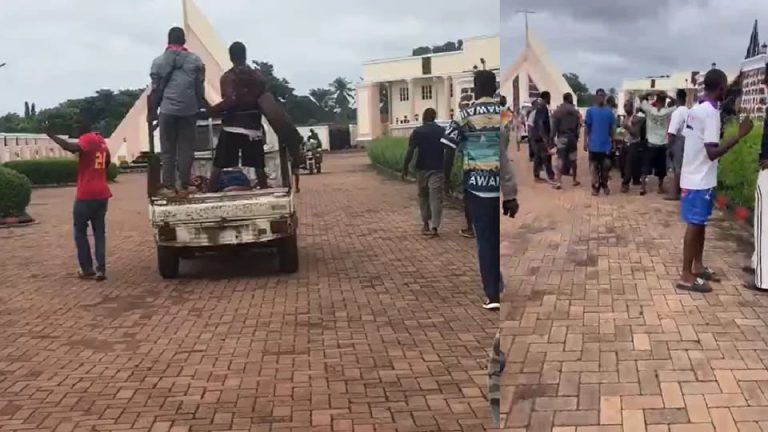
Tuesday’s All Progressives Congress (APC) stakeholders’ meeting was broken up by some political thugs at the party’s secretariat in Akure, the capital of Ondo State.

The event happened as the ruling party was reportedly experiencing increased internal divides due to the upcoming state, local, and ward congresses to pick new leadership.

It was discovered that party leaders had to escape for their life after the attack, which also injured a number of members.

According to reports, the assailants chased members indiscriminately, disrupting the gathering and causing panic on the property.

According to witnesses who talked to The Nation, the violence started when the party leaders, officials, and delegates had gathered to talk about internal issues.

However, while discussions were taking place, the attackers entered the party’s secretariat with machetes, shattered bottles, boards, stones, and other deadly things.

According to a party official who spoke on condition of the publication in question, members had already taken up residence when the assailants arrived.

“They came with weapons and started threatening everyone, so we had to flee for our lives,” he claimed. While trying to flee, a few of us were hurt. In order to protect their cars, those who drove to the event quickly left.

In the meantime, Steve Otaloro, the APC’s Director of Media and Publicity in Ondo State, acknowledged the occurrence and stated that more information would be released later.

African Monetary Institute: Cardoso Applauds Nigeria’s Permanent Board Role

0

Mr. Olayemi Cardoso, the governor of the Central Bank of Nigeria (CBN), has praised the African Union’s (AU) recent decision to formally confirm Nigeria’s permanent participation on the African Monetary Institute’s (AMI) board.
Cardoso made the praise in an Abuja statement on Monday.

The permission was made public during the 39th Ordinary Session of the Assembly of the African Union (AU) during its February summit, according to the News Agency of Nigeria (NAN).

At its 48th Ordinary Session, the Executive Council of the AU had previously adopted it.

As a forerunner of the African Central Bank (ACB), which would have its headquarters in Abuja, Nigeria, the AMI was founded under the AU’s financial institutions agenda.

Cardoso stated that Nigeria and the continent will greatly benefit from hosting the AMI and, later, the African Central Bank.

He claimed that it would strengthen Nigeria’s voice and influence in forming the continent’s single currency architecture and establish her as the focal point of the continent’s developing monetary union.

He said that Nigeria is now a permanent member of the Convergence Council as a result of the decision.

He stated, “This historic decision further highlights Nigeria’s strategic role in shaping the continent’s evolving financial architecture and marks a significant milestone in Africa’s financial integration journey.”

Its execution, according to the governor of the CBN, was a critical step in advancing Africa’s long-term goals of financial sovereignty and economic integration, strengthening macroeconomic convergence, and encouraging monetary cooperation.

He stated that by supporting Nigeria’s permanent presence on the AMI Board, the AU heads of state and government at the summit reinforced the road.

According to him, the role will be maintained during the transitional period until the ACB was formally established.

In order to reach this milestone, the CBN, the Ministries of Foreign Affairs, Justice, and Finance all played crucial, strategic, and historic roles.

“The Bank spearheaded the technical work that went into the Draft AMI Statute, which was accepted at the 5th Extraordinary Meeting of the Specialized Technical Committee on Finance in Abuja over the past few years.

Additionally, it supplied the AU with the first hosting facilities and necessary logistics for AMI’s instant launch.

In order to support Nigeria’s advocacy at the highest political levels, the CBN also took part in an interministerial partnership with the Federal Ministry of Finance, the Ministry of Foreign Affairs, the Ministry of Justice, and the Presidency.

The most recent accomplishment, according to Cardoso, is the result of teamwork based on persistent willpower, structural changes, strategic diplomacy, technical coherence, and a fresh macroeconomic focus.

He clarified, saying, “These initiatives have resulted in enhanced banking supervision, payment system modernization, foreign reserves management, and monetary stability.

“Overall, the results of these endeavors are attaining unprecedented heights, as demonstrated by Nigeria’s increased legitimacy and sway throughout the continent.

“In order to lay a strong foundation for the ACB and the future African Single Currency, we will keep working with the AU Commission, the Association of African Central Banks, Member States, and development partners.”

He claimed that the permanent seat allotted to Nigeria included a sunset clause at the creation of the ACB and was time-bound to the AMI transition period.

He claims that this architecture ensures that the host nation stays involved in governance throughout AMI’s early years while completely adhering to the AU’s criteria of rotation, equity, and regional balance.

In addition to congratulating President Bola Tinubu and Vice-President Kashim Shettima for their strategic leadership, Cardoso called the development a victory for Nigeria and a win for Africa’s monetary autonomy and integration.(NAN) (www.nannews.ng)


BREAKING: Police Use Teargas on Protesters at National Assembly

0

When the demonstrators attempted to enter the complex by force after gathering at the National Assembly gate, the police were prompted to use tear gas canisters on them.

After the altercation, chaos broke out outside the National Assembly gate as a number of the demonstrators, including ladies, rushed for their lives.

It was alleged that a woman of ordinary age fainted from the gas she inhaled during the ensuing panic.

More information later.

Anambra Tragedy: Four Nabbed for Alleged Murder of Three Cameroonians

0

In relation to the abduction and killing of three Cameroonian citizens in the state, the Anambra State Police Command has detained four more suspects.

In Anambra West Local Government Area, the victims were allegedly kidnapped in November 2025, murdered, and their remains disposed of in a river. After their decaying remains were later found floating on the sea by police officers, a thorough investigation was launched.

Initially, the investigation resulted in the arrest of two defendants who were allegedly providing information. But according to a statement released on Monday by SP Tochukwu Ikenga, the Police Public Relations Officer, confessions from the previous suspects led to the arrest of four additional people on Friday.

Ikenga said that after a gunfight with security personnel, the criminals were caught at a shrine in Nando, Anambra East Local Government Area.

The accused were identified by him as Michael Ekwunife, 38; Nwabunne Bright, 27; Chinecherem Chiama, 21; and Chukwuemeka Emmanuel, also known as “Ugoebenajah,” 27, the purported chief priest of the shrine.

Five rounds of 9mm ammo, ten live cartridges, expanded ammunition, a machete, two pump-action guns, a locally manufactured Beretta handgun, and various charms were among the items found at the scene.

According to Ikenga, the operation was executed by members of the Rapid Response Squad, Awkuzu, who were acting on reliable information from the detained detainees.

Upon arriving at the shrine, roughly thirty physically fit guys were seen assembled on the grounds. The statement stated in part that the armed individuals opened fire on the operatives after spotting the police.

“The armed individuals were engaged in a gunfight by the professional response of the police officers. The main suspect, Oroma Etiti Anam native Uchenna Mmaduamaka Nicholas, escaped with other gang members who were wounded, although one of the suspects who was apprehended was shot in the thigh and is presently being treated at a hospital.

The police claimed that although efforts are being made to capture gang members who are escaping, the captured suspects are being questioned.

The command called on the public to contribute valuable information to support current investigations and reaffirmed its dedication to protecting people.

On November 29, 2025, it had previously reported that a river in Anambra West LGA had yielded two decaying female bodies that were thought to be those of three missing Cameroonian ladies.

The horrific discovery was made on November 28, 2025, after a thorough search along the Omambala River by members of the Rapid Response Squad, Awkuzu, along with professional divers and local volunteers, Ikenga revealed at the time.

Two suspects, Nonso Augustine Akpeh, 37, and Kingsley Akpeh, 44, were first taken into custody to aid in the investigation, he said, while a third suspect was released on bail.

Lagos’ Only Opposition Lawmaker Alleges Taunts Over Refusal to Join APC

0

Osafile Stella, the sole opposition member in the Lagos State House of Assembly, revealed that she has been made fun of for choosing to join the African Democratic Congress (ADC) instead of the ruling All Progressives Congress (APC) after leaving the Labour Party.

In a conversation with reporters following Monday’s Assembly plenary session, Osafile revealed the information.

She stressed that criticism is inevitable in public office and admitted that the taunts have persisted, but she claimed she has learned to deal with the reality of political life.

“Teasing is inevitable in politics, but you have to learn to tolerate it.” It is hard to go without that,” she stated.

When asked if the ADC has assured her of a reelection ticket before the next election, the lawmaker responded that her political choices are based on what her constituents want.

“The party is not new and already has functional structures in place,” she continued.

The ADC has a solid reputation. These structures exist. I was urged to do this by my folks. I was invited to relocate to the ADC by the constituents I represent,” she said.

Regarding the significance of religion in governance, Osafile emphasized that Nigeria has a secular system and that political engagement transcends religious lines.

“How you play politics will always be a reflection of your personality. Government comes after God’s authority, therefore you can’t separate yourself from it,” she remarked.

Additionally, Osafile, who is presently the chair of the House Committee on Wealth Creation and Employment, denied claims that she has been subjected to prejudice in the Assembly because she is an opposition member.

She noted that in carrying out his responsibilities, Speaker Mudashiru Ajayi Obasa has remained unbiased and professional.

“I placed a strong emphasis on ability, competence, and character during my campaign.” I think the speaker is aware of his responsibilities and allocates them correctly. “I have not encountered any kind of discrimination,” Stella stated.

“He is dedicated to governance, which goes beyond party politics. He has allowed me the freedom to work and has continuously put the Constitution ahead of party differences,” she continued.

Defence HQ Announces Deployment of 100 American Troops to Nigeria

0

DHQ would like to report that about 100 US military soldiers and related equipment have arrived at Bauchi Airfield.

A working group engagement between the Nigerian and US delegations includes discussions about the deployment.

The Federal Government of Nigeria formally requested that the US government support a well-defined military training requirement, technical assistance, and information sharing with the members of the Armed Forces of Nigeria. This prompted the planned and purposeful arrival.

The statement, which was signed by Samaila Uba, the Director of Defense Information, said thus.

Access to specialized technical capabilities will be made possible by the partnership, which aims to improve Nigeria’s capacity to counter terrorist threats and improve the safety of its most vulnerable people nationwide.

Only consulting and training functions are performed by the technical professionals in the US.

These aren’t fighting forces. In close cooperation with the Nigerian Armed Forces, all training operations would be carried out under the supervision, guidance, and authority of the Nigerian government.

Nigerian troops and these advisors will begin a number of cooperative training exercises and intelligence-oriented cooperation projects.

Through these exercises, Nigerian forces would be better equipped to recognize and destroy extreme terrorist organizations that want to undermine the country.

Nigeria’s Armed Forces are still steadfast in their resolve to dismantle and destroy terrorist groups that endanger the nation’s security, sovereignty, and civilian safety.

Nigerians are guaranteed ongoing transparency and fast, accurate, and clear information about the military cooperation initiatives from the DHQ.

8 Nigerians’ assets are frozen by the US due to their ties to ISIL and Boko Haram.

Eight Nigerians are accused of having connections to Boko Haram and the Islamic State of Iraq and the Levant (ISIL), and the United States government has blocked their assets and properties in response to new penalties from the Office of Foreign Assets Control (OFAC).

The announcement was made in a more than 3,000-page sanctions document that was made public over the weekend and included a list of people linked to cybercrime, terrorism, and other offenses pertaining to national security.

OFAC claims that the release acted as a formal notification of individuals who were added to its list of Specially Designated Nationals, whose assets were barred under U.S. jurisdiction, and that it forbade Americans and businesses headquartered in the United States from engaging in financial or commercial dealings with them.

One of those identified is Salih Yusuf Adamu, also called Salihu Yusuf, who was earlier found guilty in the United Arab Emirates of organizing a fundraising network for Boko Haram.

He was one of six Nigerians who were convicted in 2022 of trying to send $782,000 to Nigerian rebels from Dubai.

Additional names on the list included Ibrahim Ali Alhassan, who was allegedly based in Abu Dhabi; Abu Bakr ibn Muhammad Al-Mainuki, who was sanctioned for alleged ISIL connections; Abu Abdullah ibn Umar Al-Barnawi, also known as Ba Idrisa; Abu Musab Al-Barnawi, who was described as a leader of Boko Haram; Khaled Al-Barnawi, who was associated with the group under a variety of spellings and nicknames; Babestan Oluwole Ademulero, who was identified under multiple aliases; and Nnamdi Orson Benson, who was designated under cybercrime provisions.

All assets and financial interests owned by those under U.S. control are blocked under the sanctions, and any transactions with them are strictly forbidden.

OFAC stated that Executive Order 13224, which targeted networks that finance and support terrorism, was the legal basis for the sanctions.

Since 2013, the United States has designated Boko Haram as a foreign terrorist organization because of its role in killings in northern Nigeria and the Lake Chad Basin.

Additionally, the action comes as the U.S. Congress recently called for harsher sanctions against specific Nigerian political figures and organizations, including as asset freezes and visa restrictions, due to claims of insecurity and human rights abuses.

According to U.S. officials, the penalties were a component of larger initiatives to dismantle the funding of terrorist organizations and bolster global counterterrorism enforcement.

2026 Budget: Lawmakers Approve N1.504trn for Army, Stress Oversight of MDA Allocations

0

The Nigerian Army’s proposed 2026 budget of N1.504,251,069,722 trillion was praised by a joint National Assembly committee on Monday.

The Nigerian Army was given assurances by the House Committee that it would make sure the approved funds were distributed through efficient oversight of the proper authorities for the budget’s implementation.

This was disclosed by Senator Abdulaziz Yar’Adua, the chairman of the Senate Committee on Army, following a joint budget defense of the Joint Committee in Abuja with Lt. Gen. Waidi Shaibu, the Chief of Army Staff.

“All members have expressed satisfaction with the presentation made by the Chief of Army Staff following our joint session of the Senate and House of Representatives Committees on Army on the 2026 budget,” he stated.

But every member of the joint committee also concurred that the main problem is the funding release delay, which has an impact on the other MDAs.

However, I want to reassure the Chief of Army Staff that we are dedicated to working with him to achieve our goals. We would help you with anything you need because the Army is so important to our country.

Speaking as well, Hon. Aminu Balele, the chairman of the House Committee on Army, praised the COAS and his officers and soldiers for their dedication to defending the country’s territorial integrity and fighting insurgency.

He pledged that his committee will keep working to ensure that monies are released on schedule so the Army may fulfill its constitutional obligations.

Balele promises that the committee would carry out its oversight role with the highest level of accountability.

“I want to express my gratitude to my Senate colleague, Senator Abdulaziz Yar’Adua, and his colleagues for working together on this national task as we wrap up the 2026 budget defense. I commend the Chief of Army Staff and his team for their dedication and patriotism.

“I want to thank Speaker Tajudeen Abbas for his steadfast support in my role as chairman of the House Committee on Army. We are prepared to push for the prompt release of funds so that you can fulfill your obligations, and we will keep pushing since we are aware of the problems that budgets can cause.

Additionally, Hajia Imaan Sulaiman-Ibrahim, the Minister of Women Affairs and Social Development, has asked for an increase in the N134.2 billion allocated to the Ministry for the fiscal year 2026.

This comes after the Senate’s Women Affairs committee expressed disapproval of the pitifully inadequate cash releases allocated to the Ministry’s overhead and capital expenditures in the 2025 budget.

During the budget defense session with the Senate Committee on Women Affairs on Monday, the Minister called for an upward assessment of the 2026 budget plan for the Women Affairs Ministry.

According to her, the upward assessment will assist the Ministry in putting programs into place that address the various issues that women face nationwide. An upward revision of budget projections for the Ministry of Women Affairs and Social Development should be carried out in accordance with the plan and the requirement for additional domestic appropriations in the fiscal year 2026,” she stated.

The Committee’s Chairman, Senator Ireti Kingibe (FCT), responded, however, that while the request was good, the executive branch should address the issue of inadequate funding releases first. While we do not oppose a review of the 2026 budget for your ministry, we do object to the issue of transparency. We have major concerns about the flows of monies, as demonstrated in your recent presentations on budget appropriation and releases for your ministry in 2025. “First, that issue needs to be resolved,” she stated.

The Minister had previously stated in her presentations on the 2025 budget’s performance and the 2026 predictions that just N394 million of the N89.8 billion allotted for capital expenditures had been released in December and had not even been used. Similarly, just N471 million of the N2.8 billion earmarked for our overhead in 2025 was disbursed, she said.

She went on to say that N134 2 billion was set aside for the ministry in 2026, of which N2.1 billion was allocated for personnel costs, N131.2 billion for capital, and N810.9 million for administrative costs.