Home Blog Page 36

I’m more determined to remove Tinubu from office in 2027 — El-Rufai

0

Nasir El-Rufai, a former governor of Kaduna State, has urged opposition leaders to be unified and committed to overthrowing President Bola Tinubu in the general elections scheduled for 2027.

When El-Rufai was visited by former Vice President Atiku Abubakar following a purported effort by security personnel to detain him at an airport, he made the statement.

El-Rufai claimed that the event had made him more determined to oppose the current government.

“What happened today has made me more determined,” he said. Until we oust this government from office in March 2027, we must continue working nonstop.

He said the incident at the airport was regrettable, needless, and potentially illegal.

He said he was detained without a formal invitation by the Independent Corrupt Practices Commission (ICPC) using Department of State Services (DSS) agents.

El-Rufai clarified that he has previously been asked to be questioned by the Economic and Financial Crimes Commission (EFCC). He claimed, nonetheless, that during the time he was abroad. He stated that his attorney had told the commission that he would come back and show up at their office on Monday at 10 a.m.

He maintained that prior to the incident at the airport, he had never received a letter or message from the ICPC.

“I would have honored a letter of invitation, which was all I asked for,” he stated.

The former governor further claimed that Nuhu Ribadu, the National Security Adviser, gave the ICPC orders. He said that security agencies were being utilized by the government for political ends.

He said a government that is afraid of losing reelection is using security agencies as partisan political tools.

He cautioned that such measures might erode the rule of law and democratic institutions.

Although he insisted that proper process must be followed, El-Rufai stated that he is prepared to accept any legitimate invitation from anti-corruption organizations.

Why Tinubu’s govt is afraid about my return – El-Rufai

0

Nasir El-Rufai, a former governor of Kaduna State, has hinted that his return to Nigeria is unpopular with the ruling class.

At the same time, he said that the political battle to overthrow the existing government had only just begun.

During an interview with BBC Hausa that was aired on Friday, he made the assertion.

“You know, I was one of the few people who publicly told her that we would oppose and overthrow that regime when it came in. I didn’t say anything.

The issue would have been resolved long ago if they had something against me that they say they have against others. Even so, if you choose to accuse me, be sure to provide evidence. “I’m waiting; I’ll go if someone invites me,” he declared.

El-Rufai went on to say that he disagreed with the current administration since their goals were different.

Regarding his relationship with President Bola Tinubu, the former governor stated that he does not have a personal conflict with the president.

Security Operatives Move After Pete Edochie’s Family Places Reward on TikToker Over Death Hoax

0

Anyone with information that will help apprehend the TikToker who posted about their father’s death has been offered a reward by the family of famous Nollywood actor Pete Edochie.

The most recent development was said to have occurred when Pete Edochie’s family and management refuted a widely circulated allegation that he had passed away.

In a viral video posted to his Instagram page, Leo Edochie, the movie star’s first son, called the news of his father’s passing a lie straight out of hell.

However, Leo revealed in a Facebook post on Thursday night that he had called the Department of State Services (DSS) to request the arrest of the TikToker who made the announcement of his father’s passing.

While the DSS is pursuing the TikToker, he said, anyone with pertinent information should get in touch with the family.

“This young man posted a video on TikTok that our father is dead,” Leo said beside a picture of the TikToker. @ONE_BOR 001 is his handle.

“Anyone with information that results in his arrest will receive a substantial cash reward.” DSS is pursuing him; I’ve been in touch with them.

“You’ll receive your reward in cash as soon as he is arrested; DM me with the details.”

Sit-At-Home: Igboho Hails Kanu for Suspension Move

0

The convicted leader of the Indigenous People of Biafra, Mazi Nnamdi Kanu, has been praised by Yoruba nation activist Sunday Adeyemo, also known as Sunday Igboho, for the alleged lifting of the Monday sit-at-home order in the South-East states.

According to Igboho, the development would boost socioeconomic activity in the area and foster an atmosphere that would support the growth of small and medium-sized businesses.

The Monday sit-at-home edict, which had been in effect for around five years, was reportedly canceled by Kanu, who is presently incarcerated for life at the Sokoto Correctional Facility for terrorism.

Igboho characterized Kanu’s choice as timely and well-considered in a statement released by his attorney, Mr. Pelumi Olanjengbesi.

“I want to urge the IPOB leader to vigorously explore dialogue and mediation with the Federal Government to break the deadlock in his current ordeal,” the statement said in part.

According to Igboho, communication is still a feasible route to peace and security, even though self-determination is still a fundamental right.

“I think that the current administration of President Bola Ahmed Tinubu is inclined to negotiation and mutual understanding for the peace, shared prosperity, security, and the deserved respect that the South-East commands,” he said, adding that Mazi Kanu has the fundamental right to pursue self-determination.

In the interest of peace and prosperity, the activist also urged those who are purportedly profiting off the region’s strife to stop.

For the sake of regional and national peace and economic growth, he continued, “it is equally imperative to appeal to all those who profit from the desecration and despoliation of the South-East through violence to desist from such acts.”

Bashir Ahmad Urges INEC to Reconsider 2027 Election Schedule Over Ramadan

0

Because the dates of the 2027 general elections coincide with the Islamic holy month of Ramadan, former presidential adviser Bashir Ahmad has encouraged the Independent National Electoral Commission (INEC) to reevaluate the calendar.

In a previous announcement of the election schedule, INEC set the dates for the governorship and state assembly elections for March 6, 2027, and the presidential and national assembly elections for February 20, 2027.

After the dates were announced, Ahmad responded on his 𝕏 Twitter, calling his stance a “respectful observation”.

“After the announcement of February 20th and March 6th, 2027, as the dates for the next Presidential and National Assembly and Governorship and State Assembly elections, respectively,” he said, “this is a respectful observation.”

He asserts that the suggested dates coincide with the holy month of Ramadan.

The suggested dates coincide with the holy month of Ramadan, when many Muslims spend a lot of time in prayer, fasting, and introspection, he continued.

Ahmad maintained that conducting elections during Ramadan might have an impact on Muslim voters’ turnout.

“Scheduling such a crucial national exercise during Ramadan may present challenges for a large segment of the population if the intention is to encourage full and inclusive participation in the electoral process,” he added.

“In order to concentrate on their religious duties, many Muslims tend to reduce their involvement in demanding worldly activities during this time.”

The former aide emphasized that when organizing national events, Nigeria’s religious diversity must be taken into account.

Considering the sizeable Muslim population in this nation, it could be beneficial to reevaluate the date in order to guarantee greater involvement and ease for all residents. He said, “I sincerely hope that this observation will be interpreted in a way that promotes inclusivity and national unity.

Inside the 1976 Coup: How Murtala Muhammed Was Killed

0

Michael Otuwe (retd.), a former orderly who witnessed the failed 1976 coup firsthand, has brought back new recollections of the assassination of former Head of State Murtala Muhammed fifty years later.

In a rare interview that was re-examined to commemorate the anniversary ten years ago, the retired soldier talks about his experiences during the civil war, how the charismatic leader nearly escaped his assailants, and the personal sacrifices that characterized years of close service to one of Nigeria’s most admired military leaders.

“I am an Igala man from Olamoboro Local Government of Kogi State,” Otuwe recounted in the interview with Daily Trust, recalling his entry into the military. I went to Ankpa Primary School and Ankpa Model Secondary School prior to enlisting in the army, which is the career I most loved.

He claims that on September 11, 1967, he joined the Nigerian Army at the Ikeja Military Cantonment in Lagos, where he received six months of training just before the start of the Nigerian Civil War.

“Incidentally, Murtala Ramat Mohammed was a Colonel and the Inspector of Signals at the time I was assigned to the Nigerian Army Signal Corps following the training,” he continued.

Otuwe claimed that Muhammad personally picked him due to his neatness and discipline.

“He told me that at our master parade, he saw how well-groomed I was in my army uniform. He remarked, “When I was a Lance Corporal, he chose me to be his orderly.

He clarified that he had worked closely with Muhammad in a number of positions, including during the civil war, when the late General was appointed the first General Officer Commanding of the Nigerian Army’s Second Division.

The General had three children during that time: Aisha, Zakari, and Fatima. Otuwe stated, “I worked with him till he was killed, and that was 11 years.”

Otuwe characterized Muhammad as a military leader who was both strategic and disciplined.

He was an organizer for the welfare of men. He was intelligent and diligent, and he put Nigeria first,” he remarked.

He recounted an instance in which they were surrounded by Biafran soldiers.

He made an amazing tactical move and withdrew, leaving even those of us with him perplexed. When many wanted to give up, he set out to fight and win so that Nigeria might remain a single nation.

Overcoming Ambushes
The former soldier described a number of ambushes he had come across throughout the conflict. We had a lot of ambushes and attacks, but one of the more memorable ones was when we were surrounded at Ukpo Junction in Abbagana, he stated. Many towns and cities were taken as a result of Murtala’s tactical move to withdraw and get ready for a defensive onslaught.

Following several actions, Otuwe continued, troops marched through Asaba and then to Idah in modern-day Kogi State in order to get ready for more offensives.

After a reorganization in 1968, General Murtala returned to Lagos as the Minister of Communications and the Inspector of Signals. In other words, he was working two jobs at once,” he said.

Otuwe talked about how his work had impacted his family, stating that his wife had become used to life in the military.

She was married to a soldier and had integrated herself into the system. He explained, “She knew we were off duty when she saw us at home.”

Because of his hectic schedule, he noted, his kids hardly ever saw him.

“I left home at dawn and returned late at night, so most of my kids almost forgot me,” Otuwe wrote.

Price monitoring and covert visits
Otuwe also described how Muhammad concealed himself in order to keep an eye on Lagos’s market rates.

He claimed that at one point, he was followed to evaluate prices and the growing cost of things by his ADC, Lieutenant Akintunde Akinterinwa.

Wearing a tracksuit, a face cap, and dark goggles, he rode a horse to a filling station, got off, tied it, and went into the marketplaces of Sangross (Lagos Island), Ajegunle, and then Agege. I was posing as a window shopper while the ADC acted as though we were not together and that they were writing the prices. People were more disciplined back then, and everyone waited for their turn, so a market woman advised him to give other purchasers a chance. Meat and commodities arrived in ships after two weeks. The flesh was labeled “Murtala Meat” by others.

Orderly, Murtala Muhammad, and Michael Otuwe

Assassination Day
When questioned about what transpired on the day of Murtala’s murder, Otuwe recounted, “He was killed on July 29, 1976 (begins to cry).” He held power from July 29, 1975, to February 13, 1976, for a total of six months. Before General Gowon left Dodan Barracks, he allowed the residence to be repaired and his personal belongings to be carefully removed rather than thrown out, demonstrating his great character. His absence of pilot cars, motorbike outriders, armed military personnel, and security escorts was the reason he was commuting from Ikoyi. He only drove the official Mercedes-Benz, which was flying two flags: the military flag on the right and the national flag on the left. That fateful day, we went by the Federal Secretariat in Ikoyi, which was coated in zinc and undergoing renovations.

When we arrived at Alagbgon Junction, the traffic cop failed to see the flags and would have let the cars heading our way continue, but instead he stopped the five or six cars ahead of us. I then noticed some people in Agbada (Babanriga), and when they raised them, they brandished AK-47 rifles and opened fire on us. A man wearing a mask had already struck Sergeant Adamu Michika, the driver, in the head and felt the armrest where the suit bag with the General’s mufti was located. I landed on the driver after taking cover.

Additionally, the General and the ADC sought refuge. As the assassins departed and made their way to the National Broadcasting Corporation, Radio House, to declare the takeover, one of the Majors noticed that the Major shouted and informed his colleagues that they were still alive when the ADC opened the door to assist the General. As a result, they turned, hurried back, and fired at us. After being shot in the arm and hip, I was the only one who survived.

The soldiers were pursued by General Murtala’s loyalist troops, who led us to the mortuary. I came out of my coma when the discomfort and the air conditioner’s breeze roused me up. I raised my hand, and a mortuary attendant saw it. He called a doctor, who confirmed that I was still alive. I was then taken to Dodan Barracks and a hospital on Awolowo Road in Ikoyi.

Otuwe spoke of his recuperation from the incident, saying, “I returned to work with the Nigerian Army Signal Corps after six months of recuperation. There I collaborated with Generals Tanko Ayuba, Raji Rasaki, and Adenaju.

When asked if he had ever been honored, the former soldier said, “No, not at all.”

Otuwe disclosed his living arrangement during the interview, saying, “I currently reside in a rented two-bedroom house in Maraba, Nasarawa State. Not to mention a home number, the street is nameless. However, I work in Maitama at Riskua Murtala Muhammad’s office.

Otuwe remembered that on December 31, 1999, he retired as a Master Warrant Officer.

Otuwe responded, “No, no, no, not at all,” when asked if he ever regretted serving in the Nigerian Army.

Reps’ Proposal for Statutory Funding of Traditional Councils Explained

0

It is now appropriate to strengthen the established institutions and increase their efficiency in carrying out their mandate.

Keep in mind that there have been worries about the historic institution becoming politicized, and many believe that many palaces have become political playgrounds.

They claim that contract-seekers and sycophants have taken over the hallways that were once famed for community justice and sound guidance.

One of our informants claims that political survival and patronage have come at the expense of the stool’s dignity.

States like Kano, Adamawa, and Katsina are the places where this unsettling tendency is most noticeable.

We saw the ruthless politicization of the emirate in Kano, when a centuries-old institution was purposefully destroyed in the name of control and retribution.

Traditional unity in Adamawa has been undermined by polarizing politics. Creeping interference poses a threat to the voices of moral fortitude and tradition in Katsina.

Two former ministers, Professors Tunde Adeniran and Taoheed Adedoja, are at odds over a proposed constitutional amendment that would create a formal and stable funding system for traditional institutions.

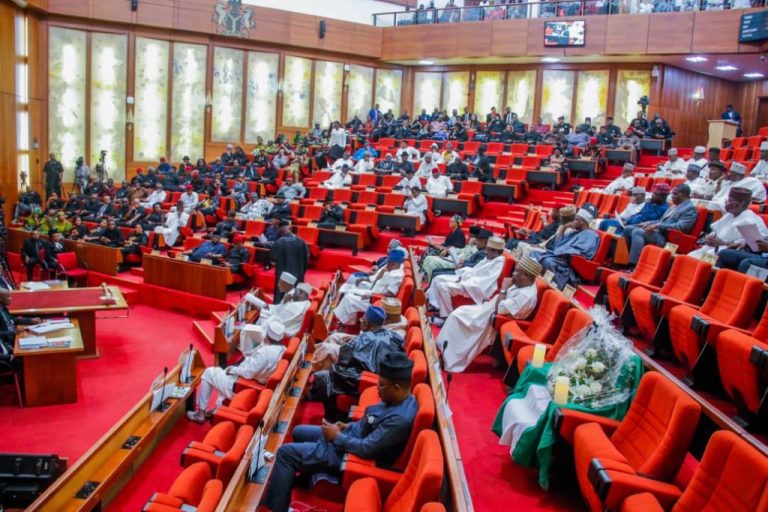
After the House Committee on Constitution Review, led by Deputy Speaker Benjamin Kalu, adopted a report, the bill is now before the House of Representatives.

In order to provide a specific financing source for traditional councils nationwide, the committee is recommending a change to Section 162 of the 1999 Constitution (as amended).

Funds standing to the credit of local government councils in a state “shall be distributed among the local government councils of that state on such terms and in such manner as may be prescribed by the House of Assembly of the state,” according to Section 162 of the Constitution, which regulates the Distributable Pool Account.

The committee suggests that a new proviso be included after Subsection (8) of the proposed amendment, requiring state legislatures to pass legislation requiring the direct funding of traditional councils.

In particular, the new clause mandates that a House of Assembly “adopt legislation for the direct payment to the head of the traditional council in that state of not less than five percent of the amount standing to the credit of the local government councils in that state.”

If approved, the amendment would eliminate traditional institutions’ reliance on state and municipal governments’ discretionary subventions by providing them with a constitutionally guaranteed source of revenue for the first time.

In an exclusive interview, former Education Minister Prof. Adeniran warned against the perils of forcing traditional institutions to adopt a standardized national model.

He maintained that, given their unique histories and requirements, subnational governments are in a better position to decide how such organizations should be run.

“The importance of traditional institutions varies from state to state,” he stated. They shouldn’t be subjected to national homogeneity and politicized. States should deal with these matters, and constitutional guarantees protecting conventional institutions shouldn’t make matters worse at the federal level.

The stance of Prof. Adedoja, a former Minister of Sports and Special Duties, who has endorsed the proposed modification, stands in stark contrast to Adeniran’s.

Adedoja praised parliamentarians for bringing about the constitutional reform and urged widespread support, emphasizing the significance of traditional rulers in grassroots governance and dispute resolution.

“In all local governments in Nigeria, traditional institutions are closest to the people at the community level,” he stated. They are essential in keeping peace, resolving family and land issues, and mediating conflicts through culturally appropriate means.

“They can react quickly to these local disputes thanks to budgetary backing, which eases the burden on formal courts that are overburdened with cases. “In local government areas, traditional institutions help maintain peace and order,” he informed our correspondent.

Adedoja asserts that the constitutional support for traditional council funding is justified solely by the maintenance of cultural and social values.

“Traditional rulers are stewards of indigenous culture, history, and moral values,” the speaker stated. Funding is used to assist cultural festivals, local history documentation, and the dissemination of ideals that foster civic identity, harmony, and respect.

“This cultural stability enhances social cohesiveness and supports community development initiatives by local governments.”

The former minister also used community mobilization for security and development as justification for the proposed bill.

He went on to say, “Traditional institutions are good ways to get people involved in development projects like public health campaigns, education enrollment, cleanliness, and local security.

“Budgetary allocations improve their ability to work with local governments to implement policies at the grassroots level, support vigilante and early-warning systems, and engage stakeholders.”

Since Nigeria returned to democratic governance in 1999, the fight for constitutional funding and recognition of traditional institutions has taken center stage in constitutional discussions.

Under the current Constitution, traditional rulers are not given any official position in the governance structure, despite their impact on grassroots mobilization, cultural preservation, dispute resolution, and community governance.

Despite their continued significance, reformers contend that this exclusion has undermined conventional institutions, especially in rural areas where they frequently serve as the closest authority to the populace. Traditional leaders, according to supporters, are essential allies in addressing security issues, resolving intercommunal conflicts, assisting with public health initiatives, and fostering local development.

Proponents of the proposed amendment argue that constitutional funding will improve conventional institutions’ efficacy, independence, and dignity. They contend that the current funding structure, which is mostly reliant on the cooperation of governors or chairmen of local governments, leaves traditional leaders vulnerable to political pressure and compromises their objectivity.

They contend that a statutory funding structure would boost administrative capacity, provide predictability and transparency, and enhance traditional councils’ power to assist grassroots government. While nominally acknowledging the historical and social relevance of traditional authority inside Nigeria’s federal structure, they nevertheless maintain that distributing a small portion of local government monies will not disturb fiscal balances.

Legislative discussions on the plan are anticipated to center on accountability and the lack of clearly defined constitutional roles for traditional rulers, which are concerns expressed by opponents.

INEC’s Proposed N873bn Budget for 2027 Not Excessive — Osaze-Uzzi

0

According to Oluwole Osaze-Uzzi, a former director of the Independent National Electoral Commission (INEC), the Commission’s planned N873 billion budget for 2027 is not excessive.

During an interview on Channels Television’s Politics Today on Thursday, Osaze-Uzzi stated this.

According to reports, INEC has put out a N873.78 billion budget for the general elections that will take place in 2027.

“When we look back at the budget for the 2023 elections, I don’t think there has been an exponential growth in what is being presented to the Assembly now,” Osaze-Uzzi noted in response.

“To make sure that resources are used and allocated effectively, I anticipate that the National Assembly will examine it carefully, consider the inflation rate, and examine the breakdown.

“Hopefully, we’ll figure out the logistics properly. Appropriate funding for trading, logistics, and system advances in technology. These all need to be taken into account.

Anthony Joshua’s Career in Doubt Following Deadly Accident in Nigeria — Eddie Hearn

0

After two of his close friends died in a vehicle accident in Nigeria, Anthony Joshua’s promoter Eddie Hearn said Joshua might give up boxing.

As he continues his physical and psychological recuperation from the December accident in Ogun State, Hearn stated that there are no assurances the former heavyweight champion will make a comeback to the ring.

After stopping Jake Paul with a single blow in his last fight, Joshua reportedly traveled to Nigeria to see family. But catastrophe came on December 29, 2025, when the car he was riding in met a halted truck on the Lagos-Ibadan Expressway.

One of Joshua’s trainers, Latif “Latz” Ayodele, and his strength and conditioning coach, Sina Ghami, perished in the collision. After surviving, Joshua was treated in a hospital and then sent back to the UK. He later went to both men’s funerals.

Hearn acknowledged that there is still uncertainty around Joshua’s future in the sport in an interview with First Round TV.

Although there are no promises that he would fight again, I do expect him to do so because he enjoys it. But he can also bring those individuals along, and he wants to do it,” Hearn stated.

He went on to say that the crash’s effects extended beyond psychological distress.

Physically, it wasn’t easy for him either, from a boxing perspective. Most likely, people are unaware of the depth of his experiences. Although he has been training, the boxing promoter pointed out that he is not yet ready and won’t be for some time.

Hearn revealed that Joshua was getting ready for a fight in March and that a fight against fellow Brit Tyson Fury was being considered. Those plans are currently on hold.

“We were getting ready for him to face Tyson Fury in March.” That won’t happen now, of course. I doubt it will ever occur. He will increase his workout intensity over the next few months to assess his progress, Hearn stated.

After more than a year away from the ring, Fury is expected to make his comeback in April against Arslanbek Makhmudov.

Joshua, meanwhile, has tattooed the names of his departed buddies on his body as an homage. Photographs of the artwork were posted on Instagram by London-based company Fulham Tattoo, which said the two-time world champion stopped by unexpectedly for his first session.

“A huge thank you to Anthony Joshua, the two-time heavyweight champion of the world, for coming in the door a few weeks ago for his first visit with us at Fulham Tattoo London … what a walk in,” the post said.

Regarding his future in boxing, Joshua has not yet made any public remarks.

Bisi Ilaka, Former Chief of Staff to Makinde, Quits PDP

0

Former Oyo State Governor Seyi Makinde’s chief of staff, Bisi Ilaka, a prominent member of the Peoples Democratic Party (PDP), has formally resigned from the party.

In his letter of resignation dated February 10th, which was made public to reporters in Ibadan on Thursday, Ilaka expressed gratitude to the PDP for providing him with the chance to serve in a variety of roles at the state and federal levels.

On May 29, 2019, not long after taking office, Governor Makinde named Ilaka his first Chief of Staff.

Following the general elections in 2023, Ilaka was reappointed after Segun Ogunwuyi assumed the office in 2021.

“The Chairman, Ward 5, Oyi East LG: Re: Resignation of Party Membership,” was the title of the letter Ilaka wrote.

“I respectfully submit my resignation as a member of the PDP.”

“The party has offered me opportunities and unwavering support over the years, for which I will always be thankful. Till we cross paths again.

His departure follows the departure of another well-known PDP member in Oyo State, Senator Agboola Ayoola, widely known as Alleluyah, who was the Senate’s former Deputy Chief Whip who ended his long-standing association with the party in October 2025.

From 2003 to 2011, Ayoola, who hails from Itesiwaju Local Government Area, worked as the Commissioner for Local Government and Chieftaincy Affairs under former governors Rashidi Ladoja and the late Adebayo Alao-Akala.

Additionally, from 2011 to 2015, he was the only PDP senator elected from the South-West, making history.