Home Blog Page 317

Fire Tragedy in Ondo: Two Siblings Under 5 Lose Their Lives

0

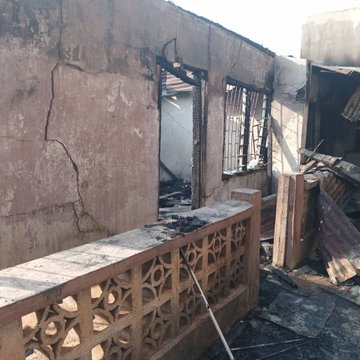
Two siblings, Jenson and Jelad Oluwaranakinse, were killed in a building fire in the Oluwatuyi neighborhood of Akure, Ondo State.

When their mother, Deborah Oluwaranakinse, went out to get food for the family, the children, who were three and five years old, respectively, perished in the fire that destroyed their parent’s home.

It was learned that when the fire started while Deborah was away, she had allegedly locked her kids inside the house while they were looking for food.

Before State Fire Service personnel could reach the scene of the event, the house was reportedly reduced to ashes by the fire.

“When the fire started, the neighbors around made efforts to put it out and rescue the kids, but their efforts were unsuccessful,” claimed neighbors who spoke about the fire outbreak.

“The state fire service was contacted, but by the time they got there, the situation had gotten out of control. The witness stated, “The children had passed away.”

Another local resident claimed that despite multiple attempts by neighbors to put out the fire in order to save the children, the fire just started.

Speaking on the regrettable event, Funmilayo Odunlami, the spokesperson for the Ondo Police Command, stated that an inquiry has been started to determine what caused the fire.

The two male youngsters who were left in the room were burned and strangled, according to Odunlami. Jenson Oluwaranakinse, age three, and Jelad Oluwaranakinse, age five, are the two.

Read Also: Imo Tragedy: Lawyers Mobilize After Gunmen Kill Colleague

After locking the two kids in their room, their mother, Mrs. Deborah Oluwaranakinse, went to get dinner. “An investigation has begun,” she declared.

The boys’ burned bodies, meanwhile, have been placed at the University of Medical Sciences Teaching Hospital’s mortuary in Akure.

Imo Tragedy: Lawyers Mobilize After Gunmen Kill Colleague

0

Imo State attorneys have temporarily suspended legal activities in three regions of the state in response to the murder of one of their colleagues, Chinedu Nwowu, by unidentified gunmen.

In observance of the mrudered lawyer, it was decided that on Thursday, January 24, courts in the three regions of Mgbidi, Oguta, and Omumma would not be in operation.

According to reports, on Wednesday, January 22, Nwowu was ambushed and fatally shot by armed assailants in his village of Mgbidi.

He was shot after the shooters ambushed him and double crossed his car while he was driving, according to sources close to the late lawyer and his companions.

With the Nigeria Bar Association (NBA) in Orlu’s leadership proposing a boycott of court proceedings today, Nwowu’s passing has continued to incite fear and some indignation.

The announcement was made in protest of the member’s death, according to a memo written by Chukwuemeka Okoro for the NBA’s Orli chapter.

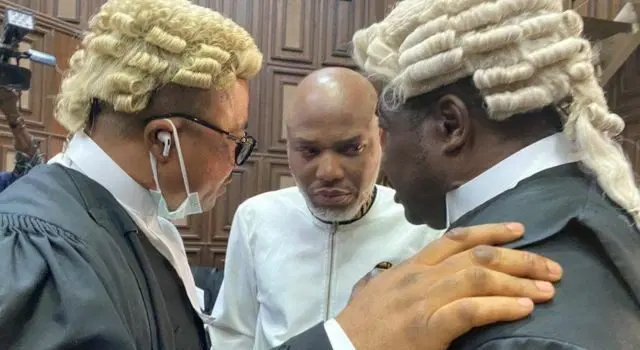
Read Also: Kanu to Judiciary: Move My Case to Southeast or Appoint a New Judge

At ten in the morning, an emergency meeting would be held in Mgbidi, according to Okro.

In response to the horrific murder of one of us, CHINEDU NWOWU, in his hometown of Mgbidi last night, Okoro announced, “All attorneys of Oru/Oguta Forum are hereby notified of a crucial emergency meeting this morning by 10am at the High Court, Mgbidi.”

Today’s sessions of the High Courts of Mgbidi, Oguta, and Omumma will not be held. Be on time, please,” he said.

Kanu to Judiciary: Move My Case to Southeast or Appoint a New Judge

0

If no other judge in Abuja is ready to preside over the case, Nnamdi Kanu, the jailed leader of the Indigenous People of Biafra (IPOB), has urged that his trial be moved to a Federal High Court in the South-East or assigned to a different judge.

After a regular meeting at the Department of State Services (DSS) facility in Abuja on Wednesday, January 22, Kanu’s principal counsel, Aloy Ejimakor, revealed his demand in a statement.

The action follows Justice Nyako’s September 24, 2024, recusal from the case, which was based on Kanu’s disbelief in her ability to conduct the trial.

Kanu objected when Justice John Tsoho, the Chief Judge of the Federal High Court, later referred the case to her.

Ejimakor claims that Kanu believes that Justice Nyako’s decision to resume the trial compromises the integrity of the legal system. He has given his legal staff instructions to make sure she doesn’t oversee the case.

Read Also: Tinubu Meets Lagos Lawmakers, Labels Obasa’s Impeachment a ‘Coup’

The main topic of discussion during today’s visitation is when the court hearing for MNK’s case will take place.

“Onyendu has directed the legal team to act quickly to prevent Justice Binta Murtala-Nyako from handling his case. She withdrew from the case due to the order of recusal entered on September 24, 2024,” Ejimakor said.

Additionally, Kanu’s legal team demanded that the trial be transferred to a South-East court, claiming that the alleged offenses took place there.

“The Chief Judge may transfer the case to Umuahia, Awka, Enugu, Asaba, Port Harcourt, or any other Federal High Court in the former Eastern Nigeria, where the alleged offenses were alleged to have occurred or had their impact,” the statement continued, if no other judge in Abuja is willing to take on the case.

Tinubu Meets Lagos Lawmakers, Labels Obasa’s Impeachment a ‘Coup’

0

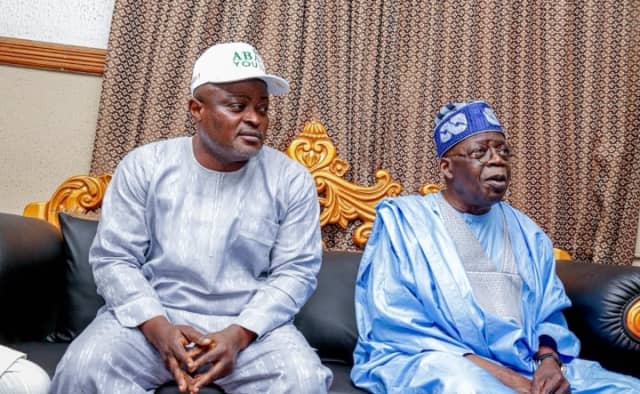
According to reports, President Bola Tinubu has implicitly approved the expulsion of Hon. Mudasiru Obasa from his position as Speaker of the Lagos State House of Assembly. This comes after 32 members of the 40-member Assembly impeached him last week.

The MPs blamed Obasa’s dismissal on alleged transgressions, such as corruption and haughtiness.
President Tinubu met with the new leadership of the Assembly, including the newly elected Speaker, Rt. Hon. Mojisola Lasbat Meranda, and members of the Governance Advisory Council (GAC), in a private meeting in Abuja on Wednesday night.

Despite supposedly being in Abuja, deposed Speaker Obasa, Deputy Governor Obafemi Hamzat, and Lagos State Governor Babajide Sanwo-Olu were conspicuously absent from the meeting.
According to those who spoke to Western Post, President Tinubu compared the impeachment process to a coup and voiced his displeasure with the way the MPs handled it.

However, Tinubu grudgingly accepted the Assembly’s decision following cries from GAC leaders and recognition of Obasa’s purported excesses.

Read Also: Military Airstrikes Kill Multiple Terrorists in Niger Forest

under order to effectively deliver democratic dividends to Lagosians, Speaker Meranda promised to place a high priority on openness, inclusivity, and sound governance under her leadership.

Military Airstrikes Kill Multiple Terrorists in Niger Forest

0

Numerous suspected terrorists who were hibernating at Alawa Forest in the Shiroro Local Government Area of Niger State were killed by Nigerian Air Force aerial attacks, the service announced on Thursday.

According to the statement, the air component of Operation FANSAN YAMMA, a military assault designed to drive terrorists from the country’s northwest and north central areas, carried out the airstrikes.

Air Vice Marshal (AVM) Olusola Akinboyewa, Director of Information and Public Relations (DOPRI), claimed in a statement that the mission also destroyed the terrorists’ forest logistical hub.

Based on reliable intelligence and subsequent confirmatory aerial surveillance efforts that showed an influx of armed terrorists into the forest, this action was carried out on January 21, 2025.

These offenders were connected to several acts of violence, such as two IED attacks that killed multiple innocent people in Bassa, Shiroro LGA, on December 19, 2024.

The Nigerian Air Force (NAF) responded by conducting a three-day airstrike under the code name KONAN DAJI in an effort to weaken the militants’ capabilities and make the forest uninhabitable.

Read Also: Each Nigerian Bears N656,000 Debt as National Borrowing Reaches N142.3trn

In order to achieve this, AC OPFY sent out a group of fighter planes to conduct air interdiction operations in the region. As evidenced by several secondary explosions, the planes quickly targeted the targets with accurate strikes after arriving, eliminating their supplies hub and several armed fighters.

“The NAF is steadfast in its resolve to uphold operational supremacy throughout the region, working closely with ground forces. In order to provide people in Niger State and beyond with long-term peace and security, persistent efforts are being made to eradicate all criminal elements from Alawa Forest and the adjacent areas,” he stated.

Each Nigerian Bears N656,000 Debt as National Borrowing Reaches N142.3trn

0

According to the Debt Management Office (DMO), Nigeria’s public debt profile increased from N134.3 trillion in June 2024 to N142.32 trillion on September 30, 2024.

This most recent number indicates that, when N142.32 trillion is divided by the estimated 216.78 million people living in Nigeria, each Nigerian may be in debt to the tune of around N656,514 per capita.

However, the DMO claimed that the debt stock included both domestic and foreign borrowings, implying that the external debt was converted to Naira using the Central Bank of Nigeria’s (CBN) official exchange rate of N1,601.028/$1 as of September 30, 2024, as opposed to N1,470.19/$1 as of June 30, 2024.

Nigeria’s national debt increased from $91.35 billion in June 2024 to $88.89 billion in September 2024, indicating a larger debt profile brought on by the naira’s depreciation versus the dollar.

While domestic debt increased from N71.22 trillion to N73.43 trillion, external debt increased from N63.07 trillion to N68.89 trillion. Given that the federal government issued $2.2 billion Eurobonds in December of last year, it is anticipated to increase even more by the fourth quarter.

According to DMO data, the Federal Government of Nigeria (FGN) owes N69.22 trillion, while the 36 states and Federal Capital Territory (FCT) owe N4.21 trillion of the domestic debt stock.

The FGN domestic debt stock rose from N66.96 trillion in June 2024 to N69.22 trillion in September 2024, according to a quick glance at the debt stock. This increase may have been caused by a rise in the issuing of FGN bonds and other fixed-income securities.

Nonetheless, throughout the review period, the states’ and FCT’s debt stock decreased from N4.27 trillion to N4.21 trillion.

An additional analysis of the DMO’s statistics reveals that the weight of domestic debt is 51.60 percent more than that of external debt, which is 48.40 percent.

Only Cross Rivers State’s domestic debt stock was as of June 30, 2024, according to the DMO; all other states and the Federal Capital Territory were as of September 2024.
Concerns over Nigeria’s debt sustainability have been raised by the country’s rising debt profile, particularly in light of the exchange rate volatility that has increased the cost of external obligations in local currency.

The federal government’s increasing reliance on local markets to cover budget shortfalls in the face of limited foreign exchange reserves is highlighted by the overall rise in domestic debt.

Given that the government is requesting N15.81 trillion for debt servicing in the 2024 budget estimates, economic observers are concerned about the risk that Nigerians face as a result of their debt.

According to Economy Associates CEO Ayo Teriba, “borrowing is not criminal because the country faces serious infrastructure challenges, but borrowing to pay interest on outstanding debts is wrong.”

The Tinubu-led administration’s propensity for taking on new loans while the nation struggles to pay off its debts and its crumbling infrastructure is the main source of criticism among Nigerians.

Notwithstanding these enormous debts, politicians continue to lead extravagant lives, prioritizing long convoys over fundamental amenities like reasonably priced primary healthcare, well-maintained roads, and reasonably priced housing.

Financial analysts have frequently expressed doubts about the sustainability of the growing debt levels, especially as interest payments take up a sizable amount of government revenue.

According to a World Bank analysis last year, Nigeria spent more than 96% of its 2022 revenue on debt service, and the ongoing fiscal deficit has made the nation’s public debt stock worse.

Read Also: Cricket World Cup: Nigeria Hits Super 6 After South Africa Defeat

Economic observers, aside from the World Bank, maintain that Nigeria’s desire for Eurobonds exposes the country to greater currency concerns brought on by the unstable exchange rate.

Since the Eurobond is a commercial loan, we should be concerned about the interest rate we pay on it. Additionally, the interest rates on Treasury bills and Federal Government bonds are currently excessively high. Muda Yusuf, the former director-general of the Lagos Chamber of Commerce and Industry (LCCI) and the CEO of the Center for the Promotion of Private Enterprise (CPPE), stated that these factors put a great deal of strain on government finances from the perspective of debt payment.
Additionally, Yusuf stated that it is imperative that Nigeria’s exposure to Eurobonds be significantly decreased moving forward.

“I think we need to be more careful about how quickly we take on these debts because more debt will lead to more debt service obligations,” he emphasized.
The naira’s depreciation from N1,470.19/$ to N1,601.03/$ between June and September 2024 made the burden of external debt in local currency much worse.

President Bola Tinubu’s 2025 budget proposal, which is presently being examined by the National Assembly, calls for a N13.08 trillion deficit and N15.81 trillion in debt servicing.

The President sent the N47.90 trillion 2025 budget to the National Assembly in December 2024 for approval.

The proposed budget is projected to generate N34.82 trillion in income, assume 2.06 million barrels of crude oil per day (mbpd), have a 15% inflation rate, and have a N1,500 naira-to-dollar exchange rate.
Cricket World Cup: Nigeria Hits Super 6 After South Africa Defeat

0

After placing second in Group C behind South Africa, Nigeria’s women’s U-19 cricket side advanced to the Super 6 stage of the 2025 ICC U-19 Women’s T20 World Cup.

The Junior Female Yellow Greens’ historic two-run victory over New Zealand on Monday and their share of points against Samoa were more than enough to secure them a spot as the second-best team in Group C, despite their 41-run (DLS method) loss to South Africa on Wednesday.

In the second women’s cricket match between South Africa and Nigeria in the past year, skipper Piety Lucky won the toss and sent the top African team to bat first.

South Africa got off to a strong start in the crease thanks to four fours from Simone Lourens, but she was eventually stopped by Lucky in the seventh over before a rain break reduced the game to eight overs.
The South Africans ended the first innings 49 for 2 after Lucky picked up where she left off after the break, removing Kayla Reyneke with another devious ball.

Nigeria’s chase was nerve-racking, and Sarah Bakhita’s team only managed 24 for 8 due to the adrenaline surge.

The Nigerian team will continue to attempt to make history when they play England and Ireland in the Super 6 stage on Saturday, January 25, and Wednesday, January 29, respectively, regardless of the outcome.

Read Also: FRC Refutes Hyperinflation Status of Nigeria’s Economy

After finishing first and third in Group B, respectively, England and Ireland advanced.

To build on their group stage performances and advance to the semi-finals, the Junior Female Yellow Greens will need every run and point in the upcoming round.

FRC Refutes Hyperinflation Status of Nigeria’s Economy

0

According to the Financial Reporting Council (FRC), Nigeria’s economy does not meet current criteria for being considered hyperinflationary.

Rabiu Olowo, the CEO of the FRC, stated in a statement on Wednesday that local businesses will not use the international accounting standard (IAS) 29 in their financial reports for 2024.

Financial reporting is governed by a set of guidelines called the IAS.

According to Olowo, the FRC determined that the standard does not apply after evaluating Nigeria’s economy using the five indicators in “IAS 29: Financial Reporting in Hyperinflationary Economies.”

According to him, IAS 29 defines accounting standards for hyperinflationary economies, citing signs including pricing in stable currencies, reliance on non-monetary assets, and a cumulative three-year inflation rate that is close to or more than 100%.

Nigeria does not match the majority of the criteria, according to the CEO, who summarized the five IAS 29 factors.

He stated that the majority of people would rather hold their wealth in non-monetary assets or in a foreign currency that is comparatively stable.

“To preserve purchasing power, the amount of local money held is promptly invested.

The general public views monetary quantities in terms of a comparatively stable foreign currency rather than the local currency. That currency may be used to quote prices.

Even if the credit duration is brief, sales and purchases made on credit are made at prices that make up for the anticipated decline in purchasing power.

“A price index is linked to prices, wages, and interest rates.”

But according to Olowo, Nigeria satisfies the requirement for a three-year cumulative inflation rate that is close to or higher than 100%.

Read Also: NLC Condemns 50% Telecom Tariff Hike as ‘Assault on Workers’

According to him, Nigeria’s economic prospects would improve and inflation would be lessened with the operationalization of the Dangote refinery as well as the Port Harcourt and Warri refineries.

The FRC stated that the improved trajectory would also be supported by import policies, agricultural initiatives, increasing crude oil output, and structural reforms.

Olowo went on to say that the FRC will keep an eye on economic developments and, if needed, revise its position for the fiscal year 2025.

NLC Condemns 50% Telecom Tariff Hike as ‘Assault on Workers’

0

The federal government’s approval of a 50% hike in telecommunications charges has drawn criticism from the Nigeria Labour Congress (NLC).

The Nigerian Communications Commission (NCC) approved a 50 percent pricing rise for telecommunications companies (telcos) on Monday.

The NLC’s president, Joe Ajaero, described the decision as a “clear assault” on the welfare of Nigerian workers in a statement released on Wednesday.

“This decision, coming at a time when Nigerian workers and the masses are grappling with unprecedented economic hardship, is a clear assault on their welfare and an abandonment of the people to corporate fat cats,” the statement reads.

“Everyday communication, work, and information access all depend on telecommunication services.

However, the typical Nigerian worker already spends almost 10% of their income on telecom costs.

“For a worker earning the current minimum wage of N70,000, this means an increase from N7,000 to a staggering N10,500 per month, or 15 percent of his salary—a cost that is unsustainable.

This increase is a perfect example of how easily the government seems to put corporate profits ahead of the welfare of its constituents.

It is astonishing that, despite the fact that inflation and the growing cost of living are reducing purchasing power, the government took almost a year to approve the recent minimum wage for workers while only approving a 50% rate rise for telecom companies in less than a month.

This stark discrepancy highlights a concerning fact: the government seems to be more concerned with the needs of powerful corporations than with the needs of the people and workers it is supposed to represent.

Read Also: Shettima Joins African Leaders in Pushing for AfCFTA Rollout at WEF

We need to know when the government will defend those it pledged to defend. When will the national assembly step up and demand accountability from the executive branch for policies that clearly jeopardize the interests of the majority?
When will the average Nigerian breathe a sigh of relief?

‘NLC IS NOT OPPOSED TO TARIFF REVIEW’
Ajaero clarified that the labour body is not opposed to tariff reviews but is not in support of the approved rate of increase.

“We therefore call on the government, the NCC, and the national assembly to stop the implementation of this ill-advised hike to allow a reasonable conversation around it,” he said.

“If the dialogue agrees on the need for the hike, then, we can all seek a more humane increase and definitely not this 50 percent hike.

“The NLC calls on all Nigerian workers and masses to reject this unjustifiable tariff hike.”

He called on citizens to prepare for collective action, including a possible nationwide boycott of telecommunication services.

Ajaero said the initiative would push for the reversal of the tariff increase, describing it as essential for “our dignity, our rights, and our survival” as a people.

Shettima Joins African Leaders in Pushing for AfCFTA Rollout at WEF

0

With the goal of increasing the continent’s GDP to $29 trillion by 2050, Vice-President Kashim Shettima has joined other world leaders in advocating for the full implementation of the African Continental Free Trade Area (AfCFTA) accord.

At a summit titled “Friends of AfCFTA,” the world leaders announced their countries’ stances on Wednesday.

The event took place in Davos, Switzerland, during the World Economic Forum’s (WEF) current 2025 annual meeting.

Shettima reportedly reiterated during her remarks that Nigeria is prepared to lead the AfCFTA and capitalize on the market potential for digital transformation and African economic unity.

According to a statement released by his spokesperson, Stanley Nkwocha, the vice president also reiterated Nigeria’s dedication to the AfCFTA as a means of achieving shared prosperity.

Citing a Korn Ferry report that predicts a global human skill shortage of over 85 million people by 2030, Shettima was quoted as saying, “Africa stands in a unique position to take advantage of global talent deficits.”

“With 440 million inhabitants, Nigeria will overtake the United States as the world’s third most populous country by 2050.”

Nigeria’s technology prowess is driving it into the knowledge era, Shettima added, citing Africa’s expanding digital ecosystem.

“In Nigeria alone, we currently have 163 million internet users and 220 million telecom subscribers,” he continued.

“This gives us a ton of chances to empower our workers. India made roughly $120 billion from outsourcing alone last year, compared to our greatest oil export profits of $35 billion in 2011.

“The African Continental Free Trade Area is a bold declaration of our common destiny as much as an economic agreement.

“Africa is well-positioned to prosper in the post-industrial knowledge age, despite having missed the agricultural and industrial eras.”

The WEF president, Borge Brende, reportedly claimed that Africa’s population advantage offers the continent enormous economic potential.

Brende, while welcoming Shettima and other African leaders to the forum, pointed out the transformative potential of the AfCFTA — projecting that its full implementation could boost Africa’s economy to $29 trillion by 2050.

Brende said while most nations face workforce challenges, Africa’s young population positions it for unprecedented growth.

“If the secretary-general of AfCFTA, Wamkele Mene, is given all the support he deserves, we can boost intra-African trade by a staggering 50%,” the WEF leader was quoted as saying.

“As of today, $29 trillion represents one-third of the global GDP. Africa is such a growing continent, and one of its key promises is demography.”

Brende also said the major challenge in Africa is creating new jobs for the youth population.