Amnesty International Is Working To Destabilise Nigeria — Army
By Ajogwu Jerry
The Nigerian Army has raised alarm concerning the activities of Amnesty International (Nigeria) alleging that the organisation is working hard to destabilise the country.
A statement by the Army spokesman, Brig Gen Sani Kuksheka Usman revealed that organisation is working hard to effect their dubious aims through a routine publication and sponsorship of fake reportage.
The statement reads in part:
This is noted through fabrication of fictitious allegations of alleged human rights abuses against the Nigerian security forces and clandestine sponsorship of dissedent groups to protest, as well as unfounded allegations against the leadership of the Nigerian military. They have tried over the years using Boko Haram terrorists conflicts, Islamic Movement in Nigeria, some activists and now herders-farmers conflicts.
The NGO is at the verge of releasing yet another concorted report against the military, ostensibly against the Nigerian Army. Consequently, Nigerians should be wary of Amnesty International (Nigeria) because it’s goals are to destabilise Nigeia and to dismember it. The Nigerian Army has no option than to call for the closure of Amnesty International offices in Nigeria, if such recklessness continues,” it said.
Recall that Amnesty International is reputed for sponsoring numerous allegations against the Nigerian Military without investigation.
Nigerian Army Troops Crush Four Boko Haram Terrorists
By Ajogwu Jerry
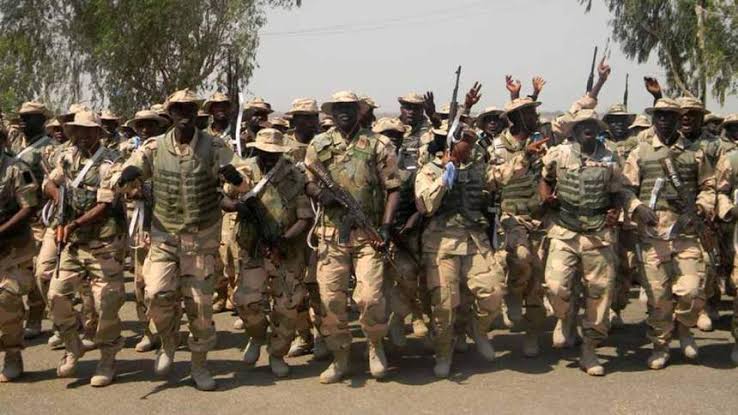
Troops of Operation LAFIYA DOLE has crushed four Boko Haram terrorists and recover weapons.
According to available report, the terrorists attacked Maibukarti village along Maiduguri-Damboa road before they were repelled by the gallant troops.
A statement by the Army Spokesman, Brig Gen Sani Kuksheka Usman said “the troops were further reinforced and went on hot pursuit of the fleeing terrorists, while the Nigerian Air Forces provided close air support.
“Unfortunately, one soldier paid the supreme price during the encounter with the terrorists,”.
Gen Usman further hinted that the gallant troops recovered 4 AK-47 rifles, 45 rounds of 7.62mm ammunition, 5 AK-47 rifrles magazine, 2 Motorcycles and 1 bicycles. Other items recovered include 1 Bandolier, 1 GSM handset, 3 SIM cards, an earpiece, some phone accessories, kolanuts, gloves and drugs from the scene.

What They Don’t See: A Reflection On PMB At 76
By Okanga Agila
In the final months of transition from military to civil rule between 1998 and 1999, I never felt the enthusiasm that gripped most people in the country. My lethargic disposition at that time was not due to the uncertainty of whether the process would work – it was largely seen as an attempt, an experiment, a trial at that time because no one was certain the military will retreat to their barracks and stay put for one year without overthrowing the elected government, so any thought of a decade without military rule was stretching it.
The seeming indifference on my path was because the one man I believe as capable of resetting Nigeria, Muhammadu Buhari, was not taking part in the contest. I easily concluded that those that will emerge from the process between 1998 and 1999 would merely continue the maladministration of the military albeit without khaki uniform. Sixteen years of the People’s Democratic Party (PDP) and I dare say my assumption was proven right.
At the other times that Buhari unsuccessfully ran for office I supported him with all I can, which is not much. It consists mainly of one on one engagements to persuade people to see the value of getting a man that is not of the established order into office. Whenever those I engage in discourse ask what he has to offer I am quick to mention that his role is to bring the disruption that is needed to restart Nigeria on a new foundation.
May 29, 2015 my desire was fulfilled. President Muhammadu Buhari was inaugurated and the changes desired kicked-in in earnest. While it has been a case of a half-empty and half-filled cup, perspective, since his inauguration, the results are nonetheless glaring for the discerning to see. For instance he was accused of not hitting the ground running when in reality it is about taking time to look before leaping. The same rabble that allege tardiness to act would have accused him of brashness in the same measure.
President Buhari did disrupted the system. He dislocated those that had made it their life mission to continually loot the treasury to the detriment of the larger population. This disruption of corruption from source has left those caught in the storm to continually lament about the hardship they are facing, which in reality is no hardship but people being jolted back to reality after decades of thriving on stolen easy money.
He disrupted the fixation on crude oil as the major revenue earner of our economy. We are not there yet but the path of growth that is possible for Nigeria is becoming clearer. This shift from dependency on oil revenue to a broader base economy is underpinned by massive investment in infrastructure across the country. In focusing on infrastructure, he displayed a trait that has been missing among Nigerian leaders – that capacity to complete what others started but never developed the will to finish. This alone has saved the country from wastages that come from abandoned projects.
Meanwhile, the capacity to focus and complete the task at hand extends to building systems like the implementation of the Treasury Single Account (TSA), enforcement of Bank Verification Number (BVN) for the operation of bank accounts and other steps that have contributed to the war against corruption championed by him.
Under his watch I have seen a realignment that may not be visible to Nigerians yet, but it shall become clearer in the course of time. There has been a kind of silent wealth redistribution under his watch. In the course of executing actual projects, the money that would have gone into the pockets of a few individuals is now not just providing infrastructure but also putting money in the pockets of workers engaged to execute the jobs. In the same space of time that some people are lamenting about hardship in the land, there has been a shift that is seeing more family sized apartments and bungalows being built versus the time that only a few mansions were built by those that cornered national resources. So in the real sense honest people now have the chance to earn clean money and not be dependent on tainted money.
In terms of state intervention, social interventions like N-Power, Trade Moni, the Conditional Cash Transfer and other programmes have placed made money available to Nigerians under different terms. These are funds that in the past would have been diverted for personal use by those that were sworn to act in the nest interest of the country.
Irrespective what critics want the world to believe, President Buhari’s uprightness is unrivalled. Take for instance his directive to all the agencies with roles in the conduct of the General Elections to ensure that they conduct a free, fair and acceptable exercise. It takes someone that is truly desirous of progress for the country to issue such directive, totally in keeping with his credential as a democrat at heart. He is a leader I respect tremendously more so that all efforts to tarnish his image have failed because he stands above board at all times.
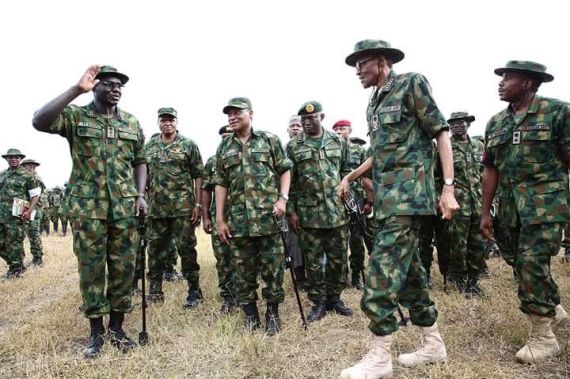
I recall these qualities of President Muhammadu Buhari on the occasion of his 76th birthday knowing that an additional year adds additional wisdom, patience and understanding to his person. My prayer is that God grants him good health so that by 2022 we will again extend our good wishes to him on his 80th as the President of Federal Republic of Nigeria. I know for a certainty that the positive results of the foundation he is presently laying would be visible and appreciable for all to see and experience. Happy Birthday President Muhammadu Buhari. May God sustain your rule.
Okanga wrote from Agila, Benue State.
What They Don’t See: A Reflection On PMB At 76
By Okanga Agila
In the final months of transition from military to civil rule between 1998 and 1999, I never felt the enthusiasm that gripped most people in the country. My lethargic disposition at that time was not due to the uncertainty of whether the process would work – it was largely seen as an attempt, an experiment, a trial at that time because no one was certain the military will retreat to their barracks and stay put for one year without overthrowing the elected government, so any thought of a decade without military rule was stretching it.
The seeming indifference on my path was because the one man I believe as capable of resetting Nigeria, Muhammadu Buhari, was not taking part in the contest. I easily concluded that those that will emerge from the process between 1998 and 1999 would merely continue the maladministration of the military albeit without khaki uniform. Sixteen years of the People’s Democratic Party (PDP) and I dare say my assumption was proven right.
At the other times that Buhari unsuccessfully ran for office I supported him with all I can, which is not much. It consists mainly of one on one engagements to persuade people to see the value of getting a man that is not of the established order into office. Whenever those I engage in discourse ask what he has to offer I am quick to mention that his role is to bring the disruption that is needed to restart Nigeria on a new foundation.
May 29, 2015 my desire was fulfilled. President Muhammadu Buhari was inaugurated and the changes desired kicked-in in earnest. While it has been a case of a half-empty and half-filled cup, perspective, since his inauguration, the results are nonetheless glaring for the discerning to see. For instance he was accused of not hitting the ground running when in reality it is about taking time to look before leaping. The same rabble that allege tardiness to act would have accused him of brashness in the same measure.
President Buhari did disrupted the system. He dislocated those that had made it their life mission to continually loot the treasury to the detriment of the larger population. This disruption of corruption from source has left those caught in the storm to continually lament about the hardship they are facing, which in reality is no hardship but people being jolted back to reality after decades of thriving on stolen easy money.
He disrupted the fixation on crude oil as the major revenue earner of our economy. We are not there yet but the path of growth that is possible for Nigeria is becoming clearer. This shift from dependency on oil revenue to a broader base economy is underpinned by massive investment in infrastructure across the country. In focusing on infrastructure, he displayed a trait that has been missing among Nigerian leaders – that capacity to complete what others started but never developed the will to finish. This alone has saved the country from wastages that come from abandoned projects.
Meanwhile, the capacity to focus and complete the task at hand extends to building systems like the implementation of the Treasury Single Account (TSA), enforcement of Bank Verification Number (BVN) for the operation of bank accounts and other steps that have contributed to the war against corruption championed by him.
Under his watch I have seen a realignment that may not be visible to Nigerians yet, but it shall become clearer in the course of time. There has been a kind of silent wealth redistribution under his watch. In the course of executing actual projects, the money that would have gone into the pockets of a few individuals is now not just providing infrastructure but also putting money in the pockets of workers engaged to execute the jobs. In the same space of time that some people are lamenting about hardship in the land, there has been a shift that is seeing more family sized apartments and bungalows being built versus the time that only a few mansions were built by those that cornered national resources. So in the real sense honest people now have the chance to earn clean money and not be dependent on tainted money.
In terms of state intervention, social interventions like N-Power, Trade Moni, the Conditional Cash Transfer and other programmes have placed made money available to Nigerians under different terms. These are funds that in the past would have been diverted for personal use by those that were sworn to act in the nest interest of the country.
Irrespective what critics want the world to believe, President Buhari’s uprightness is unrivalled. Take for instance his directive to all the agencies with roles in the conduct of the General Elections to ensure that they conduct a free, fair and acceptable exercise. It takes someone that is truly desirous of progress for the country to issue such directive, totally in keeping with his credential as a democrat at heart. He is a leader I respect tremendously more so that all efforts to tarnish his image have failed because he stands above board at all times.
I recall these qualities of President Muhammadu Buhari on the occasion of his 76th birthday knowing that an additional year adds additional wisdom, patience and understanding to his person. My prayer is that God grants him good health so that by 2022 we will again extend our good wishes to him on his 80th as the President of Federal Republic of Nigeria. I know for a certainty that the positive results of the foundation he is presently laying would be visible and appreciable for all to see and experience. Happy Birthday President Muhammadu Buhari. May God sustain your rule.
Okanga wrote from Agila, Benue State.
SERAP, others and the abuse of activism
By Ifure Ataifure
Socio-Economic Rights and Accountability Project (SERAP), Enough is Enough (EiE), and BudgIT have been doing great work. Nigerians like them and they get positive press for their efforts, which they should do everything possible not to abuse.
SERAP has been at the forefront of utilizing the Freedom of Information Act, often dragging recalcitrant government ministries, departments and agencies before the courts to compel them to release information that they are not willing to make public. BudgIT has done much to simplify the otherwise cumbersome data around government, it makes them into easy to understand infographics that are easy to understand and trendy at the same time. EiE has done much to translate the works of the other two to street actions, often being the rallying point of protests against opaque tendencies in government.
To their credit, the history of entrenchment of good governance in Nigeria, when it finally happens, cannot be told without acknowledging and commending the roles played by this trio. They have built for themselves such reputation that the mere mention of their names is enough to get the cooperation of otherwise indifferent public office holders. It is a reputation that has gotten them seats at the table in various international engagements where matters of transparency and good governance is discussed. The leaderships of the three organizations have been recognized with awards for the work they are doing and in other instances their performance have guaranteed them prestigious grants and funding.
But there is something about reputation. It is like a balloon. One brush against a sharp object and it gets deflated, fit for no use except perhaps to be recycled and deployed to other uses. Reputation is like choice cut of meat that stays prime to the extent that it is preserved under the right environment like in a refrigerator. Power the fridge off long enough and the same choice cut goes bad, putrid and something that becomes toxic for consumption.
Like guarding the balloon against contact with sharp objects or taken caution to ensure the refrigerator stays powered, SERAP, EiE and BudgIT must take precautions what they allow themselves to be dragged into. There are issues around the personal lives of those driving the groups that are kept out of the job they do to the benefit of the country, so that could be immaterial here. There are relationships they maintain with certain politicians that would not be condoned in other climes because it would cast doubts on the work they do, dent on their capacity to be objective. But Nigerians are willing to look away from such blemishes to the extent that these organizations are not seen to be partisan.
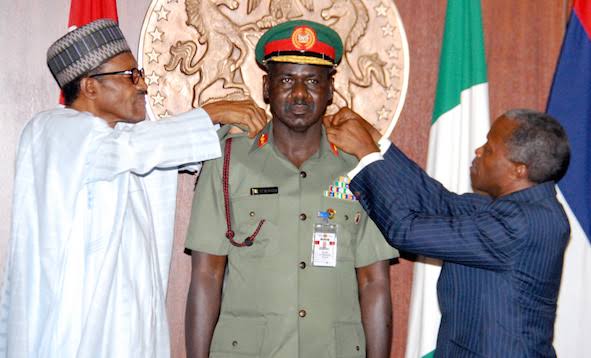
The recent letter jointly signed by Bamisope Adeyanju of SERAP, Seun Akinyemi of EiE and Atiku Samuel of BudgIT, addressed to Lt. General Tukur Yusuf Buratai, Chief of Army Staff (COAS), requesting details of the Army’s budget could unravel the gentleman understanding that has allowed Nigerians ignore the limited impropriety on the part of those running the show at these places. The letter wants the COAS to “urgently provide information on the 2015, 2016 and 2017 budget implementation reports of the Nigerian Army, including the amounts released (financial implications) and expended in fiscal years 2015, 2016 and 2017 for the various operations the Army carried out.”
Addressed to any other agency of government it would have been a welcome development since it will beam the searchlight on one more sector of the country and certainly initiate some measure of accountability in such place. But what could be wrong with making such request of the Army?
First, the request smacks of ignorance. Too bad that this strain of ignorance is wilful because the petitioners knew even before they filed their request that it is one not likely to be granted on account of requested details directly impacting the security of the country. It also wilfully ignores Section 11 of the Freedom of Information Act that stated in sub-section (1) that “A public institution may deny an application for any information the disclosure of which may be injurious to the conduct of international Affair and the defence of the Federal Republic of Nigeria.”
Secondly, there is no record that any of the people that these organizations hobnob with on the international scene had successfully pulled off such requests in their own countries. If that was possible it would have been a cakewalk for Nigeria to track how some these countries directly and indirectly finance Boko Haram to destroy Nigeria. It would have been easy to track how these countries pay for the sophisticated weapons that Boko Haram fighters take to the battlefield and possibly even lead us to uncovering the receipts for haulage of those weapons to the terrorists, which would effectively allow the Nigerian Army to know how to cut off Boko Haram supplies. But the nations that give grants to SERAP, EiE and BudgIT are opaque in their defence spending to the extent that these things are untraceable. Yet, they these groups accepted the assignment to be the minions that will get information for these covertly hostile nations about how the Nigerian Army has been able to circumvent the arms purchase blockade that has slowed down the eradication of Boko Haram.
Thirdly, without prejudice to their rights to personal relationships, these groups should have sequestered themselves from filing the petition on the account of their personal relationship with some other interests that have been openly hostile to the Nigerian Army on a scale bothering on obsession. The CEO of one of the groups is a protégée of the presidential candidate of Allied Congress Party of Nigeria (ACPN), Oby Ezekwesili. She is one of the owners of Bring Back Our Girl (BBOG) group that transited from seeking the safe return of the abducted Chibok School Girls into a rent-a-crowd rabble that has deployed for any conceivable cause provided the protest is against the army. This particular CEO hangs around Oby anytime he is in Abuja and even shuns hotels to take up transit accommodation in her abode. So it this request continuation of a vendetta against the army on Oby’s behalf? Is it a cover to get information that she can use to bolster her lacklustre campaign? Is the information being sought for onward transmission to contacts that are known to Oby in the course of her international work?
Whatever the answers are, they definitely will not smell nice.
Furthermore, the staffers of these groups interact constantly with operatives of Amnesty International, Transparency International, the United Nations International Children’s Emergency Fund (UNICEF) and host of other entities that had made it clear in the past that they have an axe to grind with Buratai’s leadership of the army. Should the Nigerian Army be naïve enough to provide the requested information, how much of it would be passed onto the aforementioned organizations? What guarantees are there that they would be professionally managed not to further pass into questionable hands? These posers should be considered against the backdrop of a UNICEF that only recently has its suspension from the northeast reversed. Part of allegation against it was that it was passing intelligence to Boko Haram terrorists. What country will then pass information that can expose the nitty-gritty of its military asset to groups that are connected with an organization that has been caught passing information to terrorists?
Nigerians have in the past praised the work of the trio in speaking truth to power and holding public office holders to account. But their request to acquire sensitive military information is a handshake taken past the elbow. With the little known about the shady side of these groups one can only conclude that they are engaged in flagrant abuse of their positions as activists and social crusaders. Persisting on the path they have recently chosen will shred their credibility and taint their reputation, which would only go to hurt the only community left to challenge those in power. But the call is theirs to make whether they desire to end up as villains or to remain as champions of accountability.
In conclusion, the Nigerian Army must ensure it is in no way intimidated by the stature of SERAP, EiE or BudgIT. Their clout is not enough to stop Boko Haram so the army cannot afford to compromise sensitive information to satisfy groups that no one knows for certain what they plan to do with the requested information.
Ataifure is a research fellow at the Centre for International and Stratgic Studies, Abuja.