Home Blog Page 2700

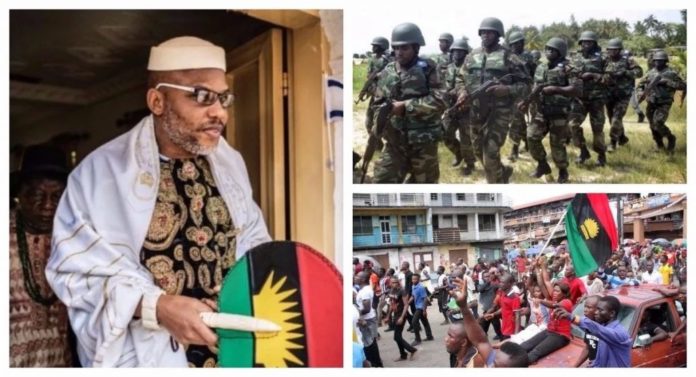
Don’t Dare The Strength of Nigerian Army, Yoruba Monarch Cautions IPOB

0

A traditional ruler in Osun has called on a group, the Indigenous People of Biafra (IPOB) led by Nnamdi Kula threatening to cause crisis in the eastern party of the country to desist from daring the strength of the Nigerian Army as the general elections for 2019 get closer.

This was disclosed during a press conference by Oba Hammed Adekunle Makama ,Tegbosun III with newsmen held at the palace of the royal father, Kuta Osun State.

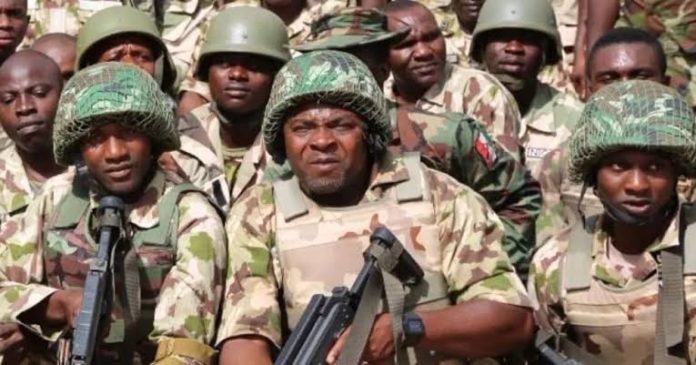
The Oba described the Nigerian Armed Forces as an institution above ethno-political and religious ills adding that Nigerians should learn to show respect to the soldiers.

The traditional ruler appealed to political parties going to the poll on February 16 and March 2, 2019 to stop politicizing security issues being addressed by the Nigerian armed forces with politics in the interest of their parties in order to gain political mileage .

He also appluaded the troops stressing that “I can not but award a credit mark to our armed forces their journey so far in taming the hydra-headed monster known as Boko Haram terrorists’ “Our troops need our individual support and concerted support through prayers and positive comments” explaining that “A situation whereby their efforts are greeted with scornful remarks would naturally kill their morals and also incapacitate their spirit to fight and get desired results”.

The traditional leader further urged his counterparts in the eastern part of the country to live  up to their fatherly role and advice Nnamdi Kalu and his IPOB members to stop their unlawful activities against the Nigerian state saying” His regular inflammatory statements against the country are not needed at this critical time of our national life”.

The Yoruba monarch said traditional rulers in the south-east should let Nnamdi Kalu see reasons to stop his call for boycott of the election as a huge disservice to the people of the southern region and an effort to provoke the country.

U-20 AFCON: FLYING EAGLES HELD TO A ONE ALL DRAW WITH SOUTH AFRICA

0

GAME OF CURLING: NIGERIA BREAK RECORD AS FIRST AFRICAN COUNTRY TO PARTICIPATE ON WORLD STAGE

0

STREET BUSINESS: THE CHALLENGES OF PETTY TRADING IN NIGERIA

0

TINUBU FAULTS OBASANJO AS AN ELECTION RIGGING BENEFICIARY

0

GANDUJE SHUTS SANI ABACHA STADIUM AHEAD OF PDP PRESIDENTIAL RALLY

0

PDP PROMISES 70 PER CENT WOMEN/YOUTH INCLUSIVENESS IN CROSS-RIVER STATE

0

Zero Tolerance Day – YNCSD promotes active participation of young people in the elimination of FGM/C in Nigeria

0

By Nnamdi Eseme

As the world commemorates the Zero Tolerance Day, the Youth Network for Community and Sustainable Development (YNCSD) joins the rest of the world to restate it’s committed to engaging young people as change makers to support the elimination of Female Genital Mutilation/Cutting in Nigeria. The engagement of young people is vital in discussions as the issue borders on key global concerns such as human rights, gender based violence and young people’s sexual and reproductive health.

What is FGM/C?

Female genital mutilation consists of the (partial or complete) removal of the external female genitalia, and the infliction of other injuries to the female genitalia for no medical reasons. There are several variations, including partial or complete removal of the clitoris, of the labia minora and majora, the narrowing of the vaginal opening by joining the two sides of the wound, leaving only a small opening for urine and menstrual fluids, and any other non-medical injury such as scraping, incising, pricking or burning. Female genital mutilation causes pain, infection, problems with sexual intercourse, problems with urination, problems with childbirth, and death.

Reports indicate that an estimated 19 million women in Nigeria have undergone FGM/C and 200 million women worldwide. A European Union forecast on the practice of FGM across 25 countries states that if the practice continues at the current pace, 68 million girls will be cut between 2015 and 2030 in 25 countries where FGM is routinely practiced and data available.
February 6 was unanimously adopted at the International Conference on Zero Tolerance to FGM organized by IAC from February 4 to 6, 2003 in Addis Ababa, Ethiopia. Further, the UN Resolution A/RES/67/146 on FGM ”Intensifying global efforts to end FGM” adopted on 20 December 2012, confirmed February 6 as the International Tolerance Zero Day to FGM.

What does YNCSD do to address the issue?

YNCSD tackles FGM through robust advocacy and community engagement programmes in practicing communities. Our projects have applied innovative approaches such as social and behavioural change communications, engagement of non-SRHR allied professionals and community-based anti-FGM champions, led by young people to learn, unlearn and relearn harmful social norms. Furthermore, creating dialogue sessions with communities using an approach is open and non-judgmental have proven to lead to positive attitudinal shifts in communities where we have worked in. Our efforts also improved access to support for survivors and capacity building of practitioners.

Sharing knowledge through advocacy and communications

Estimates show that there may be as many as 200 million victims of female genital mutilation (FGM) worldwide, including at least 19 million in Nigeria. YNCSD continues to conduct research and disseminate findings (resources can be found on our website) to members of the public about the potential harm associated with the practice. In 2017, under our TSON I project funded by Amplify Change, we focused on transforming social norms through advocacy and communications across 4 states in Nigeria. The project saw the engagement of the Circumcissers Association of Nigeria as well as Religious leaders as key influencers to end the practice. In 2018, in partnership with Orchid Project and with support from Amplify Change, we conducted a Knowledge Sharing Workshop for organisations working on ending FGM/C in Nigeria. The Knowledge Sharing Workshop is based upon the ‘six elements for the abandonment of FGC’ developed by UNICEF using academic theory and lessons learned from such field experiences as Tostan in Senegal. These six key elements can contribute to transforming the social convention of cutting girls and encourage rapid and mass abandonment of the practice. An underlying theme is application and the workshop concluded with how learning may be adopted and used within the activities of participating organizations. Deliverables of the workshop included:
• To promote the concept of non-judgemental open dialogue in advocacy and community mobilisation targeted at addressing social norms underpinning female genital mutilation/cutting.
• To share knowledge on best practices and create safe spaces for survivors to tell their stories and be at the forefront in speaking against the practice of FGM/C I their communities.
• To develop the capacity of organisations working on FGM/C in communications and knowledge sharing.

Scaling up advocacy
Prevention of FGM is essential and largely depends on the existence of policies guiding behavior and practices. Just recently, we launched the TSON II project which will focus transforming social norms that underpin the continued practice of FGM/C in 4 states in Nigeria. To achieve this; the project will work closely with traditional rulers and influential religious leaders, young people and the traditional cutters themselves to change norms, attitudes and expectations at the community level towards ending FGM/C. The Project will work with Ministries of Education across the four states to advocate for the inclusion of FGM/C into state education curriculum. For states where this has already been included, advocacy efforts will be targeted at implementation of the curriculum as well as building capacity of school teachers on the subject matter.

What happens next?

The Youth Network for Community and Sustainable Development will continue to work with partner, key linkages and stakeholders to ensure the abandonment of female genital mutilation. We are also setting up a social media interactive site where we can share best practices, ask and address questions and disseminate findings based on research conducted. We also commit to working with boys and men via awareness raising campaigns and promoting the dissemination and interpretation of the Violence Against Persons Prohibitions (VAPP) Act 2015 to key agencies and CBOs.

Eseme is Senior Technical Adviser, YNCSD

Boko Haram: Coalition salutes military for repelling multiple attacks in Adamawa, Yobe, Benue

0

The Coalition Against Terrorism and Extremism (CATE) has saluted the Nigerian Army for averting what it described as ‘Black Monday’ by successfully repelling multiple terror attacks in several parts of the country.

Recall that the gallant Nigerian troops had overpowered and decimated some terrorists in Adamawa, Yobe and Benue States yesterday.

CATE in a statement through its Presidenct, Gabriel Onoja, lauded the Nigerian Army and the entire military for the dedication, commitment and the sense of sacrifice that inspired them to take down the terrorists while putting others in flight with varying degrees of bullet wounds.

His statement reads below.

These locations include Shuwa town in Madagali Local Government Area of Adamawa State, where Boko Haram terrorists where given a taste of the powers of a sovereign state and in Kanama, Yunusari Local Government Area of Yobe state, where an invasion by Boko Haram rather left several of the terrorists dead when troops intercepted them. In Tomatar community in Guma Local Government Area of Benue, three militant herdsmen were gunned down by the Army after they tried to stage a surprise attack on the community.These multiple attacks happening on the same day indicated that they were meant to plunge the nation into a sense of grief and insecurity even as the General Elections are a matter of days away.

The attacks call to mind the series of alarms that have been raised by different stakeholders that there are people that have commissioned and paid terrorists to carry out such attacks so that Nigeria’s democracy can be aborted and an interim government illegally put in place.

The Army has averted what was apparently planned to be a Black Monday of sorrow and terror on account of the number of Nigerians that would have been massacred had these terrorists not stopped in their track. This success recorded by the Army is a demonstration of the positive results that can be had when citizens trust the military enough to collaborate with them and provide vital information.

The successful thwarting of the terrorists in all the instances has affirmed that the decision the Chief of Army Staff, Lieutenant General Tukur Buratai, to launch Operation Python Dance nationwide was the right call for which he should be commended. It has turned out to be a proactive approach to the nation’s security challenges since it is now apparent that there are really those that are embittered that the country is on the way to having peaceful elections, which has made them even more desperate to destroy Nigeria’s democracy.

We also praise the troops that brought down these terrorists. The troops have remained committed to Nigeria and obedient to the military leadership even when disgruntled politicians have tried all manners of gimmicks to manipulate them into allowing terrorists gain the upper hand in the days preceding the elections. Nigerians cannot thank them enough for the valour they have shown in dealing the common enemy, which politicised terrorism.

However, it is apparent that there will be more of these kinds of attacks spread over wide geographical areas. This is because the sponsors of these attacks will adapt the “whack-a-mole” strategy, in which they will randomly chose to launch attacks in different geographical locations that are spatially incongruous in a bid to wear down the Army and to make it impossible for troops to deploy to all such locations at short notice. The desperation of those that want Nigeria to fail is such.

We therefore urge that the Army increases its collaboration with other agencies to improve on intelligence gathering with a view to nabbing some of the brains behind these attacks at the planning stage before they have time to cause their desired carnage in any part of the country. This must be closely followed by ensuring that anyone found to be complicit in planning or financing attacks against Nigeria is made to face the law without delay to serve as deterrence to others with similar plans.

Buratai: A study in warfare

0

By David Onmeje

The story of the Nigerian Army is such that invokes memories of exploits, especially in the Sub Saharan Africa. In times past, the Nigerian Army won countless laurels in its operations so much to the envy of other nations. At a point, the Nigerian Army was adjudged one of the best professional armies in the world.

Nigerians were indeed proud of the Nigerian Army, and it became a thing of pride for one to be enlisted as either an officer or a soldier in the Nigerian Army. This euphoria continued until the advent of democracy in Nigeria in 1999. And that era saw to the gradual and steady decline in the operational effectiveness of the Nigerian Army for some strange reasons.

We didn’t notice the decline until we were confronted with the Boko Haram challenge from 2009. So much that the Nigerian Army has lost its footing on the threats posed by evolving warfare such as cyber warfare, insurgency, terrorism, nuclear warfare and other forms of unconventional wars. It was so apparent that the Nigerian Army was still leaving on past glory. And this gave rise to the casualties it suffered during the early stages of the Boko Haram crisis.

The Nigerian Army was at its lowest ebb. The morale of the fighting troops was at an astonishing low. And Boko Haram continued to gain grounds so much so that over 16 local government areas in North East Nigeria fell under the control of the Boko Haram terrorists. Other parts of the country too were not safe including the federal capital territory that witnessed scores of Boko Haram attacks. This was as recent as 2015. It was such a bad tale to recount in the annals of Nigeria and the Nigerian Army.

But all of that has changed for the better as we are now witnesses to the return of the Nigerian Army to the path of glory in the past three years. In my opinion, there is no way one can talk about the return of the operational effectiveness of the Nigerian Army without mentioning two people. One is the president and commander-in-chief of the Armed Forces, Muhammadu Buhari and also the dynamic Chief of Army Staff, Lt. Gen. Tukur Yusufu Buratai.

How the Nigerian Army has achieved total peace for Nigeria is still what observers and researchers are still battling to unravel despite the security threats posed by the Boko Haram terrorists and other militant groups such as the Islamic Movement in Nigeria (IMN), the Niger Delta Avengers, the Indigenous People of Biafra (IPOB). This is mainly on the heels of the fact that before the coming of the administration of President Muhammadu Buhari, the Nigerian Army was a shadow of its self. In truth, we had a Nigerian Army that was just some kilometres away before its final disintegration. But not anymore.

I am of the opinion that God truly loves this country. If not for the intervention that saw the coming of the administration of President Muhammadu Buhari and the subsequent appointment of a dexterous general as the Chief of Army Staff, I wonder what would have been left of Nigeria with the ferocity with which the Boko Haram terrorist carried on. The terrorists and other militant groups would have overrun Nigeria.

That the Nigerian Army under the leadership of Lt. Gen Tukur Buratai was able to turn the tide against the enemies of the country is indeed an indication of capacity and strategic intelligence. I stand to be corrected. For the Nigerian Army to carry out operations simultaneously across the country and was still able to maintain peace is an indication that the Nigerian Army has been repositioned for operational effectiveness by none other than Lt. Gen Tukur Buratai. Little wonder the avalanche of awards that have come his way? Worthy of mention is the award of the Brazilian Military Order of Merit Award, which is the highest military honour awarded to military officers that have distinguished themselves in various military endeavours.

The likes of Lt. Gen Tukur Buratai should be a topic of research for military historians on how he was able to take the deplorable Nigerian Army to an effective operational force in a record three years. In my opinion, the topic of the research should read “Army Leadership in Nigeria and operational effectiveness: a case study of Lt. Gen. Tukur Buratai.”

In so doing, other upcoming officers and commanders would have something to chew on when the lot falls on them. In truth, this is what is obtainable in western climes ass it is done to the likes of General David Petraeus. It is indeed a record feat for Nigeria to have turned the tide against the Boko Haram terrorist. And it explains why the war exploits of Lt. Gen Tukur Buratai should be subject to a robust academic pursuit.

One of the landmarks of the operations of the Nigeria Army in North East Nigeria is the creation of the Special Strike Force that has continued to lead the onslaught against Boko Haram terrorists in North East Nigeria. In my opinion, the establishment of the Strike Force was the game changer and in conformity with the famous quote by General David Petraeus that says “Life is a competitive endeavour. And there’s nothing more competitive, obviously, than combat.”

And I could not agree less. It takes a whole lot of thinking outside the box when fighting an unconventional war. You must be prepared to assess the psychological state of the terrorist to be able to formulate an effective counter-strategy. This much I have noticed was deployed by the Nigeria Army in the fight against Boko Haram terrorists and other militant groups in Nigerian from 2015 to date. And with the present state of the Nigerian Army, it is just a matter of time for the remnants of Boko Haram terrorists to be wiped completely. Need I say more? Lt. Gen. Tukur Buratai is indeed a study in warfare.

Onmeje is a media strategist based in the United Kingdom.