Army/Daily Trust face-off: Nigerian media urged to uphold national interest
A Coalition of Civil Society Organizations for Good Governance and Change Initiative has reacted to the recent face-off between Daily Trust Newspaper and the Nigerian Army over a report published by the media outfit.
Daily Trust had published a story about the army preparing to take over Baga, Borno State from Boko Haram, a story the military authorities tagged as insensitive.
Irked by the development, some soldiers stormed the Maiduguri office of the media house and picked up its regional editor, Uthman Abubakar, alongside a reporter.
They have since been released.
Reacting to the development, the Coalition of Civil Society Organizations for Good Governance and Change Initiative chided the newspaper for betrayal of trust and working for the terror groups.
Addressing a press conference on Wednesday, Comrade Okpokwu Ogenyi,
National Coordinator of the coalition; tasked the Nigerian media on the need to uphold national interest.
According to Okpokkwu, leaking sensitive security plans to members of the terrorists group would rather cause more harm than good to the nation.
Okpokwu said, “As some analysts have questioned, why has Daily Trust/Sunday Trust never published exclusives that alert the Nigerian Army to impending Boko Haram attacks. Why has the publication never provided information on Boko Haram/ISWAP on scale that corresponds to what it has published about the military?
“Their failure to publish these kind of details about terrorists, which would have been a patriotic thing to do, is a clear indication that something is fishy somewhere since they can give out the kind of information they gave out about the army. Taken against the pro-Boko Haram stories that had been published by this organization, there is ground for a deeper suspicion.
“The publication of these classified details by Sunday Trust has gotten us reviewing past attacks on military posts by terrorists in new light with the benefit of hindsight. It will appear that there are reporters in the employment of Media Trust that are ardent members of Boko Haram and ISWAP.
“These disguised terrorists must have been regularly passing information received in trust as journalists to Boko Haram and ISWAP hence the sustained leak that has made it possible for the terrorists to ambush military convoys and attack military posts with deadly consequences. What we do not know at this point is if Media Trust as an organization has it as a policy to deploy its publications to provide information terrorists. The rapprochement it will reach with military authorities would confirm or disprove this.
“We had wished that the Nigerian military had not visited the premises of Media Trust in Abuja and Maiduguri to invite the journalists and editors that committed this breach. Had they not been invited yet we would have been having a citizens’ action against that organization because in the long run it is the citizens that have been put at risk by that publication. But the step taken by the military has stayed our hands while the intervention of the Presidency has reminded us of the need to revert to dialogue in seeking redress from Media Trust for this breach of trust on its part.
“Our coalition has monitored the response to the failure of the Sunday Trust publication to respect the ethical consideration needed for handling security related classified information. We see that efforts are being made by a vocal minority to obscure the core issues involved in this matter. Sentiments are at play when the focus should have been on how to set applicable benchmarks in handling information related to the war against terrorism so that troops are not unnecessarily placed in harm’s way and for them to be able to in turn protect Nigerians.
“The issue has also become fodder for politicians that want to play the populists card by insinuating that the invitation to the media staffers that breached ethics is a clamp down on free speech. The heating up of the polity is therefore another of the negative consequences of what the newspaper has done.
“In all these, we recognize the place of the liberties guaranteed by the Nigerian Constitution. Among them is the empowerment of the media to hold the government accountable, which is also at the heart of freedom of expression or press freedom. But these freedoms are moderated. Basic journalism textbooks teach the need to be considerate of national security, which does not appear to have been the case in what was published in the Sunday Trust. So when the issues of press freedom and the war against terrorism are taken in the proper context and from the proper perspective then Media Trust betrayed public trust.
“Leaking troops’ movement in the name of news stories, special reports and exclusive stories has become the hallmark of some media organizations in Nigeria. This development is highly uncalled for in view if the risk it poses to the country. We further appeal to the media to understand when the misuse of the power of the pen becomes a danger to society.
“The Nigerian Army should work with the nation’s intelligence agencies and the Department of State Services (DSS) to review the accreditation for journalists covering the defence beat and the war against terrorism since the prospects now appear strong that persons impersonating as media representatives are among those passing information to terrorists.
“We appeal to the Army to be magnanimous in accepting an apology from Media Trust, agree on corrective and remedial steps and put this matter behind it so that it can return to focusing on clearing out the terrorists from Nigerians soil.”
Shettima’s tears and fear mongering
By Abel Audu
At a time when an average Nigerian politician appears to have taken courses in film acting and stage performance, the tears shed by Borno state governor, Kashim Ibrahim Shettima when he led the state elders on a visit to President Muhammadu Buhari, were suspect. Not even his bawling and cracking voice, when speaking with State House Correspondents, could convince one that he is not an alumni of sort with Ayodele Fayose the former theatrical governor of Ekiti State and the entertaining Dino Melaye, who recently suffered a fainting spell when he turned himself in to the police.
Shettima is clearly not a dullard. The timing of his visit to the President could not have been more strategic. The visit was calibrated to coincide with a time when the country direly wants to be done with Boko Haram insurgents, the group’s birthplace is Borno. It is coming at about the fourth year anniversary of when the 2015 elections were postponed to fight the group. It is a time that the combined military is on an onslaught to dislodge the terrorists – and the military is reporting success in the wake of a directive to wipe out the vermin.
The Borno governor, who is outgoing by the way, choses now of all times to present a ten-point demand to President Buhari. These demands were meant to be under wraps so that they would have been acceded to before Nigerians become any wiser, by which time it would have become too late to roll back whatever concessions have been made to Shettima and his chosen successor. But much of the classified demands have become subject of public discourse since that which is hidden inexplicably become revealed in line with the tradition that has now become commonplace even for military secrets.
Before touching on Shettima’s demands, it is appropriate to revisit the past if only to refresh memories and put certain facts in proper perspective.
The first thing to remember is that Boko Haram has its roots in the political misadventure of someone that once occupied the position that Shettima is about now vacating. Street urchins that were recruited as political thugs, infamously called ECOMOG then, were the founding blocks that were later brainwashed and radicalised into the first generation members of Jamā’at Ahl as-Sunnah lid-Da’wah wa’l-Jihād (derisively referred to as Boko Haram until the name took hold and the stigma it was meant to connote was stripped away).
This Shettima’s political forebear was complicit in the killing in custody of Yusuf Mohammed, Boko Haram founder, which paved way for the decade of violence that has been visited on Nigeria. It must be noted that the then Borno Governor paid similar cloak and dagger visits to the Presidential Villa to confound issues with the late President Umaru Yar’Adua.
It must be similarly recalled that the virulent group had its founding demand as the strict implementation of Sharia law across the country.
A few years of fighting has taught them that this is a pipe dream that will never materialized – the international news network and media that used to intone this objective have since dropped it from their reportage. With its recent association with the Islamic State, Boko Haram’s objective in this regard has changed from desiring a sweeping implementation of Sharia to carving up a caliphate administered to its own barbaric taste. This would be an interim goal of a few decades since the larger objective of the Islamic state is to have a single caliphate spanning from the Mediterranean to Central Africa.
To Shettima’s demand, the memo he submitted to the President included asking for the Civilian JTF to carry automatic weapons and for all Borno State Indigenes in the Police and military to be redeployed to their home state, Borno, to fight for him. He premised these demands on the grounds that he no longer trust the current Nigerian Military. He also made points that the Borno state government already pays the allowances of the Civilian JTF members in addition to procuring the hardware they use in their operation against Boko Haram terrorists.
These demands are innocuous of the surface. A dispassionate review would however reveal that Shettima has, through these demands, revealed an ambition that is worse than the initial proposition of Boko Haram and comparable to the terrorists’ current quest for a caliphate. By presenting these demands, Shettima has practically served Nigeria a notice of secession of Borno state to become an independent country, which is the same objective that Boko Haram has been pursuing. Any iota of doubt should be removed by the request to set up a Borno Military Service with a compliment of the state police, since that is what will happen by default if all the indigenes of the state are posted there.
He has indicated that the state can pay the salaries and allowances of these Borno indigenes while he is already paying the allowances of Civilian JTF, which he implies he is prepared to pay the standing military for the state. When Borno state has its own army, can it still be regarded as part of Nigeria? Is Shettima and indeed the entire Borno prepared for the nightmarish scenario he is trying to bring about?
Another question to ask is how long before Shettima hands over his dream “Republic of Borno” to his Boko Haram overlords for it is now apparent that his sympathies has been with the terrorists all along? If not, why would he be attempting to accelerate the achievement of their objective at lesser cost to them? What has been the contributions of the elders that accompanied him in terms of leveraging their positions to stop recruitment, indoctrination, brainwashing, radicalization and recidivism of youths in their jurisdiction?
There are even more questions. Has Borno state not learnt enough lessons from the misadventure of its one time governor, Ali Modu Sheriff, whose indiscretion laid the foundation for today’s horror? Other than buying gadgets and paying Civilian JTF members, what did Shettima do with his eight years as governor by way of addressing the underlying factors that sustain Boko Haram? Has Shettima suddenly discovered himself?
If Shettima has any strand of humanity left in him then that should make him realize that he needs to own up to his failure, openly accept that he has failed the people and his maker by pursuing a narrow agenda when he could have teamed up with the federal government to end the scourge in the land he presided over.
It is the height of unrepentance for him to continue to make it appear like the federal government failed his people when he has been an obstacle towards restoring peace in the state. This unrepentance takes on a soullessness with his now seeking to sever Borno state from Nigeria, maybe he wants to be the first president of Borno Republic.
With the elders he led in tow on this recent visit, Shettima has one more visit to the Presidential Villa, but without the tears and fear mongering.
He should go before president Buhari to apologise for the irresponsible demands he made of the Nigerian state. Or, Shettima should arrive the Villa with the black flag and coat of arms for his new republic so that Nigeria can better define the enemies in the war against terrorism.
Audu contributed this opinion from Lagos Street, Maiduguri.
Buratai’s media-friendly disposition and the Need for Synergy
By David Onmeje
When I stumbled on the news report by Daily Trust Newspaper for Sunday 6th January 2018, I screamed to myself that this was too much information for public consumption. I could not come to terms as to why such sensitive items should be on display by a paper like Daily Trust, whose readership is domiciled in Northern Nigeria. To me, it was like an attempt to undermine the operations of the military in North East Nigeria because it revealed all the operational strategies of the military on combating the sudden resurgence of Boko Haram scourge.
It was indeed a mouthful that I wondered who sat and approved of such a story to go to the public domain without thinking of the implication for National Security. I also saw that story as a means to send a warning signal to the Boko Haram terrorists on the need for them to strategize for the military onslaught against them. I stand to be corrected. While all of these still dwell in the realm of speculations as regards the motive(s) for the publication of the story, if the truth be told, Daily Trust went above bar and their actions have caused monumental damage to the operational strategies of the Nigeria Army in North East Nigeria and had indeed put the lives of officers and soldiers on the line.
I must extend my empathy to the Chief of Army Staff, Lt. Gen. Tukur Buratai who has been in the North East strategizing with his men on how to keep the situation under control and all of a sudden there was a loud bang. I could imagine his anger and disappointment. I could also sense him gnashing his teeth wondering how such sensitive information leaked to the press. Two things could suffice in the whole drama. One is that there might be some informants leaking out sensitive military operational strategies to Boko Haram, and two, is that Boko Haram might have compromised some media houses. And if that was the case, Daily Trust newspapers has a responsibility to question sources and share such sensitive information with the relevant authorities for vetting before hitting the headlines.
While it is not in my place to comment freely on the insider conspiracy within the Nigeria Army, I would dwell extensively on the media which in my opinion has a critical role to play in National Security. The power of the press to decide what the people should read, see or hear has never been in doubt. What has been in the centre of the controversy is the capacity of those in whose hands reside such enormous powers to use that power judiciously and in public interest. Media professionals have the options to use the power of media instruments in their hands either to serve the nation or indulge in self-propelled interest. And in this case, Daily Trust Newspaper decided to indulge in self-propelled interest and at the detriment of National Security. Let us call a spade a spade.
It was quite unfair and somewhat a disserve to all the efforts the Chief of Army Staff, Lt. Gen. Tukur Buratai has put in to ensure a robust relationship between the military and civilians. So much so that the COAS has in numerous forays courted as one of the most media-friendly personality in the country who has exhibited a high sense of decency in his relationship with members of the civilian populace and the media and also one who understands that the Army has a responsibility to protect the civilian populace and not intimidate them.
Take the example of the Civil-Military relations; the Army hierarchy indeed observed that a significant weapon in the war on terror is improving its relationship with the civilian populace in these communities. And this has yielded excellent results according to those in the know of the events surrounding the success recorded by the Nigeria Army.
I recall in one of the forums of improving Civilian-Military relations in Nigeria; I left with an impression that fighting a war is not only about tanks and bullets. But also winning the hearts and minds. And this much the Nigeria Army has done with the activities of the Directorate of Civil-Military relations through its numerous outreaches and stakeholders interactions. I am also aware that the directorate has embarked on quite a number of initiatives such as the provision of essential amenities in these communities, rendering of free medical services, construction of roads and bridges, identifying and felicitating with them in times of need and in times of joy, constantly getting feedback on ways the Nigeria Army can continue to make advances in the war against terrorism and many more.
Having stated the above, it is my considered opinion that the management of Daily Trust Newspapers owes the Chief of Army staff and by extension the Nigeria Army an unreserved apology for the shameful story it published. This is important so as not send a message to members of the unsuspecting public that it is not sympathetic to the Boko Haram sect, and two, also not to ruin the relationship it has built with the Nigeria Army over the years.
While the above should happen, the Nigeria Army also has a role to play too. Not minding the great damage, the exposure must have cost it, there is always a learning curve that entails that we forgive and move on in the spirit of national interest. Though tough for the Nigeria Army especially with the public perception that Boko Haram terrorists have regained grounds, we must look at the larger picture regardless of our hurt and realize that national interest should always supersede personal interest.
The deed has been done, yes, but it might not be intentional. We should also look at things from such perspective because so doing allows us the strength to forgive and move on. The Nigerian project requires all working together in harmony and not at cross-purposes. National interest should always supersede personal interest. That is just the way to go.
Onmeje wrote from the United Kindom.
Electric cars project to begin in Nigeria
The Federal Government has opened discussions with international stakeholders in the automobile sector to kick-start a pilot programme on electric vehicles (EV), it has been revealed.
This is in line with the global trend in vehicle electrification with fossil fuel being phased out while mobility is largely powered by electricity and batteries.
The Director-General of the National Automotive Design and Development Council (NADDC), Mr. Jelani Aliyu, disclosed this at the weekend while delivering a keynote speech at the 2018 annual Nigeria Auto Journalists’ Awards (NAJA) awards in Lagos, saying electric vehicles are desirable in Nigeria.
Aliyu explained that the EV Pilot Programme comprised three components such as the vehicles itself, charging stations and training/maintenance.
According to him, Nigeria must not shy away from vehicle electrification which informed the discussion the country has opened with both electric vehicle and power station manufacturers.
Asked when the programme would take off, he said, “very soon”.
“We are working out details on the pilot programme to have these vehicles in Nigeria so as to better understand the viability, challenges and opportunities,” he stated.
The DG stressed that it was in line with this commitment that the council in August this year signed a memorandum of understanding (MoU) with Volkswagen to produce vehicles in Nigeria.
He said, “We are particularly excited because VW is Europe’s largest auto manufacturer and it is very serious about electric vehicles and other new mobility solutions. The company is investing $84 billion in electric cars and batteries.
“NADDC is dedicated to developing the Nigerian automotive sector. It is in the quest to provide the best for Nigerians that the Federal Government and NADDC are committed to engaging and supporting some of the world’s best car manufacturers to set up operations in Nigeria,” he stated.
He further disclosed that in order to develop the technical manpower of the youth, NADDC is building seven automotive training centres, one in each of the six geopolitical zones, and the seventh in the FCT.
Aliyu also said, “in collaboration with the Presidential Social Investment Programme, N-Power, NADDC is training 3,200 youth in mechatronics across the country. Nigeria presents a new beginning, ready for innovation in its truest form.”
Source: DailyTrust
FIRS targets N8trillion after record N5.3trn in 2018
The Federal Inland Revenue Service, FIRS, re-wrote Nigeria’s collection history in 2018, with a record N5.320 trillion collected in taxes, beating the 2012 record of N5.07 trillion.
Tunde Fowler, Executive Chairman, FIRS, who made the announcement in Lagos today at a retreat: “Parliamentary Support for Effective Taxation of the Digital Economy” said it is targeting N8 trillion for 2019.
FIRS’ generation of N5.3 trillion is significant as it was at a period when oil prices averaged $70 per barrel. Oil price was at an average of $100 to $120 per barrel between 2010 and 2013.
Non-Oil component of the N5.320 trillion is N2.467 trillion (46.38 per cent), while oil element of the collection is N2.852 trillion (53.62 per cent. From audit alone, FIRS collected N212.8 billion from 2278 cases with a huge reduction in audit circle.
“While we have been steadily increasing revenue collection over the years, our cost of collection has actually been going down. In 2016 we collected N3,307 trillion, in 2017 we collected N4,027 trillion and in 2018 we collected N5,320 trillion. Meanwhile, the cost of collection as a percentage of actual taxes collected has been reducing; in 2016 it was 2.6%, in 2017 it was 2.49% while in 2018 it was 2.14%”, said Fowler
“The Service has been making tremendous efforts in also increasing the amount of non-oil revenue it collects. Non-oil collection contributed 64.99% in 2016, in 2017 it contributed 62.25% and in 2018 it contributed 53.62%. This represents the government’s focus on increasing non-oil sources of revenue and the diversification of the Nigerian economy.
Fowler reiterated the fact that only companies that made a profit are obliged to pay taxes. According to him, if a company is situated in Nigeria it is only fair that it pays its fair share of tax for the benefit of all Nigerians.
The Executive Chairman also stated that various initiatives were implemented by FIRS to enhance tax administration and make taxation as easy as possible. FIRS deployed ICT initiatives that enable a taxpayer to pay taxes from anywhere in the world, at any time. With the e-payment channel one can pay taxes with the click of a button and one can also download their receipts. Other e-Services are the e-Registration, e-Filing, -Stamp Duty and e-Tax Clearance Certificate.
“Taxpayers can now also choose the tax office where they would like to conduct their tax transactions. Before now, if one was registered with a particular tax office, one had to conduct all of their tax transactions in that office. However, to make it more convenient for the taxpayer, they can now choose which ever office they wish to conduct their transactions with.
He noted that Nigerian taxpayers are embracing the modern way of tax collection, introduced by the FIRS through the 6-e Solutions.
Said Fowler: “We are automating the collection of Value Added Tax, VAT in key sectors which will facilitate reduction in compliance cost in the long term. We are doing System to system integration between banks and FIRS. And I am happy to announce to you that we had a 31% increase year on year in VAT collection in the banks that have gone live between Jan 2017- Dec 2018 and collected 25bn so far
“Amongst others, there is also the Government Information Financial Management Information System (GIFMIS), which links FIRS to the Office of the Accountant General of the Federation OAGF for real-time exchange of information and data. We are also automating the payment of VAT by states through the State Offices of Accountant General Platform (SAG). This will ensure that we aautomate and deduct at source and remittance of VAT and WHT from State governments contract payments directly to FIRS’s account and so far, collected 13bn”.
He noted that taxpayers that requested for and processed their Tax Clearance Certificate, TCC through tcc.firs.gov.ng, from the comfort of their homes. “Tax clearance on the platform grew from 9,574 – 59,350 within a year of introducing the platform.
“Auto VAT collection in key sectors has also facilitated in reducing the cost of compliance. Between January, 2017 and December, 2018 VAT collection increased by 31% which translates to a collection of N25 billion. Overall, in 2019 VAT crossed the N1 trillion mark. Indeed, VAT is the fastest growing tax type in the world and even rich countries that did not depend on taxation have now introduced VAT, like the United Arab Emirates.
“In 2016 FIRS initiated a tax amnesty programme which attracted over 3000 applications for waiver of interest and penalties. The programme resulted in payment of over N68 billion out of about N96.2 billion liability established by the exercise.
The Voluntary Assets and Income Declaration Scheme (VAIDS) was initiated by the Federal Ministry of Finance and the FIRS received over 5122 applications under the Scheme. The Scheme resulted in voluntary declarations of over N92 billion, with over N54 billion paid so far by companies.
Fowler also explained how FIRS ascertained whether those companies with banking turnover of N1 billion are tax compliant or not. He said, “FIRS wrote to all commercial banks in May 2018, requesting for a list of companies, partnerships and enterprises with a banking turnover of N1 billion and above. This activity was aimed at ascertaining those companies that are compliant with the tax laws and those that are not compliant. So far, non-compliant organisations have paid about N21.75 billion.
“Companies that had a Tax Identification Number (TIN) and were paying were 45261, those that had a TIN but were not paying were 40611 and those without a TIN and who were not paying were 34504.”
*Statement
Buhari reiterate commitment to flushing out Boko Haram remnants
President Muhammadu Buhari Monday in Abuja met a delegation from Borno State, during which he restated his administration’s unwavering determination to equip the military to overcome Boko Haram insurgency in the North-East.
The President also told the delegation led by an emotional Governor Kashim Shettima of Borno State that the collective safety and security of civilians would continue to remain paramount in the administration’s strategy to restore peace and stability in the region.
‘‘Having been a former Governor in the North East, a GOC in the region and very familiar with the terrain, I assure you that as Commander-in-Chief, I’ll raise the standard of the Nigerian Armed Forces and get the resources to encourage them to do better than what they are doing, ’’ he said.

The President told the delegation comprising political, traditional, religious, women and media leaders in the State that he was impressed by their leadership roles and participation in helping the government deal with the insurgency in the North East.
The President commended the contributions of the stakeholders from Borno State particularly the need for more air support for troops on the ground and coordination among different security agencies.
‘‘I am getting at least a weekly situation report from the services and of course from other sources. I encourage the commanders to remain committed,’’ he said.
President Buhari thanked Governor Shettima for demonstrating leadership in the State during these difficult times.
‘‘I have an idea how much you are doing and I very much appreciate it. I’m sure that has earned you more respect from the people,’’ he said.
Governor Shettima recounted that before 2015, Boko Haram had almost completely overrun the State, occupying many local government areas because the state government did not receive the necessary support and succour from the then Federal Government.
‘‘We are here as a people who worked, prayed and waited for your presidency in the firm belief that with you as Commander-in-Chief, Boko Haram will become history.
‘‘We are here because you have demonstrated empathy for Borno people and the overriding commitment to end Boko Haram.
‘‘We are here because we knew you would welcome us without any suspicion or contempt.’’
An emotional Shettima told Buhari that the leaders have not lost hope in his ability to win the war and restore peace to the state.
“Between 2013 and 2014, we witnessed the most daring and most vicious evil of the Boko Haram, losing 20 Local Government Areas. However, we rushed here because of the recent upsurge in the activities of the demented monster called Boko Haram especially in northern Borno senatorial district. We are here because since 2015, Mr President, you were able to restore our hope.
“We are here because we thought that Allah will use you to fully reclaim Borno traditional glory of being the home of peace. We are here as a people who worked, prayed and waited for your Presidency in the firm and under the belief that with you as the Commander In Chief, Boko Haram will become history in Borno.
“Mr. President, we have not, and Insha Allah, we will not lose hope in you because we have witnessed and survived worse moments before you came. We do not feel hopeless.
“Our hopes are very much alive and they are very high.
“We came with some observation and 10 requests for urgent presidential intervention. These observations and requests are products of discussion in the aftermath of our extra-ordinary security meeting held one week ago.
“We didn’t rush to come after the meeting. We felt the need to travel to northern Borno, interact with displaced persons and the military so as to strengthen public confidence.
“I will seek the understanding of the journalists by not making public any of our observation and 10 requests. They are matters of security which we hope to discuss with Mr President in a closed door.
Other stakeholders from the State who made comments included Bishop Mohammed Naga, Chairman, Christian Association of Nigeria (CAN), Borno State, Dr Bulama Mali Gubio, Secretary, Borno Elders’ Forum, Maina Ma’aji Lawal, former Governor of the State, HRH Muhammad Masta II bn Al-Amin El-Kanemi, Emir of Dikwa, representing the Shehu of Borno, Senator representing Borno North, Abubakar Kyari and Senator Ali Ndume, Leader, Borno Caucus, National Assembly.
How witnesses rubbishes Adeleke’s case at Osun election tribunal
Proceedings resumed on Monday before the Osun State Governorship Election Petition Tribunal in Abuja with the petitioners, Senator Ademola Adeleke and the PDP calling 10 more witnesses.
However, most of the witnesses proved useless to the petitioner as they could not substantiate their claims.
The petitioners – the PDP and its candidate Senator Ademola Adeleke – are contesting the outcome of the election won by the candidate of the All Progressives Congress (APC), Adegboyega Oyetola.
The 10 witnesses called on Monday by the petitioners brought to 34 the number of witnesses so far called by the petitioners, who planned to call over 100.
All the witnesses called on Monday, most of whom were barely literate artisans, alleged that there was over-voting at the polling units where they served as agents of the PDP.
Some of the witnesses could not read the statements they claimed to have signed and adopted before the tribunal on Monday as their evidence in chief in the case.
The witnesses, most of whom could also not express themselves fluently in English language, were however unable to substantiate their allegations of over-voting.
When asked, under cross-examination, to provide proof of their claimed over-voting, the witnesses would point to some alterations in the result sheets tendered before the court.
When reminded, by respondents’ lawyers, that they signed the said result sheets on their own volition, the witnesses claimed to have signed after protesting.
At a point, some of the witnesses became unruly as they refused to answer questions under cross-examination, thereby necessitating occasional intervention by tribunal’s Chairman, Justice Ibrahim Sirajo.
Some of the witnesses, also confessed, under cross-examination, that they were not the actual PDP’s agents, whose names were submitted to the Independent National Electoral Commission (INEC) before the election.
One of the witnesses, Mrs. Victoria Fadeke Alo admitted that it was actually another agent – Ilesanmi Samson Taiwo – who signed the result sheet as agent of the PDP in the polling unit she claimed to have represented the party.
Under cross-examination by Wole Olanipekun (SAN) who appeared for Oyetola, Mrs Alo admitted that she was not the Ilesanmi Samson Taiwo, whose name appeared on the result sheet as the PDP agent.
Another witness, Oyedokun Wasiu Soyode, who said he acted as PDP agent at Polling Unit 9, Ward 5 in Ejigbo Local Government also admitted not being the actual agent whose name was sent to INEC.
Buhari receive erstwhile Atiku loyalists into APC
President Muhammadu Buhari has formally received various members of the Peoples Democratic Party(PDP) Support Groups from the North East, who defected to the ruling All Progressives Congress (APC).
Receiving the delegation of the North East political stakeholders including the defectors led by Umar Bukar Bolori, at the Presidential Villa, Abuja, on Monday, President Buhari commended them for their decision, and also welcomed the new members to the APC.
He said he was not surprised by their defections because a good majority of the people in the North East were traditionally APC members and supporters.
Buhari thanked the defectors for demonstrating their support and love to him and the APC.
He urged them not to relent in their efforts aimed at ensuring electoral victory for the APC in the forthcoming general elections.
Bolori, who later spoke to State House correspondents, said the country needed someone like President Buhari for speedy transformation of the nation’s economy.
“The issue is not on whether a Northerner is leading the country or not, it doesn’t matter. We need somebody who can actually deliver the goods.
“We witnessed what happened when Abubakar Atiku was the Vice President of this country; basically he was the de facto President in the first term of former President (Obasanjo) but nothing to show in the entire North-East
“ We have confidence in Buhari and that is why we are now with him,” Bolori said.
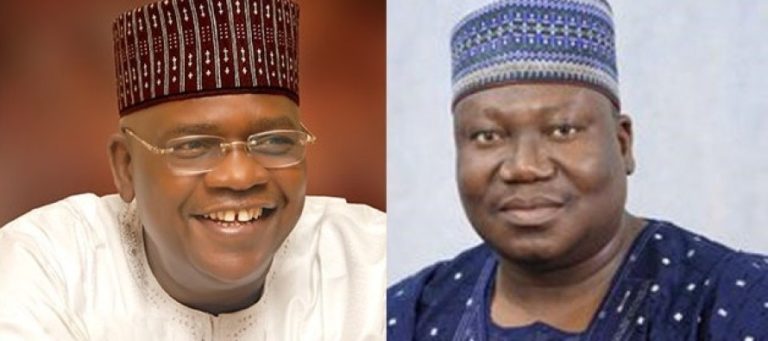
Former Governor of the old Borno State, Mohammed Goni, who was among the defectors, said he defected from the PDP to join the APC due to respect he has for President Muhammadu Buhari.
Goni, who governed old Borno from 1979 to 1983, said his defection was also informed by the achievements of the president, particularly in the area of security as relative peace had returned to the northeast.
Goni, who was also PDP governorship candidate in 2011 general elections, said: “I know the President very well; I was the council Secretary when he was Governor of North-East. He is a performer.
“We want the President to continue, we don’t want him to go because if he goes, the insurgency will not end, if a new person comes, the process will start all over.
“The way he is handling that problem now, shows he is energetic and committed to the course.
“ So, he needs time to consolidate what he has done. It is important to keep him in office for two consecutive terms.’’