Home Blog Page 2593

Revealed: Foreign media promoting disintegration of Nigeria through falsehood, malicious reports—CISS

0

The Centre for International and Strategic Studies (CISS) has accused foreign media of propagating falsehood with the sole motive of tearing the country apart.

The think-tank, dedicated to conflict research in developing countries, made this conclusion after examining the Boko Haram insurgency and then exploring the possible factors behind its continuous existence.

In a detailed report titled “Foreign Links and the weaponization of falsehood against Nigeria and humanity” signed by Country Representative, Ifure A. Ifure (PhD), on Thursday, CISS analysed the role of foreign media in furthering insurgency.

As part of its fact-finding mission, the Centre undertook a study tour of the theatre of operations in North-East with particular reference to strategic places and institutions which dominated the narrative on the war since inception in 2009.

Among others, the think-tank observed that “ the Boko Haram narrative as propagated in the media by some external links is an attempt to label the administration of President Muhammadu Buhari as incompetent and lacking the political will to handle the crisis in the North East region.

“ It also observed that the use of propaganda by the Boko Haram terrorist is one of their principal weapon of war against the Nigerian state and in connivance with select international news mediums such as AFP, Reuters, etcetera.”

The group reckoned that in an “attempt to elicit cooperation from locals, the NGOs often promise groceries and money to anyone willing to speak against the Nigerian Army in operations, and forcing them to make false allegations of rape, deprivation, brutality, and other vices.

The team was able to identify that the bulk of the news emanating from most of the foreign media on the state of affairs in North-East Nigeria are outright falsehoods with the intent to cause a distraction to the Nigerian troops and to further the activities of the Boko Haram terrorists in operations in North-East Nigeria.

On completion of this exercise and in a bid to avert further foreign interference, the Centre recommended that the Nigerian authorities must:

“ Begin the process of auditing the credentials of the international NGOs in operations in North-East Nigeria to identify those that are carrying out espionage activities on behalf of some foreign interest that want to see to the disintegration of Nigeria.

“ Rise up to curtail the agenda of some vested international interest who by their proxies have launched a campaign of defamation against the Nigerian Military as evident in adverse reports, news stories, articles, documentaries been projected by these group with a vested interest in seeing to the advancement of the activities of Boko Haram in North-East Nigeria.

“ Attempt to take charge of the narrative on the state of affairs in North-East Nigeria by embarking on a massive awareness campaign to expose the spread of falsehoods by foreign interest group who are unhappy with the successes recorded by the Nigerian Military in its operations in North-East Nigeria.

“ Criminalize the spread of falsehood (fake news) on the Boko Haram conflict by any foreign media organization in operation in Nigeria, as well as their accomplices regardless of their nomenclature.

“ Devise a means to keep the citizens abreast of the activities of the Nigerian Military in North-East Nigeria. This is on the heels that a failure to dominate the narrative might give the foreign interest groups the edge in furtherance of their goal, which is to advance the cause of Boko Haram.

“ Closely monitor the activities of the international NGOs in operations in North-East Nigeria, as there is an abundance of pieces of evidence that most of them are working against the interest of Nigeria.”

War on Insurgency: Terrorists fleeing to North and Central Africa – Army

0

The Nigerian Army says a massive exodus of criminals out of Lake Chad Tumbus to North and Central Africa sub-regions has been observed consequent on the combined onslaught on the identified hideouts of elements of the criminal elements of bandits and erstwhile Boko Haram/ISWAP fighters by our troops and the Multi-National Joint task Force MNJTF, at the fringes of Lake Chad region.

Credible reports from very reliable sources particularly among residents have indicated massive movements of the criminal groups out of the area towards Sudan and Central African Republic as a result of successful artillery and aerial bombardments of their settlements and as the heat of the onslaught is becoming unbearable.

The mass movement for their lives the Army say was necessitated following the sustained air and artillery bombardments by the Nigerian Armed Forces and Coalition forces of the MNJTF, which killed uncountable erstwhile Boko Haram/ISWAP fighters and destroyed their weapons and equipment.

In a statement the Acting Director of Army Public Relations, Col Sagir Musa said the various national troops and the MNJTF are maintaining aggressive patrols and blocking positions against infiltration by the escaping criminals.

”It is important to note that most of the Tumbus are located along the Quadrangular borders of Cameroon, Chad, Niger Republic and Nigeria.

”To further annihilate the fleeing terrorists, efforts are ongoing for continued shelling, bombardment and pursuits. Similarly, the countries in these sub-regions have also had been contacted through the MNJTF HQ.” He added

Disregard any news of panic in Maiduguri – Army

0

…Says city Remains Peaceful and Calm

The Nigerian Army has described information circulating on social media of ‘terrorists’ plan to execute deadly attacks on some selected populated areas and key facilities in Maiduguri town and neighboring areas as an attempt to cause panic within the metropolis by mischief makers.

In a statement, Deputy Public Relations Officer for the Theatre Command, Operation Lafiya Dole, Col Ado Isa while assuring the public that necessary measures have been put in place to checkmate the purported evil plans of the criminals, urged residents to go about their normal businesses.

Col Ado added that troops in the Theatre, have been committed to ensure movements and activities of the marauders are effectively thwarted.

”Troops are also in staging positions in line with the Super Camp Concept to destroy the bandits whenever they are seen.”

He called on members of the public to disregard the rumor of ‘deadly attacks’ on Maiduguri and environs.

”The fake news is circulated by mischievous elements and other collaborators of the criminals with the aim to instil fear and panic in the minds of the people as well as to sabotage the efforts of the military and other security agencies in the struggle to end the menace.” He added.

He equally called on the public to be more vigilant and report unusual/suspicious presence or movements of persons especially at important public places like markets, schools, mosques and churches as well as venues for occasions to security agencies.

General Buratai And Onwubiko’s Confession Before Damascus

0

By David Onmeje

“I hereby second the motion by General Buratai that the media plays the role of key stakeholders in the protection of our national security interest,” –Emmanuel Onwubiko, Head, Human Rights Writers Association of Nigeria (HURIWA)

I believe, the name Emmanuel Onwubiko has a household flavour in Nigeria. He prides himself as a media practitioner, social commentator, human rights critic and campaigner for social justice. From his vintage position as Head, Human Rights Writers Association of Nigeria (HURIWA), Onwubiko has churned out a dozen articles in the exposition of the human rights dilemma in our country, especially as it relates to the security agents burdened with ensuring public law and order as well as protection of lives.

This critic’s pen is acerbic and flows with a bile ink. His ink is particularly dripping “crazily” on the Nigerian Army’s (NA) handling of counter-insurgency operations and other violent insurrections in the country. And I think, this is not bad, because if leaders must be reminded of their obligations, the media must not shrink on its constitutional responsibility of acting as the conscience of the nation.

But I have no doubt and like echoed by Onwubiko a few days back, on national security threats, the media and its practitioners’ proclivities in practice should be amplified more in safeguarding the corporate unity and sanctity of national security. I have realized that often times, the knack and persuasions to scoop news or be deeply critical of every situation unconsciously dumps us into some damaging compromise of national security.

In my estimation, Onwubiko has been “guilty” on this score several times. It is evident in his ceaseless pen engagements of the Nigerian Army under the leadership of the Chief of Army Staff (COAS) and helmsman of the counter-insurgency operations, Lt. Gen. Tukur Yusufu Buratai over military’s operations, especially in the Northeast in the last four years.

And most times, his analyses in the media on Army’s confrontations with insurgents and insurrectionists leaves a bitter taste in the mouth and elevates the tendency to embolden these criminals and compromise national security. Onwubiko has authored scathing and persecutory articles against the operations of the Army such as; “Trump as ‘Poster Boy’ of Nigerian Army;” “ How Torture Diminishes Nigeria Army;” “Unresolved Atrocities of Python Dance;” and “The martyrs of Rivers polls;” among a motley of others. They are usually, very virulent in contents against the Army.

Quite discomfortingly, Onwubiko has been a strong, baseless critic of the Nigerian Army. And the snag many noticed in some of his outings was that in repeated instances, he resorted to defending certain positions considered inimical to public security interests or against the interest of Nigeria, as a nation.

His claims to human rights expertise sometimes compel him to re-write extant laws according to his feelings and not necessarily the spirit of the letter, which passes as defending armed criminals terrorizing Nigeria with violence and bloodbath. I might not be wrong by accusing him of being an ethnic bigot or a critic horned and incensed to defend the aberrations of ethnic cum religious warlords.

And he was dangerous, dragging his image and self-esteem into the mud by the senseless or illogical criticisms of the Army’s leadership by Gen. Buratai. His somewhat vindictive obsession with Gen. Buratai reminded me of former British Prime Minister, Margret Thatcher, who said sarcastically that; “If my critics saw me walking over the Thames, they would say it was because I couldn’t swim.”

At such times of Onwubiko’s absurd umbrage against the Army, I would only be consoled by the words of the American scientist, K Eric Drexler’s wit that “I’ve encountered a lot of people who sound like critics but very few who have substantive criticisms. There is a lot of scepticism, but it seems to be more a matter of inertia than it is of people having some real reason for thinking something else.”

Therefore, it was not a misplaced conception that many Nigerians who followed Onwubiko’s criticisms of the Army before now thought or believed he is easily available for hire to hit at anyone since he had the viable platform of HURIWA. I could sometimes be perplexed on how he derived some arguments and obstinately clung unto to it over non-existing issues.

And excitingly, one virtue anyone could never fault in Onwubiko is the tendency to lace his prose with quotes of great writers when he wants to be on the absurd track. And this unique prose style held his audience spellbound to the issues he espoused and convictions.

But the good news is that Emmanuel Onwubiko has repossessed his lost senses on national security and confessed the much the Army is professionally doing to ensure peace and security in Nigeria. I want to believe he has genuinely encountered Jesus Christ, as reflected in his recent write-ups about the COAS, Gen. Buratai. He can be pardoned even though it took him four years to see the leadership qualities in Gen. Buratai to venerate and fete him with enduring accolades today.

So, it has gladdened my heart that Onwubiko has become a strong crusader of support for the Army by the media. He is also backing, extolling or endorsing the sound leadership initiatives of Gen. Buratai as I quoted at the beginning of this article, which I lifted from his latest article titled, “Terrorists, Army and Media Glamour,” (published on September 17, 2019). For Onwubiko to concede to the same policies and actions of Gen. Buratai he had previously and virulently criticized can be likened to the Biblical story of Saul on the road to Damascus.

I am least in doubt that my esteemed colleague in the media, Mr Onwubiko has encountered the ideal light and his sane wisdom restored. And even if belatedly, I still congratulate him because there is no time that is too late to stand, recognize and defend the truth.

I invite you into Onwubiko’s changed mindset on the Nigerian Army with brief excerpts from another article titled, “General Buratai And His Chinua Achebe’s Card.” It has this submissive connotation and bows to the repressed truth on Gen. Buratai’s leadership of the Army these past years;

Therefore, Onwubiko wrote in the piece, “General Buratai And His Chinua Achebe’s Card;” that “Buratai played the Chinua Achebe’s card by calling a spade by its name and stating the obvious that the Army needs to carry out systematic re-orientation of the operatives and officer corps of the Nigerian Army so as to achieve service discipline and rid the institution of professional misconduct.”

He expatiated; “I call the leadership courage exhibited by the current Chief of Army Staff the Chinua Achebe’s card because the illustrious professor had in a very clear format stated the trouble with Nigeria and recommended that for Nigeria to get it right, we need to look at the leadership crisis.”

Like others, I am no less excited that Onwubiko has purged himself of his prejudiced and malicious criticisms of the operations of the Nigerian Army to embrace caution and truth, by canvassing the support of other Nigerians, especially the media to bolster the morale of Nigerian Army in safeguarding the ethos of national security. It has invoked in me the Biblical story of Saul on the road to Damascus as reflected in Acts 9: 1-4.

Nonetheless, I admire Gen. Buratai’s comportment throughout the period of the induced persecution. He never bothered about the distractions of a thousand Onwubikos because like the American businessman, Jeff Bezos said; “If you can’t tolerate critics, don’t do anything new or interesting.”

So, the leader of the counter-insurgency operations in Nigeria was rather stimulated into more determined actions’, exploring and breaking new grounds, with fresh war strategies and tactics in combating insurgencies. Buratai imbibed the wisdom of an English writer; Ella Woodward, who underscored that “Stay true to yourself, engage with your followers, and ignore the critics.”

Interestingly, with Gen. Buratai’s endurance and tolerance of bile criticisms from adversaries with malicious intents, he has been able to win the hearts of his adversaries. And this is what I know happens to a focused and truthful leader. Gen. Buratai’s fate is akin to that of King Solomon in the scriptures.

King Solomon faced similar persecutions; but when the time was ripe, angels and even his enemies all came together to accept Solomon as the wisest king. It is good tidings that Onwubiko has shamed his sponsors to now lauding the leadership qualities of Gen Buratai. It’s a sign of genuine repentance which is instructive and should not be taken for granted, particularly by our colleagues’ in the media he touchingly advised in his latest piece-, “Terrorists, Army and Media Glamour.”

Onmeje is a columnist based in the United Kingdom.

Boko Haram: France, allies warned over path with insurgents to undermine Nigeria

0

Save Humanity Advocacy Center (SHAC) has warned France to desist from its unholy union with members of the dreaded Islamic sect, Boko Haram to undermine the entity called Nigeria.

The group was reacting to a recent report by New York Times, which claimed the insurgents bought some sophisticated weapons from France.

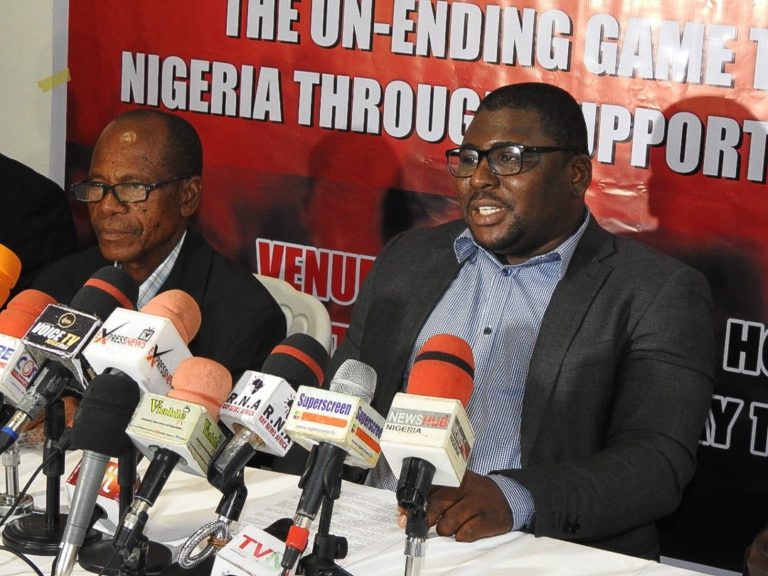
Addressing a news conference on Tuesday, Comrade Ibrahim Abubakar,
Executive Secretary of SHAC warned France and any country it may be using as proxy to prop up Boko Haram by using them as conduit to deliver arms and military gear to the terrorists to stop.

The group further urged the international community to ask France the pertinent questions before it becomes too late.

His speecb below.

Gentlemen of the press, you must have noticed the report that said Boko Haram insurgents have acquired sophisticated drones.

The reported hardware are presently capable of reconnaissance, intelligence gathering and spying missions. It is a matter of time before they escalate to using drones that are capable of carrying out attacks.

We find expedient to believe the report because it was widely syndicated by western owned media, which are known to run propaganda for Boko Haram in the past.

Their report of the drones acquisition came about the same time that there were reports from locals that the terrorists have started sporting new weapons in recent weeks.

In the past, the source of the weapons air-dropped to Boko Haram terrorists in Northeast of Nigeria has been established as patently French. It is something that has attracted outcry from the Save Humanity Advocacy Group in the past with the concern echoed by other individuals and organizations that became aware of the French treachery.

Let it be noted that in spite of the overwhelming evidence that indicted France it has not done anything meaningful to address its complicity in the distribution of instrument of death to terrorists for use against Nigerians. Even the arrest of French trainers among the terrorists has not moved French to own up to its negative role in the axis neither has it taught it to halt it subversive activities against Nigeria.

When this French involvement in arming Boko Haram was raised in the past France will sidestep the issues by sponsoring international NGOs and some media circuits to demonized the Nigerian authorities, especially the military and particularly the Nigerian Army. It is this practice that has again surfaced as the running commentary about the military being incapable of fighting the terrorists or that Boko Haram members have the upper hand over the Nigerian state.

The timing of the report about Boko Haram now possessing drones and even newer firearms curiously coincides with the announcement of a $1 billion regional effort aimed at combating terrorism in the West African Sub-region. These kind of reports coinciding with announcement of regional efforts have been pivotal to the demise of such efforts at fighting Boko Haram in the past.

The stories we are now reading means we will be seeing a repeat of previous patterns – Boko Haram will attempt hitting soft targets and occasional military targets that will not dare try now that there are Super Camps. These will then be followed by lopsided media campaigns that will first cast Boko Haram as the superior force and later present insurgents as victims of human rights abuses.

We are challenging France to tell the world who is responsible for arming Boko Haram in the past. The answer to this question of who supplied past weapons will signpost who to hold responsible now that the terrorists are getting drones that could strike any city of the world.

For this reason, we are imploring the world to ask France the pertinent questions before it becomes too late. Whether by default or by accident, it is a matter of time before Boko Haram tests the weapons France is arming them with on other nations, possibly in the west. Hopefully, by that time the world would not be in a quandary over who to hold accountable for such disaster should it unfold.

We use this opportunity to warn France and any country it may be using as proxy to prop up Boko Haram by using them as conduit to deliver arms and military gear to the terrorists. There are international instruments at the disposal of Nigeria to address the rascality being put up by those undermining Nigeria’s war against terrorism.

On its part, the Nigerian military must repeat the device blows it had dealt terrorists in the Northeast in the past. Eliminating the new threat posed by Boko Haram is crucial to the safety of citizens in Borno and other places. It must punish the terrorists with the same intensity that had made it impossible for them to overrun the country as planned by the countries secretly supporting them. It must continue with its strategy of Super Camps since this appears to be what has rattled the sponsors of Boko Haram to both increase weapons supply to the terrorists and to re-open the media front in the war.

The member states that have committed to the new funds to combat Boko Haram must break free of colonial loyalties, after all, no nation should continue tying itself to the apron strings of a nation that once postured as their conqueror. They should stand firm to the terms of the fund and make sure that all countries in the region make the place unconducive for terrorists and terrorist activities.

Super Camp, Boko Haram and the end of evil

0

By Kareen Goulding

Since 2009 when Boko Haram began its violent campaign against the state in Nigeria, it has been a tale of invincibility. The military authorities underrated their sophistication at the time, and this resulted in heavy casualties on civilian populations as well as troops who employed conventional war strategies in a war that is asymmetric.

I must add that the Nigerian authorities were dumbfounded as they could not phantom the way out of dealing with the threat posed by the terrorist group. So this trend lasted for an upward eight years, and with millions displaced and properties worth millions of naira destroyed in North-East Nigeria. The Boko Haram phenomenon posed a severe threat to the territorial sovereignty of Nigeria and consequently plunged North-East Nigeria in a humanitarian crisis that shook our very foundation.

I recall that various school of thoughts propounded theories that would curtail the activities of the terrorist group, but none seemed to provide that magic wand needed to turn the tide against the terrorist group. And they gained more grounds, so much so that they took control of over 16 local government areas in North-East Nigeria. They established caliphates and attempted to begin an inglorious regime of abductions, maiming and killings, rape, destructions, and other nefarious activities centred around crimes against humanity.

The then government of the day seemed clueless, and there was no solution in sight. And the monster of Boko Haram grew in phenomenal proportion. Nigeria was on the brinks, nowhere including the federal capital territory was safe with the constant attack on critical government infrastructures including the headquarters of the Nigerian Police Force, as well as the headquarters of the United Nations in Nigeria. It was such a sorry tale in Nigeria.

However, things began to look positive with the coming into office of the administration of President Muhummadu Buhari in 2015. I recall one of the first decisions taken was the relocation of the military high command from Abuja to North-East Nigeria, and it was followed with the appointment of service chiefs who were mandated to hit the ground running in the quest to bring the activities of Boko Haram terrorist to an end.

Many of us wondered then how such would happen with the level of grounds gained by the group as well as with the sophistication with which it operated that had left a huge demoralizing effect on the troops in the theatre of operations in North-East Nigeria.

I must confess that some of us had doubts on how this gargantuan task was going to be accomplished by a military that was highly demoralized and lacking the required weaponry to confront a terrorist group that was growing in sophistication daily.

When on 24th December 2016 news filtered in that Sambisa Forest, the operational headquarters of Boko Haram had been captured by Nigerian troops, the country leaped in joy. Even though in some quarters, the news was received with a pinch of salt, it was nonetheless true. This was a significant milestone in the war against terrorism in Nigeria, and since then, there has been no turning back. The Boko Haram group was left in disarray and attempted to employ other nocturnal means to regain control of their strong base, and that saw to the deployment of suicide bombings using women and children targeted at unarmed civilians. But again, the Nigerian Military was able to sustain the tempo with renewed vigour to the amazement of all the doubting Thomas’s.

The tide changed entirely, and there was hope once again that the threat posed by the terrorist group had been curtailed. And Nigerians celebrated this rare feat and urged the troops to do more. The political leadership of the country also provided that support by offering all that was needed to boost the morale of the troops.

The military leadership also led by example. The Chief of Army Staff was always in the trenches with the troops in a manner that was quite commendable. In my opinion, that was strategic in the sense that the troops were charged to give their best in defence of the country. And today, the successes recorded have been applauded in many quarters.

I must add that one of the things that caught my attention with the operations of the Nigerian Military is the deployment of operational strategies that were dynamic and yielded the required results in the war against terrorism in Nigeria. Amongst the avalanche of strategies introduced, the recent introduction of the Super Camp Strategy by Nigerian Military in the final onslaught against Boko Haram terrorist is indeed a masterstroke worthy of commendation.

According to available information, the Super Camp Strategy is such that has seen to the rapid decimation of the Boko Haram fighters. It was revealed that upon the realization that the Boko Haram terrorists were taking advantage of rural communities to strategize and launch attacks on military formations in North-East Nigeria, the military hierarchy designed the Super Camp Strategy that involves the setting up of military camps in remote communities across North-East Nigeria. This was aside the various army formations already in place.

The idea is indeed strategic that it gives the remnants of Boko Haram fighters little or no opportunity to move freely and to pass in between static defence location. And the result has been phenomenal with heavy casualties inflicted on Boko Haram remnants.

I am elated with the final defeat of Boko Haram terrorists and must give credit to the gallantry exhibited by the Nigerian Military. I believe that Nigerians must indeed doff their hats for the efforts of the Nigerian Military in defeating Boko Haram in Nigeria. This is on the heels that those in positions of authority made a lot of sacrifices.

The introduction of the Super Camp Strategy has proven to be effective in the war against terrorism in Nigeria. Nigerians must indeed come to terms with this reality and extend their support to the operations of the Nigerian Military.

Credit must also go to President Muhammadu Buhari for standing by his words to do everything within his powers to ensure that no Nigerian territory is under the control of Boko Haram terrorists. And to the leadership of the Nigerian Military for exhibiting a high sense of patriotism in protecting the territorial sovereignty of Nigeria. The fighting troops that have laboured day and night also deserve our commendation. I think that a cue must be taken from this sense of dedication and commitment to duty as exhibited by the Nigerian Military. And if that is the case, there would be no stopping Nigeria in our quest for greatness.

Goulding wrote this piece from the UK.

Missing N400million: Army begins General Court Martial to try Major General Hakeem Otiki, GOC 8 Division

0

By Lawrence Audu

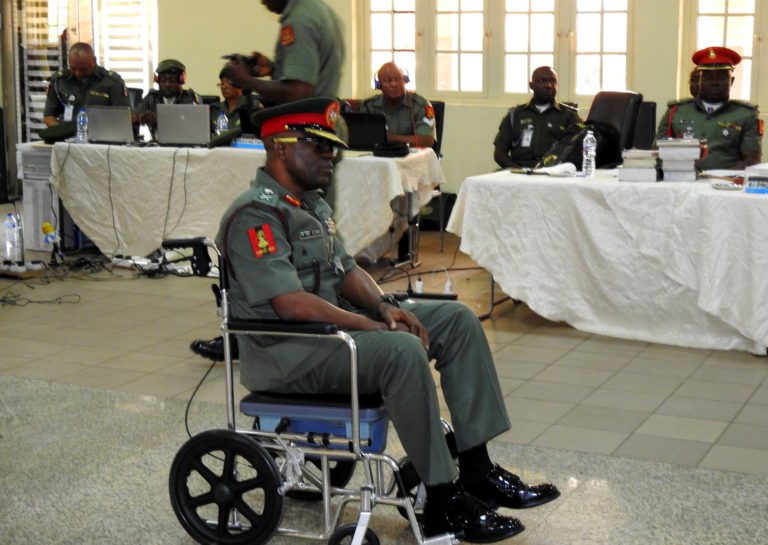
The Nigerian Army has commenced court-martial of former General Officer Commanding (GOC) 8 Division, Maj. Gen. Hekeen Otiki, for alleged diversion of N400,000 million security funds.

The Court Marshal which commenced Tuesday at the Command Headquarters Officer Mess, Asokoro, Abuja is being led by Lt. General Lamidi Adeosun, the Chief of Policy and Plans at Army Headquarters, and seven other Major Generals as members while Major A. Mohammed is the Judge Advocate.

The members are Major General AA Tarfa, Commander Training and Doctrine Command (TRADOC), Major General John Malu, Commander, Nigerian Army Engineering Corps, Major General CT Olukoju, Director General, Nigerian Army Land Simulation Center, Major General CC Okonkwo, Special Adviser, Nigerian Army University, Biu, Major General Aguguo, Chief of Transformation and Innovation, Nigerian Army and Major General M Mohammed, former GOC 1 division, Kaduna.

While the prosecuting counsel is led by Major JS Obot, he is supported by Major I Suleiman, and Major Orumo.

The defence counsel for Major General Otiki has Barr Okechukwu Ajunwa, supported by Major Femi Oyebanji retired and Mr Ishaq Adekunle.

Disclosing the convening order for the General Court Martial, Lt. General Adeosun said, “I Lt. General TY Buratai, by the powers conferred on me as the Chief of Army Staff, Nigerian Army, and pursuant to Section 131 Sub Section 201 of the Armed Forces Act, Cap 20, Laws of Nigeria 2004, hereby convene this General Court Martial to assemble at Army Headquarters Command Mess, Asokoro, Abuja on 17th September 2019.

The President said the proceedings will be guided by the Federal Republic of Nigeria Constitution 1999 as amended, the Armed Forces of Nigeria Act 2004, the Evidence Act, the Holy Bible, the Holy Quran and relevant authorities.

Boko Haram: Who is afraid of Super Camp Strategy?

0

By Richards Murphy

I was jolted out of my seat when I read the story published by Reuters titled ‘Islamic State fills the void in Nigeria as soldiers retreat to ‘super camps”. I imagined how such a piece laced with outright mischief, and illogical conclusions would have passed editorial integrity and certified fit for publication.

As a start, the whole concept of the Super Camp Strategy launched by the Nigerian Army was deliberately presented to picture a situation where troops would leave communities they hitherto protected to form clusters somewhere in a bid to avoid or minimize casualties. While this misrepresentation of fact can be stated to be uncharitable, it further reinforces the conspiracy theory that stated that Boko Haram/ISWAP fighters are receiving support from external sources, as well as the deplorable role most international NGOs are playing in the theatre of operations in North-East Nigeria.

I say this because the Reuters story quoted sources from the international NGOs in operation in North-East Nigeria and they based their judgment on what was availed them, which in my opinion is the height of unprofessionalism and unbecoming of a news medium such as Reuters.

It is more challenging to come to terms with the fact it was stated that the army’s withdrawal into large bases has coincided with a string of insurgent raids on newly unprotected towns and has left the militants free to set up checkpoints on roads as they roam more freely across the countryside. The first question is, were they referring to any part of North-East Nigeria or a neighbouring country? Because I am at a loss, just like the generality of Nigerians as to why anyone or organization would want to adopt a strategy such as the one advanced by Reuters in areas that it has complete control over. It is tantamount to leaving the comfort of one’s bedroom and taking solace elsewhere.

This is quite worrisome and somewhat an insult to our sensibilities as a people in Nigeria when foreign media organizations come in and scoop half-truths from their accomplices masquerading under various humanitarian nomenclatures in an attempt to unsettle the efforts of the Nigerian Military in the fight against terrorism in Nigeria mainly when successes are recorded and Boko Haram/ISWAP fighters retreating to the fringes of the Lake Chad Basin region.

This in my considered opinion is the height of mischief, and unsuspecting members of the general public must disregard it because, since the introduction of the Super Camp Strategy by the Nigerian Army in the fight against terrorism in North-East Nigeria, Boko Haram/ISWAP fighters have suffered heavy casualties as rightly reported by reputable news mediums in Nigeria.

The Super Camp Strategy is not a situation where troops would withdraw to “super camps” that can be more easily defended against insurgents as stated by Reuters. Instead, the Super Camp Strategy is one that is designed to create military presence everywhere in villages and localities of the troubled areas of Borno, Yobe, and Adamawa states.

I recall in a parley with members of the Borno Elders Forum, the Theatre Commander, Operation Lafiya Dole, Major General Olusegun Adeniyi, stated that the Super Camp Strategy will ensure fast mobilizing, quick reaction and more extended reach at tactical level, combined with the striking power of the Air Taskforce to see that the days of Boko Haram moving freely and passing in between static defence location is over.” Also, true to his words, the introduction of the Super Camp Strategy has seen to the presence of troops in places such as remote communities, unlike in times past where soldiers were stationed in military bases.

If the Super Camp Strategy is not a brilliant one, I don’t know what else to call it. And my guess is that those that do not want an end to the Insurgency in North-East Nigeria are those behind the Reuters story, and it is such a shame that Reuters with all its years of journalism would condescend so low to tow this dishonourable path.

This is on the heels that activities of international NGOs operating in North-East Nigeria have been suspect. For them, the war against terrorism in North-East Nigeria should not come to an end so they can continue to justify their stay in Nigeria as well as funding for their operations. This is aside from the fact that it has been speculated in some quarters that most of these NGOs are involved in espionage activities for the sponsors of Boko Haram/ISWAP terrorists.

In all of these, one thing comes to my mind, and it is the fact that with the introduction of the Super Camp Strategy, the end of Boko Haram/ISWAP is in sight, and this fact is not going down well with a group of actors and as such all must be done to discredit in its entirety. But again, would this new offensive against the operations of the Nigerian Military work? Would the Military hierarchy succumb to the Reuters blackmail?

Your guess is as good as mine. I believe that all must be done by the military hierarchy to sustain the tempo in its operations in North-East Nigeria, with regards to the Super Camp Strategy. And less I forget to mention that the Super Camp Strategy involves two critical components, which is taking the fight to the enemies in their domains and a routine introduction of counter-insurgency strategies that always takes the Boko Haram/ISWAP fighters unawares as against what was obtainable in the past.

At this point, the likes of Reuters and its accomplices should adopt another strategy in their attempt to mislead members of the unsuspecting general public. The attempt at discrediting the Super Camp Strategy is feeble in its delivery. And those afraid of the end of Boko Haram/ISWAP should do the needful, which is to pack their belongings and leave Nigeria, instead of the futile attempt at distorting facts.

Murphy is a security expert based in Calabar.

T.Y Danjuma, Governors, others perpetrate evil under farmers-herders’ crisis to undermine Buhari presidency – Ex-Senate President Ebute

0

By Lawrence Audu

Third Republic Senate President, Chief Ameh Ebute, has accused some respected politicians, serving governors and elder statesmen of leveraging on the Famers-herders’ clashes to discredit President Muhammadu Buhari’s administration.

The highly-revered ex-lawmaker made this known in a paper presented at a One Day International Conference on Good Governance and Accountability in Government organised by the Coalition for Civil Society Organizations for Change and Good Governance on Tuesday in Abuja.

In his piece titled “Appraising 100 Days of President Buhari on the saddle and building a nation where justice shall reign”, Chief Ebute gave an honest assessment of the president’s second term thus far.

According to him, out of desperation for power, certain well-known politicians have either taken to sponsoring violence or simply turned blind eyes to clashes around them for their selfish gains.

In the forefront, as stated by Mr Ebute, is former Defence Minister, LT Gen TY Danjuma (Rtd) who he claims has surprisingly remained mute despite the farmers/herders in his state, Taraba, because those affected are not from his ethnicity.

The former number 3 citizen also fingered the opposition of fuelling the wave of violence, going as far as allegedly sponsoring the Islamic Movement of Nigeria (IMN) – thus keeping to their vow to make the country ungovernable for Mr Buhari.

Despite these conspiracy, however, Chief Ebute hailed the pesident for remaining resolute and focused, holding firm to his transparent and accountable ideals.

While admitting that the positive signs points towards path to greatness for the country, the ex-Senate President urged Nigerians to embrace the excellent governance philosophy of Mr Buhari.

Read excerpts from the paper below:

It is no longer a secret that the various security challenges facing Nigeria predate the Administration of President Muhammadu Buhari. It is on the heels that before 2015, there has been insinuation in certain quarters about the sponsorship of violence as a means of achieving political, religious, and ethnic goals by elite politicians.

These politicians whom in some instances are referred to as senior citizens or elderly political leaders have exploited ethnic and religious clashes to their advantage. A good example suffices in Taraba state where a former minister of Defence is silent over the killings in Taraba state because those being killed are not from his ethnicity.

The Taraba state killings raise the question as regards the sincerity of heart and of the purpose of supposed elderly political leaders in Nigeria who have been exploiting situations for their personal and selfish gains. They turn a deaf ear if the victims of such nefarious activities are not from their ethnicity and also feign ignorance if their kin perpetrated acts of violence. When factions of political elites compete for political power at the national level based on identity, groups emerge at the subnational level in Defence of these identities.

Also, those that lost in the 2019 general elections in Nigeria have vowed to make the country ungovernable, and this explains why despite the efforts of government, some of these issues won’t go away. I believe that they intend to cause the disintegration of Nigeria and to paint a picture of incapacity before the eyes of the international community.

Nonetheless, some of us conversant with the dynamics involved in the contemporary Nigerian society would readily attest to the fact that the killings and kidnappings, as well as the rise in cases of armed banditry, is as a result of what members of the opposition have plotted thinking that Nigerians would be gullible.

They have deployed huge resources to make the country ungovernable, they have also engaged the services of both local and international media to escalate issues to their advantage, not minding the consequences of their actions.

They have also adopted a negative narrative in the clashes between farmers and herders. In the wisdom of members of the opposition, the farmers-herders conflict must be construed in such a way that would make the citizens lose faith in the present Administration. While this is not only despicable, it is also an indication that those that failed to actualize their political ambitions at the general elections have refused to move on with their lives. However, instead, they have chosen this dishonourable path of fuelling ethnic and religious conflict aimed at distracting and destabilizing and distracting the Administration of President Muhammadu Buhari.

Most politicians hide under cover of farmers-herders’ crisis to perpetrate evil in the society. They arm and sponsor militia groups to wreak havoc. This much has been witnessed in situations where there has been a hasty ascribing any form of crime or criminality to a particular ethnicity or religion.

For example, we have seen situations where people from southeast Nigeria have been arrested masquerading as herdsmen after committing a crime or engage in any criminal behaviour. I also recall a particular episode that happened in Ghana, where a Nigerian man was arrested after killing three persons. He claimed to be a Fulani herdsman but couldn’t speak Hausa or pronounced a word in Fulani.

That is the irony of the situation we face as it stands today. People are masquerading under different umbrellas to perpetuate evil and passing the blame on ethnicity or religion, which would ultimately lead to reprisal attacks on innocent people going about their normal businesses. The cases presented in the Benue-Taraba axis gives us a hint on how the political elites have continued to exploit the situation for their benefits.

The political elites understanding the gullibility of their subjects have formed the habit of taking advantage of communal clashes to paint a particular ethnicity or religion in a bad light just in an attempt to be able to perpetuate their nefarious activities thereby causing unrest in the polity.

It is most worrisome that in a state like Taraba, the government would choose to play petty and feign ignorance to the monster they created. I am particularly pained that a personality such as Lt. Gen. Theophilus Danjuma would condescend so low as meddling in petty politics despite what he has benefitted from Nigeria.

The likes of Danjuma and his cohorts have indeed shown that they do not have the interest of the country at heart. This is also on the heels that some CSOs have been able to expose the fact that a high ranking member of the opposition is behind the wave of violent protests by members of the Islamic Movement in Nigeria (IMN) with huge sums of monies.

While I consider such acts as despicable, I am gladdened with the fact that Nigerians didn’t sell their birthrights for a plate of porridge. Indeed, Nigerians were wise when they cast their votes for integrity, accountability, and transparency. If the reverse has been the case, I am sure there would have been no country called Nigeria today due to the wickedness of these individuals parading themselves as elder statesmen.

I believe that the traditional rulers must rise to the challenge instead of blaming the table of President Muhammadu Buhari. They must understand the dynamics involved in the farmers-herders’ crisis and realize that it is merely the act of political elites manipulating the system to their advantage, and at the detriment of peace and tranquillity in the system.

A good example can be seen in Zamfara state where peaceful engagements and collaboration with security agencies have helped to tame the nagging problem of insecurity. Also, the South-West Governors have been holding meetings on how to support the security agencies to address the insecurity situation.

However, some governors who have exhibited a high level of incompetence are still bent on passing the blame on President Muhammadu Buhari, whereas they are the Chief Security Officers of their respective states and they draw security votes every month.

The democratic experience in Nigeria has not come without its challenges. Some of us have witnessed Nigeria in its lowest, so much so that we feared for the worst to happen. However, our hopes were rekindled with the advent of the Muhammadu Buhari led administration, which by all standard is a worthy example of accountability and transparency in governance.

Nigeria indeed got it right in 2015, as well as 2019 with the way and manner the government has carried on since then. So in this context of this conference, which is the first 100 days in office of President Muhammadu Buhari, I am convinced to say the foundation for economic growth has been laid.

As an elder statesman, I have witnessed administrations in Nigeria, and I dare say that the level of commitment displayed by President Muhammadu Buhari in the governance of Nigeria is equal to none.

The first 100 days in office of President Muhammadu Buhari is filled with hopes for Nigeria. All the critical sectors of the economy are receiving the required attention, and it is sufficing to say that President Muhammadu Buhari has indeed displayed an unalloyed commitment to the growth and development of Nigeria and as such it behoves on all well-meaning Nigerians to lend its support to this Administration in its quest to building a country of our dreams for this generation and generations to come.

Civil society organizations (CSOs) are often assumed to be institutions that facilitate communication between citizens and policymakers. However, CSO advocacy is only as effective as the space allowed by the government, the resources available from funders, and their internal capacity.

Emerging trends point to the fact that the Muhammadu Buhari led Administration has indeed highlighted to Nigerians that when there is a will, there would always be away. This much the Administration of President Muhammadu Buhari has displayed in the first 100 days in office.

This is noteworthy that despite the conspiracy to paint the Administration of President Muhammadu Buhari in a bad light, the high level of transparency and accountability displayed has indeed negated the plot to make the country ungovernable.

The first 100 days in office of President Muhammadu Buhari has indeed proved to Nigerians that indeed Nigeria is on the path of greatness. I cannot but align with the vision and mission of this Administration, and I encourage the generality of Nigerians to do same because never in the history of Nigeria have we experienced such display of sincerity of heart and purpose and a rare demonstration of commitment to the advancement of Nigeria as a country.

The leaders and the led should embrace the excellent governance philosophy if development administration is to meet the underlying rationale it stands for. Both the leaders and the led have their roles to play to embrace good governance and strengthen development administration. Highly developed nations can attest to the promotion of national development through the application of good governance in their development administration.
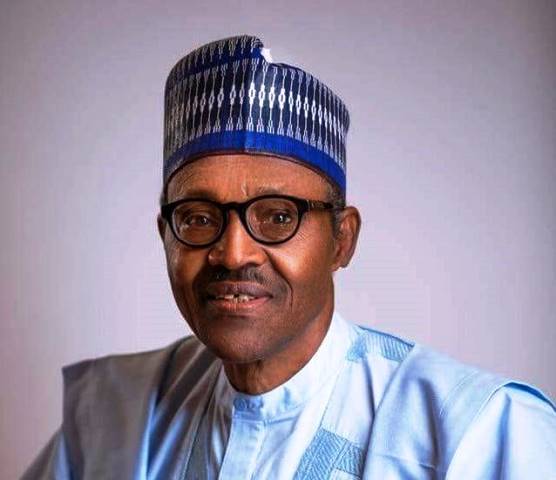
President Buhari’s First 100 Days: A Nigerian Scholar’s Perspective

0

By Prof Pita Ogaba Agbese

One American that has been copied by many other countries is to assess a new administration’s performance after its first 100 days. By itself, there is nothing magical about the first 100 days. Nor is the number, 100, sacrosanct. Nonetheless, the logic behind assessing the performance after the first 100 days is that the tenor, the zeal and the overall direction of how the administration would perform for its entire term can be gauged from how it has fared in its first 100 days.

For political leaders like President Muhammadu Buhari who get re-elected, one can assess not just their first 100 days in office but a reassessment of their performance in their first term and to evaluate the what amounts to a second first 100 days against the background of their performance in their term in office.
President Buhari went through a rigorous re-election campaign. He won convincingly. He won both on his performance in his first term and his promise to take Nigeria to the “Next Level.” What do the first 100 days tell us about the trajectory of the Next Level? What can and should Nigerians expect in the next four years from the Buhari administration? Can we use the first 100 days to get a glimpse at what Nigeria would look like four years from now?

As was the case in 2015 when Buhari was first elected, his administration in the second term, was off to a slow start. Ministers were not immediately appointed as many of us had hoped and expected. Even after the ministers had been nominated, it took several weeks before portfolios were assigned to them. Now, the ministers are in place and the business of governance has started in earnest. Many of these ministers are going to be met with enormous difficulties. Take the state of roads for instance. As usual, the rainy season is upon us and that means that many roads in Nigeria are virtually impassable. Recognizing this, the administration is seriously committed to improving the conditions of our highways by repairing roads and building new ones but it seems, given the enormity of the tasks, that more efforts have to be made to create more conducive driving conditions on our roads. The administration must be commended for what it has done so far on this score but the more must be done.

Insecurity, particularly in terms of kidnapping for ransom and armed robbery, continue to be a major issue in Nigeria. Although Boko Haram is still able to launch sporadic hit and run operations, its ability to maintain arduous and sustained attacks has been seriously degraded. The Buhari administration deserves a high commendation for taming the menace of this bloody terrorist group. The police and the armed forces are doing much to curtail insecurity in its many manifestations but it is clear that the first 100 days of President Buhari’s second term have been very challenging on the security situation.

The war on corruption seems to maintain its tempo although the administration lost a few high-profile anti-corruption cases in the first 100 days. Some more recoveries of the stolen commonwealth were made and the administration must be applauded for this. I urge the administration to use proceeds from recovered assets to building infrastructure or providing some other visible means of showing the public that recovered assets are being put to use to improve the welfare of Nigerians.

Unemployment, particularly among young people, is one of the most difficult tasks in the Nigerian economy. New employment initiatives must be designed to reduce the scourge of unemployment. The administration’s commitment to raising and paying the new minimum wage must be fully acknowledged.

Bumper agricultural harvests have been recorded in many sectors of Nigeria’s agriculture. Consequently, the prices of foodstuff continue to decline. The tempo of local production of foodstuff and the curtailment of food imports must be sustained. The administration has doggedly pursued the goal of increasing local production of foodstuff and it appears that sustained local production of agricultural products will be one of the most important legacies of the Buhari administration.

All in all, if the first 100 days are anything to go by, we should expect a much better Nigeria by the time President Buhari finishes his second term. It will be a less corrupt Nigeria. More Nigerians will be gainfully employed. Stealing of public money would no longer be a directive policy of the government. New and better roads and railways will be constructed. Insecurity will be greatly curtailed.