Home Blog Page 2590

Buratai: Nigerian Army’s Symbol Of Discipline

0

By Nkechi Odoma

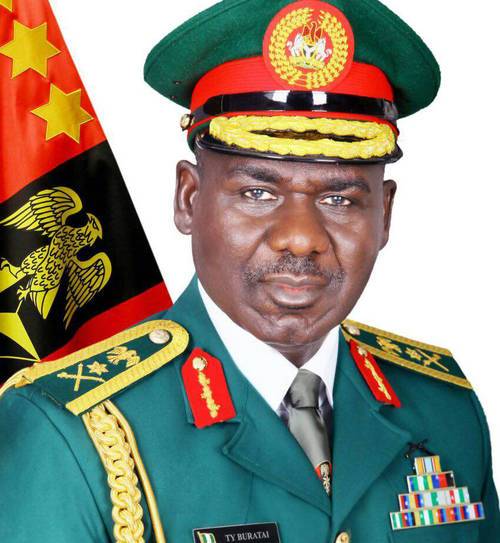
The office of the Chief of Army Staff ( COAS) is powerful anywhere by every yardstick of perception. The occupant of the exalted office, and in the case of Nigeria now, Lt. Gen. Tukur Yusufu Buratai who wears a second heavier badge as leader, counter- insurgency operations is an influential personality by all standards.

As Nigeria’s number one soldier, the COAS wields enormous powers both within and outside military circles. And in the age of perennial and festering insurgency in Nigeria, Gen. Buratai ought to have been egoistic as Nigeria’s most priced warrior or man of valour.

Others in his position would have been prancing the Nigerian space with panache, haughtiness and magisterial aura for decimating and significantly crumbling Boko Haram insurgents. It is an uncommon feat.

And it is the experience of Nigerians with most previous occupants of the esteemed office of COAS, even when they have nothing to show as positive results for the war against terrorism. But such officers usually have enough pride and prompting for showmanship.

But Gen. Buratai’s humility, discipline and simplicity is remarkably unparalleled with some of his professional colleagues, including those of lesser status. He is always in control of himself in decency; he does not allow the aura of his exalted position usurp and suspend his senses as evident in his public outings and interactions with soldiers, and Nigerian public consistently.

He is grandiose in thoughts and calculative in actions. For ages, the people knew, an average Nigerian soldier is traditionally brash, brutish, fastidious, beast-like and permenantly callous. But even as the leader of Nigerian Army, Gen. Buratai is the direct opposite of the aforementioned traits.

Although a crack soldier, rugged and rough in the trenches, but the Army General and leader of counter-insurgency operations in Nigeria is unassuming, amiable, honest, blunt and a level-headed team player. He walks into a public place and departs unannounced, unlike other high-profile personalities.

And right from childhood, Gen. Buratai imbibed the virtues of discipline, self-esteem, hard work, truthfulness and preseverance. He has nurtured and grown up with these qualities. A strict soldier to a fault, Gen. Buratai is a stickler to excellence, timeliness and obligations he covenants with people.

These personal principles have endured in Buratai throughout his military career. They have been his source of nourishment especially when he began holding leadership positions in the Army. For years, he commanded the several special operations launched against militants in the Niger Delta. And thereafter, he participated in United Nations Observer Missions/assignments in Angola and elsewhere in the world, emerging with worthy medals in virtually all instances.

Therefore, upon his appointment as the COAS, by President Muhammadu Buhari in 2015, Gen. Buratai met an Army that was unprofessional, undisciplined, disloyal, unpatriotic and frustratingly weak. It is mild statement to say, he inherited an Army was in complete disarray.

Many may hate to recount, but it was a national shame and disgrace that Nigeria had an army that faltered before Boko Haram insurgents or shirked womanishly in the frontline of battles with terrorists. Buratai knew, an effeminate Army was the worse thing that could ever happen to a country.

Instantly, Gen. Buratai realized at once that a burden has been placed on his head to rebrand the Nigerian Army into a professionally responsible and responsive institution worthy of a great nation like Nigeria. He had the daunting task of remoulding Army personnel to align with it’s core constitutional mandate of preserving, safeguarding and protecting the sovereignty and territorial integrity of Nigeria.

Gen. Buratai hit the ground running, by immediately touring Army Divisions and Formations throughout the country. The visits afforded him a platform of personal interactions with officers and personnel. He gathered firsthand information about their problems and afflictions.

There was no time to waste, as the fire of a raging Boko Haram insurgency need to be urgently extinguished. The Army Chief instantly solved interim problems afflicting the Army such as poor or lack of fighting equipments, unpaid or delayed salaries and allowances which dampened the spirit of soldiers in confronting terrorism.

Going forward, he introduced welfare schemes such as ownership of personal houses by soldiers in retirement, expansion of office and barracks accomodations, alongside renovation of existing Army establishments across the federation.

Gen. Buratai introduced reforms and innovations in the Army which were strictly anchored on discipline, loyalty, patriotism, hard work, transparency and honesty, as pathfinders, which morally, pyschologically and physically prepared the Army for excellence in the performance of it’s constitutional responsibilities.

These were achieved via training and retraining of Army personnel through workshops, seminars and scholarly courses in specialised military institutions. Gen. Buratai’s creed which is popularised and has become a singsong in the Army is strict adherence to oath of office, professional ethics and Rules of Engagement ( ROE) at all times, whether on Internal Security (IS) special assignments or battling the religious extremist sect, Boko Haram.

It is to Gen. Buratai’s credit that a reformed Nigerian Army is substantially complying with the defined operational creeds, as soldiers are aware of Buratai’s zero tolerance for professional misconduct. And soldiers also knows, he does not fail to punish erring soldiers each time one is found culpable.

The Army Chief’s aversion to soldiers human rights violations of Nigerians is infectious. Apart from ensuring a smooth Army/ civil relations, Gen. Buratai has established a Human Rights Desk at the Army Headquarters ( AHQs) and replicated same in all major Army Divisions for ease of access to members of the public with such complaints against soldiers.

Today, and through the perfect reorientation of the Army by Gen. Buratai, soldiers are now served court summons by civilians who have disputes with them. And they appear in court to defend their actions in accordance with laws of the land. This was impossible in the immediate past history of the Nigerian Army and alien in civil/ military interactions.

But notwithstanding the stiff discipline imposed on the Army by Gen. Buratai, there are a few bad eggs who deviate from the norms by violating the code of conduct or creed of professionalism as persistently trumpeted. It’s not in doubt that every institution or system has it’s share of deviants.

However, Gen. Buratai spares no one caught in the ring over any professional misconduct. He has been consistent in punishing every established infraction by any soldier, no matter his rank. Those who have tested and relished Gen. Buratai’s affection for his personnel, but rewarded it with engaging in professional misconduct usually encounter him at a sour point.

Recent examples would suffice and for instance, by end of 2018, the General Court Martial (GCM) sitting in Maimalari Cantonment Maiduguri, Borno State handed down different punishments to
five personnel of the Nigerian Army for various offences.

President of the Court Martial, Brig. Gen. Olusegun Adesina revealed that the offences hinged on cowardice, negligence, abduction and indiscipline.

So, Captain Alhamdu Kwasau was found guilty of cowardly behaviour and negligence while on military duty. He had his rank of Captain reduced to a Lieutenant with two years lost of seniority.

The second and third accused officers, Captain Jimen Babangida and Lieutenant Sanusi Bello were also found guilty of conduct prejudiced to service discipline and were punished variously by the GCM.

Also, Sergeant Aliyu Hassan and Lance Corporal Bello Nasiru were found guilty by the GCM on offences bordering on abduction or attempts to commit abduction and extortions. They were sentenced to as much as five years imprisonment on different counts, aside demotion in ranks.

Similarly, last week, the Nigerian Army arrested a soldier, Ajayi Johnson who allegedly shot dead a commercial motorcyclist Chimaobi Nwaorgu of Umuokereke-Ngwa community in Obingwa Local Government Area, of Abia State.

The acussed soldier has not only been b arrested, but detained and the disciplinary procedure of trial is in progress in accordance with extant military laws. And if found guilty, he will be dismissed and handed over to the police for civil prosecution.

Additionally and in some instances, Gen. Buratai has had cause ton dismiss soldiers who indulged in professional misconduct and compromised the integrity and tainted the reputation of the Army as an institution.

In 2016, at least 38 Army personnel deployed on election duty were dismissed from the Nigerian Army for professional misconduct, as a disciplinary measure to serve as deterrence to others. And when Nigerians saw the vehemence Senior Army officers resisted alleged financial inducements by the Rivers State Gov. Nyesom Wike to compromise the 2019 general elections in the state, it was a loud testimony of Gen. Buratai’s reformation and rebranding of the Army.

Therefore, there is no doubt that Gen. Buratai is the Nigerian Army’s shining portrait of discipline and mirror of excellence. His dream and efforts at making the Nigerian Army one of the best in the world is gradually coming to fruition with a drastic reduction in incidents of professional misconducts by Army personnel generally.

Nigerians must necessarily spot the thin dividing line between an individual bad soldier and the institution of the reverred Nigerian Army. Much as they are intertwined, but there are slight differences.

Odoma wrote this piece from Garki, Abuja

Sallah: North-East residents express joy over the peaceful celebration, wants other stakeholders to emulate Buratai, Nigerian Army

0

Residents of North-East Nigeria have expressed joy over the peaceful celebrations during the Eid celebrations. This much was gathered when our reporters visited communities in the various states in the North East. The atmosphere was calm with Muslim faithful’s going about their Sallah celebrations without fear from harassment and intimidation.

In the communities visited in Borno State, the resident expressed delight that the Boko Haram terrorist was not able to disrupt their festivities, unlike in times past where bombs would detonate in religious centres and other places where people are gathered. According to the district head of Baga, Mallam Shehu Garba, he stated that this year’s Sallah celebration was one of the most peaceful his community has experienced in recent years.

“It was an enjoyable and peaceful celebration for us as we went about our normal businesses. However, if not for the presence of the Army who kept watch over our community day and night, we were not sure of what would have happened, especially from the Boko Haram boys.”

He also stated that the Nigerian Army personnel stationed in the district assured them that there would be no disruption of the festivities. “Soldiers came to us days before the Sallah to ask for our support by reporting suspicious faces and movements and that they were on ground to foil any attempt by the Boko Haram boys to disrupt our celebrations. Also, true to their words, all went well, and we are very grateful to the Nigerian Army.”

In Maiduguri Metropolis, residents went about the festivities with excitement. A couple of people interviewed expressed satisfaction with the way and manner the Nigerian Army was able to prevent any form of disruption of the festivities by Boko Haram terrorists. Mallam Ali Goni, a tea seller, stated that for him, this is the most peaceful Sallah celebration he has witnessed in recent times. He said that people stayed out late into the night without fear.

“This year’s Sallah was very nice to all of us. We prayed to Allah to protect and save us from the hands of the bad people, and Allah did it for us. We also thank the soldiers who were patrolling everywhere from morning till night,” he said.

This same sentiment was expressed across other parts of the state where resident chanted “Sai Baba” when our reporter interviewed them. According to them President Muhammadu Buhari indeed gave them a perfect gift for Sallah by ensuring that there were no attacks by Boko Haram fighters or suicide bombers.

“President Muhammadu Buhari is a good man that has the interest of the masses at heart because there is nothing like peace of mind. You can have plenty to eat and drink, but without peace of mind, everything is useless. So we thank him for providing us with adequate security during the Sallah” says Alhaji Garba Gubio, the head of the tricycle operators in Maiduguri.

Mallam Ali Goni, a worker in one of the ministries in Borno state, commended the Nigerian Army for the display of professionalism throughout the duration of the festivities. He stated that if all critical stakeholders can maintain this tempo, then lasting peace would return to Borno state and its environs in good time.

“Most of us have come to understand if all stakeholders can lend their support to the Nigerian Army; the fight against Boko Haram would have been long concluded. However, again, the play of politics by some stakeholders are undermining the efforts of the Nigerian Army, and we believe that with time, these challenges shall be overcome.”

Similarly, in a chat with religious leaders in other parts of Borno State, they stated that the efforts of the Nigerian Army in ensuring that the Sallah celebration was without skirmish is highly commendable.

“The Borno State religious’ council is highly appreciative of the efforts of the Nigerian Army in ensuring that the Boko Haram insurgents did not thwart our Sallah celebrations and that no life was lost throughout the period.”

“This is one of the best Sallah celebrations for us in North-East Nigeria because people were not stopped from freely practicing their religion, there were no bomb blast, women and children were not kidnapped or harassed and no gunshots anywhere.”

The Borno State traditional council in its goodwill message to the people during the festivities appreciated the efforts of the Nigerian Army in the restoration of peace in the state and encouraged the hierarchy of the Nigerian Army not to relent in its efforts at ensuring that all citizens are protected at all times.

In a related development, it was observed that the Nigerian Army was present in almost all the communities in North-East Nigeria. Our reporter who visited select communities in Borno and Yobe state noted that personnel’s of the Nigerian Army were seen felicitating with locals during the Eid celebrations.

According to one of the officers interviewed, he stated that they were carrying out the directive of the Chief of Army Staff to ensure that they win the heart and minds of the local by feasting and interacting with them.

“What we are simply doing is an attempt at winning the heart and mind of the locals in line with the directive of the Chief of Army Staff. This is so because the use of force is not the only strategy for the war. You must have the locals on your side at all times, and this much the Nigerian Army has been doing through our cooperate social responsibility initiative.”

The officer also stated that as part of the CSR initiative of the Nigerian Army, there is a constant visit to liberated communities to assist those that have returned to settle down by helping in reconstruction work, the provision of amnesties such as water.

“The Nigerian Army has been fully involved in assisting returnees to liberated communities. As a fact, the Chief of Army Staff routinely visits these communities unannounced and away from the press to interact with locals as well as troops stationed in these communities.”

“This strategy has paid off for the operations of the Nigerian Army in the fight against Boko Haram terrorist as the locals are happy with our operations and provide information to us whenever they notice strange faces in their communities.”

In addition, a security expert, Dr. Chuks Obigwe has stated that the security situation in North East Nigerian can be improved tremendously if other critical stakeholders support and emulate the novel strategies introduced by the Chief of Army Staff in the operations of the Nigerian Army in North-East Nigeria.

“From reports we have gathered from the theatre of operations, it is just a matter of time before North-East Nigeria would be free from Boko Haram/ISWAP terrorist if the relevant stakeholders in International NGO, humanitarian organizations, agencies, and others lend their support to the Nigerian Army.”

“Worthy of mention is the need for these stakeholders to emulate the Nigerian Army in helping those that have returned to their communities to settle down to overcome their pains and begin their lives.”

Dr. Obigwe was also of the opinion that if others emulate the Nigerian Army, there would be no basis for Nigeria not to overcome its security challenges.

“As a first, the mind-set of those that have been affected by the insurgency in North-East Nigeria must be reoriented through constant interaction and acts of kindness in what the Nigerian Army through its CSR initiatives is doing in these communities.”

“I am aware that the Nigerian Army undertakes medical outreaches, assist in the reconstruction of houses and roads in these communities. This is very commendable, and if other stakeholders can do the same, substantial progress would be recorded, and Nigeria would be better for it.”

It would be recalled that the Nigerian Army recently launched a campaign of winning the heart and minds of those affected by the Boko Haram insurgency in North-East Nigeria by undertaking various Corporate Social Responsibility Initiatives in liberated communities in North-East Nigeria.

Buhari’s Decision That Changed Boko Haram Narrative

0

By David Onmeje

A South African adage says;” Even an ant can hurt an elephant.” So, on May 29, 2015, when President Muhammadu Buhari took the oath of office as Nigeria’s democratic leader, it was clear, his first, second and third immediate priorities centered on ending Boko Haram terrorism. It was not controvertible even to the blind that Boko Haram had repressed Nigeria and it’s security forces in conquerors might.

Buhari’s first official action was to order the Security Chiefs he inherited from the preceding administration to take the war to the doorsteps of the insurgents. He directed the instant relocation of the Command Theatre to Maiduguri, the epicenter of raging Boko Haram insurgency.

In his inaugural speech to the nation, President Buhari lamented how some small group of religious extremists who preached everything in negation to Islam amassed so much power and morphed from causing ” small fires, to big fires.” Apparently, President Buhari was pained that insurgents held the whole country to ransom, in anguish, sorrows, killings and other dehumanizing atrocious acts.

However, six weeks after he maintained the then Security Chiefs, they continued to exhibit the same and glaring incapacity to confront and subdue Boko Haram. A President, who somewhat concealed his indignation sacked all of them by mid July 2015 and calmly thanked them for service to fatherland.

He immediately announced a new set of Security Chiefs to commence the job of dislodging, decimating and defeating Boko Haram terrorists in order to free Nigeria from it’s pangs. The drastic change in the apex leadership of the military enthroned trusted and competent Military officers with proven track records of splendid service to the country.

Among the new arrivants on the leadership ladder of Security Chiefs was Lt. Gen. Tukur Yusufu Buratai. The hitherto unknown soldier, who hails from the obscure village of Buratai, in Biu LGA, Borno state, also ravaged by Boko Haram was named the Chief of Army Staff (COAS).

Perhaps, satisfied with his records of excellence and unblemish service over the years, President Buhari also crowned Gen. Buratai as leader of the counter- insurgency operations in Nigeria.

The choice of Gen. Buratai as COAS shocked many Nigerians because albeit, he had accomplished much in his military career, but was unnoticed. His lifestyle attuned more to the trenches than the urbanian display of sophistry as done by some military officers of his calibre.

Unknown to the hitherto “triumphant,” Boko Haram insurgents, in Gen. Buratai, President Buhari had silently packaged their nemesis and conqueror. Buratai’s colleagues in the military vouched for him as a dogged and relentless warmonger, military tactician and strategist in the famed shadows of Chinese war veteran, Gen. Sun Tzu.

Gen. Buratai’s first official conversation with Nigerians embodied the soothing message of decimating and defeating Boko Haram insurgents. And he gave time frames for reclaiming Nigeria from insurgents back to Nigerians. He was specific that by December 2015, Boko Haram would be completely decimated.

A Liberian proverb says; ” Good millet is known at the harvest.” And from Gen. Buratai’s initial actions, it was clear to discerning minds that this great soldier and chief armour bearer of counter- terrorism knows his briefs . It indicated he was quite familiar with the rudiments of battling insurgency having led the MNJTF as Field Commander.

Frighteningly, the tasks before Gen. Buratai and his troops were quite enormous. He was to lead troops to recover about 18 LGAs in the Northeast under the total control of insurgents with their headquarters at Gwoza and another seven others under the partial control of terrorists in the region.

Also, he was battling an insurgent sect which had spread horrendous atrocities to virtually every major city in the North, including Kano and Abuja, Nigeria’s FCT. Insurgents were also making incursions into the Southwest through Kogi state as transit camp.

Added to this burden, were the over 20, 000 Nigerians held hostage by Boko Haram in secret camps in the Northeast and the neighboring countries of Niger, Chad and the Cameroun republics, including the abducted Chibok schoolgirls. These Nigerian Boko Haram hostages yearned for freedom from captivity for reunification with their families.

Elsewhere in the Northeast, there was the problem of demystifying Sambisa forest, Boko Haram’s most fortified haven. It housed it’s most vicious leader Abubakar Shekau and other top commanders as well as some captives.

Boko Haram’s recruitment of innocently hypnotised youths as foot soldiers and charmed consecration of female suicide bombers was also rampant. These were the herculean tasks before Gen. Buratai and the Nigerian troops. Boko Haram regaled in destructive might each time it staged an onslaught on any community and often, for hours in gruesome killings, abductions and destructions. IDPs camps were filled to exhaustive limits of elasticity.

But Gen. Buratai convinced himself in the wisdom enunciated by a Ghanaian adage that says, “If there were no elephant in the jungle, the buffalo would be a great animal.” Thus, he personally led troops into the jungle of Boko Haram for the battles.

And sticking to his words, Gen. Buratai and the Nigerian troops effectively decimated Boko Haram by December 2015. The hard confrontations of terrorists marked the beginning of the reclamation of Nigerian territories under insurgents control at the dawn of Year 2016.

He achieved substantial progress, alongside rescue of hundreds of hostages in their gulags. By the twilight of December 2016, Gen. Buratai delivered a demystified and dismantled, dreaded Sambisa forest as Christmas gift to Nigerians. Troops encounter with insurgents was fierce, with Abubakar Shekau escaping narrowly, after abandoning his personal copy of Holy Koran and his Jihadi flag. He reportedly disguised as a woman and sneaked out of the region to nurture his wounds.

It is unquestionable that Gen. Buratai has presided over sustained winning streaks against terrorists. Presently, no Nigerian territory is under the annexation of Boko Haram. Insurgents are pained that despite their repeated attacks to regain control of lost territories, but none has afforded them such luxury because of the strong resistance by troops on the frontline.

And despite the multiplicity of terror sects operating in the region and with increased funding from foreign sponsors like the Republic of Iran, insurgents are still licking wounds of defeat as troops do not only repel their attacks, but most them have met their waterloos in gunbattle with soldiers.

Over 18, 000 Nigerian hostages have regained their freedom and reunited with families. Boko Haram has also lost scores of top commanders and foot soldiers to the Nigerian Army. Gen. Buratai has ended the scourge of female suicide bombers with the introduction of Army Female Corps. He battles both field and cyberspace terrorism with same vigour and in all dimensions.

Most strikingly, Gen. Buratai has not only been able to conveniently halt Boko Haram ingress into Southern Nigeria, but has effectively holed and confined their operations in the obscure parts or bushes of the Northeast, in occasional sneaky and isolated attacks.

Yet, sequel to Gen. Buratai’s leadership of counter-insurgency operations, Boko Haram had the generous liberty to bomb Kano, Kaduna, Gombe, Bauchi, Jos, Yobe, Adamawa, Borno and other parts of the Northern region very freely and recklessly, without hindrance.

The tears and sorrows of Abuja residents from terrorism has also ended, as no one has heard a bomb blast since the July 2015 date of the assumption of duty by Gen. Buratai. But it was a mega city, citizens were essentially driven by the phobia of Boko Haram which would sometimes bomb the city twice in a week or serially.

Nigerians have not experienced any detonated bombs in Nyanya bus station, Police Headquarters, UN building, Media Houses or Shopping Malls in the national capital city in the past four years.

Significantly too, the number of IDPs in the Northeast has also declined incredibly. And death toll from Boko Haram insurgency has reduced drastically under the Buhari Presidency despite the spirited battles launched by insurgents to regain control of rescued territories in Nigeria.

Evidently, in five years, former President Goodluck Ebele Jonathan told the United Nations Security Council in New York on Boko Haram that, “The costs are high: over 13,000 people have been killed, whole communities razed, and hundreds of persons kidnapped.”

However, independent accounts from reputable organizations pegged casualty figures much higher.

For instance, the Nigerian Security Tracker (NST) a project run by Africa Program of the Council on Foreign Relations (CFR) estimates the death toll covering a shorter period from May 2011 to August 2014 at over 17,500.

And between January 3- 7, 2015 alone, Boko Haram serial attacks on Baga town reportedly massacred up to 2, 000 people in just four days.

And a report by the same NST & CFR stated that Boko Haram is responsible for the deaths of “only” about 5,598 people in the last four years of the Buhari Presidency. This is in spite of the intense pressures mounted against Nigeria by a conglomeration of terrorists sects competitively gunning to retake the country.

It is certified and indisputable that the appointment of Gen. Buratai as COAS was an ideal decision by President Buhari. It has changed the Boko Haram narrative in favour of Nigeria. His leadership of the counter-insurgency operations has really changed the terrorists’ perception of the Nigerian troops now, as a formidable Army which is ever ready to see to the complete routing out of insurgents from Nigeria.

Therefore, once a nation makes the right decision, seemingly unsolvable problems begin to ebb out gradually to the final end. With Gen. Buratai still on board, it’s a sure bet that Boko Haram must fizzle out of Nigeria in humiliating final defeat. He has vowed to supervise the reign of good over evil by terminating terrorism and uprooting every insurgency from it’s roots.

President Buhari Does Not Have What it Takes to Lift Nigerians Out of Poverty

0
By Jude Feranmi… 
In the last couple of weeks, there has been debate about what we now refer to as buharinomics, moreso against the backdrop of President Buhari’s directive to the Central Bank of Nigeria to ban all food importing companies from access to much needed forex needed for their businesses.
This debate has, rightly so, bordered around the constitutionality of that directive and the independence of the CBN. In a democratic setting as we claim to have in Nigeria, a directive from the Presidency to the CBN is akin to directing the electoral commission on which parties to have listed on the ballot paper. If this happened, and INEC as much as even positioned as though they were going to heed the directive, we would announce that we were no longer in a democracy.
What is however understated in these discussions and analysis going on is the lack of ideas as to how to usher in prosperity for the Nigerian people and lift Nigerians out of poverty. Recently, there was an announcement about a new figure of Nigerians living in multi-dimensional poverty. From all indications, the only ideas and policies that the President Buhari-led administration have to offer Nigerians are only those which multiply poverty and close out the opportunities for prosperity.
Experts have argued that while the benchmark oil price for the year’s budget is $60 per barrel, the price of crude oil has reduced to $57 per barrel. The CBN has had to fill in this gap by dipping into the external reserves. The justification for this policy is then in a bid to prevent further subtraction from the reserves with the argument that banning food importing companies will save the country close to $22billion dollars. This rationalization of this food ban policy is also being floated as reinforcing the government’s focus on agriculture as the sector that will boost the country’s economy and provide jobs for the youth.
To anyone with a basic understanding of economics, it should be clear that the implications of this policy is an increase in the price of food. While the government says on one hand that we have to be able to produce the food we eat as a nation, it is clear on the other hand that we cannot currently do so and the figures being pushed around as saying we are food secure are only a façade reflecting our porous borders from which bags of rice come in on a daily basis.
The average Nigerian already coughs out 60% of his/her income on food supplies. With this policy and the food increases, more Nigerians will become hungry and recede into even more poverty. As a result, the ripple effect we should expect is that not only will other companies in other sectors lose customers who now have to spend their money on buying food, the food companies who spring up will now have to sell at a price higher than they would have sold to already poorer Nigerians.
To cap it all, the approach to the growing the Nigerian economy by the current administration led by President Buhari and its overrated focus on agriculture is misplaced. Countries that compete on the global market for agriculture do not depend on human labor for increased productivity. They depend on machines. If the government continues to think that the way to compete and improve our economy is by sending hundreds and thousands of our youths to the farm to carry out work that a few machines will do, then we will only be headed to more poverty down the road.
What is clear and should be clear is that President Buhari and his team do not have the political will to take the right decisions and the tough decisions to set Nigeria on the path where industrial technology and  21st century innovation is driving our economic growth and providing jobs for our youth for clients and customers across the entire globe. And while we must as a matter of democratic commitment wait another four years to see the end of this administration, we must ensure that these policies that make our people poorer and more susceptible to vote buying during the elections as a result of their poverty, are resisted.
Nigeria can no longer afford the manufacturing of more poor people through these poverty inducing policies and it is our duty to stop them by all means necessary.
Jude ‘Feranmi (JFK) is the Executive Director of ToBuildANation (TBAN). He is also the Convener of Raising New Voices Initiative.

Investigative report on military cemetery exposes Wall Street Journal’s falsehood

A detailed investigative report has rubbished the Wall Street Journal’s publication about the Nigerian military’s alleged secret cemetery, describing it as a mere piece of fiction.

A team of intellects in a Global think tank known as “The Global Amnesty Watch”, consisting of human rights lawyers, humanitarian workers, NGOs, journalists, academics among others came to this conclusion after embarking on a verification mission to the north-east.

The group made the revelation at a public presentation of its two-week extensive research and investigation in Abuja on Friday.

In a bid to unravel mysteries alleged by the US journal, the team embarked on the mission armed with all the necessary support from the relevant stakeholders, facilitating access to military bases ( Mailamari Barracks), public and military morgues, as well as unhindered access to military personnel and their families in Maimalari barracks.

On completion of this thorough exercise, the Global Amnesty Watch concluded that the Wall Street Journal’s report is a false, misleading and not in line with the realities on the ground.

It added that the malicious piece was aimed at painting the Nigerian military in a bad light while causing a distraction to the final onslaught on Boko Haram/ISWAP terrorist confined to the fringes on the Lake Chad Basin region.

The detailed report also commended the Nigerian authorities for drastically reducing the casualty rate for three consecutive years.

However, the team advised the New York-based newspaper to forthwith offer an apology to Nigeria and retract its earlier mischievous report.

Read the full report below:

The global amnesty watch in collaboration with critical stakeholders embarked on a verification mission to northeast Nigeria under the auspices of a fact-finding committee of the global amnesty watch visited north-east Nigeria starting from strategically select communities in northern and southern Borno state, perceived as the hotbed in the ongoing battle against Boko Haram/ISWAP fighters.

The team was also mandated to visit other select communities where heavy casualties have been recorded since the fight against Boko Haram in Nigeria started. The idea was to have first-hand information in an attempt to leave the realm of speculation.

The team was also charged with the responsibility of interacting with stakeholders in areas visited such as traditional rulers, community rulers, members of civilian task force (JTF), government agencies, non-governmental Organizations, IDPs, primary healthcare centres, government hospitals, military hospitals, military personnel’s, officials of local government areas, military cemeteries, public cemeteries, as well as civilians domiciled in the affected communities.

The team was accompanied by a team of security operatives drawn from the Nigerian army, the Nigerian Police, the civil defence corps, and agents from the department of state security service (DSS).

Method of Data Collection:

The team employed the use of physical interaction and inspection of places and timeline of events in areas that have been affected in the crisis. The Team also engaged the services of indigenous interpreters to bridge the communication gaps that would arise for seamless interaction. Questionnaires were also designed in such a manner that would elicit objective responses from those to be interviewed. Video recording gadgets, as well as still cameras, were also used to capture events and places in the course of the research.

The findings were also subjected to a series of cross-examination by a team of experts in research methodology from the University of Maiduguri.

The Issues:

The Wall Street released a report on the existence of mass graves where the army authorities hurriedly buried thousands of military personnel in a bid to cover up for the heavy casualties it suffered in the fight against Boko Haram/ISWAP terrorist in North-East Nigeria.

The Wall Street Journal also alleged that a large portion of land in Maimalari barracks in Maiduguri, Borno state has been fenced to serve as the burial site for over 1000 soldiers killed at the battlefront. It was also alleged that some farmland had been taken over by the military authorities and fenced from the viewing eyes of the public to serve as an extension of the secret graveyard for soldiers killed in the line of duty.

The Wall Street Journal report also alleged that military commanders were not conversant with operational strategies which resulted in the poor coordination and the execution of the war against the Boko Haram/ISWAP terrorist. It also sighted poor welfare of troops, lack of fighting equipment’s as well as highly demoralized Military engaged in the fight against Boko Haram/ISWAP terrorist.

Our Findings:

The Team of researchers after an extensive review of all the allegations contained in the report of the Wall Street Journal, the Global Amnesty Watch consequently embarked on the mission armed with all the necessary support it can get from the relevant stakeholders who facilitated access to military bases ( Mailamari Barracks), public and military morgues, as well as an unhindered access to military personnel and their families in Maimalari barracks who were granted permission to speak to the Team without fear of victimization from the military authorities.

Secret Grave:

The Team upon an extensive survey of Maimalari Barracks and its environs could not establish places where the secret grave is located as there were no signs of new earthwork in the area earmarked as the burial site for military personnel killed in the battlefront. The only sign of earthwork was dated June 2018 on about 20 graves with the names of the soldiers inscribed on a wooden plate stating the date of burial and name.

The large portion of the site had been taken over by grasses as there were no signs of a pathway or recent excavation of the ground to suggest that mass burials had taken place in recent times.

Perimeter Fencing:

It was also discovered that as standard with military formations, the fences stand high as a defence strategy to ward off intruders into military facilities. The picture of the perimeter fencing used in the Wall Street Journal Report had been erected since 2010 in the heat of the Boko Haram crisis, and not a sign of recent construction work has noticed the length of the military facility.

The visible addition to the perimeter fence is the erection of watch towers mounted by solders and covered with sandbags. The tour guide stated that in military formations across Nigeria, there is always a reasonable distance between it and the civilian population and Maiduguri is not an exception.

Seized Farm Lands:

The Team interacted with locals within the vicinity of Nigerian Army facility and it was stated that since the Boko Haram crisis started farming activities had reduced, and people are not willing to risk their lives unnecessarily. They also noted that the land in question belonged to the Nigerian Army, and they only took advantage of its vastness to cultivate crops since it was lying fallow.

The bulk of those interviewed also stated that the Nigerian Army advised those using the Army land for farming purpose to desist from doing so after cultivation, and this message was passed to them through their district heads.

The state ministry of Agriculture compensated those who planted economic trees and crops under the supervision of state and local government officials. It was also discovered that the issue of mass movement of corpses in the dead of night could not have been possible because the whole area is well illuminated.

Overflowing Morgues:

The Team visited the Nigerian Army Reference Hospital where it interacted with Military and civilian workers. From the interactions, it was gathered that the story by the Wall Street Journal was at best a fiction as there were no such cases of overflowing corpses recorded in recent times. A visit to the wards was greeted by widespread excitement from soldiers receiving treatment for various degrees of injuries.

The bulk of those of admission were victims of landmines planted by Boko Haram terrorist in the theatre of war. The Chief Medical Director of the hospital stated that cases that cannot be handled at the hospital are transferred to the 44 Nigerian Army Reference Hospital in Kaduna. A total number of 64 soldiers were on admission at the time of the visit.

The same goes for public morgues within Maiduguri metropolis. Where it was expressly stated that the Nigerian Army does not patronize the facility, but from time to time, their doctors are called upon to render assistance in areas they are experts.

The Atmosphere in Maimalari Barracks:

The atmosphere in Maimalari Barracks is that of the typical military formation. Families of military personnel are seen going about their regular business but for the high alert placed on security. The Team was granted permission to interact undercover without revealing the identities of those interviewed, and the issue raised mostly were the strict restrictions placed on entry and exit from the barracks by the authorities.

Those randomly interviewed seemed confused when some of the issues alleged in the report of the Wall Street Journal were raised. Thy refuted most of the claims, especially on mass burials and wondered how such activities would happen without the news spreading around the barracks as most of their husbands are directly involved in the battlefront.

They also stated the Nigerian Army Officers Wives Association (NAOWA) which they belong to holds meetings regularly where issues were raised and discussed.

Poor Decisions by Commanders:

The allegation of a poor decision by commanders could not be verified at the officers and soldiers interviewed. The case of the General Officer Commanding 7 Division of the Nigerian Army in Maiduguri is that of sterling performance that culminated in a special promotion by the President from the rank of a Brigadier General to a Major General for outstanding performance and dedication to duty. The bulk of those interviewed was full of praises for the military commanders whom they described as professionals.

Officers and soldiers corroborated this much at the battlefront in areas like Melete, Dambao, Baga, Faltori and other areas of military operations. They questioned the criteria used in arriving at the allegation of a poor decision. They stated expressly that the claim is laced with mischief with no iota of truth.

Operations and Funding:

The Team upon inspection of military facilities discovered that emphasis had been placed on an advanced level of security awareness. The bulk of the troops interviewed were in high spirit and exhibited the sophistication of their armoury. Serviceable military tanks were well-positioned at strategic places with tons of riffles and defence equipment.

The Team experienced high spirits amongst the troops at the battlefront who were full of praises for the Chief of Army Staff whom they described as the father of modern Nigerian Army. They stated that Lt. Gen. Tukur Buratai had been a role model and every officer and soldier of the Nigerian Army aspire to be like him.

The stated that in the past three years, he had taken the issue of welfare of the troops seriously unlike in times past where those in the battlefront were neglected and left to their fate. His frequent visits to the theatre of operations have served as a morale booster.

Conclusion:

The Team concludes that the Wall Street Journal Report is a mischievous attempt at painting the Nigerian authorities in a bad light as well as causing a distraction to the final onslaught on Boko Haram/ISWAP terrorist who has been confined to the fringes on the Lake Chad Basin region. It must be stated that the Team relied on first-hand knowledge and not rumours or hearsays.

Our findings were in sharp contrast to the allegations raised in the Wall Street Journal report, such that it seems there must be a sinister motive as there are no substantial pieces of evidence to support their claims in the report.

The Team also wondered the methodology that was employed in the compilation of the report without reference to the key actors in the war in North-East Nigeria.

Recommendations:

The Global Amnesty Watch in light of the following revelations make the following recommendations:

That Wall Street Journal should tender an unreserved apology to the Nigerian authorities for the highly misleading report it issued without recourse to the sensibilities of families and relatives of those engaged in the fight against terrorism in Nigeria.

That the Wall Street Journal report is highly misleading and with no iota of truth and without any form of objectivity in the light of the fact that there are no secret graveyards anywhere in Northeast Nigeria and as such the Nigerian Authorities must begin the process of seeking redress in court against the Wall Street Journal.

That the promoters of Wall Street Journal should as a matter of urgency publish a retraction to its earlier mischievous report, stating the accurate picture of events with regards to the operations of the Nigerian Military in North-East Nigeria.

That the Nigerian Authorities should begin the process of scrutinizing the activities of foreign media organizations in North-East Nigeria to protect the general public from toxic information that could have far-reaching psychological effects in the polity.

That the Nigerian Authorities must enforce a ban on the activities of the Wall Street Journal and its agents in Nigeria.

Buratai visits Forward Operation Base, announced the construction of 171 Battalion Barracks in Daura

The Chief of Army Staff Lt. General Tukur Yusufu Buratai has  commended the commitment and achievement of troops deployed at Forward Operating Base at Daura in Katsina State for combating armed banditry, cattle rustling and kidnapping among other menaces during Operation Harbin Kunama III and ongoing Operation HADARIN DAJI in the North Western part of Nigeria.

Loud Jubilation by  troops of Forward Operating Base Daura  during COAS  visit to the Base
Loud Jubilation by troops of Forward Operating Base Daura during COAS visit to the Base

The Army Chief gave the commendation while on a working visit to the base to celebrate Eid with troops.

He also disclosed the Army authority’s plans to replicate the noble concept of Super Camp in the region, with the aim of projecting offensive patrols, raids, ambushes and other combat missions  to tackle the security threats occasioned by the activities of bandits and other criminals elements.  He maintained that provision of logistics to enable troops perform effectively remains his top priority.

Lt Gen TY Buratai announced that works and provision of infrastructure will soon commence on the proposed permanent site of the 171 Battalion located in Daura.

He informed them of the introduction of Boots and Polish allowances, among other welfare packages to boost troops morale, encourage hardwork and professionalism. There was loud ovation when the COAS conducted troops at the base to series of push ups.

Nigeria”s Army Chief Lt Gen TY Buratai presents a souvenir to His Royal Highness, the Emir of Daura, Alhaji Umar Farouk Umar CFR, when he paid Sallah homage to the revered Emir on 15 August 2019. .

In another development, the COAS along with the Chief of Defence Staff General AG Olonisakin and other Service Chiefs attended the commissioning of Nigerian Air force Reference Hospital in Daura and thereafter paid Sallah greetings to Mr President, Commander in Chief, President Muhammadu Buhari GCFR. The COAS also paid Sallah homage to the Emir of Daura, Alhaji Umar Farouk Umar CFR

Revealed: India foils El-Zakzakky’s planned escape to Iran

0

Impeccable sources in the know of events at Mendata Hospital in Indian has revealed that the leader of the Islamic Movement in Nigeria, Sheik Ibraheem El-Zazaky has refused treatment in Medanta Hospital in India due to the failure of the Indian Hospital to facilitate his escape to Iran.

The source who pleaded anonymity because he was not authorized to speak on the matter stated that the plot for the escape of Ibraheem EL-Zazaky was meant to have been carried out from the airport with an aircraft from the Iranian authorities already on the ground.

“The plot was hatched the moment it was confirmed that he was coming to India for treatment. Officials from the Iranian Embassy reached out to some staff of the hospital to assist with ferrying El-Zazaky to Iran in an attempt to evade his ongoing terrorism trial in Nigeria. The hospital management quickly informed the Indian authorities of the overtures made and stated their unwillingness to receive the patient at the hospital in case anything went wrong.”

“The Indian authorities were incensed by the revelation and pleaded with the management of the hospital not to back out as the move might further generate unpleasant headlines that the Indian authorities were not ready for the backlash that might arise.”

The source further added that the Chief Medical Director was promised extra security for the high profile patient with support from the Indian Immigration as well as the security agencies to ensure there is no breakdown of law and order.

“The hospital with support from the security agencies succeeded in creating a decoy by using a different route from the airport in an attempt to take unawares those mandated by the Iranian authorities to execute the plot.”

A top functionary of the Medanta hospital stated that the hospital put many security measures in place to ensure that the ride from the airport to the hospital was a smooth one and devoid of any escape attempt.

“The extra security presence rattled the patient who was visibly angry with the high presence of security operatives from the airport to the hospital. This situation prompted Ibraheem El-Zazaky to complain that he wanted to meet with his supporters and that he has a message for them. However, the hospital management assured him this his health is of paramount than meeting with supporters, and moreover, his condition would not warrant such a meeting. However, it did not go down well with him.”

“The patient consequently refused any form of access to him. He stated that his religion forbids for a non-Shia to take his blood samples and that it must only be a Shia Muslim that can take his blood sample.”

It was gathered that the insistence of the IMN leader to have a Shia doctor take his blood sample infuriated the management of the hospital that they requested that the patient be transferred to another medical facility. But this request was turned down by the Indian authorities knowing that the Medanta hospital is one the best in India with the specialty in treating his ailment.

A top member of the Indian security stated that it had been a difficult situation for the government in India that fear the possible diplomatic row that would ensue between Nigeria and India should the Iranian authorities have their way in ferrying the patient out of the country.

“The medical board was forced to make a presentation to the Indian authorities to the fact that the bulk of those coming to India for medical treatment are from Nigeria and should a diplomatic row ensue, it would harm their businesses. They further stated that in the light of the patient refusing treatment, no other hospital would be willing to admit him, but instead, he should be taken back to Nigeria in the interest of peace.”

It was also gathered that the pressure from the Iranian authorities intensified with overtures made to the security agencies, including the Indian immigration, to assist in facilitating the escape of the IMN leader.

An immigration source stated that the pressure forced the Indian Immigration to carry out sweeping changes in the immigration department at the airports if those earlier posted had been compromised.

“There was a massive redeployment of security and immigration officials at the airports with a stern directive from the authorities to seek clearance from the Foreign ministry for landing and take-off from any country in the Western Asia region.”

The source further stated that the extra security measure deployed in Indian indeed frustrated those that have been making overtures for the movement of the IMN leader from India to Iran.

“it is a difficult situation for the Indian authorities as it stands because of the refusal of the IMN leader to subject himself to treatment and it was observed that his continued stay in India might have some consequences in the polity.”

“We fear for a radicalization of the youths who can be easily swayed by a few wads of dollars, and as we speak the authorities in India have reached out to the Nigerian authorities with its reservations to the continued stay of the IMN leader in the country with his refusal to subject himself to treatment.

“They fear the worst could happen, and if that happens, the consequences might be unpleasant, and as such, the authorities are considering a couple of options on the table. Which includes the immediate departure of the IMN leader from India to any country of his choice.”

This medium was able to gather that the IMN leader and his supporters have resorted to making unguarded statements as a ploy to attract public sympathy. This explains the statement credited to the IMN leader as describing the Medanta hospital as worse than the Kirikiri prison in Nigeria.

A highly placed hospital source confided in this medium that the statements by the IMN leader that the reception he has received from the Medanta hospital is worse are as a result of the refusal of the hospital to play ball in his quest to evade justice.

“The Medanta hospital in India is one of the best specialist hospitals that boasts of the best hands in the medical industry. So for such statements questioning the capacity of the hospital to attend to his health issue is pure mischief and I can assure you that, but for the pressure from the Indian authorities the hospital would have discharged Ibraheem El-Zazarky for the negative implications his statements would have on the reputation of the hospital.”

“The hospital authorities, as well as the Indian authorities, are concerned about the politics been played by the IMN leader, which was not the initial arrangement.” He stated.

In a similar vein it as gathered that the Nigerian authorities are in touch with the Indian authorities towards seeking an amicable solution to the impasse created by the IMN leader.

El-Zakzaky seeking escape route from justice- Group warns US, UK over IMN leader’s refusal to take medication in India

0

The Advocates of Social Justice For All (ASJA) has reacted to the refusal of the leader of the outlawed Islamic Movement in Nigeria, Ibrahim El-Zakzaky, to take his medication in Indian hospital where he was flown to for treatment.

Recall that a Kaduna State court had granted the IMN permission to travel abroad for medication.

However, latest report had it that El-Zakzaky has refused taking medication from doctors in the Indian hospital, insisting that he wants to be treated by those booked to treat him before he and his wife left from Nigeria.

Reacting, however, ASJA said the claim by El-Zakzaky was a ploy to escape route from justice.

The group further called on El-Zakzaky to accept treatment, complete the treatment and return home to face justice

His speech reads below.

Addressing newsmen on Wednesday, Venatius Asogo, President of ASJA advised the government to immediately exploit diplomatic channels, particularly with India and the other countries that he could transit through to arrive in Iran.

In keeping with a court ruling allowing the leader of the Islamic Movement in Nigeria (IMN), Mr. Ibrahim el-Zakzaky, seek medical treatment in India, the Federal Government facilitated his travel to the country to commence his treatment.
Recall that the government of Kaduna state expressed reservations about this trip. The state, among other things, predicted that el-Zakzaky will like flee India to Iran. If the IMN leader ever makes it to this Islamic Republic then we can all be certain that it will result in unmitigated disaster. He will be able to run the terrorist organization from Iran, which has the reputation of being a state sponsor of terrorism.

Nigerians must equally not lose sight of the fact that 186 Shia doctors from Pakistan, India, Iran, Afghanistan, Syria, Lebanon and Iraq had written a vexatious letter to the Federal Government asking for el-Zakzaky to be flown abroad for multidisciplinary treatment without specifying a destination country. The implication of this letter, even at a time the Indian trip has been finalized, is that they plan to route the IMN leader through any of six countries before ultimately smuggling him into Iran.

With these backgrounds, we are worried about the stories emanating from India since el-Zakzaky and hi wife arrived in that country. Update from the Indian hospital indicated that he has been refusing treatment from doctors while insisting on particular doctors that are apparently part of the 186 Shia doctors that wrote the referenced letter.

He even went as far as creating drama and lying that Nigeria switched his doctors in order to eliminate him. If he was not eliminated for the period he was in custody here in Nigeria he definitely is not worth wasting international efforts upon now that he is in the jurisdiction of another country. We also note, on the strength of his recalcitrance, that the gamut of symptoms that a visiting gang of Iranian doctors diagnosed him with were nothing but a ruse to make him escape Nigeria.

We further observed that the IMN leader was lamenting that he was under heavy security guard at the Indian hospital. This observation on his part is comical because it shows that his expectation of his medical trip was the one of escape from his ongoing trial in Nigeria. We wonder if he seriously thought he would be treated to a five star hotel experience without guards so that he can sneak into Iran.

It bears mentioning that not only are the security operatives needed to prevent him from escaping, they are as well a necessity to ensure his fanatical members do not secretly murder him to sour relationship between Nigeria and India while making our dear country appear bad.

A dimension we will like to call attention to is the fact that the IMN leader who claimed to be mortally ill and under heavy security did not just refuse treatment but also had time to make an audio recording to resume inciting his members even from far away India. If he can commit such inflammatory act while receiving treatment and under guard India we can then imagine what he will do when he finds his way into Iran.

These behaviours on the part of el-Zakzaky, going by these reports emanating from some quarters that he no longer fancies the Indian hospitals, which he desperately sought and for which his followers made all manner of trouble including killing innocent Nigerians, is the height of callousness and wickedness by the IMN leader.

For him to have said he had his own arrangement with certain India doctors, which tallies with the widespread claims that Indian has some of the best doctors in the world, el-Zakzaky should remain there. The only place he is free to leave India for is Nigeria, where his trial will resume once he sets foot in this jurisdiction. His best bet is to allow professional doctors without sectarian sentiments treat him while forsaking the coalition of charlatans that had petitioned President Buhari. El-Zakzaky should accept treatment, complete the treatment and return home to face justice.

We remind IMN and el-Zakzaky that they cannot continue to fool Nigerians with his drama, which is nothing but a decoy to escape justice over the numerous acts of terror that he is being tried for in Nigeria. He must by now know that India, as a committed ally of Nigeria, will not allow him become a fugitive from justice. Authorities of that country will see to it that he gets well in time to return to Nigeria and hear the verdict in the case of treason and other charges against him.

The federal government must take immediate measures to guard against the fast one that suspect is trying to pull on the country. This will include approaching to amend the leave it granted him to travel. To the best of our knowledge, the approval to travel did not include permission to produce, distribute and promote terrorist propaganda. This singular step is necessary to prevent el-Zakzaky from using his treatment in India as a cover to target inciting messages against Nigeria.

We advise that the government immediately exploit diplomatic channels, particularly with India and the other countries that he could transit through to arrive in Iran. The message must be put out there for countries to know not to provide refuge or passage that el-Zakzaky is seeking in order arrive in Iran and from that country send messages to radicalize their youths and instill extreme religious views in the population.

Advocates for Social Justice for All (ASJA) warns countries that are dispose to be tolerant of evil in pursuit of political correctness that making intervention for el-Zakzaky is at the same level with embracing fire to their bosoms. Their countries will eventually be contaminated by the sectarian extremism that the suspect has promoted in his bid to destabilize Nigeria. Specifically, the United States, the United Kingdom and European Union are warned that El-Zakzaky is the leader of a designated terror group in Nigeria. The youths of these nations will pay the price of being radicalized should they make the mistake of packaging the IMN leader as a victim.

Nigerian Army clears air on Isheri Olofin clash, says no one was killed by troops

0

The 81 Division of the Nigerian Army has described a news story making the rounds that soldiers of 9 Brigade on patrol were involved in the killing of three people in Isheri Olofin Community of Kosofe Local Government Area of Lagos State.

The Brigade in a statement through its acting Director of Public Relations Major CK Abiade said the patrol team in response to a distressed call, made a prompt intervention to forestall bloody clash among the “Isheri boys” who are allegedly referred to as a dangerous cult group terrorizing the community.

He noted that there was no firing or exchange of fire between the troops and the alleged cult group throughout the period of the troops’ intervention.

‘However, a soldier got a deep cut on the head arising from the troops’ efforts to avert lethal conflict in the community.

”The wounded has been evacuated to Gentalbert Hospital for first aid treatment from where he was subsequently transferred to the Military Hospital.

”He is responding to treatment at the moment. Peace has since been restored to the affected area” he said.

While describing the news as baseless and fake, he advised members of the public to disregard the news indicating the so called killing of three people in the area.

Consequently, the General Officer Commanding 81 Division, Nigerian Army, Maj Gen JO Irefin has assured the public of the resolve of the Division to protect life and properties of all law abiding citizens of the State and environs while urging the people to continue with their legitimate routine activities unhindered.

Report says Army captain who ordered the killing of 3 policemen in Taraba was on payroll of escaped kidnap kingpin

0

Investigations have allegedly revealed that an Army Captain may have orchestrated the gruesome killing of the three police officers attached to the Intelligence Response Team (IRT) and two civilians in Taraba State recently.

A report by Vanguard on Wednesday alleged that the Army Captain ordered soldiers at a security check-point along the Ibi-Jalingo Expressway in Taraba State to attack and kill the police operatives, and their civilian helpers.

According to the report, information gathered so far revealed that the kidnap alleged kingpin, Wadume and the Captain, had about about 191 phone conversations within a space of one month between July 9, 2019 and August 6, 2019.

To this end, the police authorities believe that the army captain might have been providing cover for the kidnapper, who is said to have received hundreds of millions as ransom from his victims.

It was also learnt that the Army Captain has been arrested and currently undergoing interrogation at the Defence Headquarters Abuja.

He was arrested alongside five other Army personnel, who were alleged to have taken part in the horrific killing of the three policemen and their two civilian agents in an operation to arrest a notorious kidnapper, Alhaji Hamisu Balla, alias Wudume, in Ibi area of Taraba State.

The arrested solders allegedly confessed that they received orders to attack the policemen from the captain, whom they said informed them that Wadume had been kidnapped and was being transported in a silver-coloured Toyota Hiace Bus.

A source at the Defence Headquarters, Abuja said that the soldiers claimed they acted squarely on the orders of the captain, being their superior officer, but Police sources at Force Headquarters Abuja, disclosed that the police authorities have established strong links between the army captain and the notorious kidnapper, alleging that the army captain was on the kidnapper’s payroll.

It also learnt that investigations have also revealed that the army captain, who was not present in Ibi Town at the time the IRT operatives arrested Wadume, might have ordered his men to attack and kill the IRT operatives as well as rescue his friend, the kidnapper.

Meanwhile, it was gathered, that the IRT’s manhunt to arrest and bring down Wadume’s kidnapping empire began in March 2019, when it received a petition against him.