Home Blog Page 2461

Ondo 2020: I’ll defeat consensus candidate from unity group — Akeredolu

0

AKURE—GOVERNOR Rotimi Akeredolu of Ondo State, yesterday, vowed to defeat the consensus candidate that emerged from the Unity Forum.

No fewer than 12 aspirants in the team are jostling to unseat Akeredolu in the party’s foremost scheduled for July this year.

A committee set up to display the 12 aspirants has picked a consensus candidate who will be introduced with the aid of the chief of the group, Alhaji Ali Olanusi.

Speaking via his Information and Orientation Commissioner, Donald Ojogo in Akure, the governor denied sponsoring the disaster presently rocking the Unity Forum.

He said: “I am prepared to go into party primary with any of them. Remember that I defeated all of them before. So, this will no longer be an exception.

“Governor Akeredolu is greater targeted on turning in proper governance to the human beings and making ready for the essential alternatively than dissipating electricity making an attempt to create troubles in the Unity Forum.

“He is a flesh presser that does no longer undermine absolutely everyone however enable matters to take a herbal course.

“The lesson from what is taking place in the Unity Forum is that there is a restrict to the pace of lie. Every lie has an expiry date. The restriction of each and every lie is truth and conscience.

“There is none amongst these governorship aspirants that the governor had now not had a private stumble upon with in phrases of conflicting relationship however they will usually come collectively as leaders of the birthday celebration and they will settle.

“We have an Olusola Oke there; we have Ife Oyedele, Segun Abraham. Who, amongst them, will now make himself on hand to be used?

“In any case, they all understand that the most sudden man or woman to strike a deal inside that manner is Akeredolu due to the fact he won’t have time for that.”

No fee charged on COVID-19 loan application — CBN

0

The Central Bank of Nigeria (CBN) says the bank does not charge any fee on the COVID-19 loan application as claimed in false reports circulated on social media.

The CBN’s Director, Corporate Communications Department, Mr. Isaac Okorafor said this in a statement in Abuja on Monday.

Okorafor explained that procedures for accessing the N50 billion Targeted Credit Facility (TCF) stimulus package for households and Micro, Small and Medium Enterprises affected by the pandemic were clearly spelled out.

“The attention of CBN has again been drawn to false reports on the social media circles, those loan seekers and owners of small scale businesses who apply for loans provided to cushion the effects of COVID-19 are required to pay a certain amount as application processing fees.

“Members of the public, particularly, households and owners of small scale businesses are therefore advised to disregard any message requiring them to pay any amount to process their applications.

“Prospective applicants are advised to approach NIRSAL Micro Finance Bank or the CBN branch nearest to them for clarification on the procedure for accessing any of the bank’s related loans.

“Any observed irregularities should be reported to the Consumer Protection department of the CBN via cpd@cbn.gov.ng or call 07002255226” he stated.


Ogun PDP suspends former chairman

0

THE Peoples Democratic Party, PDP, in Ogun State, yesterday, suspended its former chairman, Mr. Adebayo Dayo, over alleged anti-party activities.

In a statement by its Publicity Secretary, Mr. Oyejide Sunkanmi, the party cited the refusal of Bayo Dayo to attend the party’s meeting despite being notified.

The statement reads: “At a meeting of the Ogun State Working Committee, OGSWC, of the PDP held at the State PDP Headquarters in Abeokuta on the 26th of March, 2020, attended by officers listed in the schedule hereto with their signatures affixed, concerning allegations of anti-party activities against Engr. Adebayo Dayo (erstwhile State Chairman), it was resolved as follows:

“Notwithstanding the refusal of Engr. Adebayo Dayo to attend this meeting after being duly notified of the convening of the meeting by 2/3 of the members of the OGSWC of our great party drawn from the three Senatorial districts, the PDP OGSWC, hereby, resolves to send its complaints of anti- party activities against Engr. Adebayo Dayo to the National Executive Committee of the party for disciplinary measures to be considered.

“Engr. Adebayo Dayo is hereby suspended for a period of one month from the date hereof in the first instance and thereafter until the National Executive Committee takes a decision regarding the allegations made by the PDP OGSWC against him.

“The State Deputy Chairman of the PDP, Mr. Samson Kayode Bamgbose, is hereby authorised to act as State Chairman till the election of and handover to new officers of the Party at State level as scheduled.”

The resolution was signed by 10 members of the 14-member State Working Committee, who are more than the quorum required to pass any resolution.


‘I will be with you until substantial progress is made’ -Buratai assures troops in the Northeast

0

***Hosts Troops to Easter Luncheon

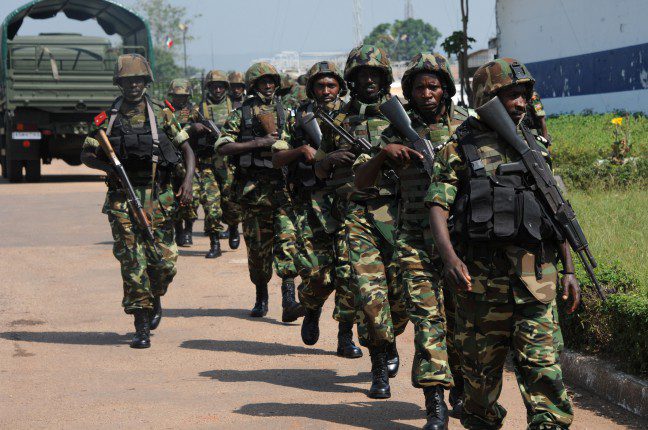
The Chief of Army Staff (COAS) Lt Gen Tukur Buratai has assured troops He assured the troops of his unflinching support and that of the Federal Government of Nigeria to crush insurgency in the shortest possible time.

Gen Buratai was speaking at a Special Easter luncheon with troops of Theatre Command Operation LAFIYA DOLE (TC OPLD) on Monday, at the Army Special Super Camp Ngamdu in Kaga Local Government Area of Borno State.

Army Chief directed troops to demonstrate more commitment and determination to ensure the speedy defeat of terrorism in Nigeria.

Gen Buratai extended his appreciation and commendation and that of the President, Commander – In – Chief, President Muhammadu Buhari for their sacrifices and uncommon commitments in the collective efforts to end Boko Haram/ISWAP’s terrorism.

He said – “Let me assure you of our total support to bring Boko Haram/ISWAP Terrorism to an end. As you can see, we have started getting some consignments of our needs, what we want from you is total loyalty to the Nation, the President, C-In-C and to ensure destruction of terrorism in our country very soon.

”I assure you I will be with you until substantial progress has been made in this regard”.

The event was led by the COAS who was accompanied by the Chief of Training and Operations Army Maj Gen EO Udoh, Corps Commander Engineers Maj Gen JS Malu, Theatre Commander Theatre Command OPLD Maj Gen F Yahaya, Commander Sector 2 Brig Gen LA Araba, Brigade Commanders, Commanding Officers and large number of gallant and resilient troops of TC OPLD.

High point of the luncheon witnessed Gen Buratai taking time to serve some soldiers, interacted with officers and men during the morale boosting event.

Troops were highly elated for the caring/inspiring leadership of the COAS.

Consequently, the Acting Director of Army Public Relations in a statement Monday evening cautioned media houses against sensational reportage of military activities as they are capable of misleading the general public.

Re: Chad’s Idriss Déby As Odogo’s Wife, The Incriminator

0

By Philip Agbese

I respect Festus Adedayo as writer, public affairs commentator, analyst and author. Consummating his articles anytime fills the void in knowledge and information. But I read the article captioned, “Chad’s Idriss Déby As Odogo’s Wife, The Incriminator,” (published in Sahara reporters dated, April 11, 2020), and was staggered by its unpardonable gaffes.

Definitely, I want to believe it was not intentional. I sighted the writer’s dilemma in the hanker to speak the truth on the counter-terrorism battles of Nigeria from 2009 between former President Goodluck Jonathan and incumbent President Muhammadu Buhari.

I perceived his desperation to spin the truth he knows on Nigeria’s battles with terrorism these years, but was hamstringed by the deficiency of facts and accuracy. It is understandable because the dreary terrain of terrorism battlegrounds makes access to precise and trustworthy information on the war extremely difficult.

Nonetheless, Adedayo cannot be permitted to escape with some inappropriate representations, which I have reasons to believe it is not deliberate. It even includes the wrong insinuations which reeks throughout the otherwise nice piece. I concur with the writer religiously that Chad’s President Idriss Deby is one heck of an adulterated and debased military cum civilian dictator on the Chadian political corridors.

The public commentator upbraided him rightly as treacherous, tyrannical, an excited betrayer and worse enemy of humanity by his overt romance with Boko Haram/ISWAP terrorists. I prefer to call them armed criminals anyway.

An African adage says, “When the wind blows, the fowl’s anus is exposed.” President Deby preposterously exposed himself by hyping “yesterday’s” battles with terrorists in the Chadian enclave of Kelkoua, on banks of Lake Chad in her sovereignty, April 4, 2020.

Let’s pardon Deby’s empty boasts. But I am yet to understand Adedayo’s wisdom, which figured Deby’s action as heroic or an act of valour! If I properly discerned Deby’s history, he is a rebel himself, as leader of the Patriotic Salvation Movement and ardent student of the Moummar Gaddafi’s tutelage of armed revolutionary radicalism.

What has baffled me is the writer’s tenders on Deby’s hoax or ruse on fighting terrorism. Adedayo wrote; “it must be said that his rout of Boko Haram has revealed that Nigeria under Buhari is nothing more than a pusillanimous military leadership. The fact must be stated that fighting this insurgency seems to be, for the military Generals in the war theatre, a mercantile activity that must be prolonged for the sake of the belly.”

This is absolute gibberish! It reconfirms my earlier position about the writer’s desolation in knowledge of whatever terrorism entails in Nigeria and the unrelenting battles which clipped the wings of Boko Haram/ISWAP terrorists under President Buhari. Its much of bad blood for him to ingeniously infuse the known and politicized campaigns on stampeding President Buhari to sack his Service Chiefs.

Adedayo finally came in his flawed damaging self. He wrote; “So while Derby may have fought his Boko Haram allies as comeuppance for their “betrayal” of their alliance, the Nigerian government, devoid of cronyism and fired by the leadership and determination of the Derby hue, would have made far greater marks than it is making in the war against the terrorists. The first move in this regard would be for Buhari to sack his expired security chiefs.”

In whatever disguised manner the commentator has sprouted this issue, we know, it is this overriding interest that has triggered the piece. President Buhari has repeatedly said he is satisfied with the performance of his Service Chiefs and it is needless to over-flog the issue. And I have reason to believe him.

Very often, Nigerians assume a simplistic understanding of terrorism wars. It is the writer’s first blunder. I believe that is also the conviction of the writer when he submitted that “Nigeria slipped from a country known, before now, for her military prowess, into a hub of global jokes, a sissy if you like. Strategic experts have located a troubling metastasis of the cancer.”

But the security experts he relied upon for this conclusion have no slightest idea about terrorism and its tempo in Nigeria before the Buhari Presidency. I know, terrorism wars are not easy to crack anywhere in the world because of its asymmetrical nature.

America with all its sophistry has been in the Middle East fighting terrorism, since 2002, but no end in sight yet. The war has engulfed over a trillion dollars of America’s funds. That Nigeria has been able to decimate and defeat Boko Haram terrorists in four years is enviable and commendable.

Nigeria has curbed the rage of terrorists to the extent that they are unable to trouble Abuja again; their plots to make ingress into Southern Nigeria has also been guillotined and the push-back of insurgents has confined their operations to the Lake Chad area. How else could Nigeria or efficiency of the Service Chiefs be expressed?

And so, because of certain partisan motivations, we prefer to condemn the impressive efforts of President Buhari and his Service Chiefs in combating Boko Haram terrorism. Adedayo like some other Nigerians are under the false illusion that President Idriss Deby has done a wonderful job by leading Chadian troops to the battlefield to battle Boko Haram and destroy their armoury bunkers. Nigeria through Gen. Buratai has performed similar feats and posted better streaks of victories against terrorists.

But terrorists have an amazing resilience. When the battle gets tough, they recoil into sleeper cells, recuperate, replenish and stage greater onslaughts at targets. Deby and anyone else should not be deluded that the “Operation Anger of Boma,” has erased all vestiges of Boko Haram in Chad or the region.

It is this indefinite character of terrorism that Nigeria is still under the spell of remnants of Boko Haram and with their dislodgment from Sambisa forest. Chadian territories offered them conducive recuperation abodes when they chased out of Nigeria. Deby and his praise singers just have to look further afield.

So, it is a fluke for Adedayo to say, “The Chadian Army also said with confidence that the terrorists had been driven “out of all the islands of the lake… Chadian soldiers are currently stationed deep on the islands of Niger and Nigeria, waiting for these friendly countries’ soldiers to take over.” No nation has the power to station his army in the territory of another country without a permission. Chadian Army are not stationed anywhere in Nigerian territory. The writer must not swallow hook and sinker or jump at every propaganda reeled by Chad.

The insinuation that President Buhari should have also personally led Nigerian troops to the frontlines to confront terrorists because he is a retired Army General is misplaced. President Buhari and Deby cannot operate on the same template. Buhari is far older than Deby, no reasonable person would expect that both should have the same physical stamina now.

It is false conclusion to claim that “Billions of dollars are voted for hardware, software and military welfare yearly which allegedly slip into the bottomless pockets of the Generals and their collaborators in government. Moles within are also alleged to collect fat dividends from the insurgents for revealing tracks of proposed attacks.”

I cannot refute the problem of moles in the military who frustrate Nigeria’s counter-terrorism operations. It is real! But the problem is bigger and has more more tentacles than envisaged by Adedayo. Former President Jonathan once bemoaned that there are Boko Haram spies everywhere including Aso Rock. Politicians, religious and traditional rulers, and other arms of security agencies have spies who work for Boko Haram. But Gen. Buratai has considerably reduced the influence of moles on counter-insurgency operations and it explains the impact Nigeria has recorded on counter-terrorism.

But it is blatant falsehood to mouth that billions of dollars voted for hardware, software and military welfare annually are embezzled under the Buhari Presidency. The statement is too generalized and fluid. Military or security budgets are not opaque. It is open to public scrutiny.

Nigerians are under the mistaken notion that weapons purchased in 2015 for counter-insurgency operations are never exhausted in warfare, but should remain in military armory. Counter-terrorism is a battle which expends and deflates military armoury every day on the battlefield and requires constant replenishment.

Adedayo claims that Military welfare is ignored is also inaccurate. My understanding of the situation is that the Nigerian Government and the National Assembly have not voted enough funds for military welfare. It is not an issue of embezzlement. In the 2020 budget for instance, just one percent of the national budget is provided for all the arms of Nigeria’s security agencies. And 90 percent of it is for recurrent expenditure, comprising salaries and allowances of security personnel.

This is grossly inadequate. And parliamentarians never harkened to pleas to increase the budget for security agencies in the age of insurgencies. So, where does anybody get “billions of dollars” to embezzle? And when we talk about welfare, Gen. Buratai has kept faith with soldiers. He pays their approved salaries and allowances promptly. And by his personal initiatives he has launched various economic empowerment schemes for the Nigerian Army, aside the partnership with corporate organizations for the construction of post-retirement housing scheme for the Army.

It is my honest view that Adedayo overrated and amplified the prowess of President Deby and the Chadian Army. The battle at Kelkoua is nothing spectacular, but the country’s rebellion against its own rebels it has sustained in its territory for years.

Agbese, an author and human rights activist contributed this piece from the United Kingdom.

Full speech by President Buhari on the lockdown extension in Abuja, Lagos and Ogun

0

ADDRESS BY H.E. MUHAMMADU BUHARI, PRESIDENT OF THE FEDERAL REPUBLIC OF NIGERIA ON THE EXTENSION OF COVID- 19 PANDEMIC LOCKDOWN AT THE STATE HOUSE, ABUJA
MONDAY, 13TH APRIL, 2020

1. Fellow Nigerians

2. In my address on Sunday, 29th March, 2020, I asked the residents of Lagos and Ogun States as well as the Federal Capital Territory to stay at home for an initial period of fourteen days starting from Monday, 30th March 2020.

3. Many State Governments also introduced similar restrictions.

4. As your democratically elected leaders, we made this very difficult decision knowing fully well it will severely disrupt your livelihoods and bring undue hardship to you, your loved ones and your communities.

5. However, such sacrifices are needed to limit the spread of COVID-19 in our country. They were necessary to save lives.

6. Our objective was, and still remains, to contain the spread of the Coronavirus and to provide space, time and resources for an aggressive and collective action.

7. The level of compliance to the COVID-19 guidelines issued has been generally good across the country. I wish to thank you all most sincerely for the great sacrifice you are making for each other at this critical time.

8. I will take this opportunity to recognise the massive support from our traditional rulers, the Christian Association of Nigeria (CAN) and the Nigerian Supreme Council for Islamic Affairs (NSCIA) during this pandemic.

9. I also acknowledge the support and contributions received from public spirited individuals, the business community and our international partners and friends.

10. I must also thank the media houses, celebrities and other public figures for the great work they are doing in sensitizing our citizens on hygienic practices, social distancing and issues associated with social gatherings.

11. As a result of the overwhelming support and cooperation received, we were able to achieve a lot during these 14 days of initial lockdown.

12. We implemented comprehensive public health measures that intensified our case identification, testing, isolation and contact tracing capabilities.

13. To date, we have identified 92% of all identified contacts while doubling the number of testing laboratories in the country and raising our testing capacity to 1,500 tests per day.

14. We also trained over 7,000 Healthcare workers on infection prevention and control while deploying NCDC teams to 19 states of the federation.

15. Lagos and Abuja today have the capacity to admit some 1,000 patients each across several treatment centres.

16. Many State Governments have also made provisions for isolation wards and treatment centres. We will also build similar centers near our airports and land borders.

17. Using our resources and those provided through donations, we will adequately equip and man these centres in the coming weeks. Already, health care workers across all the treatment centers have been provided with the personal protective equipment that they need to safely carry out the care they provide.

18. Our hope and prayers are that we do not have to use all these centres. But we will be ready for all eventualities.

19. At this point, I must recognise the incredible work being done by our healthcare workers and volunteers across the country especially in frontline areas of Lagos and Ogun States as well as the Federal Capital Territory.

20. You are our heroes and as a nation, we will forever remain grateful for your sacrifice during this very difficult time. More measures to motivate our health care workers are being introduced which we will announce in the coming weeks.

21. As a nation, we are on the right track to win the fight against COVID-19.

22. However, I remain concerned about the increase in number of confirmed cases and deaths being reported across the world and in Nigeria specifically.

23. On 30th March 2020, when we started our lockdown in conforming with medical and scientific advice, the total number of confirmed cases across the world was over 780,000.

24. Yesterday, the number of confirmed COVID-19 cases globally was over one million, eight hundred and fifty thousand. This figure is more than double in two weeks!

25. In the last fourteen days alone, over 70,000 people have died due to this disease.

26. In the same period, we have seen the health system of even the most developed nations being overwhelmed by this virus.

27. Here in Nigeria, we had 131 confirmed cases of COVID-19 in 12 States on 30th March 2020. We had two fatalities then.

28. This morning, Nigeria had 323 confirmed cases in twenty States. Unfortunately we now have ten fatalities. Lagos State remains the center and accounts for 54% of the confirmed cases in Nigeria. When combined with the FCT, the two locations represent over 71% of the confirmed cases in Nigeria.

29. Most of our efforts will continue to focus in these two locations.

30. Majority of the confirmed cases in Lagos and the FCT are individuals with recent international travel history or those that came into contact with returnees from international trips.

31. By closing our airports and land borders and putting strict conditions for seaport activities, we have reduced the impact of external factors on our country. However, the increase in the number of States with positive cases is alarming.

32. The National Centre for Disease Control has informed me that, a large proportion of new infections are now occurring in our communities, through person-to-person contacts. So we must pay attention to the danger of close contact between person to person.

33. At this point, I will remind all Nigerians to continue to take responsibility for the recommended measures to prevent transmission, including maintaining physical distancing, good personal hygiene and staying at home.

34. In addition, I have signed the Quarantine Order in this regard and additional regulations to provide clarity in respect of the control measures for the COVID-19 pandemic which will be released soon.

35. The public health response to COVID-19 is built on our ability to detect, test and admit cases as well as trace all their contacts. While I note some appreciable progress, we can achieve a lot more.

36. Today, the cessation of movement, physical distancing measures and the prohibition of mass gatherings remain the most efficient and effective way of reducing the transmission of the virus. By sustaining these measures, combined with extensive testing and contact tracing, we can take control and limit the spread of the disease.

37. Our approach to the virus remains in 2 steps – First, to protect the lives of our fellow Nigerians and residents living here and second, to preserve the livelihoods of workers and business owners.

38. With this in mind and having carefully considered the briefings and Report from the Presidential Task Force and the various options offered, it has become necessary to extend the current restriction of movement in Lagos and Ogun States as well as the FCT for another 14 days effective from 11:59 pm on Monday, 13th of April, 2020. I am therefore once again asking you all to work with Government in this fight.

39. This is not a joke. It is a matter of life and death. Mosques in Makkah and Madina have been closed. The Pope celebrated Mass on an empty St. Peter’s Square. The famous Notre Dame cathedral in Paris held Easter Mass with less than 10 people. India, Italy and France are in complete lockdown. Other countries are in the process of following suit. We cannot be lax.

40. The previously issued guidelines on exempted services shall remain.

41. This is a difficult decision to take, but I am convinced that this is the right decision. The evidence is clear.

42. The repercussions of any premature end to the lockdown action are unimaginable.

43. We must not lose the gains achieved thus far. We must not allow a rapid increase in community transmission. We must endure a little longer.

44. I will therefore take this opportunity to urge you all to notify the relevant authorities if you or your loved ones develop any symptoms. I will also ask our health care professionals to redouble their efforts to identify all suspected cases, bring them into care and prevent transmission to others.

45. No country can afford the full impact of a sustained restriction of movement on its economy. I am fully aware of the great difficulties experienced especially by those who earn a daily wage such as traders, day-workers, artisans and manual workers.

46. For this group, their sustenance depends on their ability to go out. Their livelihoods depend on them mingling with others and about seeking work. But despite these realities we must not change the restrictions.

47. In the past two weeks, we announced palliative measures such as food distribution, cash transfers and loans repayment waivers to ease the pains of our restrictive policies during this difficult time. These palliatives will be sustained.

48. I have also directed that the current social register be expanded from 2.6 million households to 3.6 million households in the next two weeks. This means we will support an additional one million homes with our social investment programs. A technical committee is working on this and will submit a report to me by the end of this week.

49. The Security Agencies have risen to the challenges posed by this unprecedented situation with gallantry and I commend them. I urge them to continue to maintain utmost vigilance, firmness as well as restraint in enforcing the restriction orders while not neglecting statutory security responsibilities.

50. Fellow Nigerians, follow the instructions on social distancing. The irresponsibility of the few can lead to the death of the many. Your freedom ends where other people’s rights begin.

51. The response of our State Governors has been particularly impressive, especially in aligning their policies and actions to those of the Federal Government.

52. In the coming weeks, I want to assure you that the Federal Government, through the Presidential Task Force, will do whatever it takes to support you in this very difficult period. I have no doubt that, by working together and carefully following the rules, we shall get over this pandemic.

53. I must also thank the Legislative arm of Government for all its support and donations in this very difficult period. This collaboration is critical to the short and long-term success of all the measures that we have instituted in response to the pandemic.

54. As a result of this pandemic, the world as we know it has changed. The way we interact with each other, conduct our businesses and trade, travel, educate our children and earn our livelihoods will be different.

55. To ensure our economy adapts to this new reality, I am directing the Ministers of Industry, Trade and Investment, Communication and Digital Economy, Science and Technology, Transportation, Aviation, Interior, Health, Works and Housing, Labour and Employment and Education to jointly develop a comprehensive policy for a “Nigerian economy functioning with COVID-19”.

56. The Ministers will be supported by the Presidential Economic Advisory Council and Economic Sustainability Committee in executing this mandate.

57. I am also directing the Minister of Agriculture and Rural Development, the National Security Adviser, the Vice Chairman, National Food Security Council and the Chairman, Presidential Fertiliser Initiative to work with the Presidential Task Force on COVID-19 to ensure the impact of this pandemic on our 2020 farming season is minimized.

58. Finally, I want to thank the members of the Presidential Task Force on COVID-19 for all their hard work so far. Indeed, the patriotism shown in your work is exemplary and highly commendable.

59. Fellow Nigerians, I have no doubt that by working together and carefully following the rules, we shall get over this pandemic and emerge stronger in the end.

60. I thank you all for listening and may God bless the Federal Republic of Nigeria.

Counter-insurgency in Lake Chad Region: Is Chad ‘playing God’?

0

By David Otto

“Lake Chad Basin States have been engaged in Porous Border Terrorism for almost a decade, a genuine One-for-All and All-for-One, multi-level counter insurgency strategy is the missing ingredient.”

The ongoing factional splits and bitter leadership challenges between Boko Haram Shekau faction and Islamic State of West Africa Province (ISWAP) has left jihadist cells operating along the fringes of the Lake Chad Basin weakened, disorientated and uncoordinated. The chaotic state of affairs presents a golden opportunity for all members (Nigeria – Niger – Chad and Cameroon and to some extent, Benin Republic) of the Multi National Joint Task Force (MNJTF) to put any pre-existing differences aside and rally as a coordinated military and civilian task force, plan and launch joint offensives against existing local and ISIS affiliated jihadist positions in the Lake Chad Basin. No single state can achieve this on their own however much they try.

On April 9th, 2020, a one minute seventeen seconds video was circulated on social media platforms and twitter. A Chadian army, one Colonel Azem Bermendoa Agouna read a statement in French in Baga-Sola–Chad Republic. Colonel Agouna announced that:
“This is a statement from the Chief of Army Staff. “Operation Boma Wrath” launched on the 31st of March 2020 under the supervision of the Commander in Chief (President Idris Derby) of the armed forces has come to an end. The security and defence forces with bravery and determination have chased Boko Haram terrorist from the Lac Chad Islands. Boko Haram Terrorist have been chased away from all the Lac Chad islands. This is the summary of the eight (8) days battle. On the side of our friendly forces, we counted 52 martyrs and 196 wounded. On the enemy’s side,1000 Boko Haram terrorist were neutralized (killed).

Destroyed (jihadist) materials: 50 water canoes destroyed. Materials recovered (from the jihadist): Many collective and individual small arms were recovered. The security and defence forces are deeply stationed in the Islands of Niger and Nigeria while waiting to hand over to the respective army of these friendly nations.”
Background to “Operation Boma Wrath”
On March 23rd 2020, Chad experienced one of the largest single casualty from an offensive attack by Boko Haram-ISWAP jihadist factions on the Boma peninsula- Lac Province, bordering Niger and Nigeria. In that devastating attack, ninety-eight (98) Chadian soldiers including senior officers were massacred in cold blood by the jihadists, while Forty- Seven (47) soldiers escaped with life threatening injuries.

The Chadian President, Idriss Deby Itno, made an emergency visit to the scene in Boma and promised his country men and women immediate retaliation against Boko Haram jihadist. A number of videos and still images were circulated on social media showing the President and Commander-in-Chief, Idriss Deby, dressed in military fatigue commanding front line forces after launching ‘Operation Boma Wrath’ on the 31st of March 2020. After eight (8) days, the Chadian Armed Force declared mission accomplished and said it had cleared the Lac Islands of all jihadist killing, 1000 of them, while a few others narrowly escaped to Niger and Nigeria borders.

Did Chad launch “Operation Boma Wrath” alone?
Strategically, “Operation Boma Wrath” was planned exclusively by Chadian Army leadership. It was a retaliatory offensive against Boko Haram ISWAP jihadist hiding and operating within the Lac Province of Chad and suspected to have been behind the massacre of Chadian soldiers and senior officers. There is no evidence that any other neighbouring state was involved in the strategic planning and execution phases of “Operation Boma Wrath.”

However, from a logistics, operations and tactical engagement angle, “Operation Boma Wrath’’ did involve the active participation and coordination of Nigerian troops under Sector 3, Niger under sector 4 and Chad under Sector 2 of the Lake Chad Basin’s Multinational Joint Task Force (MNJTF). However, it is apparent that the MNJTF Sectors 3 and 4 provided Intelligence, Surveillance and Reconnaissance (ISR) assistance along the Tumbun Fulani and Madayi Axis.

Incidentally, a huge cache of Boko Haram weapons is reported to have been recovered during the eight (8) days offensive along the same Madayi axis with operational coordination from MNJTF contribution Sectors’ troops.
Nigeria Air and ground forces combined with Sector 3 MNJTF with ‘Operation Yancin Tafki’ and provided tactical aerial cover to Chadian ground forces; Nigeria Air Force launched aerial strikes and bombings against moving and fleeing Boko Haram jihadist in Madayi axis and provided key amphibious logistics for engine boats to Chadian naval forces. Niger Republic in Sector 4 MNJTF, provided tactical and operational logistics, including landing fields in Diffa and aviation fuel to Chadian Air Force – there is no evidence that Cameroon took any part in these operations.

Geographically, the MNJTF Headquarters is based in N’djamena, Chad. Cameroon covers Sector 1 Mora, Chadian soldiers man Sector 2 Baga-Sola, even though for some years now, and by the admittance of President Idriss Deby in an interview granted in Boma Island, Chad had practically limited its force deployment capacity in Baga-Sola leaving the remaining unit very fragile and vulnerable to heavy Boko Haram ISWAP presence in the Lac Islands. The Lac Province in Chad consist of several difficult to access Islands. It is well known fact that, Boko Haram/ISWAP jihadist have been using the islands as safe haven, to plan and launch attacks against hard military and civilian targets in Nigeria, Niger and Cameroon.
It is acknowledged that Chadian army and security forces launched ‘Operation Boma Wrath’ with great success but the overall success of the Eight days battle was only possible with the active tactical and operational coordination and support of the MNJTF including Nigeria Sector 3, and Niger Sector 4. Accordingly, “Operation Boma Wrath” mission accomplished statement by the Chadian Army should have expressly acknowledged the operational, logistics and tactical assistance from friendly states of the MNJTF; Nigeria and Niger Republic.

Is 1000 BHT/ISWAP casualty Not Less, Not More & Not Even an Estimate?
According to Chadian army, its security and defence forces neutralized 1000 or 90% of Boko Haram fighters in the Lac Islands and a small number of jihadist – estimated by the Chadian President as 10% managed to flee across Nigérien and Nigeria’s porous borders. From a strategic communication perspective, a retaliatory offensive that results in the death of 1000 Boko Haram/ISWAP jihadists has the potential to strike a huge warning and psychological damage to remaining jihadists in the region. It sends a message; that jihadist should stay clear of Chadian Armed Forces. Tactically, the human capacity of the jihadists should have been seriously diminished.
From a moral boosting perspective, a casualty of 1000 Boko Haram/ISWAP jihadists is more than Ten times the number of 98 Chadian soldiers and officers killed by armed groups linked to Boko Haram/ISWAP jihadists on the 23rd of March 2020, in Boma Island.
It is not uncommon that the bodies of neutralized terrorist are not retrieved unless if and when it is established that a known high-ranking commander or leader is amongst the casualties. There is no evidence that any such high-ranking Boko Haram/ISWAP leader or commander including the elusive Abubakar Shekau was killed during “Operation Boma Wrath” as being touted in the media.
The 1000 round figure seems more of an element of statecraft messaging technique targeting a variety of audiences; including Boko Haram jihadists leadership and foot soldiers; families and friends of killed Chadian soldiers, the Chadian citizens; regional partners. Thus, saying that the brave Chadian security and Armed Forces have retaliated disproportionately against Boko Haram jihadists. Accordingly, justice has been done and mission accomplished with direct command by President Idriss Deby. The Chadian Army did not provide any evidence of 1000 dead Boko Haram/ISWAP jihadists or half of that number but insisted that “no Jihadist remain in their territory.” As it stands, the rationale behind the ‘1000 killed jihadist’ appears to be more significant than realistic.

Are Chadian Forces stationed in Nigeria and Niger Republic following “Operation Boma Wrath”?
Colonel Azem Bermendoa Agouna stated in Baga-Sola MNJTF Headquarters that “the Chadian security and defence forces are deeply stationed in the Islands of Niger and Nigeria waiting to hand over to friendly forces”. This claim was immediately corrected as misleading in a press release by Nigerian Army Acting Director of Army Public Relation Colonel Sagir Musa. In the statement, Colonel Musa boldy stated that no Chadian soldier was stationed in Nigerian territory. He acknowledged that as part the MNJTF, Chad (Sector 2), and Nigeria (Sector 3) carry out joint operations in the region against the BHT/ISWAP armed jihadists. It has also been acknowledged that MNJTF Sector 2 (Chad), Sector 3 (Nigeria) and Sector 4 (Niger Republic) have one battalion each stationed in Niger and Mallam Fatori ready for deployment. The Nigerian Army condemned as misleading any allegations suggesting that Chadian forces are stationed in any part of Nigerian territory waiting for a handover to the Nigeria Army. There is yet to be any counter claim or disputation by the Chadian forces.

Has Chad Defeated Boko Haram jihadist following “Operation Boma Wrath”?

The Chadian Army declared that no single Boko Haram jihadist remain on its side of the border, as “Operation Boma Wrath” was successfully accomplished. Chad did not declare outright victory against armed Boko Haram/ISWAP jihadists. Clearly, a lot remains to be achieved nationally and regionally from a multi-agency civilian and military coordination perspective. In the meantime, the Chadian security and Armed Forces should maintain a strong and visible presence in the Lac Islands within its borders and enhance its Force coordination with Baga-Sola Sector 2 axis of the MNJTF, simultaneously engaging with partner states in developing the MNJTF civilian component.

A visible presence of the Chadian security and Armed Forces in the Lac Province will prevent further and future internal buildup of armed groups within and outside Chadian borders affiliated to Boko Haram/ISWAP Jihadist. A Chadian military presence will deter and prevent jihadists escaping attacks from neighbouring Nigeria, Cameroon and Niger or access the Islands to use as safe haven.
One major counter insurgency lesson for Lake Chad Basin states to take home from the US coalition experience against Al-Shabaab (Somalia), Taliban (Afghanistan), Al-Qaida (Iraq) and ISIS (Syria), is that winning one-off battles does not translate to permanent victory against jihadists. Genuine partnership and regional planning, collaboration, coordination and communication is key to lasting success. A systematic grassroots military and civilian engagement involving all key stakeholders bears better fruits, else in no time, the jihadists will regroup and return to full capacity – in the Lac Islands of Chad.
Who Are the Lac Islands Armed Jihadists?
For years prior to ‘Operation Boma Wrath’ the Lac Islands served as safe haven for armed groups linked to Boko Haram ISWAP jihadist. The Lac Island was a magnet which attracted both local Chadian armed rebel groups and Boko Haram/ISWAP jihadists fleeing attacks from either the MNJTF or the security and armed forces of neighbouring Nigeria, Niger and Cameroon. The marshy and difficult to access terrain provided excellent hiding spots for armed groups to hibernate, plan and launch frequent cross border raids into neighbouring states.
The raids were made easier for armed groups by very limited Chadian security and military presence in the Lac Province. In a video interview in Boma Island, Chadian President Idriss Deby explained the presence of a weaker battalion in Lac Province was due to other operational demands elsewhere, an acknowledgment that Chadian security and armed forces placed little importance on growing jihadists activities and presence in the Lac Province.
Three years ago (in 2017), Chad withdrew a 1,200-man force from its Baga-Sola sector 2 position of the MNJTF after the US included Chad in a travel ban list without prior warning. The US accused Chad of not providing information on Boko Haram/ISWAP jihadist activities in the region. The travel ban was in retaliation to the October 2017 attack by a jihadist faction linked to Boko Haram Islamic State of the Greater Sahel (ISGH) in the Nigérien village of Tongo Tongo in Tillaberi region, near the border with Mali. A number of Nigérien forces and 4 US soldiers were killed in that ambush.
In Nigeria, the Army leadership under the Chief of Army Staff Lieutenant General Tukur Yusufu Buratai launched “Operation LAFIYA DOLE” literally translated, “Peace by all means” in 2016. Several coordinated ground and aerial offensives against Boko Haram ISWAP Jihadist strongholds resulted in jihadists tactically escaping ‘en masse’ into the Lac Islands of Chad for shelter without any resistance from Chadian Security and Armed Forces. Free jihadists access to the Lac Province often resulted in a cat and mouse battlefield engagement with Boko Haram/ISWAP jihadists retreating into the Lac Islands when pursued by states and regional forces. Strategically, the Lac Islands created an existential tactical and operational frustration severely impacting the effectiveness of counter insurgency for neighbouring states and the MNJTF.
The Timing of “Operation Boma Wrath”
To eliminate Boko Haram/ISWAP jihadists activities and ideological base in the region, one state led, one off operations, however overwhelming, will not achieve long term success. The massacre of 98 Chadian soldiers and senior officers and wounding of many others in March 2020 should not have come as a shock to Chadian authorities. Chad “Operation Boma Wrath” response indicates more of anger and less of security concern for Chad. This reaction can only be interpreted as ‘overfed monsters’ who overstepped their limits and crossed the red line. The retaliatory killing of an alleged 1000 Boko Haram/ISWAP jihadists is likely a deserved punishment for overstepping set boundaries.
As host to the MNJTF headquarters in N’Ndjamena, Sector 2, Baga Sola, a joint MNJTF planned and better coordinated operation would have yielded and could still yield better results for Chad and her neighbours against the armed jihadists. Similarly, the alleged 10% jihadists that allegedly escaped towards the borders would have been blocked and dealt with by Nigeria and Niger forces if the timing was known to all regional partners appropriately.
Perhaps there is lack of mutual trust and logistical ineffectiveness between MNJTF member states which has the real potential to impact on joint planning and operational success. If indeed, the Chadian Security and Armed forces were after retaliation for the lost soldiers in Boma Island, planning such a huge offensive without regional partners even when these partners will be needed during field operations only deepens mistrust.

Conclusion
The Chadian Army and Commander-in-Chief, President Idriss Deby may have singlehandedly planned “Operation Boma Wrath” as a preemptive retaliatory operation. However, any battlefield success should not ignore the logistics and tactical collaboration from Nigeria and Niger forces under sector 3 and sector 4 of the MNJTF. Armed groups linked to Boko Haram/ISWAP jihadist have consistently exploited gaps created by regional weaknesses and lack of an effective and well-resourced military and civilian MNJTF. They to use porous borders of the Lake Chad Basin and the Lac Islands as a safe haven. Boko Haram/ISWAP, the ISIS most powerful wiyalat in Africa is experiencing its worst time in its decade’s history triggered by bitter factional splits and leadership rivalry. From “Operation LAFIYA DOLE” to ‘Operation Boma Wrath’, no single state driven military or civil offensive, however well intended and well planned will succeed in crushing Boko Haram/ISWAP jihadists ideology and criminal activities in the region without the genuine participation of all regional partners. The war against terrorism in the Lake Chad region is a regional affair. No one state, however vexatious, frustrated or high in battle moral will succeed against Jihadist armed groups by “playing God.”

About the Author:
David Otto is the Global Risk International (GRI) Director of Anti & Counter Terrorism programme design and training. David is a world-renowned Counter Terrorism and Organised Crime Expert. He is a Certified Anti-Terrorism Specialist (CAS), a Certified Master Anti-Terrorism Specialist (CMAS) and a programme trainer with the Anti-Terrorism Accreditation Board (ATAB); a Certified Expert in Field Criminalistics from The National University of Penal, Administrative and security Science – Mexico; He holds a Master of Science (MSc) in Counter Terrorism & Organised Crime & BA(Hon’s) in Law & Criminology from the University of East London United Kingdom of Great Britain. David is a certified ProQual Level 2/ C4Skills practitioner on Preventing Radicalization and safeguarding solutions. He serves as a Senior Advisor to the International Police Commission (IPC). David is also a selected expert and lecturer for NATO forces on Defence Against Terrorism at the NATO School and Subject Matter Expert (SME) on US DoD Africa Command. He was a pioneer Expert panelist and contributor to Interpol’s Global CT Strategy 2016 in Bali Indonesia. – Twitter: @ottotgs

Boko Haram: Final show-down imminent as Army moves weapons, troops to Lake Chad

0

The Nigerian Army has began movement of newly acquired weapons of war and soldiers into Sambisa forest and Lake Chad region for final showdown with Boko Haram.

The Nigerian Army recently took delivery of a shipment of military vehicles from the China North Industries Corporation (NORINCO).

NORINCO delivered the first of 17 military vehicles compromising of VT4 main battle tanks, SH5 105mm wheeled self-propelled howitzers and ST1 tank destroyers.

Boko Haram/ISWAP: Report lauds Nigeria’s leading role in Lake Chad counter-terrorism campaign

0

A special report by the Lake Chad Counter-Terrorism Crusade Network (LCCTCN) has applauded Nigeria for spearheading counter-terrorism campaign in the Lake Chad Basin region.

The group’s commendation followed a thorough research and extensive analysis of the dynamics involved in the counter-insurgency operations of the member countries.

In the report signed by the President, McCarthy Ronald, the group harked back to the genesis of the Boko Haram/ ISWAP menace, reawakening of the Multinational Joint Task Force (MNJTF) and how each nation has fared afterwards.

According to the Lake Chad Counter-Terrorism Crusade Network, aside Nigeria, other countries have not displayed a substantial commitment to the regional efforts towards ending terrorism.

While the Nigerian troops constantly led onslaught against the radical Islamic sect , neighbouring nations held back, especially Chad, with the terrorists finding refuge in their shores.

To put a lasting end to the Boko Haram/ISWAP fighters, the Lake Chad group, however, recommended that other countries must emulate the efforts of the Nigerian authorities.

Read full report below:

Preamble:

The Boko Haram Insurgency in North-East Nigeria has spiralled into the Lake Chad Basin Region comprising of Nigeria, Chad, Niger, and Cameroon. The impact of the insurgency has been felt in these countries, and that necessitated the formation of a Multinational Joint Task Force intending to bring to an end the Boko Haram insurgency.

The Lake Chad Counter-Terrorism Crusade Network, an organization devoted to appraising the effectiveness of the counterinsurgency efforts of the countries under the Lake Chad Basin Region, subsequently researched the effectiveness of the counterinsurgency efforts of the various countries towards bringing to an end the Boko Haram Insurgency.

The research dwelled on military strategies, the commitment of the political authorities of the various countries, as well as the successes recorded in the war against terrorism as well as the sets backs recorded by the different countries.

Introduction:

The Lake Chad Basin is the largest endorheic drainage basin in Africa, centered on Lake Chad. It has no outlet to the sea and contains large areas of desert or semi-arid savanna. The drainage basin is roughly coterminous with the sedimentary basin of the same name. However, it extends further to the northeast and east. The basin spans seven countries, including most of Chad and a large part of Niger. It has an ethnically diverse population of about 30 million people as of 2011, growing rapidly. However, the geographical area that is of concern is the four countries bordering Lake Chad: Cameroon, Chad, Niger, and Nigeria.

The Lake Chad Basin region is the setting of a violent campaign by Jama’atu Ahlis Sunnah Lidda’awati w’al Jihad (People Committed to the Propagation of the Prophet’s Teachings and Jihad), commonly known as Boko Haram. The violence perpetrated by Boko Haram has resulted in the deaths of nearly 30,000 people since 2009, with extensive physical destruction, the displacement of over 2 million people and economic activity has effectively ground to a halt.

From the outset, nationals from Niger, Chad, and Cameroon traveled to northern Nigeria, attracted by Mohammed Yusuf’s charismatic sermons and by the small loans offered to his followers. This thus provided the foundation for a multinational sect.

Given Boko Haram’s pre-2014 focus on north-east Nigeria, neighboring governments initially responded to the threat mainly by keeping the sect under surveillance, and in some cases, reportedly agreeing non-aggression pacts. Governments were reluctant to launch a major crackdown in border regions, possibly for fear of retaliation and, more concretely, owing to their limited capabilities. As Boko Haram’s territorial control expanded across north-east Nigeria and the threat the group posed spread across the borders of Cameroon, Chad, and Niger, regional concerns increased, pushing governments towards military cooperation.

The Multinational Joint Task Force (MNJTF) – created by the Lake Chad Basin Region (LCBC) in 1998 to address cross-border security issues in the Lake Chad region – was reactivated in 2012 with an expanded mandate to encompass counter-terrorism operations. It was given a more specific strategy against Boko Haram at the Extraordinary Summit of LCBC member states and Benin in October 2014. Unlike its previous iteration, the task force included Cameroon among its troop-contributing countries. It was provided with pledges of financial support from international actors, including the African Union (AU).

The mandate included conducting military operations to prevent the expansion of Boko Haram activities; conducting patrols; preventing transfers of weapons or logistics to the group; actively searching for and freeing abductees, including the girls kidnapped from Chibok in April 2014; and carrying out psychological operations to encourage defections within Boko Haram ranks.

Each country agreed to deploy a battalion of up to 700 troops within its national boundaries, in addition to the deployment of soldiers to the MNJTF headquarters.

Nigeria:

Nigeria is a highly complex and ethnically diverse country, with over 400 ethnic groups.

This diversity is played out in the way the country is bifurcated along the lines of religion, language, culture, ethnicity, and regional identity.

Nigeria’s significant response to the insurgency since 2010 has been the deployment of its Joint Task Force (JTF), consisting of the Army, Air Force, Navy, State Security Services, and Police under unified command structures. It encouraged increased intelligence-sharing, force coordination and unity of direction, which are considered essential for any counterinsurgency operation, although this has been limited.

The Nigerian parliament passed anti-terrorism legislation, initially introduced in 2011, in 2013. The law was designed, in part, to facilitate greater counter-terrorism coordination. However, interagency cooperation and information sharing remain limited by Nigeria’s federal structure, which has caused confusion between chief state security officers and federally-controlled security forces.

On his inauguration in May 2015, President Muhammadu Buhari immediately began strengthening cooperation with neighbouring governments and took on the leadership of the Multinational Joint Task Force for the entire duration of its mission.

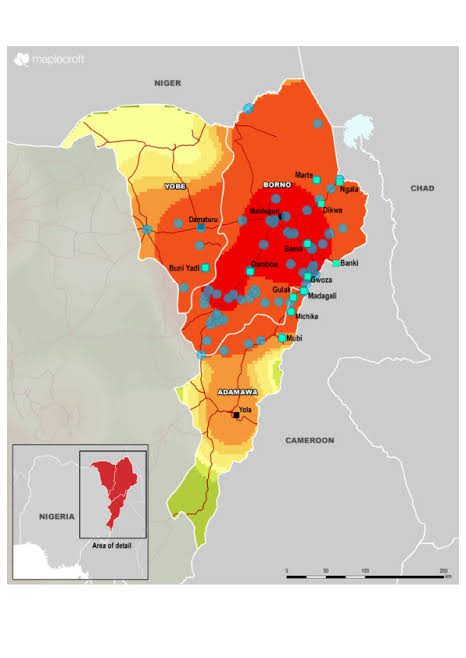
Counterinsurgency operations by the Nigerian Military increased in scale and power throughout 2015 and 2016. Except for its stronghold in the Sambisa forest and Gwoza Hills in north-eastern Borno state, Boko Haram became confined mainly to Abadam, Mobbar, Guzamala, Kukawa, Gubio and Nganzai local government areas (LGAs) by late 2016. However, continued insecurity prevented the reestablishment of civilian administration in areas ‘liberated’ by the Nigerian Military.

In adjacent border regions, the massive military bombardment of Boko Haram by the Nigerian Military pushed them further into the far northern region of Cameroon, the Lac region in Chad, and the south-eastern Diffa region in Niger. Many militants were killed or apprehended, forcing Boko Haram to resort to coerced recruitment in these areas increasingly.

After a peak in Boko Haram–related violence in 2014 and 2015, the number of casualties attributed to the group fell dramatically. The Nigerian Military pushed Boko Haram out of several provinces in north-eastern Nigeria. However, the group retains control over some villages and pockets of territory. It continues to launch deadly suicide attacks and abduct civilians, mostly women, and children.

The conflict has been primarily contained in the north-east, particularly in Borno state. However, it has displaced millions of people in the region. In June 2018, the Nigerian Army announced that thousands of internally displaced people were to return home.

The Nigerian Military had been the most active amongst the countries in operation in the Multinational Joint Task Force through the renewed concept of Operation YANCIN TAFKI, under Sector 3.

Cameroon:

Cameroon is an example of an increasing number of countries confronting both separatist rebellions and jihadist-armed groups. Two characteristics are nevertheless remarkable in the Cameroonian case. First, the fact that unlike some countries facing similar crises, no confusion is possible between the two insurgent fronts (in terms of territory, social base, resources mobilization channels, tactical interests, and even repertoire of violent action). One deploys under the Boko Haram flag and is located in the northern margins of the country, where hostilities began in 2014. The other, raging since 2017, is linked to secessionist demands within the Anglophone minority in the western regions.

In May 2014, Cameroon declared war on Boko Haram at the Paris Summit. Since then, Boko Haram has intensified its activities in the Far North Region of the country, making Cameroon the second most targeted country, in terms of attacks, by the sect.

The penetration of Boko Haram in Cameroon took place gradually and in several phases. At each period, the group has been able to change its modus operandi and adapt to the response of Cameroonian defense forces. While the first frontal attack of Boko Haram against Cameroon dates back to March 2014, the presence of members of the sect in the Far North was signaled as far back as 2009.

Boko Haram’s interest in Cameroon grew between 2011 and 2013. It was during this period that Boko Haram started spreading its religious ideology, mainly in the Logone and Chari and Mayo Sava divisions of the Far North, recruiting Cameroonians as fighters and using this part of the territory as a rear base or haven.

Specifically, from 2011, in addition to seeking refuge on Cameroonian territory after attacks in Nigeria, members of Boko Haram regularly bought foodstuffs on different markets in the far North. They also infiltrated former networks involved in trafficking, smuggling of motorbikes, adulterated fuel (zoua-zoua), and Tramadol (drug) in the far North.

Boko Haram started launching a frontal attack on Cameroon because the Government strengthened the security apparatus in the Far North and dismantled about ten arms caches of the sect, as well as corridors for the transit of weapons. Cameroonian authorities were in an increasingly untenable situation at the beginning of 2014.

Despite the head-in-the-sand policy adopted at the beginning, which consisted of turning a blind eye on the presence of Boko Haram members in the Far North in the hope that they would not take on Cameroon, the sect continued to abduct foreigners and Cameroonians. Moreover, the Nigerian Government and press accused Cameroon of serving as a rear base and support for Boko Haram. Faced with such pressures and following the abduction of ten Chinese nationals at Waza, the only rational option for Cameroon was to declare war on the sect. Of course, once the war was reported in May 2014, Boko Haram, in turn, increased its attacks in Cameroon to the extent that the country became the second primary target of the Islamist group.

To combat Boko Haram, Cameroon has deployed two military operations, namely Operation EMERGENCE 4 made up of units of the regular army and Operation ALPHA comprising of units of the Rapid Intervention Battalion (BIR), the elite corps of the Cameroonian Military. In addition to these operations, we have the multinational joint task force whose first military sector is based in Mora and comprises of 2450 Cameroonian troops. On the whole, about 7000 men have been deployed by Cameroonian defense forces in both operations they and the Multinational Joint Task Force have efficiently warded off conventional attacks by Boko Haram.

Niger:

Niger has been at war with Boko Haram. The conflict has disrupted the country’s development, especially public finances, and destabilized the southeast, the main scene of armed clashes. In this region, located some 1,350km from the capital and faced with an economic collapse, the battle against Boko Haram has stoked up local intercommunal tensions and exacerbated violence over access to resources.

Nigerien forces have been unable to put a stop to attacks by insurgents, some of whom have links to the Islamic State (IS). The military option has produced results but has also shown its limits. Nigerien authorities initially responded to the Boko Haram threat by keeping the movement under surveillance. They believed that it was mainly a Nigerian problem.

This attitude changed in 2014 when the threat became more pressing. Boko Haram’s territorial expansion toward the Niger border was accompanied by a new push to recruit hundreds of young Nigeriens. Persuaded by its regional and international partners to become more actively involved, Niger joined the military efforts of the Multinational Joint Task Force (MNJTF).

The Diffa region is suffering from both Boko Haram attacks and counterinsurgency measures taken by the Nigerien authorities, such as the extension of the state of emergency introduced in February 2015 that includes a ban on some commercial activities. On the shores of Lake Chad, in the extreme east of the Diffa region, Boko Haram’s presence has aggravated intercommunal tensions, which have degenerated into deadly conflicts since May 2016.

Chad:

Since early 2015, attacks in Chad by Boko Haram have killed hundreds, displaced more than 100,000, and damaged the regional economy of the Lake Chad Basin. Violence peaked in 2015 with suicide bombings in the capital and the Lake region. Chad’s military engagements and its role in the fight against terrorism – around Lake Chad and elsewhere in the region – have mainly been lackadaisical.

To counter the ongoing threat while responding to the immediate and longer-term needs of the population, Chadian authorities need to build on the relatively successful regional security cooperation, start to move away from their highly militarized response to include a more significant civilian component, elaborate a more coherent economic development plan and deal more effectively with Boko Haram.

Boko Haram’s presence in Chad has been most strongly felt around Lake Chad, which lies primarily within Chadian territory. The area combines rich agriculture, pastoralism, and fishing. It is a magnet for migrants from all over the Sahel, leading to tensions over control of resources. Boko Haram has taken advantage of the geography of the lake seeking refuge on its many islands.

The violence Boko Haram unleashed has led to over 100,000 displaced and 7,000 refugees on Chadian territory by the beginning of 2017. In 2015, this heightened longstanding antagonisms between communities and made community-level conflict management more challenging.

Boko Haram’s success in establishing itself on the lake and its recruitment of youths with few prospects despite the area’s economic dynamism cast a harsh light on the commitment of the Chadian authorities.

At present, the profoundly flawed Chadian judicial system fails to deal with the Boko Haram issue: since the start of the conflict, only one – much-criticized – trial has been organized, resulting in the imposition of death sentences on ten suspected members of the group.

Today, between 500 and 1,000 suspected Boko Haram members are reportedly detained at Koro Toro, a prison located in the desert, near Faya Largeau, and dubbed the “Chadian Guantanamo.” The prisoners, drawn from various ethnic groups and nationalities, have one thing in common. In essence, they have all been locked up without prior judgment and for indefinite periods. Some might be active members of Boko Haram, but others are business people. This situation carries risks.

Conclusion:

This report drew lessons from the various countries reviewed. It concluded that, but for Nigeria, the other countries, mainly Chad, have not displayed a substantial commitment to the regional efforts towards ending the Boko Haram menace.

Chad:

Chad is a weak state with a military, known for its brutal treatment of combatants and civilians. In late July, without notifying the U.N., the Chadian Army ordered an evacuation of all islands in the southern basin, warning that anyone who was still there in a week would be considered a member of Boko Haram.

Chadian authorities are ill-prepared to deal with suspected Boko Haram members who have surrendered or been captured.

Chadian authorities should propose clear political options for the future of the lake. They should elaborate on a medium and longer-term plan for the development of the Lake Chad region, together with the development donors and in consultation with the local population. It should be sensitive to the needs of a highly mobile population.

The Chadian Rebels have turned a large swathe of the area in the Northern part of the Lake Chad Basin region into abode from where they launch offensives against the Government of Idriss Deby. The presence of these rebel groups has, in numerous ways, buoyed the operations of the ISWAP faction of the Boko Haram sect, which has continued to leverage on the platform to carry out attacks in Nigeria and retreat to regroup when they come under heavy bombardment from Nigerian troops.

The Government of Idriss Deby has not shown enough commitment to the regional efforts in place by the various countries under the Lake Chad Basin Region. This is mainly because his 30-year rule has been met with stiff resistance from a segment of the population that desires a change in Government.

The Chadian Government has been more involved in fighting the threats posed by rebels seeking to overthrow the Idriss Deby led Government to the detriment of the regional security of the Lake Chad Basin region.

The recent exploits of the Chadian army in operation in the North of Lake Chad was a retaliatory operation in the aftermath of the attack by rebel groups that led to the death of 92 Chadian soldiers.

The operation was haphazardly done in such a way that it has threatened the efforts of countries like Nigeria, Cameroon, and Niger.

Nigeria:

The Nigerian political authorities have displayed a commitment towards ending menace posed by the Boko Haram sect by strengthening ties with countries under the Lake Chad Basin Region.

The Nigerian Military has been fully involved in the fight against terrorism. However, their efforts have been mainly hampered by the uncooperative attitude of the Chadian authorities’ that have done very little to curb the activities of rebel groups that have teamed up with the ISWAP faction of Boko Haram to launch offensives in Nigeria.

The Nigerian authorities’ have also been confronted with the challenge of insider collaborations in thwarting the operational effectiveness of its Military. Such a disposition has seen the efforts of the Nigerian Military go unnoticed.

The various stakeholders must join hands with the administration of President Muhammdu Buhari in its final push towards ending the Boko Haram insurgency, given the fact that the francophone countries in the Lake Chad Basin Region have not shown enough commitment in the success of the Multinational Joint Task Force.

The Nigerian authorities’ must develop a strategy that would elicit the much-needed cooperation from Chad since it has been established that the Boko Haram sect has found a haven in Chadian soil from where they regroup and launch attacks in Nigeria.

Cameroon:

The authorities in Cameroon have acted only in times when the Boko Haram threats directly affect them. Their level of commitment to the operations of the Multinational Joint Task Force is below average.

Their lacklustre disposition to Nigeria is somewhat enforced by the fact that Nigeria is not a francophone country. This has seen in the fact that Boko Haram fighters use the route from the North of Cameroon to bring in logistic supplies for their operations.

The Mandara Mountains in Cameroon has also been used as recruitment and training ground by the Boko Haram sect.

The Cameroonian authorities must join hands with Nigeria by ensuring that the Northern part of Cameroon is secured and made uninhabitable for the Boko Haram sect and must also carry out joint operations with the Nigerian troops when the need arises.

Niger:

Niger is challenged economically to face squarely the threat posed by the Boko Haram sect. However, there is a need for unalloyed cooperation with member countries in the Lake Chad Basin Region, especially Nigeria.

The Government in Niger must, as a first, prevent the further recruitment of young Nigeriens into the ranks of the Boko Haram sect as many pieces of evidence suggests that the Boko Haram sect has seen a large pool of willing recruits from Niger due to the economic challenges faced in the country.

The Government in Niger must show commitment to the Multinational Joint Task Force by ensuring that it passes Intel to the command in areas it is handicapped and incapable of dealing with.

Recommendation:

The Lake Chad Counter-Terrorism Crusade Network, having extensively studied the dynamics involved in the Counter-Insurgency operations of the member countries, herby states that the solution to the Boko Haram menace lies in urgent need for all countries to emulate the efforts of the Nigerian authorities.

It has also been established that regional efforts would prove to be the magic wand in the final defeat of the Boko Haram insurgent group. Even though the Nigerian authorities have not relented in its onslaught against the Boko Haram sect, all of these efforts would not yield the desired result as some of these countries have not been forthcoming in carrying out their roles in line with the mandate of the Multinational Joint Task Force.

The threat posed by the Boko Haram sect has assumed a regional dimension. It is expedient that the member countries under the umbrella of the Lake Chad Basin Region put their interests’ aside and work towards attaining a common goal.

The Lake Chad Counter-Terrorism Crusade Network commends the Nigerian authorities for its commitment this far and also encourages Cameroon, Chad, and Niger to join forces with Nigeria in defeating the Boko Haram sect.

Why FG’s digitising payment to the poor — Umar Farouq

0

A Nigerian newspaper and Online version of the Vanguard, a daily publication in Nigeria covering Nigeria news, Niger delta, general national news, politics, business, energy, sports, entertainment, fashion,lifestyle human interest stories, etc

The Federal Government has started the digitisation of payment of the Conditional Cash Transfer programme to the poor for accountability and transparency, according to the Minister of Humanitarian Affairs, Disaster Management and Social Development, Sadiya Umar Farouq.

The pilot programme, which is in six states of the federation, is in apparent response to the concerns of many Nigerians over the administration of the various programmes for the poor embarked upon by Buhari’s administration that had lately been engulfed in controversies.

The leadership of the National Assembly had asked for improvement, including legislation for effectiveness and inclusiveness.

Hajia Farouq, who is team leader in the provision of relief materials to the poor, the vulnerable and persons living with disabilities,  in the fight against COVID-19 pandemic, stated this in her state tours to Imo, Anambra, Lagos and Ogun states to check the  effectiveness of the Federal Government’s ongoing payment of N20,000 Conditional Cash Transfer programme.

The minister had earlier flagged off the programme and distributed relief materials   in Kwali area council in the Federal Capital Territory, Abuja and was in Ihu, Ikeduru   and Ihiala local government areas of Imo and Anambra states respectively.

She said her visit to the states was to inspect the CCT programme and carry out symbolic distribution of relief materials as well as meet stakeholders and beneficiaries.

“My visits are intended to inspect the programme, meet with various stakeholders   and beneficiaries. We want to continue to explain to the people how the programme works. The idea is to ensure accountability and transparency and assure them that the exercise is ongoing and continuous,’’ she said.

The minister disclosed that one of the steps taken by the ministry to ensure accountability and transparency was piloting digital payment in six states.

She said:  “One of the priorities of the ministry is to digitise the payment of Conditional Cash Transfer programme for accountability and transparency. We will continue to expand the digitalisation.’’

In the same vein, the minister also presented relief materials on behalf of the Federal Government in all the states visited.

“In all the states I visited, I also presented relief materials on behalf of the Federal Government. In my interaction with governors, I implored the state governments to prioritise the poor, vulnerable and persons with disabilities as a result of COVID-19 pandemic.”

The minister, who commended the state governors for their commitment towards implementation of the CCT programme and distribution of relief materials, restated the Federal Government’s commitment to economically vulnerable and poor Nigerians.

She said: President Muhammadu Buhari is concerned about poor and vulnerable Nigerians. Our priority is to implement the president’s agenda of reaching out to ordinary Nigerians. And as a ministry, we remain committed to the poor, vulnerable and persons with disabilities.’’