Home Blog Page 2394

Nigerian Army @ 157, the role  of corporate social responsibility in the fight against insurgency

0

By Tunde Johnson

The Nigerian Army has come a long way. From the West Africa Frontier Force, WAFF, where it evolved to its current designation as Nigeria Army, the NA has seen lots of transformation and changes all aimed at enhancing professionalism and efficient service delivery. For an army that has won many battles and wars, it has however suffered in the aspect of public perception.

Years back, when soldiers are sighted on the streets, people avoid contact with them or even take to their heels, believing that soldiers know nothing other than to ‘obey the last order’ or ‘kill and go.’

Derogatory names such as ‘Ajuwaya,  Go and kill,’ ‘Zombies’ etc were given to army personnel to depict the perception of ruthlessness and lack of human feeling they people hold about them. This belief has not been helped by some unfortunate incidences involving the military and the civil populace. The perception intensified over the years with the handling of the issue of the invasion of Fela’s house by unknown soldiers, the malhandling of then popular business mogul by the military and the invasion of Odi and Zaki Biam etc.

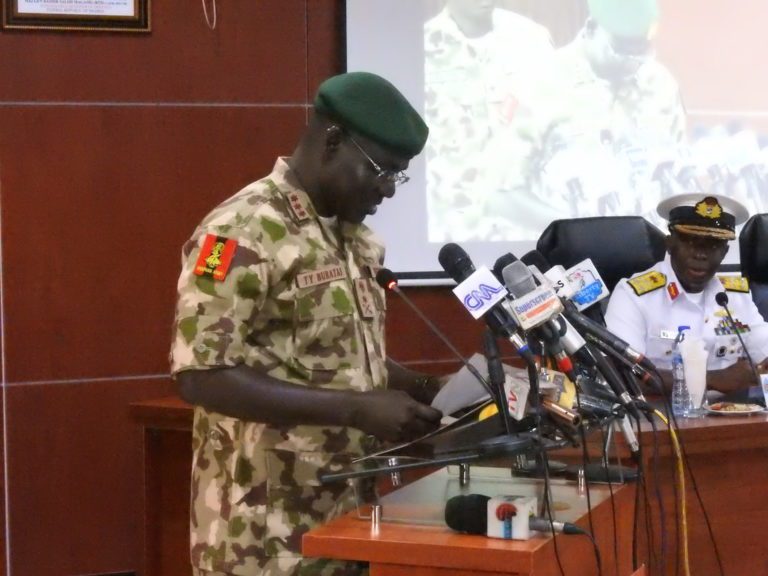
When the current Chief of Army Staff, Lt. General Tukur Yusuf Buratai came on board, it was that obvious that he was worried about the perception of the military by the civil populace and set out quite early to give the average Nigerian soldier a positive image that would make them accepted as integral part of the society and as humane and compassionate as every other member of the society can be.

By 2015 when Lt. Gen TY Butatai assumed command as the Chief of Army Staff, our soldiers were already involved in military operations in many parts of the country including the Northeast where insurgency activities had intensified, in Jos, Plateau State, where there were religious crises as well as in Southern Kaduna and other places.

The presence of soldiers in many of these communities, worsened the perception that they were mainly forces of occupation sent to harass and intimidate the people as well as loot the communities to take spoils of war. Protests were being sponsored against the soldiers with naked women chanting insulting slogans asking the soldiers to leave their communities.

The image of the Nigerian Army clearly needed redemption and that was what the army chief sought to achieve when he assumed office.

Lt. Gen Buratai on assumption of office, in no time,  introduced corporate social responsibility into the Nigerian Army as a way of creating a relationship between the people and the Army.  He knew there was the  need to assure the people that the army in keeping to its constitutional  responsibilities is not out to humiliate the ordinary citizen but to help in checking the activities of unwanted elements who threaten the sovereignty of the state and quickly put some measures in place.

Luckily, the measures he put in place to achieve this fusion began to work as people began to see the army as not only performing patriotic duties, but as those who feel the pain of those communities.

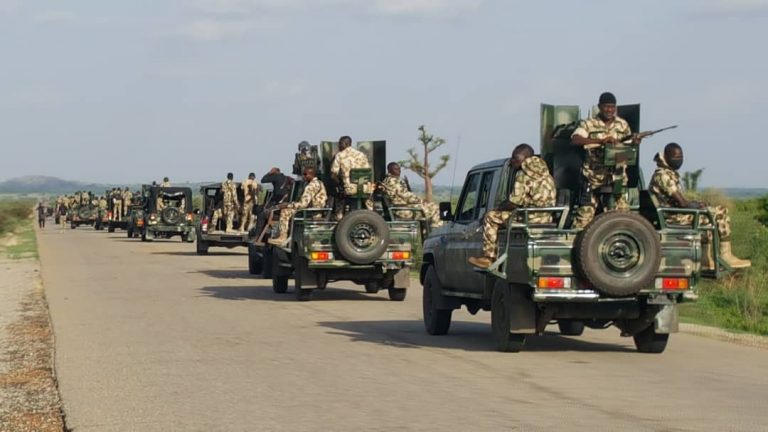
Soon, it became a common sight to see children and women coming out to cheerfully welcome troops anywhere they are sighted for any operation. Nigerian Soldiers were pleasantly surprised when the people of Gwoza in Borno State, an area which has suffered devastating attacks by terrorists in the past, came out to clap and hail them as they were passing through the town after a major operation. It was obvious that the people are beginning to realise that the soldiers are not what they had believed them to be.

Apart from helping to deescalate criminal activities in many parts of Nigeria, the soldiers have undertaken to do more to assure citizens of their good intentions. They have organised classes for warring communities, helped in clearing blocked drainage through environmental sanitation exercises, constructed bridges and other public service structures and donate to communities and have equally engaged members of communities in dialogue.

The Chief of Army staff, for instance, took the level of interaction with the populace at the highest level by personally going to communities and speaking with the people. He has several times gone to Borno and Yobe States to assure communities of the capacity of troops to handle threatening security situations and has been to Katsina, Zamfara and to Birnin Gwari in Kaduna State to have a firsthand impression of the problems there.

In Birnin Gwari, the army constructed a bridge over a stream that made it difficult for vehicles to pass. The army chief also flagged-off the 2 Battalion Forward Operation Base (FOB) in fulfilment of his promise to establish an army formation in the area.

Prior to Birnin Gwari, the army chief laid the foundation stone ‎ for the building  of a military barracks in Kafanchan in Jema’a local government area of Kaduna State in fulfillment of the Federal Government’s promise to establish two military formations in Southern Kaduna to ensure security in the zone.

Then in May 2017, Buratai commissioned the Nigerian Army School of Artillery Officers Mess which provides accommodation for troops when they report to new units before they are quartered. This one may say is for the Army alone but help to bring development n terms of social amenities such as schools, hospitals etc which are shared with the host communities.

One of the most commendable efforts of the army in this regard, is the commissioning of situation rooms for election monitoring to stop violence. This was Lt. Gen Buratai’s way of contributing to a transparent election unlike in the past where soldiers go into unholy alliance with politicians to rig elections in Nigeria. Our last election cannot be adjudged as the best in history but one credible exercise that international observers have continued to laud the role of the Army.

Buratai explained during the commissioning that post election violence which characterized previous elections clearly highlights the challenges posed by incidents of electoral violence in the country, hence he said, the NA saw the need to devise new strategies of stemming such ugly tides or completely eliminate them..

He said,  having observed this cycle of violence reoccur severally in past electioneering processes, the NA has thus deemed it necessary to adopt a proactive and responsive posture that would allow it better respond to early signs of insecurity before they could escalate into a major security challenge.

In the Northeast, the Chief of Army Staff also added value to the lives of the people of the region by building an army university in Biu, one of the local governments being targeted by the insurgents. A development model for the north east mirrored after countries that have witnessed wars in the past and how the scars were wiped out.

Lt. Gen. Buratai also established Nigerian Army Brigades in Monguno, Gubio, Gwoza, Damaturu and Damboa to enhance security in the area. This is because as a war strategist. Gen. Buratai understood that holding a recovered ground is more important in any war than just winning the battle.

He designayed the Sambisa Forest as Nigerian Army Training Area and established a Command Secondary School to help with the education of their children .

The measures have worked to such an extent that these days, when troops are sighted, people no longer run to take cover but come out to shake hands with them. At 157,  the people of Nigeria can proudly call the Nigeria Army their own.

Johnson is a freelance journalist based in Lagos.

You came at a time Nigeria needed you most, proud citizen hails ‘mother’ Sadiya Farouq in open letter

0

A well-meaning Nigerian has described Minister of Humanitarian Affairs, Disaster Management and Social Development, Hajiya Sadiya Farouk as an “epitome of true motherhood” who came at a time Nigeria needed her the most.

Priscila Guoti, who simply dubbed herself as a ‘proud Nigerian’ made this known in an open letter to the minister, published on her social media platforms.

Established in August 2019, the Ministry of Humanitarian Affairs, Disaster Management and Social Development, was among others, tasked with providing humanitarian policies, coordinating humanitarian interventions and ensuring strategic disaster mitigations.

Hajiya Sadiya was saddled with the responsibility of piloting this infant ministry and Guoti believes that decision by President Muhammadu is a shrewd one.

Guoti said Hajiya Sadiya’s “passion to work for the upliftment of the vulnerable in the society” propelled her into writing the letter.

Outlining the minister’s impact barely one year in office, Gouti added that the ” efforts you put in during the Covid-19 lockdown saw to the delivery of palliatives to thousands of persons”.

She further disclosed that, “your initiative not to relax the school feeding programmes but to extend it to homes was another brilliant idea that helped indigent families to continue the mental and physical building of their children”.

According to the Lagos-based lady, the minister’s biggest achievement yet is the introduction of the N-Power Batch C sheme which could potentially benefit 4,000 young Nigerians.

While applauding her dedication and commitment to the job, Gouti, however, urged Hajiya Farouq not to relent or distracted by enemies of humanity, assuring her of the prayers of Nigerians.

Read full letter below:

It is said that when a child looks into a mother’s eyes while being carried in her arms, you’ll know that is the purest love he has found on earth; because, a mother’s arms are made of tenderness and love.

Though you are not our biological mother, the brief period you have stayed in office has given us; we, the women of Nigeria, the kind of joy a child gets when in the arms of a loving mother.

Since you were appointed a minister in the cabinet of President Muhammadu Buhari and given a portfolio that requires compassion and love for the people,  I have noticed your passion to work for the upliftment of the vulnerable in the society and that is why I have decided to write a public letter to you.

I apologise if my action will cause you any embarrassment, but I think it will be the height of ingratitude to see something going well and fail to commend it for fear of being labelled.

Honourable Minister, I have seen the uncommon intellect you have brought to bear in the ministry of humanitarian affairs and the energy you have devoted to working out programmes that would see to the development of the society at large and I commend your efforts.

President Buhari is indeed a visionary leader for him to have created a ministry that would take care of emergencies and appointed you as its minister even when there was no outbreak of the coronavirus Pandemic.

One cannot imagine what would have happened if the ministry of humanitarian affairs was not created and you appointed as a minister when the pandemic broke out.

The efforts you put in during the Covid-19 lockdown saw to the delivery of palliatives to thousands of persons and the ministry was able to reach out to an equal number of households with relief items.

I am based in Ikeja,  Lagos State, and as a small scale business owner who was compelled to close her shop for months, I have seen the effect of your work on our women who collected various sums of money and food items that helped them in surviving the lock down period.

Your initiative not to relax the school feeding programmes but to extend it to homes was another brilliant idea that helped indigent families to continue the mental and physical building of their children.

This has turned out to be a most welcome idea because of the impact on children and the relief it brought on their parents who were under pressure to provide for them when no economic activity was going on was massive.

Honourable Minister, one of the most important things you have done which promises to profoundly affect the lives of people positively is the introduction of the Batch C, N-Power Scheme.

The programme when it was introduced in 2016 sounded to us like a fairly tale until we started seeing beneficiaries making good use of their earnings under the programme to start businesses and raise the living standards of their families.

By the time we began to appreciate how the government was helping people, it was too late for those of us who had not applied.

Honourable Minister, if not for you, the 5,000 beneficiaries of the first and second phases of the programme would have continued even when many of them have been able to establish their own businesses while some of us that missed the first and second flights would have been left stranded at the airport.

But your intervention, has opened a window of opportunity for fresh set of 4,000 people to enrol and our joy knows no bound.

Though our applications are yet to be confirmed, the hope that there’s a possibility for some of us to qualify and be paid about N30,000 a month means a lot to us.

I am not asking for any favours or undue considerations over others, my concern is that more people would have the opportunity that others have had which have stabilised their families and given them a legitimate source of livelihood.

Even if I don’t qualify, the fact that some other people would, gives me great joy as the overall impact would also trickle down on me.

I have heard some people trying to criticise the initiative due to one reason or the other but I will advise you to remain focused and not shift ground because you have taken the right decision that would broaden the scope of poverty alleviation in our country and bring succour to many.

You have come a time when Nigeria needs you most as the post-pandemic era threatens to come with its challenges.

We implore you Honourable Minister to once again use your out-of-the-box calculus to see to the success of the N-Power Batch ‘C’ programme or introduce new schemes that will focus on the plight of rural women.

Honourable Minister, you must not be distracted by whatever names the enemies of humanity are calling you.

You must remain focused and committed to the virtues of accountability, humility and kindness to succeed as the success of the programmes you have embarked on so far all bear testimony to your courage and integrity.

Do not relent and I can assure you that we will continue to pray for you to succeed.

Breaking: Shekau, Chibok girls’ location revealed by counter- terrorism expert

0

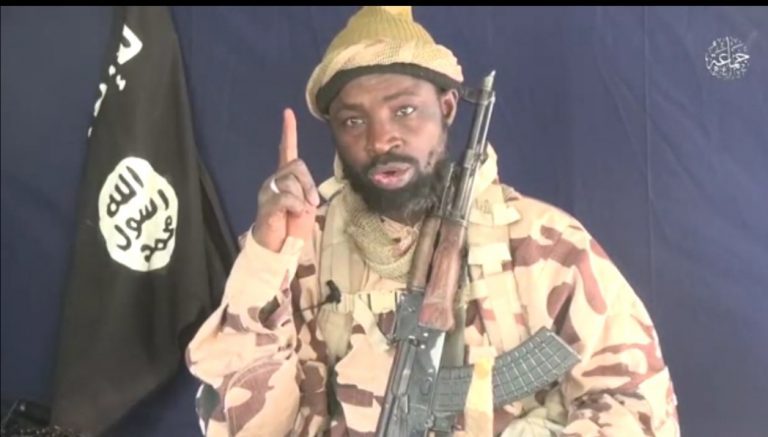
The location of major Boko Haram commanders and leaders such as Abubakar Shekau and the Chibok girls have been revealed by a counter terrorism expert, David Ottu.

In his recent article, the respected specialist revealed amongst others that the remaining Chibok girls have  converted to Islam with their names changed to prevent ever being located by experts and investigators.

Read his full article below:

All the remaining Chibok Girls in the custody of Boko Haram JAS faction have converted to Islam and changed their names permanently. This is to escape any chances of being identified and rescued from captivity by the Nigerian security and intelligence apparatus from jihadist remote camps in the Sambisa Forest – North East Nigeria.

Impeccable sources with inside knowledge of the Al-Qaeda and ISIS linked Jihadist operations in the region confirmed that about 10 of the abducted Chibok secondary school girls currently camped at Garin-Maluma and Sabil-Huda had ‘voluntarily’ converted to Islam and selected new Muslim names. Converting to Islam requires a change of names but in the case of the Chibok girls, their identities have been changed entirely to prevent any planned identification and rescue mission from the Nigerian government. Some of the common Muslim names they selected for themselves  include Maryam, Falmata, Zara, Rukkayya and Summayya among others.

The ‘Chibok Syndrome’:

Almost all of the abducted Chibok girls are now married with children (some as many as 4) to some influential Boko Haram commanders – some for the second or third time after their jihadist husbands were neutralised in battle or other conflict circumstances. After 6 years in captivity, there is a strong case to suggest that the remaining Chibok girls have accepted the lifestyle  in the Sambisa Forest as the new normal and adapted to the new environment – drawing similarities to an advanced form of ‘Stockholm syndrome’.

Chibok School Girls Abduction:

A JAS Boko Haram faction stormed a remote town of Chibok, Borno State and abducted more that 200 girls from Chibok Secondary school in March 2014. Less than 6 months (August 2014) after the mass abduction, Abubakar Shekau proclaimed an Islamic Caliphate after his fighters overran the border town of Gwoza – Borno State.

The over 200 Chibok school girls were abducted by Boko Haram primarily to serve as wives and domestic servants for young jihadist fighters in the so-called Caliphate. However global condemnation and outcry from prominent individuals, activists, and organisations across the globe for the immediate release or rescue of the Chibok girls turned the largely Christian girls from potential wives to golden bargaining chips for Boko Haram unit commanders to hold the Nigerian government and security services ransom.

So far, 107 Chibok girls have been released or found through negotiations by the Nigerian government, local actors, international partners and lucky escapes. More than half of the suspected number (about 112) of abducted girls are still reported as missing. After years in captivity, sources say some of the Chibok girls have joined Boko Haram terrorists group as active fighters and have refused to be selected for any release deals. Others have been given or sold out as wives to ‘deserving jihadist commanders’ – some have died in the conflict circumstance.

Dapchi Girls Kidnap:

The security situation became complex in Northern Nigeria following a February 2018 copy-cat abduction of 110 girls by the Boko Haram splinter faction -Islamic State of West Africa Province (ISWAP). The girls were abducted in Chibok style from government science and technical secondary and school,  Dapchi in neighbouring Yobe State.
A quick negotiated intervention supported by local actors, state and Federal authorities, led to the immediate release of all the ‘Dapchi girls’ except Leah Sharibu, the lone Christian student who refused to be converted to Islam. Sources close to ISWAP faction say ISIS leadership had advised the new ISWAP Wali – Abu Musab AlBarnawi (Habib) that all the Muslim girls be released without delay.

The Nigerian Army that had been mobilised to search and rescue the abducted girls was drafted in to stand down and give ISWAP fighters a safe passage to return the young school girls. In an effort to secure hearts and minds of the local Muslim population, ISWAP fighters who accompanied the girls took advantage and held religious sermons with the local population and told them that the western countries, the government of Nigeria and anyone who supports them were their real target and enemies, not the local population. The Federal government of Nigeria, security services and state authorities have consistently promised to rescue all those in Boko Haram and ISWAP captivity.

Boko Haram Leader Operation Theatre:

In a related development, the command and control location where Boko Haram/JAS leader conducts jihadists operations and religious sermons during the day has been revealed. The alleged location was given as “Sabil-Huda” (an enclave located deep in Sambisa Forest). However sources said that the place is  known within the jihadists circle only as “Farisu.” The insurgents led by Abubakar Shekau, other senior commanders and members of the Shura council usually converge in the highly fortified ‘Farisu’ camp to observe Friday Jummat prayers at an approximate local time of 12:30pm and 1:00pm. Other nearby active camps in ‘Farisu’ which host thousands of jihadist fighters, abducted women and children include Garin Kago, Garin Maluma, Daurul Tauhid and Tokombare etc.

Many of the active Boko Haram camps in ‘Farisu’ have been bombarded by the Nigerian Army artillery and Nigerian Air Force bombs several times but because of the strategic position, the insurgents always find a safe haven in ‘Farisu’ to conduct their activities. Sabil-Huda or ‘Farisu’ also serves as a jihadists market for the sales of basic items such as telephone cards, charging of phones and provision stores.

The bloodthirsty jihadist leader is known to command and control about 25 Boko Haram jihadist camps headed by unit commanders within remote locations in the deep and marshy Sambisa Forest. Sources with knowledge of these camps say each Boko Haram camp is likely to contain approximately 1000 fighters. A number that has been significantly diminished by ongoing precision aerial strikes from the Nigerian Air Force, Nigerian Army under the auspices of Operation LAFIYA DOLE and the Multi- National Joint Task Force (MNJTF). It is impossible to verify the actual number of Boko Haram fighters in these mostly remote camps given Jihadist commanders have been notorious for inflating the number of unit fighters managed within their camps to claim for operational ‘expenses’, other essential resources from their sponsors and for propaganda.

Hideout of Abubakar Shekau:

Sources further revealed that the permanent hiding place of Abubakar Shekau is a protected location within the thick and rocky forest of Firgi. Shekau relocated to Firgi forest after the Nigerian Army under leadership of Lt.Gen. Yusufu Tukur Buratai — ‘Operation LAFIYA DOLE’ overran Shekau’s hideout in Sambisa forest  in December 2016 and again as recently as March 2020.

The erratic and bloodthirsty leader  is protected by 10 loyal special fighters. He retains possession of about 40 Toyota Hilux mounted with Anti-Aircraft guns, 2 Armoured tanks and 2 APCs, all carefully concealed under the thickness of the Firgi forest. His selected location provides absolute camouflage from the aerial radar of the Nigerian Air Force reconnaissance. Shekau sleeps in refurbished deep natural tunnels protected by heavy rocks with mines planted at vulnerable locations. His  final location is only accessible by foot and only a selected handful of his body guards are allowed to enter his last dungeon.

Abubakar Shekau is an example  of the proverbial cat with 9 lives and remains the most wanted Boko Haram leader by the Nigerian Army, regional and international states. No doubt, he will be replaced by another leader when he dies or killed. The Chibok girls and Leah Sharibu remain the most searched for girls in the history of terrorist mass kidnap. As far as a long term and sustainable Counter insurgency (COIN) strategy is concerned, the focus of the Nigerian government and regional MNJTF should be on releasing and rescuing all captives while ensuring that current battlefield ground and aerial efforts are not undermined from within and without.

Author:
David Otto, CMAS – Global Counter Terrorism & Organized Crime Expert and Founder of the conflict resolution programme – Step-In Step-Out (SISO) UK. Twitter: @ottotgs

COVID-19: Humanitarian Affairs Minister, Sadiya Farouq, gets kudos for transparent administration of aides to poor Nigerians

0

Minister of Humanitarian Affairs, Disaster Management and Social Development, Hajiya Sadiya Farouq, has received applause for her supervision and transparent administration of aides to the poorest Nigerians to cushion the effect of the coronavirus.

This was contained in a report by the  Coalition for Good Governance (CGG), signed by Comrade  Mohammed Abu, after a critical assessment of the various social interventions in the country.

The report also lauded the minister’s management of emergency issues and the N-Power scheme which recently began enrolling Batch C.

It added that under her supervisory agency, the National Emergency Management Agency and North – East Developmemt Commission is reaching out to Nigerians in need of help with the speed of light.

After considering the millions of less-priviledged and young Nigerians impacted, the coalition concluded that Hajiya Farouq has lived up to expectations, setting a lofty standard in governance and administration in the country.

While calling on the Federal Government and relevant stakeholders to sustain its support for the minister, CGG, in its report, however, urged Nigerians to key into her amiable projects.

Read full report below:

Introduction:

The outbreak of the novel Coronavirus pandemic across the globe has had some effects on the economies of most countries, Nigeria inclusive. It is against this backdrop that the governments of various countries put in place various measures and interventions to cushion the effect on the lives of their citizens.

The Coalition for Good Governance as part of its focus on the socio-economic situation in the country undertook a critical analysis of the various interventions by the federal government through the Federal Ministry of Humanitarian Affairs, Disaster Management and Social Development.

The analysis touched on various sectors of the economy and how well the government responded and the impact of such inventions on the lives of the ordinary citizens who are worse hit by the Coronavirus pandemic.

COVID-19 Crisis Intervention Fund:

The federal government established a N500 billion COVID 29 Intervention Fund to upgrade healthcare facilities and fund special public works programmes to generate employment, with the adequate framework for the collection management and reporting of donations into the fund. COVID 19 donor accounts formed part of the existing TSA arrangement in some select commercial banks across the country.

Direct food/ cash distribution by FGN:

The FGN directed the implementation of direct food/ cash distribution to 2.6 million households comprising the most vulnerable. This vulnerable group comprises those who are resident around the satellite and commuter towns and communities in Lagos and Abuja and earn daily wages for their sustenance, such as artisans and petty traders.

The N-Power Scheme:

The federal government has commenced the expansion of the N-Power scheme to accommodate more youths in the country. The government consequently introduced the commencement of the Batch-C Stream to accommodate over 500,000 youths across the country.

The Role of the Federal Ministry of Humanitarian Affairs, Disaster Management and Social Development:

The Federal Ministry of Humanitarian Affairs, Disaster Management and Social Development is mandated to carry out the social intervention programmes of the federal government under the auspices of the National Social Investment Programmes.

The outbreak of the coronavirus pandemic indeed tasked the ministry to live up to expectations in ensuring that the effect of the coronavirus on the lives of the vulnerable and the poorest of poor are mitigated.

Our Assessment:

The Coalition for Good Governance after a critical assessment of the various social interventions carried out by the federal ministry of humanitarian affairs, disaster management and social development wishes to state that the ordinary citizens indeed felt the impact of the various interventions of the federal government in the country.

The Honorable Minister of Humanitarian Affairs, Disaster Management and Social Development, Hajia Sadiya Umar Farouq indeed displayed an unalloyed level of commitment to alleviating the plight of the less privileged across the country.

Her steadfastness in ensuring a transparent process in the distribution of conditional cash transfer is indeed outstanding and largely responsible for the success of the initiative.

The Coalition for Good Governance wishes to state that the Honorable Minister indeed lived up to expectation by providing sound leadership guidance for the implementation of the COVID 19 response plan of the government on the lives of the ordinary citizens in Nigeria.

It indeed suffices to state that it wasn’t business as usual as the distribution of monies and food items meant for the vulnerable groups were strictly monitored through an enhanced feedback system the detects any shortcoming on the part of the field officers.

The winding down of the Batch A and B streams of the N-Power scheme and the introduction of the Batch C Stream is indeed commendable due to the impact it would have in the lives of over 500,000 youths across the country.

This is another testament of the efforts of the Honorable Minister in implementing the social intervention policy of the Muhammadu Buhari administration as a means of cushioning the impact of the coronavirus pandemic in the country.

This noble initiative reinforces the commitment of the Muhammadu Buhari administration in touching the lives of the youths and ordinary citizens in numerous ways in line with his electoral promises.

The Coalition for Good Governance acknowledges this fact. It reiterates that the various social intervention programmes of the federal government have been a huge success under the supervision of the Honorable Minister of Humanitarian Affairs, Disaster Management and Social Development.

Conclusion:

The Coalition for Good Governance having studied the socio-economic situation in the country with regards to the implementation and the management of issues that affect the less privileged and youths in the country wishes to state that the Honorable Minister of Humanitarian Affairs, Disaster Management and Social Development has lived up to expectations by setting a lofty standard in governance and administration in the country.

Her passion for her job is evident in the giant strides recorded in the federal ministry of humanitarian affairs, disaster management and social development since assumption of office. This is aside the proactive steps taken in disaster management in the country.

Recommendations:

The Coalition for Good Governance having stated the above wishes to make the following recommendations:

That the federal government of Nigeria should as a matter of necessity continue to give the required support to the ministry of humanitarian affairs, disaster management and social development in the implementation of the various social intervention programmes in the country.

That all relevant stakeholders should continue to extend their support and understanding to the honourable minster in her quest to promote Human dignity and integration of basic humane benevolence and compassion in the treatment of all Nigerians.

That all Nigerians must support the federal government’s efforts towards alleviating the sufferings of the ordinary citizens in the country by showing support to the activities of the ministry of humanitarian affairs, disaster management and social development.


International NGOs complicit in Boko Haram activities in North-East Nigeria, report reveals

0

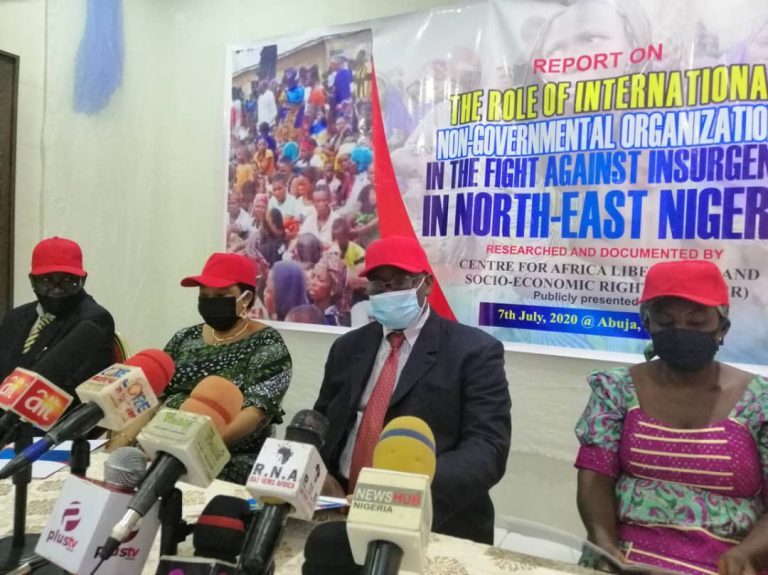
A report by the Centre for Africa Liberation and Socio-Economic Rights (CALSER) says some international non-governmental organizations (INGOs) are culpable of unlawfully aiding Boko Haram/ISWAP activities in North-East, Nigeria.

Instead of providing humanitarian assistance to victims of the Boko Haram crisis, CALSER said these INGOs bolster and encourage the carnage being perpetrated by the insurgent group.

This and other findings were made public on Tuesday in a report compiled by CALSER and signed by Executive Director Dr. David Idoko in Abuja.

The centre raised alarm over the number of INGOs in operation in the North-East under various nomenclatures.

According to CALSER, there is multiple evidence that funds from the coffers of these INGOs – most of which come from Francophone countries – end up in the hands of terrorists,.

While some of these groups divert food and other relief items meant for the IDPs to the camp of the Boko Haram terrorists, the centre added that others provide them with medical services.

More baffling, though, the centre disclosed that certain INGOs engage in propaganda on behalf of the Boko Haram group, especially when they come under heavy bombardment from the Nigerian troops.

Among others, however, CALSER urged relevant authorities to compel international NGOs operating in the North-East to disclose their sources of funding as well as their mission.

It added that INGOs that have operated for more than five years and made no significant impact in tandem with their mission should be expelled from the country.

Meanwhile, those found to be aiding and abetting the activities of Boko Haram terrorists should be proscribed and expelled from the country with immediate effect.

Read full report below:

Introduction:

The war against insurgency in Nigeria has come with its attendant socio-economic consequences in the economy of North-East Nigeria since 2009 when the Boko Haram group began its violent campaign.

There have been concerted efforts by the federal government in Nigeria to address the challenges, and this has seen to the deployment of troops to the theatre of operations in North-East Nigeria. Aside from these interventions by the government, some international NGOs have also been involved in mitigating the effect of the war in the region by providing humanitarian assistance to compliment the efforts of the government.

This is on the heels that the role of international non-governmental organizations (NGOs) in wars situations and the consequences of their presence for the dynamics of these conflicts cannot be overemphasized. More important for their influence is the financial resources that they can command, which, in no small extent, derive from their close association with donor governments, as their implementing partners.

This complex relationship between donor governments and NGOs has contributed to an increasingly political role of NGOs and has undermined some of the benefits resulting from their non-state character.

This is aside the fact that the presence of NGOs in conflict zones is hardly a new phenomenon. The International Committee of the Red Cross has cared for the victims of modern conflict situations for some time. More recently, a number of international humanitarian organizations like Care International, Oxfam, ActionAid among others have been highly visible players in coping with disasters.

What is different about the human rights NGO activism in zones of conflict is that many groups are now playing a leading role in trying to defuse nascent or full blown conflicts, as opposed to just cleaning up the human suffering that results.

NGOs have developed a wide range of conflict prevention and resolution activities including monitoring conflict and providing early warning of new violence; opening dialogue between adversarial parties; playing a direct mediating role; strengthening local institutions for conflict resolution; and helping to strengthen the rule of law and democratic processes in countries affected by violent conflict.

Like international relief agencies, NGOs focusing on conflict resolution respond to major failures on the part of the international community to deal effectively with global problems. Too often, intergovernmental bodies and agencies have proved too slow and cumbersome in dealing with emerging urgent crisis situation as demonstrated in Bosnia, Rwanda, Somalia, DRC and Darfur. Also, both international agencies and governments often have institutional and political limitations that hamper their effectiveness in situations of enormous complexity and delicacy.

NGOs facilitate up to date extensive fact-finding missions, engage in dialogue with a wide range of groups involved in conflicts, map out strategies for defusing conflict and galvanize action by national governments and international organizations to help stabilize tense situations. Situations in Burundi, Northern Uganda, Southern Sudan, Darfur, DRC and Rwanda provide examples of where NGOs have played a decisive role in heading off major conflicts.

However, despite the critical role that NGOs have continuously played in helping to stabilize the conflict situations, the future engagement of NGOs within the international agencies and governments, remains vague. Partnerships between NGOs and governments or international agencies are inherently difficult and awkward. NGOs are on one hand strong critics of these agencies and government policies.

In the case of Nigeria, there seem to be widespread condemnation of some of the activities of INGOs wherein accusations have been made by the government and the citizens alike on the culpability of these organizations in the ongoing Boko Haram crisis in North East Nigeria. This situation has brought about mutual suspicion on the role of international NGOs in the fight against Boko Haram Insurgency. Consequently, this report seeks to examine the role of international non-governmental organizations (NGOs) in the Boko Haram conflict in North-East Nigeria and the consequences of their presence for the dynamics of these conflicts.

Issues:

Provision of Humanitarian Assistance:

The role of non-governmental organizations (NGOs) in humanitarian relief has thrived in recent years, but that rise has been characterized by a changing and increasingly difficult strategic and operating context for these entities.

Paradoxically, while perhaps never more significant, relief organizations now confront more opaque and more problematic strategic environments as well as a variety of enduring and bedeviling operating level challenges. At the strategic scale, NGOs are dependent upon the often unpredictable decisions of critical states for funding, are enmeshed in a service delivery structure characterized by competition, complexity, and diffuse authority and accountability and are divided as well by growing differences in how participating organizations define their identities, especially in light of more than a decade of experience with human rights-related humanitarian interventions.

The case of Nigeria presents a very delicate situation for a number of reasons. The number of INGOs in North East Nigeria is alarming and under various nomenclatures. The activities of some of these INGOs runs short of providing humanitarian assistance to victims of the Boko Haram crisis, but rather they seem to bolster and encourage the carnage been perpetuated by the insurgent group.

Findings from the theatre of operations in North East Nigeria corroborates this position, which has led to a running battle with the military authorities striving to begin the profiling of some of these organizations in a bid to identifying those with clearly defined mission and objectives and those acting as spies or carrying out espionage activities on behalf of the Boko Haram group.

The Nigeria INGO Forum:

Findings revealed that the INGOs in Nigeria have come together under a platform called the Nigeria INGO Forum, with a mission to provide a joint platform for INGO members to promote a collective approach to efficiently and effectively coordinate interventions and address key issues of common interests.

To also provide a coordinated approach through which INGOs, the Government of Nigeria (GoN), the UN, donors and other external stakeholders can exchange information and shared expertise, and establish guidelines for a more coordinated, efficient and effective use of aid resources in Nigeria.

NIF was established in 2014 to facilitate the coordination and cooperation of humanitarian and development INGOs and between INGOs and external stakeholders including Government of Nigeria, Nigerian civil society, UN agencies, diplomatic actors, and donors. In 2014, membership of NIF was fourteen (14) agencies and by the end of 2019, NIF has increased to forty-seven (47) members including six (6) observers.

Findings also indicate that there are over 50 more of such INGOs that were not captured as members of the NIF, yet they are actively present in North East Nigeria. And this indeed calls to question on the activities of these INGOs.

Funding for Terrorist activities:

The peculiarity of the Boko Haram crisis in North-East Nigeria is such that the illicit flow of funds has mainly contributed to the festering of the Boko Haram crisis. It has been argued in some quarters that the Boko Haram group enjoys funding for their activities from the unlikely of sources that include politicians that are benefiting from the crisis, bank robberies, kidnappings for ransom, as well as funds from the terrorist network around the world.

This fact has been stated and evidence provided, especially with the array of INGOs in operation in North-East Nigeria. While it can be stated some of the INGOs have ulterior motives with regards to their operations in North-East Nigeria, it can thus be argued that indeed the activities of some of the INGOs in operation in North-East Nigeria portends grave danger if urgent and proactive steps are not taken to curtail their excesses by the relevant authorities.

The military authorities have not been successful in tracking the inflow and disbursement of millions of dollars that have passed through the coffers of the INGOs in North East Nigeria. The discreet nature of their transactions has made matters worse.

While there are multiple evidence that suggests that funds from the coffers of these INGOs end up in the hands of the Boko Haram terrorist group, it was also established that most of these funds do come in the country from the francophone countries in cash.

The military authorities have on numerous occasions intercepted huge foreign currencies meant for delivery to the Boko Haram group by some of the INGOs under the guise of purchasing relief materials for IDPs.

Boko Haram has depended on financial donations from sympathizers and external funding for it operations. In 2002, Osama Bin Laden sent an aide to Nigeria with $3 million. Bin Laden’s aide was instructed to disperse the money among groups that believed in Al-Qaeda’s cause. The International Crisis Group reported that Boko Haram received some of that money, but the exact amount is undetermined.

In March of 2015, the current leader of Boko Haram, Abubakar Shekau, pledged allegiance to Abu Bakr al Baghdadi, the leader of the Islamic State of Iraq and Syria (ISIS). Later that month ISIS’s English-language magazine approved of the alliance with Boko Haram.

When ISIS accepted Boko Haram’s pledge of allegiance, an ISIS spokesman informed fellow Muslims looking to join its ranks that “a new door for you to migrate to the land of Islam and fight” had opened within Africa.

In April of 2016, the commanding general of the U.S. Special Operations Command Africa (SOCAF), Brigadier General Donald Bolduc, said that ISIS and Boko Haram are increasingly sharing “tactics, techniques and procedures.” General Bolduc highlighted that an ISIS weapons convoy was detected departing Libya and believed to be headed to the Lake Chad region to provide support to Boko Haram.

Boko Haram has not only depended on external funding, throughout its movement it has received financial support from local sympathizers and politicians. Many Northern Nigerian politicians have also been accused of giving Boko Haram financial support over the years.

Nigeria and the international community over the years have struggled to suppress Boko Haram’s ability to raise money. The Nigerian government has had some success in highlighting Boko Haram’s financial support network within Nigeria and internationally. Since the election of President Muhammadu Buhari in May of 2015, Nigeria has seen positive gains in its fight against Boko Haram. The MNJTF has been successful in regaining control of territory once occupied by Boko Haram, the majority of which is territory from which Boko Haram launched many of its kidnapping and bank robbery operations. Depriving Boko Haram of territorial safe havens will cut into its ability to generate funds. With recent military success and positive results in implementing follow the-money tactics, Nigeria, with the help from the international community, can further disrupt Boko Haram’s ability to fund its existence.

With Boko Haram’s illicit trafficking operations taking place across borders, the Nigerian government should enhance border security operations. Increasing border security will impact Boko Haram’s ability to move freely across borders and its ability to take part in illicit trafficking. Impacting illicit trafficking will need to be done through multilateral cross-border cooperation. The Nigerian government and its neighbors should be willing to work together to secure their borders to impact Boko Haram’s finances.

The International NGOs in North-East Nigeria:

The number of international NGOs in operation in North-East Nigeria is indeed alarming according to findings from this report. More worrisome is the fact that most of these organizations have no clear cut description of their mission.

Some come under various nomenclatures and enjoys massive funding from donor countries. Worthy of mention is the number of French NGOs in North-East Nigeria. This report was able to identify that these NGOs have been in operation for close to nine years, and most of them have paid for hotel accommodations for upward ten years at a go.

This statement of fact indeed buttresses the position of the Nigerian Military that indeed some international NGOs are aiding and abetting the activities of the Boko Haram terrorist group. A good example can be found in places visited like Maiduguri, where supposedly large shipments of humanitarian items are imported into the country by some International NGOs. These items end up in the camp of the Boko Haram group.

INGOs in the northeast provide humanitarian support to terrorists in violation of international protocol and laws:

It was also observed that INGOs in the northeast provide humanitarian support to Boko Haram terrorists in violation of international protocol and laws. They divert food and other relief items meant for the IDPs to the camp of the Boko Haram group. In most instances, some medical NGO have been reported to be providing medical services to injured Boko Haram members, which goes against the provisions in the International Humanitarian Law in armed conflict situations.

This fact was buttressed from revelations from locals in some communities that stated that there are numerous instances where some INGOs move truck load of food items and medical supplies and abandon them in the middle of nowhere and before dawn these trucks and the items would disappear.

It was stated that some INGOs move about with unmarked trucks which makes it difficult to track their identities. The reason for this it was gathered was to leave no trace behind for the military to trace. This is also on the heels that there have instances where the military intercepted such consignment and it lead to the suspension of one of the INGOs operating in North East Nigeria for distributing food and other essential items to the Boko Haram group.

INGOs in the northeast engage in the blackmail of the military:

This report was able to uncover that the bulk of the information about the operations of the Nigerian military in North-East Nigeria are untrue. As a statement of fact, some INGOs engage in propaganda on behalf of the Boko Haram group, especially when they come under heavy bombardment from the Nigerian troops.

This much was gathered from multiple sources in North-East Nigeria, and it further lends credence to the position of the Nigerian Army and other critical stakeholders.

The report also revealed that some foreign interest contracted some well-known INGOs in Nigeria to act as the intellectual arm of the Boko Haram group through the issuance of press statement and reports accusing the Nigerian Military of human rights abuses. These tactics are meant to cause a distraction when there seems to be intense pressure on the Boko Haram group.

Multiple sources in North East Nigeria corroborated this fact wherein it was stated some INGO often visit IDP camps with recording devices and throw food items in the air for IDPs to scamper for while recording them to paint a picture despair.

It was also gathered that the bulk of the rape allegations made against the military in IDP camps were fabricated by some INGOs who offer young girls and women monies to appear before the camera to make such allegations.

It was also discovered that the reports by some INGOs is intended to present Nigeria as a country with a military that has no good reputation, which would in turn make the country ineligible for international support. The strategic aim of the INGOs is to scandalize the military to a point where the only option left is to withdraw troops from areas where they are operating, which would create an environment that would be conducive for a Boko Haram comeback to terrorize people in these places.

INGOs engage in human rights abuses:

The Universal Declaration of Human Rights (UDHR) was unanimously adopted and proclaimed by the United Nations through the General Assembly Resolution 217A(111) on the 10th of December, 1948. Since its declaration, it has become fashionable for most countries of the world (Nigeria inclusive) to entrench the catalogue of rights in their national constitutions. Regrettably, in Nigeria, some INGOs have been carrying acts against the provisions of the Universal Declaration of Human Rights through their activities in North-East Nigeria.

The activities of INGOs in North-East Nigeria also transcend the various allegations of complicity in the festering of the Boko Haram crisis. It was also gathered that most of the INGOs are perpetrators of gross human rights abuses.

Some INGOs in North-East Nigeria are actively involved in human trafficking and exploitation. There is a particular case of a French NGO that carries out documentaries in IDP camps depicting a picture of gloom as against the wishes of women and children and they consequently send these documentaries to donor organizations soliciting for funds. They are also notorious for other inimical acts that are dehumanizing to IDPs in their various camps.

Some INGOs in North East Nigeria have also been identified to be notorious for making locals go against their wishes to coercing them into making submissions and divulging information about their communities which ultimately ends up in the hands of the Boko Haram group to aid their operations.

It was discovered that extracting such sensitive information about the movement of the military in the area on security surveillances ultimately leads to the series of ambush carried out by the Boko Haram group against the military.

Conclusion:

The Centre for Africa Liberation and Socio-Economic Rights after an extensive review of the activities of some INGOs in North-East Nigeria concludes that they have not helped much in line with their mandate. What can be seen in any case is a betrayal of these roles and responsibilities and a total waste of donors’ resources in pursuing narrow interests in the country.

These INGOs have acted against all known international protocol in rendering humanitarian assistance to victims of the Boko Haram insurgency in North-East Nigeria, as they have turned the crisis to a viable business venture and this has seen to the perpetuation acts that undermine the efforts of the Nigerian military towards decimating the Boko Haram terrorist group.

Recommendations:

The Centre for Africa Liberation and Socio-Economic Rights in the light of the forging recommends the following to be implemented by the relevant agencies in Nigeria in a bid to address the various challenges posed by the activities of INGOs in North-East Nigeria.

INGOs operating in North-East Nigeria must be made to disclose their sources of funding to the Nigerian government in a bid to entrench a regime of transparency and accountability.

INGOs operating in the country must make full disclosure of their mission and comply with strict laws and regulations to be put in place.

INGOs that have operated for more than five years and made no significant impact in tandem with their mission should be expelled from the country.

INGOs found to be aiding and abetting the activities of Boko Haram terrorists should be proscribed and expelled from the country with immediate effect.

INGOs should publish periodical financial transactions in line with the National Financial Intelligence Unit and other extant laws.

The Nigerian government and international community must adapt and find ways to prevent Boko Haram from funding its operations.

DSS Bars Newsmen from Panel Investigating Magu at the Villa

0

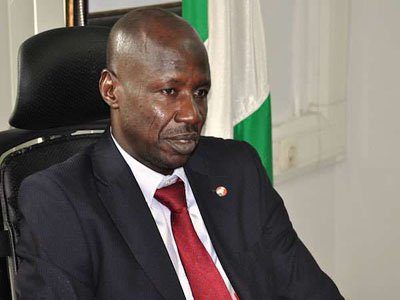
State House Correspondents were on Monday bared from accessing the Banquet hall of the Presidential Villa, Abuja, venue where the embattled Acting Chairman of the Economic and Financial Crimes Commission (EFCC), Ibrahim Magu was being grilled for alleged infractions against him by a panel comprising men of the Department of State Services (DSS).

The EFCC boss was reported to have been arrested by the DSS when his vehicle was said to have been stopped in traffic while moving out of the Wuse II Annex of the EFCC office in Abuja and the invitation was extended to him.

But the DSS, in a statement on Monday clarified that it did not arrest the Acting Chairman of the EFCC ”as has been reported by sections of the media.”
Public Relations Officer, DSS National Headquarters, Peter Afunanya said, ”the Service, has since, today, 6th July, 2020, been inundated with enquiries over the alleged arrest.”
The venue was being secured by the Special Force (SF) wing of the DSS when the newsmen made to access the Press Center situated atop the Banquet Hall, before a plain clothes security detail asked the journalists to leave the facility.
The press had arrived the venue to cover the event at about 3.20pm.

“They said you people should excuse the use of this place for today, ” the Operative said.

The investigative panel was constituted by President Muhammadu Bubari penultimate week following allegations that he owns four choice properties and was laundering funds abroad through a third party.

The main opposition – Peoples Democratic Party (PDP), Friday said the memo by the Attorney General of the Federation, Abubakar Malami, indicting the acting chairman of the Economic and Financial Crimes Commission, of financial scam, has further exposed the corruption, deception and hypocrisy that pervade the President Muhammadu Buhari-led government

”It is the worst national embarrassment in the history of Nigeria, that the head of anti-corruption agency in an administration that prides itself on zero tolerance for corruption, is being dragged on allegation of diversion of recovered funds and fraudulent sale of assets seized by the agency.”

In a statement issued by the national publicity secretary of the party, Kola Ologbondiyan, the party noted that Malami’s memo has “exposed the credentials of President Muhammadu Buhari’s anti-corruption architecture, rubbished his standing as Africa Union(AU) anti-corruption champion and shattered our national integrity in the international arena,” the statement said.

The statement further read: “The world can now see that the much hyped anti-corruption fight of the Buhari administration, has been nothing but a huge fraud and a racket by certain persons in the APC administration to harass political opponents, intimidate and extort money from innocent Nigerians and steal public funds.

“Nigerians and the world have further seen why corruption has worsened under the Buhari administration, as copiously documented by credible international organizations, including the Transparency International, TI.

“Indeed, our party, Nigerians across board and of course, members of the international community, have completely lost confidence in President Buhari’s capacity to fight corruption as he has not demonstrated the littlest effort against corruption since he came into office in 2015.

“Instead, Mr. President had continued to run a system that condones corrupt practices by officials of his administration while providing cover for individuals indicted for corruption including those who are now serving as cabinet ministers and other federal appointees in his government.

“The PDP recalled that President Buhari had insisted on Magu as the EFCC Chairman despite his rejection by the Senate over reports by the Department of State Services, DSS, which raised certain integrity issues against him.
“The party further recalled that the DSS report, which was read out on the floor of the Senate, allegedly stated that ‘Magu has failed the integrity test and will eventually constitute a liability to the anti-corruption stand of the current government.’

“Our party therefore holds that the latest report coming from none other than the Attorney General of the Federation; the EFCC’s supervising minister, who believably has unhindered access to facts and documents related to the anti-graft issues, must be received by President Buhari as a huge demand on him to clean up the system.

“Moreover, following the allegation of diversion of recovered funds coming from the nation’s Attorney General, the EFCC chairman has lost all moral rectitude to preside over our nation’s anti-corruption agency to investigate and prosecute others until he comes clean of these horrible allegations.

“However, given this administration’s history of concealment and cover for indicted officials, our party enjoins the National Assembly to immediately constitute a joint ad-hoc committee and commence an independent investigation into these alleged disgraceful acts which have the potencies of collapsing our nation’s integrity before the comity of nations.

“Our party also calls on Mr. Magu to immediately step aside and submit himself for an independent investigation in order to clear his name.”

It would be recalled that Malami had in a letter addressed to President Buhari earlier in the week, accused Magu of failing the transparency test in the disclosure of recovered assets amongst other alleged infractions.

Brazil’s President, Bolsonaro tests positive for coronavirus

0

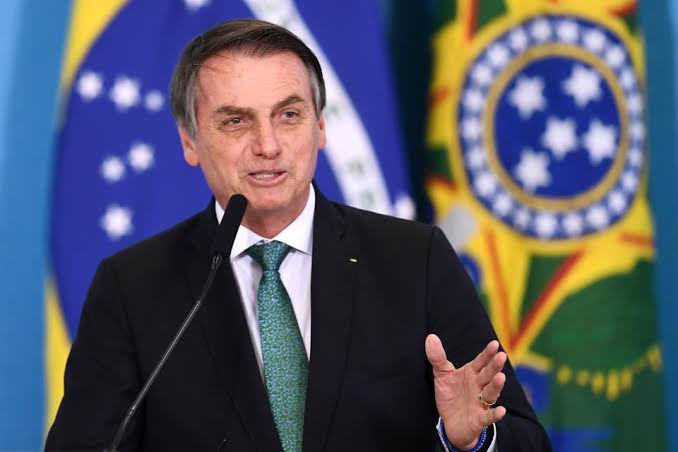
Brazilian President Jair Bolsonaro has been tested for the novel coronavirus, local media cited the president’s office as saying on Monday.

The right-wing populist president, who has been dismissive of the illness as a ‘little flu’, had shown symptoms and run a fever before taking a test at the military hospital in the capital Brasilia, news portal UOL reported.

He also had his chest X-rayed.

On Monday, Bolsonaro was seen in public wearing a face mask and reportedly told a supporter not to come too close.

The president had previously been seen several times in public without a face mask, which is compulsory in Brasilia.

The 65-year-old has already been tested three times for the virus.

Following a suit by the state of Sao Paulo, the government presented the results to the Supreme Court in May – all were negative at the time.

Bolsonaro has so far shown great reluctance to implement measures to stop the spread of the virus.

Last week, he watered down a law that would require widespread mask-wearing in the country to stem its spread.

More than 1.6 million people have been infected with the coronavirus in Brazil, a number of cases second only to the United States’ and more than 65,000 people have died.

Buratai launches Exercise Sahel Sanity, inducts locally manufactured MRAPs

0
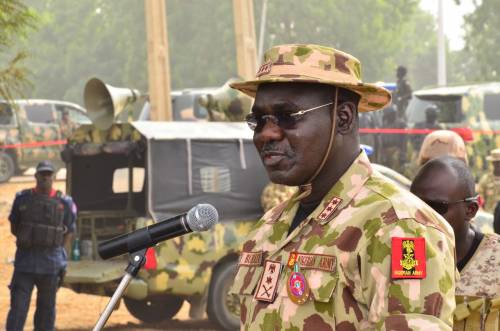
The Chief of Army Staff, Lt.-Gen. Tukur Buratai, on Monday, launched the Exercise Sahel Sanity and inducted 10 new locally made combat vehicles into operation to tackle banditry in the North West.

The official launch of the new exercise climaxed the Nigerian Army Day Celebration (NADCEL) 2020, taking place at Army Super Camp 4 in Faskari.

Enter made-in-Maiduguri MRAP war vehicles - Television Nigerian

Buratai said the exercise was scheduled to run from July 6 to Sept. 6

According to him, it is Nigerian army’s response to the escalating security challenges bedevilling parts of the North West and of course the North Central geo-political zones.

He said the exercise was expected to metamorphose into real-time operation, adding that it was designed to flush out armed bandits, terrorist groups and criminal elements in forests in the states.

“As you are aware, the worrisome spate of armed banditry, kidnapping, cattle rustling and other sundry crimes, have continued unabated particularly in Zamfara, Katsina, Sokoto, Kaduna and Niger States in the past two months.

“This continued intransigence of bandits and terrorist elements has led to wanton destruction of lives and property with significant destruction in socio-economic activities which is predominantly the occupation of the people of the region.

“It is against this backdrop that Ex-Sahel Sanity is being launched to mitigate the current spate of banditry, kidnapping, cattle rustling and other activities of criminal elements in these states,” he said.

Buratai explained that the exercise would be conducted in conjunction with sister services, the police, Department of State Services and state authorities to decisively get rid of banditry activities and restore peace in the regions.

He disclosed that good number of equipment, platforms and necessary logistic supports had been made available for the exercise, adding that troops would demonstrate empathy towards law abiding citizens.

According to him, be rest assured that as the chief of army Staff, I will continue to give you my full support and try to ensure total victory over criminal elements and terrorists.

He urged the people to render their full support for the Nigerian army troops and other security agencies in areas of providing useful information on the activities of the bandits.

According to him, this will enable the security forces provide the needed security and an enabling environment for socio-economic activities to thrive.

“Additionally, Nigerian Army will also continue to support the non-kinetic efforts of the civil authority to combat criminal elements and reassure the nation of our commitment and determination to secure the country and protect lives and property of law abiding citizens,” he said.

Buratai stated that the locally manufactured Mines Resistant Ambush Protected Vehicles being inducted into operations were the initiative of the 107 Equipment Support of the army in Maiduguri.

He said that the vehicles emanated from the theatre of Operation Lafiya Dole and commended the efforts of the commanders for looking inward in their operational requirements.

According to him, the Nigerian army is going to be self-reliant internally through its efforts, adding that order had been placed for 20 more of the vehicles.

Earlier, the Commander, 107 Division Equipment Support, Maiduguri, Brig.-Gen. Babatunde Alaya, said the MRAPs were conceptualised and designed to support the existing platforms.

Alaya said the vehicles were produced using local content, adding that the products had been tested and were battle ready.

He commended the COAS for giving the command the needed support and resources to embark on the project and come up with the vehicles within a short period of time.

Gen Buratai’s homemade innovations and the Nigerian Army of our dreams

1

By Michele Aluor

The history of the Nigerian Army is replete with stories that should make every Nigerian proud. In its 157 years of existence, there has been a steady transformation of the Nigerian Army into a professional and formidable force to reckon with in the world.

These are indeed no mean feat; however, this is not to say the Nigerian Army hasn’t experienced its fair share of challenges, especially with the prosecution of the Boko Haram war in North-East Nigeria. In recent times, a lot has been said about the efforts of the Nigerian Army in the security architecture in Nigeria. While in some quarters accolades have poured in, there has also been an unimaginable level of criticisms which in my opinion was brought about as a result of ignorance on the constitutional mandate of the Nigerian Army.

To say that the Nigerian Army has not been overstretched would be an understatement given the fact that is aside carrying out its core mandate; it has been called to support the civil police in internal security operations. The deployment of the Army in Internal Security Operations dramatically increased since the return to democratic governance on May 29 1999.

This is mainly because the Nigeria Police Force that is constitutionally charged with the responsibility of tackling internal security challenges is constrained due to a couple of factors. As such, these factors have often made civilian authorities to heavily rely on the expertise of the Army and its sisters’ forces, the navy and air-force to manage internal security challenges. In effect, the regular engagements of its personnel have made the organization to assume the position of the first line of internal security defence which ordinarily is the role of the police.

The Nigerian Army involvement in the internal security operations is inevitable as the need for a higher level of aggression continues to reveal itself. Although, this has been the case ever since Nigeria was formed and it also continued throughout the colonial period, the recent occurrence of terrorism witnessed in the country has further justified the need for the army participation in internal security operations.

The year 2020 marked the 157 years of the existence of the Nigerian Army and as such the drums have rolled out in celebration of the Nigerian Army Day with the theme “Nigeria’s Territorial Defence and Sovereignty: Imperatives for Nigerian Army’s Sustained Training and Operations.”

This year’s celebration is unique in the sense that the Nigerian Army of today has witnessed quite substantial technological innovations that have positioned it as a professional fighting force courtesy of the leadership strides of its present Chief of Army Staff, Lt. Gen. Tukur Buratai.

It is indeed a statement of the fact that the innovations in the Nigerian Army began to take shape from the year 2015 when the administration of President Muhammadu Buhari came on board. This was followed with the appointments of Service Chiefs, a move that was hailed in many quarters as one of the best decisions by the President upon assumption of office. This fact was further buttressed with the way and manner the Service Chiefs hit the ground running, especially the Chief of Army Staff due to the strategic role of the Nigerian Army in the fight against terrorism in the country.

It suffices to say that the confidence reposed in Lt. Gen. Tukur Buratai has been indeed justified with the level of technological innovations in the present day Nigerian Army. This much has been revealed with the display of homemade technological innovations in line with the requirements of modern warfare.

Technology changes warfare. Technology has been the primary source of military innovation throughout history. It drives changes in warfare more than any other factor. It is the clash of arms or the manoeuvre of armed forces in the field. It entails what military professionals call operations.

The Nigerian Army, today under Lt. Gen. Tukur Buratai, has witnessed tremendous rejigging to conform to the requirements of modern-day warfare. There has been the establishment of new units such as the Nigerian Army Aviation Corps and the Nigerian Army Women Corps to complement the operations of the Nigerian Army. This much was stated by the Chief of Army Staff, Lt. Gen. Tukur Buratai during the maiden Nigerian Army Women Training Week. He said that “there is no gainsaying the fact that there are some military operations such as psychological operations, in which the female officers and soldiers by their gender excel over men.”

I agree in totality with his line of thought in line with historical evidence that suggests integrating women into combat roles would not impact effectiveness, and perhaps even increase it under certain circumstances. In recent years, multiple countries have altered their policies to allow women to serve in combat roles. In 2015, U.S. Secretary of Defense Ash Carter opened all military roles to women. In the same year, India allowed women to become fighter pilots. Famous for being the world’s only country with a mandatory draft for both men and women, Israel inaugurated its first mixed-gender combat unit, the Caracal Battalion, in 2000. And I am glad Nigeria is not left out of this modern-day thinking.

Under Lt. Gen. Tukur Buratai, the Nigerian Army has continued to look inwards in the production of small and light arms and other combat artilleries by the Nigerian Army Vehicle Manufacturing Company established in 2019. This is on the heels that since the 1960s, there had not been a serious effort at producing military equipment locally by the Nigerian Army.

This is indeed a milestone in the Nigerian Army’s march towards self-reliance in the production and maintenance of Armored Fighting Vehicles and other classes of vehicles as over the years the Nigerian Army has relied on the importation of such vehicles thereby spending substantial foreign exchange which in turn depletes capital allocations.

Another brilliant initiative is the establishment of the Nigerian Army Resource Centre which was established in 2015 as a service think tank which provides intellectual researches, promotes workshops, seminars and offers solutions to the Nigerian Army of proffering solutions to defence and security issues confronting the Nigerian Army (NA) in particular and the nation in general.

The list is indeed endless in the innovations that Lt. Gen. Tukur Buratai has introduced in the Nigerian Army. We must admit that armies of the world have gone beyond the conventional to the advanced both in operations and policy formulations. This is the lot of the Nigerian Army today, and we must be indeed grateful to Lt. Gen. Tukur Buratai whose foresight has led to all of the above mentioned.

Little wonder the war against Boko Haram terrorism has been successful regardless of what some false alarmist and people with ulterior motives wants the generality of Nigerians to believe. That the Boko Haram insurgents have been restricted to the fringes of the Lake Chad Basin region and not in occupation of any territory in Nigeria is worthy of mention.

We must also admit that indeed the Nigerian Army of today is not what it used to be five years ago. This is indeed the Nigerian Army of our dreams. An army that is proactive and alive to its responsibilities. An army that is compliant with the rules of engagement in warfare as evidenced in the establishment of the Directorate of Civil-Military Affairs and Human rights desks at all its formations.

Lest we forget that the Nigerian Army under Lt. Gen. Tukur Buratai has successfully established two new divisions as part of a strategic plan to improve on the Nigerian Army’s operational capabilities in the face of emerging threats to national security, however, it is not yet Uhuru as there is a place for the cooperation of all Nigerians in making the Nigerian Army the Army of our dreams.

Those that have elected to be on the other side of the fence fanning the embers of war must have a rethink. Those that are consistent in their antagonism of the Chief of Army Staff must also have a rethink and be true to themselves and appreciate Lt. Gen. Tukur Buratai for repositioning the Nigerian Army.

Aluor is a public affairs analyst and independent writer based in Abuja.

Troops sustain onslaught as bandits surrender in Katsina, Zamfara

0

The Defence Headquarters says the troops of Operations Accord and Hadarin Daji have continued to annihilate bandits in Katsina and Zamfara forcing many of them to surrender.

The Co-ordinator, Defence Media Operations, Maj.-Gen. John Enenche, disclosed this in a statement on Monday in Abuja.

Enenche said the troops have continued to conduct intensive clearance operations to identified bandits enclaves in the North- West, with attendant successes against the criminal elements.

He said the troops had on July 3, stormed a bandits’ camp at Sanu village in Zurmi Local Government Area of Zamfara sequel to actionable Human and technical intelligence on the heavy bandits’ presence in the vicinity.

He said that the bandits fled with gunshot wounds, adding that the troops pursued the bandits, engaged them and overwhelmed them with heavy volume of fire.

According to him, exploitation of the general area led to the recovery of one AK47 rifle and one SMG rifle.

“It was also revealed that several bandits suffered heavy injuries and most likely died, as evident in the vast pools of blood along their withdrawal route.

“In a related development, troops made contact with bandits at Bawan Daji village and neutralised one bandit while many others were fatally wounded.

“Troops further raided bandits’ enclave at Gidan Zamfarawa about 10km from Mashanyin Zaki.

“The bandits fled on sighting troops from afar but were pursued by the determined troops who engaged them with aggressive firing.

“Troops exploited the general area and destroyed seven major bandit camps while one AK47 rifle, and two motorcycles, among others were equally recovered,” he said.

Enenche further disclosed that troops had on July 5, stormed an identified bandits camp at Salihawa village in Batsari area of Katsina State following credible intelligence on their activities in the village.
He said that the troops overwhelmed the bandits with superior firepower and neutralised one of the criminals while several others escaped with fatal gunshot wounds.

According to him, troops also apprehended a suspected bandits’ logistics supplier, Mohammed Illela, at Illela village on July 4, following a tip-off.

He explained that the suspect was arrested while attempting to convey 13 jerrycans of 30 litres of PMS concealed in an ash-coloured Volkswagen wagon car, to suspected bandits.

The co-ordinator also revealed that a bandit was also eliminated during a cordon and search operation by the troops at Bawar-Daji village on July 5.

He added that one AK 47 rifle, five rounds of 7.62 mm special ammunition and one magazine, among others were recovered during the operation.

According to him, owing to intensified operations, projected by aggressive presence and posture of troops in the theatre, three notable bandits have surrendered to troops along with their weapons.

“The repentant bandits submitted one Light Machine Gun and two AK 47 rifles.
“The Military High Command commends troops of Operation HADARIN DAJI for their dedication, dexterity and professionalism in the conduct of ongoing operations.

“It equally urges them to intensify operations against the bandits and all other criminal elements threatening the peace and security of our beloved country,” he said.