Home Blog Page 2347

Apologise to Nigerian Army now, Lagos Observers tell Sanwo-Olu over false statements on Lekki shooting

0


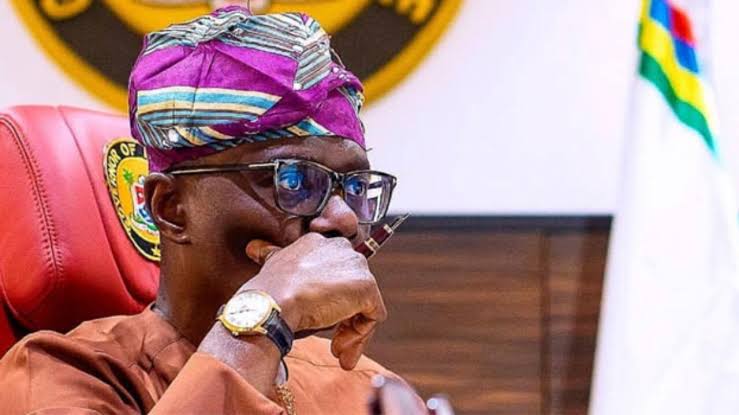
The Lagos Observers Group (LOG) says Lagos State Governor, Babajide Sanwo-Olu, must apologise to the Nigerian Army for misleading the general public on the EndSARS protests.

The group said this has become paramount after reviewing circumstances that led to the escalation of violence in the state during the protest while analysing the Army’s testimony as well as other critical stakeholders before the Lagos State Judicial Panel of Inquiry and Restitution.

In a communique co-signed by Folarin John Odusote and Dr Boboye Olarewaju, its chairman and secretary respectively, on Monday, the LOG said the Army’s testament was factual to support their position that the EndSARS campaign was not a reflection of the reality on the ground.

The group noted that indeed Governor Sanwo-Olu called for reinforcement from the Army when it was apparent that the Police has been overwhelmed.

It also said that the soldiers deployed to the Lekki Tollgate were pelted with stones and other items upon arrival but did not have live bullets.

At the end of its extraordinary general meeting, the group, however, said the allegations
levelled against the Army are “fictitious and meant to disparage the timely intervention of the troops”.

According to the Lagos Observers Group, there is overwhelming evidence that indeed the Nigerian Army was invited by the Governor of Lagos State.

The group called on Sanwo-Olu to tender an apology to the troops or resign honourably.

Read full communique below:

Introduction:

The Lagos Observers a pan-Nigerian group with membership cutting across all ethnic nationalities, religious groups and professional bodies convoked an extraordinary general meeting to deliberate on the recent revelations made by the Nigerian Army at the Lagos State Judicial Panel of Inquiry and Restitution.

The Lagos Observers Group in the attempt to put issues in proper perspectives given the enormity of the task at hand in unraveling the circumstances that led to the escalation of violence in the state during the EndSARS protest reviewed the testimony by the Nigerian Army and other critical stakeholders before the Lagos State  Judicial Panel of Inquiry and Restitution.

The Deliberations:

Members of the Lagos Observers Group deliberated on the facts presented by the Nigerian Army with regards to the following:

The use of live bullets

Who invited the Nigerian Army

How many people died and what led to the death

Was there a case of provocation

Read also: Apologise to Nigerian Army now, Lagos Observers tell Sanwo-Olu over false statements on Lekki shooting

The Lagos Observers group indeed noted that the testimony by the Nigerian Army was backed by facts and evidence to support their position which is an indication that the bulk of the information on the EndSARS campaign was not a reflection of the reality on the ground.

Our members took the time to scrutinize the various testimonies by other concerned parties involved in the EndSARS protest to identify the number of casualties as a result of the intervention of the Nigerian Army at the Lekki Tollgate.

Our findings:

The members of the Lagos Observers group after extensive deliberations and fact checks indeed identified that the Governor of Lagos State, Babajide Sanwo-Olu called for reinforcement from the Nigerian Army when it was apparent that the Nigerian Police has been overwhelmed and things were about to get out of control.

Read Also: https://thenigerian.news/nigeria-today/hoodlums-likely-behind-lekki-shooting-agf-malami/

It was also discovered that the soldiers deployed to the Lekki Tollgate were pelted with stones and other items upon arrival in an already tensed atmosphere susceptible to the crisis of immeasurable proportion in the Lekki-Ikoyi axis.

The soldiers deployed at the Lekki Tollgate did not have live bullets as widely claimed and reported by a large segment of the population. What was used were blank ammunitions usually deployed in quelling riots.

It was also discovered that soldiers at the Lekki Tollgate fired into the air to disperse the already riotous crowd and not into the crowd as erroneously stated in different quarters. This fact is buttressed with the fact that the only death recorded at the Lekki Tollgate was not as a result of gunshot injuries.

It was also discovered that even in the face of provocation, the soldiers remained calm and within their mandate of dispersing the crowd with the use of minimal force. This much was seen in the various video recordings scrutinized.

Conclusion:

Read also: Apologise to Nigerian Army now, Lagos Observers tell Sanwo-Olu over false statements on Lekki shooting

The Lagos Observers group at the end of its extraordinary general meeting herby makes the following conclusions:

That the allegations levelled against the Nigerian Army are indeed fictitious and meant to disparage the timely intervention of the Nigerian Army in the restoration of law and order in Lagos state.

This is on the heels that despite the denial of the Lagos State Governor with regards to the invitation extended to the Nigerian Army to intervene to restore law and order, there has been an avalanche of evidence that indicates that indeed the Nigerian Army was invited by the Governor of Lagos State.

Recommendations:

The Lagos Observers Group as a consequent of the recent revelations that the Governor of Lagos State, Babajide Sanwo-Olu indeed invited the Nigerian Army, we are recommending the following:

That the Governor of Lagos State, Babajide Sanwo-Olu should tender an unreserved apology to the Nigerian Army for misleading the general public with regards to the intervention of the Nigerian Army during the EndSARS protests.

That the Governor of Lagos State, Babajide Sanwo-Olu should in future take ownership of his actions as the Chief Executive Officer and Chief Security Officer of the state.

That if the Governor fails to tender an unreserved apology, he should tow the honourable path of resignation as he would no longer be fit to occupy the position of Governor of Lagos State.
Read also: Why Nigerians want Amnesty International out of the country

Peru President, 12 ministers resign

0


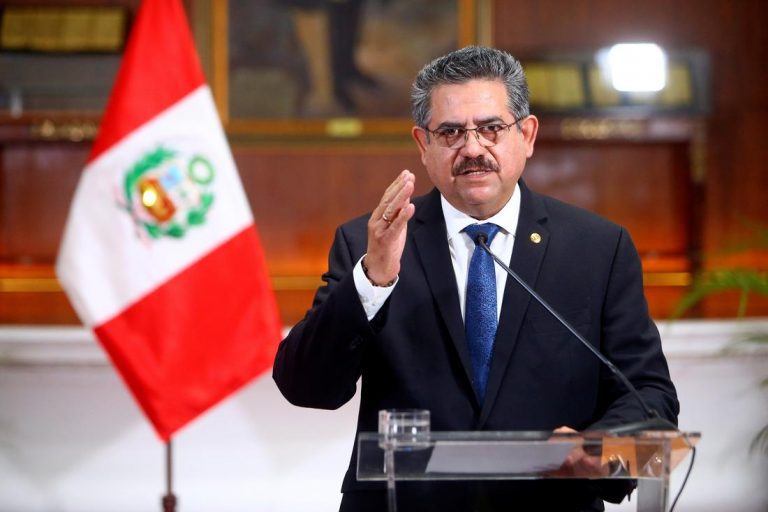
Peru’s interim president Manuel Merino resigned on Sunday after less than a week in office, leaving the country in limbo following lawmakers’ demands he step down over two deaths during protests at the sudden ouster of his predecessor.

The latest political shake-up comes as Peru, the world’s No. 2 copper producer, battles the coronavirus pandemic and what is expected to be its worst economic contraction in a century.

People poured into the streets to celebrate Merino’s departure, waving flags, chanting and banging pots, although the news plunges Peru deeper into uncertainty and legal disarray as lawmakers now wrestle over who will take his place.

Congress is expected to hold a second vote in the evening after a first vote failed to garner majority support for leftist lawmaker and human rights defender Rocio Silva-Santisteban to be designated interim president.

A tense calm prevailed in the capital, Lima, as Peruvians awaited a decision on who would be the next president.

“Merino has resigned because his hands are stained with blood, with the blood of our children,” said Clarisa Gomez, one of those who turned out to celebrate Merino’s departure, while adding that the lawmakers who put him in power should also pay.

The opposition-dominated Congress voted last Monday to remove Merino´s predecessor Martin Vizcarra as president, over bribery accusations he denies. Lawmakers met on Sunday afternoon to determine the next president, or, at least, how one might be chosen.

In a televised speech, Merino, the former head of Congress who had led the push to impeach Vizcarra, asked his cabinet to stay on to help in the transition. He called his resignation “irrevocable” and urged peace and unity.

Just minutes before the announcement, Congress president Luis Valdez said all political parties had agreed Merino should resign. If he declined, Valdez said, lawmakers would launch impeachment proceedings.

Thousands in Peru had staged some of the largest protests in decades, most of them peaceful but increasingly marred by clashes, since the vote to remove Vizcarra.

A tense week collapsed into chaos late on Saturday, after mostly peaceful demonstrations grew more intense by nightfall.

Two young protesters were killed in clashes, the public ombudsman said, while state medical program EsSalud confirmed in a statement that two men had died from gunshot wounds.

Peru’s National Human Rights coordinator said 112 people were injured, some by inhaling tear gas, with 41 missing. At least nine had gunshot wounds, health officials said.

Vizcarra, whose ouster sparked the crisis, warned Peruvians not to let lawmakers once again determine who would become Peru’s next leader.

“Should those who took these unconstitutional measures be the ones who bring us a solution?” he asked reporters outside his home after Merino’s resignation on Sunday.

Instead, he wanted Peru’s Constitutional Court to weigh in immediately on whether his own impeachment had been legal. Soon after, the court said it would move to Monday a hearing set for Wednesday to fast track arguments in the case.

“I am here to collaborate,” said Vizcarra, a politically unaffiliated centrist popular with Peruvians, who has yet to be found guilty of the corruption charges that led to his removal.

FIREWORKS AND TEAR GAS

On Saturday hundreds of mostly young protesters had unveiled a massive Peruvian flag and sang the national anthem in Lima’s central Plaza San Martín.

But the sprawling coastal city soon resounded with sirens, shouts and chants for Merino’s removal as rallies and the police response grew increasingly violent.

Peru’s ombudsman warned on Twitter that security forces had begun “misusing force and throwing tear gas without justification” against those gathered in the city’s center. The agency has demanded an investigation.

“The march is not for Vizcarra to return, it is strictly against Merino,” said César Anchante, a graduate of the city’s university who marched in a rally.

“We are tired of corruption, of the usual politicians who divide and impose their personal interests.”

Also on Saturday, Merino’s prime minister told reporters that Vizcarra’s removal had been legal, defending it as a “constitutional change.”

Merino too had urged calm and promised to hold presidential elections already set for April 11.

U.S. Election: Trump admits defeat to Biden

0

President Donald Trump acknowledged publicly for the first time that President-elect Joe Biden won the election.

The president’s comments, made in a seemingly offhand post on social media, come as his campaign continues to challenge the results of the election in court and as his administration holds up formal transition processes.

In subsequent tweets, Trump wrote that he would not concede.

The ostensible acknowledgement of defeat came on Twitter, in response to a post by the Fox News show “Watters’ World” that suggested that Biden “didn’t earn” the presidency.

“He won because the Election was Rigged,” Trump wrote, repeating an allegation that has been debunked by election officials around the country and his own Department of Homeland Security.

Shortly after writing that Biden had won, though, Trump wrote in another post that he conceded “NOTHING” and claimed that “WE WILL WIN!”

“He only won in the eyes of the FAKE NEWS MEDIA,” Trump wrote.

‘Competent’ Buhari has integrity — Ndume

0


The chairman of the Senate Committee on Army, Ali Ndume, has said that President Muhammadu Buhari has integrity and the competence to lead but being betrayed by kleptocrats in his government.

Ndume, who represents Borno South district, stated this when he spoke on Channels Television’s Sunday Politics programme.

He said, “The president is a genuine person that has the interest of the common man at heart. He has integrity and the competence but unfortunately, the kleptocrats in the government have formed the majority and therefore, betraying the laudable policies that the president wants to implement”.

Ndume claimed that Buhari had performed in all the promises he made which include to fight corruption, insecurity and provide infrastructure.

The senator, meanwhile, said that the major problem remained the implementation of certain policies put forth by President Buhari.

The senator at the programme also expressed his support for the controversial social media bill as he said that he saw nothing wrong with the proposed bill.

The bill on social media, which seeks to curb the spread of false news has since passed second reading at the Senate.

It has, however, continued to receive strong opposition from Nigerians who claimed that the bill was part of the efforts by Buhari’s government to gag the press and infringe on the right of expression of the citizens.

But Ndume said “there is nothing wrong in having social media bill” because people should be held responsible for what they say or do on social media.

Noting that he was not saying that the freedom of speech should be muzzled, the senator reiterated that it was necessary to have a kind of law that controls the way people express themselves on social media.

“Anything in this world that has no control can be disastrous,” he said.

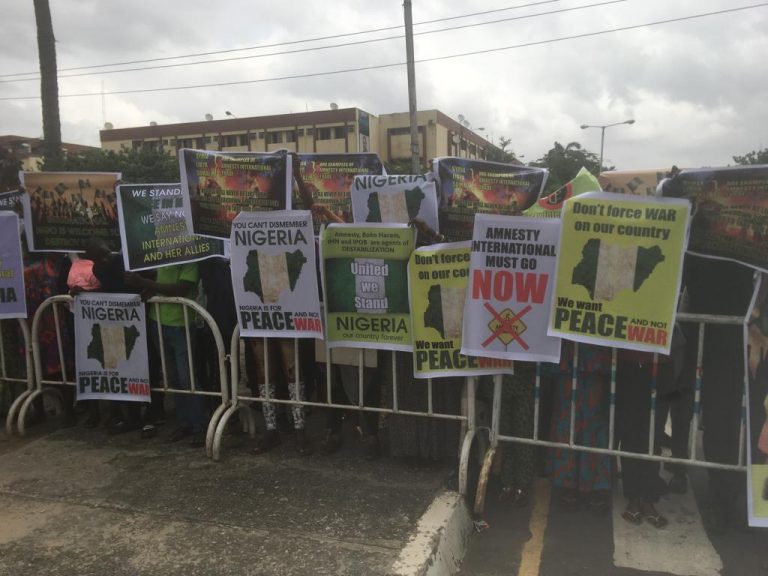
Why Nigerians want Amnesty International out of the country

0

A lot was expected from Amnesty International’s maiden foray into Nigeria in 2015. With its burgeoning global status, Africa’s most populous nation envisaged a new chapter in human rights violation. However, five years down the line, AI has underwhelmed, on its way out of the country.

Read also: Amnesty International And Global Rejection

Amnesty presented itself as the “messiah” on a rescue mission to Nigeria. Following the emergence of President Muhammadu Buhari, the West African nation was gradually recuperating from the wreckage of the Boko Haram terrorists in the north. Far south, there was also the looming insurrection by the Indigenous People of Biafra (IPOB). At that point, any help whatsoever would be welcomed.

While admitting instant progress under the new administration, it alleged serious human rights violations. “Nigeria has achieved remarkable things – but serious violations continue, unpunished,” said Amnesty International Secretary-General, Salil Shetty. “In establishing a permanent base in Nigeria, we want to send a clear message: Amnesty International stands in solidarity with the victims of human rights violations, alongside the individuals and organizations already fighting abuses”.

Read also: AI And Its Failed Neo -Colonial Agenda In Nigeria

Indeed, AI’s message was instant. The group’s adventure hit the rocks from the start. In a report published in January 2016, it immediately championed a campaign pushing for the legalisation of homosexuality. In a massively religious country where same-sex marriage contract or civil union faces up to 14 years imprisonment and the death penalty in states under Shari’a law, it was a mission in futility.

“The rights of LGBTI people continued to be curtailed,” AI wailed. “Human rights defenders reported a significant increase in the number of arrests of LGBTI people and police extortion. The Coalition for the Defense of Sexual Rights, a coalition of NGOs working on the rights of LGBTI people in Nigeria, cited over 200 cases across the country where people perceived to be LGBTI were beaten by mobs and handed over to the police”.

Amnesty then admitted war crimes and crimes against humanity committed by Boko Haram in the northeast. Despite this obvious catastrophe and even acknowledging “sustained offensive by the military”, nonetheless, the group accused the troops of using excessive force. It was like chiding a father for disciplining his wayward child.

Read also: Understanding Amnesty International And Nigeria’s Divorce

It was early days, yet Nigerians already perceived bias. Amnesty International subsequently sympathized with separatists. The group lashed out at the Nigerian authorities over the arrest of IPOB’s leader, Nnamdi Kanu and Sheikh Ibrahim El Zakzaky, the spiritual head of Iran-backed Islamic Movement of Nigeria.

Amnesty International’s scathing onslaught on the Nigerian government has not ceased. The group has maintained the same script, agenda and modus operandi, striking at the slightest instance.

The military has been worst hit. Each time troops appear to be gathering momentum on the war against Boko Haram terrorists, AI would show up with a damning report to dampen the progress in the guise of advocating for human rights and equality.

However, this penchant for falsehood and desperation to satisfy its paymasters reached an all-time low recently during the EndSARS movement. Without any tangible proof, AI alleged a ” massacre” in Lagos on October 20. The group said at least 12 persons were killed by the police and military in Alausa and Lekki Toll Gate, with hundreds injured. AI also claimed that CCTV cameras were dismantled to cover up the murder.

Desperate to stay relevant, Amnesty characteristically released this misleading report barely 24 hours later. Worse still, AI based its conclusion on “social media videos”. In all its supposed investigation, Amnesty is yet to admit that scores of police officers were killed by rampaging protesters with many injured in life-threatening conditions.

Nigerians are fed up and reckon that if nothing is done these slipshod reports could plunge the nation into anarchy. Recall that the arson and killings in Lagos and other parts of the country trailed Amnesty’s publication. While Nigerians wept, the group added to their war chest, trading on and merchandising their miseries.

Amnesty has unsuccessfully tried to build a presence in the developing world for decades. In 1977, senior Amnesty members and staff set a goal to “make Amnesty more universal especially by getting a ‘foothold’ in second and third worlds.” The group is suffering an unprecedented crisis, with substantial membership numbers and dues-paying members in decline.

Amnesty’s work around the world, particularly in conflict-affected countries, is highly under scrutiny and its officials are often accused of siding with the anti-establishment forces and supporting their attempt of regime change. It crosshairs with the governments of several countries and most, unlike Nigeria, are not patient.

Amnesty is unwanted guests in nations.  Nigeria is only its third national office models. The other two are in Brazil and India.  However, Amnesty has departed the Asian nation and could be om it’s way out of Brazil too.

In India, it cited unfounded and motivated allegations for the reason for exiting, something of a twist in fortune. “We are facing a rather unprecedented situation in India. Amnesty International India has been facing an onslaught of attacks, bullying and harassment by the government in a very systematic manner,” an official said.

Not only India, but several other countries are also upset with the activities of the supposed watchdog. Around 40 countries including Russia, Israel, Hungary, and Egypt have enacted stringent laws against NGOs. Even in America, there is a ban on the interference of any foreign institution in its domestic politics.

These days, though, when under immense pressure after making multiple false claims, AI resorts to a fake apology. It deploys this strategy to save its face and potentially hold on to its sponsors.

In December 2018, the group apologised to the Netherlands over a magazine that trivialized the suffering and trauma refugees have experienced fleeing their homes, particularly women. The group placed Bangladesh among countries currently facing a war or conflict and apologised after a backlash.

In May, Amnesty International accused the Ethiopian government of committing “grave violations between December 2018 and December 2019 in some parts of Amhara and Oromia regions”. Shamefully, the group apologised later, claiming to have posted it in error.

Nigerians may not be patient to wait for an apology. AI knows the door out.

Read also: Fake News: Amnesty International gets 7-day ultimatum to quit Nigeria

André Ablom Johnson 3rd Vice-President of Togo’s National Assembly passes away

0

The third Vice-President of the National Assembly of Togo, André Ablom Johnson, died on Saturday in Lomé at the age of 72, parliamentary sources said on Sunday.

A member of the Union of Forces for Change (UFC) of Gilchrist Olympio, a former charismatic opponent of the regime in place in Lomé, he was for a long time Minister in charge of the Environment.

The president of the National Assembly, Yawa Djigbodi Tsegan, praised him as a great worker.

In recent months, Togo has lost more than a dozen politicians, including Edem Kodjo, former Secretary-General of the OAU, now AU; Fambaré Ouattara Natchaba, former President of the National Assembly, and Mr Yawovi Agboyibor, former President of the opposition Action Committee for Renewal. (PANA/NAN)

André Ablom Johnson 3rd Vice-President of Togo’s National Assembly passes away

0

The third Vice-President of the National Assembly of Togo, André Ablom Johnson, died on Saturday in Lomé at the age of 72, parliamentary sources said on Sunday.

A member of the Union of Forces for Change (UFC) of Gilchrist Olympio, a former charismatic opponent of the regime in place in Lomé, he was for a long time Minister in charge of the Environment.

The president of the National Assembly, Yawa Djigbodi Tsegan, praised him as a great worker.

In recent months, Togo has lost more than a dozen politicians, including Edem Kodjo, former Secretary-General of the OAU, now AU; Fambaré Ouattara Natchaba, former President of the National Assembly, and Mr Yawovi Agboyibor, former President of the opposition Action Committee for Renewal. (PANA/NAN)

Why Nigerians want Amnesty International out of the country

0

A lot was expected from Amnesty International’s maiden foray into Nigeria in 2015. With its burgeoning global status, Africa’s most populous nation envisaged a new chapter in human rights violation. However, five years down the line, AI has underwhelmed, on its way out of the country.

Amnesty presented itself as the “messiah” on a rescue mission to Nigeria. Following the emergence of President Muhammadu Buhari, the West African nation was gradually recuperating from the wreckage of the Boko Haram terrorists in the north. Far south, there was also the looming insurrection by the Indigenous People of Biafra (IPOB). At that point, any help whatsoever would be welcomed.

While admitting instant progress under the new administration, it alleged serious human rights violations. “Nigeria has achieved remarkable things – but serious violations continue, unpunished,” said Amnesty International Secretary-General, Salil Shetty. “In establishing a permanent base in Nigeria, we want to send a clear message: Amnesty International stands in solidarity with the victims of human rights violations, alongside the individuals and organizations already fighting abuses”.

Indeed, AI’s message was instant. The group’s adventure hit the rocks from the start. In a report published in January 2016, it immediately championed a campaign pushing for the legalisation of homosexuality. In a massively religious country where same-sex marriage contract or civil union faces up to 14 years imprisonment and the death penalty in states under Shari’a law, it was a mission in futility.

“The rights of LGBTI people continued to be curtailed,” AI wailed. “Human rights defenders reported a significant increase in the number of arrests of LGBTI people and police extortion. The Coalition for the Defense of Sexual Rights, a coalition of NGOs working on the rights of LGBTI people in Nigeria, cited over 200 cases across the country where people perceived to be LGBTI were beaten by mobs and handed over to the police”.

Amnesty then admitted war crimes and crimes against humanity committed by Boko Haram in the northeast. Despite this obvious catastrophe and even acknowledging “sustained offensive by the military”, nonetheless, the group accused the troops of using excessive force. It was like chiding a father for disciplining his wayward child.

It was early days, yet Nigerians already perceived bias. Amnesty International subsequently sympathized with separatists. The group lashed out at the Nigerian authorities over the arrest of IPOB’s leader, Nnamdi Kanu and Sheikh Ibrahim El Zakzaky, the spiritual head of Iran-backed Islamic Movement of Nigeria.

Amnesty International’s scathing onslaught on the Nigerian government has not ceased. The group has maintained the same script, agenda and modus operandi, striking at the slightest instance.

The military has been worst hit. Each time troops appear to be gathering momentum on the war against Boko Haram terrorists, AI would show up with a damning report to dampen the progress in the guise of advocating for human rights and equality.

However, this penchant for falsehood and desperation to satisfy its paymasters reached an all-time low recently during the EndSARS movement. Without any tangible proof, AI alleged a ” massacre” in Lagos on October 20. The group said at least 12 persons were killed by the police and military in Alausa and Lekki Toll Gate, with hundreds injured. AI also claimed that CCTV cameras were dismantled to cover up the murder.

Desperate to stay relevant, Amnesty characteristically released this misleading report barely 24 hours later. Worse still, AI based its conclusion on “social media videos”. In all its supposed investigation, Amnesty is yet to admit that scores of police officers were killed by rampaging protesters with many injured in life-threatening conditions.

Nigerians are fed up and reckon that if nothing is done these slipshod reports could plunge the nation into anarchy. Recall that the arson and killings in Lagos and other parts of the country trailed Amnesty’s publication. While Nigerians wept, the group added to their war chest, trading on and merchandising their miseries.

Amnesty has unsuccessfully tried to build a presence in the developing world for decades. In 1977, senior Amnesty members and staff set a goal to “make Amnesty more universal especially by getting a ‘foothold’ in second and third worlds.” The group is suffering an unprecedented crisis, with substantial membership numbers and dues-paying members in decline.

Amnesty’s work around the world, particularly in conflict-affected countries, is highly under scrutiny and its officials are often accused of siding with the anti-establishment forces and supporting their attempt of regime change. It crosshairs with the governments of several countries and most, unlike Nigeria, are not patient.

Amnesty is unwanted guests in nations.  Nigeria is only its third national office models. The other two are in Brazil and India.  However, Amnesty has departed the Asian nation and could be om it’s way out of Brazil too.

In India, it cited unfounded and motivated allegations for the reason for exiting, something of a twist in fortune. “We are facing a rather unprecedented situation in India. Amnesty International India has been facing an onslaught of attacks, bullying and harassment by the government in a very systematic manner,” an official said.

Not only India, but several other countries are also upset with the activities of the supposed watchdog. Around 40 countries including Russia, Israel, Hungary, and Egypt have enacted stringent laws against NGOs. Even in America, there is a ban on the interference of any foreign institution in its domestic politics.

These days, though, when under immense pressure after making multiple false claims, AI resorts to a fake apology. It deploys this strategy to save its face and potentially hold on to its sponsors.

In December 2018, the group apologised to the Netherlands over a magazine that trivialized the suffering and trauma refugees have experienced fleeing their homes, particularly women. The group placed Bangladesh among countries currently facing a war or conflict and apologised after a backlash.

In May, Amnesty International accused the Ethiopian government of committing “grave violations between December 2018 and December 2019 in some parts of Amhara and Oromia regions”. Shamefully, the group apologised later, claiming to have posted it in error.

Nigerians may not be patient to wait for an apology. AI knows the door out.

Lagos security: Police raids black spots, arrest 720

0

In its bid to solidify the security architecture of the state, the Lagos Police command has re-launched its Anti Crime Strategies to curb crimes and criminality across the state.

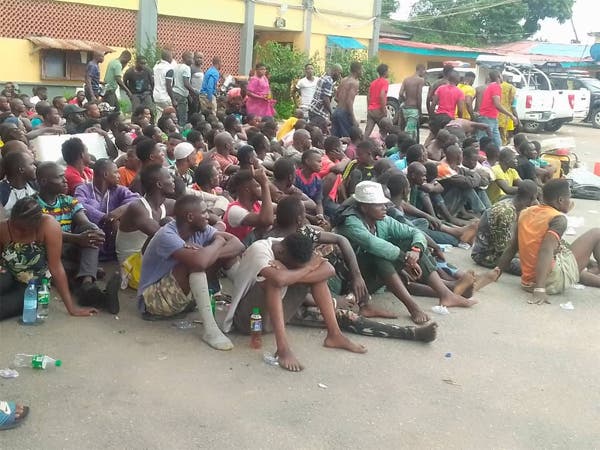
The command has on Sunday carried out raids simultaneously on identified black spots, reasonably believed to be harbouring criminals and hoodlums, across the fourteen (14) Area Commands in Lagos State.


Disclosing this in a statement signed by the PRO, SP OLUMUYIWA ADEJOBI, the force said its operatives arrested seven hundred and twenty (720) suspects with incriminating items including locally-made guns and life cartridges, charms, weed suspected to be Indian hemp, substances suspected to be cocaine and some items suspected to have been looted from various shopping outlets within the state during the recent Endsars violence.

The Commissioner of Police, Lagos State, CP Hakeem Odumosu, who matched his words with actions, had earlier warned and directed police officers and men to move against lawlessness and criminality in Lagos; he affirmed the zeal of the command to sustain the operations, even, beyond the yuletide season.

CP Hakeem Odumosu has however directed the Deputy Commissioner of Police in charge of SCID, panti, to commence discreet investigation on the arrested suspects for immediate prosecution. He also urged those whose items were looted during the recent Endsars violence to come up for claims of their items with prove of ownership.

The police chief commended the officers and men of the command for the successful operations, while he charged them to be at alert for more operations across the state.

Understanding Amnesty International as a third force

0

Emmanuel Ome

To a sleepy and unprepared world, global terrorism has caught it in deep slumber. All nations of the world have admitted the destructive potency of terrorism which is fast ravaging humanity in all ramifications. But terrorism is not Covid-19 pandemic, so cannot defile solution, if the world sincerely unites against it.

From America to London, Africa and a lot more, the foundation of terrorism laid in the Middle East has spread its fury unimaginably. Most astonishing, is the dozen covert financiers, organizations, agents, supporters and sympathizers of terrorism all over the world, who front the façade of empathy for humanity, but work behind the scenes for the prosperity of terror sects.

On the surface, most of these surfeits of interests pretend global engagements for conventional humanitarian works. But ironically, they are the demonic forces used to export global terrorism to other countries. Another serious snag is that some of these repulsive groups are only known by their actions; but many more still enjoy anonymity and keeps exploiting the ignorance of an apathetic world.

Nigeria is trapped in this mess. Since Boko Haram insurgency started in Nigeria some 10 years back, external forces are more determined now more than ever to ensure terrorism does not depart the shores of the country. The Federal Government has spent stupendous amounts of public funds, especially in the last five years to extinguish the fire of terrorism.

But the impact is not exactly commensurate with the monetary and human resources committed into the counter-terrorism operations in the country. When Nigerians thought Boko Haram was decimated, severely weakened and at the verge of absolute extermination in the country by state forces, external reinforcement came to strengthen it. Therefore, splinter groups emerged to enliven the terrorism battle against Nigeria on different fronts simultaneously.

That’s how Nigeria has ended up in the jaw of multiple terror sects, the most potent of them being the Islamic State West Africa Province (ISWAP) terrorism sect, a part from Boko Haram. The external plots or conspiracy to destabilize and destroy Nigeria are impenetrably dark. Nigerians yet to understand these devious schemes should spare time to keenly monitor these developments.

It is incredible that Nigeria has been reduced to a sulking baby, swimming in a volley of internal crises at the moment because surrogates of external forces are pushing the destructive agenda very tenaciously. While the Nigerian Army has wholeheartedly committed itself to the counter-insurgency operations, resulting into the appreciable respite Nigerians enjoy; the terrorists kingpins have weaponized cyberspace terrorism against the county.

The elevation of cyberspace terrorism is beneficial to the promoters in two ways-it bolsters the terrorists to strive to commit more atrocities by an imposed feeling of false triumph and might. And secondly, it opens the doors for European and western countries to deny Nigeria access to the right weaponry to battle terrorists, citing violations of human rights in the prosecution of the counter-insurgency offensives and thus, goaded to enforce the Leahy Act prohibition of arms purchase on Nigeria.

The implication is that while there seems to be a global conspiracy to deprive Nigeria of weapons it seeks to purchase legitimately to fight Boko Haram and ISWAP terrorism; the same weapons illegally and easily travel from any part of the world to land in the hands of terrorists in Nigeria. If not because of the internal efforts of the Nigerian Military under the administration of President Muhammadu Buhari to evolve homemade weapons to battle terrorists, the situation would have been messier.

Therefore, Amnesty International’s (AI) portrait in some Africa countries, particularly Nigeria has indicated the organization’s active conscription into the propaganda wing of terror sects in the continent. It is believed AI has gleefully and unarguably picked up the battle in some African countries on behalf of foreign terrorists sponsors in the pretext of fighting for human rights abuses.

Ordinarily, the ideal work of Amnesty International as global watch dogs on human rights violations is a noble enterprise. Everyone prays and aspires to exist in a world where his basic fundamental human rights are protected from abuse by state authorities. It is consoling that AI has dedicated itself as a third force to compel nations of the world to conduct themselves in a civilized manner on this aspect.

But ludicrously, the third force of Amnesty International is thoroughly abused by the operations of this human rights organization very shamefully. Often and very unreasonably, AI beams its searchlight in Nigeria, especially on counter-insurgency operations, but prefers or shows a nauseating penchant to protect the human rights of terrorists more than the innocent and law-abiding citizens, whose human rights are brazenly violated by the swords of terror sects.

Those who think Amnesty International is oblivious of the beneficial card it is playing must be kidding. Its agenda is to promote terrorism and other conflicts in Africa, intent on destabilizing the continent as endorsed by their foreign paymasters, who are determined to coercively re-colonize Africa to impose their barbaric version of an Islamic State.

An AI’s task as observable today is simple! It is to keep the countries in Africa under the spell of terrorism and other conflicts prostrate by senselessly amplifying non-existent human rights violations in order to deprive them of weapons to fight back the terrorists. It is common knowledge that almost all Africa countries lack the required capacity to manufacture indigenous weapon, with the technological sophistry to effectively combat the atrocities and horrendous crimes terrorists commit against humanity.

An inquisitive world should demand to know from Amnesty International why the organization has less presence and interest in the decades of festering terrorism in the Middle East? The United Nations (UN) has over-depended on paper work to curb global terrorism. It is time to stretch beyond the veneer to uncover the massive web of terrorists’ networks tormenting the world.

It raises a blindfolding dust that in countries like Iran, Iraq, Afghanistan, Pakistan and hordes of others which are famed for nurturing, nourishing and exporting global terrorism to the rest of the world go unnoticed by AI. And these countries also harbour countless terrorists lynchpins who are sponsoring the mindless destruction of humanity and sustained disruption of global security as well as peace. But Amnesty International has consistently hedged in drawing the attention of the world to the inherent human rights abuses perpetrated in these countries.

Amnesty International’s obsession is with Africa. The human rights organization reels out hourly, monthly, quarterly and yearly reports of human rights violations in African countries under the menace of terrorism and other internal violent conflicts. Kenya, Sudan, Somalia, Mali, Niger, Chad, Cameroun, Nigeria and a dozen others have suffered Amnesty International’s deliberate acts of international sabotage and wickedness in the guise of protecting human rights; but the concealed agenda is actually different.

It is to carve a smooth path for incapacitation of these African countries in the face of ravaging terrorism through an enfeebled warfare strength to withstand the disgusting terrorists. While terrorists regale in strength, the nations groan under the suffocating pressures of terrorists in protecting her peoples.

But now that the antics of Amnesty International are known, they cannot intimidate anybody. Truth must be told boldly, and plainly! Henceforth, Amnesty International must be cautious in its operations, especially in Nigeria. The desperation of fabricating tales on human rights violations in Nigeria to justify the sumptuous stipends from paymasters will no longer be tolerated.

Operators of Amnesty International should do themselves a timely and great favour by listening to one of the lyrics of the Nigerian-born Afrobeat king and sensation, Mr. Fela Anikulapo- Kuti; in the album “Beast of No Nation.” A verse in the touchy and scathing song says, “Human rights na my property/ So therefore, you can’t dash me my property.” Amnesty International cannot claim to love Nigerians more than Nigerians themselves or the Nigerian Government. It applies to any other country in Africa. It is the solemn oath of every Government to protect her citizens.

Therefore, AI cannot claim to protect the human rights of Nigerians more than the Nigerian Government and her institutions. Its delusive for AI to think it is protecting human rights in Nigeria; while it is actually on a veiled mission of subversion of Nigeria and other African countries by playing the third force for the destabilization of Africa and her peoples. Enough of AI’s leading of the propaganda wing of all terrorists’ organizations in the country because in all circumstances, interests of the majority take the front burner.

Ome writes from the school of African studies, University of Nigeria Nsukka.