Home Blog Page 2341

Ndume to withdraw as Maina’s surety

0

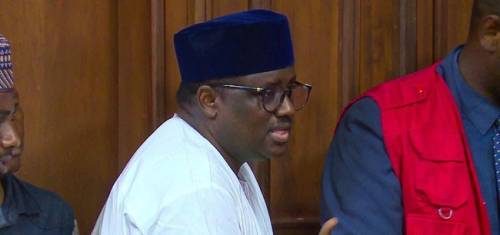
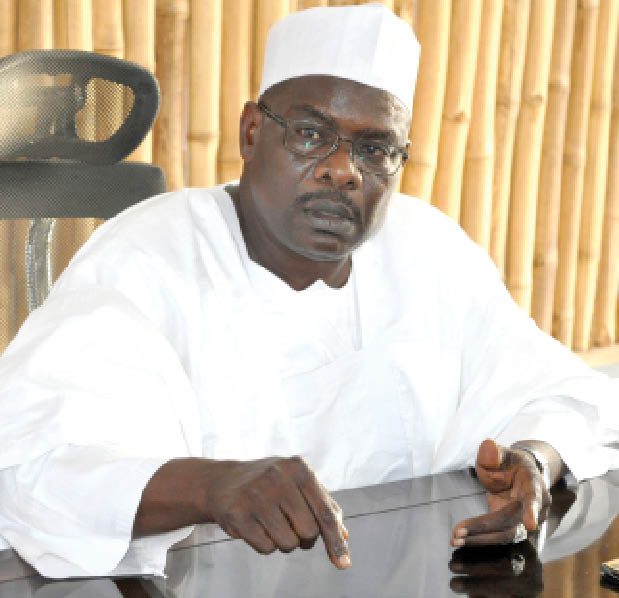
The Senator representing Borno South Senatorial District, Ali Ndume, has said he will direct his legal team to begin the process of terminating the surety bond he signed for former chairman of the defunct Pension Reform Task Force Team, Abdulrasheed Maina.

Ndume disclosed this in an interview he granted journalists on Saturday in Abuja.

Ndume, who doubles as the Chairman of the Senate Committee on Army, stood surety for Maina, prominent member of his constituency standing trial for money laundering at a Federal High Court sitting in Abuja.

Ndume took the decision to stand as surety for Maina because he satistified all bail conditions required by the court.

The judge had as part of the bail conditions, demanded among others, that Maina should produce a serving senator as his surety.

Things went awry when Maina jumped bail and his whereabouts became unknown even to his relatives.

The judge subsequently remanded Ndume in the Kuje Correctional Centre following his inability to produce Maina when the case came up for hearing.

A legal battle ensued and Ndume was left off the hook while Maina, the fugitive, was arrested in Niger Republic and extradited to Nigeria on Thursday.

He was subsequently remanded in Kuje prison by the FCT High Court on Friday.

With the decision by Ndume to sever surety bond with Maina, the Senator will be the second person to end an erstwhile intimate relationship with the former Chairman of PPRT.

Earlier today, Joe Kyari-Gadzama withdrew his services as lawyer to Maina.

Reacting to the development in the said interview, Ndume commended the Inspector General of Police. Mohammed Adamu, and other security personnel that were involved in the arrest and extradition of Maina.

Ndume said, “I commend the Nigeria Police Force for executing the bench warrant issued on Maina by the Federal High Court in Abuja.

“This has shown that the NPF is not a write-off.

“They are professionals under the able leadership of the Inspector General of Police, Mohammed Adamu.

“With the successful arrest, extradition and subsequent remand of Maina at the Kuje Correctional Centre, I will proceed to direct my legal team to begin the process of withdrawing my suretiship for Maina with immediate effect because his action has shown that he is not trustworthy.”

The Senator also thanked all Nigerians especially members of the National Assembly, the political class, family, and friends, who showed serious concern when the court moved against him following the disappearance of Maina, who subsequently jumped bail.
US House of Representatives votes to legalize marijuana

0


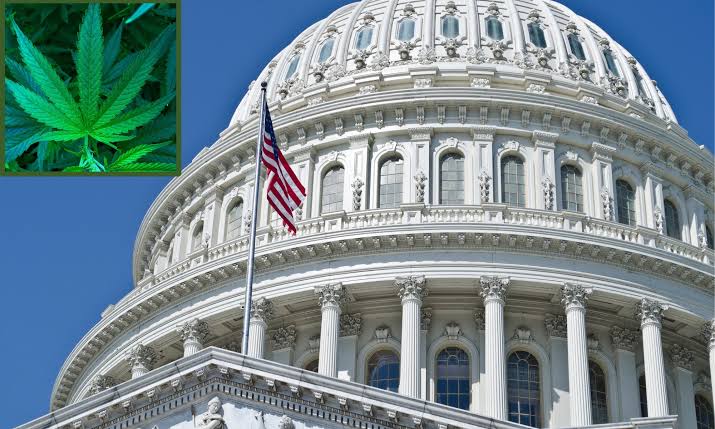
The US House of Representatives on Friday passed a bill that would legalize marijuana at the federal level.

The bill would remove marijuana from the federal drug scheduling system, the basis for much of federal drug policy, and eliminates criminal penalties for anyone who possesses, distributes, or produces marijuana.

The Marijuana Opportunity, Reinvestment, and Expungement (MORE) Act would expunge records for people with prior federal marijuana convictions. It would also impose a tax on marijuana products, which would fund new programs intended to support “individuals and businesses in communities impacted by the war on drugs.”

The bill would also take numerous steps to reverse the collateral damage of cannabis prohibition: It would open up federal loans to marijuana businesses, ban federal officials from denying public benefits to people with previous marijuana convictions, and prohibit the denial of US citizenship based on marijuana-related events, among other changes.

It’s unlikely, however, that the bill will make it much further in the current Congress, with the Republican-controlled Senate still opposed to legalization.

There is a Senate version of the MORE Act, should the legislative body, in a very unlikely scenario, decide to take it up. It’s sponsored by Sen. Kamala Harris (D-CA), who’s now the vice president-elect.

Although Harris now supports legalization, President-elect Joe Biden has said he only backs more moderate efforts and decriminalization (which would remove criminal penalties for possession but leave other penalties in place). So it’s unclear if the MORE Act will fare better under Biden.

President Donald Trump has voiced support for letting states decide their own marijuana laws, but has so far rejected full legalization at the federal level.

The MORE Act wouldn’t legalize marijuana nationwide. While it would remove a giant hurdle to full legalization by eliminating federal restrictions, it would still be up to states to decide if they want to legalize marijuana within their borders. So far, 15 states and Washington, DC, have legalized marijuana, although DC doesn’t allow recreational sales.

Several states recently voted to legalize marijuana — in the same election Biden won — including conservative Montana and South Dakota.

One potential hurdle to legalization: It would technically put the US in violation of a series of international drug control treaties, which prohibit signatories from allowing marijuana — and various other currently illicit drugs — for recreational purposes. But other countries, like Canada and Uruguay, have legalized marijuana by effectively ignoring the treaties.

Supporters of legalization argue that it eliminates the harms of marijuana prohibition: the hundreds of thousands of arrests around the US, the racial disparities behind those arrests, and the billions of dollars that flow from the black market for illicit marijuana to drug cartels that then use the money for violent operations around the world. All of this, legalization advocates say, will outweigh any of the potential downsides — such as increased cannabis use — that might come with legalization.

Opponents, however, claim that legalization will enable a huge marijuana industry that will market the drug irresponsibly. They point to America’s experiences with the alcohol and tobacco industries in particular, which have built their financial empires in large part on some of the heaviest consumers of their products. This could result in more people using pot, even if it leads to negative health consequences.

Lagos-Ibadan train tickets will cost N3,000 to N6,000 —FG

0

THE Federal Government has approved charges on the new Lagos-Ibadan rail standard gauge which would begin operations by January 2021.

The Minister of Transportation, Rotimi Amaechi, made the disclosure during the inauguration of the Governing Council of the Chartered Institute of Transport Administration of Nigeria in Abuja on Friday.

He said the train ticket would cost between N3,000 to N6,000.

Amaechi said, “I have received the mandate of President Muhammadu Buhari to inaugurate the Lagos/Ibadan rail project by January 2021 which will make Nigerians see the way the standard gauge railway looked like.

“Today I approved the charges on passengers from Lagos to Ibadan, we just transfer how we charged from Abuja to Kaduna.

“We charge N3,000 per Economy seat, N5,000 for Business class, and N6,000 for First class, the same is applicable to Lagos to Ibadan.

“It should have started running by now before Mr. President inaugurates it by January.”

The minister said that the ministry would collaborate with CIOTA to enable them to achieved their objectives.

He said CIOTA role was critical to the growth of transportation in Nigeria, adding that the country had advanced a lot in the area of transportation.

Fayose granted permission for medical trip

0

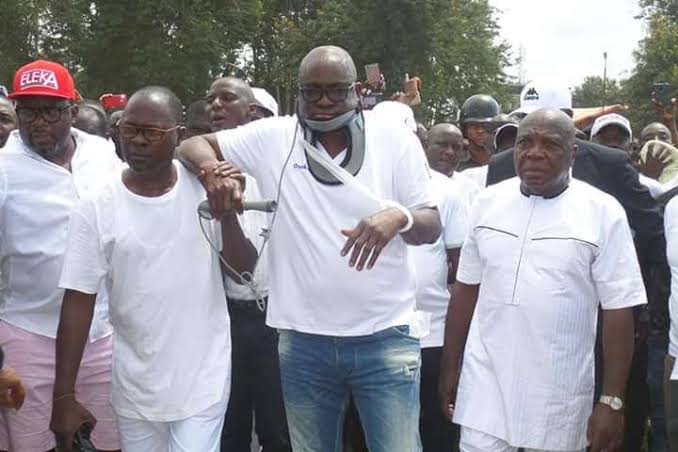
A Federal High Court in Lagos has granted permission to former governor of Ekiti State Ayodele Fayose to embark on medical trip.

Mr Fayose and his firm Spotless Investment Limited are being tried by the Economic and Financial Crimes Commission (EFCC) for alleged N2.2billion fraud.

Justice C.J. Aneke granted the permission on Friday following an application by Fayose’s lawyer Ola Olanipekun.

EFCC counsel Rotimi Jacobs did not oppose the request.

The judge adjourned further hearing in the case till January 22, 2021.

In the charges, the EFCC alleged inter alia that Fayose, on June 17, 2014, “took possession of the sum of N1, 219, 000,000 to fund your 2014 gubernatorial campaign in Ekiti State, which you reasonably ought to have known formed part of the proceeds of an unlawful act, to wit: criminal breach of trust/stealing.”

The ex-governor was also alleged to have on the same day “received a cash payment of $5,000,000 from Senator Musiliu Obanikoro, the then Minister of State for Defence, which sum exceeded the amount authorised by law and you thereby committed an offence contrary to sections 1 and 16(d) of the Money Laundering (Prohibition) Act, 2011 (as amended) and punishable under Section 16 (2)(b) of the same Act.”

In January, a video of Fayose dancing with a white woman on a cruise ship abroad surfaced on social media.

The ex-governor was on a medical trip at the time granted him by the same court in his trial for allegedly receiving and keeping N1.2 billion and $5 million stolen funds from the office of National Security Adviser (NSA).

Maryam Sanda’s death penalty stands as Court of Appeal rejects appeal

0

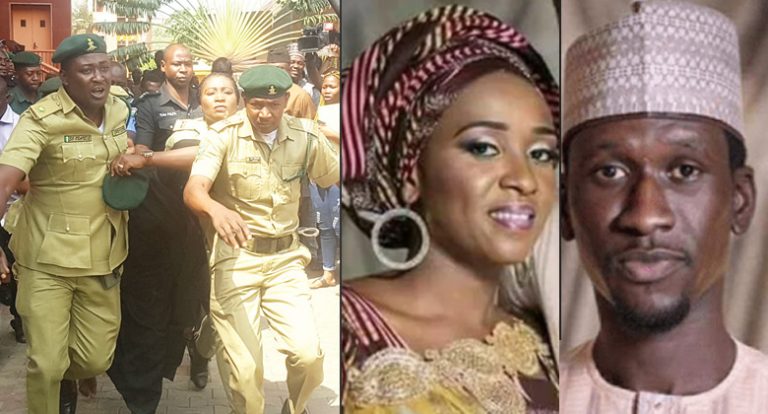
A Court of Appeal in Abuja on Friday dismissed the appeal filed by Maryam Sanda against the death sentence handed her for killing her husband Bilyaminu Bello.

In his two-hour judgement, Justice Steven Adah held that the court was duty-bound to do justice according to law and not sentiments.

Justice Adah said Sanda’s appeal lacked merit.

Justice Yusuf Halilu of an FCT High Court had on January 27 given the sentence.

He sentenced Sanda after she was convicted for stabbing Bello to death on November 18, 2017.

Bello was the nephew of former national chairman of the Peoples Democratic Party (PDP) Haliru Bello.

In the notice of appeal predicated on 20 grounds, Sanda had prayed the appellate court to set aside the verdict of the lower court and acquit her.

She claimed Justice Halilu was tainted by bias and prejudices.

Sanda alleged that the judge gave the verdict despite the reasonable doubt that was created by evidence of witnesses, lack of confessional statement, absence of murder weapon, lack of corroboration of evidence by two or more witnesses, and lack of autopsy report to determine the true cause of her husband’s death.

Those killed in Zarbamari were Boko Haram informants, not farmers -Community Source

0

By Yemi Itodo

Contrary to the believe that victims of Boko Haram attack last Saturday in Borno were rice farmers; fresh fact has emerged Friday morning that they were actually informants and logistics suppliers to the insurgents.

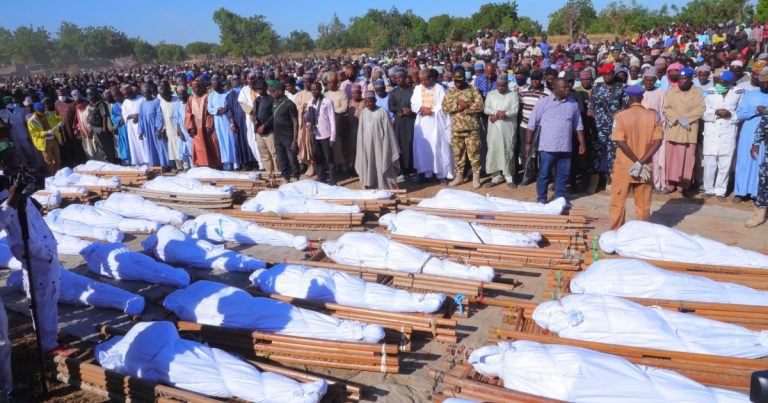
About 48 persons were reportedly slain Saturday morning in Zarbamari, a town in Borno State, North East Nigeria, by the Boko Haram insurgents, who later claimed responsibility.

The recent attack which was believed by many to be on rice farmers, has elicited commentaries and condemnations from all spheres of life.

But Mallam Kabiru Zanna, a local of Zarbamari, who spoke with this Correspond Friday morning, said those affected were mainly collaborators of Boko Haram who hailed from Zamfara and Sokoto states.

“The people that were killed were actually logistics suppliers and collaborators with Boko Haram. They supply them food, fuel. They also help the insurgents in selling rustled cows”, he said.

Zanna who spoke in Hausa, also narrated what actually transpired on that fateful Saturday and how the transaction between the insurgents and their erstwhile collaborators went awry.

“Last week, these same people were on their way to meeting the insurgents for business when they were accosted by soldiers and after the soldiers couldn’t find anything on them they let them go.

“Meanwhile, the insurgents who were waiting saw them with the troops who later killed 5 of them after an ambush, so the insurgents accused those guys of providing Intel to the soldiers. This is the main reason why the terrorists began killing them.

“The insurgents called them to meet on Thursday but they said they wouldn’t be able to make it unless on Saturday. They agreed to meet early morning 5:00am on that Saturday. They even had their morning prayers there.

“From there, the insurgents began to tell them about those guys who used to supply them food, who also betrayed them by providing Intel to the troops.

“Normally if there are betrayers in a town the entire community would pay the price for such acts. At that moment, the insurgents ordered that everyone be tied. They instructed that no gun should be fired in other not to attract troops.

“That was exactly what happened. Those people mostly are collaborators of the terrorists”, he added.

Zanna, who has been keeping tabs with activities of Boko Haram in the state, said, though some that were killed were innocent, “but very few of them. I swear most of them are traders with the insurgents. None of them is a rice farmer, they are all in trade with the insurgents”.

When contacted on phone, a Media Aide to Governor Babagana Umar Zulum, Mr. Ahidjo Abdu Likita, confirmed the revelation.

“Yes, it has been confirmed that the victims slaughtered were agents of Boko Haram”, he told our reporter on phone, adding that, further investigation was being carried to reveal more.

When asked why did the Governor go ahead to disburse money to perceived family members of the victims, since they were collaborators, Likita said, the Governor didn’t “know the real of all the scenario till today”.

He said, “everybody was thinking it was the real people of Zabarmari village”, until the information got to the Governor Friday morning.

NPA generated N291bn in 10 months – MD

0

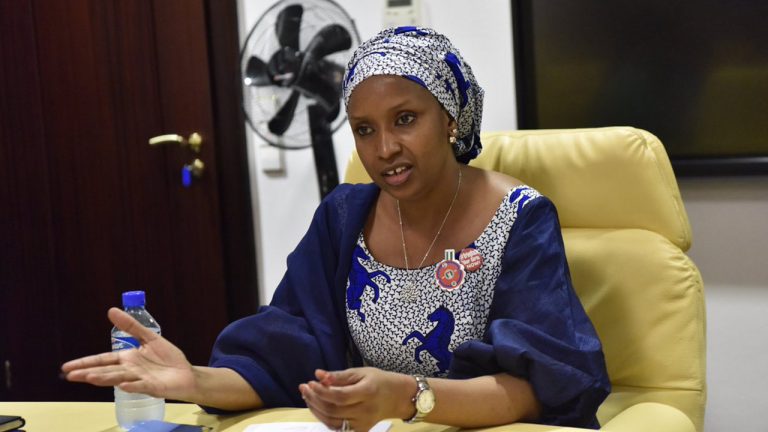
THE Nigerian Ports Authority generated N291bn revenue between January to October 2020.
This was disclosed by the Managing Director, Hadiza Bala-Usman, in a television programme on Thursday.
According to Usman the revenue generated this year does not surpass the N298bn record set last year.
She, however, noted that the differential was marginal and could be equalled between November and December.
She said, “Despite the challenges within the economy, the Nigerian ports between the period of January to October, was able to raise 291bn as revenue.
“In 2019, we raised 298bn between January to December. You can see that the differential is marginal.
“In November-December we may be able to meet up to what we made in 2019 or we may not. There was a reduction but it was not huge in terms of revenue.”
The NPA boss said port operations suffered a downtime of two days after recent attacks on port headquarters.
She said, “Regarding our operations, we had a downtime of two days sorting Internet services provisions for payment. We were up after 48 hours to continue operations.
“The offices torched were corporate and strategic communication and some part of the audit department- the windows got burnt but we didn’t lose any documents.
“On one side we look at it as random hoodlums, on the other hand, we also have a lot of questions to answer like why your office? However seven people were arrested and we have CCTV footage of the attack.”

Dangote refinery named among 20 most influential projects

0

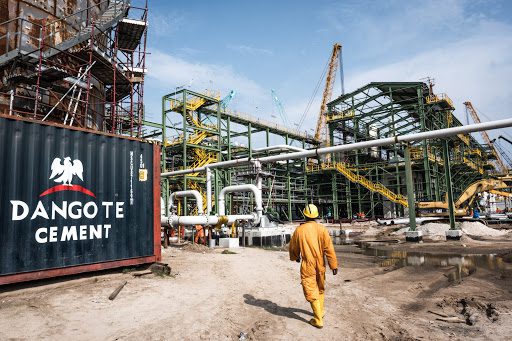
Dangote oil refinery has been listed among the top 20 influential projects surveyed in the last 18 months by the Project Management Institute.

Dangote Industries Limited said in a statement on Thursday that the refinery was recognised for the potential to fuel Nigeria’s economic transformation from an importer to a self-sustaining powerhouse in petroleum refining.

According to the statement, the PMI said the 2020 Most Influential Projects list highlights compelling projects around the world and across industries that achieved significant milestones and impacted society.

It said the list identified the noteworthy projects that had defined the past year – a year that has been dramatically transformed by the coronavirus pandemic.

PMI’s Vice President of Global Engagement, Otema Yirenkyi, was quoted as saying, “When it’s completed in 2021, the Dangote oil refinery in Nigeria will be the largest oil refinery in Africa and one of the largest in the world, processing 650,000 barrels of crude oil per day and creating nearly 35,000 jobs in and around Lagos.

“But its benefits run deeper than that. By creating a self-sustaining supply of high-quality refined petroleum products, the project will reduce the country’s reliance on imports, help stabilise its currency and aid in the fight against poverty.”

The President and Chief Executive Officer, PMI, Sunil Prashara, said the most influential projects reflected how project managers and change managers had found ingenious ways to keep initiatives moving forward in the face of unexpected obstacles associated with the pandemic.


Maina remanded at Kuje prison till end of trial

0

A Federal High Court in Abuja has ordered the remand of former chairman of the defunct Pension Reform Taskforce Team Abdulrasheed Maina at Kuje Correctional Centre pending the conclusion of his trial.

Justice Okon Abang gave the order on Friday following resumption of trial.

Maina’s counsel Adaji Abel formally withdrew from the case while the counsel engaged by Mr Maina asked for a short adjournment to enable him to study the facts of the case.

Justice Abang granted the application for adjournment on the ground that the defendant who is presumed innocent is entitled to legal representation.

The case was adjourned to December 8.

Maina who is being prosecuted by the Economic and Financial Crimes Commission (EFCC) on N2billion money laundering charges was on Thursday extradited to Nigeria from Niger Republic after he jumped bail.

QED

45-year-old civil servant, student emerges NANS president

0

A 45-year-old civil servant has been elected the new president of the National Association of Nigerian Students (NANS).

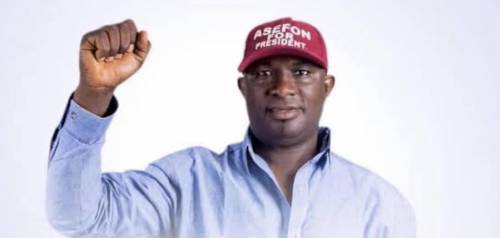
Amid chaos and violence that characterised the convention at the old parade ground, Abuja on Thursday, Sunday Asefon who works with the Ekiti State Government, got 155 votes to defeat his closest rival, Olushola Oladoja, who scored 100 votes.

Oladoja , reported to be a student of  Ekiti State University, replaces Bamidele Akpan.