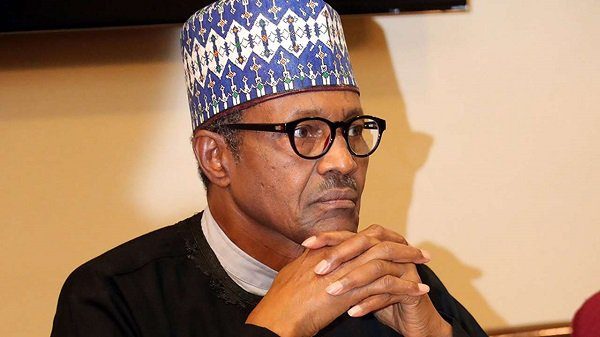
President Muhammadu Buhari has described late Nigeria’s Out-going Ambassador to the United States, Justice Sylvanus Adiewere Nsofor as “an outstanding judge of rare courage and truth who is not afraid to give justice to whom justice is due.”
While mourning the late Justice, the president expressed heartfelt commiserations with the family, friends and associates over his demise.
A statement issued by Garba Shehu, Senior Special Assistant to the President (Media & Publicity) in Abuja on Friday informed that Buhari eulogized Nsofor in a telephone call to Jane, the widow of the retired justice in New York on Friday.
The statement said apparently referring to the 2003 presidential election during which Justice Nsofor delivered a minority judgment as a member of the Election Appeal Panel in favour of Gen. Buhari as a candidate of the All Nigeria Peoples Party (ANPP), the President said the country will miss people with such exemplary pedigree.
The Edo State governorship Election Petition Tribunal sitting in Benin City on Friday, dismissed the petition filed by the Action Alliance (AA) against the state governor, Godwin Obaseki for failing to file for issuance of pre-hearing notice .
Recall that the court had on Monday said that the petitioner failed to file for issuance of pre-hearing notice which is one of the conditions required by the Electoral Act 2010.
The tribunal consequently adjourned to Friday, December 11( today), for ruling.
Dismissing the petition, the tribunal in a unanimous decision ruled that the petitioners abandoned their petition and dismissed the petition against the respondents.
Action Alliance and four other political parties are challenging the outcome of the September 19 Edo State governorship election that brought in governor Godwin Obaseki.
However, councel to the petitioners, Stephen Osaigbovo said he would appeal the dismissal of the case.
The Christian Association of Nigeria (CAN) has said men and women exchanged sex for food during the coronavirus-induced lockdown.
Speaking on Thursday in Abuja at the launch of its 16 days of activism against gender-based violence, CAN President Samson Ayokunle urged President Muhammadu Buhari to prioritise investment in food production to reduce hunger and fast-track economic wellbeing of the people, especially women and girls.
According to him, rather than pay lip service to women emancipation, the government should focus on practical means to address their economic and social needs in safe spaces free of violence and abuse.
Ayokunle said, “Economic challenges during the COVID-19 outbreak posed a serious threat to young women’s work and business activity and exposed them to increased risk of exploitation and abuse.
“We observed that higher levels of food insecurity and hunger led women and men to exchange food for sex. So, we urge the government to do more to reduce hunger in the land, which will help to fight gender-based violence in Nigeria.”
The Nigeria Centre for Disease Control (NCDC) says there is inadequate testing for COVID-19 in some states, making it difficult to understand the burden of the disease for effective response.
NCDC Director-General, Dr Chikwe Ihekweazu, made this known in Abuja at a briefing of the Presidential Task Force on COVID-19.
Ihekweazu listed the states not embarking on adequate testing as Cross River, Jigawa, Kogi, Osun, Ebonyi, Adamawa, and Zamfara.
“It’s important to test, to manage the outbreak and plan for vaccination,” he said.
He also noted that the FCT, Lagos, and Kaduna currently had the highest cases so far.
Ahead of the festive season, Ihekweazu urged Nigerians to maintain the COVID-19 protocols and avoid mass gatherings.
“The numbers are not looking good and we need to take this very seriously as we plan for the end of the year,” he said.
There were three prominent red caps dotting the hall, as the All Progressives Congress (APC) held its National Executive Committee (NEC) meeting on Tuesday at the Council Chambers of the Presidential Villa, in Abuja.
Type of caps are often symbolic of the part of the country you hail from. Red is typical of the East, particularly if you are a title holder. And these three were no mean men.
The first red cap adorned the head of Chief Orji Uzor Kalu, a former two-term governor of Abia State, and an early comer to the APC from his region of the country. He caught the vision of a renascent Nigeria early enough. He used to belong to the Peoples Democratic Party (PDP) and the Progressive Peoples Alliance (PPA).
The second red cap sat daintily on the head of Hope Uzodimma, another wise man from the East, and Governor of Imo State. He also used to belong to PDP, till he had a Damascus road experience like the biblical Saul, who became Paul.
The third red cap? Man of the moment, and star of the NEC meeting. Every mention of his name drew an applause. Chief Dave Umahi, an Engineer, and Governor of Ebonyi State.
Umahi had been a PDP man, possibly all of his political career. He was a deputy governor to Martin Elechi for eight years, succeeded him as governor, and is now in his second term.
Umahi had always loved and respected President Muhammadu Buhari, and never hid it, though they were of different political parties. And the President reciprocated in like manner. In fact, the first State the President ever visited in the country, and passed the night, was Ebonyi. Umahi was PDP in the exterior, but APC at heart.
My first inkling of what was on the way was about two years ago. There was a meeting of Progressive Governors (as those elected on the platform of APC are called), and Gov Umahi had sent his deputy to attend. A PDP man among APC Governors? Something was definitely cooking.
Umahi and Buhari
Now, the deed has been done. Gov Umahi has done what Napoleon couldn’t do. He has officially crossed from the PDP to APC. Only a man with the heart of a lion could do that.
Do you remember the 1978 reggae song by a musician called I-Roy? We were boys then, and we loved that music, a sort of DJ chant in the Jamaican patois. You were young in the 70s, and didn’t know I-Roy?You sure missed an exciting part of early life.
The title of the album was Heart of a Lion. It was a star hit, and no party was complete without it. If you suffered from reggaemylitis (as I did then), I-Roy was a chart buster. The album featured other hit tracks like Sister Nelly, and Casmas Town.
What Umahi exhibited last month in crossing from PDP to APC can best be described as the heart of a lion. We know how the region he hails from has long been overtaken by the PDP, and with little to show for it. Their roads were dilapidated, bridges rickety, and in fact, the second bridge over the River Niger was built by mouth for the 16 years PDP held sway. Now, President Buhari is building the bridge, and is poised to complete it in 2022. Holy Moses!
Why did the South East hold tenaciously to PDP, despite being given the shorter end of the stick? Nobody knows. Till people like Orji Uzor Kalu, Hope Uzodimma, and now, Dave Umahi, began to ask questions, and followed it with pragmatic action. That was how and why an APC NEC meeting was dotted by three prominent red caps.Wonders are part of the world, and will never end.
See what the entrance of Umahi into APC has done for the party. When in year 2015, Hurricane Buhari blew in, the APC had 24 Governors, PDP had 11, and All Progressives Grand Alliance (APGA) had one. But due to schisms and wrangling, APC states began to dwindle, till it was almost 18 to 17. Zamfara, Bauchi, Sokoto, Benue, Oyo, Edo, were all lost. If Ondo had not been won by Arakunrin Rotimi Akeredolu a couple of months back, it would have been the nunc dimitis of APC. The party was fast vanishing, and the auguries for 2023 were not good.
Victory in Ondo was good. It took the tally to 19-16. Then came the game changer. Ebonyi came into the bag, and it became 20-15. Anambra still remains APGA. And APC that almost couldn’t breathe again had a huge relief. See the configuration now: South East: Imo and Ebonyi. South West: Lagos, Ogun, Osun, Ondo, Ekiti. North Central: Niger, Nasarawa, Kogi, Kwara, Plateau. North West: Kano, Kaduna, Kebbi, Jigawa, Katsina. North East: Borno, Yobe, Gombe. Twenty in all.
If there was a time the APC needed a shot in the arm, it was the time Dave Umahi came. It changed the country’s political map and configuration. And APC is breathing easier again. You then see why he was easily the star, the cynosure of all eyes at this week’s APC NEC meeting. When the Caretaker Committee Chairman of the party, Gov Mai Mala Buni, introduced him, there was rapturous applause. And when President Buhari equally mentioned his name in his speech, the hall exploded again.
Umahi has displayed a courage of conviction. He said the South East has been let down by the PDP in the last 21 years, so it was time to switch camp. It takes the heart of a lion to change course in such setting. Some people said it was because he wanted to run for President in 2023. And why not? The party has not come out with its zoning formula, but in a democracy, anyone can aspire for any position, as long as he can muster the needed support and momentum for victory.
I’ve always said it. The South East must play better politics to get the ultimate office in the country. Sleeping and facing the same direction may not be the best option. The Orji Kalus, Hope Uzodimmas, Chris Ngiges, Dave Umahis, and many others, are now shining the light, so that their people can find the way.
And so let it be.
*Adesina is Special Adviser to President Buhari on Media and Publicity
Every year an increasing number of Nigerians flee poverty and unrest at home. Now, rich Nigerians are planning their escape too. And they’re taking their money with them.
Dapo has spent too long at home in Lagos, Nigeria. Back in October, protests against the SARS police unit kept him from going to his office. “First, we were told to stay at home because of the coronavirus. Then this,” he says.
A wealthy Nigerian, Dapo, who is in his late 30s, does not want to make himself identifiable by giving his surname and age, lest it draw unwanted attention.
He has had a “backup plan” for getting out of Nigeria for some time, he says. “I have Maltese citizenship. I can leave for there any time.” With one small obstacle – a 14-day quarantine upon arrival – Dapo could be permanently in Malta any time he pleases. He is not planning to go imminently, but describes it as his “plan b’’.
Dapo is one of a rapidly growing number of Nigerians who have bought so-called “golden visas” or foreign citizenships-by-investment this year. In his case it was Malta, the Mediterranean island where citizenship can be acquired for a minimum investment of 800,000 euros ($947,180) through the Malta Citizenship by Investment Programme.
An aerial view over Malta Freeport in Valletta, in March 2018 [File:Getty Images]
Not that he has any special love for Malta. A record 92 countries around the world now allow wealthy individuals to become residents or citizens in return for a fee, sometimes as low as $100,000 but often several million dollars. It is billed as a “win-win”: The country gets much-needed foreign investment and, in return, the new citizens have new passports that open up more of the world to travel or live in.
Golden visas are the lesser-reported side of the Nigerian migration story. Every year thousands of Nigerians make their way to Europe via perilous crossings over the Sahara and Mediterranean. Now their wealthier counterparts are also making their way to Europe but via a different route.
A record year for golden visas
Whether rich or poor, the reasons for leaving one’s home country are often the same. Fear of political uncertainty at home and hope for better opportunities elsewhere. But 2020 has been exceptional.
Like Dapo, Folajimi Kuti, 50, was watching the #EndSARS protests from his home in Lagos in October. “I have children, they’re teenagers, and they’re asking me questions like, ‘How did we get here?’” he says, referring to the violence that accompanied demonstrations against the controversial Special Anti-Robbery Squad (SARS).
Kuti says he has believed for some time that social unrest would boil over in Nigeria, because of issues of poverty and police brutality. “It had been clear for the past two or three years that something was going to happen. It’s happened now in 2020 but, frankly, we’ve been expecting this outburst for a while so it wasn’t a matter of ‘if’. It was a matter of ‘when’.”
An aerial view shows the central business district in Nigeria’s commercial capital, Lagos in 2009 [File: Reuters]
Citizenship or residency abroad has become appealing, he adds. As a financial adviser to the wealthy, Kuti knows the process of applying for one having walked clients through it before. Most of his work involves advising Nigeria’s growing number of millionaires about investments and wealth planning. But now they are asking about foreign citizenships and Kuti himself is tempted by the idea. “Just knowing that if you need to go you certainly could and move without any restriction.”
The rush for golden visas among rich Nigerians started before October’s SARS protests. At London-based Henley & Partners, one of the world’s largest citizenship advisory firms, applications by Nigerians increased by 185 percent during the eight months to September 2020, making them the second-largest nationality to apply for such schemes after Indians.
More than 1,000 Nigerians have enquired about the citizenship of another country through Henley & Partners this year alone, which Paddy Blewer, head of marketing, says “is unheard of. We’ve never had this many people contacting us”.
Many, like Kuti, saw political problems ahead and wanted an escape plan. Others were focused on coronavirus: What if the pandemic overwhelms Nigeria?
“There is a lack of primary healthcare capacity that would be able to manage with either a second wave or whatever happens in, say, 2025,” says Blewer. “Let’s say there is COVID-21 still going on in 2025 that is of an order or magnitude worse. It’s, ‘Do I want to be based here and only based here, or do I want an alternative base of operations where I believe I will be safer and I will be able to run my global businesses’.
“And, I think, that’s what COVID has driven.”
The Victoria Island waterfront is seen from the affluent Ikoyi neighbourhood in Lagos, in June 2014 [File: Reuters]
It was in July, when the number of COVID-19 cases in Nigeria escalated, that wealthy Nigerians started looking more seriously at citizenship abroad, experts say. “Those with medical conditions that could not fly out – a lot of them are buying passports just because if there is any problem they can fly out,” says Olusegun Paul Andrew, 56, a Nigerian entrepreneur and investor who spends much of the year in the Netherlands.
“Flying out” of Nigeria is hard and not just because of the coronavirus pandemic. Just 26 countries allow Nigerian passport holders visa-free entry, many of them part of West Africa’s ECOWAS arrangement. Both the United Kingdom and Europe’s Schengen zone require Nigerians to obtain visas ahead of travelling.
For the wealthy, this is too much hassle. “They don’t want to be queueing for visas for any EU country or whatever,” says Andrew. Instead, why not purchase the citizenship of a country with visa-free access to Europe?
To Europe, via the Caribbean
Bimpe, a wealthy Nigerian who also does not wish to give her full name, has three passports. One Nigerian, which she says she never uses, and two from Caribbean nations: St Kitts and Nevis; and Grenada.
The St Kitts and Nevis passport, which cost her $400,000 via a real estate investment programme, was useful when she travelled between London and New York on business as it allows for visa-free travel to the UK and Europe. But now that she has retired in Abuja, Bimpe, whose husband has passed away, wants her three adult sons to have the same opportunities to travel and live abroad.
“My kids were interested in visa-free travel. They are young graduates, wanting to explore the world. So that was the reason for my investment,” she explains.
A general view of Grenada taken in March, 2019 [File: Getty Images]
Her investment to gain a Grenada passport for herself and her sons took the form of a $300,000 stake in the Six Senses La Sagesse hotel on the Caribbean island, which she bought in 2015 through a property development group called Range Developments. Like most countries offering their citizenship for sale, Grenada allows real estate investments to qualify for a passport.
Bimpe’s family has lived overseas before – spending nine years in the UK between 2006 and 2015. Of her three sons, she says: “One, for sure now, is never going to leave Nigeria. He loves it here. The second one lives in England. He’s been in England long enough to get British residency. My youngest – for him, living abroad is a very, very attractive option. He’s not very happy [in Nigeria]. He went to England very young – at age 12 – and he’s had a problem adjusting since. He’s been back in Nigeria five years and he’s still not settled.”
Now aged 26, Bimpe’s youngest son is looking at settling in the UK or in the US where, thanks to his Grenada citizenship, he qualifies for an E-2 visa, something not available to his fellow Nigerians since President Donald Trump’s ban on immigrant visa applications in February. Bimpe believes his career opportunities in acting – he studied Drama in the UK – are better abroad, and therefore considers the Grenada citizenship to be a worthwhile investment.
Neither Bimpe nor her sons have ever been to Grenada even though their investment allows them to stay on the Caribbean island, once known as The Spice Island. “I intend to go. I would like to go,” she says. “Just when I did [the investment], it was soon after my husband died and I wasn’t in the mood for travel and then I got my passport but there was no good reason for travel due to the pandemic.”
The Six Senses La Sagesse is being constructed by Range Developments, whose founder and managing director, Mohammed Asaria, says it is not unusual for investors never to visit. In fact, since there is no obligation for citizenship investors to visit Grenada, interest in the scheme has ballooned among Nigerians.
An aerial view of the Six Senses Grenada [Photo courtesy of Range Developments]
“We have between high single figures and low double-digit sales of hotel units on a monthly basis to Nigerians. The average investment is just under $300,000,” says Asaria. “It’s a big market for us. And it’s going to get bigger. There are 300 million people [in Nigeria].” Of these, more than 40,000 are millionaires and, therefore, potential customers for golden visas, according to the Knight Frank Wealth Report.
It is a similar story across the Caribbean. Arton Capital, a citizenship advisory group, says demand from Nigerian families for Antigua and Barbuda citizenship is up 15 percent this year compared with the last.
St Lucia has also seen a record number of Nigerians applying in 2020. “It’s more than it’s ever been over the past four years,” says Nestor Alfred, CEO of the St Lucia Citizenship-by-Investment Unit.
The citizenship market is not exclusive to the Caribbean, but these are the cheapest and they maintain that all-important visa-free access to Europe that their clients are hankering after.
Tax incentives
“I’m rich but I’m not a Donald Trump. I wasn’t looking for a tax escape,” says Bimpe.
Investing in a foreign citizenship is not illegal for Nigerians, but the issue of wealthy citizens moving their assets overseas is a thorny one in Nigeria, where about $15bn is lost to tax evasion every year, according to the country’s Federal Inland Revenue Service. Much of that money finds its way to the Caribbean, as was highlighted in the leaked documents that formed part of the Panama Papers in 2016.
The tax benefits of an overseas citizenship are undoubtedly attractive. Citizens can become tax residents of countries like Dominica, where there is no wealth or inheritance tax, or Grenada which offers “corporate tax incentives”. In Europe, Malta has long been courting hedge funds with its light-touch regulations.
Tourists take photographs down a typical street in Valletta, Malta in 2018 [File:Getty Images]
Being a citizen of a country with a more stable currency is also appealing to the wealthy. “Second citizenship helps with capital mobility. Pull up a graph of the Naira. If you look at the Naira for the last 10 years it’s been a horrible journey,” says Asaria. Better, therefore, in the minds of the wealthy, to own assets in euros or even East Caribbean dollars which are pegged to the US dollar.
“Businesses are struggling, inflation on the rise, insecurity, and a host of other issues. These issues have prompted an increase in citizenship or residency-by-investment from wealthy Nigerians in a bid to secure a better future for their families in developed countries,” says Evans Ahanaonu, a Lagos-based representative for High Net Worth Immigration, a citizenship advisory firm. Grenada and Turkey are popular for clients wanting quick access to Europe, he adds, while some go straight for the UK Innovator Visa which means setting up a business in the UK.
Given the number of applications processed by the citizenship advisory firms interviewed just for this article, a conservative estimate would put the amount invested by Nigerians into citizenship schemes at more than $1bn this year alone.
Where rich and poor migrants meet
The loss of wealth from Nigeria has severe implications for levels of employment in the country. With wealthy businesspeople investing their capital outside Nigeria rather than in it, there is less funding for local businesses or government projects which might otherwise generate employment. This, in turn is causing more poorer Nigerians to want to move overseas as well, in search of better work opportunities, a trend backed up by the findings of a 2018 survey by Afrobarometer, the data analysis group.
Just before the pandemic struck, Kingsley Aneoklloude, 35, was able to make his way to Europe, but via a very different route.
He was working as a mechanic in his village in Edo State, one of the country’s poorer provinces which have been untouched by oil wealth, where he earned 1,500 naira ($3.95) a week.
The salary was poor but the final straw was police brutality. Aneoklloude was briefly employed as a local election monitor during the 2015 presidential elections. He says he was pressured by representatives of a political party to manipulate ballot papers, but refused, after which he became afraid for his safety. “I left because they were chasing me. Honestly, they come and chase me,” he says.
In a photo from 2019, migrants fleeing from Libya on an overcrowded wooden boat wait to be rescued in the Mediterranean Sea [File: AP]
First, he went to Kano State in the north of Nigeria. Then, in December 2019, Aneoklloude made the dangerous journey to Europe via Niger, then Libya, “where there was a heavy war in Tripoli”, before crossing the Mediterranean.
While adrift on the Mediterranean Sea, his small boat was rescued by Open Arms, an NGO which helps refugees and migrants crossing the Mediterranean. Their ship docked in Lampedusa, one of the Italian Pelagie Islands, where Aneoklloude’s asylum application for Germany was processed.
Now in Potsdam, Germany, he is waiting to hear the outcome of his application for new citizenship and a job. “I have a nine-month contract for work, but they need the immigration officer to sign the contract before I start,” he explains.
At 35, Aneoklloude is just a few years younger than Dapo. Both have witnessed police brutality from different angles, and both saw the Mediterranean as their way out.
But now, with Nigeria’s economy officially in another recession, more will likely follow. It is a dangerous spiral: The more wealth taken out of Nigeria, the fewer jobs available to its poorest.
Joseph Safra, Brazil’s wealthiest person died Thursday in Sao Paulo at 82.
Safra was said to have died of natural causes, according to his family.
Safra was the richest banker in the world and the 39th-richest person, according to Forbes magazine, with a fortune estimated at $23.2 billion at the time of his death.
Born in Lebanon, Safra ran a Brazilian banking and investment empire. His Lebanese-Syrian family’s banking connections dating back to Ottoman times.
The family moved to Brazil in 1952, when Safra was 14. Three years later his older brother, Edmond, and father Jacob started working in Brazil by financing assets in Sao Paulo. Edmond later separated from brothers Joseph and Moise and headed to New York, where he founded the Republic National Bank of New York. Edmond died in a fire set by his nurse in 1999; Moise died in 2014.
Banco Safra, the private bank that Jacob Safra opened in 1955 and Joseph Safra led until his death, reportedly is the sixth-largest private bank in Brazil. Joseph Safra became the richest person in South America’s largest nation last year.
In 2013, Joseph Safra’s family acquired more than a dozen properties in the United States, primarily in New York City. They also own a portfolio of commercial real estate in Brazil. In 2014, Safra paid more than 700 million pounds, about $930 million, to buy The Gherkin, one of the most distinctive towers in the City of London.
He is survived by his wife, Vicky; his children Jacob, Esther, Alberto and David; and 14 grandchildren.
Governor Nasir El-Rufai of Kaduna State has expressed concern over the rising debt profile of the country.
El-Rufai, who bemoaned the humongous debt incurred by the country, said the country must do something to halt the alarming rise of its debt.
He stated that there was no need to pretend that Nigeria’s debt to Gross Domestic Product ratio was still low adding that the country is getting to debt ceiling as far as liquidity is concerned,
The Debt Management Office issued a release in September this year that showed the country’s debt stock as of June 30, 2020.
According to the release from DMO, the country’s debt portfolio was N31trn.
El-Rufai, who spoke at a virtual event organised by World Bank Nigeria, noted that most rich Nigerians did not pay income tax.
The governor, who has been advocating state policing, noted that as the Chief Security Officer of his state it has been hard to adequately fund security because the government has incurred numerous debts.
El-Rifai said the Central Bank of Nigeria’s involvement in many activities should be addressed, adding that the country’s rising debt should be controlled.
He said, “You can’t fund security more than you are doing now unless you reduce spending on other ministries, departments, and agencies.
“The extensive way in which the Central Bank is into everything, I think, has to be addressed and dealt with. And we must look at our domestic debt management and do something about it.
“It is getting out of control and we are getting to our debt ceiling as far as liquidity is concerned. And to pretend that our debt-to-GDP ratio is still low, I think is not the answer to the question.”
On the collection of taxes by the federal and state governments, El-Rufai said it was worrisome to note that many rich Nigerians defaulted in the payment of taxes.
He said, “It is a travesty that in Nigeria, as of 2018, just about 20 people in the whole country paid more than N20m in income tax. It is a travesty and something should be done.”
The governor said the federal and state governments should shift attention from those early paltry salaries and those at the lowest ranks of the professional ladder and focus on the rich people when it comes to the collection of tax.
He said, “I think that rich Nigerians don’t pay taxes. They live in huge houses, drive expensive cars but when you see their tax return, you realise that the civil servants on grade level 12 pay more income tax than they do.”
President Muhammadu Buhari has congratulated his Ghanaian counterpart, Nana Akufo-Addo, on his re-election for a second term in office.
The president’s congratulatory message was contained in a statement by his Senior Special Assistant on Media and Publicity, Garba Shehu, titled “Ghana: President Buhari congratulates Akufo-Addo on re-election.”
Buhari, who noted that Ghana and Nigeria share close historical and cultural ties, appealed to opposition parties to place national interest above personal and partisan considerations.
The statement read, “President Muhammadu Buhari congratulates President Nana Addo Dankwa Akufo-Addo of Ghana on his re-election for a second term in office.
“The President also commends the people of Ghana on the successful conclusion of the presidential and parliamentary elections, attesting further that with the right institutions and political leadership, constitutional democracy in the West African sub-region has come to stay.
“President Buhari appeals to other contestants in the elections to put national interest above personal and partisan considerations and maintain the peace while seeking resolution of grievances through established legal avenues.
“The President notes that Nigeria and Ghana share close historic and cultural ties, adding that he looks forward to working with his Ghanaian counterpart in realising shared goals that bring peace, security, and prosperity to the citizens of both countries in particular and the ECOWAS community in general.
“The Nigerian leader wishes President Akufo-Addo a successful new tenure, peace and stability in his country as well as improved bilateral relations.”
The Federal Government has ordered the reopening of all isolation centers across the country.
The Minister of Health, Osagie Ehanire, made this known at a President Task Force briefing on Covid-19 yesterday.
He said the move was in anticipation of a second wave of the pandemic which some European countries are already witnessing.
He urged all Nigerians to work toward curbing the spread of the virus as Nigeria witnessed a spike in the number of infected people some days in the week.
.“We are seeing the increase in the number of confirmed COVID-19 cases in the last few days, which we have frequently alluded to in recent times. This rightly suggests that we may just be on the verge of a second wave of this pandemic.
“To prepare ourselves, I have directed that all Isolation and Treatment Centres, which were hitherto closed due to reduced patient load, to be prepared for reopening and the staff complement put on alert,” he said.
Ehanire also urged Nigerians not to lower their guards as the battle against the infection has not been totally won.
He said this against the background of the reports that some isolation centers have been closed due to the reduction in the number of patients being admitted into them.
He said until the battle against the pandemic is totally won people should adhere strictly to the Covid-19 protocols to curb the spread of the virus.
“Until vaccines are available, our best bet is still the appropriate use of face masks, physical distancing, hand sanitizers, and observance of respiratory hygiene, for prevention and control,” he said.
He advised strongly against throwing caution to the wind during the upcoming Yuletide
“We must not forget that Covid will not take a holiday. Please endeavour to protect yourselves and others and still obey the measures at Christmas,” he said.