Home Blog Page 2215

CDS receives new COAS, urges him to build on legacy

0

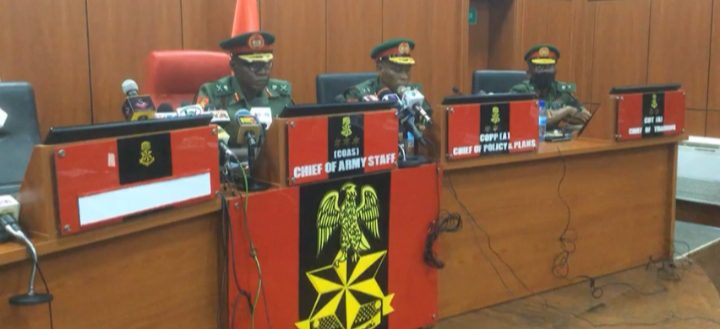
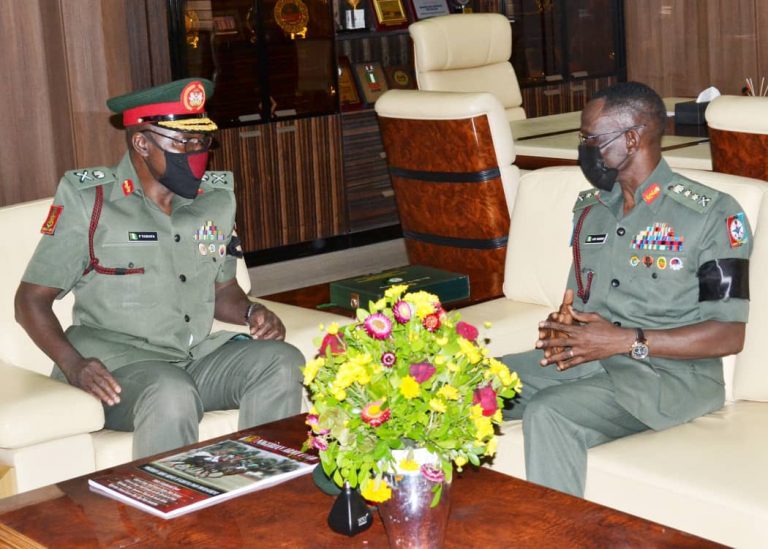
The Chief of Defence Staff (CDS), General Lucky Irabor today played host to the newly appointed Chief of Army Staff (COAS), Major General Faruk Yahaya in his office, at the Defence Headquarters (DHQ), Abuja.

The CDS congratulated Maj Gen Yahaya on his  appointment as the 22nd COAS, describing it as a well deserved appointment. The CDS also wished him a successful tenure in office as he assumes command. General Irabor further urged the new COAS to build on the legacy of his predecessor, particularly in the fight against insurgency and banditry.

The COAS was accompanied on the visit by the Chief of Policy and Plans Headquarters Nigerian Army, Maj Gen Benjamin Ahanotu.

Highlight of the visit was the CDS’ presentation of Nigerian Army flag to the new COAS.

Recall that President Muhammadu Buhari on Thursday 27 May 2021 appointed Maj Gen Yahaya as the new Army Chief.

Maj Gen Farouk Yahaya and CDS General Lucky Irabor at the Defence Headquarters

New Army Chief, Farouk Yahaya Assumes Duty

0

The newly appointed Chief of Army Staff Major General Faruk Yahaya on Friday assumed office at the Army Headquarters Abuja.

Yahaya who was appointed by President Muhammadu Buhari on Thursday becomes the 22nd Chief of Army Staff.

After the initial ceremonies, he addressed senior officers of the Nigerian Army at the main chamber of the Army Headquarters.

Before making his Address, he observed a one minute silence for his predecessor Lt Gen Ibrahim Attahiru who died in a plane crash few days ago.

Pictures from the event 


FranceAfrique: Russia to the rescue amid growing resentment against France

0


By Lawrence Audu

Only a few days ago, Mali’s military strongman, Colonel Assimi Goita, again, overthrew the months’ old transitional government which only began trying to reorganise the country, setting a pace for the return of democratic rule. How can Pro-Russians and Pro-French, form a successful transition together? In Mali, the former president of the transition Bah N’ Daw and his prime minister Moctar Ouane are pro-French and the other side the military are backed by Russia.

Since Ibrahim Boubacar Keita’s departure it had been understood that the military who took power, are more aligned to Russia than France, but because of international pressure, these soldiers gave in but they were still working in secretly with Russia which continued to infuriate France.
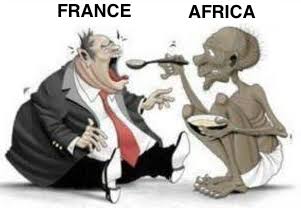
France does not allow her colonies purchase ammunition from foreign countries without her permission. Also, it remains difficult for those countries to seek foreign aid without the knowledge and approval of France.

The Accord
As part of the bargain for self-rule, France instituted a system that makes their colonies perpetual slaves of France especially with the 11 Agreement signed in the wake of African Independence.

1. Colonial debt for repayment of the profits of colonization.
That is, the newly independent states must reimburse the cost of infrastructures built by France during settlement.
2. Automatic confiscation of national financial reserves.
That is, African countries must deposit their financial reserves with the Banque de France. France’s ′′ keeping ′′ the financial reserves of fourteen African countries since 1961: Benin, Burkina Faso, Guinea Bissau, Côte d’Ivoire, Mali, Niger, Senegal, Togo, Cameroon, the Central African Republic, Chad, Congo-Brazzaville, Equatorial Guinea and Gabon.
Thus, monetary policy governance remains asynchronous and incomplete because they are driven directly by the French government, unrelated to the financial authorities of countries such as CEMAC or ECOWAS.
Thus, due to the conditions that bind banks in economic and financial zones, they are forced to keep 65 % of their foreign reserves in a transaction account held by the French Treasury, as well as an additional 20 % in order to cover ′′financial risks”.
In addition, banks in CFA zones impose a credit limit on each member country equivalent to 20 % of state receipts for the year N-1! Although the BEAC or the ECBAO have higher retirement opportunities from the French Treasury, these withdrawals must be the subject of the French Treasury agreement.
The final decision therefore goes to the French Treasury which itself invested the reserves of African countries in the Parisian stock market.
In other words, 80 % of African financial reserves, are deposited into an account controlled by the French administration.
3. The right of first refusal to any raw or natural resource discovered in the country.
That is France has the first right to buy the natural resources of the land of its former colonies. Only after France said, ′′ I am not interested “, that African countries are allowed to look for other partners.
4. Priority to French interests and companies in public contracts and tenders.
In awarding public contracts, French companies have priority over award. Although African countries can get better value elsewhere.
Consequently, in most former French colonies, all economic levers in countries are in the hands of French expatriates. In Côte d’Ivoire, for example, French companies own and control all major utilities including water, electricity, telephone, transport, ports and major banks. It’s the same thing in trade, construction and agriculture.
5. Exclusive right to provide military equipment and train colonial military officers.
Thanks to a sophisticated system of scholarships, subsidies, and the ′′defence agreements′′ attached to the colonial pact, Africans must send their senior officers to France.
6. France’s right to deploy troops and intervene militarily in the country to defend its interests.
Under what is called ′′defence agreements′′ attached to the colonial pact, France has the right to intervene militarily in African countries, and also to permanently park troops in military bases and installations, fully managed by the Frenchman.
7. The obligation to make French the official language of the country and the language for education.
An organization of the French language and the spread of French culture has even been created. It is called La Francophonie and has several satellite organizations. These organizations are affiliated and controlled by the French Foreign Minister.
8. The obligation to use the CFA franc (franc of the French colonies of Africa).
Although this system is not shared by the European Union, the French colonies are forced to use exclusively FCFA.
9. The obligation to send to France an annual balance sheet and a state report of reserves.

No report no money:

i.e. the director of central banks of ex-colonies presents the said report at the biannual meetings of finance ministers on ex-colonies. This report is then compiled by the Banque de France and the French Treasury.
10. Forfeit any military alliance with other countries, unless France has authorized it.
Most of these countries only have military alliances with their ex-colonizers simply because France prohibited them from any other military alliance.
11. The obligation to join forces with France in the event of a war or a global crisis.
More than a million African soldiers fought for the defeat of Nazism and fascism during the Second World War. These eleven (11) agreements are still in effect between France and the 14 CFA countries, and no French media or their so-called African specialists will talk to you about these eleven agreements that are still in force between France and the 14 CFA countries, and yet these agreements do exist between France and the CFA zone.

Today there seem to be a depart from this accord as many of the francophone countries have on their own in spite of the consequences began to form new alliances coupled with a growing sense of independence amongst the populace.
In Rwanda for instance, President Paul Kagame recently asked President Putin for more energy deals, arms sales and slots for college students in Russian schools. Other states, like Sudan, have also explicitly combined appeals for what Russia calls “military-technical cooperation” – that is, arms sales and support for Russian air and/or naval bases in their countries. South Africa has very close relations with Russia through common membership in the BRICS group. Russian diplomats now eagerly travel around Africa to advance their brand.

Many years after the collapse of the Soviet Union following the cold war, Russia has returned to Africa and using all of its instruments of power, including diplomacy, energy investments, and scholarships to Russian universities for African students.

Although not so visibly active politically, but Its presence can be felt mostly through “private” institutions that are really controlled by the state. One such entity, a private military company (PMC) called the Wagner Group, has been deployed to the Central African Republic to support that country’s government against local insurgents and yielding positive results.

Associate Professor Simeon Olayiwola agrees that the role of France in the entire Francophone Africa has been exploitative in nature hence the incursion of Russia checkmating these excesses. On her own part, Russia has been playing the role of liberation agent for those African countries. All along, France has put in place a mechanism that subjects African leaders (in the Francophone Africa) to the whims and caprices of France. The more reason any leader who dares make any change contrary to French interest is removed at all cost.

“Russia on her own part assumes the front burner in trying to free those countries. This is what Russia has been doing right from the era of cold war (after the second World War) since France has not in any way justified her presence in Africa especially with the rate of development in the Francophone Africa. France has been accused of playing negative roles – From the Rwandan genocide to the Boko Haram/ISWAP insurgency in the Sahel. Worthy of mention is the fact that France has blocked and still blocking military alliance of Francophone African countries with foreign powers which is why like many other francophone countries, Mali is in crisis today.

“Those who took over power in Mali had the support of Russia. They took over power from the leaders who had the backing of France. That’s the reason for the present political imbroglio in Mali. Aside from Benin republic and Senegal, all other Francophone African countries have never had it smooth. From Togo to Burkina Faso, passing by Côte-d’Ivoire, Mali, Niger, Chad up to Cameroon, the story is the same.

“Russia’s involvement in Africa is a good step in the right direction. What have they gained from their allegiance to France? Nothing. So, drifting away from Paris, in my own view is one of the best ways to achieve greatness.

“France played a prominent role in the fall of Ghadafi and eventually that of Libya. Right from the late 1960, France has never played a good role. At the wake of the Biafran war in Nigeria that led millions to their graves, coupled with starvation, General Charles de Gaulle made a declaration that Nigeria was too big and it was necessary to have the country divided. It is on record how the French mercenaries fought on the side of Biafra then. And when Biafran war was about to end, its leader had to seek asylum in one of the Francophone countries- Côte d’Ivoire. Gabon too was like the clearing house and the Fortress for Biafra back then. Those are the roles France plays in Africa. Presently, a lot of anomalies have been attributed to France as regards the activities of Boko Haram and ISWAP.” He added.

Many have argued that Russia may have an ulterior motive, but it is more about liberating countries under the strong hold of France, especially although there’s no free gift in the world of diplomacy. Like they say in French language, “tout ce qui est gratuit n’est pas sérieux”. There would surely be some implications either in form of Russia making more money or having more powers in the world. However, on the long run, it’s a win win for African countries considering the role France has been playing in the continent.
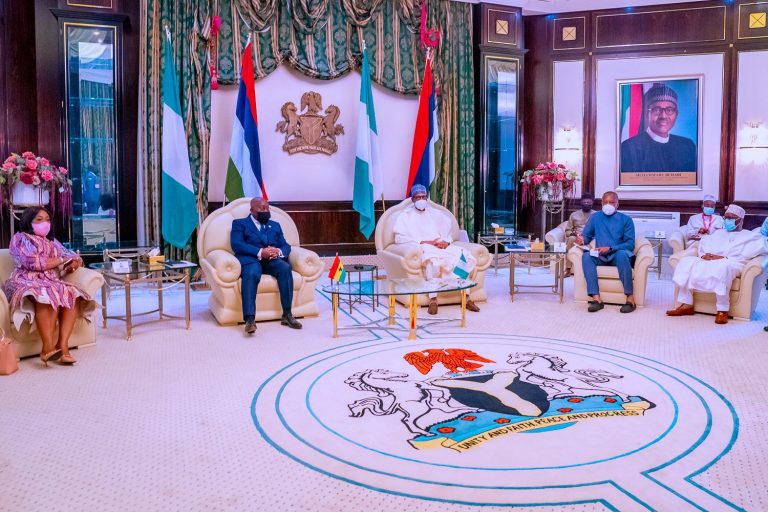
Breaking: Buhari welcomed Ghanian President H.E. Nana Akufo-Addo to Aso rock.

Breaking: Buhari welcomed Ghanian President H.E. Nana Akufo-Addo to Aso rock.

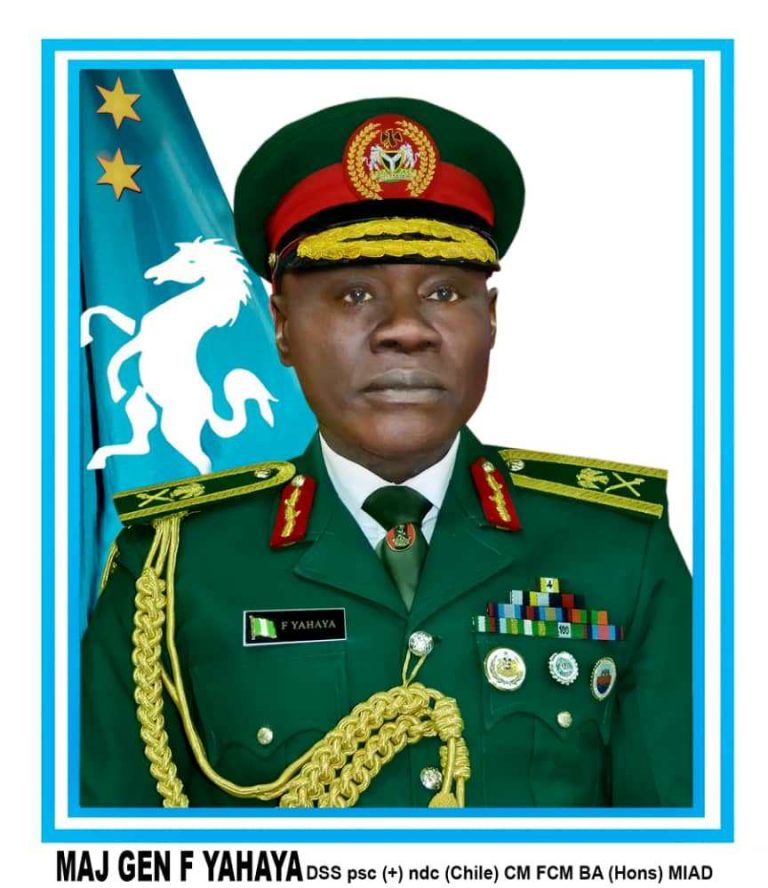
Profile of The New Chief of Army Staff Major General Faruk Yahaya

0

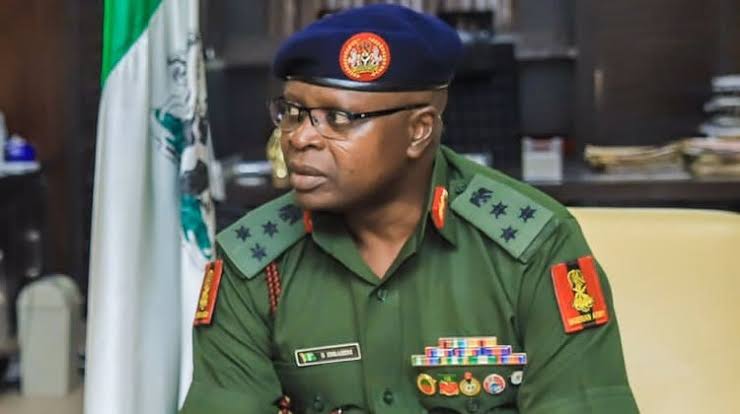
The new Chief of Army Staff (COAS), Major General Faruk Yahaya was born on 5 January 1966 in Sifawa, Bodinga Local Government Area of Sokoto state. Maj Gen Yahaya who is a member of the 37 Regular Course of the prestigious Nigerian Defence Academy (NDA), started his cadet training on 27        September 1985 and was commissioned into the Nigerian Army Infantry Corps on 22 September 1990.

Maj Gen Yahaya has held several appointments including Staff, Instructional and Command.

Notable among the appointments held by the new COAS are Garrison Commander Headquarters Guards Brigade, Directing Staff at the Armed Forces Command and Staff College (AFCSC), Deputy Director Army Headquarters Department of Military Secretary, Deputy Director Army Research and Development and the Chief of Staff, Headquarters Joint Task Force Operation Pulo Shield.

He also served as the Principal General Staff Officer (PGSO) to the Honourable Minister of Defence, the Commander, Headquarters 4 Brigade and 29 Task Force Brigade (Operation Zaman Lafiya). He was also Director Manpower at the Army Headquarters, Military Secretary, Army Headquarters and General Officer Commanding (GOC) 1 Division of the Nigerian Army.

Until his appointment as the COAS, Maj Gen Faruk Yahaya was the Theatre Commander Operation HADIN KAI, responsible for Counter Terrorism and Counter Insurgency operations in North East Nigeria.

The new COAS is a proud holder of several honours and awards, some of which include, Forces Service Star, Meritorious Service Star, Distinguished Service Star, Grand Service Star, Passed Staff Course (Dagger), National Defence Course (Chile), Economic Community of West Africa State Monitoring Group Medal, Command Medal, Field Command Medal, General Operations Medal, Silver Jubilee Medal and Golden Jubilee Medal. He is happily married and blessed with children.

Breaking: Buhari appoints Major General Farouk Yahaya as Chief of Army Staff

0

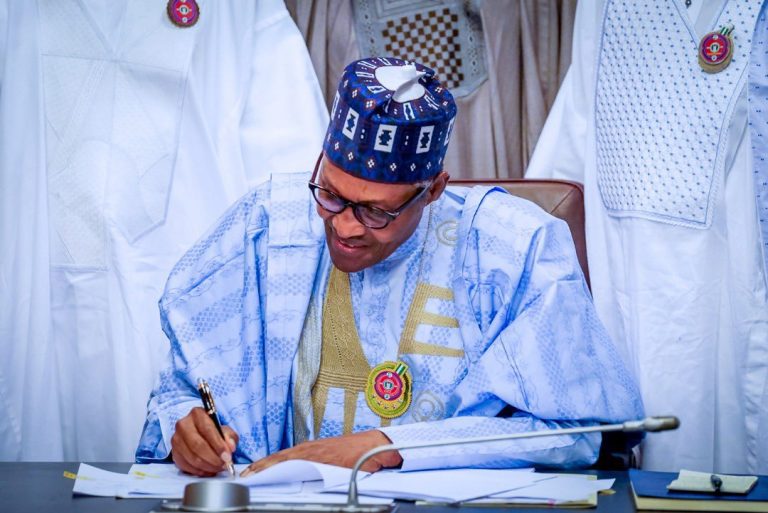
President Mohammadu Buhari has appointed Major General Farouk Yahaya as the new Chief of Army Staff.

Prior to his appointment Major General Yahaya was the General Officer Commanding 1 Division of the Nigerian Army and the incumbent Theatre Commander of the Counter terrorism Counter Insurgency military outfit in the North East code named Operation HADIN KAI.

Details shortly…

Photo of Buhari: Happy Children’s Day to all Nigerian children

Buhari spends all day with a group visiting children, in the State House. A giant Card, a Cake and tons of flags and enjoyable!

“Happy Children’s Day to all Nigerian children”

17 students of Kano University of Science and Technology arrested for harassing their female colleagues

0

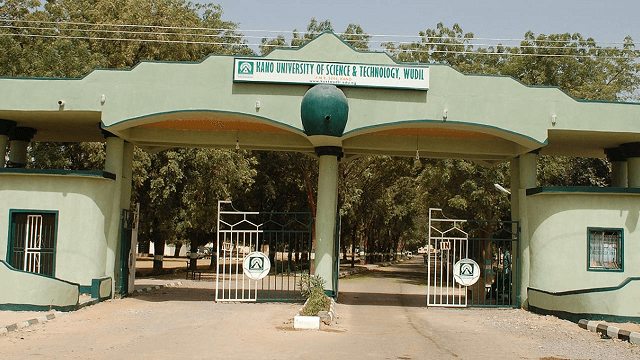
The Kano University of Science and Technology, Wudil has arrested 17 students and recommended them for disciplinary action for harassing their female colleagues over their grooming.

The institution started after verbal assaults on female pupils with a group of male pupils over”female dresses,” the college arrested 17 members of their group.

The Vice-Chancellor of the University, Prof Shehu Alhaji said after reports of harassment of female students by their male colleagues, the university swung into action and already they had identified a number of them and critical penalty will be slammed on them.

He said the university has constituted a strong committee, led by Deputy Vice-Chancellor Academics, to identify the unscrupulous students who take “immediate disciplinary action to be taken against the culprits without delay to serve as a deterrent to other people.”

“Already, the Security Department of the university has identified 17 persons in relation to the harassment of female students,” he told newsmen

Breaking: President Muhammadu Buhari, is not interested in running for a third term in 2023

0

Garba Shehu, the Senior Special Assistant to the President on Media and Publicity, has said that his principal, President Muhammadu Buhari, is not interested in running for a third term in 2023.

Shehu revealed that the burning of stations and offices of the Independent National Electoral Commission (INEC) won’t stop the 2023 general elections. The Presidential spokesperson stated this on Tuesday during a meeting on Arise TV.

Read also: Army opens inquest into alleged extortion, murder of woman by personnel in Katsina 

He said, “it’s very upsetting that INEC and police offices have been set ablaze in parts of the nation by anarchists. I believe the law enforcement agents are adequate enough to deal with them.

“Does anybody want to prevent election in 2023? President Buhari is not interested in the third term; he is not suited for that. So, there’ll be more election in 2023 and we will get there, God willing.”

Unknown gunmen have been attacking police stations and burning down offices of the Independent National Electoral Commission, INEC. It has resulted in widespread rumours that certain political interests are enthusiastic about making certain the 2023 general elections do not grip.

Understanding the DG alert mantra in NYSC

0

By Thomas Uzah

In 1964, the then American President, Mr. Lyndon B. Johnson in a pithy address to the International Labour Press Association glorified the place of the worker in public life; “You are a part of the conscience of our society. You are always goading. You are never satisfied with the job that is partially done. You are always working and calling for the further advancement of working people, and you speak from a point of view. You speak on behalf of values.”

This position amplifies the dire need to evolve favorable conditions to carter for the welfare of the worker in order to ginger his productivity and excellence in the workplace. But it is often overlooked by employers and leaders in most instances.

However, the leadership of Associate Professor Shuaibu Ibrahim, a serving Brigadier General of the Nigerian Army and the current Director General, National Youth Service Corps (NYSC) has marketed itself differently.

In appearance, Gen. Ibrahim is unassuming; but his personage is an embodiment of multiple military and administrative talents. He is governed by a doctrine of excellence anywhere he finds his feet and believes in making the best use of all human resources. But good enough, he knows there are unavoidable obligations, any leadership desiring of better results from workers must fulfill.

Therefore, from the outset, Gen. Ibrahim began to tinker with ideas the scheme would adopt to support the Federal Government in funding its operations by thinking outside the box to remain strong and relevant. And to achieve this , the NYSC boss knew, the scheme must inescapably place extra premium on welfare of both staff and corps members. “I appeal to our corps employers to take care of the welfare of members; mentor them,” he appealed soon after his appointment.

Consequently, Gen. Ibrahim deliberately attaches extraordinary premium to all who tastes his leadership anywhere. And in NYSC now, it is an entirely new and exciting experience for staff as well as corps members. As NYSC boss, Gen. Ibrahim has prioritized the welfare of workers and youth corps members to heights hitherto unknown.

The scheme is rated one of the best performing federal government agencies today, because a motivated staff leaves nothing to chance in the performance of their official functions. It is natural that when the worker is motivated to work, he goes the extra mile excitedly.

And Gen. Ibrahim has capitalized on this weapon, by his undiluted and undistracted attention to issues of welfare and remunerations. Timely payment of salaries and legitimate allowances ignite the ambience of a workplace, anywhere in the world. Even the Holy scriptures admonishes that a worker deserve his wages.

Salary payment defines everything in a working environment. It motivates, stimulates, increases productivity and encourages teamwork for excellence. Gen. Ibrahim’s leadership of the NYSC has made it his sacred obligation.

And since, Brigadier General Shuaibu Ibrahim is aware of these salient motivational doctrines, which propel productivity and triggers a convivial working environment, he is dispensing a leadership that bows to these demands at all times.

It is unarguable that in Nigeria today, issues of salary payment have been a thorn in the flesh of most government establishments. And the problem seems to exacerbate with the sudden scourge of Covid-19 pandemic, which has dealt a serious blow on global economies.

Even with the increasingly less funds in circulation, Gen. Ibrahim has insulated NYSC staff from this nightmare through prompt payment of basic and lawful entitlements. Quite pleasurably, Gen. Ibrahim has withered the storm in NYSC very conveniently.

By his relentless efforts, the Director General has been able to catapult the NYSC to a comfortable pedestal through investment initiatives. These investments have generated internal revenue for the NYSC, which partly funds the scheme’s operations. The NYSC Director General has registered the strong presence of the scheme in poultry farms; hundreds of thousands of hectares of rice plantations and milling as well as feed mills in different parts of the country are signposts of his remarkable leadership.

Added to it, Gen. Ibrahim has supported the scheme’s funding by resuscitating previously abandoned NYSC water and bakery factories to consolidate on its investment profile. With the returns yielded by these investments, coupled with the federal subventions to the agency, payment of salaries and allowances of staff have been prompt and ceaseless. His favorable disposition to salary payment has earned him the epaulet “Mr. Alert” in all NYSC offices across the nation.

In same manner, the welfare of corps members has been given top priority. Gen. Ibrahim wasted no time in implementing the New National Minimum Wage of N33,000 (thirty-three thousand) as monthly allowance of serving corps members. He boosted the monthly allowance of corps members with an additional N3,000 (three thousand) to serve as incentives to corps members and encourage personal savings. He operates on Lailah Gifty Akita’s the doctrine that “If people are paid well, there should be no poverty.”

To the NYSC boss, it does not matter whether it is staff or corps members, but salary and monthly allowances bank alerts come before the end of every month. Each time he visits NYSC office anywhere in Nigeria or even during media outings, corps members endearingly address hm with the sobriquet “Mr. Welfare,” for his rare and uncommon attention to their comfort.

Gen. Ibrahim has recorded his name as the only Director General of the NYSC who has lobbied State Governments and employers of the services of corps members to pay them additional monthly stipends. He has successful blighted the doctrine of discretionary payment of stipends to serving corps members through gentle persuasion of employers.

And his concentration on the welfare of both staff and corps members goes beyond timely meeting of their financial obligations alone. He has also demonstrated a relentless commitment to their health welfare in same measure. For instance, at the outbreak of Covid-19 pandemic in Nigeria, Gen. Ibrahim ensured the monthly allowances of corps members were paid without the usual clustering for clearance in order to forestall the spread of the disease.

He stated in a public statement that the; “…payment of monthly stipend for the month of April shall be effected without the usual gathering for clearance, in keeping with the rule of social distancing. It is equally imperative to add that there shall not be clearance for the month of May, 2020. The system shall generate automatic clearance for everyone.”

Conversely, Gen. Ibrahim instantly complied with the directive of the Presidency by enlisting all serving corps members into the National Health Insurance Scheme (NHIS). He does not hesitate in approving medical bills and has expended huge resources on critical health needs of corps members by footing medical bills where necessary.

Therefore, it is understandable that Gen. Ibrahim is feted with epaulets such as “Mr. Welfare,” or “Mr. Alert.” And it streams from a genuine heart of excitement from those he has the mandate to lead. The unalterable truth is that Gen. Ibrahim has changed the fortunes of the NYSC amazingly. He is indeed, a national asset both in intellect and capacity to do things differently.

Uzah PhD is Head of Department, Mass Communication, Kwararafa University Wukari.