Home Blog Page 2202

SERAP Sues FG, Lai Mohammed Over ‘Repressive’ Directive Asking Broadcasters To Stop Using Twitter

0

The Socio-Economic Rights and Accountability Project (SERAP) has filed a lawsuit asking the Federal High Court in Abuja “to stop the Federal Government and the Minister of Information and Culture, Mr. Lai Mohammed from using their patently unlawful directive to all TV and radio stations not to use Twitter, and to delete their accounts as a pretext to harass, intimidate, suspend or impose criminal punishment on journalists and broadcast stations simply for using social media platforms.”

The suit followed the order by the National Broadcasting Commission (NBC) asking TV and radio stations to “suspend the patronage of Twitter immediately”, and telling them to delete ‘unpatriotic’ Twitter after the social media giant was banned in the country for deleting President Muhammadu Buhari’s tweet.

In the suit number FHC/ABJ/CS/496/2021 filed last Friday, SERAP is seeking: “an order of perpetual injunction restraining the government of President Buhari, the NBC, and Mr Lai Muhammed and any other persons from censoring, regulating, licensing and controlling the social media operations and contents by broadcast stations, and activities of social media service providers in Nigeria.”

In the suit, SERAP is also seeking “an order setting aside the directive by NBC and Mr Lai Muhammed asking broadcast stations to stop using Twitter, as it is unconstitutional, unlawful, inconsistent and incompatible with the Nigerian Constitution of 1999 [as amended], and the country’s obligations under the African Charter on Human and Peoples’ Rights and the International Covenant on Civil and Political Rights.”

SERAP is arguing that “The government of President Buhari, the NBC and Mr. Lai Muhammed have consistently made policies and given directives to crack down on media freedom, and the rights of Nigerians to freedom of expression and access to information, and to impose crippling fines and other sanctions on broadcast stations without any legal basis whatsoever.”

According to SERAP: “The court has an important role to play in the protection and preservation of the rule of law to ensure that persons and institutions operate within the defined ambit of constitutional and statutory limitations.”

SERAP is also arguing that “Where agencies of government are allowed to operate at large and at their whims and caprices in the guise of performing their statutory duties, the end result will be anarchy, licentiousness, authoritarianism and brigandage leading to the loss of the much cherished and constitutionally guaranteed freedom and liberty.”

According to SERAP: “By using the National Broadcasting Act and the Nigeria Broadcasting Code to stop broadcast stations from using Twitter without recourse to the court, the NBC and Mr Lai Muhammed have contravened the right to access to justice and fair hearing guaranteed under sections 6[1] & [6][b] and 36[1] of the Nigerian Constitution 1999, and articles 1 and 7 of the African Charter on Human and Peoples’ Rights.”

The suit filed on behalf of SERAP by its lawyers Kolawole Oluwadare, Kehinde Oyewumi, and Opeyemi Owolabi, read in part: “The directive by the NBC and Mr. Lai Muhammed to broadcasters to delete their Twitter accounts is unlawful, as it amounts to a fundamental breach of the principle of legality, the rights to freedom of expression, access to information, and media freedom, and incompatible with the country’s international human rights obligations.”

“SERAP and concerned Nigerians are entitled to the rights to freedom of expression, access to information, and media freedom subject only to lawful restrictions. SERAP and concerned Nigerians frequently rely on the Twitter handles of many broadcast stations as sources of information for our activities in the promotion of transparency and accountability in the country.”

“Nigeria is a state party to the African Charter on Human and Peoples’ Rights and the International Covenant on Civil and Political Rights, which impose legal obligations on the government of President Buhari to ensure that the rights of Nigerians to freedom of expression, access to information and media freedom are respected, promoted, protected, fulfilled, and not unlawfully restricted.”

“The NBC and Mr. Lai Muhammed have not shown any law breached by journalists, broadcast stations and media houses in Nigeria, and the government of President Buhari cannot use any disagreement with Twitter as a ploy to violate Nigerians’ rights and undermine their individual businesses and professional duties.”

“The drafters of the Nigerian Constitution well knew the danger inherent in special executive and legislative acts which take away the life, liberty, or property of particular named persons. They intended to safeguard the people of this country from punishment without trial by duly constituted courts. These principles are so fundamental and must be respected.”

“The directive to broadcast stations has seriously undermined the ability of Nigerians and other people in the country to freely express themselves in a democracy, and undermined the ability of journalists, media houses, broadcast stations, and other people to freely carry out their professional duties.”

“The Twitter accounts by broadcast stations and media houses are their own properties acquired upon privity of terms and conditions formulated by the Twitter Inc. and accepted by the stations and media houses.”

SERAP is also asking the Federal High Court for the following reliefs:

1. A DECLARATION that the directive by the NBC and Mr. Lai Muhammed to broadcast stations in Nigeria to deactivate their Twitter handles and desist from using Twitter as a source of information gathering is unlawful, and amounts to a breach of the principles of legality and no punishment without law, and violation of the rights to freedom of expression, access to information, and media freedom guaranteed under sections 39 and 22 of the Constitution of the Federal Republic of Nigeria 1999 [as amended], Article 9 of the African Charter on Human and Peoples’ Rights and Article 19 of International Covenant on Civil and Political Rights.

2. A DECLARATION that the acts of the NBC and Mr. Lai Muhammed in relying on the National Broadcasting Act and the Nigeria Broadcasting Code to unilaterally direct broadcast stations to delete their Twitter handles and desist from using Twitter without recourse to the court amount to an infringement on sections 6[1] & [6][b], 36 and 44[1] of the Nigerian Constitution of 1999 [as amended], Articles 1 and 7 of the African Charter on Human and Peoples’ Rights and Article 9 of the International Covenant on Civil and Political Rights.

3. A DECLARATION that the provision of section 2[1][r] of the National Broadcasting Act and sections 5.6.3, 5.11.3 of the Nigeria Broadcasting Code being inconsistent and incompatible with sections 36[1], 39, and 22 of the Nigerian Constitution, Article 9 of the African Charter on Human and Peoples’ Rights and Article 19 of International Covenant on Civil and Political Rights are null and void to the extent of their inconsistency and incompatibility.

4. A DECLARATION that the NBC and Mr. Lai Muhammed lack the power and authority to unlawfully impose penalties such as fines and other sanctions on any journalists and broadcast stations for using Twitter, and refusing/failing to deactivate their Twitter handles.

No date has been fixed for the hearing of the suit.
NAF Trains Personnel To Tackle Incessant Aircraft Crashes

0

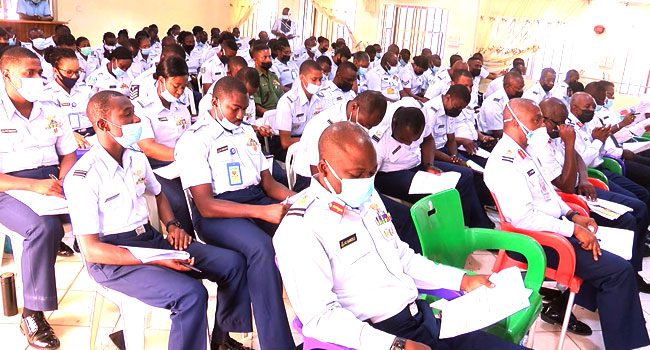
The Nigerian Air Force (NAF) has commenced the re-training of personnel in order to ensure the safety of its crew, as part of efforts to tackle the incessant air mishaps in the Nigerian military.

Just In: NAF aircraft crashes in Kaduna - AdeLove.com|Best Nigerian Blog

This followed the recent crashes that claimed the lives of at least 18 military officers, including the late immediate past Chief of Army Staff, Lieutenant General Ibrahim Attahiru.

Addressing reporters on Saturday, NAF Director of Training, Air Commodore Esen Efanga, explained that the Chief of Air Staff approved the training to enable the crew to be up to speed with global best practices and reduce human factors that cause air crashes.

He said, “We have discovered that in the world, most of accidents and incidents have bee attributed to human factors which the human being is the most critical aspect of the aviation sector.

The crash of Nigeria Air Force B350i | The Guardian Nigeria News - Nigeria  and World News — Opinion — The Guardian Nigeria News – Nigeria and World  News

“We have also discovered that most of the accidents do not have to do with the technical abilities of the crew, but rather the interface between the human-and-human, and the human-and-the-aircraft.”

“Because at this point, we are involved in several operations all over the country, this does not come without risks that we have seen in the air force of recent involving incidents and accidents,” Efanga added.

He disclosed that the training was the first in a series of training that would be carried out in all operational units at various centres all over the country.

The air commodore stated that the crew were trained by very seasoned and experienced resource persons who were certified to impart such knowledge.

“It is the Chief of Air Staff’s intention to establish a culture of safety in the Nigerian Air Force so that while we have increased and enhanced our operations, we take care of this critical aspect of NAF operations,” he said.

On May 21, the nation was thrown into mourning after the death of Lieutenant General Attahiru broke.

Attahiru, who was appointed as the Chief of Army Staff in January, died in a plane crash in Kaduna alongside 10 other personnel of the Nigerian Army and Nigerian Air Force.

The incident was preceded by two other crashes – the first being Beechcraft KingAir B350i which crashed at Bassa village in Abuja while en route to Minna, killing seven NAF personnel in the process.

Personnel on board the plane had reported an engine failure and were on their way back to the Nnamdi Azikiwe Airport before the aircraft crashed.

About six weeks after the crash, a NAF Alpha Jet aircraft went missing while on an operation in Borno State and was found to have crashed days later.

The aircraft lost contact with radar on March 31 while on an interdiction mission in support of ground troops fighting insurgency in the state.

Nigerian Military Retires 343 Personnel After A Successful Career

0


The Armed Forces of Nigeria (AFN) has retired 343 Non Commissioned Officers (NCOs) after successful careers in their various services.

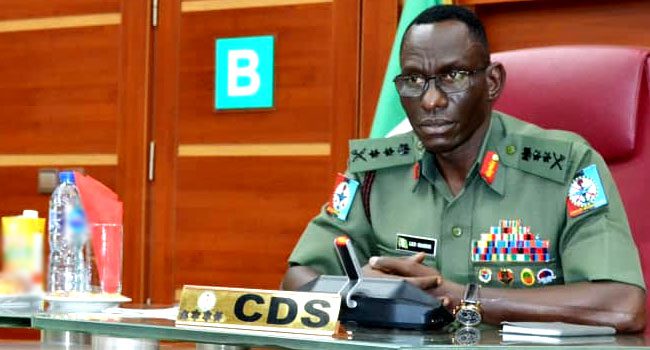
The retirement was announced by the Chief of Defence General, Gen. Lucky Irabor at the Nigerian Armed Forces Resettlement Centre, NAFRC, at the end of six months of pre-retirement training on Saturday.

The 343 retired personnel are made up of 258 from the Nigerian Army (NA); 70 from the Nigerian Navy (NN) and 15 from the Nigerian Air Force (NAF).

Irabor, represented by the Chief of Defence, Training and Operations, Rear Admiral George Eyo, said that the pre-retirement course was designed to prepare the retired personnel for civil life.

“It is our hope that on completion of this training, our gallant discharging servicemen and women seated here today will apply the knowledge and skills they have acquired and by so doing, comfortably enjoy the post service life.

“You will from now on take full charge as planners and executors of your personal daily activities, This may sound exciting and promising but beware; you need to properly manage your freedom in order to be successful.

“The society will expect a high moral standard and discipline from you. You will also have to prove in your relationships that you passed through a highly disciplined system. As our well-grounded ambassadors, I believe you are all capable of excelling in your future endeavors and positively influence your environment for the economic development of our dear country,” the Chief of Defence Staff said.

He urged them to use the various entrepreneurial, business development and management skills they had learned to be developed economically.

Travellers stranded, as protesters blocked Abuja-Kaduna highway over incessant bandit attacks

0

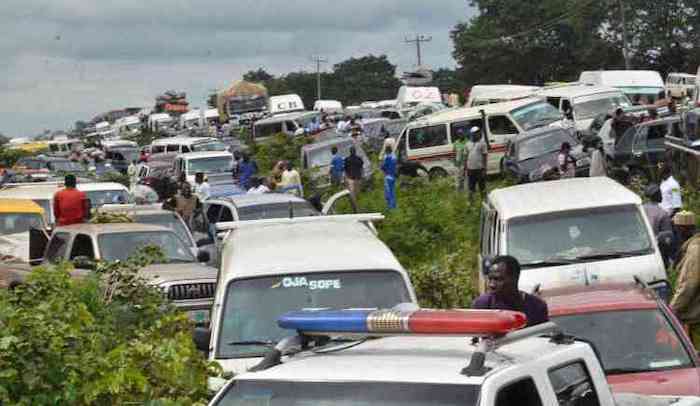
Many travellers are currently stranded on the Abuja-Kaduna Highway as angry residents have blocked the road over attacks, especially the killing of a 13-year-old girl by bandits.

The tragic incident occurred at Anguwar Magaji in Chikun Local Government Area of the state, according to Daily Trust. Residents said bandits stormed the house of the village head and abducted his family as well as other persons in the community. A resident of the area told Daily Trust that they were not safe at home and their farms.

“We cannot go to our farms and yet they will follow us to our homes to abduct us for ransom. They killed a 13-year-old girl, a security man in the village as well as abducted other residents including the family of the village head,” he said. He explained that the residents only want security or to be allowed to protect themselves against the bandits.

A witness told Daily Trust that the protesters refused to listen to the plea of security personnel who approached them. The witness, who did not want to be named, said the protesters have been out since 7:30am. “The villagers are very angry. They blocked the road and insisted that no one will pass through. When security personnel came, the men withdrew and left their women on the road.”

The Police Public Relations Officer in Kaduna, ASP Jalige Mohammed, said the State commissioner of police, Umar Muri, has directed the Area Commander to visit the scene of the protest and ensure orderliness


Anti-graft War: EFCC, CCB To Strengthen Collaboration

0

The Economic and Financial Crimes Commission (EFCC) and the Code of Conduct Bureau (CCB) are to strengthen their collaboration in the fight against corruption in Nigeria.

Speaking while receiving a delegation from the CCB led by its chairman, Prof. Isah Mohammed in his office, the executive chairman of the EFCC, Abdulrasheed Bawa, promised to assist the CCB in training staff of the Bureau in the areas of administration, assets tracing and recovery as well as forensic investigation.

He also offered CCB access to the Commission’s Forensic Laboratory for analysis pending when it is able to establish its own laboratory.
According to him, “We have a full-fledged Forensic Laboratory that can assist you rather than venture into something that will further burden the budget.”

The offer was in response to the request by CCB chairman, who specifically called for EFCC’s assistance to the Bureau in the areas of assets tracing and recovery, forensic investigation and collaborative investigation.

The EFCC boss said officials from the Commission’s academy will visit the CCB to carry out a training needs assessment which will assist them in designing programmes that will suit the needs of the CCB.

Bawa commended the CCB for her response to requests for assets declaration forms of politically exposed persons by the commission.

He, however, appealed that the process be further expedited. “We have this problem of delay in response. We understand that some of these forms are being declared at state level but we still believe that it takes too long a time for us to receive these responses,” he said.

The EFCC chairman further advised the CCB to explore the possibility of revising the assets declaration form to eliminate gaps that are currently exploited by public officers to withhold inform on their assets.

Earlier in his remarks, Prof. Mohammed commended Bawa “for the brilliant way he approach matters”, adding that they were at the EFCC “to collaborate and make sure that the fight against corruption succeed.”

Reflecting on the history of his agency as the pioneer anti-graft agency in Nigeria, the CCB chair lamented that despite its age, CCB was the most challenged among the anti-corruption agencies in terms of funding.

He also dispelled the notion that the Bureau was secretive in its handling of asset declaration forms of public officers, adding that it had always responded to requests from relevant agencies.

Widow who reportedly refused to drink bathwater of husband’s corpse in Anambra gets govt. backing

0

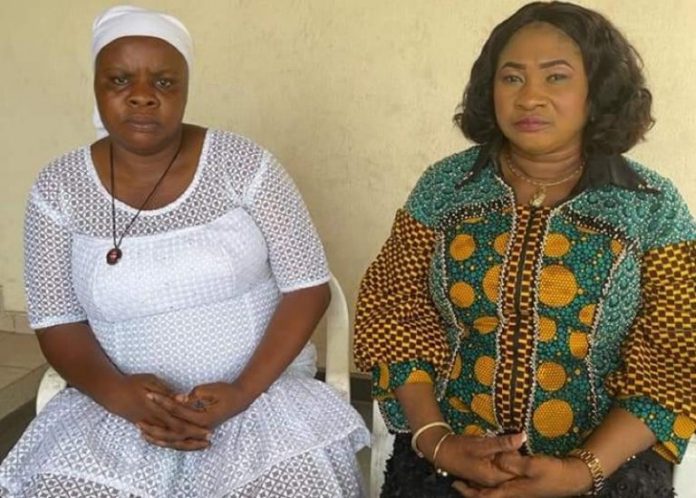
Reprieve came the way of one Mrs Chioma Asomugha, 34, from Ubahuekem in Ihiala of Anambra State, who claimed she was forced to drink the bathwater of her late husband’s corpse by her in-laws.

The in-laws, according to her, suspected that she killed her husband, and drinking the water would prove her innocence or guilt.

Such was the practice in the olden days among some Igbo communities when a wife was suspected to have killed her husband.

The woman who did not die within a month after drinking the water was believed not to have killed the husband.

According to Mrs Asomugha, she lived peacefully with her late husband, Charles, at Ojo area of Lagos before he died.

She said, “We have four children. We lived at Ajangbadi, Ojo area of Lagos. The burial was fixed for Monday June 14, but since we came home for the burial, the relatives of my husband forced me out of my matrimonial home.

“They insisted that before I would be allowed to come in, that I would drink the water used in bathing his corpse.”

However, succour came her way on Friday as the Anambra State commissioner for social welfare, women and children’s affairs, Lady Ndidi Mezue, and her information and public enlightenment counterpart, Mr C-Don Adinuba, waded into the matter.

Lady Mezue, during a visit to the family, advised the family members to do away with such obnoxious practices and learn to forgive one another.

Mr Friday Asomugha, brother to the deceased, however, denied that the family compelled the widow to drink the bathwater of her husband’s corpse.

According to him, one of their relatives made such statement out of anger because the widow left behind their four children when she returned for the burial.

According to reports, the burial eventually went ahead without any problem.

In a speech, Mr C-Don Adinuba, a native of the community, called for the protection of the image of the community as well as the state by doing away with archaic and harmful practices capable of tarnishing the image of society.

The widow was presented with some food items during the visit.

Our correspondent reports that matter attracted the attention of the Catholic Church, International Federation of Women Lawyers, and the National Human Rights Commission.


Humanitarian Minister advocates funding for state sexual assault referral centres

0

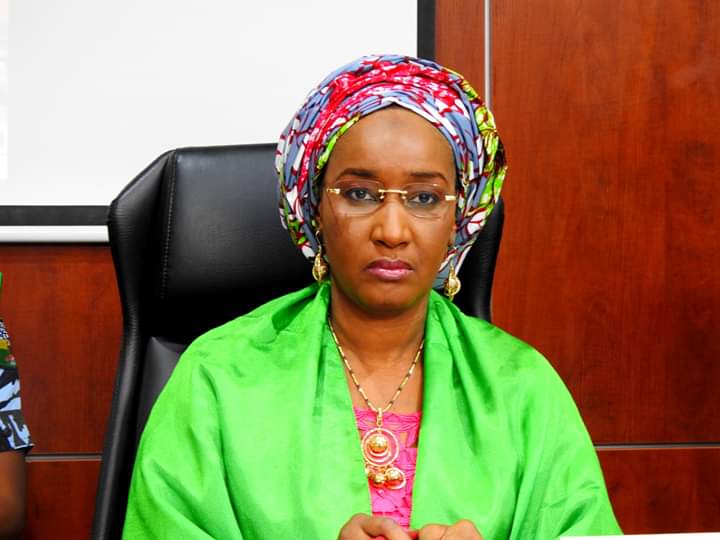
The Minister of Humanitarian Affairs, Disaster Management and Social Development Sadiya Umar Farouq is seeking more funding from the federal government to strengthen the various State Sexual Assault Referral Centres, SARC in the country.

The Minister made the call during a Virtual Economic Council Meeting chaired by Vice President Professor Yemi Osinbajo,

Presenting the National Guide For the Establishment Of Sexual Assault Referral Centres in Nigeria, the Minister noted that the weak commitment of State governments to strengthen the multi sectoral  inter-agency collaboration has made it difficult for the SARC centres to meet the ever growing demand from victims.

To this end, she said that for the 31 SARC centres in 17 states across Nigeria responsible for providing free medical assistance, forensic medical examination counselling and justice support services to survivors of sexual violence to be at their optimum best in service delivery, robust funding from the Federal Government is needed.

“A recent survey of some of the SARCs disclosed a common challenge which a weak commitment from State governments to strengthen the multi-sectoral inter-agency collaboration mechanisms that will sustain the delivery of SARC services to the public. What this means is that the State-led SARCs lack the requisite funding needed to ensure optimal service delivery.

“The need to establish and commit to adequately fund Sexual Assault Referral Centres is further justified by the low conviction rates of rape and sexual assault cases”.

According to data, the centres have provided assistance to over 17,000 victims of sexual assault with 73% of the victims under 18 years of age.

Minister Umar Farouq sadly noted that only 11 out of 3000 cases have been prosecuted in just six states, while 107 were fatal, 742 cases were still open and  188 cases were closed.

“Well funded SARCs will help increase conviction rates through the provision of forensic evidence to support prosecution in court”.

With 20 states including the FCT adopting the Violence Against Persons Prohibition Act of 2015 and 6 states awaiting Executive assent, Umar Farouq urged other states to see the issue of gender based violence as a serious pandemic that should be tackled.

In his response, the Chairman of the National Economic Council and Vice President Prof. Osibanjo also commended efforts being made by Minister Umar Farouq to fight violence against women and learnt his voice to the ‘name and shame’ penalty for offenders.

In the same vein, the Governor of Ogun state, Prince  Dapo Abiodun (MFR) praised the Minister for her commitment to the cause and fight against Sexual related offenses against women and girls and called on other states who were yet to set up Sexual Assault Referral Centres to do so.

The Minister of Environment, Muhammad Mahmood Abubakar described rape as traumatic for the victims and called for the severe punishment of sex offenders.

“Except the appropriate penalty is meted out to sex offenders, they will continue to be on the prowl” he said.

France decries Russia’s ‘seizure of power’ in Central Africa

0

France on Friday accused Russia of making efforts amounting to “seizure of power” in Central African Republic (CAR) acknowledging CAR’s CAR’s cooperation with Russian “mercenaries” had prompted Paris to scale down its military support.

France suspended military help and budgetary aid to the CAR this month accusing it of being “complicit” in anti-French disinformation campaign backed by Russia.

The CAR has become a key area in the controversy over the role in Africa of the Wagner mercenary group which is allegedly run by the shadowy businessman Yevgeny Prigozhin, a close confidant of President Vladimir Putin.

“In the Central African Republic, there is a form of a seizure of power, and in particular of military power, by Russian mercenaries,” Foreign Minister Jean-Yves Le Drian said.

“We are fighting this and it has led us to take measures to withdraw a certain number of our military personnel.”

French Foreign Minister said Russian personnel were surrounding CAR President Faustin Archange Touadera and were exploiting the wealth of the country.

CAR is one of the poorest countries in the world. It has been chronically unstable since its independence from France.

France launched three-year military operation in 2013 to halt sectarian violence. The operation was launched after the then president Francois Bozize, was ousted by predominantly Muslim rebel groups.

The CAR’s closer relationship with Moscow dates back to 2018, when Russia sent “instructors” to help train its beleaguered armed forces and supplied small arms, gaining exemption from a UN weapons embargo.

Last December, under a bilateral cooperation agreement, the Kremlin sent several hundred personnel to shore up Touadera, who was threatened by a rebel offensive.

Russians also provide the president’s personal protection and his powerful national security advisor, Valery Zakharov, is a Russian.

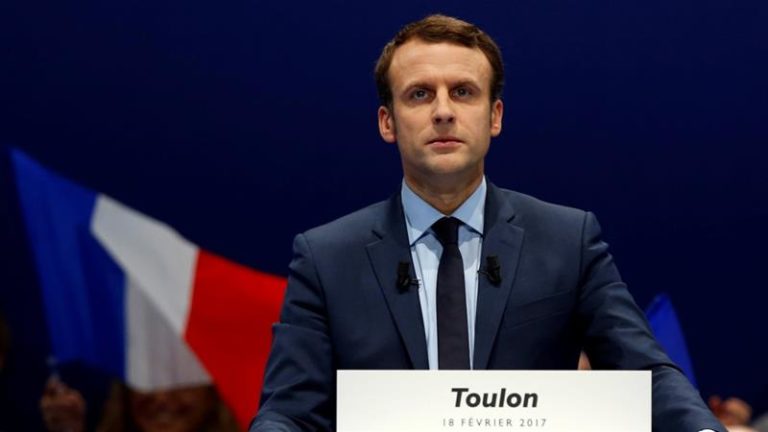
On May 30, in an interview with France’s Journal du Dimanche newspaper, French President Emmanuel Macron said “anti-French talk has provided legitimacy to predatory Russian mercenaries at the apex of the state.

“Touadera… today is a hostage of the Wagner group,” he said.

ECOWAS Summit: Mali must return to civilian rule, Buhari declares.

0

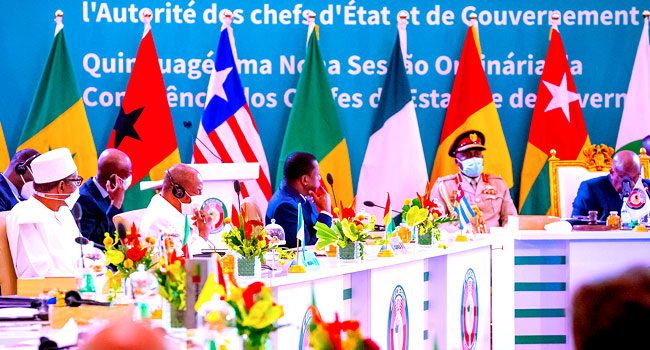
President Muhammadu Buhari on Saturday called on West African leaders to exert pressure on the military leadership in Mali to ensure that the transition process in the country is not aborted.

He made the call in his statement delivered at the 59th Ordinary session of the Authority of Heads of State and Government of ECOWAS in Accra, Ghana.

The Nigerian leader spoke on the situation in Mali which was recently suspended from the regional bloc due to a military coup.

“At this Summit today, we are expected to review a number of important reports dealing with various issues of concerns to our organisation and people. In doing so, we must take realistic and practical decisions which will positively impact our citizens,” he was quoted as saying in a statement by his spokesman, Garba Shehu.

President Buhari added, “Some of those decisions, necessarily will have to do with evolving political and security situations in our sub-region as well as evaluate the health of our organisation with the hope of repositioning to serve our people and sub-region better.

“While democracy continues to develop in our sub-region, recent events in Mali are sad reminders that vigilance remains a crucial imperative to protect people’s aspirations to freely choose the form of government they want.

“Pressures are needed to ensure that the transition process in Mali, which is halfway to its conclusion, is not aborted.

“A further slide in Mali could prove catastrophic to the Sub-region, considering that about half of that country is unfortunately under the grip of terrorists.”

The Nigerian leader, therefore, appealed to the military leadership in Mali to understand the critical state of their country, which he described as being ‘clearly under siege’.

Noting that the principal responsibility of the military must be to protect and guarantee the sovereignty of the West African country, the President cautioned them not to perpetuate acts that would facilitate the destabilisation and destruction of Mali.

“I urge our organization to remain engaged with all stakeholders in Mali through our astute Mediator, former President Goodluck Jonathan, who, I congratulate warmly, for his untiring efforts thus far.

“I encourage him to sustain these efforts to ensure that the transition is completed as scheduled,” he said.

On Libya, President Buhari faulted the recent United Nations Resolution to expel all foreign fighters in Libya, without first ensuring that they were disarmed.

He lamented that while the decision was aimed at bringing about sustenance of peace in Libya, non-collaboration with regional stakeholders has created newer threats to peace, security and stability in the region.

The President warned that this could lead to lack of coordinated management of huge humanitarian crisis across the Sahel, North, Central and West Africa, including the Lake Chad region.

He said, “It is imperative that ECOWAS leaders, at this Summit, decide how the UN-Sub-regional organisations partnerships should be reviewed to address the dangers that this UN Resolution poses to the region.”

The statement by the Nigerian leader at the Summit also addressed other pertinent issues of concern in the organisation, including the ongoing institutional reforms in ECOWAS.

Declaring Nigeria’s unequivocal support to the reforms process, he said he looked forward to an ECOWAS that would be ‘fit for purpose’, delivering services to the satisfaction of the community citizens.

He commended the President of the Commission and his team, the Ad-hoc Ministerial Committee on Institutional Reforms as well as the Council of Ministers for the excellent report presented to the Authority of Heads of State.

In his capacity as the ECOWAS champion on the fight against COVID-19, President Buhari also drew attention to the need for more citizens in the region to be vaccinated, stressing the need for adherence to other non-pharmaceutical interventions.

He said the West African region was in the grip of a third wave, warning against complacency in national and regional initiatives to address the pandemic.

President Buhari reaffirmed Nigeria’s commitment to the noble objectives of the organisation, saying, “I encourage us to take bolder steps towards ensuring that the organisation fulfils the aspirations of its founding fathers, which include a truly integrated sub-region, economically, politically, socio-culturally united and secured to permit its sustainable development and growth.”

South East Governors Condemn Violent Secessionist Groups, Back United Nigeria

0

Members of the South East Governors’ Forum have condemned the activities of secessionist groups in the region and other parts of the country.

They distanced themselves from the agitations of such groups and frowned on the violence that ensued which led to the loss of lives and destruction of properties.

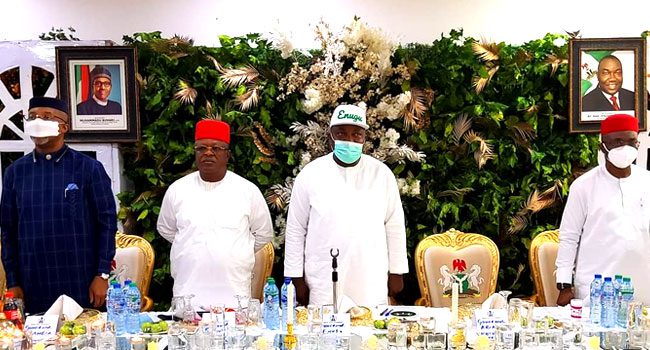
In a bid to tackle the security challenges and restore peace in the region, the governors went beyond their political differences and met on Saturday in Enugu State.

“We condemn in totality, the activities of violent secessionist groups in the South East and elsewhere; we firmly proclaim that we do not support them, they do not speak for South East,” said the Chairman of the Forum and Ebonyi State Governor, David Umahi, at the end of the meeting.

He added, “The impression that South East leaders are silent over some of our youths’ agitations for secession is not correct.

“South East Governors, Ohanaeze President, National Assembly members, notable leaders had come out publicly many times in the past to speak against such agitations. In order not to mismanage the unfortunate situation, South East leaders have set up a committee to engage such youths to stop and allow elders speak to address such fears.”


One United Nigeria

The governors noted threats by some groups against the people of the region and promised to protect everyone – from the South East and other regions.

They, however, pleaded with leaders of other regions to protect the Igbos living in their regions.

The forum also condemned the killing of security agencies, burning of strategic infrastructure, and killing of civilians in the South East and other regions.

They appealed to the security agencies to discharge their duties within the rules of engagement and the law, as well as urged the members of the National Assembly from the South East to support the creation of state police in the ongoing constitutional amendment.

“We, the Igbos do reaffirm our commitment to one united Nigeria under a platform of justice, equity of rights, fairness, love, and respect for one another.

“The meeting endorsed our South East joint security outfit – Ebubeagu and asked them to work with security agencies and to respect the rights and privileges of all those living in South East and our visitors,” Governor Umahi said while reading the communique issued at the end of the meeting.

Also at the meeting were the Minister of Labour and Employment, Chris Ngige; Minister of Mines and Steel Development, Uche Ogah; and former Secretary to the Government of the Federation, Pius Anyim, as well as religious and traditional leaders, among others.