Home Blog Page 2199

South East Governors Condemn Violent Secessionist Groups, Back United Nigeria

0

Members of the South East Governors’ Forum have condemned the activities of secessionist groups in the region and other parts of the country.

They distanced themselves from the agitations of such groups and frowned on the violence that ensued which led to the loss of lives and destruction of properties.

In a bid to tackle the security challenges and restore peace in the region, the governors went beyond their political differences and met on Saturday in Enugu State.

“We condemn in totality, the activities of violent secessionist groups in the South East and elsewhere; we firmly proclaim that we do not support them, they do not speak for South East,” said the Chairman of the Forum and Ebonyi State Governor, David Umahi, at the end of the meeting.

He added, “The impression that South East leaders are silent over some of our youths’ agitations for secession is not correct.

“South East Governors, Ohanaeze President, National Assembly members, notable leaders had come out publicly many times in the past to speak against such agitations. In order not to mismanage the unfortunate situation, South East leaders have set up a committee to engage such youths to stop and allow elders speak to address such fears.”


One United Nigeria

The governors noted threats by some groups against the people of the region and promised to protect everyone – from the South East and other regions.

They, however, pleaded with leaders of other regions to protect the Igbos living in their regions.

The forum also condemned the killing of security agencies, burning of strategic infrastructure, and killing of civilians in the South East and other regions.

They appealed to the security agencies to discharge their duties within the rules of engagement and the law, as well as urged the members of the National Assembly from the South East to support the creation of state police in the ongoing constitutional amendment.

“We, the Igbos do reaffirm our commitment to one united Nigeria under a platform of justice, equity of rights, fairness, love, and respect for one another.

“The meeting endorsed our South East joint security outfit – Ebubeagu and asked them to work with security agencies and to respect the rights and privileges of all those living in South East and our visitors,” Governor Umahi said while reading the communique issued at the end of the meeting.

Also at the meeting were the Minister of Labour and Employment, Chris Ngige; Minister of Mines and Steel Development, Uche Ogah; and former Secretary to the Government of the Federation, Pius Anyim, as well as religious and traditional leaders, among others.

Buhari Arrives In Ghana For ECOWAS Summit

0

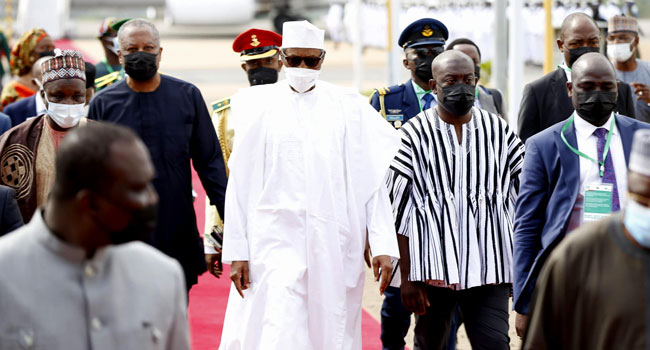
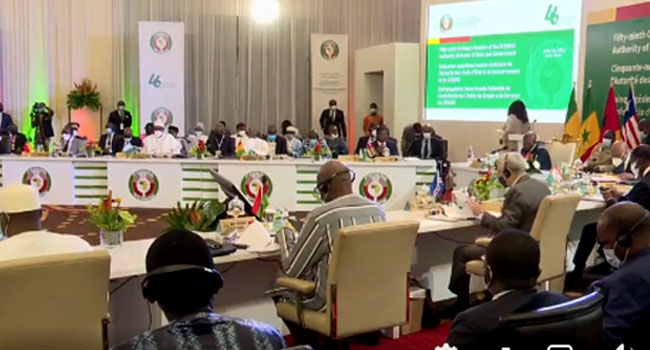
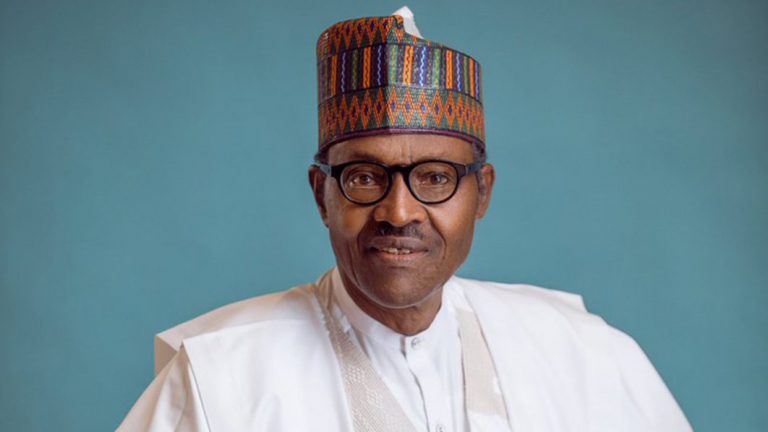
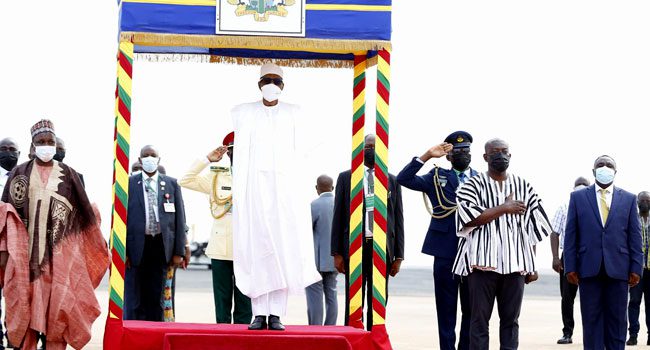
President Muhammadu Buhari is currently in Accra, Ghana participating in the 59th Ordinary Session of the ECOWAS Authority of Heads of State and Government.

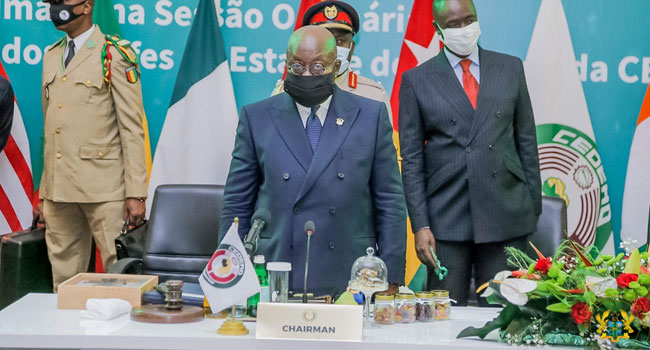
The Summit is chaired by Ghanaian President, Nana Akufo-Addo.

President of the African Development Bank (AfDB), Akinwumi Adesina is also at the Summit.

The Presidency earlier in a statement on Friday announced that President Buhari will be joining other Heads of State of Government of ECOWAS for the mid-year statutory meeting of the regional bloc, with the exception of Mali, which was recently suspended from the group.

Former President Goodluck Jonathan of Nigeria, ECOWAS Special Envoy, and Mediator to Mali is also at the event and expected to present a report on his latest working visit to the West African country to the summit of the Heads of State.

Chief of Army Staff visits Theatre Command, assures troops of adequate medical care and support

0


The Chief of Army Staff (COAS) Major General Faruk Yahaya was at the Theatre Headquarters Joint Task Force North East Operation HADIN KAI (OPHK) on his maiden operational visit to the Theatre from 16-19 June to assess the operational and welfare state of the troops. During his visit to the hospitals, he assured troops of adequate medicare and support in the ongoing counter-insurgency operations.

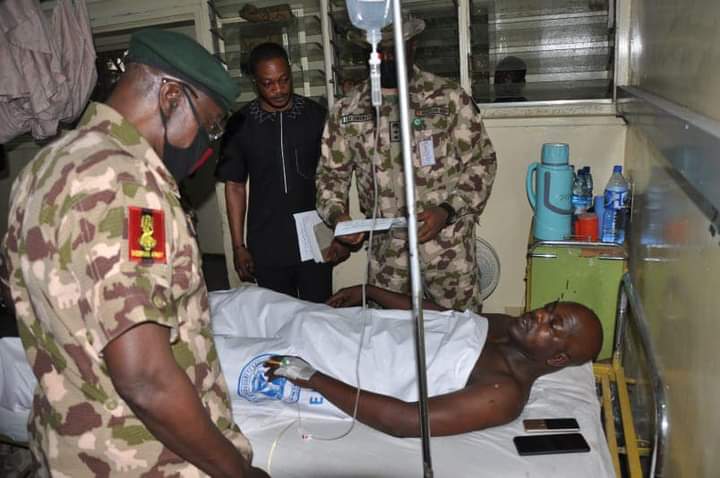
The COAS gave the assurances on Friday, 18 June, 2021 when he visited the 7 Division Hospital and University of Maiduguri Teaching Hospital (UMTH) to commiserate with the sick and wounded in action troops recuperating at the medical facilities. The COAS also prayed for their speedy recovery.

While at the hospital, the COAS took time to interact with the soldiers and assured them of proper medical care and welfare, adding that their medical care is of utmost importance to him . He averred that the nation is indeed proud of their selfless service and sacrifices towards restoring peace to the North East region.

Similarly, the COAS visited the Mechanical Repair Group to inspect the ongoing repairs and refurbishment of vehicles at the workshop through the use of local resources. He commended the resilience and ingenuity of the engineers and technicians in fixing most of the vehicles that were hitherto classified as ‘beyond local repairs’.

Earlier, the new Theatre Commander OPHK, Major General Christopher Musa briefed the COAS on the operational situation in the Theatre. He assured the COAS that all efforts will be geared towards bringing the war against terrorism to a decisive end.

The COAS appreciated the commitment and selflessness of the troops in the Theatre and implored them to exhibit a high level of professionalism and ensure that all remnants of Boko Haram and Islamic State of West Africa Province (ISWAP) terrorists are neutralised.


My successor will demolish more than I, El-Rufai warns Kaduna residents

0


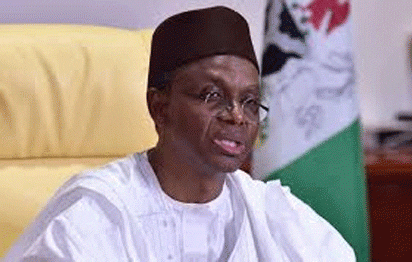
The governor, who stated this at a media chat aired on radio stations on Thursday, said residents of the state now appreciate the urban development being carried out by his administration across the state.

El-Rufai also said his administration preferred to provide infrastructural development rather than sharing money with people in the name of empowerment or human development.

The governor said, “When we started working on school construction, they said we are not providing roads; now we are working on roads, they said we are not empowering people.

“If sharing money in the night is what they mean by empowering people, they should keep insulting us.

“The masses who we are working for appreciating what we are doing for them.

“You know the election is approaching and they see me as a demolisher, “Mai rusau”; so they think that maybe the next person that will come after me will not demolish, but he will demolish more than I do, God willing.”

The governor urged the people to continue to support and pray for his administration to succeed.

Two APC members suspended for fraternising with the South West Agenda for 2023 (SWAGA)

0

For supposedly fraternising with the South West Agenda for 2023 (SWAGA), a political stage rooting for your Presidential aspiration of the previous Lagos State Governor, Asiwaju Bola Ahmed Tinubu, the All Progressives Congress, Ekiti chapter, has again suspended two members of the celebration.

Most troubling was the fact that this came barely two months after the Chairman of Ward 8, Ado Ekiti Local government, Mr. Clement Afolabi, was suspended within similar offence.

The suspension contained in two distinct letters, has been signed from the ward executives, including: Abejide Sola (Chairman), Bamisayo Abigeal (Women Leader), Oladipo Adekunle (Youth Leader), Fayemi Apeke (Secretary), along with Oloruntoba Bosede(Treasurer).

The letters dated May 31, 2021, stated:”We noticed from your actions in the party in the recent years that you have been working against the unity of the celebration even to the extent of producing a parallel defender that you termed”SWAGA” inside the ward.

“You sent in confirmation of your activity through Mr. Jide Oso, a former defender chairman on 16th May, 2021 to the ward which you’ve created another place for this purpose.

“You as well was encouraged to the overall Executive and leaders’ meeting on 20th May, 2021 to explain your action and you confirmed the message of Mr Jide Oso was sent by you as his principal and that you wouldn’t stop your parallel meeting for any reason.

“In view of the above reasons the overall executive of the ward fulfilled 27th May, 2021 and chose to suspend for conducting against the party (APC) Constitution till further notice”, it reads.

Read also: BREAKING: “There will be war when Fulani Strikes Delta” — MEND, PANDEF Show plan

Responding, the APC Publicity Secretary, Hon. Ade Ajayi, said the two were disciplined by party leaders for factionalising the celebration, stating the suspension has nothing to do with SWAGA.

Ajayi, Who’s also from Ayede Ekiti, said the report by the Ward suggested that the two were sabotaging party’s orders and dividing the party through their activities

“They weren’t suspended due to SWAGA. But they’ve been dividing the celebration and all efforts to rein them failed.

“They were encouraged to shield themselves, they confirmed it and celebration supremacy needed to come to perform. Nobody is bigger than the party”, he said.

NPHCDA and Faisal’s stellar footprints

0
By David Onmeje
Sometime in 2020, the Director- General of the World Health Organization (WHO), Dr. Tedros Adhanom, wisecracked; “Without health, people have nothing; without health, we have nothing as humanity.” Unmistakably, the global health specialist, again re-echoed the indispensability of an excited and happier humanity only when it is steeped in good health.
Nigeria is Africa’s most populous nation. And with a population of over 200 million people, issues of public health have always been the concern of successive Governments in the country. Public healthcare delivery is also topmost on the cards of President Muhammadu Buhari’s administration.  Firstly, Mr. President vowed to vacate Nigeria’s inglorious status as a nation still plagued by poliomyelitis (wild poliovirus) pandemic.
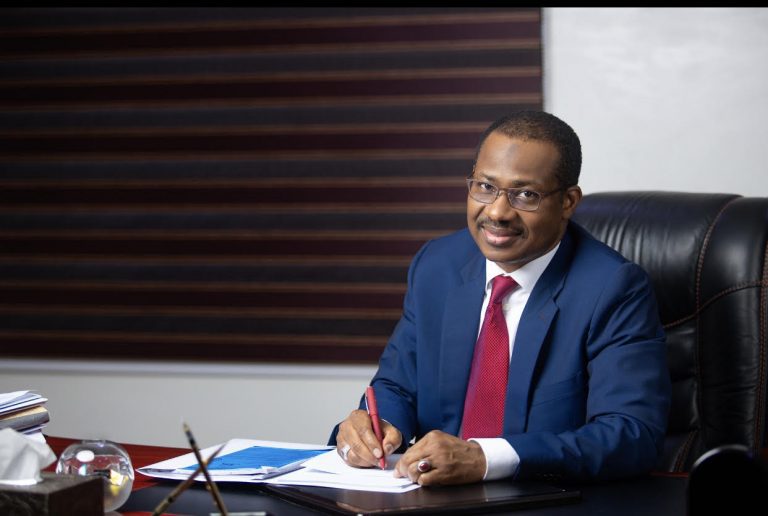
And after a painstaking search, President Buhari appointed Mr. Faisal Shuaib, a medical doctor; homebred and later, American – trained public health specialist as the Executive Director/Chief Executive Officer (CEO), National Primary Health Care Development Agency (NPHCDA) in January 2017.  He parades unimpeachable records in management of public health issues globally. Dr. Shuaib spent productive time and years at the Bill and Melinda Gates Foundation (BMGF), Seattle, USA, as a Senior Program Officer, where he excelled.
At BMGF, Nigeria’s NPHCDA boss now, mastered the rudiments of developing and implementing strategies on polio outbreak response in Africa. So, his 2017 job in Nigeria was like walking on a familiar terrain with a wave of the hand.  Frankly, dealing with Nigeria’s largely rural based population and a citizenry with diverse cultures and religious beliefs were nightmares beyond the proverbial storm in a tea cup.
But the leadership of NPHCDA fell on a seedy soil in Dr. Faisal Shuaib. He was extremely worried at the dearth of quality Primary Health Care (PHC) services in Nigeria generally. He voiced it at several fora that Nigeria only takes care of   about 20%, instead of at least 70% of primary healthcare delivery to the people. So, he sought to change the narrative and today, most State Governments in Nigeria have prioritized PHC services as the fulcrum of Government, thus lessening the burden on secondary and tertiary health institutions.
In spite of the difficulties, Dr. Faisal Shuaib braved the odds very courageously with a mind fixated on success to end the plaque of wild polio in Nigeria. Therefore, in June 2020, the Africa Regional Certification Commission, an independent body mandated by WHO to oversee and certify the African region as polio-free, declared Nigeria as absolutely exculpated from the endemic poliovirus.
Nigeria was the only country on the African continent which withheld WHO’s certification of polio eradication. But Dr. Shuaib untied the knot in collaboration with USAID by strengthening national health infrastructure systems and immunization. He faithfully and victoriously battled the scourge of poliovirus.
Upon defeat of poliovirus, Dr. Shuaib heaved a sigh of relief and excitedly exclaimed; “An amazing moment in our history…The Nigeria team led by NPHCA and partners demonstrated evidence of our polio-free status.” It was a earth-shattering point in Nigeria’s public health history.
But the eradication of the troublesome and somewhat, disgraceful wild poliovirus was merely Dr. Shuaib’s litmus test. No one, including soothsayers had an inkling of an impending and more dangerously explosive public health issue, which manifested in the outbreak of the global COVID-19 pandemic. When COVID-19 broke out, it shuddered the world, massively spreading and killing. For the first time in a long while, even developed economies and nations with sophistry in medical technology bowed to the might of a deadly health scourge.
Luckily, through Dr. Faisal Shuaib’s astuteness and leadership ingenuity at NPHCDA, Nigeria has gone down in world history books as a country, which effectively controlled and managed the outbreak   of COVID-19 pandemic.   It shocked other nations of the world that Nigeria had a little over 157, 000 confirmed cases of COVID-19 and less than 2,000 deaths, from the pandemic; whilst other countries around the globe recorded millions of infected people and deaths.
However, Dr. Shuaib proved his leadership mettle more translucently when COVID-19 vaccine was developed and certified by WHO for the immunization of people to curb the spread of coronavirus globally. In Nigeria, regressive partisanship, cultural and religious beliefs or prohibitions combined to frustrate or stifle the vaccination of Nigerians.
Indeed, some skeptics and doomsayers predicted a failure of the Buhari Presidency to   effectively administer the initial 3.92 million doses of the Oxford/AstraZeneca vaccine on the people. Mr.  Cheta Nwanze, of the Lagos-based risk consultancy firm, SBM Intelligence, bluntly proclaimed through an email; “There are quite a number of factors that work against Dr Shuaib’s hopes. We don’t have the money, and the infrastructure to distribute this amount (sic) of vaccines.”
Impressively though, the NPHCDA boss has disappointed his critics and perpetual wailers. While his adversaries mouthed all manner of insanities, it least occurred to them that a famed horse rider was on the horse in Dr. Shuaib’s personage.
In 2014, Dr. Shuaib was the main pillar of Nigeria’s successful response to the outbreak of the Ebola Virus Disease (EVD), as the Head/Coordinator of the Ebola Emergency Operation Centre (EEOC). He established comprehensive structures that provided quality diagnostic, treatment, care and monitoring of EVD patients’ contacts with friends and family members.
Therefore, superintending on the administration of the COVID-19 vaccine immunization on Nigerians was another familiar turf and merely icing of his cake, unknown to his critics. When Nigeria took delivery of the initial 3.92 million doses of the COVAX facility on March 2nd 2021, trailing after Ghana and Cote d’Ivoire, Dr. Shuaib knew, another national assignment   has beckoned to save humanity.
Faisal Shuaib rolled out a masterplan and procedures for the COVID-19 vaccination administration. The NPHCDA boss is steadily executing it and hopes to vaccinate 40% of Nigeria’s population of over 200 million by the end of the year 2021, and to achieve the feat of 70 % by 2022, with subsequent receipt of the doses of the COVAX facility.
Storage facilities and distribution of the COVID-19 vaccines throughout the federation, especially in rural communities were the haunting nightmares of Nigerians. The vaccines require a cold storage temperature of about 70 degrees Celsius in ultra-cold chain equipments, in a country still grappling with the problem of epileptic public power supply. But Dr. Shuaib perceived it as the least among the motley of problems confronting him. So, he engaged the services of the private sector for ultra-cold storage facilities for storage and distribution of the vaccines. So, no Nigerian has complained of an expired COVID-19 vaccine administered on him.
Dr. Shuaib set his targets and priorities perfectly. His first obsession was vaccinating medical doctors and public health workers as well as other publicly exposed workers. So, with vociferous public campaigns, preachments and involvement of all public health stakeholders, the NPHCDA boss has crossed the benchmark of success in the administration of COVID-19 vaccines in the country.
Nigerians have now broken the protocols and timelines Dr. Shuaib fixed for the gradual vaccination of different categories of people, depending on the delivery of the COVAX facility. COVID-19 vaccines are now crazily sought by Nigerians in every state and everywhere.  A 42-year-old medical doctor, Mr. Ngong Cyprian, exclaimed after taking the vaccine; “I want everybody to be vaccinated. I am happy to be the first and I am happy I am not the last.”
But the best part of Dr. Shuaib’s leadership of NPHCDA is that has ensured every COVID-19 vaccine landing in Nigeria is duly tested, certified and approved by relevant local and international bodies as safe and effective for use by Nigerians. The agency is actively working with NAFDAC, and other sister agencies to ensure Nigerians get the best in protection of public health.
Therefore, President Buhari never made a mistake by reappointing Dr. Faisal Shuaib for a second term in January 2021.  With him at NPHCDA, the coronavirus pandemic is longer a mystery to Nigerians. #StaySafeCoronavirusIsReal!

The Buhari Administration at 6: Counting the blessings one by one

0

By Femi Adesina

The Muhammadu Buhari administration clocks six years May 29, 2021. This milestone affords the opportunity to reflect, and recount the impact that has been made (and is being made) on different sectors of national life.
From infrastructure, to finance, education, healthcare, sports, anti-corruption, human development , housing, oil and gas, foreign relations, and many others, the Administration is recording giant strides, enough to make Nigerians proud. That is, those who are dispassionate and fair-minded, not beclouded by political partisanship and undue cynicism.
Some people claim: we don’t see what they are doing. We don’t hear about it. Well, here it is. A Fact Sheet, a report card on the Buhari Administration, just a bit of the successes, as the milestone of six years is attained.
As it is said, the past is but a story told. The future may yet be written in gold. When the Administration breasts the tape in another two years, by the grace of God, the applause will be resounding, even from the worst of sceptics. Facts are undeniable, and always remain so. They are stubborn things.
Femi Adesina
Special Adviser to the President
(Media and Publicity)
May 28, 2021
INFRASTRUCTURE
-Presidential approval, in 2020, for the establishment of InfraCo Plc, a world class infrastructure development vehicle, wholly focused on Nigeria, with combined debt and equity take-off capital of N15 trillion, and managed by an independent infrastructure fund manager.
– Establishment in 2020 of the Presidential Infrastructure Development Fund (PIDF), with more than $1 Billion in funding so far.
– The Nigerian Sovereign Investment Authority (NSIA) has seen total additional inflows from the Government of around US$2 billion under the Buhari Administration – since the original US$1 billion which the Fund kicked off with in 2012.
– Launch of the Nigeria Innovation Fund, by the NSIA, to address investment opportunities in the domestic technology sector: data networking, datacenters, software, Agri-tech, Bio-tech, etc.
RAIL
– 156km Lagos-Ibadan Standard Gauge Rail nearing completion
– 327km Itakpe-Warri Standard Gauge Rail completed and commissioned 33 years after construction began.
– Abuja Light Rail completed in 2018.
– Ground-breaking done for construction of Kano-Maradi Standard Gauge Rail, and revamp of Port-Harcourt-Maiduguri Narrow Gauge Rail.
– Financing negotiations ongoing for Ibadan-Kano Standard Gauge Rail project
ROADS
– Presidential Infrastructure Development Fund (PIDF), investing over a billion dollars in three flagship projects: Lagos-Ibadan Expressway, Second Niger Bridge, Abuja-Kaduna-Zaria-Kano Expressway.
– Executive Order 7 mobilizing private investment into the development of key roads and bridges like Bodo-Bonny in Rivers and Apapa-Oshodi-Oworonshoki-Ojota in Lagos
– Highway Development and Management Initiative (HDMI), a public-private partnership program to mobilise, in its first Phase, over a Trillion Naira in private investment into the development and maintenance of 12 Roads, amounting to 1,963km in length.
– More than 360 billion Naira worth of Sukuk Bonds raised since 2017 for dozens of critical road projects across all six geopolitical zones.
PORTS
– Completion of New Terminals for International Airports in Lagos, Abuja, Kano and Port Harcourt
– Construction of New Runway for Abuja and Enugu International Airports
– Presidential approval for four International Airports as Special Economic Zones: Lagos, Kano, Abuja and Port Harcourt.
– Approval for new private-sector funded deep sea ports: Lekki Deep Sea Port (Construction already well underway, for completion in 2022); Bonny Deep Sea Port (Ground-breaking done in March 2021); Ibom Deep Sea Port; and Warri Deep Sea Port
– Development of capacity at the Eastern Ports:
o In December 2017, Calabar Port commenced export of bulk cement to Tema Port in Ghana
o In 2019, three container ships berthed at Calabar Port, for the first time in eleven years
o Dredging of Warri Port (Escravos Bar—Warri Port channel) completed in 2018
o On October 30, 2019, an LPG Tanker operated by NLNG, berthed in Port Harcourt – the first time ever an LPG ship berthed in any of the Eastern Ports
o On December 8, 2019, Onne Port received JPO VOLANS (owned by Maersk), the FIRST gearless and largest container vessel (265.07 metres) to call at any Eastern Port in Nigeria.
o On August 1, 2019, Onne Port’s Brawal Terminal received MSC GRACE, its first container vessel since 2012.
POWER
Energizing Education Programme: Taking clean and reliable energy (Solar and Gas) to Federal Universities and Teaching Hospitals across the country. Four Universities completed and commissioned already: BUK (Kano), FUNAI (Ebonyi), ATBU (Bauchi) and FUPRE (Delta); others ongoing.
Energizing Economies Programme: Taking clean and reliable energy (Solar and Gas) to markets across the country. Completed projects include Sabon-Gari Market in Kano, Ariaria Market in Aba, and Sura Shopping Complex in Lagos.
National Mass Metering Programme: Nationwide rollout of electricity meters to all on-grid consumers, launched in August 2020. The Central Bank of Nigeria is providing 60 billion Naira for the first phase, with a target of 1 million meter installations. So far more than 500,000 meters have been delivered to the Discos, and more than 280,000 installed.
Solar Power Naija: Launched in April 2021 to deliver 5 million off-grid solar connections to Nigerian households. The program is expected to generate an additional N7 billion increase in tax revenues per annum and $10 million in annual import substitution. In May 2021, the Rural Electrification Agency announced the planned deployment of solar-powered grids to 200 Primary Health Centres (PHC) and 104 Unity Schools nationwide.
Presidential Power Initiative (PPI), aka Siemens Power Program: A Government-to-Government initiative involving the Governments of Nigeria and Germany, and Siemens AG of Germany, to upgrade and modernize Nigeria’s electricity grid. Contract for the pre-engineering phase of the Presidential Power Initiative (PPI) was signed in February 2021, following the 2020 approval for the payment of FGN’s counterpart funding for that phase.
Nigeria Electrification Project (NEP) has provided grants for the deployment of 200,000 Solar Home Systems, impacting one million Nigerians. The NEP is also delivering mini-grids across the country.
HOUSING
– The Family Homes Fund Limited (FHFL), incorporated by the Federal Government of Nigeria in September 2016, is the implementing agency for the Buhari Administration’s National Social Housing scheme.
– More than two thousand (2,000) hectares of land with titled documents have been given by 24 States for the Buhari administration’s Social Housing programme, with the capacity to accommodate about 65,000 new homes.
– Under the National Social Housing programme, Nigerians will be given at least a 15-year period with a monthly payment at 6 percent interest rate, to pay for each housing unit. The Central Bank of Nigeria is providing a N200 Billion financing facility, with a guarantee by the FGN.
OIL AND GAS
The Buhari Administration has declared this decade the “Decade of Gas.”
– Ground-breaking on 614km Ajaokuta-Kaduna-Kano Gas Project.
– Successful completion of Nigeria’s first Marginal Field Bid Round in almost 20 years, expected to raise in excess of half a billion dollars, and open up a new vista of investment in oil and gas.
– Launch of National LPG Expansion Programme (including Removal of VAT from the domestic pricing of LPG)
– Financial close and signing of contract for NLNG Train 7, which will grow Nigeria’s production capacity by about 35%
– Nigeria and Morocco have in 2021 signed an agreement to develop a US$1.4 billion multipurpose industrial platform (Ammonia and Di-Ammonium Phosphate production plants) that will utilize Nigerian gas and Moroccan phosphate to produce 750,000 tons of ammonia and 1 million tons of phosphate fertilizers annually by 2025. It will be located in Ikot-Abasi, Akwa-Ibom State.
– Commissioning, in December 2020, of the new NPDC Integrated Gas Handling Facility in Edo State, the largest onshore LPG plant in the country, with a processing capacity of 100 million standard cubic feet of gas daily, producing 330 tonnes of LPG, 345 tonnes of propane and 2,600 barrels of condensate, daily.
– Establishment of a $350m Nigerian Content Intervention Fund, to finance manufacturing, contracts and assets in the oil and gas industry
– Financial Close on the following NNPC-involved projects:
o A 10,000 tonnes per day methanol plant and a 500 million standard cubic feet per day gas processing plant, in Odeama, Brass, Bayelsa State.
o The ANOH gas processing plant, with a processing capacity of 300 million standard cubic feet of gas, in Imo State. It is a Joint Venture between Seplat Petroleum  Development Company and the Nigerian Gas Company, a wholly owned subsidiary of Nigerian National Petroleum Corporation (NNPC). It also has the potential to deliver 1,200MW of power when completed.
o Comprehensive Rehabilitation of the Port Harcourt Refinery (PHRC). Sign-off Ceremony of Engineering, Procurement & Construction (EPC) Contract held in April 2021, marking the commencement of site handover and full mobilization to site.
– Policy, Regulatory and Funding Support for the establishment of Modular Refineries across the Niger Delta. When the Administration took office in 2015 Nigeria had only one functioning Modular Refinery. Today there are at least six ongoing brownfield and greenfield Modular Refinery Projects across the Niger Delta. In 2020 President Buhari commissioned the first phase of the Waltersmith Modular Refinery, in Imo State.
– Launch of the Nigerian Upstream Cost Optimization Programme (NUCOP), to reduce operating expenses through process enhancement and industry collaboration.
AGRICULTURE
– Anchor Borrowers Program (ABP): The Anchor Borrowers Programme (ABP) of the Central Bank of Nigeria, launched by President Muhammadu Buhari on November 17, 2015, has made more than 300 billion Naira to more than 3.1 million smallholder farmers of 21 different commodities (including Rice, Wheat, Maize, Cotton, Cassava, Poultry, Soy Beans, Groundnut, Fish), cultivating over 3.8 million hectares of farmland.
– Presidential Fertilizer Initiative: Launched as a government-to-government partnership between the Nigerian and Moroccan Governments, in December 2016, the Presidential Fertilizer Initiative (PFI) produced ~12million 50kg bags of NPK 20:10:10 equivalent in 2020, bringing total production since inception to over 30 million 50kg bags equivalent; and number of participating blending plants increased to 44 from three at inception.
– Special-Agro Industrial Processing Zones (SAPZ) Programme: A partnership between FGN, AfDB Group, and other stakeholders including IFAD and BOI. Under the SAPZ programme, agro-processing centres will be established across the country. The agro-processing centres will be provided with basic infrastructure such as water, electricity and roads as well as facilities for skills training. Seven (7) States and the FCT selected for the pilot phase, due to commence 2021: Ogun, Oyo, Imo, Cross River, Kano, Kaduna, Kwara.
– The Green Imperative – a Nigeria-Brazil Agricultural Mechanisation Programme aimed at boosting agricultural production in Nigeria. The National Assembly has approved a loan for the financing of the program, which will involve the development of 632 privately-operated primary production (mechanisation) Service Centers and 142 Agro processing (value addition) service Centres across the 774 LGAs, and the reactivation of 6 privately owned partially-operational or moribund tractor assembly plants nationwide. It will also train 100,000 new extension workers.
SOCIAL INVESTMENT AND POVERTY ALLEVIATION
– In 2016, President Buhari launched the National Social Investment Programme, currently the largest such programme in Africa and one of the largest in the world. Currently, the National Social Register of poor and vulnerable Nigerians (NSR) has 32.6 million persons from more than 7 million poor and vulnerable households, identified across 708 local government areas, 8,723 wards and 86,610 communities across the 36 States of the country and the FCT.
– From this number, 1.6 million poor and vulnerable households (comprising more than 8 million individuals, in 45,744 communities from 5,483 Wards of 557 LGAs in 35 states and the FCT are currently benefiting from the Conditional Cash Transfer (CCT) program, which pays a bimonthly stipend of N10,000 per household.
– In January 2019, President Buhari launched Nigeria’s Micro-Pension Scheme – which allows self-employed persons and persons working in organisations with less than 3 employees to save for the provision of pension at retirement or incapacitation.
– Establishment of Survival Fund, National Youth Investment Fund, and National Special Public Works Program (774,000 beneficiaries across 774 LGAs nationwide), and the Central Bank’s Covid-19 300 billion Naira Targeted Credit Facility (TCF) – more than 150 billion Naira disbursed so far – to support millions of small businesses, households and young people, with federal grants, loans and stipends.
– The Buhari Administration’s Survival Fund has provided its grants (Payroll Support, Artisan and Transport Sector grants, and General MSME grants) to more than 800,000 beneficiaries, since the last quarter of 2020. It has also provided free business registration to more than 200,000 MSMEs across the country.
– Presidential approval for the establishment of the Nigeria Investment and Growth Fund (NIG-Fund), in 2021.
– As at the end of 2020, Development Bank of Nigeria (which commenced operations in 2017) had disbursed 324 billion Naira in loans to more than 136,000 MSMEs, through 40 Participating Financial Institutions (PFIs). (57% of the beneficiaries are women-owned MSMEs while 27% are youth-owned).
– Bank of Industry has disbursed more than 900 billion Naira in loans to over 3 million large, medium, small and micro enterprises, since 2015.
– In January 2019, President Buhari launched Nigeria’s Micro Pension Scheme – which allows self-employed persons and persons working in organisations with less than 3 employees to save for the provision of pension at retirement or incapacitation.
EDUCATION AND HEALTH
– Since assuming office, the Buhari Administration has committed more than N1.7 trillion of capital intervention to Nigeria’s tertiary institutions, through various means, including TETFund – with the universities taking the lion share of the total amount.
– The Federal Government has disbursed more than 170 billion Naira in UBE Matching Grants to States and the FCT since 2015, 8 billion Naira in Special Education Grant to States and private providers of Special Education, and 34 billion Naira from the Teachers Professional Development Fund to States and the FCT.
– Launch of the Alternate School Programme (ASP), designed to ensure that every out-of-school child in Nigeria gains access to quality basic education, irrespective of social, cultural or economic circumstance, in line with the aspirations of Sustainable Development Goal 4 (SDG-4).
– Presidential approval for a new (extended) Retirement age of 65 and Length of Service of 40 years for Teachers in Public Basic and Secondary Schools in Nigeria (both effective January 1, 2021), as well as a new Special Teachers Salary Scale (effective January 1, 2022), and also a new Special Teachers Pension Scheme.
– Reduction in number of out-of-school children, by 3,247,590, as at 31st December, 2020, achieved through a World-Bank financed program known as ‘Better Education Service Delivery for All’ (BESDA). 1,792,833 of that number achieved through formal schools while 1,454,757 are through non-formal interventions such as Almajiri, Girl-Child, Nomadic/Migrant and IDPs Education).
– Under the World Bank-supported Innovation Development & Effectiveness in the Acquisition of Skills (IDEAS) Project, approved in 2020, US$200m will be invested in 6 participating States (Abia, Benue, Ekiti, Gombe, Kano, Edo) as well as 20 Federal Science and Technical Colleges nationwide. Implementation will be stepped-up in 2021 to afford millions of Nigerian youths the opportunity to acquire hands-on skills to effectively contribute to national development.
– Presidential approval for the establishment of the following:
o Federal Maritime University, in Delta State
o Nigerian Army University, in Borno State
o Six new Colleges of Education (one per geopolitical zone: Odugbo, Benue State; Isu, Ebonyi State; Ekiadolor, Edo State; Gidan Madi, Sokoto State; Jama’are, Bauchi State; and Iwo, Osun State).
o Six new Federal Polytechnics in Kaltungo, Gombe State; Ayede, Oyo State; Daura, Katsina State; Shendam, Plateau State, Ohodo, Enugu State; and Ugep, Cross River State.
o Under the phased implementation of the National Youth Policy, 6 Federal Science & Technical Colleges (FSTC) were established in 2020, as follows: FSTC Ogugu, Kogi State; FSTC Hadeija, Jigawa State; FSTC Umuaka, Imo State; FSTC Igangan, Oyo State; FSTC Ganduje, Kano State; FSTC, Amuzu, Ebonyi State. Five (5) additional Federal Science and Technical Colleges (FSTC) will come on-stream in 2021, and will be located in Bauchi, Plateau, Sokoto, Enugu and Cross River States.
– Grants to State Governments: At least $2.5 million disbursed to each State of the Federation and the FCT, under the Saving One Million Lives (SOML) initiative, to improve health outcomes.
– Basic Health Care Provision Fund (BHCPF): For the first time since the National Health Act was passed in 2014, the Federal Government in 2018 began including the 1% minimum portion of the Consolidated Revenue Fund – amounting to 55 billion Naira in 2018 – to fund the Basic Health Care Provision Fund (BHCPF). The Fund is designed to deliver a guaranteed set health services to all Nigerians, through the national network of Primary Health Care centers.
– Passage of enabling legislation for the Nigeria Center for Disease Control (NCDC), for the first time since it was founded in 2011. President Buhari approved a grant of 5 billion Naira for the NCDC in March 2020, as part of the response to the Coronavirus pandemic.
– Tertiary Healthcare Upgrade Programme: A number of key Federal Hospitals across the country are being upgraded to effectively manage cancer and other major health challenges. Cancer Radiotherapy machines and other equipment are being provided to these hospitals. The National Hospital in Abuja has already received two LINAC (cancer treatment) machines.
– Nigeria Sovereign Investment Authority (NSIA) in March 2018 invested US$10m to establish a world-class Cancer Treatment Center at the Lagos University Teaching Hospital (LUTH), and US$5m each in the Aminu Kano University Teaching Hospital and the Federal Medical Centre, Umuahia, to establish modern Diagnostic Centres. These Centers have all been completed and are now operational.
– Launch in 2019 of a Cancer Treatment Support Programme, ‘Chemotherapy Access Partnership’, as a public-private partnership between the Federal Government of Nigeria and a Private Sector coalition, to enable Nigerians access lower-cost, high-quality medications for the treatment of several types of cancer.
CREATIVE INDUSTRY AND SPORTS
SPORTS
– Long overdue renovation of the Lagos and Abuja National Stadiums kicked off in 2020, ahead of concessioning for private management.
– In 2018, the National Sports Festival held for the first time since 2012.
– Nigeria national U-17 football team, the Golden Eaglets, won the FIFA U-17 World Cup for the fifth time, in 2015. Their first ever win was 30 years earlier, in 1985, when President Buhari was military Head of State.
– Nigeria’s participation at the 2016 Paralympic Games yielded her best gold medal result since Nigeria started taking part in the Games in 1992.
– D’ Tigress, Nigeria’s Female National Basketball Team won the 2017 FIBA Africa Women’s Championship, the continental championship Cup, for the first time in 12 years, and earned qualification for its first FIBA Women’s World Cup appearance since 2006.
– In 2018, D’ Tigress, Nigeria’s Female National Basketball Team earned its first-ever win at the FIBA Women’s World Cup, and went on to advance to the quarterfinals. The Team finished in 8th place – the best ever performance by an African Team.
– In 2019, D’ Tigress successfully defended its 2017 Afro Basketball Women Championship Title.
– In 2020, D’ Tigress became the only female African Team to qualify for participation in the 2020 Summer Olympic Games.
– Nigeria’s Women’s Football Team, the Super Falcons, won the African Women Cup of Nations (AWCON) in 2016 and 2018.
– In 2018, Nigeria hosted a FIFA Executive Football Summit, one of twelve worldwide.
– In 2019, the Super Falcons advanced to the group stage of the Women’s World Cup, for the first time in 20 years.
– In 2019, Nigeria won its first Athletics World Championship Medal in six years.
YOUTH AND CREATIVE INDUSTRY SUPPORT
– Establishment of the 75 billion Naira National Youth Investment Fund (NYIF), approved by President Buhari in 2020
– Establishment of the Creative Industry Financing Initiative (CIFI), by the Central Bank of Nigeria (CBN) in collaboration with the Bankers’ Committee, to provide single-digit financing to young Nigerians in the fields of Fashion, Film, Music and Information Technology.
– In 20197, the Federal Government added Creative Industries to the list of qualifying sectors for ‘Pioneer Status’ Incentives – which grants relief from Corporate Income Tax for a specified period of time.
– Presidential Approval for the handover of the National Theatre, Lagos, to the Central Bank of Nigeria and the Bankers Committee, for redevelopment into a world-class Creative Park serving the theatre, film, fashion, music, and ICT sectors. The handover has been done, and redevelopment work (valued at about 20 billion Naira) has now kicked off.
FISCAL, TRADE, MONETARY AND INVESTMENT REFORMS
– The Nigerian Investment Promotion Council (NIPC) in 2017 completed a long-overdue revision of the list of activities that can benefit from Nigeria’s Pioneer Status Incentive, which grants beneficiary companies a 3 to 5-year tax holiday. The revision, done more than 10 ten years after the last one, has modernized the List, expanding the tax holiday incentives to qualifying companies in E-commerce, Software Development, Animation, Music, Film and TV.
– Restoration of Federal Budget to January-December cycle, with the 2020 Budget, for the first time in 12 years.
– Introduction, since 2020, of annual Finance (Reform) Bills to accompany the annual Federal Appropriation Bill
– Negotiation of the billions of dollars in arrears of Cash Calls we inherited when the administration assumed office, resulting in an agreement for a significant discount of more than a billion dollars. Since 2017 the NNPC has commenced payment of the arrears to the Oil Companies. As at Q4 2020, more than $3 billion of the ~$5 billion arrears had been cleared.
– Launch of a Visa-on-Arrival Policy, as part of Ease of Doing Business Reforms. In addition, a comprehensive reform of the existing Visa Regime, leading to the rollout in 2020 of a new and enhanced Visa Policy for Nigeria (including expansion from 6 visa categories to 79; each tailored to a specific type of traveller – 36 Temporary Residence Visas, 15 Permanent Residence Visas, 24 Short Visit Visas, etc.
PRESIDENTIAL ASSENT TO LEGISLATIVE BILLS
– Deep Offshore and Inland Basin Production Sharing Contracts Act, 1993 (Amendment) Act, 2019, which will deliver increased revenues to the Federation.
– Federal Competition and Consumer Protection Commission (FCCPC) Bill, the first legislation in Nigeria’s history focused on curbing anti-competition practices; establishing the Federal Competition and Consumer Protection Commission.
– Nigeria Center for Disease Control (NCDC) Establishment Act, 2018
– Mutual Assistance in Criminal Matters Bill, an Executive Bill, signed into law in 2019. The Bill facilitates the identification, tracing, freezing, restraining, recovery, forfeiture and confiscation of proceeds, property and other instrumentalities of crime, as well as the prosecution of offenders in criminal cases regardless of where in the world they might be.
– Bill establishing the Police Trust Fund, which will significantly improve funding for the Nigeria Police Force (2019).
– Nigeria Police Act, 2020 – the first comprehensive reform of Police legislation since the Police Act of 1943.
– Repeal and Re-Enactment of the Companies & Allied Matters Act (CAMA), 2020 – the first comprehensive reform since 1990.
– Not Too Young to Run Bill (2018) – a Constitution Amendment Bill, to reduce the age of eligibility for running for elective office in Nigeria.
– Nigerian Correctional Services Bill, 2019 – the first comprehensive reform of prison legislation in close to five decades
– Suppression of Piracy and other Maritime Offences Bill, 2019 – the first anti-piracy legislation in West Africa.
– A Bill to grant financial autonomy to States’ Houses of Assembly and States’ Judiciary (2018)
– Banks and Other Financial Institutions Act (BOFIA) 2020
– Finance Act 2019 and 2020
– The Discrimination Against Persons with Disabilities (Prohibition) Act, 2018.
EXECUTIVE ORDERS
– The Buhari Administration has, since 2017, issued a number of landmark Executive Orders:
o Executive Order on Promotion of Transparency and Efficiency in the Business Environment (2017)
o Executive Order on Promoting Local Procurement by Government Agencies (2017)
o Executive Order on Submission of Annual Budgetary Estimates by all Statutory and non-Statutory Agencies, including Incorporated Companies wholly owned by the Federal Government of Nigeria (2017)
o Executive Order on the Voluntary Assets and Income Declaration Scheme (2017)
o Presidential Executive Order on Planning and Execution of Projects, Promotion of Nigerian Content in Contracts, Science, Engineering and Technology (2018)
o Executive Order (and Amendment) on the Voluntary Offshore Assets Regularization Scheme (VOARS) (2018)
o Executive Order on Road Infrastructure Development and Refurbishment Investment Tax Credit Scheme (2019)
o Executive Order Implementing Financial Autonomy of State Legislature and State Judiciary (2020)
SUPPORT TO STATES
– The Buhari Administration has extended more than N2 Trillion Naira in bailout packages to State Governments, to enable them meet their salary and pension obligations, especially in the face of dwindling oil revenues in the first 3 years of the Administration. The support has come in the form of the following:
– Budget Support Facility (Total of 614 billion Naira extended to the States.
– Paris Club Refunds ($5.4 billion)
– Infrastructure Loans & Refunds: More than 700 billion Naira in refunds for Federal Road projects embarked upon by State Governments.
– Loan Restructuring for Facilities with Commercial Banks: In 2015, the DMO restructured Commercial Bank loans with a total value of N575.516 billion for 23 States to reduce the debt service burden on the states. In exchange for their loans to State Governments, the banks were issued 20-year FGN Bonds at a yield of 14.83% per annum. The Restructuring Exercise benefited the States through:
o Reduction in the monthly debt service burden of States from between 55% to 97% for various States;
o Interest rate savings for the States ranging from 3% to 9% per annum;
o Longer repayment period for the loans now converted into Bonds; and,
o Freeing up of needed cash to run the machinery of Government.
NIGER DELTA
– Take-off of the Nigerian Maritime University in Okerenkoko, Delta State. The University was granted approval in January 2018 by the National Universities Commission (NUC) to commence undergraduate degree programmes effective 2017/18 session, and commenced academic activities on April 12, 2018.
– Resumption of work on the 337km East-West Road project, originally awarded in 2006. The Buhari Administration expects to complete the project by Q1 2022.
– President Buhari approved 5 billion Naira in take-off grant for the Maritime University.
– Ogoni Clean-Up: Setting aside of US$170m seed funding for the Ogoni Clean Up, in an Escrow Account established for that purpose. The Escrow Agreement Signing Ceremony took place in April 2018. The Clean-Up commenced in January 2019, with the handover of the first batch of 21 sites to the selected remediation firms, after a painstaking procurement process. As of March 2021, 16 of the first 21 sites had been certified cleaned.
– Approvals for the establishment of private-sector-led Modular Refineries across the nine States of the Niger Delta – the first three Refineries have now been completed, while construction is ongoing on others.
ANTI-CORRUPTION AND TRANSPARENCY
EXPANSION OF TSA AND IPPIS COVERAGE
– On August 7, 2015, President Buhari issued a directive to all Ministries, Departments and Agencies (MDAs) to close their accounts with Deposit Money Banks (DMBs) and transfer their balances to the Central Bank of Nigeria on or before 15th September 2015.
– The TSA system was launched in 2012, but failed to gain traction until President Buhari’s executive order in August 2015. The TSA system has now been implemented in more than 90 percent of all Federal MDAs.
– This decision to fully operationalize the Treasury Single Account (TSA) system—a public accounting system that enables the Government to manage its finances (revenues and payments) using a single/unified account, or series of linked accounts domiciled at the Central Bank of Nigeria — has resulted in the consolidation of more than 17,000 bank accounts previously spread across DMBs in the country, and in savings of an average of N4 billion monthly in banking charges.
– In spite of great opposition, the Buhari Administration has expanded IPPIS coverage to the Armed Forces, as well as Federal Universities and other academic institutions.
BVN DEPLOYMENT FOR SOCIAL INVESTMENT PROGRAMMES AND OTHERS:
– Considering that personnel costs are the Federal Government’s largest expenditure line, the Federal Government has given priority to the deployment of the BVN for payroll and pension audits. The use of BVN to verify payroll entries on the Integrated Personnel Payroll Information System (IPPIS) platform has so far led to the detection of 54,000 fraudulent payroll entries.
– The Federal Government has also ensured the deployment of BVN system to serve as the verification basis for payments to beneficiaries and vendors in the Anchor Borrowers Programme (ABP), the N-Power Scheme and the Homegrown School Feeding Programme (HGSFP)
OPEN GOVERNMENT PARTNERSHIP
– In May 2016, President Buhari attended and participated in the International Anti-Corruption Summit organised by the UK Government. At that Summit he pledged that Nigeria would join the OGP, an international transparency, accountability and citizen engagement initiative.
– In July 2016, Nigeria became the 70th country to join the OGP. Following this, Nigeria constituted an OGP National Steering Committee (NSC), which went on to develop a National Action Plan (2017–2019) that aims to deepen and mainstream transparency mechanisms and citizens’ engagement in the management of public resources across all sectors.
– In 2018, Nigeria was elected to lead the OGP, alongside Argentina, France, and Romania. All four new members of the OGP Steering Committee will serve for three years starting on October 1, 2018.
ASSET RECOVERY
– Presidential Advisory Committee Against Corruption (PACAC) has helped anti-corruption agencies devise clearer strategies for obtaining forfeiture of assets suspected to have been acquired fraudulently, mainly from State Coffers, before prosecuting suspected culprits. Part of this work has involved painstakingly reviewing existing Laws (like the Money Laundering Act, 2004, the EFCC Act, 2004 and the ICPC Act, 2000), to identify and highlight sections directly conferring powers of forfeiture on Nigeria’s anticorruption agencies. This advocacy has led to a significant increase in the use of Non-Conviction Based Asset Forfeiture Mechanisms by anti-corruption agencies
– ICPC scrutiny of practices, systems and procedures of MDAs’ personnel cost from 2019 to 2020, yielded 189 billion Naira in recoveries from inflated personnel budgets.
– In 2019 alone ICPC also recovered 32 billion Naira worth of Land, Buildings and Vehicles.
– ICPC’s audit of Constituency Projects covering 2015 to 2018 helped recover 2 billion Naira of diverted funds and assets.
SECURITY AND JUSTICE REFORM
– Nigerian Air Force has acquired 26 brand new aircraft since President Buhari assumed office in 2015, and is expecting another 12 (the twelve Super Tucano currently on order from the United States Government, due for delivery starting July 2021). The NAF is also locally re-activating several previously unserviceable planes.
– The Nigerian Navy has acquired close to 400 new platforms since 2015, including 172 Riverine Patrol Boats (RPBs), 114 Rigid- Hull Inflatable Boats (RHIBs), 2 Seaward Defence Boats (SDBs), 12 Manta Class/Inshore Patrol Craft (IPC), 3 Whaler Boats, 4 Barges / Tug Boats, 22 Fast Attack Boats, 14 Unmanned Aerial Vehicles (UAVs), 4 Helicopters, 14 River Town Class, 14 House Boats and 4 Capital Ships.
– In line with the President’s directive, the Nigerian Navy has established a Naval Base Lake Chad in Baga, Borno State, as well as deployed 14 Naval Security Stations along the nation’s coastline in areas prone to criminal activity.
– President Buhari signed into law, in 2019, the Bill establishing the Police Trust Fund, which will significantly improve funding for the Nigeria Police Force.
– Nigeria Police Force launched a new National Command and Control Center in Abuja in 2019
– As part of Criminal Justice Reforms, President Buhari in 2020 granted amnesty to 2,600 prisoners nationwide, representing about 3.5 percent of all inmates, in a bid to decongest Nigeria’s prison population. The beneficiaries were those 60 years and above; those suffering from ill-health that might likely lead to death; convicts serving three years and above and have less than six months to serve; inmates with mental health defect; and inmates with a pending fine not exceeding N50,000 and with no pending cases.
– Presidential approval for commencement of Community Policing Programme nationwide, and release of take-off funding. The Community Policing Programme has now been enshrined into the Police Act, 2020.
– The Nigerian Immigration Service (NIS) is deploying a Migration Information and Data Analysis System (MIDAS) at five International Airports. MIDAS is a global real-time border management system developed by International Organization for Migration (IOM), and is linked to INTERPOL & other watchlists. The implementation of MIDAS at the International Airport in Abuja was described by the IOM as “the largest deployment of MIDAS at any airport globally, to date.”
DIPLOMACY AND INTERNATIONAL RELATIONS
Re-establishment of Nigeria’s position and influence in the regional and global arena. Fragile/broken relations with the United States, United Kingdom, South Africa, and with neighbouring countries (Chad, Niger, Cameroon) have been revived and strengthened since June 2015.
Major outcomes/results/manifestations of Nigeria’s renewed visibility and respect on the International Stage include:
– The positions of Deputy Secretary-General of the United Nations, Director-General of the World Trade Organization, Secretary-General of the Organization of Petroleum Exporting Countries (OPEC), African Development Bank, and African Export–Import Bank are all currently held by Nigerians.
– The signing, in August 2016, of an MoU with the UK Government on modalities for the return of Nigeria’s stolen assets in the UK.
– The establishment of a Global Forum for Asset Recovery (GFAR), hosted by the governments of the US and UK in December 2017, to focus on assisting Nigeria and three other countries to reclaim their stolen assets.
– Nigeria joined the Open Government Partnership (OGP) in 2016 and developed a National Action Plan, which is already being implemented.
– In 2016 Nigeria signed an Agreement on the identification and repatriation of Illicit Funds with the United Arab Emirates during President Buhari’s Visit to that country.
– The Federal Government under President Buhari has successfully engaged the governments of Switzerland, Jersey Island, United States, United Arab Emirates, and Liechtenstein among others, in an effort to ensure the repatriation of Nigeria’s stolen assets.
– A total of US$622 million in looted Abacha funds repatriated to Nigeria in two tranches in December 2017 and April 2020. The first tranche ($322m) is being disbursed as part of the Buhari Administration’s Social Investment Programme interventions, while the second tranche ($311m) is being invested in the Presidential Infrastructure Development Fund (PIDF), managed by the Nigeria Sovereign Investment Authority (NSIA).
– Under President Buhari’s watch, Nigeria has been playing an active and stabilizing role in OPEC. In 2017 Nigeria was able to successfully negotiate a vital exemption from production cuts agreed at the time, a move that helped shore up revenues and foreign reserves.
– The Buhari Administration has mobilized International Support for the War against Boko Haram, forging strong partnerships with key countries, including the United States, the United Kingdom, France and Germany, ECOWAS, the AU, the UN, and others. After years of stalemate, the United States finally agreed to sell – and has sold – weapons to Nigeria (12 Super Tucano Aircraft)
– Revamp of the Multinational Joint Task Force (MNJTF) comprising troops from Nigeria and Chad, Niger, Cameroon and Benin.
– The designation of President Buhari as the African Union (AU) Anti-Corruption Champion for 2018
– The designation of President Buhari by ECOWAS Heads of State as West Africa’s Covid-19 Champion in 2020.
– President Buhari’s interventions have helped restore and strengthen democracy in The Gambia and Guinea Bissau. He authorized the deployment of troops, fighter jets and warships to The Gambia during the impasse that followed the December 2016 Presidential elections.
– Successful evacuation and repatriation of more than 10,000 Nigerian migrants from Libya, with the support and partnership of the International Organization for Migration (IOM).
BILATERAL RELATIONS:
CHINA
– Billions of dollars in concessional infrastructure funding for critical road and rail projects. President Buhari’s April 2016 official visit to China has unlocked billions of dollars in infrastructure funding, primarily for road, rail and port projects;
– Implementation of a Chinese Yuan (CNY) 15 billion Currency Swap Agreement between the Peoples Bank of China and the Central Bank of Nigeria.
GERMANY
– Support for the Presidential Power Initiative (PPI), six-year Programme to modernise Nigeria’s electricity grid, under a Government-to-Government framework between the Nigerian and German Governments; to be managed and implemented by Siemens AG.
– Signing of a Memorandum of Understanding (MoU) between Nigeria Incentive-Based Risk Sharing System for Agricultural Lending (NIRSAL) and Petkus Technologie of Germany, aimed at significantly reducing the incidence/impact of post-harvest losses in Nigeria’s Agriculture Value Chain.
– Signing of a MoU with Volkswagen of South Africa (VWSA) to develop a joint vision for an automotive hub in Nigeria.
UNITED STATES (USA)
– Renewed cooperation in Security and Anti-Corruption. The US Government has approved the sale of 12 Super Tucano Aircraft to Nigeria, as well as repatriation of recovered looted monies and assets stashed in the US. In 2020 the United States and the Bailiwick of Jersey repatriated $311 million to Nigeria
– Nigerian and U.S. militaries collaborated to host, April 2018 in Abuja, the 2018 African Land Forces Summit, the largest gathering of African Army chiefs, to discuss cooperation aimed at improving security on the continent.
UNITED KINGDOM (UK)
– 2018: Nigeria commenced the implementation of Automatic Exchange of Tax Information (AETI) protocol with the United Kingdom. This Protocol will provide the Nigerian Government with data on bank accounts, property and trusts held in the UK by Nigerian nationals, and will support the Voluntary Assets and Income Declaration Scheme (VAIDS) by allowing Nigerian tax authorities to check the accuracy of declarations received regarding overseas assets and income.
– 2018: Launch of a UK-Government funded £13 million education programme that will provide training for teachers, school equipment, and security for schools, for 100,000 children living in parts of the Northeast affected by Boko Haram.
– 2021: Repatriation by the United Kingdom of GBP 4.2 million being recovered loot from the Ibori family, to Nigeria.
SOUTH AFRICA
– The SA-Nigeria Bi-National Commission was in 2019 elevated from Vice Presidential to Presidential Level, as a symbol of a renewed commitment to cooperation between Africa’s two largest economies.
MOROCCO
– The Presidential Fertilizer Initiative, PFI (which involves a partnership with the Government of Morocco, for the supply of phosphate, as well as technical assistance), has resulted in the revitalization of more than 40 blending plants across Nigeria.
– As part of the PFI, in 2018 Nigeria and Morocco signed a Memorandum of Understanding (between OCP of Morocco and the Nigeria Sovereign Investment Authority) on the establishment of a Basic Chemicals Platform, specifically to develop a significant Ammonia Production Plant in the Niger Delta. In March 2021, contracts were signed by NSIA and OCP for land acquisition, joint venture equity investment, and gas supply for the project.
RUSSIA
– Government-to-Government Arms Deal involving the supply of 12 Attack Helicopters to Nigeria
– Resuscitation Deal for the Ajaokuta Steel Rolling Mill, agreed by Presidents Buhari and Putin, during the Russia Africa Summit in 2019. The Russian Government has agreed to support the completion and full operationalization of the plant.
UNITED ARAB EMIRATES (UAE)
– Nigeria has signed and ratified an Extradition Treaty with the United Arab Emirates that allows extradition of Nigerians who flee to the UAE after committing crimes in Nigeria.
SAUDI ARABIA
– During the Future Investment Initiative (FII) in 2019, President Buhari met separately and held extensive talks with the King Salman bin Abdulaziz, and his son, Crown Prince Mohammed bin Salman, MBS; as well as the leadership of ARAMCO and the Saudi Sovereign Wealth Fund.
– One of the outcomes of the Saudi Visit was the agreement by the two governments to set up a joint Saudi-Nigeria Strategic Council, made up of government officials and businessmen from both countries, and which will focus on economic growth and development, investments in oil and non-oil sectors, and security cooperation.
INTERNATIONAL APPOINTMENTS HELD BY NIGERIANS
– Designation of President Buhari as the African Union (AU) Anti-Corruption Champion for 2018, and by ECOWAS Heads of State as West Africa’s Covid-19 Champion in 2020.
– Amina Mohammed, Deputy Secretary-General of the United Nations (UN), appointed 2017
– Ngozi Okonjo-Iweala, Director General of the World Trade Organization (WTO) (first African and first woman to hold the position, elected 2021)
– Akin Adesina, President of the African Development Bank, elected in 2015 and re-elected 2020.
– Benedict Oramah, President of African Export-Import Bank (Afreximbank), re-elected for a second term in 2020
– Mohammad Sanusi Barkindo, Secretary-General of the Organization of Petroleum Exporting Countries (OPEC); elected 2016, re-elected 2019.
– Chile Eboe-Osuji, President of the International Criminal Court (ICC), 2018–2021.
– Tijjani Muhammad-Bande, President of the 74th Session of the United Nations General Assembly, 2019–2020.
– Bankole Adeoye, Commissioner, African Union Commission’s Department for Political Affairs & Peace and Security, elected 2021
CORONAVIRUS RESPONSE
“In Nigeria, we are taking a two-step approach. First, to protect the lives of our fellow Nigerians and residents living here and second, to preserve the livelihoods of workers and business owners to ensure their families get through this very difficult time in dignity and with hope and peace of mind.” – President Buhari
– The President in March 2020 set up an Economic Sustainability Committee chaired by Vice President Osinbajo, to develop a comprehensive economic plan to respond to the disruptions and dislocations caused by the COVID-19 pandemic.
– The ESC produced an Economic Sustainability Plan (ESP) that is being implemented and has been credited with helping Nigeria exit the Covid-induced recession faster than expected.
– The President in March 2020 set up a Presidential Task Force on Covid-19, chaired by the Secretary to the Government of the Federation, to coordinate Nigeria’s multi-sectoral inter-governmental approach to COVID-19. The PTF has since April 2021 transitioned into a Presidential Steering Committee (PSC) on Covid-19
President Buhari also approved the following, in 2020:
– Establishment of a 500 billion Naira COVID-19 Crisis Intervention Fund, for the upgrading of health facilities nationwide, finance a national Special Public Works Programme, as well as any other interventions that may be approved in the future.
– Launch of the Export Expansion Facility Programme, designed to ameliorate the impact of the pandemic on exporting businesses. The goals are market development (22 identified export markets), capacity building, export aggregation, and trade facilitation.
– Release of special intervention grants of 10 billion Naira and 5 billion Naira to the Lagos State Government and the Nigeria Center for Disease Control (NCDC) respectively, to facilitate the Covid-19 Response.
– A three-month repayment moratorium for all Social Investment Programme microcredit loans (TraderMoni, MarketMoni and FarmerMoni), with immediate effect.
– A three-month moratorium for all Federal Government funded loans issued by the Bank of Industry, Bank of Agriculture and the Nigeria Export Import Bank.
– Presidential approval for Expansion of National Social Register (official database for implementation of the Conditional Cash Transfer programme) by 1 million additional households.
Go For The Truth; Get The Truth And Shame Propagandists And Enemies Of Nigeria
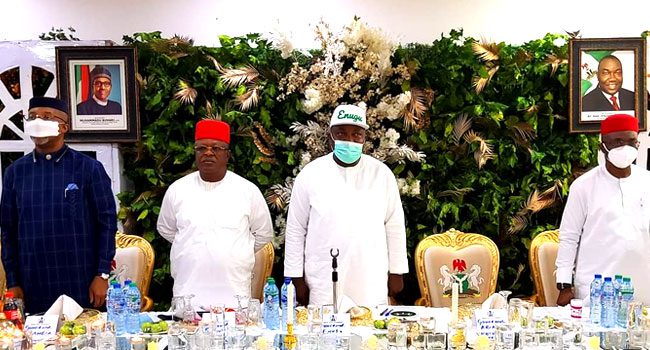
Ambassador TY Buratai and the place of merit

0
History is a silent guardian of reality. It has neither a voice nor animated sense, but its verdict is strong and loud.  It defiantly bows to the dictates  of truth and it is not prone to the conscious conspiracies of a dubious world. Indeed, history is the soundest judge in the affairs of men.
Nigeria’s former  Chief of Army Staff (COAS) and leader of the anti-insurgency combats in the country, Ambassador Tukur Yusuf Buratai, a retired Lieutenant General stands in the corridors of the shinning ambience of history. When he commanded the anti-terrorism operations for nearly six years, he gave his best even at the risk of his personal life. He exhibited  an uncommon patriotism and loyalty to his country. Apparently, history has today passed a kind and favorable verdict on him.
It was Mr. Harry Truman, a former President of the United States of America, who once said; “Do your duty and history will do you Justice.”  Gen. Buratai (rtd) performed his duty creditably and, he is standing on the judgment podium of history, beaming with smiles and pride.  History ricochets him as a soldier who defended his fatherland from the claws of terrorists, bandits and other armed criminal gangs in the country impactfully and defiantly.
Today, retired Lt. Gen.  Tukur Yusuf Buratai has another mandate to serve Nigeria. It is at the diplomatic scene, as Nigeria’s ambassador designate posted to serve in neigboring Benin Republic. From the warfront’s earsplitting sounds of bombs and guns in the forests and caves of the Northeast region, His Excellency, Ambassador TY Buratai  will now continue to fight terrorists with diplomatic weapons.
He prosecuted the counter-insurgency operations gallantly. He manifested courage, doggedness and determination. He spared no enemy or foe of Nigeria and their conspirators. He even placed his life in the path of danger countless times because he willingly took a decision to defend his country. Therefore, the odds neither discouraged nor deterred him. The frustrations strewn on his path by adversaries and villains rather bolstered him.
Whilst in military garbs in the service of Nigeria, Ambassador Buratai was inspired by the wisdom of Afro-American civil rights activist and anti-racism campaigner, Martin Luther King Jr who echoed that; “There comes a time when one must take a position that is neither safe, nor politic, nor popular, but he must take it because conscience tells him it is right.” Gen. Buratai (rtd) exhibited exceptional military exploits because he vowed Nigeria must be exculpated from the tusks of terrorists and allied criminal gangs.
But while on this noble national assignment, Gen. Buratai (rtd) stepped on toes, bruised known and unknown forces, who many times plotted a cruel death on him or attempted his assassination. But Buratai fought back tenaciously and viciously. It earned him uncomplimentary remarks and sobriquets from these antiheroes.
But Gen. Buratai knew, and like the famous thinker Eugene Victor Debs’ “In every age it has been the tyrant, the oppressor and the exploiter who has wrapped himself in the cloak of patriotism, or religion, or both to deceive and overawe the People.
”Therefore, history remembers Gen. Buratai  as a soldier and military leader, who yesterday, faced  multiple Boko Haram  ambushes in the warfront;  but he defeated them the many times they tried. Whether the attacks came at nights or day time, Gen. Buratai (rtd) outsmarted his assailants and killers.
So, barely few months into office as COAS, many disguised terror sects like the Shiek Ibraheem El-Zakzaky’s Islamic Movement of Nigeria (IMN) with affinities with terror sects in Iran, executed an assassination plot on Gen. Buratai (rtd) in Zaria. It failed woefully. And the incident never deterred or discouraged the former COAS to give the best to his fatherland. Gen. Buratai believed like the US war veteran George S.Patton Jr;  “The soldier is also a citizen. In fact, the highest obligation and privilege of citizenship is that of bearing arms for one’s country”
Gen. Buratai (rtd) love Nigeria with a passion. He believed the country’s misplaced fortunes in security can be recovered. It was America’s first black President, Mr. Barack Obama who reasoned patriotically that; “In the face of impossible odds, people who love this country (America) can change it.” Gen. Buratai knew that it was possible to change the demonic face of Nigeria on insecurities and he achieved   it prodigiously.
So, he frequently slept in the trenches with troops and personally led onslaughts against terrorists in the frontlines. Gen.  Buratai (rtd),  a reputable  warmonger, world class  combatant, famed military strategist and tactician never scowled in giving Boko Haram insurgents a bloody nose at all times and everywhere. Gen. Buratai (rtd) was insurgents and bandits’ mortal nightmare.
Boko Haram’s factional leader, Abubakar Shekau whined several times in the warfront over the excessive subduing pressures Gen. Buratai unleashed on his top Commanders and foot soldiers. He loudly bemoaned Gen. Buratai’s cruelness.
Some of these terrorists who could not withstand the heat of war grimaced and voluntarily surrendered to the Nigerian Army. It was the foundation of Gen. Buratai’s “stick and carrot” policy in prosecuting the war, which eventually birthed “Operation Safe Corridor.”
Also, under Gen. Buratai’s watch, tens of thousands of Boko Haram foot soldiers willingly surrendered to the Nigerian Army. Gen. Buratai accomplished this feat because he sermonized to the terrorists the wisdom of Chris Hedges; “If we really saw war, what war does to young minds and bodies, it would be impossible to embrace the myth of war. If we had to stand over the mangled corpses of schoolchildren killed in Afghanistan and listen to the wails of their parents, we would not be able to repeat clichés we use to justify war.”
Therefore, Gen. Buratai (rtd) discharged his responsibilities as a soldier very perfectly. Under his reign, Gen. Buratai (rtd)  led military operations, which  rescued over 20,000 thousand persons including women and children, held hostage by  Boko Haram and housed in different camps within the Northeast. When Gen. Buratai (rtd) served as  the honcho man of the anti-insurgency, over 1,000 top commanders of Boko Haram were neutralized in fierce battles with Nigerian soldiers within five years.
As leader of the counter-insurgency, Gen. Buratai completely blighted and rendered extinct, splinter terror sects like Ansara and DESH among others. He personally led troops in some of the operations which reclaimed all Nigerian territories once held and controlled by the terrorists, who displaced natives, sacked or deposed emirs and other community leaders. He substantially normalized existence in the Northeast.
The dreaded Sambisa forest was not only demystified, but   became a favorite game reserve for soldiers when Gen. Buratai (rtd) prosecuted the war. Nigerian Army even hosted series of Army competitions in Sambisa forest.
In Sambisa forest, Gen. Buratai roaringly gunned for the terrorists and they knew it. Every terrorist knew, the fear of Buratai was the beginning of wisdom. It was the Buratai phobia which compelled the hurried migration of remnants of terrorists to the fringes of Lake Chad Basin axis in their search for safer havens.
Pleasurably today, Gen. Buratai (rtd) has been posted to Benin Republic as Ambassador designate. Benin Republic shares boundaries with Nigeria and it is a major commercial route into the country, where also, illegal weapons are smuggled. As Nigeria’s ambassador to this country, Gen. Buratai will collaborate with the Government of Benin to halt the massive smuggling of illegal weapons into Nigeria, which partly services the weaponry needs of Boko Haram terrorists and bandits.
Furthermore, through persuasion, His Excellency, Ambassador Buratai will assist in strengthening the participation of Benin republic in the Multi-National Joint Task Force (MNJTF), the regional security outfit formed to collectively tackle terrorists in these five nations, including Nigeria, Niger, Chad and Cameroun. This would be in addition to availing the Benin Republic with his wealth of experience in anti-terrorism warfare in advisory capacity.
It is for these reasons and many others that Nigerians have described Ambassador Buratai’s new posting as the icing on the cake for Nigeria to boost her economy and security through a good understanding with Benin Republic on some of the illegal activities that take place around the borders of these two countries. He is expected to bring his strategy on board to help these two nations foster a better and stronger economic/security ties that will be beneficial to the two countries.
Interestingly, Gen. Buratai does not perceive his ambassadorial assignment as the reward for all his services to Nigeria in the strict sense of it or really what excites him. Gen. Buratai (rtd) cherishes his feting in every nook and cranny of the country as the hero of counter-insurgency more than anything else.
From Agila to Mafa, Kaura Namoda to Otuoke.  Lt. Gen TY Buratai (rtd)  is being celebrated for his efforts in combating terrorism in Nigeria and the  professional and patriotic Army he bequeathed to Nigeria. His name unites Nigerians across all walks of life. He is that quintessential patriot that even his enemies fall in love with his good works. Truly, history has done him Justice.

NYSC @48: Gen. Ibrahim’s midas touch

0
Since its introduction nearly five decades ago, the National Youth Service Corps (NYSC) scheme has fostered unity among young Nigerians from different tribes and background across the nation. The scheme, though, under President Muhammadu Buhari and Brigadier Gen. Shuaibu Ibrahim has outdone its mandate.
The NYSC is one national asset which has benefitted tremendously from President Buhari’s impactful leadership. And the sche under the leadership of Brigadier Gen. Ibrahim, as it’s Director- General has greatly harvested and it’s still plucking the fruits of the Buhari Presidency’s focused leadership, more than any other time in it’s history of 48 years.
NYSC is 48 years; merely eying two more years ahead to beat the drums of it’s golden jubilee anniversary. Since its creation in May 1973, the NYSC  has had many senior Army officers directs its affairs  as the Director General.
In fact, the current Director General of the scheme, Brigadier Gen. Shuaibu Ibrahim Ph.D, is the 18th DG. The native of Nasarawa LGA of Nasarawa State assumed the position on 10th May, 2019. And within just two years in office, Gen. Ibrahim  has been able to competently impose his leadership excellence on the scheme to enviable and unimaginable  heights.
Until his appointment to succeed Major General Suleiman Kazaure, Gen. Ibrahim’s leadership acumen exposed him at  the Nigerian Army University, Biu, in Borno State, where he served as it’s pioneer registrar. The NYSC was in desperate need of a redeemer and President Buhari sighted the trusted credentials in Gen. Ibrahim.
The NYSC boss’s excellent performance in office barely two years is not surprising and an apt  testimony of his belief and convictions as an unwevering  apostle of the #NextLevel agenda of the Buhari Presidency.
Gen. Ibrahim  has a track record of building people and institutions as well as attracting solid development for national growth.
Posted to  NYSC, meant a platform  and a familiar terrain had been delivered on his hands for salvationary overhaul.
Gen. Ibrahim’s massive successes as  the DG of the NYSC is tethered to his stint with the scheme from 1996-1999 as Military Assistant to the then DG, Brig. General S.M. Dule.  His firm background as an academic and his vast experience in administration due to his previous responsibilities has been felt immensely during his two years of grooming vibrant,  educated and aspiring  youths of the country.
As a leader  with foresight and as someone with  set targets  to uplift the NYSC, Gen. Ibrahim immediately rolled out his plans for the scheme as soon as he assumed office in 2019. His agenda as he stated when he took over office was to “sustain effective utilization of the potentials of Corps Members for optimal benefit; to pursue a technologically driven organization to deepen effective service delivery; to improve on the welfare and security of corps members and staff; strengthen existing collaboration with stakeholders; and reinvigorate NYSC ventures and Skill Acquisition and Entrepreneurship Development programme in line with the NYSC Act for greater impact.”
These were the identified fulcrums  of his vision from the outset. There is no doubt today that barely two years in office,  and despite the challenge posed by the outbreak of COVID-19 for the most part of 2020, NYSC has birthed most of it’s set targets under the incumbent Director General.
First, his agenda to make the scheme a technologically driven organization to deepen effective service delivery has been put to effect. The NYSC scheme was hitherto known for mobilizing unqualified graduates with fake or questionable degree certificates, obtained from unrecognized schools or outrightly, the famed “Oluwale certificates” stuff.
For the first time in the history of the scheme, Gen. Ibrahim quickly dialogued  with relevant stakeholders of some African educational institutions, where major decisions were adopted to curb the trend.
Today, the deployment of ICT solutions to drive the operations of the scheme for greater efficiency has been sustained by the administration of Ibrahim.  And most of the illegal institutions that were producing fake graduates especially in the West African sub-region have been noted and blacklisted.
The Director General  had sternly warned people with dubious intentions of compromising the integrity of the mobilization process to desist as they will certainly be caught and made to face the consequences. He asserted  that “Under my watch no unqualified person will be allowed to participate in the NYSC.”
His stern and uncompromising posture  has sent shivers into the spines of some unscrupulous elements, who would have tarnished the image of the scheme. The initiative has been heartwarming such that some foreign and local prospective corps members with questionable academic credentials have been uprooted,  apprehended and dealt with.
The increase in the allowances of the Corps members has been another milestone achieved under the NYSC’s  leadership of Gen. Ibrahim. This is in line with his agenda to improve the welfare and security of corps members and staff. Under his watch and through his consistent engagement with the relevant stakeholders, there has been a review of corps members’ allowance from N19, 800 to N33, 000, based on the increase in the remuneration of public servants in the country.
He has also ensured that entitlements of staff are promptly settled, while also intensifying the level of capacity building and training to enhance the productivity of the NYSC staff. The scheme has also witnessed staff promotion exercises that have led to the elevation and promotion of deserving  staff of the scheme to higher ranks under his watch.
More soothingly, both staff and corps members have overcome the nightmare of delayed or unpaid legitimate  salaries /allowances. Under Gen. Ibrahim,  bank  alerts hits accounts before end of every month.
Again, the Brigadier General Ibrahim leadership of the NYSC scheme has finalized arrangement with the National Health Insurance Scheme (NHIS) for the enrolment of Corps Members into the NHIS to provide health care to the corps participants. This shows the commitment of the current leadership towards effective healthcare of the corps members during their service year. There have also been collaborations with various security agencies so as to ensure the safety of youth serving the country.
And as a soldier  of profound intellect and knowledge, Gen. Ibrahim has made collaboration with all  relevant stakeholders a mandate or focal policy  of his administration of the NYSC. He has gone round the country, putting heads with the relevant stakeholders to remind them of their statutory responsibilities and obligations to the scheme as enshrined in the NYSC Act. And this has yielded positive results, as hitherto apathetic stakeholders have woken up from slumber in the discharge of their duties to NYSC.
Already, the engagements have started yielding results through the provision of befitting Orientation Camps and maintenance of same; provision of accommodation for corps members, accommodation for Area Offices and State Secretariats, release of states  subvention, security of corps members and support for the Scheme’s Community Development Services. It has never been this good!
Also under  Gen. Ibrahim leadership, the Skills Acquisition and Entrepreneurship Development programme (SAED) has been reinvigorated and made compulsory for all corps members. This has helped to engage the corps members in practical skills that have proven to be  self-sustainable and beneficial to corps members in the post- service year,  especially as there are few job opportunities in an already saturated labour market.
There have also been consistent engagements with many of the scheme’s existing partners and potential ones that are yielding results.  Again, the collaboration with Access and Unity Banks to fund Business Plan Development programmes for Corps Members, partnership with the British American Tobacco Nigeria Foundation (BATNF) for empowerment of corps members with agricultural skills and business training, farm internship, mentoring and farm input supplies have offered a lot in this direction. These  are positively turning around the fortunes of rural communities in investments and agricultural engagements.
The NYSC Gen. Ibrahim has struck and depeened relations with International Labour Organisation (ILO) which has consummated  windows of utilizing the potentials of youths’ empowerment through employment and entrepreneurship skills development in Nigeria. Today, Nigerian corps members are proud  beneficiaries of  ILO’s “Start and Improving Your Business (SIYB) Management Programme.”
And in order to raise funds that will augment the scheme’s allocation from the federal government, the NYSC under Gen. Ibrahim has taken advantage of the agriculture initiative of the President Mohammadu Buhari administration, thereby raising funds for the smooth operation of the scheme. New tractors and other agricultural implements have been purchased for the NYSC rice farm in Ezillo, with a rice mill located in the same area. There is also a new rice mill that has been established for the NYSC rice farm in Kebbi State. Gen. Ibrahim has engaged all formerly forlorn NYSC farms nationwide and established fresh NYSC farms. It’s rice fields now cover up to 60,000 hectares and he plans to expand it.
The NYSC Bakery and Water Factory at the FCT Orientation Camp, Kubwa have been resuscitated, with the products made available to consumers in the FCT and Nasarawa State. All these are initiatives that are now raising revenues  for the scheme.
It is important to emphasize that the outbreak of COVID-19 in Nigeria presented a leadership test and challenge which the scheme under Gen.Ibrahim rose up swifly and conquered it’s challenge. First, there was the need to keep corps members safe from contracting the deadly COVID-19 disease. The 2020 Batch ‘A’ Stream One Orientation exercise had to be suspended nationwide, yet serving corps members across the country played key roles.
With the support of the scheme, the corps members were able to produce hand sanitizers, liquid soaps and face masks that were donated to the Federal and State Governments, as well as communities to help in containing the pandemic. Corps medical personnel were sensitized and equally deployed to assist their senior colleagues in the medical field in battling the pandemic which unarguably posed  a formidable threat to humanity.
In his tireless efforts to secure the future of Nigerian young graduates, Gen. Ibrahim has also engaged stakeholders on the ambitious project to officially establish a legislation-backed   NYSC Trust Fund.
 The NYSC Trust Fund is intended  to source its funding from a percentage of profits of mega companies in Nigeria to financially empower passing -out corps members to start  independent work-life through  private investments from  the capital availed them by the Trust Fund. When it finally comes into fruition, which Gen. Ibrahim is vigorously pursuing, post service years would no longer be the tormenting nightmares of most corps members in the country.
 It is obvious that the Director General  is someone who understands the importance of information to the society. This is why under him, the NYSC has secured a license from the Nigerian Broadcasting Commission (NBC) to establish the NYSC Radio Station.  The radio station will also boost the publicity drive of the scheme, as well as serve as a training ground for corps members who have interest in broadcast journalism.
Overall, Brigadier General Ibrahim has introduced a unique administrative approach that resonates with staff, given his resolute stand for discipline.  With his rare qualities, unique disposition and cutting-edge leadership, Gen. Ibrahim has clearly demonstrated that he is a man on a mission.
No doubt, the NYSC is in safe hands and certainly on the path to more achievements under Gen. Ibrahim, hence President Buhari is poised to deepen his focus on its absolute perfection.

NEDC and Alkali’s giant strides in office

0
Under a Buhari Presidency, Nigeria must salvage itself from the organised crimes/ killings and bloodshed all over the land  to discredit his administration. Those still  angered with his administration should know and are free to continue with the killing spree of compatriots across Nigeria in the guise of hatred for  President Muhammadu Buhari through their moles planted everywhere in sabotage.
They should never have bothered because in 2023, Buhari would not be a factor in the presidential elections of Nigeria any longer.  Those seeking political power either for themselves or acolytes (annointed godsons/daughters)  under any particular political party platform in 2023, must know, in democracies globally, power is not obtained by savagious means. Democracy  frowns at the  barbaric force of weapons of bloodshed prevalent in the country now to discredit the incumbent leader.
Nigerians imposed the Boko Haram insurgency and other allied insurrections on themselves since 2009. The present administration of Buhari  has battled this lionized criminal oddity for too long and in spite of the frustrations, President Buhari is still obstinently trudging ahead.
So, both the sabs and their enablers, should give Buhari and Nigerians a break. Nigeria  deserves a break from this satanic “madness,”  just for sake of  political grandstanding.
Terrorism has brought a lot of setbacks to the states in the Northeastern part of the country.  The war has left many people of the region homeless,  displaced from their ancestral homes, deprived in many ways and has re-interpreted life to them as meaningless. But Buhari vowed never to falter. And the positive results are glaring now.
And indisputably and  at this point of Nigeria’s history, the survival of the people and reconstruction of the region rests firmly on the shoulders of the federal government and sympathetic NGOs now that respite has descended substantially in that region. No evil can puncture the sanity of humanism.
Normalcy has returned to the affected areas and this is where the Buhari Presidency is concerned. The Boko Haram  propagandists, promoters and sympathisers in Nigeria  never wished the insurgency would douse it’s fires to this level palpable now under the Buhari Presidency.
With the military imposition of normalcy, Buhari has also prioritized the reconstruction and rebuilding of the Northeast region. Mr. President has sought and obtained a legislation from National parliament for the establishment of North East Development Commission (NEDC).
It’s not new news anymore.  But since the  assumption of office in 2015, the President Buhari- led administration in a bid to reconstruct the damaged physical and social  infrastructures in order  to tackle the humanitarian crisis faced by the people of the region, never deviated from this focus. The President also persuaded  the Nigerian Army to execute Corporate Social Responsibility (CSR) projects in the region.  And the Army came full swing, traversing the region, including Sambisa forest.
With these combined efforts, Buhari has concretized  a solid peace-building, reconciliation and de-radicalization framework, birthed in  the NEDC,  as the  lawful executor.  The President knew that issues such as illiteracy, poverty and unemployment which were rampant in the region have  the potency to recruit fresh Nigerian youngsters into the terror sects.
 The mandate of the NEDC which was established in 2017 and inaugurated in 2019, is to reconstruct damaged infrastructures  in the region, rehabilitate and resettle the victims of the Boko Haram insurgency, tackle illiteracy, ecological and environmental disasters  and any other related developmental challenges in the North-Eastern states of Adamawa, Bauchi, Borno, Gombe, Taraba and Yobe states, using FGN allocated  funds to NEDC and International donors.
The Commission is a brainchild of other initiatives hitherto in place such as the Victims Support Fund (VSF), the TY Danjuma- led Presidential Initiative on the North East (PINE), and Presidential Committee on the North-East Initiative (PCNI).
As a lawful initiative of  President Buhari’s administration, the NEDC started on a solid foundation.The commission needed to be headed by a resourced, prepared individual with vast knowledge and an unquestionable track record of performance as its pioneer Managing Director.
And  the  Managing Director/ Chief Executive Officer, Alhaji  Mohammed Goni Alkali assumed leadership. Thereafter, the commission commenced full operations  in 2019, recording  success upon successes in it’s operations of  rebuilding the insurgency ravaged region.
Apparently, an old horse on the saddle, Mohammed Alkali understood  that the mandate of the NEDC is to first of all, serve as a humanitarian – interventionist agency in the region. Secondly, to render the needed support to the people of North-Eastern Nigeria having suffered  enough from  the atrocities of  terrorist sects.
And the commission has impacted marvelously through an Eye Care Foundation. It has successfully conducted over 1000 minor and major  cataract surgeries for natives in the region.
Also, the NEDC’s  Eye Care Foundation has been  replicated in all states of the region,  especially at  Internally Displaced Persons (IDPs) camps.
All patients with eye related ailments are treated free- of- charge, at no cost of whatever indentity. The commission is working in conjunction with all the state governments in the region on the Eye Care Intervention project and the results have been wonderfully impressive.
So far, the NEDC’s Eye Care Intervention has reached out to IDP’s  camps in Monguno and 12 other  separate camps in Maiduguri. It has covered  over 5,000 persons affected by the  long years of unrest in the Northeast region.
The commission under Mohammed Alkali has also helped in resettling hundreds of thousands of IDPs back to their deserted and ruined ancestral homes. It is also providing agricultural inputs to returnee-IDPs to  reactivate farming  activities, which is the traditional occupation of the people.
And since it’s establishment, the NEDC  has also been able to empower thousands of aspiring Nigerians from the North East using other initiatives. It’s  prominently registered a yearly N6 billion  Education Endowment Fund for youths in the region has offended the sensibilities of Boko Haramists, whose central ideology is “western education is forbidden.” Desirous youngsters after educational pursuit in the region are glad as proud beneficiaries of NEDC’s annual scholarship.
Nigerians can only appreciate the great job the NEDC is doing in Northeast on the realization that the region accounts  for nearly 60 per cent of the 13 million out-of-school children in the country.  It’s a great leap forward!
The NEDC’s Education Endowment Fund has been able to provide an avenue for the engagement of over 20,000 beneficiaries annually to enable them have access to academic and professional capacity development opportunities in their various fields of endeavour. It is also redressing  the region’s devastated educational sector by rebuilding insurgency- damaged educational infrastructures.
This is in addition to the implementation of about 1,300 Rapid Response Intervention projects in the whole of the 112 Local Government Areas of the North Eastern region of the country.
Additionally, there has also been a regular awards of scholarship for undergraduates, students of post-graduate studies and other lower cadre entrepreneurial interventions. The scholarship has covered all the 1,028 wards and 112 Local Government Areas in the six member-states of the Northeast region as beneficiaries.
It is in addition to the implementation of an Integrated Agriculture Programme involving the provision of agricultural machinery and equipment, seeds, fertilizers, agro-chemicals and extension service logistics vehicles to enhance the production capacity of smallholder farmers in Northeast to enable resettled displaced persons regain their lost livelihoods.
Still concerned, the  NEDC staged out out boldly on outbreak of the  coronavirus pandemic in Nigeria in 2020  The  NEDC donated medical equipment and preventive items to the six states of the region as part of measures to curtail the spread of the Virus.
The items donated to the each of the state governments included Personal Protective Equipment (PPE), ventilators, surgical masks, ordinary masks, infra-red thermometer, hand gloves and  sanitizers. This support by the NEDC went a long way in complementing the efforts of the federal and state governments in controlling the spread of the virus in the region.
The Mohammed Alkali led NEDC is building a Molecular Laboratory at the Yobe State University. This is another wonderful initiative and when completed, the laboratory would be used as a test centre for Covid-19, yellow fever, Lassa and other hemorrhagic fevers among other diseases and outbreaks. The NEDC is building the laboratory in partnership with the Yobe State Government and, the Nigeria Centre for Disease Control (NCDC), among other partners.
And just within a short period of time in the office, the Mohammed Alkali led North East Development Commission (NEDC) has almost completed the rehabilitation of drinking water and Sanitation facilities in many states in the North East. Upon completion, this facilities will provide over 1.3 million people of the region with access to clean drinking water. This project is being undertaken by the NEDC in collaboration with the World Bank under the Multi-sectoral Crisis Recovery Project.
In the area of accountability, the NEDC boss has ensured that all funds allocated to the commission are judiciously used for the good of the people of the region. As attested by many staff of the commission, the NEDC under Alkali is result- oriented. Contracts awarded by the commission always follow due process and are executed to the latter. This is the kind of foundation Mohammed Alkali has laid for the NEDC.
It is important to note that as a brainchild of the President Buhari’s  administration, the NEDC is currently living up to its expectations. The Alkali commission has not derailed from its given mandate.
 All Nigerians must support the leadership of the commission to salvage the Northeastern region in the aftermath of the Boko Haram crisis, in order to make the region a better place for all Nigerians.  Through the NEDC, President Buhari is actualizing his fondest dream of rebuilding the war-torn Northeast region, after the defeat of terrorism.