Home Blog Page 2078

Continuous dialogue critical to tackling telecoms industry challenges – NCC boss, Danbatta

0

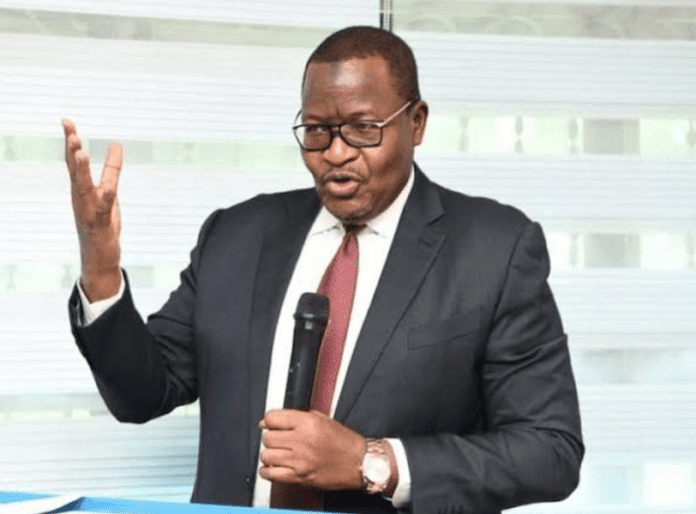
Prof. Umar Garba Danbatta, Executive Vice Chairman and Chief Executive Officer of the Nigerian Communications Commission (NCC), has stated that ongoing dialogue between the regulator and its various licensees is critical to finding long-term solutions to issues affecting licensee compliance with existing regulations and posing a challenge to the telecoms industry’s growth.

Danbatta mentioned this during the NCC’s 2021 Talk to The Regulator (TTTR) session, which was held over the weekend at the Four Points by Sheraton in Lagos.

The discussion’s theme is “Improving Stakeholder Satisfaction.”

The program’s Lagos iteration came after a successful holding of a similar dialogue in Kano on October 16, 2021.

Read Also:  Army Chief of Staff Urges Troops to Continue Fighting Bandits

The goal of the event is to gather direct input from licensees on how the Commission is achieving their expectations as a regulator.

The initiative was also created to identify areas for regulatory reform, highlight areas where licensees are defaulting, and address major industry obstacles that are impeding the full realization of the established goals for consolidating telecoms sector benefits.

According to Danbatta, who was represented at the forum by NCC Executive Commissioner, Stakeholder Management, Adeleke Adewolu, the forum is organized in accordance with the Commission’s commitment to continuously ensure regulator-licensee interactions in order to develop collaborative solutions and implementation programs to the telecom ecosystem’s challenges.

“The Nigerian Communications Act (NCA, 2003) gives the NCC with the authority and responsibility to regulate both technical and market-related aspects of Nigeria’s telecoms infrastructure and services. Because NCC views consultation to be the lifeblood of regulation, we see our position as regulator as critical to ensuring industry sustainability,” the EVC stated.

“We have constantly utilized stakeholder engagement mechanisms like public inquiries, private investigations, written information requests, one-on-one dialogues like the ones we’re conducting now, and varied consumer engagement platforms,” the EVC added.

“We can use these techniques to ensure that our interventions are well-founded and that our judgments are based on a thorough grasp of the perspectives of stakeholders.”

Read Also: Andy Uba accuses INEC of frustrating his decision to go to court in Anambra

Regulatory Excellence, Promotion of Universal Broadband Access, Development of the Digital Economy, Facilitation of Market Development, and Strategic Partnering are among the five pillars of the Commission’s Strategic Management Plan (2020-2024), according to Danbatta.

“Through regular interactions with our licensees, the Commission is able to gain valuable insights to improve our regulatory output, enabling us to drive excellence in accordance with the five pillars of our strategic vision for the industry as outlined in the Commission’s Strategic Vision Plan (SVP), 2021-2025,” he said.

The EVC also reaffirmed the Commission’s belief that Nigeria will only be able to achieve the national objectives and targets set out in the National Digital Economy Policy and Strategy (NDEPS) 2020-2030, the Nigerian National Broadband Plan (NNBP) 2020-2025, and other national policy instruments aimed at developing the country’s digital economy ecosystem if licensees perform optionally.

“As a result, we intend to use this forum to seek support for many initiatives that the commission has carefully developed in our quest to enhance market opportunities for all our licensees,” Danbatta said, emphasizing NCC’s belief in collaboration with stakeholders and its licensees to address any concerns that may obstruct the achievement of the relevant policy objectives.

Read Also:  Afenifere: Why Yoruba Groups Won’t Beg Buhari To Release Sunday Igboho

The NCC CEO further stated that the Commission will continue to implement forward-thinking and all-encompassing regulatory actions to ensure that all of its licensees have access to the market. Danbatta also stated that the NCC is committed to reviewing the licensing framework as well as key regulatory instruments on a regular basis in order to keep the Commission’s regulatory frameworks up to date and ensure better service delivery for consumers as well as efficient achievement of other national interest goals.

However, according to Danbatta, some licensees are not doing as much as they should. “Several licensees are having difficulty paying their employees, many are unable to meet basic license obligations, and several are defaulting on their Annual Operating Levies (AOL), while interconnect and other inter-licensee debt remains unacceptably large.”

As a result, we must guarantee that regulatory measures are in place to resolve issues, bottlenecks, and grievances that may occur among licensees,” he said.

The Director, Licensing and Authorisation at NCC, Mohammed Babajika, also spoke at the event, saying that the purpose of the forum was to foster a harmonious relationship with licensees, identify their challenges, and provide feedback on licensees’ compliance with their license obligations, as well as to re-emphasize the role of licensees in ensuring good quality of service (QoS) and quality of experience (QoE) for consumers.

Despite the impact of the Covid-19 pandemic and its resulting challenges, Babajika said the Commission was taking steps to further liberalize the telecoms industry by finalizing the framework for Mobile Virtual Network Operators (MVNOs) and reviewing existing licensing regulations, while informing licensees of some regulatory initiatives focused on licensing issues.

The Director also informed the licensees that the Commission was nearing completion on an Information Memorandum (IM) for the deployment of Fifth Generation (5G) technology, which will promote emerging technology trends such as the Internet of Things (IoT), Artificial Intelligence (AI), Over-The-Top (OTT) Services and Big Data Analytics, as well as Blockchain.

Read Also:  Insecurity: Nigerian telecom masts should be equipped with cameras – Gen Usman

At the event, the Commission’s management team presented presentations to licensees and others, who actively participated by listening, providing observations and comments, and asking explanations in order to improve the quality of the conversation and the intended outcomes.
Army Chief of Staff Urges Troops to Continue Fighting Bandits

0

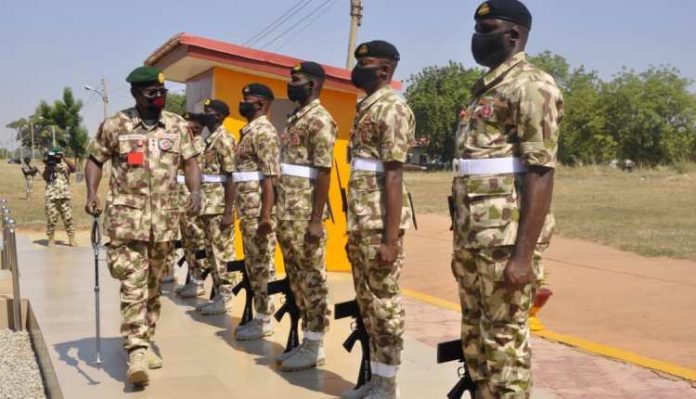
Lieutenant General Faruk Yahaya, the Chief of Army Staff (COAS), has ordered Nigerian Army forces to maintain aggressive offensives against terrorists and bandits who are causing insecurity in the country until they are decimated to the point of surrendering.

The COAS delivered the charge while on an operational visit to Yola’s 23 Brigade, where he was briefed by the Brigade’s Commander, Brig Gen Aminu Garba, on the security situation and the Brigade’s activities.

In a speech to the Brigade’s men, Gen Yahaya promised them that the problems raised by their commander would be given the attention they needed to allow them to accomplish their tasks to the best of their abilities.

According to Brigadier General Onyema Nwachukwu, Director Army Public Relations, the COAS highlighted the need of the troops continuing to train and bringing their battle expertise to bear in effectively fighting the opponents.

The COAS commissioned two blocks of military housing during his tour, as part of his commitment to improve personnel welfare and boost unit morale. He asked them to keep the facilities in good working order and to put them to good use.

Visit with Courtesy

Lieutenant General Faruk Yahaya, the Chief of Army Staff, had earlier paid a courtesy visit to the Executive Governor of Adamawa State, Rt Hon Umaru Fintiri, at the Government House in Yola.

Read Also:  COAS orders troops to kill bandits and bring their bodies and weapons

The COAS thanked the Adamawa state government for providing financial assistance to the families of the fallen soldiers.

The Army Chief also praised the people of Adamawa State for their support of Nigerian Army forces, especially Governor Umaru Fintiri, who personally attended the funeral of Late Brig-Gen Zurkushu and seven other heroes.

Governor Fintiri responded by praising the troops’ efforts and the selfless sacrifices of the heroic officers and men of the Nigerian Army in sustaining peace and security in Adamawa State and the country at large, while asking the military to conduct their operations with professionalism.

The COAS also paid a courtesy call on the Lamido Adamawa Alhaji Barkindo Aliyu Mustapha at his palace, stating that he was there to pay his respects and express gratitude for the monarch’s unwavering support for the Nigerian Army.

General Yahaya also expressed gratitude for the traditional leader’s peace-building efforts in his domain, asking the monarch to continue preaching and promoting peaceful coexistence among people of various ethnic backgrounds.

Read Also:  Mustapha: Why Should the Next APC National Chairman Come From North Central?

The COAS enlisted the help of traditional leaders to continue to encourage people to provide credible information to security authorities in order to improve ongoing operations.

In response, the Lamido prayed for the NA and other security agencies’ operational engagements to be successful in stemming the tide of insecurity and restoring peace in the country. He urged all stakeholders and members of the public to join the NA and other security agencies in their activities rather than remain silent.

House passes bill to regulate broadcasting practices

0

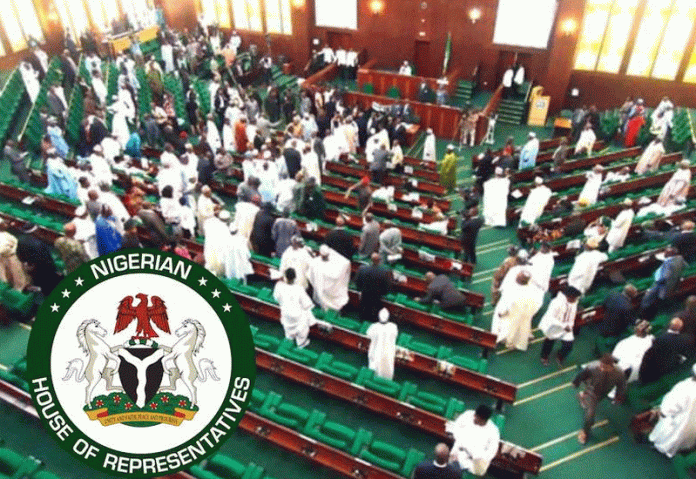
The House of Representatives has approved a bill to regulate the broadcasting profession in Nigeria for a second reading.

Hon. Olaifa Jimoh Aremu is the sponsor of the proposed legislation, titled ‘A Bill for an Act to Provide for the Regulation and Conduct of the Practice of Broadcasting Profession in Nigeria and for Related Matters (HB.1150).’

Aremu, who presented the Bill for second reading in the plenary on Thursday, said it aims to establish a regulatory authority to regulate broadcasting in Nigeria, as well as set academic requirements and ethical standards for broadcasters, broadcast journalists, and broadcast practitioners.

Read Also:  Mustapha: Why Should the Next APC National Chairman Come From North Central?

He also stated that the Bill proposes that a person is only qualified to practice as a broadcaster or be identified as one if they have obtained or attained the prescribed academic or standard of training set by the council and have been certified and registered to practice as a broadcaster by the council.

He explained that a person can be qualified to practice as a broadcaster if, prior to the commencement of the Act, he or she obtained the necessary practical knowledge, training, or experience in a recognized academic institution, broadcasting station, or organization, which will entitle the council, upon verification, to certify him or her as a broadcaster and register him or her to continue to practice as such.

“There shall be established a body to be known as the Broadcasting Practitioners Council (in this Act referred to as ‘the Council’), which shall consist of broadcasting practitioners of the highest distinction in the broadcasting profession in Nigeria,” he says. The council shall be a perpetual succession corporation with a common seal. The council will be responsible for and undertake the following general responsibilities.

“Formal admission, certification, and registration of people who want to work in the broadcasting industry.” Formal admittance, recognition, or certification for deserving individuals who have been trained, practicing, or employed as broadcasting practitioners prior to the passage of this Act.

Read Also:  Benue people are victims of Ortom’s maladministration, mendacity, not drunkards – Reps aspirant, Agbese

Prescripting, deciding, and setting the standard of knowledge and abilities required of anyone wishing to join the broadcasting profession, as well as periodically revising such criteria. regulating and controlling the conduct of the broadcasting profession’s practice.”

The bill was voted on and referred to the House Committee on Information, National Orientation, Ethics, and Values for a second reading.

Benue people are victims of Ortom’s maladministration, mendacity, not drunkards – Reps aspirant, Agbese

0


…tasks Gov to spend his remaining two years on prayers for forgiveness

Chief Philip Agbese, the leading aspirant for Ado/Okpokwu/Ogbadibo federal constituency in 2023, has rejected the drunkard tag used by Governor Samuel Ortom on the people of Benue State.

Rather, Agbese, a chieftain of the All Progressives Congress (APC), said Benue people are the victims of Ortom’s maladministration, mendacity and misrule in the last six years.

Governor Ortom, speaking at the commissioning of Remnant Christian Network Embassy’s new edifice in Makurdi was quoted to have said “If you go round Makurdi town, our people start drinking beer from 9 am and some from there, they will go to sleep and they come back and insult the governor for not helping them to add value to their lives”.

But in a statement signed by Akor Ikwuoche,
the Director-General, Philip Agbese Campaign Organisation (PACO), the astute UK-trained legal practitioner said while such unguarded utterances aren’t strange from the governor, ” It appears his ‘mouth diarrhoea’ has gotten out of control and may require combined spiritual and medical therapy”.

He recalled how Ortom launched scathing attacks on President Buhari Muhammadu, Minister of Special Duties and Inter-governmental Affairs, Dr George Akume and other elder statements in a bid to attract public sympathy and divert attention.

Agbese said it is, however, unfortunate that some “noble sons and daughters of Benue, who cheered when this intractable ailment came on him are now on the receiving end as they are now known as ‘drunkards’ beyond the state. It speaks volumes about what our governor represents and how he presents us before his contemporaries. As they say, betrayal never comes from your enemies”.

The statement added ” We at the Philip Agbese Campaign Organisation totally reject this drunkard tag on our illustrious brothers and sisters. It is false, treacherous and demeaning. May we remind the governor that Benue has produced some of the country’s most respected brains in different fields of endeavours. How come suddenly they are all drunkards for holding him accountable for his misrule in the last six years?

“Perhaps still having hysteria over the N18.5 billion bailout funds, the governor should return to reality and understand that Benue people are wiser now and tired of his usual blame games. Our people have had enough of the attacks on President Buhari as well as the herdsmen and IDPs propaganda. They are demanding translucency. They are not drunkards. He should provide answers as to why the workers and pensioners are being owed. He should address them on why there’s untold hardship and prove that Benue is not ‘worst than Afghanistan’ as rightly suggested by our principal Chief Philip Agbese.

“Just like Agbese, a UK-trained lawyer, human rights activist and entrepreneur, Enone natives are not drunkards. Never! The good people of Ado/Okpokwu/Ogbadibo federal constituency despite the governor’s abysmal leadership have proven to be hardworking, intellectually sound and goal getters.

“If there’s anyone who should be labelled a drunkard, it is Ortom who may have picked up this habit during his time toiling around different motor parks, first as a tout and then taxi driver. He probably thinks because he is the only Benue indigene that can afford a bottle of Andre Champagne at N3,500 due to the hardship that he brought on the state, everyone else seems to be tipsy on something cheaper. But we wish to advise Ortom to take out time to reflect and stop getting drunk at ceremonies and thinking that his citizens are ‘high’.

“Publicly acknowledging criticism is good news. At least, he is aware that the people, victims of his maladministration and mendacity are fed up. Even his most staunch supporters are exhausted of the excuses. They want more action and less talk”.

Describing Ortom as a monumental failure and disaster, the Philip Agbese Campaign Organisation, therefore, urged the governor to spend his remaining two years on prayers. It said perhaps, through divine intervention, Benue people can forgive him.

Agbese, however, assured his people that the hour of liberation is not far again and all the rhetoric of Ortom’s failed administration will be over.

‘Can you tell us how many slots you’re going to give us?’

0

The expectation that officeholders help themselves and others with jobs, contracts, and other favors is a major manifestation of our prebendal attitude toward public office. This expectation extends to include regular and substantial cash donations, clearly in excess of the office holders’ salaries and allowances. It should be noted that the concept of “bringing home the pork” or patronage politics is not unique to our region. Ours, on the other hand, is on the verge of going too far, and in most cases amounts to outright abuse of power.

To be sure, there is a slew of laws and regulations in place to prevent or limit abuse of power. Most citizens also believe that government exists solely to advance the collective interests of the people, not the narrow interests of a select few; that public officials should serve the people, not themselves; that things should be done correctly, and that everyone should be treated fairly.

But the prevailing and pervasive culture, which sees the public office as a conquered territory where the conquerors are free to treat themselves to the spoils of war and be magnanimous enough to sprinkle the largesse either to those lucky enough to be close to them because of kinship, religion, or ethnicity or to those who contributed in cash or in-kind to a campaign, easily undermines and trumps these laws and regulations and open commitments. People hardly raise an eyebrow when officeholders clearly live beyond their means because of the prevailing culture.

For many in our society, the public office has thus almost become a sure path to wealth. Families, friends, and associates of various stripes also expect such wealth to trickle down to them, as having one of their own in a position of power is a once-in-a-lifetime opportunity to partake in the ‘national cake.’ It’s their turn to ‘chop.’ The pretense of doing the right thing for most people crumbles under the weight of the hidden commitment that they have a right to benefit from being near or in power.

Those who do not help themselves or others are labeled as stupid, naive, wicked, or self-centered. Also, refusing to help others or ‘be useful,’ particularly to patrons and real or assumed constituents, may put a limit on how long or how far officeholders can hold on to their seats. So, not only is the nature of the expectations layered into these dynamics but so are the potential costs of not meeting those expectations.

During my five years as the head of NEITI, I decided to take on this deeply entrenched value system one person at a time. My reasoning was that not favoring myself or those close to me would give me the moral right to demand due process and assist me in gaining others’ understanding, even if reluctantly. I insisted on fair, competitive, and transparent procurements and a few limited recruitments.

Avoiding conflicts of interest is still a priority for me. I made it clear that the office should never buy food or pastries from my wife, who owns a bakery and a food business in Abuja, and that if they did, I would refuse to approve the payment. I asked my wife to bring cakes, pastries, and food to the office on special occasions like International Women’s Day, Christmas, or the achievement of a major milestone like EITI Validation Satisfactory Progress. However, I paid for these out of my own pocket; otherwise, my wife would have contributed to my work.

Someone I know has applied for a contract or a job on a few occasions. I couldn’t stop them from applying, but I couldn’t help them improve or influence their chances. In such cases, I would declare a conflict of interest and withdraw from the proceedings. None of the few people working under my supervision were from my state, geopolitical zone, or religion. But it’s not like I went out of my way to prevent anyone from joining these organizations. But I didn’t go out of my way to make things easier for anyone. My former special assistant, a Christian from Cross River State, was the only person I had any sort of prior relationship with who got hired while I was at NEITI. He was chosen through a competitive process, and when it came time for him to be interviewed, I unexpectedly excused myself from the board’s interviewing committee.

Read also: Andy Uba accuses INEC of frustrating his decision to go to court in Anambra

This attitude did not deter many people from asking me to hire, hire, or hire, hire, hire, hire, hire, hire, hire, hire, hire, hire, hire, hire, hire, hire, hire, hire, hire, hire, hire, hire, hire, hire, Even when there were no vacancies or ongoing recruitment processes, I received a steady stream of letters from members of the National Assembly, presidential aides, traditional rulers, and others introducing candidates for employment. The first of these letters came from a high-ranking traditional ruler in the Southwest, introducing someone from the Northwest to NEITI for employment.

I was aware of the country’s unemployment situation, which undoubtedly drives people to desperate measures, but I also wondered if people were actually employed in this manner. However, I made certain that we responded to such letters promptly by stating that we were not recruiting at the time and that they would be notified when positions became available. We also made it clear that any future hiring would be done through a transparent, competitive process.

It’s important to note that these were not requests for their candidates to be given a fair chance to compete, but rather to be given preferential treatment, for the process to be rigged in their favor, or for their candidates to be hired without going through any process at all. The number of letters increased, and replying to them all would have been a full-time job in and of itself. Just for their information, I used to promptly minute on the letters to the appropriate departments. I did, however, make a few exceptions for NYSC and internship postings, but not for job postings. Even the exemptions didn’t apply to anyone I knew personally.

However, it is not uncommon for public officials, particularly CEOs, to hire relatives and others from their clans, communities, states, or tribes. Even those who are not CEOs are able to secure such a position. In some cases, based on the state with the largest number of employees in the organization or the language or dialect most commonly spoken as if it were the official language, it is simple to figure out where the organization’s leader or most powerful person is from. In fact, one of the erroneous metrics for evaluating public officials’ performance in their communities is the number of ‘their people’ they employ.

This and other preferential approaches to recruitment invariably create a lopsided workforce, reduce young people’s faith in their country, and shut out the best and brightest where they are desperately needed, in addition to violating the tenets of conflict of interests and advantaging those already privileged. I had relatives and siblings looking for jobs as the head of NEITI, not to mention friends and others. I could only point them in the direction of opportunities or provide financial assistance.

However, the fact that you chose not to bend the rules for your relatives and friends will not deter others from pressuring you to hire their own relatives and friends. In fact, some of the people who make requests might be quite bold. I recall one of the FCT’s traditional rulers stationing himself at our Asokoro office gate, complete with all the necessary office paraphernalia. He drove straight into the compound after me. It was difficult to claim that I was not in the office or in a meeting because I had been out in the official car. As a result, I had to pay him a visit.

He began by speaking to me in Hausa (as many people do because of my first name), then switched to impeccable Yoruba when he realized I was Yoruba. He came to hand-deliver letters containing CVs of his subjects that must be employed at NEITI, which he had sent earlier. I explained our situation to him politely and promised to let him know if anything came up. My explanation seemed to impress him. I followed him to his car, half-prostrated in respect, and even waited for his car to leave.

My explanations of our tight financial situation and the need to follow due process fell on deaf ears on several occasions. Those seeking favors would promise to speak with higher-ups in government to increase and release our budget in full so that we could hire more people, particularly their candidates. Because these were events that would occur in the future, and I knew they were unlikely to occur, I would often play along because arguing with such people would have been pointless. There were also those who advised me to hire my own people because “everyone does it.” It was made clear to me that if you don’t help your own people, you will be reminded of it when you need them in the future, perhaps when you run for office. Because “this is Nigeria, everyone assists their own,” a cleric once advised me to help people of the same faith.

I vividly recall a meeting with the chairman of a National Assembly committee who had requested my presence. I knew there had to be something based on previous encounters. To make sure I had a witness, I went to see him with one of the directors. He brought out an envelope and called in a man who had been waiting in the outer part of his office prior to our arrival before we could finish exchanging pleasantries.

He stated flatly, “I know how much I put in your last budget for your audit.” “This is the individual who will conduct the audit, and this is his proposal.” Go talk to him about it.”

Before I took office, this was the budget, and luckily for me, the contract had already been awarded. I informed him of this, as well as the fact that the selection of NEITI auditors was a lengthy, open process that would be difficult for anyone to control. I had no choice but to request that our team explain the process to his candidate so that he could submit a competitive bid in the future. He reluctantly agreed.

I developed a variety of responses to these requests, ranging from offering to visit VIPs who would have requested to see me, to painting a bleak but accurate picture of our financial situation in a way that would elicit pity, to taking the time to explain why we had to do things in an open and transparent manner, or promising to help in other ways or when things improved. But I suppose it also helped that they couldn’t use anything to force my hand. Abuja is a small city with a lot of hidden gems. They would have gotten a whiff of it if I had been assisting myself and those close to me, and there could have been investigations, especially from those with oversight powers, to put me on the spot and possibly extract concessions from me.

I’d been in some meetings where those with oversight authority would start by picking holes in our performance, putting us on the defensive, only to conclude with something like, “We got information that you’re using.” “How many slots do you have available for us?”

*The above is an edited excerpt from Waziri Adio’s memoir “The Arc of the Possible,” which will be available on December 1st.

Mustapha: Why Should the Next APC National Chairman Come From North Central?

0

Saliu Mustapha, a candidate for the All Progressives Congress (APC) national championship, said over the weekend that the country’s north-central geopolitical zone is best qualified to produce the party’s next National Chairman.

Mustapha spoke to a group of journalists in Lagos, where he also stated that if given the opportunity to become the party’s next national chairman, he would ensure that the practice of imposing candidates during elections is abolished, as it is one of the main causes of election rigging.

“The APC as a political party was formed by a coalition of the Action Congress of Nigeria (ACN) led by former Lagos State governor Bola Tinubu, the Congress of Progressives Change (CPC) led by President Muhammadu Buhari, and the New Peoples Democratic Party (NPDP), a faction of the PDP led by defecting governors of Sokoto State, Aminu Waziri Tambuwal,” Mustapha said. Bukola Saraki, Chibuike Amaechi, and the All Nigeria Peoples Party (ANPP)

“So far, President Buhari of the CPC has held the presidency, while Prof. Yemi Osinbajo of the ACN has served as Vice President and Speaker of the House of Representatives. “With Ahmad Lawan, the ANPP produced the Senate President,” he said.

He went on to say that the North-central zone deserves to produce the APC national chairman because it determines the outcome of all presidential elections in the country.

“Though there is no official zoning of the party’s offices for the national convention in the run-up to the 2023 election, we are certain that it will be zoned to the North-central zone,” Mustapha says.

Mustapha stated that it will be up to the CPC stakeholders to decide who will be the next national chairman of the party.

He stated that the North-central zone has paid close attention to be noticed, keeping in mind the zone’s role in the zone’s political history in determining the central party.

Mustapha expressed his ambitions by saying that “all that is big in the APC has endorsed him,” and that he will work to ensure that the party promotes equity.

He also stated that if elected as the party’s chairman, he would work to bring the various factions together.

Mustapha, who previously served as the CPC’s deputy national chairman, believes he has what it takes to take the party to the next level.

“I have been endorsed by every well-meaning stakeholder,” he said, “and that is why I am motivated in this race.”

“As CPC’s former deputy national chairman, I oversaw the merger. In Kwara APC, no one is older than me. They were all at the party when I arrived.

“I’ve kept my neutrality, and I’m hoping that being elected chairman of the party will be my first legal step toward reuniting the party’s factions.” All hands must be on deck.

“Having played a key role in the merger, I decided to run for the position of APC national chairman because I believe we don’t have the best.”

Read also:Kidnappers of Ondo Principal, 4 Others Demand N35m Ransom

“I’ve accumulated enough experience and goodwill. I want to see a party that is based on fairness, equity, and justice, not one that is based on oppression.”

He insisted that he was never intimidated in the race, which is dominated by former governors and senators, and that ideology should be the primary consideration when selecting an APC chairman.

“I’m not intimidated by titles; I bow to superior argument,” he says. It is ideas that are in charge. “I’m excited to work with all of these fellow aspirants, who I believe are key stakeholders,” he said.

“Our problems aren’t the ones that will split the party. People are begging to join us because we have been able to manage our challenges.”

He promised to end the practice of imposing candidates during elections, claiming that “this is the main reason for rigging because a candidate who is not popular has been imposed.”

According to the coalition, over 40% of Nigerian women lack formal education

0

According to the Feminist Coalition, more than 40% of Nigerian women have never received formal education.

Damilola Odufuwa, co-founder of the Feminist Coalition, revealed this yesterday in Abuja, adding that 5.5 million girls in the country are out of school, with dropout rates highest in the sixth grade and higher among girls than boys.

According to Odufuwa, these statistics have worsened since the outbreak of the COVID-19 pandemic, when nearly 90% of the world’s countries closed their schools in an attempt to slow the spread of the disease.

“Ultimately, this has a disproportionate impact on the girl child, who, unfortunately, due to gender bias, is the first to be negatively affected in times of unrest and often the last to recover from the socio-economic ramifications,” she said.

Read also: Andy Uba accuses INEC of frustrating his decision to go to court in Anambra

“Every girl has the right to a good education, according to the Feminist Coalition.”

One of our three pillars of work is women’s rights and safety, and undoubtedly, girls’ education is an area in which we are committed to working for the protection and advancement of Nigerian women.

“This is why the Feminist Coalition Girls Education Program was created.” It is a yearly full scholarship and mentorship program for brilliant young Nigerian girls from low-income families who face the greatest financial barrier to obtaining a quality education.”

According to the convener, the coalition’s scholarships cover not only full tuition but also boarding house fees, co-curricular activities, examination fees, and other necessary school requirements and logistics.

“In addition to the all-inclusive scholarship, each Feminist Coalition founding member is assigned to a student and will provide mentorship through a “Big Sister” program. This includes weekly check-in calls with each ‘little sister,’ as well as attendance at school open days and visiting days.

We hope to continue sponsoring this first group of girls for the next six years of their secondary school education…”

Makinde’s Development as a Strategist

0

“Yiyo ekun, ti ojo ko,” the Yoruba proverb goes. ‘The gentleness of a tiger is not a sign of weakness,’ it says. ‘The fact that the lion is a master of stealth does not translate to fear in the jungle.’ That is what those words in the Yoruba saying confirm.

Governor Seyi Makinde had just delivered his candidate, Amb. Taofeek Arapaja, as the Deputy National Chairman (South) of the Peoples Democratic Party at Eagle Square in Abuja in the early hours of Sunday, October 31. (PDP). Someone shouted – The master strategist! – from the throngs of his supporters. The general backslapping continued after the governor gave him a thumbs up.

Makinde, who was thrust into the forefront of Oyo State politics by the March 9, 2019 governorship election, is quickly establishing himself as the master of stealth as his politics and policies pervade the state, zonal, and national scenes. But the amusement is that his political opponents frequently fail to recognize that the Oja’ba, Ibadan-born Engineer-turned-stealthy politician’s strategic moves are not signs of weakness.

Read also: Andy Uba accuses INEC of frustrating his decision to go to court in Anambra

Many people mistake his slow speech, gentle mien, and simple looks for those of an everyday man, whose benign postures could easily be put out with a featherweight punch.

Political analysts and theorists are still debating whether his friendly demeanor contributed to the lightning-fast penetration of his Omituntun mantra across the length of Oyo State ahead of the 2019 election, but it is becoming clear that some natural affinities that were once considered off-cuts by some contenders have become firm parts of the robust stratagem that delivers the goods to GSM, battle after battle.

At the state level, he faced challenges firsthand: a state engulfed in a hellhole of local and international debt, owing more than 96 months of pension arrears and gratuity arrears dating back to 2010; a state burdened by infrastructural decay; the worst out-of-school and educational records in the Southwest; a state engulfed in filth and whose Internally Generated Revenue (IGR) offers no solace for its my

The task may appear daunting, but Makinde knew that making a lot of noise wouldn’t solve the problem. According to the elders, the empty barrel makes the most noise. As Shakespeare would say, stealthy stratagem is the way to go. And by stalking the challenges one by one, the debonair Engineer, whose trademark is using science, logic, and data to solve the state’s problems, has depleted the ranks of the challenges and provided some comfort to his people.

He launched salvos at the education sector’s woes from the inauguration podium at Ibadan’s Liberty Stadium, declaring free and high-quality education, canceling levies, and announcing the implementation of the Roadmap to Accelerated Development of Oyo State, 2019-2023, which encapsulates the four-point service agenda of security, health, education, and economic expansion through the agribusiness value chain.

The free and high-quality education initiative included the hiring of 5,000 teachers, teacher training and retraining, textbooks, notebooks, a compendium, and extra classes for students taking external exams, among other things. As a result, the state rose from 26th to 11th place in external examinations, with more students receiving individual awards. The fact that he was able to separate the Ladoke Akintola University of Technology from Osun’s joint ownership was a huge win, raising LAUTECH’s already high standards even higher.

Again, in the dead of night on Monday, November 25, 2019, the governor declared a waste emergency in the state to clear the mountain of filth that had accumulated across the city of Ibadan and other towns, and within months, the city of Ibadan began to take on new appearances. Old habits, however, are difficult to break. People were taught to throw trash on road medians and strategic street corners by the previous government.

The Makinde government does not operate in this manner. The old habit would fight the new, but the huge mountains of refuse are being subdued thanks to the persistence of the new environment commissioner, Okunrinjeje Abiodun Oni.

Infrastructure projects aimed at boosting the economy began in June 2019, and positive results began to pour in within months, despite the stalling effects of the COVID-19 pandemic. The 65-kilometer Moniya-Iseyin road was reconstructed in record time, providing direct access to Oke-Ogun, the state’s food basket. The Challenge-Felele-Idi Odo Junction Improvement in Ibadan, which gave road users a new lease on life, the light-up Oyo State project covering over 223.8 kilometers of roads across the state, and the Akufo-Awotan first concrete road, leading to the foremost Akufo Farm Estate are among the results.

The Makinde government is keeping its promise to build infrastructure that benefits the economy, with the Oyo-Iseyin Road, which connects the Fashola Agribusiness Hub, moving along at a rapid pace. The 21-kilometer Ajia-Airport road with a spur to Amuloko; the Awotan Dumpsite turned Landfill; the upgraded Adamasingba Stadium and mini-stadiums across the seven geopolitical zones; and the bold Agribusiness engagements such as the establishment and rejuvenation of Oyo State Agribusiness Development Agency (OYSADA) and the training of 10,000 agripreneurs at CSS Farms, Nasarawa are among the other

Read also: Kidnappers of Ondo Principal, 4 Others Demand N35m Ransom

It’s no surprise that the state’s Internally Generated Revenue has increased as a result of improving the ease of doing business and promoting the state’s comparative advantage in agriculture, agribusiness, and solid minerals. It increased by as much as 26% during the Covid-19 pandemic and by 42% year over year by the end of 2020. The state’s IGR earnings placed it among the top seven performing states in the country in the first half of 2021, and there is no doubt that the rise is now a permanent feature of the Makinde government.

On security, the governor established the Amotekun security network to supplement the federal security structure, which was already overburdened, and to boost local initiatives aimed at resolving widespread security issues. A security component is provided by the light-up Oyo project, while another is provided by the state’s CCTV coverage. The battle to build a modern primary healthcare center in each of the 351 electoral wards across the state and promote the Tomo Tiya health initiative is being quietly won in the area of health. In the surrounding areas, remodeled primary healthcare centers are already springing up.

After overcoming the obstacles posed by the government, a political battle arose. Many people were quick to point out that the Peoples Democratic Party (PDP) in the Southwest was already doomed under his leadership. The zone’s congress in Osogbo, Osun State, was a divided house, with the Makinde camp reportedly at odds with the Fayose/Adebutu/Adeleke camp. Many people wrote off Makinde-backed Ambassador Taofeek Arapaja in the zonal congress, but Makinde snatched victory from the jaws of defeat using stealth as a strategy and science, logic, and data as core strengths. Arapaja was elected National Vice Chairman, Southwest, and attention turned to the party’s national convention, which took place in Abuja on October 30-31. However, the same scenario was to repeat itself, with the same Arapaja, backed by the Ibadan strategist, emerging as the PDP’s Deputy National Chairman (South) by a landslide vote of the delegates. Makinde’s actions have forged unity within the ranks of the PDP at the zonal and national levels, rather than succumbing to the doomsday projection that his style would keep the party divided. First, the factionalized Osun PDP has reformed, and the South-West PDP now speaks with a single voice. Makinde and Fayose, who were previously depicted as arch enemies, are now best friends. It is now clear that the South-West PDP, led by Makinde, is leaning toward peaceful coexistence rather than hostility. Such is the effect of Makinde’s stealthy strategy concentrated in the gentility of a tiger posture.

Makinde, as secretary of the convention’s central planning committee, and the chairman, Governor Ahmadu Fintiri of Adamawa State, spearheaded the shuttle diplomatic moves in the days leading up to the national convention, when it appeared that the bid for consensus was on the verge of collapsing. The Oyo State governor’s daily routine was predictable: an early morning trip to Legacy House to meet with key members of the convention planning committee, occasional press briefings, and then Governors’ Forum meetings. He was attending to files in Legacy House one minute, his convoy was on its way to visit some elders the next minute, another meeting was already set up in a governor’s residence to perfect the consensus plan the next minute, he was on his way to the home of ex-President Goodluck Jonathan and other leaders the next hour, he was on his way to the home of ex-President Goodluck Jonathan and other leaders the next hour, he was on his way to the home of ex-President Goodluck From Monday to Friday, the routine was almost predictable, and by Saturday morning, it had reached a crescendo. 18 of the 21 positions had been decided by consensus, and the PDP convention had begun in the most peaceful manner in 23 years. When the full list of the new PDP National Working Committee-elect was announced by the convention’s Chief Returning Officer, Governor Makinde, in the early hours of October 31, events had completed a full cycle, confirming the strategic engineer’s legend.

Andy Uba accuses INEC of frustrating his decision to go to court in Anambra

0

Senator Andy Uba, the All Progressives Congress (APC) candidate in the recently concluded governorship election in Anambra State, has accused the INEC Resident Electoral Commissioner, Dr Nkwachukwu Orji, of attempting to thwart his attempt to challenge the election result in court.

Read also: Afenifere: Why Yoruba Groups Won’t Beg Buhari To Release Sunday Igboho

Uba had told his supporters to calm down two days after the election results were announced, as he was heading to court to reclaim the mandate he had been given.

However, it was discovered three weeks after the election that Uba had yet to file a case with the governorship election petition tribunal as promised.
However, Comrade Ikechukwu Onyia, the Deputy Director of Media and Publicity for the Uba campaign organization, has claimed that the INEC REC in Anambra is contributing to the delay.

Onyia claimed that the REC had yet to provide the candidate with the certified true copy of the Anambra State governorship election result in a letter forwarded to the REC and made available to Tribune Online in Awka on Saturday.

“Sir,” Onyia wrote in the letter. Is becoming increasingly concerning and obvious that your attitude toward the issue of releasing certified copies of election results to eligible candidates after receipt of timely applications for the same amount amounts to sabotage.

“Your actions have the potential to jeopardize the state’s security.” Note that if we do not receive certified copies of these results and other relevant forms by the end of the day today, we will have no choice but to seek redress from the appropriate authority,” Onyia wrote.

The Inspector-General of Police, Assistant Inspector General in Charge of Zone 13, the Anambra State Police Commissioner, and the Director of DSS in the state were all copied on the letter.

Onyia went on to say that the INEC REC’s refusal to release the results to the party is suspicious and that they believe he is trying to stifle Uba’s decision to challenge the election results.

Onyia provided evidence that the Andy Uba campaign organization had applied for a certified copy of the election result several times without receiving a response from the REC.

We learned that Senator Uba has been pressured by powerful Anambra residents to abandon his plans to go to court and accept the victory of Prof Chukwuma Soludo, the former Central Bank Governor, a plea he has long rejected.

Kidnappers of Ondo Principal, 4 Others Demand N35m Ransom

0

The abductors of the Principal of Auga Community Grammar School, Auga, his vice principal, and three other teachers have demanded a ransom of N35 million.

This comes two days after unidentified gunmen kidnapped a three-year-old girl who was inside her mother’s car with another sibling on their way home from a church service in Akure, the Ondo State capital, as well as the Eze Ndigbo of Ifon, in the Ose Local Government Area of Ondo State, on Monday.

Mr. Joshua Adeyemi, his vice, Mr. Ifedayo Yesufu, and three teachers, Mrs. Bukola Oloyede, Funmilayo Adagunodo, and Blessing Okeke, were kidnapped on Thursday evening while traveling on the Auga-Ise Road in Ondo State’s Akoko North East Local Government Area.

Mrs. Okeke, one of the abductees, was later released because she was severely pregnant, according to reports.

read Also:  kidnappers kill an ex-Zamfara governorship aspirant along the Abuja-Kaduna expressway

Mrs. Hellen Adeyemi, the Principal’s wife, revealed that the abductors called the family and demanded N35 million before his husband and the three others could be freed, noting that their demand was too high and unsustainable for the affected families.

When contacted, DSP Funmilayo Odunlami, the state’s Police Public Relations Officer, stated that the command was doing everything necessary to ensure the victims’ release.

“It’s terrible that we had a case like that, but the Anti-kidnapping and Operations Department, including the DPO of that division, combed the area.”

“It was a case of robbery in the vicinity and the child was abducted,” the police image maker said of the three-year-old girl who was abducted. Our Anti-Kidnapping Unit has taken up the case and is closely monitoring the situation in order to ensure the girl’s safe release and apprehend the perpetrators.

Read Also:  Two suspected kidnappers Arrest by Police in Kano, three-year-old victim is rescued

“Say something when you see something.” Some of these activities are premeditated, and some people are aware of them. You do not remain silent; whenever you have a suspicion, call the cops,” the PPRO added.