Home Blog Page 1762

Wike’s alleged poisoning, beer hall gossip, says former PDP scribe

0

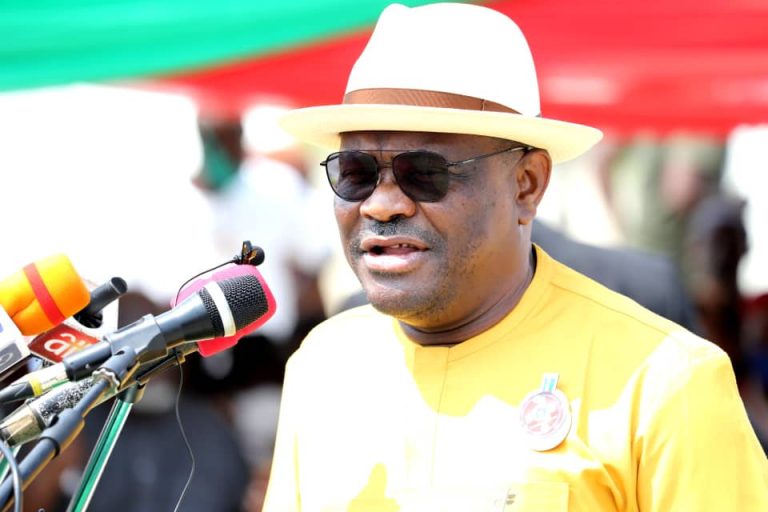
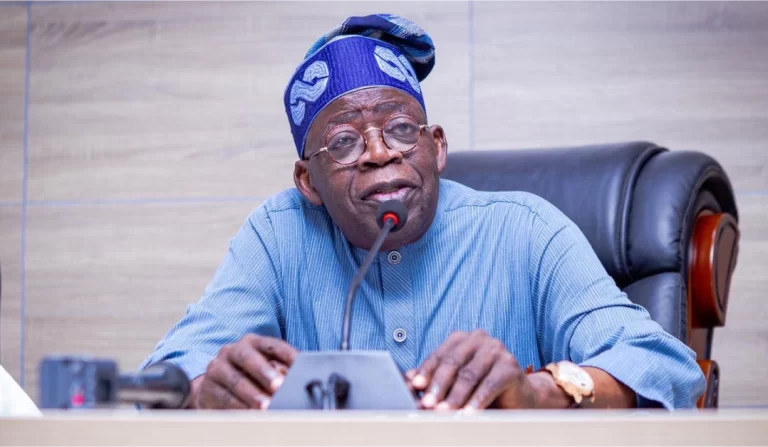
Nyseom Wike’s allegations that he was poisoned at the PDP secretariat in 2018 have been characterised as “beer parlour chats” by the Peoples Democratic Party’s Immediate Past National Secretary, Senator Ibrahim Tsauri.

At a family Thanksgiving celebration held in Wike’s honour two weeks ago in Port Harcourt, the capital of Rivers State, he claimed his liver and kidneys quit working after he was allegedly poisoned at the PDP secretariat.

“Starting on that Sunday, I never left my room. It was terrible, but everybody who was present at the 2019 state dinner on January 1 will recall that I remained silent the whole event. I simply sat down and asked my deputy governor to represent me.

“People were unaware of what was happening. I believed it was done after that banquet, but by midnight I was being escorted out of the country. When we arrived in Beirut, I was gazing at the physicians and they were looking at me. They didn’t provide any information to me. We supposedly had to take a lot of tests.

But thanks to divine providence, God suddenly turned around the dreadful situation and started restoring the damaged organs right away.

A PDP National Executive Committee member named Tsauri questioned: “If Wike was poisoned, who did the poisoning? We don’t discuss or make comments about matters that just concern a beer hall. We can comment if Wike named certain people or organisations by name.

“You should also try to figure out when, when, and how he made those assertions,” the former federal politician continued. In sociolinguistics, you infer meaning from a person’s manner of speaking rather than from the words they use.

We still consider Mr. Wike to be a PDP member, hence we prefer not to criticise him for his statements. He has always been that way, so you shouldn’t expect him to change just because he recently vacated the executive branch of government. Give him time to process the out-of-office betrayals by people he thought were his pals.

However, Chief Ogbonna Nwuke, a former commissioner for information and communications for the state of Rivers, quickly criticised Tsauri for politicising such a severe situation.

“This is the kind of response you get when people are horrified by your profile and the fact that they are disappointed when they believe you don’t matter. This is ignorant.

Read Also: Tinubu can’t make all the difficult decisions now, By Rotimi Fasan

Why won’t he travel to Beirut to confirm the veracity of the former governor’s assertion? Or would he rather the man pass away? How can you play politics with something as important as someone’s health and life? Nwuke asked.

He said, “I assume they are the ones having beer parlour conversations because their comments are meaningless.

The fact that Wike is still speaking and addressing issues of national importance has plainly disappointed those who believed he would keep quiet after leaving his position as governor.

Tinubu can’t make all the difficult decisions now, By Rotimi Fasan

0

Just over four weeks have passed since President Bola Tinubu ended the system of oil subsidies. Many Nigerians wouldn’t have felt out of place had Tinubu waited a little longer before plunging them into the pit of expensive petrol per litre given how long his predecessor had toyed with and given up the idea.

It’s a significant increase from 183 to 500 naira per litre. Nigerians had flocked to the streets in their millions when the price was half what it had been in the past. No Nigerian leader dared to rush into the removal of oil subsidies, but Bola Tinubu did so just minutes after taking over the reins of government.

President Muhammadu Buhari put off eliminating oil subsidies at least three times during his final year in office. Nigerians had no doubt that the decision had turned into a booby trap for whoever succeeded Buhari after his previous unsuccessful attempt, which was marked by discordant tunes from the presidency, the leadership of the Ministry of Finance and the Nigerian National Petroleum Corporation, NNPC, on the one hand, and oil marketers on the other. Bola Tinubu was declared the winner of the 2023 presidential election, but the failure to take action was a cunning move that caused many Nigerians to wonder and project in pity what turbulent ride Bola Tinubu was bound to encounter.

Given his struggles and everything he had to endure just before, during, and after the election, the government’s and the president’s inaction on the oil subsidy issue—who were still negotiating loans and signing contracts on Nigeria’s behalf up until their final hours in office—seemed utterly ominous and dangerous. Although President Buhari technically put an end to the oil subsidy regime by not including it in the 2023 budget, he left the execution of it (along with all of its ominous details) to his successor at the end of June, one month after he would have left office.

Nothing could have been more cowardly or exposed the hot potato decision that the departing administration was making than their lack of resolve. Bola Tinubu, however, took a cautious and possibly naive approach to the situation. The entire situation could have collapsed in his face. He spoke in an urgent and very direct manner about ending the oil subsidy. like a decree in some ways. It happened without fanfare and had a nearly immediate impact. Before long, petrol stations had readjusted their gauge and jerked up the metres.

It may have been the right thing to do in retrospect. It did not allow time for the typical arguing and endless consideration of the suffering that would follow such a difficult decision. Additionally, it prevented labour leaders from making a show of it while lining their own pockets while pretending to be fighting for the common man. Nigerians had already endured unspeakable suffering, and they were prepared to face whatever awaited them in the forest of exorbitant oil prices. Although the outcome was shocking, it was significantly less upsetting than what some had envisioned as Armageddon. In just a few days, Nigerians began to weather the storm, as they have been doing for the past month.

The president’s bold move would soon garner praise, and the choice appeared to be the right one, leaving some to wonder why it had not been made sooner. Things were starting to seem just right. The president’s “immediate effect” actions, which include, among others, the decision to unify the exchange rate and the presidential approval of a student loan programme, are winning him more support from Nigerians than their condemnation. These choices now seem so wise and promising that President Bola Tinubu dared to claim credit and accountability for the decision to remove subsidies.

When he declared the end of the subsidy regime in his inaugural speech, Nigerians now know that he disregarded the advice of his advisers to keep quiet about the divisive subject. If the president’s words had been directed at Nigerians differently, we can only speculate as to where he would have stood and how he would have responded. Would he have admitted to using them or would he have said they were “out of context”? He might have argued that a careless speechwriter accidentally added those words without his knowledge, or he might have just admitted he spoke too much.

Nigerians have merely chosen to put off personal gratification while embracing the discomfort of their current situation by opting to support the president for the difficult choices he has had to make on their behalf. They are still unable to see the promised advantages of this string of business choices, which have the immediate effect of throwing their finances into turmoil. Nigerians are now more economically exposed than at any other time in recent memory. For them, the bitter pill that must be swallowed before the process of national economic healing can begin is the result of the Tinubu administration’s recent monetary and fiscal policies, which are pushing the nation even further into the western neo-liberal orbit.

This is not the same as advocating for leaving Nigerians open to the market forces—a.k.a. the bears—of western capitalism. They need and demand protection from government policies that prevent them from becoming targets of strong economic entities acting alone or in concert from within the nation, but especially from abroad. Following the removal of the oil subsidy, it is proposed to seek to increase the price of electricity by as much as 40% starting next month. This will only worsen the already precarious economic situation of Nigerians.

The electricity companies (the GENCOS and DISCOS etc.) that bought the government-owned monopolies of National Electric Power Authority, NEPA, and the Power Holding Company of Nigeria, PHCN, have been largely dependent on government support, read subsidy, for the entire decade of their existence. They only generate less than 40% of the revenue that the old power monopolies did, and have never even reached break-even point. Abuja covers the income shortfall in a similar manner to how it did for gasoline up until a month ago. But Abuja has decided to stop its support because it is worn out.

But this is not the appropriate time for it. While it may seem like President Tinubu got away with his decision to end the oil subsidy and the potential increase in the cost of higher education, he must be careful not to push his luck too far or too quickly. Otherwise, he might be chewing more than he can bear. He could move swiftly.

CBN limits transactions via contactless payments to N50,000 per day

0

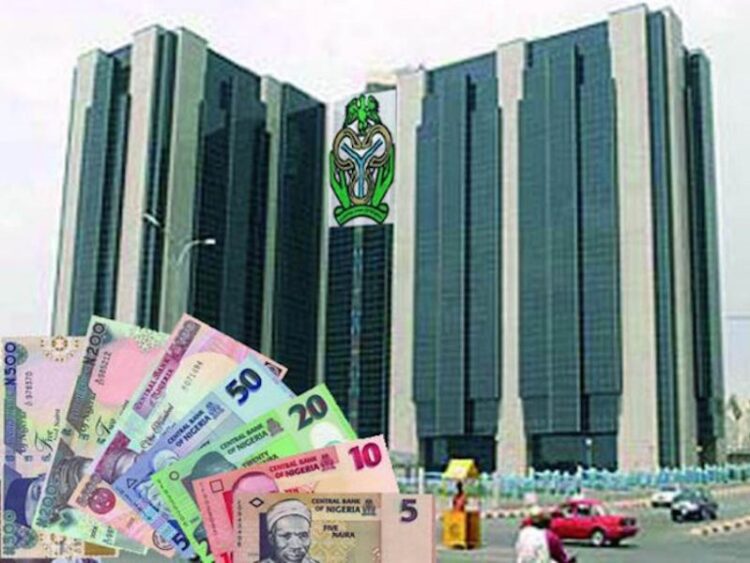
The Central Bank of Nigeria (CBN) has imposed a daily limit of N50,000 on the use of contactless payments made either through bank accounts or digital wallets.

A maximum of N15,000 could be spent using a contactless payment method at one time, as this was another restriction imposed by the central bank.

The Central Bank of Nigeria (CBN) made this information public yesterday in a circular titled “Transaction Limits on Contactless Payments.”

The circular was signed by the Director of the Payment System Management Department at the Central Bank of Nigeria (CBN), Mr. Musa Jimoh. It stated: “Following the issuance of the Guidelines on Contactless Payments in Nigeria and in cognizance of the risks associated with contactless payments, the Bank hereby defines transaction limits above which verification and authorisation are required.

“The following shall constitute the transaction limits for contactless payments made through accounts or wallets in Nigeria: The maximum amount that can be spent on a single transaction is N15,000, and the daily cumulative limit cannot exceed N50,000.

Read Also: COAS affirms commitment of Nigerian Army to reestablish peace, security throughout Nigeria

“Higher-value contactless payments are transactions that exceed the aforementioned limits and shall require appropriate verification and authorisation. These payments can only be made using a card that is enabled for contactless payments.”

Know Your Customer (KYC) regulations and limits on electronic payment channels will still be enforced for these types of transactions.

“Limits that are above this stipulated daily cumulative limit must be conducted using technology that requires physical contact. Please adjust your behaviour accordingly.

“Contactless technology is a technology that enables an alternative payment method whereby payment instruments are used without making physical contact with devices,” the Central Bank of Nigeria (CBN) stated in its ‘Guidelines for Contactless Payments in Nigeria’ that were also issued yesterday. Users are given options that are easy, convenient, and efficient when it comes to not using cash thanks to the implementation of contactless technology in payment systems.

It went on to say that some examples of contactless payment instruments include pre-paid, debit, and credit cards, stickers, fobs, wearable devices, tokens, and mobile electronic devices. Payment terminals that are enabled for contactless payments communicate with contactless payment devices to make the payment process easier.

COAS affirms commitment of Nigerian Army to reestablish peace, security throughout Nigeria


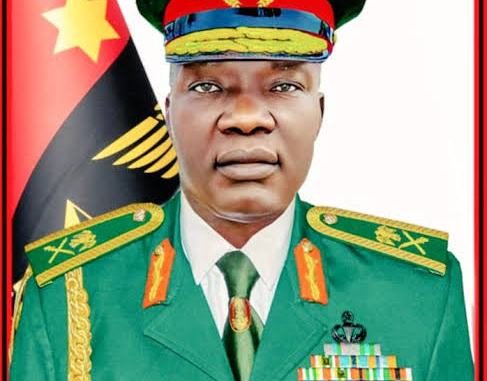
Maj-Gen Taoreed Lagbaja, the Chief of Army Staff (COAS), has reaffirmed the Nigerian Army’s commitment to working in unison with other law enforcement agencies to reestablish security throughout the country.

At a news conference conducted on Tuesday in Abuja as part of the celebrations for the Nigerian Army Day (NADCEL) 2023, Gen. Lagbaja offered the guarantee.

The NADCEL 2023’s topic is “Sound Administration as a Panacea for Effective Military Operations”. The celebration for this year’s Nigerian Army accomplishments is slated to take place from July 1–6, 2023.

In addition to showcasing the Army’s operational endeavours, Gen. Lagbaja said that the NADCEL 2023 would also highlight the Army’s transformational achievements in innovation, R&D, civil-military interactions, and technology development.

He claims that in addition to showcasing the Army’s strengths, the event also aims to portray the Army as a tool for fostering national harmony and growth.

He pledged that the Nigerian Army will work in unison with its sister services and other security organisations to address the problem of insecurity plaguing the nation.

It is important to recognise your long-standing cooperation with the Nigerian Army, which has recently improved its operations, he remarked. As a result, I can assure you of the Nigerian Army’s dedication to working diligently in coordination with other security agencies and services to professionally carry out its assigned tasks, putting the interests of the country before any individual interests or concerns.

I implore you to work with us to reestablish safety and peace throughout our dear country.

The COAS highlighted that the Nigerian Army has through many stages of growth and development over the course of its 160-year history.

He acknowledged his happiness at having the opportunity to serve as Chief of Army Staff on the 160th anniversary of the Nigerian Army.

According to the Army Chief, this year’s festivities will also highlight the Army’s operational endeavours as well as its transformative advances in innovation, R&D, civil-military interactions, and technical development.

He claims that in addition to showcasing the Army’s strengths, the event also aims to portray it as a tool for fostering national harmony and growth.


NLNG equips journalists with knowledge of digital communication

0

deep faith in the enormous potential of its stakeholders.

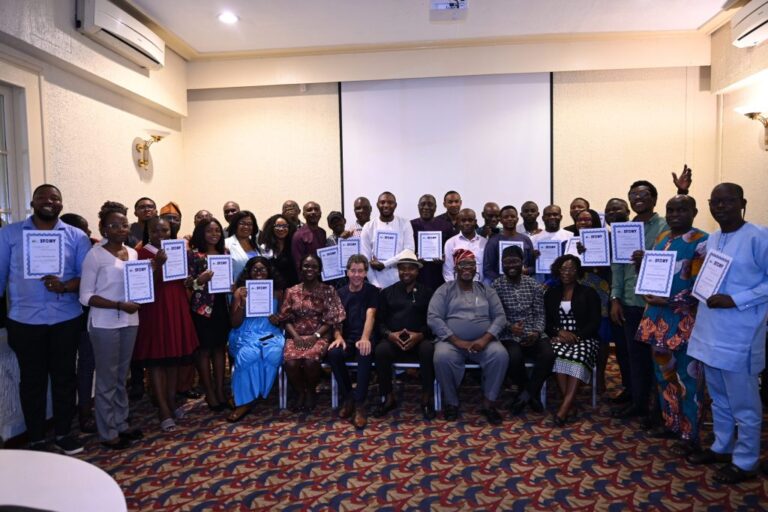
Recognising the crucial role journalists play in influencing narratives and public opinion, NLNG intended to empower them by giving them the knowledge and abilities to alter their own tales and, as a result, the stories of the country. The Journalism Clinic, directed by the acclaimed Taiwo Obe, and well-known journalist Dan Mason worked with NLNG to conduct this training. Participants were guided through the complexities of digital communication and social media by these experts as they offered their wealth of knowledge and experience.

After the inaugural #NLNGChangeYourStory workshop, which took place in 2015, there was a pause. Since the yearly programme restarted in 2021, over 70 journalists have received training, bolstering their social media and digital communication skills.

The #NLNGChangeYourStory workshop unquestionably made a difference in the empowerment of journalists by giving them the tools they need to succeed in the rapidly changing digital environment. The nation and its stakeholders continue to thrive and prosper as a result of NLNG’s unwavering commitment to capacity building.

The Nigerian National Petroleum Company Limited owns 49% of NLNG, followed by Shell Gas B.V. (25.6%), TotalEnergies Gaz & Electricite Holdings (15%), and Eni International N.A. N. V. S.àr.l. (10.4%).

British Govt, Ohaneze Ndi Igbo Partner To Develop South-East Region

0

Ohaneze Ndigbo Worldwide has been given official approval by the British government.

The government desires to collaborate with Ohaneze in business, investment, agriculture, and other areas in order to develop the South-East region.

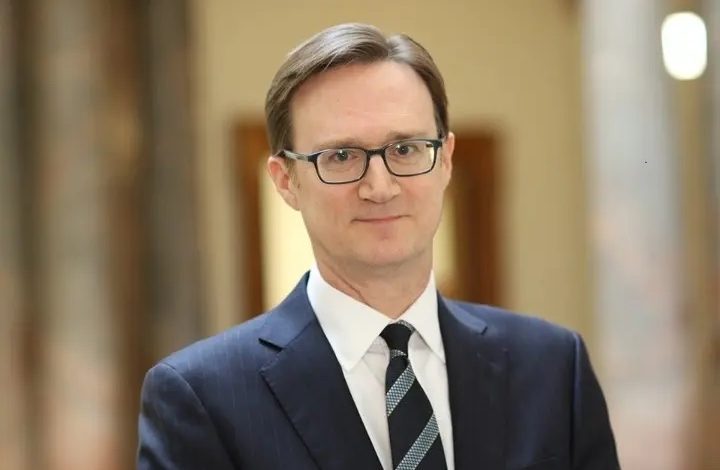
Dr. Richard Montgomery, the British High Commissioner to Nigeria, made this information public.

At the headquarters of the Ohaneze Ndigbo Worldwide in Enugu, Montgomery made a visit to the organization’s leaders.

He claimed that the UK and Enugu State already had a long-standing development partnership in the areas of health, education, and the economy and vowed to strengthen that engagement in order to develop the area.

He said,

“I am aware of the difficulties this area faces as well as the potential for growth, and I share the desire to maintain the close ties between this region and the UK.

“We will investigate the problems, see what we can do, and work on various regional development initiatives.

We are interested in the agriculture services and industries, the Business Council that the President General, Chief Iwuanyanwu, claimed he would form, and other related fields.

Additionally, “we are examining ways to increase opportunities for investment and trade between Nigeria and the UK.”

GC: NSCDC to carry out Tinubu’s order to stop oil thieves

0

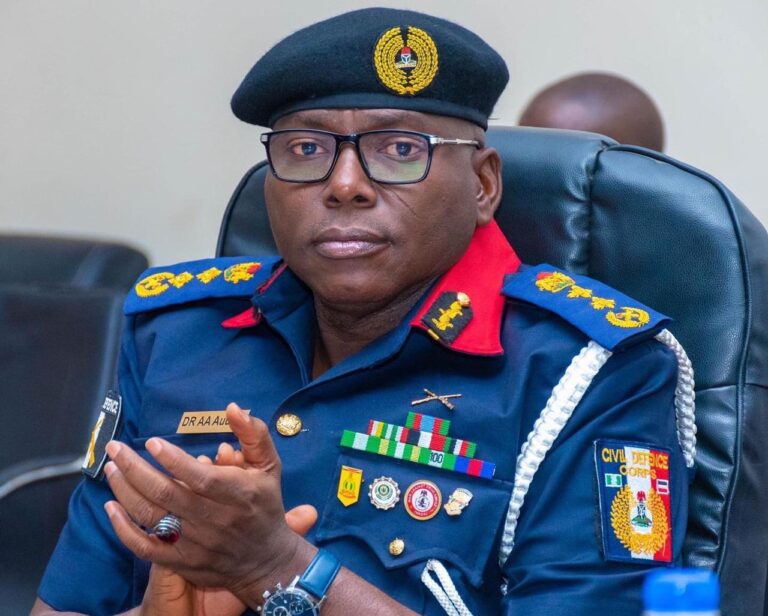
Ahmed Audi, the Commandant General of the Nigeria Security and Civil Defence Corps, claims that his organisation has embraced President Bola Tinubu’s policy of “zero tolerance” for oil theft and has instructed oil thieves to leave the nation or face retaliation.

He emphasised that oil thieves would not have it easy with his men, saying that President Bola Tinubu has a tough stance against oil theft.

At Course 10’s passing out parade on Monday in Abuja, Audi gave a speech.

In the ongoing battle against oil theft, he declared that the NSCDC, which he led, would not tolerate any personnel compromise.


The oil thieves must be caught, so Audi told his men to use all available means to do so.

Don’t forget, he urged, that we are the leading organisation in the defence of vital resources. Fuel pipelines are one of the national infrastructure components that must be safeguarded. The President’s position on oil thefts is well known. No concessions should be made.

“You must commit to reducing and, if possible, eliminating oil theft. Oil thieves and those who damage our pipelines must be apprehended; otherwise, we will catch them. We warned those who wanted to continue launching attacks on our pipelines to relocate to other nations, or else we would go after them and arrest them all.

Additionally, Audi warned employees not to discharge accidentally and promised strict punishment for those found at fault.

A standard of operations now governs our service-related activities, according to Audi. You’re going to face a court martial. Thus, the service’s discipline is upheld. Accidental discharge is forbidden by this service.

“You will incur the wrath of the SOP if you commit an error and get trigger-happy, killing a citizen. When using your rifle, kindly use caution. You are taught to use a rifle responsibly and, unless instructed otherwise, avoid killing. So, if someone is trying to kill you on the battlefield, you can only act to stop them.

While this is going on, some officers who joined the NSCDC in 2012 with a Higher National Diploma have complained that they haven’t progressed since they started working there 11 years ago or that they have been stagnated.

In an open letter to the President and the National Assembly, the concerned officers bemoaned the fact that many new officers hired after them received promotions.

We are using this medium to ask President Bola Tinubu, the Senate President, the Speaker of the House of Representatives, the Head of Service, and all well-meaning Nigerians to look into our problem in the Nigeria Security and Civil Defence Corps (2012 HND holders intake).

“The question that needs an answer from whoever it may concern is: Why are the 2012 intakes, who are HND holders in the NSCDC, being treated worse than their counterparts in sister agencies under the same Ministry of Interior?

“We joined the NSCDC in 2012 as NCE holders and recruits with the Inspector of Corps rank (Level 7).

As required by public service regulations, we took the confirmation and promotion examination in 2014, but despite passing the Compro, we were neither promoted nor advanced after passing the exam.

“Fast forward to 2016, there was another replacement exercise, and all officers hired then as Assistant Supretendent of Corps II were all given automatic promotion to the next rank, while all HND holders hired from 2012 still remained inspectors(Level 7). When the NSCDC recently implemented the removal of the HND/BSC dichotomy, the same change that had been made in sister paramilitary organisations under the Ministry of Interior since 2016, HND holders who had been hired since 2012 were still inspectors.

When we were all hired together in 2012, the majority of our B.sc. counterparts are now hanging the rank of Superintendent (Eagle), but up to 95% of us, HND holders, are still on one star as of this year, 2023.

Buhari turns over N974b in unfinished road projects

According to research, the Muhammadu Buhari administration left 38 unfinished road projects worth N979 billion to President Bola Tinubu’s administration.

The projects were found by analysing the 2023 budget and comparing it to the national monitoring and evaluation system, EYEMARK, which Buhari introduced in December of the previous year.

According to reports, despite the former President’s assurances that the roads would be finished before the end of his administration, several important road networks remained unfinished due to a lack of funding and other difficulties.

The dualization of the Keffi-Akwanga-Lafia-Makurdi road in Nasarawa State and the expansion of the Abuja-Keffi dual carriageway are two crucial projects.


Other significant projects that are still unfinished include Benue State Phase I, the Lafia Bypass, the 9th Mile (Enugu)-Otukpo-Makurdi Road in Enugu, and Phase II of Benue State, which is estimated to cost N32.5 billion.

Another project on the list is the N100 million rehabilitation of the Ikorodu-Shagamu Road in Lagos State, which also includes the access road to Mosimi, and the N54.95 billion full-scale development of Federal Capital Terriory Highway 105 (Kuje Road), which runs from the airport motorway to the outer Southern Motorway with a spur at Kyami District.

Ondo/Ekiti states’ dualization of Akure-Ado Ekiti Road was estimated to cost N90 billion.

The dualization of Obajana Junction to Benin phase 2: Section 11 (Okene to Auchi) costs N5 billion and is one of the other projects.

The construction of the roads in Bichi township, which cost N1.40 billion, the Dawakin Tofa-Gwarzo-Dayi Road in Kano, which cost N2, billion, the 5.4-kilometer Abuja-Keffi Motorway, and the 220-kilometer Keffi-Akwanga-Lafia-Makurdi Federal Roads, which were awarded for N166.36 billion, are all unfinished road projects.

Other projects include the N101.1 billion Keffi-Akwanga-Lafia road project, the N100 million Chanchangi bridge along the Takum-Wukari road in Taraba State, the dualization of the N100 million Jattu-Fugar-Agenebode road, and the N250 million reconstruction of the Irekpa-Fugar-Agenebode road in Edo State.

Another project is the Lagos-Ibadan Motorway, which is currently being managed by RCC and Julius Berger Nigeria Plc and is said to cost about N315 billion.

The 126.6 km road is reportedly 85 percent complete, but the protracted construction has put commuters and drivers through unspeakable hardship, with many of them spending hours in traffic every day.

Additionally, N400m was allotted for the building of the Bidda-Sacci-Nupeko road and the Nupeko/Patigi bridge that spans the River Niger in the Niger/Kwara States and connects Nupeko and Patigi.


FG calms concerns

The Director of Highways South-West, Adedamola Kuti, promised in an interview on Sunday that all unfinished projects would be finished.

Related News Tinubu won’t be president if Buhari had removed the fuel subsidy, and the APC would have lost the election, according to an ex-aide, Garba Shehu.
The federal civil service operates in a very different manner, he observed.

If the new administration has taken over the unfinished tasks, we will make sure that those projects are finished. You would probably agree that the previous government inherited unfinished road projects and they completed some of them even as they started new ones. We are making great progress, and no project will be shelved.

According to information obtained by our correspondent on Sunday, the Federal Government has set aside N25 billion to pay off local contractors this year.

The budget for 2023 included the sum.

The amount is, however, a far cry from the N11 trillion that succeeding administrations owe to local contractors.

The contractors who finished building numerous highways and other infrastructure projects across the nation and received certificates of completion have protested the government’s failure to pay them for contracts that were completed up to 12 years ago.

Dandy Rowland, the president of the Local Contractors Association of Nigeria, said in an interview from last year that the association’s members were owed N28 billion by the government.

Additionally, Babatunde Fashola, the former minister of works and housing, admitted during his defence of the ministry’s 2023 budget that the government still owes ongoing highway contractors N10.4 trillion worth of unpaid completion certificates, totaling N765 billion.

However, when our correspondent asked for an update on the situation, a senior ministry source claimed that the reason for the payment delay was the synchronisation of the amounts with the finance ministry.

The source further stated that there is no deadline for paying the contractors.

We are still matching our numbers to those of the finance ministry, the source stated. There has not yet been a payment made, and the completion date for the harmonisation is unknown.

It has been learned that payments to contractors engaged in the ongoing construction of roads have continued despite the current administration’s freeze on the financial transactions of the ministries, departments, and agencies.
Contractor payments continue even though recurrent spending has been halted, according to a source, because they fall under the capital vote and are made by the federal government directly.

“All recurring expenses in the ministry have been delayed, even our duty tour allowance has not been paid, due to the recent ban on MDA accounts. All payments have been halted because TSA (Treasury Single Account) has been compromised. Only urgent payments, such as for the purchase of the new president’s portrait, can be handled by the ministry.

“Contractors are still being paid, though, as a result of the fact that their budget falls under the federal government’s capital vote. As long as payments are made without interruption to all of our contractors, the country’s development will continue.

Calls to Mrs. Blessing Adams-Lere, the ministry’s spokeswoman, went unanswered because she did not pick up. As of the time of publication, she had not responded to a text message.
Aboru Aboye: Tope Alabi declines comment on viral video

0

Tope Alabi, a well-known gospel performer in Nigeria, has declared that she will refrain from commenting on the controversy surrounding her trending video, which has been making rounds on social media.

The singer was seen singing in the Yoruba language in the viral video. The celebrated singer was singing in the Ifa worshippers’ greeting language, “Aboru boye,” while doing so.

“abiye ni mi, Oruko mi ni yen,” the singer could be heard singing. “I am a sacrifice, that’s my name,” said Mo de bo, “Mo ru, Mo ye. I go by the name “I am a sacrifice accepted by God.”

Since then, the phrase Aboru Aboye, which is primarily used by Ifa worshippers in adoration of the deity, has gained popularity on social media.

Alabi, who is currently in the United States for her “Praise The Almighty Concert, declined to comment on the matter in an exclusive phone interview with our correspondent, claiming that The PUNCH had already published stories about the “Aboru boye” controversy.

“After writing, did you publish a post on social media? Hmmmm. When asked by our reporter about her thoughts on the controversy the viral video has sparked, she responded, “No Comment.


Air Vice Marshal Hassan approves redeployment of 98 senior officers

0

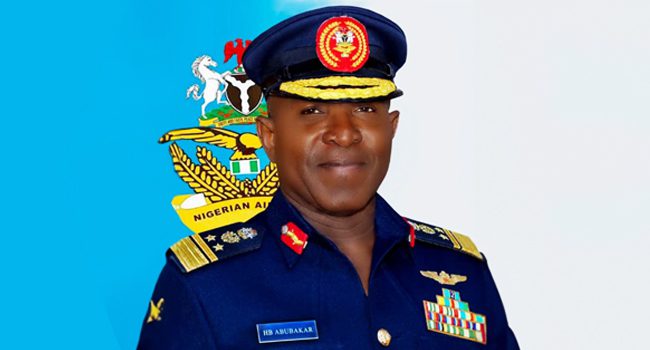
The redeployment of 98 senior officers in the service has been approved by Air Vice Marshal Hassan Abubakar, the newly appointed Chief of Air Staff.

The Commandants of Tri-Service Establishments, Branch Chiefs, Air Officers Commanding, and NAF institutions are prominent among the new appointees.

On July 3, 2023, the newly chosen senior officers are anticipated to start their new positions.

According to a statement made by the service’s spokesperson, Air Commodore Ayodele Famuyiwa, the newly reappointed senior officers consist of 52 AVMs and 46 Air Commodores. Among them is the former Commandant of the Air Force War College, AVM Abraham Adole, who is now the Chief of Defence Policy and Plans at the Defence Headquarters. AVM Nkem Aguiyi also takes on the role of Chief of Defence Transformation and Innovation at the

Read Also: If Buhari had scrapped fuel subsidy, Tinubu wouldn’t be president – Garba Shehu

Former Air Officer Commanding Ground Training Command, AVM Sayo Olatunde, is now the Chief of Policy and Plans at the Headquarters Nigerian Air Force. AVM Ibikunle Daramola continues to be the Chief of Communications Information Systems, AVM Pius Oahimire was named the Chief of Aircraft Engineering at the HQ NAF, and AVM Uchechi Nwagwu assumes the role of the Chief of Accounts and Budget.

Others include former AOC Special Operations Command Bauchi, AVM Abubakar Abdulkadir, who is now the Chief of Training and Operations; AVM Dominic Danat as the Chief of Logistics; AVM Ahmed Bakari as Air Secretary; AVM Michael Onyebashi as Chief of Standards and Evaluation HQ NAF; AVM Idi Sani as Chief of Administration; AVM Anthony Ekpe retains his appointment as the Chief of Medical Services; while Air Cdre Friday Ogohi is now the Chief of Air Intelligence, HQ NAF.

AVM Hassan Alhaji is in charge of the Armed Forces Command and Staff College in Jaji; AVM Sani Rabe is in charge of the Air Force Institute of Technology in Kaduna; AVM Adebayo Kehinde is in charge of the Air Force War College in Makurdi; and AVM Esen Efanga is in charge of the Air Warfare Centre in Abuja. These are some of the newly appointed commandants.

Also affected by the latest redeployments are AVM Francis Edosa appointed the AOC Tactical Air Command, Makurdi; AVM Tajudeen Yusuf as AOC Mobility Command, Yenagoa; AVM Eneobong Effiom as AOC SOC, Bauchi; AVM Nnamdi Ananaba as AOC Air Training Command, Kaduna; AVM Usman Abdullahi as AOC GTC, Enugu; and AVM Abubakar Abdullahi as AOC Logistics Command.

AVM Sunday Aneke is the Deputy Commandant of the Nigerian Defence Academy in Kaduna; AVM Titus Dauda is the College Secretary of the National Defence College in Abuja; and Air Commodore Edward Gabkwet has been reappointed as the Director of Public Relations and Information. In a similar vein, AVM Kabir Umar is now the Group Managing Director of the NAF Investments Limited Group of Companies.