Home Blog Page 1760

NCC orders telcos to respond to subscribers within 30 minutes

0

The Nigerian Communications Commission is expected to order telecom companies to attend to customers who arrive at any customer service centre in the nation within 30 minutes.

‘Draught Quality of Service Business Rules,’ a recent document posted to the commission’s website, served as the basis for this.

It states that the key performance indicators, associated measurements, and minimum quality and standards of service are all specified by the business rules.

The telecoms regulator stipulated in the document’s customer care section that a subscriber’s wait time to be physically attended to by relevant staff at customer care centres must not exceed 30 minutes, as opposed to the current situation, in which customers can be kept waiting for hours.

The NCC stated, “Waiting time at customer care centres is 30 minutes before being physically attended to by relevant staff. The Licensee must supply tools for measuring waiting times beginning with the time of arrival at the location.

The commission is also taking action to guarantee that subscribers who call a telco’s helpline can speak to a customer service agent within five minutes.

Read Also: Government, private security companies must cooperate – Arase

The maximum time allowed on the queue or IVR should be 5 minutes before answer, it was stated, in cases where a customer chooses to speak to a live agent.

Customers should be given the option to hang up and be called back within a maximum of 30 minutes in exceptional circumstances where a live agent may not be available to answer the call within five minutes.

The NCC states that subscribers who do not use their numbers within a year risk losing them. If a subscriber line is not used for a revenue-generating event within six months, it may be deactivated, and if the situation continues for another six months, the subscriber may lose their number, unless a network-related issue prevents an RGE.

“Money left in account on deactivation can be claimed by subscribers once proof of ownership can be established at any time within 1 year (less any fee paid by the operator for the number within the 1-year of non-RGE),” the statement continued.

It also stated that a subscriber may request queue parking if they can provide documentation of a valid reason for their absence.

Adeolu Ogunbanjo, president of the National Association of Telecom Subscribers, said of the initiative to shorten wait times in customer service centres, “This is a fantastic development. When it comes to enhancing the customer experience, the NCC has been doing well.

“This is a positive development for the customers, as opposed to the past, when people had to wait for hours on end and wasted labour hours. It will reduce customer wait times at telco customer experience centres. We are delighted about this.

Government, private security companies must cooperate – Arase

Collaboration between security agencies and their private counterparts, according to Dr. Solomon Arase, Chairman of the Police Service Commission, will promote economic growth in Nigeria.

Arase made this statement recently at the 2023 leadership retreat held at the International Institute for Tropical Agriculture in Ibadan and hosted by the Lagos Chapter 206 of the American Society for Industrial Security.

Former Inspector General of Police Arase emphasised the critical part that public-private partnerships play in boosting security.

Such collaborations can enhance security outcomes by utilising the resources and experience of the private sector to support government efforts. Additionally, because security is so important to investor confidence, these partnerships may promote economic growth.

Read Also: Delta Assembly approves government’s request for N40bn loan

Also speaking at the event was Mrs. Joko Olanitori, Chairman of ASIS Chapter 206, who emphasised the value of fostering strategic alliances between Nigeria’s private security sector and state-run security organisations.

‘Secured Handshake: A public and private sector imperative for effective security operations and practise in a volatile, uncertain, complex, and ambiguous world,’ she said, was the theme of this year’s event.

According to Olanitori, the cooperation is seen as essential for making the necessary progress towards resolving the country’s enduring problems with insecurity.

She claimed that the purpose of the gathering was to encourage knowledge sharing and best practises among ASIS members while also coming up with creative solutions to the growing insecurity in Nigeria.

In order to effectively address the country’s increasing insecurity, Olanitori emphasised the urgent need for structured and formalised engagement between Nigerian public security agencies like the Army, Nigerian Navy, Air Force, Police, Department of State Service, and others, and the private security industry.

However, in order to bring about the much-needed positive change, Brigadier-General Idam Agachi (Retd) urged the private security industry to reflect and start working with governmental organisations.

Delta Assembly approves government’s request for N40bn loan

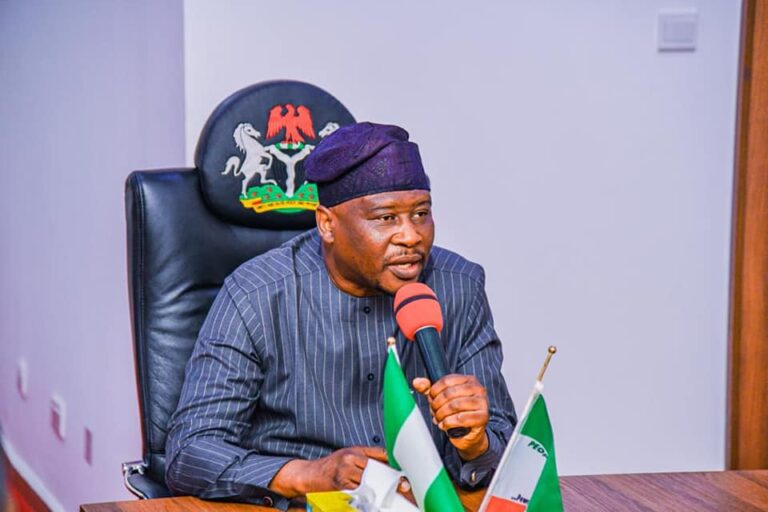
The Delta State House of Assembly has granted Governor Sheriff Oborevwori’s request to use an N40 billion credit facility to pay off backlogs in pension arrears.

The approval was given by the House on Tuesday during its first plenary session, according to our correspondent.

On the House floor, Speaker Emomotimi Guwor had read the governor’s letter of request.

The letter states that Oborevwori informed the House that his administration was working with the state association of local governments of Nigeria to clear up the backlog of accrued pensions owed to retired primary schoolteachers and local government employees.

Read Also: Adamawa government asks monarchs for assistance in fighting deforestation

According to the letter, the loan requested would help state seniors who worked in local government and then retired from it.

The governor continued by saying that Zenith Bank Plc had provided the 25 local government councils with the aforementioned facility in a prorated manner in accordance with each council’s individual debt to pensioners, for which the bank had issued offer letters to the councils.

Emeka Nwaobi, the majority leader of the house and a representative of Aniocha North Constituency, made the motion for approval. Perkins Umukoro, a representative of Sapele Constituency, seconded Emeka Nwaobi’s motion.

Ifeanyi Okowa’s term as governor came to an end three days prior, and the 7th Assembly approved a N71 billion loan for the departing administration.

Adamawa government asks monarchs for assistance in fighting deforestation

0

The governor of Adamawa State, Ahmadu Fintiri, has made it illegal to cut down trees for charcoal fuel in an effort to stop deforestation and combat climate change.

Atiku Abubakar, the former vice president, represented the Lamido of Adamawa, Dr. Barkindo Mustapha, the chairman of the Adamawa Council of Emirs and Chiefs, when Fintiri issued the ban on Thursday while the state was hosting a delegation of traditional leaders.

At the Presidential Lounge of the Yola Government House, the delegation honoured him for Sallah.

In addition to thanking the traditional leaders for honouring him on the occasion, Fintiri also filed a lawsuit to get their support for his decision to outlaw using charcoal made from burning trees in the state.

The governor reiterated the state’s ban on tree cutting for charcoal fuel during a meeting with lawmakers, which was also attended by Barthiya Wesley, Speaker of the Assembly.

He declared, “I have just issued a directive to our traditional institutions that moving forward, even though we have a law that forbids the felling of trees, that law has not been fully implemented. I have now ordered that no more trees will be cut down going forward, especially for the purpose of burning them for charcoal.

Therefore, it is up to all of us to make sure it is fully implemented as stakeholders.

According to the governor, recent flooding had demonstrated the negative results of not paying enough attention to the factors causing climate change, such as the indiscriminate cutting down of trees for the production of charcoal as fuel.

Read Also: Delta group defends Okowa in the N1tn diversion case

In the past, former Vice President Abubakar claimed Fintiri’s progress was unmatched in Adamawa state’s history. He pledged the government the support of conventional institutions.

Fintiri declared that he was not taking his victory for a second term for granted and promised that the following four years would be significantly better than his first.

Delta group defends Okowa in the N1tn diversion case

0

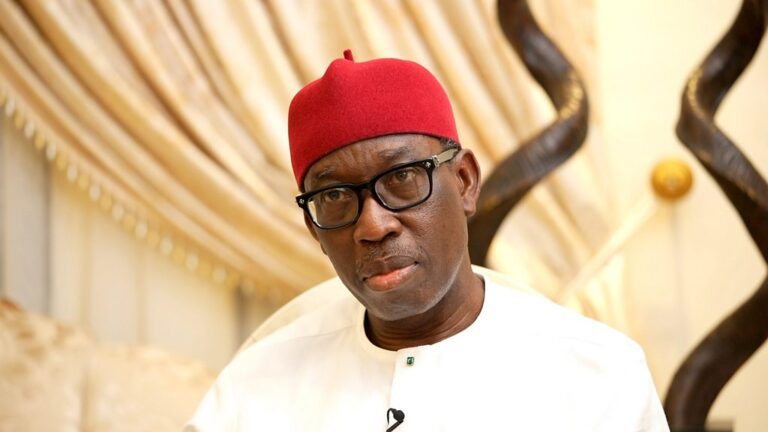
The immediate-past governor, Dr. Ifeanyi Okowa, has come under fire for allegedly diverting half of the 13% derivation fund accruable to the Delta State Oil Producing Areas Development Commission, according to the Delta State chapter of the Host Communities of Nigeria Producing Oil and Gas.

Several representatives of Delta State’s oil and gas producing communities reportedly stormed the Economic and Financial Crimes Commission’s Abuja headquarters on Thursday to protest the alleged misappropriation of the state’s over N1 trillion oil derivation fund under the Okowa administration.

But the Delta HOSTCOM described last week’s anti-Okowa protest as politically motivated in a statement released on Thursday by its chairman, Sunday Enujeke, and secretary, Joseph Lamienghan.

According to Delta HOSTCOM, the orchestrated campaign is “considered as a calculated attempt to mislead, confuse, and invite the unsuspecting public against the person of Dr. Okowa by his traducers.”

The group claims that the immediate-past administration in Delta State “had used judiciously” the 13% Oil Derivation Fund allocated for the development of oil and gas bearing communities in the state.

Read Also: HURIWA advises FG to detain Asari-Dokubo or face a protest

The Ijaw elder statesman Edwin Clark was urged by Delta HOSTCOM “not to allow himself to be used by these political hustlers and desperate power mongers seeking to settle cheap political scores.”

Delta HOSTCOM also urged the current governor, Sheriff Oborevwori, “to build on the infrastructural development agenda of the immediate-past administration by putting in place tangible physical development for the teeming residents of the creeks in the Delta riverine areas.”

HURIWA advises FG to detain Asari-Dokubo or face a protest

0

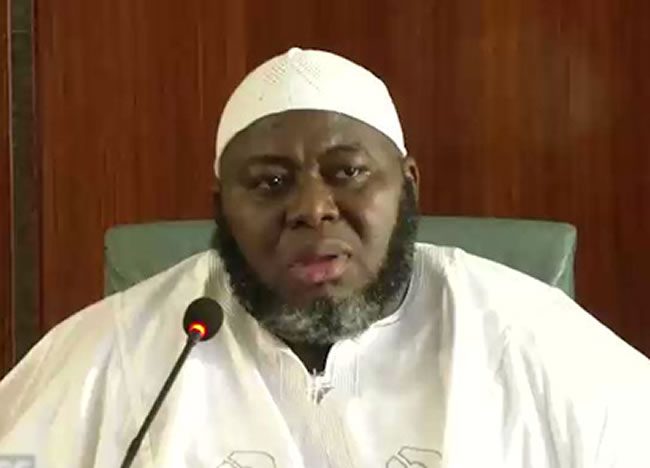
The Federal Government has been given a 72-hour deadline by the Human Rights Writers Association of Nigeria to place former Niger Delta agitator Mujahid Asari-Dokubo under immediate arrest.

The group threatened to organise its members to launch a national protest across all 36 states of the federation should the Federal Government refuse to arrest Asari-Dokubu as demanded.

The threat was made by HURIWA on Thursday in a statement by Emmanuel Onwubiko, its National Coordinator.

According to the group, Asari-Dokubo must be detained by the Department of State Services or another appropriate security agency due to his alleged affiliation with the South-East region’s violent “unknown gunmen” phenomenon.

Read Also: Kane talks are put on hold as Bayern turns to Osimhen

The Federal Government is indirectly ordering Igbo youths, Igbo lovers, and all organisations that support the well-being of the Igbo people to start peaceful protests at the same time if the Nigerian Government does not immediately arrest Asari Dokubo.

President Bola Ahmed Tinubu has 72 working hours to order the arrest and investigation of Asari Dokubo over his alleged connection to the South-East’s violent phenomenon of unidentified gunmen, or HURIWA will convene its members for a protest in Abuja the following week.

“Illegality must not be permitted to continue while the security agencies deliberately do nothing or pretend they are unaware of it. Arresting Asari-Dokubo is necessary. It is not a banana republic, Nigeria.

Kane talks are put on hold as Bayern turns to Osimhen

0

Bayern Munich, the league champion, has put Harry Kane’s negotiations on hold in favour of Nigerian striker Victor Osimhen, according to Sports Extra.

La Gazzetta dello Sport reports that Bayern Munich has suspended negotiations and is considering making an offer to Napoli for Osimhen after Tottenham rejected a €70 million offer for the England international and demanded €90 million instead.

The Bavarians are reportedly willing to offer more than €100 million despite not being willing to match Napoli’s €180 million asking price, according to the Italian publication.

Read Also: Fubara warns Muslim clerics to prevent herdsmen from attacking farmers.

Bayern prefers to spend this amount on the 24-year-old over €90 million on Kane, who will turn 30 on July 28. The club and the player’s support group have already started talking.

Osimhen is worth €180 million, according to an Italian pundit
In competition with Liverpool, PSG acquires Osimhen
Osimhen is advised to “close your ears” by Koulibali when transferring.
It is uncertain whether it will be sufficient for Napoli, who reportedly turned down a €100 million offer from PSG. Osimhen has drawn interest from Liverpool as well.

The Nigerian international will reunite with Kim, a defender for Napoli, if he signs with Bayern, as Kim has already agreed to personal terms with the Bundesliga powerhouses in advance of a transfer worth more than €50 million.

In the meantime, talk TV host Piers Morgan has identified Osimhen as a world-class striker that Arsenal should spend big money to sign. Morgan believes that Osimhen can help Arsenal go one better next season and score the goals necessary to end the team’s 20-year title drought.

It’s fantastic that Arsenal appear to have won the race to sign @_DeclanRice, who will be a monstrously good addition to the team, Morgan wrote in a tweet. However, we also need a world-class striker who will average 25+ goals a season if we’re going to win significant trophies. I would spend extravagantly for @victorosimhen9.

Fubara warns Muslim clerics to prevent herdsmen from attacking farmers.

0

The governor of Rivers State, Siminalayi Fubara, has instructed Muslim clerics in the state to warn herdsmen against harassing residents of communities, murdering farmers, and destroying crops in the state.

Thursday at the Government House in Port Harcourt, Fubara issued this charge to the Muslim community’s leadership, who paid him a Sallah visit.

The governor’s media aide, Boniface Onyedi, disclosed in a statement that Fubara informed his guests that his administration was committed to safeguarding the lives and property of all state residents.

However, he stated that he could not protect everyone if some of their own members were destroying enterprises and livelihoods.

Fubara stated, “The local government areas are complaining, so I anticipate results within a couple of weeks by reining in those who engage in open grazing in Ikwerre, Etche, Ahoada East, Ahoada West, and portions of Emohua local government areas.

They shouldn’t harass the populace and should cease murdering them on their farms.

Read Also: Senior service leaders: Military gives generals until Monday to retire

Fubara reassured them that he would maintain an open line of communication with the Muslim community, as they are crucial stakeholders in governance and should be able to conduct their business and practise their religion without interference as a result of the prevailing harmony.

In his address, the leader of the delegation and Vice President General of the Rivers State Council of Islamic Affairs, Alhaji Nasir Uhor, vowed that the Muslim community would not be involved in using religion to destabilise the state and pledged support for the administration of Fubara’s policies and programmes.

Senior service leaders: Military gives generals until Monday to retire

0

The newly appointed service chiefs’ senior officers have been given until Monday by the Defence Headquarters to voluntarily retire from the military.

The directive, which was included in a memo dated June 26 and signed by Maj Gen Y. Yahaya on behalf of the Chief of Defence Staff, was given to senior officers in the Nigerian Army, Air Force, and Navy, including generals, brigadiers-general, air vice marshals, and rear admirals.

The news confirmed a rumour that numerous senior military officers would retire after President Bola Tinubu appointed new service chiefs on June 19.

It has long been a military custom to retire officers who are senior to the chiefs of each service, and this was the case with the senior officers in all three services.

When a junior officer is appointed as a service chief, it is customary for senior officers who are appointed before him or her to retire.

Senior military officers are thought to be unlikely to follow orders from their juniors.

General Lucky Irabor, the Chief of Defence Staff, Lieutenant General Farouk Yahaya, the Chief of the Naval Staff, Vice Admiral Awwal Gambo, and Air Marshal Oludayo Amao, the Chief of the Air Staff, had been announced as retiring immediately by Tinubu. They had been replaced by new military chiefs.

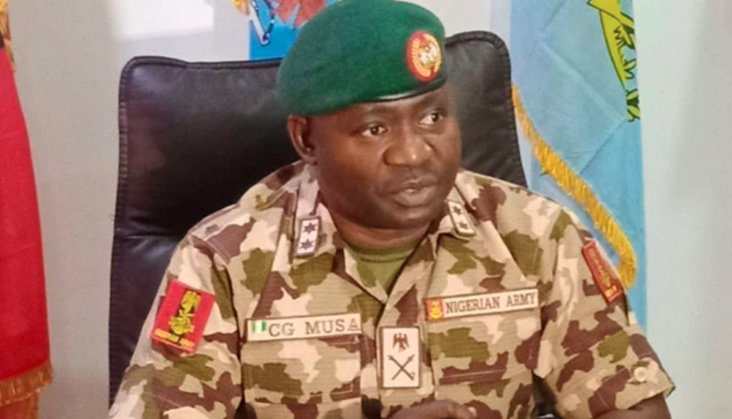
The new service chiefs are Maj Gen Christopher Musa, who will serve as the Chief of Defence Staff, Maj Gen Taoreed Lagbaja, who will serve as the Chief of Army Staff, Rear Admiral Emmanuel Ogalla, who will serve as the Chief of Naval Staff, and Air Vice Marshal Hassan Abubakar, who will serve as the Chief of Air Staff.

Read Also: Catholic bishops inform NASS Christian education bill is unconstitutional

Both Maj. Gen. E Undiandeye and DIG Kayode Egbetokun have been named as the interim chiefs of defence intelligence.

Nuhu Ribadu, who had previously served as the chairman of the Economic and Financial Crimes Commission, was also promoted to the position of national security adviser.

The COAS, the CNS, and the CAS are members of 39 Regular Course, whereas the new CDS is a member of 38 Regular Course.

However, the DHQ instructed all officers with seniority on commission above that of the Nigerian Defence Academy Regular Course 39 to submit their applications for voluntary retirement from service with immediate effect in the memo with reference number DHQ/I5/PLANS/801/13.

It stated that this was done to uphold the military profession’s values of hierarchy and service discipline.

It would be remembered that the President, Commander-in-Chief of the Armed Forces of the Federal Republic of Nigeria, His Excellency, Bola Ahmed Tinubu, recently appointed new CDS and Service Chiefs on June 19, 2023. The memo was copied to the army, navy, and air force headquarters.

“All officers whose officer cadet courses run seniority above that of the current Service Chiefs should disengage from the Service in order to preserve and uphold the tenets of the military profession, which values hierarchy and service discipline.

As a result, I am instructed to politely request that all officers with commissions that are senior to NDA Regular Course 39 direct their subordinates to submit their applications for voluntary retirement from service with immediate effect. The affected officers must submit their applications to their respective Service Headquarters by Monday, July 3, 2023, at the latest.

Onyema Nwachukwu, the army spokesperson, declined to provide any statistics regarding the number of naval officers who may be impacted by the directive when questioned about it on Thursday.

Adedotun Ayo-Vaughan, a captain in the Nigerian Navy, responded by saying, “I believe the acting DDI, DHQ (Director, Defence Information) can be reached to speak for the AFN on this. There were rumours about this already in some print media. However, it will be disclosed once approved and allowed.

Air Commodore Ayodele Famuyiwa, the Nigerian Air Force’s spokesperson, declined to comment because he will be replaced on Monday.

However, due to his failure to return calls or a text message sent to his phone, acting Director of Defence Information Brig Gen Tukur Gusau could not be reached to inquire about the number of senior officers who might be impacted by the directive.

However, retired Col. Foluso Saka said in response to the order to the senior officers that it was time the military set up a corps for retired personnel, adding that their experiences, especially those with technical skills, could still benefit the nation.

Corps of retired officers

“I am aware that it is customary for some senior officers to retire when a junior officer is appointed, but I am of the opinion that there should be a corps or similar reserve for retired military personnel instead of asking them to simply retire,” he said.

“The military can rely on them if they require their services or be required to raise and educate the children. Their services, particularly those of the highly skilled among them, shouldn’t be wasted because they can be used for the good of the country. For them to gain the knowledge they do, a lot of resources have been used.

Timothy Avele, a security analyst, claimed that the retirement might not have an effect on the ongoing military operations across the nation and added that the country needed a modern strategy to address its security challenges.

It won’t have much of an impact if they are replaced with younger, more tech-savvy officers, he said. Although experience is important, having the rank of a general is no longer sufficient to combat today’s security threats.

Another development involves the redeployment of 56 senior officers and one commodore, as announced by the Nigerian Navy.
A few days after Ogalla assumed the position of chief of naval staff, the Nigerian navy underwent a significant shake-up.

The move, according to the navy’s spokesperson Ayo-Vaughan, was necessary to reposition the navy for peak performance.

The chief of communications and information technology at the naval headquarters, Olusanya Bankole, formerly the director of logistics for the Defence Space Administration, according to him, while Alexander Bingel, formerly the director of combat policy and tactics, is now in charge of logistics at the Defence Headquarters.

While Rear Admiral Kennedy Ezete, formerly the Director of Project Monitoring, Defence Headquarters, has returned to his previous position as the Chief of Administration, Naval Headquarters, Rear Admiral Ibrahim Dewu is now the Chief of Defence Civil Military Cooperation, Defence Headquarters.

Rear Admiral Musa Madugu, formerly the Deputy Director of Special Operation Forces at the Defence Headquarters, has been named the Admiral Superintendent Naval Ordnance Depot. Rear Admiral Livingstone Izu, Director Manning at Naval Headquarters, is the new Chief of Logistics, Naval Headquarters.

While Rear Admiral Zakariya Muhammad, the previous Director of Training at Naval Headquarters, has been reappointed Chief of Training and Operations, Rear Admiral Daupreye Matthew, the former Director of Innovation and Concept Development at Naval Headquarters, is now the Director of Training at Defence Headquarters.

While Rear Admiral Ibrahim Shettima, formerly the Flag Officer Commanding Central Naval Command, is moving to Defence Headquarters to serve as Director of Plans, Rear Admiral Emmanuel Nmoyem has been reappointed as Director of Human Rights Desks at Defence Headquarters.

Rear Admiral Monday Unurhiere, formerly of Naval Headquarters’ Director of Plans, has been named the Chief of Defence Administration at the Defence Headquarters, and Rear Admiral Hamza Kaoje, formerly of the Defence Headquarters’ Director of Equipment Standardisation and Harmonisation, has been named Group Managing Director of Navy Holdings Limited.

Rear Admiral Idi Abbas, formerly the Director of Operations at Naval Headquarters, has been reappointed as the Chief of Naval Safety and Standards. Rear Admiral Sulaiman El-ladan, formerly the Chief of Naval Engineering at Naval Headquarters, is now the Director of Marine Research at the Defence Research and Development Bureau at Defence Headquarters.

While Rear Admiral Saheed Akinwande, formerly the Commandant of the Naval War College Nigeria, has been appointed Director of Operations at Naval Headquarters, Rear Admiral Mohammed Abdullahi, the most recent Director of Communications at Naval Headquarters, now serves as the Flag Officer Commanding Western Naval Command.

 

Catholic bishops inform NASS Christian education bill is unconstitutional

0

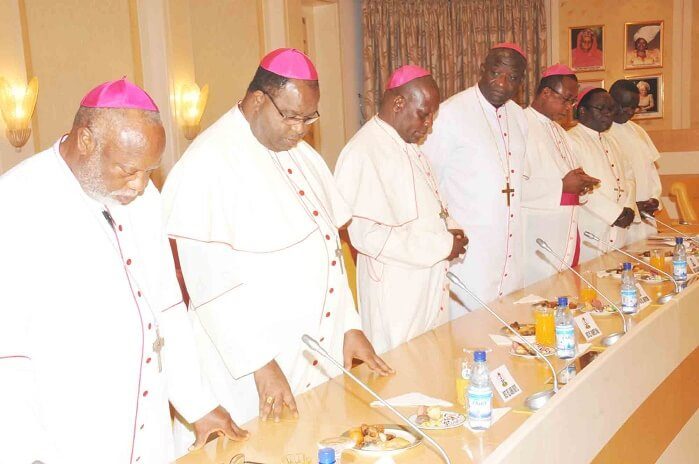
The National Council of Christian Education bill was rejected by the Catholic Bishops Conference of Nigeria on the grounds that it would have violated sections 10 and 42(3) of the Nigerian Constitution.

The bishops asked the Christian Association of Nigeria, which was the organisation that first pushed for the bill at the National Assembly, to support legislation that would forcefully address, among other things, unprovoked attacks on Christians in the North.

The CBCN’s President, Archbishop Lucius Ugorji, and Secretary, Bishop Donatus Ogun, issued a statement rejecting the bill.

The legislation, which aims to create, control, and approve curricula/content at all levels of Christian education, was sponsored by Representatives Rimamde Kwewum, Beni Lar, Yusuf Tajudeen, John Dyegh, Solomon Bob, and Benjamin Mzondu.

The bill included provisions to accredit courses offered by Christian theological institutions as well as to certify teachers of basic and secondary Christian religion education, approve the subject matter of all Christian religion education taught in all schools, and more.

The bill did not provide any exemption for seminaries or other religious institutions owned by the various Christian denominations in the federation, which bothered the Catholic bishops.

On this basis, the bishops asserted that the bill violated their right to instruct and form people in accordance with their own doctrines and cited Section 42 (3) of the 1999 Constitution as support.

Read Also: Tinubu declares, “I’m making small steps of pains to fix Nigeria.”

Along with that, they asserted that the bill “is incompatible with the secular character of the Nigerian State as enshrined in Section 10 of the 1999 Constitution of the Federal Republic of Nigeria.”

The bishops argued that since neither the federal nor state governments have adopted any religion as their official religion and cannot do so, they must respect the legal principles that control how the state and the church interact.

The idea of pursuing a bill “to regulate religious studies in secular schools came up during the education summit organised in 2019 by the Association of Christian Schools in Nigeria, a group of primarily Pentecostal private school owners and some protestant denominations,” according to the bishops.

They pointed out that the bill’s original intent and conception did not include any regulation of theological issues or any reference to theological institutions.

The bishops revealed that after discussing the idea, CAN decided to move forward with it by asking the lawmakers to support the bill. They claimed that certain elements that were added to the bill at various points were not in the church’s best interests.

The bill is unnecessary and impractical, they continued, “because of our doctrinal differences. Our legal independence in educational matters is being ceded to the government.

Additionally, they tasked CAN with conducting “a proper needs assessment to identify the needs of Nigerian Christians that would necessitate government assistance. It is ineffective to ask the government to create a Council for Christian Education simply because Muslims do.