Home Blog Page 1721

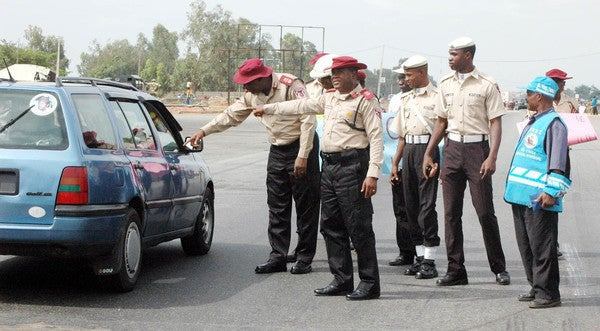
FRSC nabs 162,834 site visitors offenders in six months

0

From January through June 2023, the Federal Road Safety Corps arrested 162,834 traffic offenders countrywide.

This information was provided to our journalist on Sunday by the corps’ spokesperson, Bisi Kazeem.

Kazeem claims that the 179,165 infractions for which the traffic offenders were arrested.

“The corps recorded a total of 162,834 arrests of traffic offenders and a total of 179,165 offences from January to June 2023 alone,” he claimed.

The FRSC spokeswoman gave the following details about the offences that led to the arrests: “They were arrested for speeding, seatbelt use violation, route violation, light sign violation, use of phone while driving, overloading, and dangerous driving.”

Jide Owatunmise, Chief Executive Officer of the Professional Driving and Safety Academy, told our correspondent on Sunday that the FRSC needed to use more technology, including installing CCTV cameras “at the blind spots to capture traffic offenders.”

“The CCTV cameras can be connected to the BVN of vehicle owners for immediate, automated deduction of traffic violation fees.

“The caught offenders may be immediately detained, detained later, or prohibited from renewing their car information, driving licence, or filing any insurance claims until they have paid their fines in full and have completed the required refresher instruction at approved driving schools.

He argued that traffic offenders should always be prosecuted using mobile small claim courts.

The FRSC spokesman also revealed that between January and June, 4,387 individuals died in road traffic accidents across the 36 states of the federation and the Federal Capital Territory.

“The corps also recorded 14,108 injuries from the crashes during the same time period,” Kazeem continued.

These accidents happened as a result of nighttime driving, exhaustion, route violations, risky overtaking, using worn-out or expired tyres, and speeding.

And as you are aware, our guys do not drive at night; therefore, these drivers take advantage of our absence from the road at night to break the law.

According to Kazeem, an FRSC examination also revealed that many of the collisions involved novice and untrained drivers.

Naira declines extra as banks are beset by greenback scarcity

0

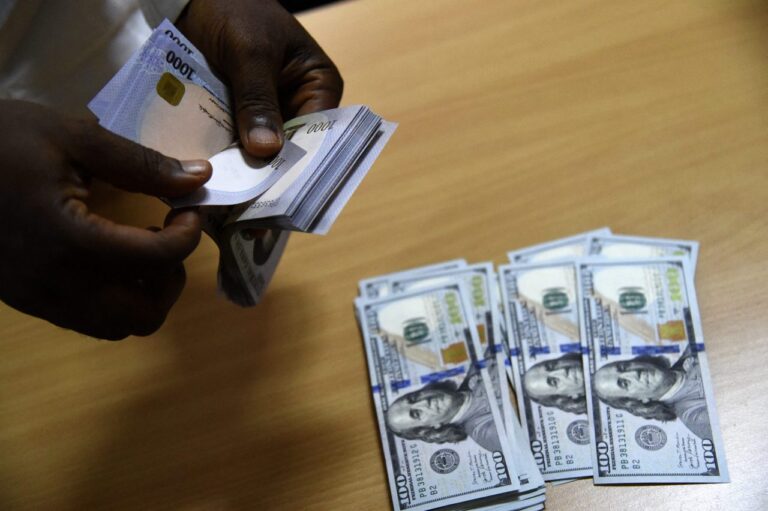
Findings show that the value of the naira has continued to deteriorate due to the expanding imbalance between the supply and demand of dollars in banks and on the black market.

The naira dropped from 860 to 960 per dollar as of Friday, losing N100 in less than three weeks.

Before the Central Bank of Nigeria allowed the naira to freely fluctuate against other world currencies in June, the exchange rate at the Investor & Exporter window was 471/$.

However, the naira increased to 664/$ the following day on June 13, a day after the regulator launched the local currency.

However, the naira, which had been trading in a narrow range in both the official I&E window and the parallel market, quickly started to see significant volatility there.

The local currency fell to 925/dollar in Lagos after surpassing the N900/dollar threshold at the parallel market last week.

The naira peaked at 799 to the dollar on Friday before falling to 740.60 to the dollar at the I&E FX window. The naira, however, ended the day at the parallel market at 930 to the dollar in Lagos and 960 to the dollar in Abuja.

A dollar scarcity is affecting banks, and some institutions have complained that they do not have enough dollars to meet client demand.

Currency merchants at the black market also voiced their complaints over a lack of dollars.

The lifting of cash deposit restrictions on domiciliary accounts by the CBN in June, according to bank executives, has caused money to be repatriated through banks.

He claimed that as a result, there was a substantial imbalance between supply and demand for the dollar.

“Some of the dollars are being repatriated through the banks, but the demand is still higher than the supply because everyone is still sourcing for dollar for imports, PTA, BTA, and others,” an official of a lender who spoke on the condition of anonymity because he was not authorised to speak on the subject said.

Because they don’t trust the policy, Nigerians continue to hoard dollars and foreign exchange. The CBN is no longer consistently providing banks with foreign currency, he continued.

A tier-1 bank official who asked to remain anonymous added, “Before, the banks used to get dollars from the CBN every week, but today, it has substantially decreased; we have not been getting. Everywhere, banks are looking for foreign exchange. Banks lack sufficient funds. For some weeks, the CBN has not been supplying us.

Aminu Gwadabe, the president of the Association of Bureau De Change Operators of Nigeria, stated in a conversation with our correspondent that the naira has continued to come under strong attack from speculators due to a lack of liquidity in the foreign exchange market.

The demand was pushed to the parallel market, where volatility and spikes were most prevalent, he claimed, because of the I&E window’s diminishing supplies. Lack of liquidity is a problem that affects the entire forex market.

“The banks are reducing their available position for the financing of visible letters of credit and abandoning the invisible request like PTA, school fees, and medical expenses of their clients, inadvertently increasing pressure in the parallel market,” says the author.

He continued, “As it is, most licenced BDCs have lost their clients to the parallel, unregulated, and unstandardized space because of their desire for KYC requirements. Given that we are left out of the harmonised market, it is tough for the majority of our members.

With regard to solutions, Gwadabe suggested that Nigerians strive for a stable exchange rate free of unethical economic practises such arbitrages, hoarding, and panic buying.

“ABCON is desirous to partner the apex bank and the Federal Government for an elaborate dialogue and engagement to champion paths to naira recovery,” the official added.

The financial architecture should be overhauled, he continued, so that BDCs can participate in the harmonised markets.

He argued that favourable policies and an enabling environment should be implemented by the monetary and fiscal authorities.

Why Tinubu shouldn’t ship troops from Nigeria to Niger

0

I was unprepared for the news regarding the Economic Community of West African States’ decision to encircle the neighbouring Niger with a military force during its strategic and extraordinary conference on the political situation in the Niger Republic. In truth, I was among the many Nigerians who had the bravery to promptly refute the alleged fake news in order to prevent it from festering and becoming true. Eight heads of state from ECOWAS member nations as well as the foreign ministers of Liberia and The Gambia attended the meeting, which was purportedly organised under the direction of President Bola Tinubu.

While Tinubu deserves praise for his fearless demeanour and audacious leadership in the face of the most obvious threat to democracy in the annals of our African history, he should be aware of the boundaries of his authority, particularly in relation to his romance with the legislature, which has the constitutional authority to check the executive during delicate and crucial times like the one we are currently experiencing in Nigeria.

There is no denying that Tinubu holds a crucial position of authority within the community of African countries. Tinubu’s election as ECOWAS’s leader continues to be a brusque affirmation of Nigeria’s status as the continent of Africa’s robotic spirit-machine. In the course of his leadership, we must continue to hope that he receives the greatest honour owed to Nigeria.

It must be made clear, though, that Tinubu’s status as President of Nigeria gave him the exceptional opportunity to lead ECOWAS. The president of Nigeria holds a constitutionally mandated role. A person in a legally recognised position should not act in a way that interferes with the full body of laws that recognise him as the president. It is also important to emphasise that his devotion to Nigeria does not in any way conflict with his loyalty to ECOWAS.

I am not surprised by the important step ECOWAS has taken. Additionally, I don’t believe Tinubu should be held directly or individually accountable for an agreement struck among the ECOWAS members. As the chairman, he could hardly disguise the duties of a football referee and not an autocrat who makes all the decisions. Even though he serves as the chairman of the regional bloc or organisation, no one is required to follow his example in promoting peace by assisting in a diplomatic settlement of the dispute in Niger.

Tinubu has tried to mediate peace by starting many conversations with the obstinate junta in Niger. The desperate junta won’t give up until it has incited Nigeriens to defend their country in a bloody conflict, protecting its head, Abdourahmane Tiani, from the reach of various delegations. Young people in Niger are alleged to have recently created a number of vigilante groups. This was done in an effort to stave off any assault from the rival African nations.

Sanusi Lamido is a member of the delegation skillfully led by former Nigerian Head of State Abdusalami Abubakar. Other members of the mission are Patrice Talon of Benin and Mahamat Deby of the Chad Republic. The obstinate military junta will not accept peace. Niamey, the Niger capital, was reportedly off limits to the Abdusalami Abubakar mission. According to reports, they were imprisoned in a room. Despite the Sultan of Sokoto, a well-known Nigerian monarch, being a part of it, this was the case. From the aforementioned, it is conceivably clear why ECOWAS decided to use force.

However, our president and ECOWAS chairman is unable to personally join this fight. His tongue is likewise twisted, and his hands are bound. At this crucial moment, neither can speak the same language. While his mouth can give the order, his hands are unable to deploy a squadron on the field of gruesome combat. He is limited to a “siddon look.”

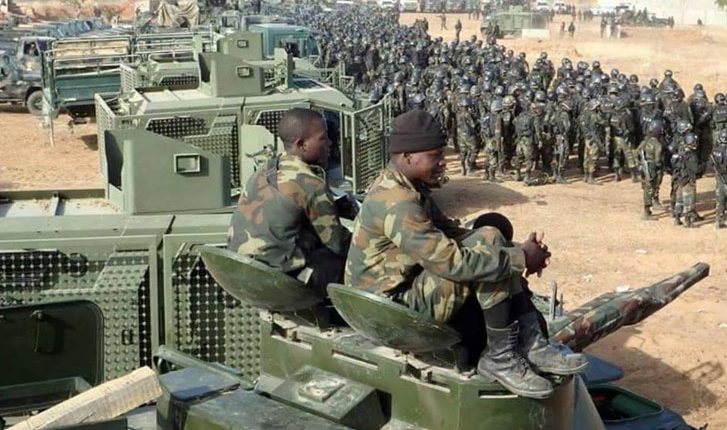
By informing the National Assembly about the development in Niger, he has walked the path of honour. He declared his aim to enlist the Nigerian military in this all-out conflict in West Africa. He asked for a “military build-up and deployment of personnel for military intervention to enforce compliance of the military junta in Niger should they remain recalcitrant.”

The contentious request of Tinubu ignited the Nigerian Senate. Representatives from the states bordering neighbouring Niger, the northern caucus, who believed a war against Niger could bring hardship for their people, protested with knowledge. Thinkers have also anticipated that the conflict in Niger will also involve Mali, Burkina Faso, and other militarily dominated nations. Attention has been drawn to Russian President Vladimir Putin’s recent trip to Burkina Faso. Nigerians, who took pride in promoting his name on the streets, have been currying his favour in the meantime.

By explicitly opposing the proposed military intervention in favour of diplomatic relations between the two countries, the Senate exercised its authority under section 5(4) of the constitution. Tinubu was informed of the aforementioned parliamentary resolution.

Despite the preceding provisions of this section, Section 5(4) of the 1999 Constitution states: “Notwithstanding the foregoing provisions of this section: (a) the President shall not declare a state of war between the federation and another country except with the sanction of a resolution of both Houses of the National Assembly, sitting in a joint session; and (b) except with the prior approval of the Senate, no member of the Armed Forces of the Federation shall be deployed on combat duty outside Nigeria.”

Building on the premise of the aforementioned clause, subsection 5 reads as follows: “Notwithstanding the provisions of subsection (4) of this section, the President may, in consultation with the National Defence Council, deploy members of the Armed Forces of the Federation on a limited combat duty outside Nigeria if he is satisfied that the national security is under an imminent threat or danger: provided, however, that the President shall, within seven days of actual combat engag

Nigeria cannot be claimed to be under a threat in this situation that is serious or immediate enough to justify acting prematurely. A request had been made, but it had been denied. Tinubu is unable to ignore this flagrant constitutional clause that prevents him from launching any intervention in support of ECOWAS. He need only approve of the military conflict that has been declared with the Niger junta. As the President of ECOWAS and not the President of Nigeria, he is also allowed to endorse the action. It is entirely permissible to rebel against any upcoming executive orders in this regard.

Tinubu must constantly keep in mind that he was chosen as president in a democratic process, not as a military commander. In a constitutional era and creation, he cannot issue unconstitutional orders. The authors of the constitution are aware that the Commander-in-Chief must collaborate with the legislators on problems of war since they are too complex for him to consider alone. Even though he has demonstrated that he is aware of this clause by writing to the Senate, he should not ignore it.

CBN employees loans enhance by 113% to N40 billion

As of December 2022, the Central Bank of Nigeria had issued N40.67 billion in loans to its employees.

This was according to the apex bank’s audited financial statement for 2022.

There was a 133.77% increase from N17.43bn in 2021 to N40.67bn in 2022.
The number of employees who benefited from the loan was not specified by CBN.

However, details on its website gave information about the bank’s current workforce size.

“From a bank-wide staff strength of 10,000 staff, excluding the over 2,000 casuals in the HQ and branches as at 1999, the bank operates with a substantially reduced staff strength of and (sic) 4,914 by December 2005, further down from 6,119 as at December 2004,” the apex bank stated. It should be added that professionals currently make up 79% of the present workforce.

Despite the N155.63 billion allocated as staff allowances in 2022, a high level of debt was documented.

The audit states that the worker allowances covered things like furniture, housing, time off, transport, productivity bonuses and ‘others paid to staff during the period’.

The amount was N90 billion more than the CBN’s reported profit for the same time period of N65.63 billion.

Additionally, it was 37.2% higher than the N113.35 billion spent on staff allowances in 2021.

Furthermore, it was noted that during the course of seven years, the CBN spent N1.2 trillion on staff expenditures while reporting a net profit of N520.04 billion.

The apex bank’s profit experienced a significant decrease and recovery between 2016 and 2022, according to highlights of its seven years of audited financial records released from 2016 to 2022.

This occurred as worker compensation increased consistently over the course of seven years, increasing by 119%.

The apex bank’s recently disclosed consolidated and separate statements of accounts show that profit fell dramatically from N124.47 billion and N107.39 billion in 2016 and 2017 to N43.77 billion in 2018.

Prior to increasing to N75.12bn in 2021, it further decreased to N34.63bn in 2018 and N30.81bn in 2019 and 2020.

The Apex Bank’s earnings for the year increased to N103.85 billion at the conclusion of the 2022 fiscal year, just as employee emoluments had increased steadily over the previous seven years, from N121.23 billion in 2016 to N135.95 billion in 2017 and N137.36 billion in 2018.

Before stabilising at N265.87bn last year, the amount spent on worker salaries, allowances, and perks increased to N168.03bn, N183.60bn, and N200.04bn in 2019, 2020, and 2021.

According to the most recent report, which was signed by Godwin Emefiele, the bank’s suspended governor, and audited by Ernst & Young and KPMG, the banking regulator’s credit loss expense jumped to N875.2 billion in 2022 from N498.2 billion in 2021.

CCB ignored request about Tinubu, Shettima’s property

0

In response to a Freedom of Information Act request, the Code of Conduct Bureau declined to provide information about the assets that President Bola Tinubu and Vice President Kashim Shettima have legally disclosed.

sought the specifics of the assets that the President and Vice President had disclosed in a letter dated June 22, 2023. Under the guidelines of the 2011 Freedom of Information Act, the request was made.

The letter to the CCB Chairman, Isa Muhammed, was headlined “FOI request for details of President Bola Tinubu and Vice President Kashim Shettima’s assets.”

“We write in accordance with the Freedom of Information Act, 2011,” it stated. We thus want information regarding the assets included on the asset disclosure forms that Vice President Kashim Shettima and President Bola Tinubu submitted to the CCB.

“As they are of public interest, the specifics of the assets must be published. The information may be provided in physical copy or digital version. In accordance with the FoI Act’s provisions, we anticipate that you will grant our request within seven days of receiving this letter. I’m grateful.

Despite the fact that the request was received and acknowledged on June 26, 2023, with a stamp from the CCB Chairman’s Office, the bureau refused to abide by the FoI Act’s requirements that such information must be made public within seven days.

The CCB declined to give the information 48 days after the request. A CCB communications staffer named Veronica Kato was called to follow up on the request, but she didn’t return calls, texts, or WhatsApp messages from our correspondent.

Deji Ajare, a human rights attorney, claimed that the CCB’s reluctance to comply with the FOI request was a blatant legal infraction.

The CCB’s rejection or inability to provide the specifics of the President and Vice President’s assets declaration, despite repeated demands made in accordance with the Freedom of Information Act, is very troubling, according to Ajare.

“Our democratic culture is supported in large part by the Freedom of Information Act, which was passed in 2011 and ensures openness, responsibility, and access to information of public interest. It was created to give people the ability to access public information and data maintained by public servants, including their asset disclosure. The FoI Act applies to public records, including the assets that public officers have disclosed, including those of the President and Vice President.

“The CCB’s rejection or inability to disclose the specifics of the President and Vice President’s assets declaration is a blatant violation of the principles entrenched in the Freedom of Information Act. This conduct undermines democracy and good governance by undermining the transparency necessary to hold public authorities accountable. It can erode public confidence in the presidency’s integrity and increase allegations of malfeasance or corruption.

He requested action from the CCB.

“The release of the assets declaration details will not only fulfil its legal obligations but also demonstrate its commitment to combating corruption and fostering integrity within the highest echelons of government,” added Ajare.

Festus Ogun, another public interest attorney, expressed regret that the court had not taken more action to make the FoI Act more effective.

“Painfully, Nigerian courts have taken the position that no explicit law has yet been enacted by the National Assembly with respect to granting public access to the declared assets,” he added in reference to how they have interpreted the asset declaration clause of the law.

The inference is that, notwithstanding the Freedom of Information Act of 2011, elected officials, including the CCB, are not required by law to divulge the information on the forms. The legislation is currently in a terrible position.

But because laws are made for people, not the other way around, I believe that the President and his Vice should disclose their holdings in good faith and for the sake of transparency and accountability. if desires were animals.

Army swears allegiance to Tinubu, helps democracy

0

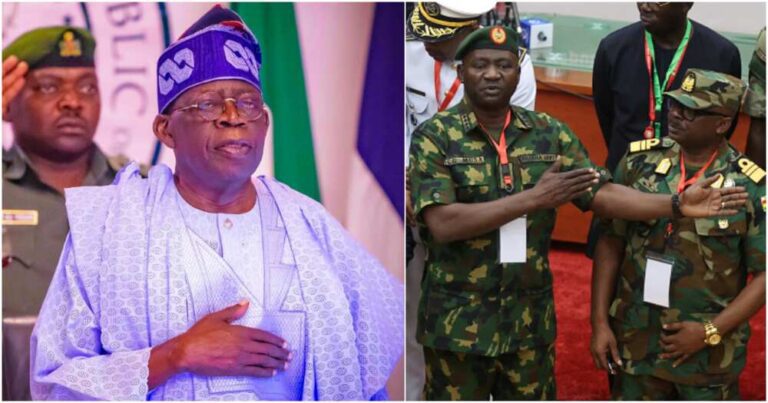
The country’s democratic system of governance was not requested to be overthrown, according to the military high command, which asserted that it was loyal to President Bola Tinubu.

Following complaints of poor welfare among troops across the services, the Defence Headquarters had on Friday rejected comments asking the Armed Forces to meddle in the nation’s democratic process.

However, the DHQ said on Sunday that it never received a request to take over the nation’s administration in a statement from the Director of Defence Information, Brig. Gen. Tukur Gusau.

The statement said: “The Defence Headquarters is worried by misleading and worrying social media rumours that suggest the Armed Forces of Nigeria were asked to bring about a change of government in the nation.

“We would want to use this occasion to emphasise that the AFN has never received or made a declaration of this nature to any individual or group, at any time. We think that people who don’t want the country to succeed made this declaration. It is unquestionably the evil imagination of a select few people who are not content with the advancement and prosperity of our beloved country.

“The AFN is quite at ease with democracy and still firmly supports His Excellency President Bola Ahmed Tinubu as President and Commander-in-Chief of the Armed Forces of the Federal Republic of Nigeria. The military is always prepared and willing to defend the Federal Republic of Nigeria’s Constitution.

The military high command announced that a manhunt had been started by security personnel to find the source of the report.

“We warn people who spread such untruths to stop doing so or risk legal repercussions. The military and other security organisations are searching for these agents of death. To strengthen our democracy, we must all work together, the statement continued.

I took a shower with human cranium to spice up my enterprise -Suspect

0

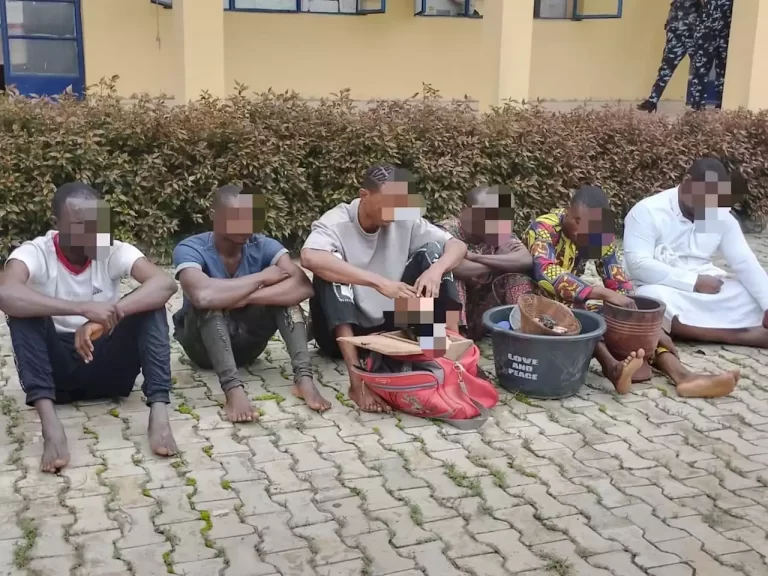
Franklin Akinyosuyi, 26, who was detained in Ondo town, Ondo State, with a human skull in his flat, has admitted that he used the skull to bathe for a month.

The photographer and shop owner claimed that a herbalist advised him to take a bath with a skull every Thursday at one in the morning in order to grow his business.

As he and his accomplices were being paraded Saturday at the state police headquarters in Akure, Akinyosuyi gave a press conference.

The suspect was detained after his landlord brought up the presence of a human skull in the suspect’s Eleworo neighbourhood flat last week at a police station.

The suspect admitted, “I am a photographer and I also operate a store. My uncle took me to a herbalist the previous year. I told him that my company wasn’t doing well, and he requested N200,000 to create a mixture for me. I paid him in full within three weeks.

“After he finished, he called me to come pick it up, and that was in November of last year. He gave me the order to take a bath with a human skull every Thursday at precisely one in the morning. After using it for a month, I noticed no change in my business. I had to phone the herbalist to request a money-back refund.

I requested that he pick up the human skull as well, but he declined. Despite this, he began refunding my money because he had already handed me N20,000.

“On that fateful day, I made the decision to go dispose of it, so I left it in my backyard. Unfortunately, I left, and before I could come back, the children of my landlord witnessed it, told their father, and they called the police. The herbalist stated that he bribed someone to obtain the human head after we were taken into custody.

Five people are allegedly implicated in the case, according to the state police public relations officer, Mrs. Funmilayo Odunlami.

She claimed that although three individuals had been taken into custody, two remained at large.

“Further questioning and investigation resulted in the arrest of one Oyegoke Dare, an evangelist, who had given the suspect the skull and other fetish items. One Oyelade Sarafa, a herbalist, was also taken into custody after confessing to having assisted in obtaining the skull from one Asekun (a vigilante) in Ikirun. Two further individuals who have been linked to the case but remain at large, she added.

Kebbi gov expresses sympathy with Gov. Sani, Zazzau Emir over Mosque collapse 

0

The governor of Kebbi State, Comrade Nasir Idris, expressed condolences together with the governors of Kaduna and Zazzau, Amb. Ahmed Nuhu Bamalli and Uba Sani, following the terrible collapse of a mosque that took many lives.

This information can be found in a press statement that the governor’s chief press secretary, Alhaji Ahmed Idris, signed and distributed to newsmen in Birnin Kebbi on Sunday night.

The 12 fatalities were termed by the governor as a tragedy and huge loss for Kaduna State, Nigeria, and Zaria and Zazzau Emirate in addition to Zaria and Zazzau Emirate.

Idris expressed his profound sorrow over the deaths and prayed for the souls of those who perished in the incident.

Idris begged Allah (SWT) to accept their Shahada and grant them Jannatul Firdaus while pleading with the Emirate and the entire population of Kaduna State to accept the will of God Almighty in good faith.

The governor sent condolences to the families of those who lost loved ones and hoped for those who were injured to recover quickly.

He also prayed that the All-Powerful God would stop such a despicable pattern from happening again.

Kano stops non-public colleges from elevating tuition

0

Umar stated that the goal of the new registration is to guarantee the accessibility of a database for monitoring. He mentioned that parents had been warned not to pay fee increases at any of the schools.

“The new registration’s main goal is to ensure that we have an accurate database for the government’s policy and monitoring, to sanitise the sector,” he continued. Everything we are doing to support the functioning of private schools in the state complies with the law passed in May 2014.

“Fee increases have been suspended for the time being, therefore parents should notify any schools asking for them. No school will ever be permitted to unilaterally raise tuition again.

He said that since the operators are not nonprofit organisations, the state government will also make sure that parents pay their children’s tuition at the same time. He added that operators of private schools who fail to submit an application by the deadline will face sanctions if it is discovered that they are running their schools.


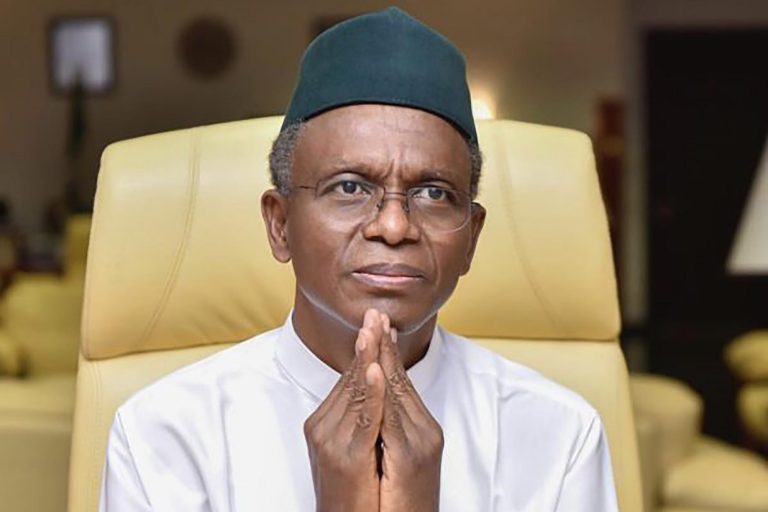
El-Rufai: Betrayal Of A Serial ‘Traitor’

0

Following a vetting of the 48 applicants for ministerial positions included on the list President Bola Tinubu provided, the Senate said last Monday that it had approved 45 of them while rejecting three.

The Senate’s refusal to approve Mallam Nasir El-Rufai’s appointment as a minister of the Federal Republic of Nigeria was, however, a major surprise. El-Rufai was the recently-resigned governor of Kaduna State.

Senator Abubakar Danladi, a former deputy governor of Taraba State, and Stella Okotete, a candidate from Delta State, were not successful in getting their ministerial nominations confirmed by the Senate.

El- Rufai informed President Tinubu last Tuesday afternoon during his visit that he was no longer interested in becoming a minister. El- Rufai was undoubtedly startled by the senate’s refusal to approve his nomination.

When El-Rufai visited the President last Tuesday, Tinubu reportedly informed him that he had received several petitions objecting to his candidature for a cabinet position.

According to reports, he requested time so that he could evaluate the petitions and a report from the Department of State Security (DSS) before reporting back to the Senate. However, a report citing insiders at the Presidency claimed El-Rufai told President Tinubu he would no longer entertain his nomination as a minister in the administration.

According to reports, he told Tinubu that he would keep making his individual contribution to national development.

According to the article, El-Rufai suggested that President Tinubu hire Jafaru Ibrahim Sani, who had previously served as commissioner in Kaduna State’s local government, education, and environment ministries.

According to the report, El-Rufai assured Tinubu that he would find Sani to be “very useful and resourceful” in the administration and explained that he “needed time to focus on his doctorate programme at a university in The Netherlands.”

However, reports also stated that Muyiwa Adekeye, El-Rufai’s spokesperson, had yet to comment on the situation.

The rumoured resignation of Nasir El-Rufai from Tinubu’s incoming government follows a proposal by Dr. Doyin Okupe, the former director-general of the Peter Obi Presidential Campaign, that the Senate should require El-Rufai to submit a written undertaking before confirming him.

Okupe suggested that El-Rufai be required to sign a pledge promising not to disparage religion. El-Rufai’s dismissal as a minister was overturned, but he encouraged the Senate to change its mind.

In a tweet, Okupe asserted that El-Rufai is capable of managing Nigeria’s electricity issue. He declared, “I am not a fan of Mallam El-Rufai, who I regard to be somewhat of an extremist and who has recently shown some signs of religious fanaticism. But few will question El-Rufai’s skill and prodigious ability to deliver.

The Senate may request that he give an assurance before being confirmed that, while serving as a minister, he won’t make any comments or remarks on religion.

“The power ministry is crucial to our nation’s economy and to our sincere efforts to fight poverty.

Former Governor El-Rufai is undoubtedly one among the Nigerians who can solve our country’s energy issues.

On Tuesday, August 1, 2023, El- Rufai boldly informed the senators that President Tinubu had requested him to collaborate with him on the nation’s electricity crisis.

According to him, the President gave him a deadline of seven years to get Nigeria’s power shortages under control.

The reason the Red Chamber declined to approve the former Kaduna governor, who is regarded as a staunch APC supporter and a close associate of President Tinubu in a Senate predominated by members of his political party, is then a mystery.

The three ministerial nominees, whose names were not released, were awaiting security clearance, according to Senate President Godswill Akpabio, who made the announcement at the conclusion of Monday’s session.

Senator Yemi Adaramodu, who serves as the Senate’s spokesperson, further stated that “48 names, including both boys and girls, were received. We had all the motivation we needed to complete the final screening, and 45 candidates were confirmed. The three remaining candidates are awaiting further legislative action, which will depend on the activities of other government agencies.

The Federal Republic of Nigeria has acknowledged and accepted 45 of the 48 names that were sent as ministers as of today.

“This, along with the three other names that are still awaiting further legislative action, will be communicated to the President.”

El-Rufai may have been removed from consideration, though, as a result of numerous petitions that were filed against him and that raised concerns about security and the supposed “toxic comments” he had made in public that were against the “national interest.”

Several petitions were brought against El-Rufai during the screening, including those sent by Senator Sunday Karimi (APC, Kogi West).

Senator Karimi spoke out against the former El-Rufai during the ministerial screening. He informed the chamber that he had drafted a petition accusing the previous governor of failing to address the security situation in Southern Kaduna.

Karimi remarked, “Your performance in every office you had in the nation has been exceptional. Your track record in the Bureau of Public Enterprises is there, as is your record as a minister in the Federal Capital Territory, and as the twice-elected governor of Kaduna State, you did well.

Karimi continues, “But, I have a very strong petition against you that bothers on the security, unity, and cohesiveness of the Nigerian nation.” He holds up a brown package in support of his claim. And I believe that the petition needs to be taken into account during this screening process.

Following that, Karimi presented the petition to Jibrin Barau, the Deputy Senate President in charge of the screening process at the time.

Nevertheless, Akpabio stepped in and declared, “This is not the place to consider petitions. Later, after sitting with the petitions, we will refer them to the appropriate authorities.

In addition to the petitions, El- Rufai was the subject of reports that he could not be trusted and simply intended to accept the ministerial position in order to further his desire to run for president in 2027.

In some circles, El-Rufai was held in high regard. He was viewed as “someone who will oppose President Tinubu’s desire for a second term.” He is not regarded as a dependable, loyal politician.