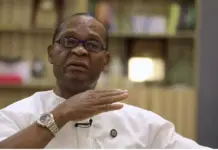

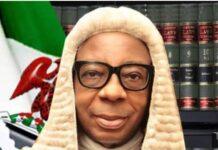










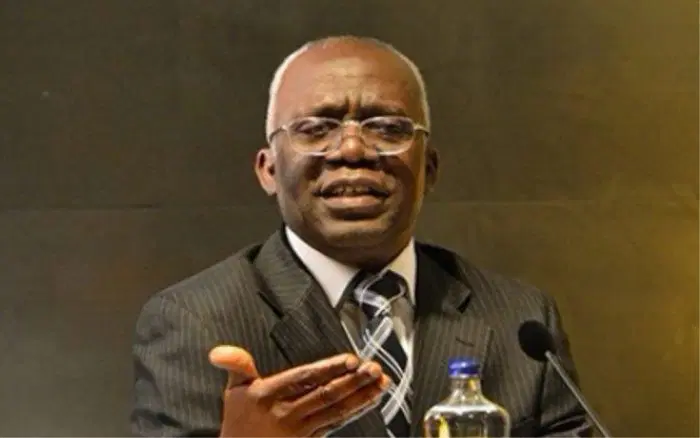
Femi Falana is a human rights attorney and a Senior Advocate of Nigeria (SAN). In this interview, he discusses the Supreme Court’s decision upholding the President’s authority to take drastic steps to restore law and order in any state where an emergency has been declared in order to stop law and order from collapsing. He also discusses how, among other things, the Supreme Court has offered certain guidelines so that there won’t be any disagreement the next time the president announces a state of emergency. JOY ANIGBOGU provides the passages:
In his ruling, Justice Idris of the Supreme Court stated that as section 305 does not specify the precise form of the extraordinary measures, the President may exercise his discretion. What possible ramifications might this ruling have for Nigerian politics in the coming years?
To be fair to the Supreme Court, I believe that the Honourable Justice Muhammad Idris, who delivered the leading opinion, did issue what is known as a summary decision. Sadly, the majority of commentators have not taken the time to read the ruling. Indeed, the court unquestionably stated or confirmed the President’s authority to take exceptional steps to restore law and order in any state where a state of emergency has been declared. Before today, the President’s ability to use force or take other actions to reestablish law and order was undeniable. The scope of the President’s powers has long been debatable, and the Supreme Court noted that section 305 of the Constitution does not specify the scope of the President’s authority. However, the Honourable Justice Idris stated in the majority ruling that, in contrast to the constitutions of Pakistan and India, section 305 of the Nigerian Constitution does not specifically grant the President the authority to take over or temporarily replace a state’s legislative or executive branches. Furthermore, his lordship stated that Nigeria’s constitutional commitment to federalism and state government autonomy is reflected in this deliberate omission, which is the President’s lack of authority to dissolve democratic structures. Prior to that ruling, the court was informed that Nigeria’s three levels of government—federal, state, and local—are separate, autonomous entities and that none of them is superior to the order. To put it another way, the Supreme Court was merely upholding its previous rulings that state governors are not allowed to suspend or remove democratically elected chairmen and councilors.
Similarly, the Supreme Court has now reaffirmed its stance that elected public officials and structures cannot be disbanded, dissolved, suspended, or relocated unless the Constitution’s requirements are followed. Therefore, I would strongly advise Nigerians to thoroughly review the rulings. In reality, the Honourable Justice Obande Oguiya did not hesitate in the slightest to avoid any ambiguity in what has been considered a minority ruling. His lordship emphasized that the president does not have the authority to remove elected public officials under any clause in the Constitution. The Supreme Court did not decide on the merits of imposing an emergency rule in Rivers State, and I believe this was done on purpose. Given that the governor has since returned to his position, one could argue that it has become academic. I’m referring to Governor Fubara, but the Supreme Court’s challenge to the plaintiffs’ locus standi—that is, the eleven attorneys general who brought the case—is another perplexing aspect of the ruling. This is concerning since the locus standi of the Attorney General of the Federation was contested in the matter of Attorney General of the Federation and Attorney General of Abia State and 35 States, which was resolved in July of last year.
However, the Attorney General has locus standi to bring the case on behalf of the 774 local governments, the Supreme Court ruled. If that was the case, I believed that the court ought to have upheld the locus standi of the 11 attorneys general who filed this extremely important action. However, in contrast to 2004 and 2006, when the emergency rule was contested in Plateau State and Ekiti State, the Supreme Court went beyond its earlier stance this time by merely stating that the court lacks jurisdiction because you lack locus standi. However, the Supreme Court went farther, and only the Supreme Court has the authority to do so by issuing a policy declaration about Section 305 of the Constitution.
According to the ruling, the plaintiffs failed to prove that there was an actionable disagreement between them and the federation, which would have allowed the court to exercise its original jurisdiction. Do you want to elaborate on it and what they were attempting to convey?
Regarding the emergency rule in Rivers State and the suspension of Governor Fubara and other elected officials in that state, the court is attempting to state that the President’s action or decision on Rivers State did not cause a conflict between the plaintiffs, which are the 11 Attorney Generals and the federal government, the Attorney General of the Federation. However, the plaintiffs did assert that any Nigerian governor had a stake in the events in Rivers State and a lawsuit that can be pursued. Furthermore, a few days after the emergency was declared, the Federation’s Attorney General stated that we had only addressed Rivers State and could handle any other governor. The plaintiffs were already terrified, and properly so, because they believed that because it would be our turn, it would be preferable to stop the potential political catastrophe in our states. Therefore, with all due respect, I disagree with the Supreme Court that there was no disagreement between the federal government and the plaintiffs. Of course there was a disagreement. The governors are then free to act without having to wait. They can act quickly in court to stop what they see as constitutional heresy without waiting for their own removal or a state declaration of emergency.
How will the anomaly be fixed if that’s the case and this is the highest court?
When you lose a Supreme Court case, all you have to do is inform your client what to do if he asks. That is the end of the road, you say. The All-Powerful God is appealing. However, the Supreme Court has already offered some guidance on what we might need to do in this specific circumstance, so there shouldn’t be any issue the next time the President of Nigeria needs to declare a state of emergency. As I previously mentioned, the court’s leading ruling made it quite evident that the President is not authorized by section 305 of the Constitution to temporarily replace the state’s legislative or executive branches. And in my opinion, that is the most crucial aspect of the verdict. Whether the plaintiffs have locus standi and whether the court has jurisdiction are the additional areas where we disagree. However, even after the lawsuit was dismissed, the court continued to discuss the case’s merits in great detail. And that will serve as a roadmap for the next time the Nigerian president has a reason to proclaim a state of emergency. That’s my perspective on it.
Many people find this rather perplexing because the final arbiter claims he lacks jurisdiction. It raises a lot of questions. Could you explain how this is possible? Is there any precedence in Nigeria or anyplace else in the globe, and if so, what were the exceptional conditions that made that precedent necessary?
I believe the court’s ruling. When our rights are abused, we also need to learn how to fight back. The suspended governor did not appear in court in the Plateau State case. The suspended governor and lawmakers did not file a lawsuit in the Ekiti State case. The governor and lawmakers of Rivers State did not file a lawsuit. Therefore, if you subscribe to the antiquated locus standi doctrine, you will inevitably disagree with a government decision until it directly affects you. Because any concerned member of the public must be allowed to contest any constitutional dereliction or violation in these days of public interest litigation. It’s also in everyone’s best interests. The president and Abraham Adesanya’s case had been abandoned by the Supreme Court. It happened during the Second Republic. Even then, the late Justice Fatai Williams, who was Nigeria’s Chief Justice at the time, made a minority ruling stating that the courts should open their doors and let disgruntled residents air their grievances. And that was preferable than pushing them underground, where revolutions take place. In the cases of Fawemi Anakilu No. 1 and No. 2, the Supreme Court went one step farther. In fact, the Honourable Justice Ese stated in the Fawemi Anakilu No. 1 case that the word “brother” in England refers to your blood relative, in contrast to the United Kingdom. However, we are all our brothers’ keepers in an African environment with the extended family system. As a result, the Supreme Court has now embraced public interest lawsuits, deviating from the narrow road of locus standi.
In the Centre for Air Pollution v. NNPC case, the Supreme Court reaffirmed that stance. However, the Supreme Court recently seemed to be shifting away from public interest litigation by requiring that your injury be greater than that of other members of the public before you can petition the court. It ridicules the idea of public interest litigation. Furthermore, Nigeria is currently the only nation in the Commonwealth—almost the only one—that is returning to the extremely narrow notion of locus standi. And I sincerely hope that our courts would have granted locus standi or acknowledged the locus standi of the eleven Attorney Generals who petitioned the Supreme Court on this issue, just as they did in the case of local government autonomy last year.
In the first place, why does the Supreme Court provide rulings that allow the parties that filed the case to provide alternative interpretations? How detrimental is this to our policy?
I believe that everyone should study court rulings in order to comprehend the rationale behind the rulings. And once more, as I mentioned in this instance, as soon as word spread that the case had been dismissed. The suspension of elected legislators and governors appeared to have the support of the Supreme Court. I’ve taken my time reading the ruling several times. The president has great authority to guarantee the restoration of law and order or constitutional order if a state of emergency is declared, which is why the court acknowledges the president’s extensive powers. However, this does not provide the president the authority to remove elected lawmakers and governors. Both the majority and minority rulings of the Supreme Court made that extremely evident. Now that I’ve accepted it, we may go to the next phase. Where do we go and where do you go from here when something like this happens? It is to exploit other, comparable instances, and I am aware that the Supreme Court is currently considering a number of cases in which the issue of locus standi will be brought up once more. I mean, I’ve just filed a case. On the locus standi issue, I lost a few of my cases. The High Court stated that I might contest the diversion of cash that ought to have been transferred to the federation account using local standards. However, the appeals court remarked, “Oh, Mr. Falana, we commend your effort.” But you no longer have locus standi because of the Supreme Court’s recent ruling in Fawehinmi and Okonjo-Iweala. Once more, we are bringing that before the Supreme Court so that it can examine his locus standi stance in the public interest and for the benefit of all of us. Because locking up the court’s gates will force residents to take alternative actions that could jeopardize law and order and state security. For this reason, I believe the Supreme Court was involved once more in the case of A.G. A.G. and Bende. of the Federation that the floodgates should be opened in order for the courts to carry out their constitutional function of serving as arbiters in disputes between citizens and the government.
What do you think about the problem of justice being postponed or denied, and then, of course, the issue of the elected governor, deputy, and Assembly members being removed? How can such wrongs be rectified?
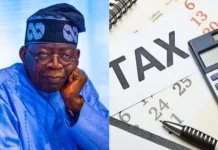
Once more, the Supreme Court is advising those impacted to summon the bravery to contest their removal under the constitution. President Bola Tinubu would have gone to court if it had happened in Lagos during his tenure as governor. The goal of every action the Lagos State Government filed against the federal government, as well as every litigation it initiated against the federal government, was to bolster the democratic process. In fact, I can state without fear of contradiction that in some of those cases, state governments may have even been declared bankrupt because the Lagos State Government’s victories in those cases defined Nigerian constitutionalism, whether state governments could establish local governments, whether they could approve building plans within their states, and so on. Since we are transitioning from a military junta-run unitary system of government to a civilian one, the federal government has complete authority over national matters. However, the Lagos State Government organized all the states to oppose the federal government’s efforts to prolong the terms of local government chairmen, hold local government elections, seize local government funds, regulate state physical planning, and so on. They are also redefined. In fact, I contend that litigation encourages restructuring in those circumstances. Because our constitution is unitary, we have been able to settle many conflicts brought on by the military organization. Other governments have also done the same. However, we have been able to redefine federalism and implement it from the unitary structure in Abuja thanks to cases brought by state governments and certain concerned citizens.I]K=8
Join Television Nigerian Whatsapp Now
Join Television Nigerian Facebook Now
Join Television Nigerian Twitter Now
Join Television Nigerian YouTUbe Now