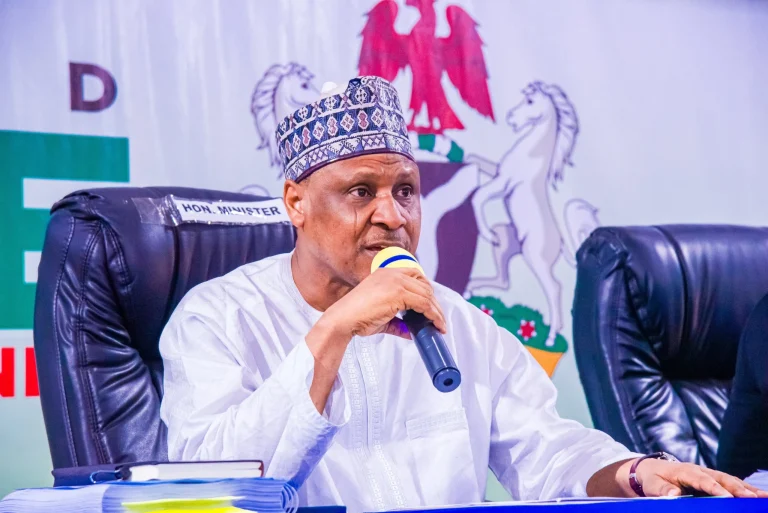
The Federal Government is committed to making sure that public service reforms are not only put into place but also effectively communicated to Nigerians in order to improve accountability, transparency, and digital governance, according to the Honorable Minister of Information and National Orientation, Mohammed Idris.
Dasuki Ibrahim Arabi, the Director-General, and the Bureau of Public Service Reforms (BPSR) management team paid the Minister a courtesy call in his Abuja office on Wednesday.
He emphasized that any reform program’s effectiveness depends on effective communication. In addition to being put into practice, reforms also need to be effectively conveyed.
Resistance to reforms is inevitable when they are not fully understood.
We must make sure Nigerians know that these reforms are intended to benefit them more broadly,” he stated.
Rabiu Ibrahim, the Minister’s Special Assistant (Media), signed the statement, which included this information.
He called reform “crucial to national development” and praised BPSR for maintaining institutional improvements throughout the public service.
The Minister cited the digitization of Nigeria’s public finance management system as one of the most significant developments in the last few years. He claims that the elimination of paper-based financial procedures has strengthened accountability within Ministries, Departments, and Agencies (MDAs), enhanced openness, and prevented leaks.
“The days of contractors racing ministries to pick up checks at year-end are long gone. These days, the system is digital.
The smooth operation of the banking industry throughout Nigeria with technology run by Nigerians would enable our public service to function effectively as well,” he stated.
According to the Minister, attitudinal transformation is necessary to complement structural reforms. National Orientation’s inclusion in the Ministry’s mandate, he clarified, indicates the Federal Government’s determination to encourage civic engagement, patriotism, and shared ownership of public institutions.
He also revealed continuous initiatives to digitize and modernize Nigeria’s archival system in order to avoid policy gaps and preserve institutional memory. When addressing deepfakes, misinformation, and manipulation by artificial intelligence, he emphasized the value of media and information literacy.
He gave the delegation his word that the Ministry’s organizations, such as the News Agency of Nigeria (NAN), Voice of Nigeria (VON), Federal Radio Corporation of Nigeria (FRCN), and Nigerian Television Authority (NTA), would keep promoting reform milestones and making sure Nigerians were informed.
The visit, according to the Director-General of BPSR, was intended to advance cooperation with the Ministry in order to speed up reforms, boost communication, and increase transparency among MDAs.
The visit, according to the Director-General of the Bureau of Public Service Reforms, was intended to improve cooperation with the Ministry in order to expedite reform communication and improve transparency among MDAs. He described the main tenets of the National Strategy on Public Service Reforms, which include enhancing citizen involvement, digitizing public finance management, bolstering national development planning, and raising governance standards.
“Public service reform is an ongoing process of bolstering institutions, enhancing accountability, and utilizing technology to improve outcomes for residents; it is not a one-time intervention.
To make sure that these changes are effectively understood, communicated, and sustainably implemented across all MDAs, our collaboration with the Ministry of Information and National Orientation is essential,” the Director-General said.
The DG pointed out that payroll integrity has improved across federal, state, and local agencies and that digitization improvements have greatly decreased irregularities like phantom workers.
He also called for better adherence to the Freedom of Information (FOI) Act and urged MDAs to make operational and budgetary data available on their official platforms.
He also emphasized current initiatives to improve public servants’ digital literacy, such as safeguarding government communication systems through training on the proper use of cutting-edge technologies like artificial intelligence.