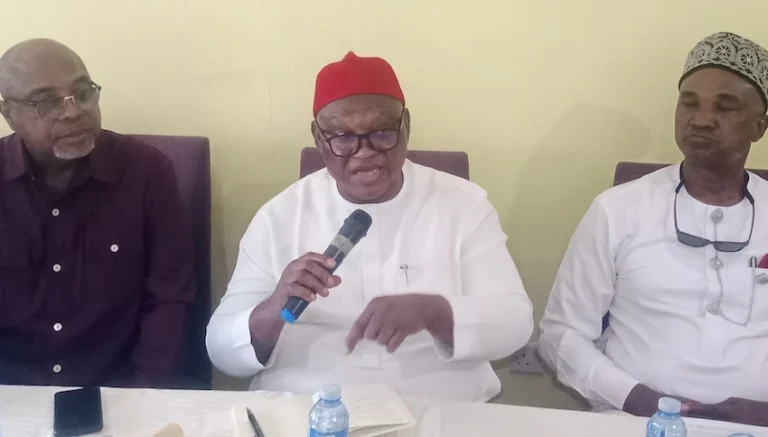
A non-partisan, pan-Igbo forum, the Igbo Agenda Dialogue (IAD) was established to bring together, involve, and inspire Igbo stakeholders in Nigeria and the diaspora in pursuit of a common political goal. Cross-party leaders, town unions, market and professional associations, women’s and youth organizations, diaspora organizations, and esteemed individuals dedicated to forging a more robust and united political future for the Igbo Nation come together for the Igbo Agenda Dialogue.
What role does Igbo Agenda Dialogue play in promoting peace, political awareness, and participation throughout the South East in the wake of the recent event in Anambra State where Governor Charles Soludo closed the Onitsha Main Market for a week, resulting in a relative calm?
The failure to engage the people in a meaningful way is still the root cause of the problem. Additionally, they appear to be clueless on how to deal with it. The query is: How can we get in touch with well-known individuals to assist in reaching out to these young men and women and determine whether there are any other ways to guarantee peace through communication? I don’t say things that I don’t do myself, for instance. I started the Igbo Agenda Dialogue primarily to address such circumstances, and it is rapidly expanding. something that we only started last year. Reaching out to our young men and women and explaining to them how they can reclaim their spot in Nigeria by taking part in the country’s democratic process is the main goal of what we are doing. Our goal is to change Nigeria’s political landscape in opposition to those who wish to undermine us. We lack the resources necessary to use force. We are reaching out to traditional institutions and market associations through outreach, town hall meetings, and persuasion and interface in order to have a conversation with them about the full involvement of Ndigbo and their legitimate place in Nigerian politics.
Ahead of the election next year and any future elections, is Igbo Agenda Dialogue associated with or endorsing any political party?
No, it’s a pro-democracy, social, political, and nonpartisan organization. Once more, it is a pro-democracy, social, political, and nonpartisan organization. Thus, it is not a part of any party. Like the All Progressives Congress (APC) now does, a party will go out and canvass for votes, urging people to come and register to vote for their people. The Igbo people are being charged with the necessity of political engagement in this one. Before the 2023 election, for instance, you registered 11.5 million voters, and the results were made public throughout all of Nigeria’s regions. Only two million votes were cast for each of the presidential contenders during the election, which means that over 9.3 million Igbo people did not cast any ballots at all. In addition, we have stated that we aim to reach 20 million Southeast voters before the election ends. Igbo people believe that you should secure the floor before you start looking for a place to lay your mat, thus it doesn’t even matter which party receives the 20 million votes; the president should be voted first. Indeed, Azobute, Azotala. We are here for this reason. I am still here, and I have been here for a long time. I presented APGA, the first political party for Igbo people, to them. The first Igbo man to launch a political party in Nigeria was myself. The justification for not using that party to run for president was because Chief Awolowo, Malam Aminu Kano, and Malam Waziri Ibrahim had all done so before me. Azikiwe was a member of the NCNC, which was established by Herbert Macaulay. The NCNC was a division of the NNDP, which was established in 1923. Thus, over 80 years later, I, an Igbo guy, was able to establish a political party in Nigeria for the first time.
How many Igbo votes is the Igbo Agenda Dialogue specifically aiming for?
Initially, we aim to have 20 million registered voters in the Southeast and roughly 15 million Igbo registered voters in the rest of Nigeria on the official INEC record. This is attainable. Now that we have this block, the political parties need to go and check how many of the current amount of votes they can win. My experience has shown me that the average Igbo guy is logical, thus we are not here to encourage anyone to vote for this or that. Furthermore, he doesn’t need convincing to know who to vote for once he has made the decision to cast his ballot. Peter Obi received 1.9 million of the 2.2 million votes cast in 2023, or 89.6% of the total. On an exam, however, that % is outstanding. An A is what it is. However, in terms of political statistics, it is a bad pass because it falls short of one-third of the more than six million votes that the Igbo people cast for Jonathan in 2011.
What is the Igbo Agenda Dialogue doing to alleviate the South East’s voter apathy notwithstanding this admirable idea? This is due to the fact that many Nigerians, especially those from the South East, think that their votes don’t always matter in elections, which causes them to abstain from voting.
That’s our goal. To avoid any misunderstandings, we have also held discussions with the police leadership to ensure that no one goes to claim that we are organizing the populace for subversion of any kind. The National Security Advisor, or DSS, has not yet met with us. However, even Igbo Agender Dialogue has been registered in the United States when we are meeting our people. I couldn’t believe how quickly our folks overseas are embracing it. Because Igbo people are linked by a broad network of groups and unions, this organization is not for individual membership; rather, it is connecting to all known associations and unions worldwide. Thus, the Igbo Gender Dialogue resembles a grid. It resembles a political grid similar to Nigeria’s electrical grid, which hosts all of these associations and communicates with them in real time. We also receive real-time feedback for action. We are now active on at least six social media sites. In response, we were invited by the Inspector General of Police. We have written to all of our governors, including Soludo, explaining what we are doing and requesting their cooperation in order to improve our area’s peace and inspire our population to take pride in their citizenship and help reclaim their own space.
Returning to the problem of insecurity in Anambra and other South East regions, how do you believe the Igbo Agender Dialogue will contribute to reducing anxieties and regaining the trust of traders to resume conducting business on Mondays as usual? Will there be a conversation of some sort with those who are reiterating the traders’ and others’ fears?
It has only just begun through our actions. Through interaction, our people will be able to halt this on their own. by having a connection to them. by explaining to them how their actions are harming the Igbo land’s economy. that they aren’t assisting us. Observe how our people, including my modest self, have responded to the Nnamdi Kanu crisis. When their own son is being mistreated because they carried their cross, it is how the Igbo people should react. However, I regret to inform you that Nnamdi Kanu was not involved in this sit-at-home activity. It is outrageous that a group would now turn around and claim that their justification for putting their people through this misery is Nnamdi Kanu’s imprisonment. However, you cannot coerce someone into arguing with you by using force, which is why I thought Soludo’s strategy was insufficient. I know this since I’ve been here for a long time. It was me that gave my approval for Nnamdi Kanu to be appointed chairman of the APGA in the United Kingdom in 2002. That was around twenty-four years ago. The failure of the APGA in the diaspora caused the individuals who founded IPOB in Europe to lose faith in the political system. There most likely wouldn’t have been an IPOB today if the APGA issue had never occurred. Ironically, the very answer that saved APGA’s soul is now being used for the reason we established it. To accomplish the same goal that APGA was unable to, we are now turning to a nonpartisan strategy, which is much more successful. If we know people who were upset at the time, it indicates we can too, and they are older now because anyone who has grown older by 24 years is no longer a child. Therefore, we can still get in touch with them tomorrow if we knew them back then and we still know them now. They are aware of this past, which is a plus. Why not interact with people who have gained their trust? Will they recognize that there are things we can accomplish without betraying our people and putting them in needless risk if I start acting like Gumi and the other man, the other professor in Katsina?
Do you think the Federal Government or the governors of the region should really mobilize and maintain enough security in markets to further reassure the traders, even though it appears that everything are normal on the South East’s markets right now? This is so because it’s not about interacting with the traders. Their lives may still be in danger when you engage them and they return to the market.
The merchants are just victims, as I have stated. They are not the reason. Address the cause of that insecurity. The AK-47 is used by certain individuals. They’re familiar. Who said they were unknown? They’re familiar. Who would have guessed that America’s jets had seen the militants’ lodgings in Nigeria? In Sokoto State, I recall that once they arrived and killed some of them in a single strike, they launched fighter jets into the air to declare that they had reclaimed the Sambisa Forest, which they had been unable to do so for roughly 15 years. One man said, “We know where these people are.” Thus, you cannot claim that we are unaware of those problematic Igbo lands. I don’t have the intelligence resources and capabilities that our governors possess. Therefore, they are familiar with them. Furthermore, these are mostly not herdsmen; they are not Fulanis. They are our daughters and sons.
Do you favor deploying more Nigerian troops and other security forces to guarantee that normalcy returns to the area, even in the face of the relative calm?
We have seen the harm they have inflicted in the past and are currently causing with the presence of Nigerian soldiers and other Federal Government security forces. By erecting toll gates everywhere and demanding money from our people, they are the ones who have made matters worse. Additionally, the soldiers will see an opportunity to virtually clear a whole hamlet when these individuals attack a single station or roadblock. Therefore, the war that threatens Nigeria in the north should be confronted by Nigerian security forces. One element is that Igbo people are renowned for their local security systems. Reaching out to these individuals to help them stop being aggressive and loud is another element. They aren’t threatened by you. You sit down to talk with them. They will explain their actions to you. But there is little you can do about the crooks among them. Some of them actually think of themselves as freedom fighters. If you get rid of these, you’ll be able to identify crooks and deal with them accordingly. Dealing with these individuals is necessary because you can negotiate with those who are fighting for freedom and you can identify them when you speak with them. You do not negotiate with someone who is already a criminal.
However, do you believe that the merchants in Anambra, for example, were correct to consistently close their businesses? What do you believe to be their main concerns?
The traders had legitimate concerns, and the governors had no right to intimidate them. In the past, traders in the Onitsha Main Market had lost their lives and property that should have been preserved. The problem in that market—I must emphasize its significance in all of West Africa—is not just that it is murdering the people who have gone there to conduct business. These enigmatic individuals have the ability to set one market stall on fire, causing trillions of Naira’s worth of damage. This is because, if you visit the market and observe its contents, you would realize that the Igbo people, not just Anambra, have their hearts there. Thus, a governor like Governor Soludo, who ought to be focusing on ways to boost domestic revenue—of which commercial activity is the main source—will not turn around and seek to harm people and their businesses as though that were the only solution to the sit-at-home problem. No sane Igbo person would be content to stay at home and work. Lazy folks are not Igbo. Despite their dislike of extending their weekend to Monday, they are doing so due to the threats. He assembled his squad, but they were unable to resolve the issue. Rather, they made things worse. There is no question that the traders are not staying at home because of Nnamdi Kanu; rather, they are doing so for their own protection because they are always in danger and have no one to defend them from those thugs. That was universally known. They aren’t breaking the law since they want to close their company. People will shut down their businesses on Sundays because it’s already too painful. Then, as the majority of us are Christians, we observe Sunday as a day for worshiping God. Some people also utilize Sunday to recuperate and get ready for Monday. They are now compelled to conduct their regular lives at home on Monday. As stated in the Nigerian Constitution, the government’s first duty is to ensure the safety and security of its citizens; nevertheless, they now lay the blame for their wars on the victims. I’m hoping they will finally get involved and make sure this problem is put to rest.