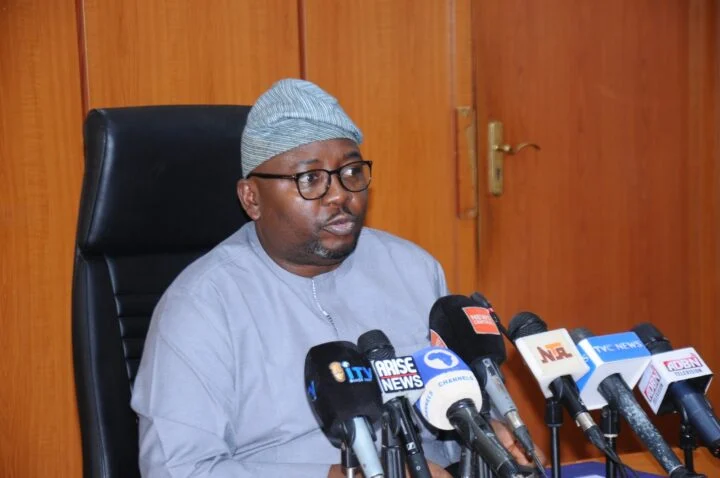
Chief Adebayo Adelabu, the minister of power, revealed on Wednesday that the Federal Ministry of Power did not receive any capital funding in the 2025 budget. However, he stated that this did not prevent the ministry from fulfilling its regulatory and supervisory duties in the electricity industry.
Additionally, Adelabu promised parliamentarians that the Federal Government has taken action to prevent the fiscal failures that hindered the implementation of the capital budget for 2025, promising better performance in 2026.
At the National Assembly in Abuja, the minister revealed during the budget defense session before the Senate Committee on Power that the lack of capital funds slowed down activities in various ministries, departments, and agencies. However, he expressed confidence that the situation would not happen again.
Although salaries and overheads were fully executed, he claimed that the ministry’s capital spending performance for 2025 was zero because there were no budget releases.
According to him, the budget is divided into three parts: capital expenditures, overhead expenses, and salaries and wages. Although we reported 0% on the capital component, we were 100% on the first two. The ministry does, however, have agencies that are able to continue their operations and make money on their own. We found it much simpler to weather the year as a result.
Despite the financial limitations, Adelabu emphasized, the ministry continues to oversee agencies and promote sector reforms.
He informed Congress that, in 2025, the nation’s grid remained comparatively steady, with only one outage, which he ascribed to vandalism and a disruption in the gas supply.
While budget performance was much better in 2024, we did record roughly four disturbances and one complete grid failure. When we received nothing in 2025, however, we only noted one disruption, which occurred in the Niger Delta due to an explosion and vandalism that impacted the gas supply,” he stated.
We were able to overcome this obstacle because of the investments made to stabilize the grid,” the minister continued. That the country was plunged into darkness in 2025 because we did not receive funding is therefore untrue.
Nigeria’s power industry has long been plagued by underfunding, inadequate infrastructure, and funding shortages. Several administrations have struggled to strike a balance between the need for significant capital infusions into transmission, distribution, and generating and budgetary restraints.
In order to improve power access, reinforce transmission networks, and increase grid capacity, capital expenditure in the sector is essential. Budget announcements that are delayed frequently result in slower project execution and less successful reforms.
Despite the 2025 setback, Adelabu revealed that in order to speed up implementation, a portion of the funding allocation would be made available in the first quarter of 2026.
According to him, the ministry should receive around 30% of the 2026 capital budget before the end of March, with the remaining 70% being implemented during the course of the year. In 2026, the Federal Government is making every effort to prevent the budgetary miscalculation that impacted the implementation of the 2025 budget.
The statement was consistent with President Bola Tinubu’s pledge to enhance budget performance in all important economic sectors, the minister said.
Senator Enyinnaya Abaribe, the chairman of the Senate Committee on Power, had earlier in his speech characterized budgeting as an essential tool for guaranteeing accountability, transparency, and efficient management of the public sector.
“In light of this, government ministries, departments, and agencies are required to present their yearly budget assessments and revenue forecasts to the National Assembly for approval,” he stated.
Abaribe emphasized the role that the electrical industry plays in promoting industrialization, economic growth, and diversification. He also said that the committee would continue to monitor approved budgets to make sure they are implemented effectively.
“As everyone knows, the power industry is essential to an economy’s ongoing success, especially during a time of fast global development and economic diversification. To guarantee that approved budgets are implemented in a tangible way and to identify issues that call for legislative support, the committee will keep working with the ministry,” he stated.
Senior officials, including Mamuda Mamman, the ministry’s permanent secretary, accompanied the minister.
With the passage of the energy Act, which decentralized the industry and gave states more authority over the production and distribution of energy, Nigeria’s electrical value chain is being strengthened through continuous changes.
MDAs got less than N1 trillion for capital projects in the first seven months of 2025, according to the figures.
The Medium-Term Expenditure Framework and Fiscal Strategy Paper (2026–2028) from the Budget Office of the Federation was analyzed to reveal that, although N18.53 trillion was allocated for capital expenditure for “MDAs and others” in 2025, the January–July pro rata benchmark was N10.81 trillion.
But during that time, only N834.80 billion in actual capital transfers were made to MDAs and associated organizations. The performance rate for the seven-month period was only 7.72 percent, leaving a pro rata deficiency of around N9.98 trillion.
Even worse was the overall capital picture. The projected total capital expenditure for 2025 was N23.44 trillion, with a pro rata amount of N13.67 trillion expected by July. The total amount of capital spending that was actually spent was N3.60 trillion, which was 73.7% less than the reference amount.
“Capital expenditure implementation was notably weak,” the MTEF/FSP document said, acknowledging that capital expenditure spending was weak in 2025. From the pro-rata capital budget of N10.81 trillion, only N834.80 billion had been disbursed to Ministries, Departments, and Agencies, indicating a performance of less than 10% throughout the review period.
Join Television Nigerian Whatsapp Now
Join Television Nigerian Facebook Now
Join Television Nigerian Twitter Now
Join Television Nigerian YouTUbe Now