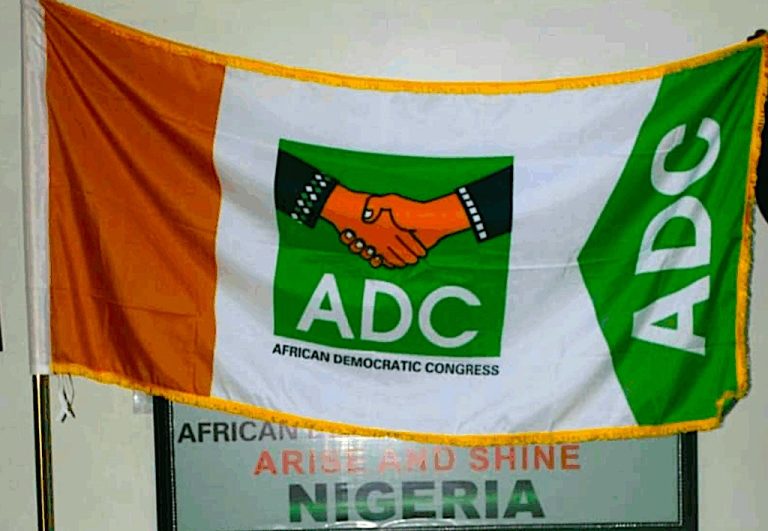
Ahead of the general elections in 2027, the African Democratic Congress (ADC) has promised to provide people-focused governance based on empathy, pragmatism, and accountability.
This was announced by the party on Monday in Abuja during the Policy and Manifesto Committee’s inauguration, which it called a crucial turning point in its efforts to save Nigeria from escalating socioeconomic suffering.
Speaking at the event, Senator David A. B. Mark, National Chairman of the ADC, stated that the nation was in dire need of a new political narrative that put citizens at the center of governance rather than detached policy experiments.
He said that the inauguration was a calculated move to provide Nigerians legitimate options to what he called “years of ineffective governance,” rather than a standard party ritual.
Families are earning less while working harder. The power supply is still unstable despite rising tariffs, food prices are rising more quickly than wages can keep up, and social and economic life is still disrupted by insecurity, according to Mark.
Although poverty and hardship have always existed in Nigeria, he contended that under the current administration, the extent of suffering has increased due to policies that disregard the everyday reality of the populace.
Mark emphasized that Nigerians are anxious for measures that alleviate their suffering and give them hope; they are no longer interested in political rhetoric, statistics, or blame-shifting.
“Nigerians do not seek out persuasive arguments. He stated, “They want policies and actions that demonstrate that the government is aware of what they are going through and is ready to act with courage, compassion, and clarity.”
According to the former Senate President, Nigeria’s problem is not a lack of ideas but rather a failure to bring them to life. He pointed out that many government initiatives are still merely theoretical endeavors that do not result in better living conditions.
“Reports are written, committees are formed, and documents are produced, but nothing changes in the lives of the people, which is what matters most,” he continued.
Mark questioned the rationality of measures that place greater obligations on citizens without real advantages, citing the elimination of fuel and energy subsidies.
Whether or not people can enhance other aspects of their lives by paying more for food, transportation, gasoline, and power is the true question. “The answer is obviously no,” he stated, adding that the ADC needs to give specific explanations of what it will do differently.
As important areas that need to be tackled comprehensively rather than piecemeal, he named insecurity, food production, healthcare, education, transportation, and job creation.
“Loss of life is only one aspect of insecurity. Mark cautioned, “It is about closed schools, displaced communities, abandoned farms, and a climate of fear that stifles economic activity.”
Additionally, he advocated for internal party protections to prevent the concentration of power in the hands of a select few, stating that no one individual should control the party regardless of their wealth or influence.
“You are here to do more than just make suggestions. “You are here to make sure that every suggestion is realistic and lessens suffering, not just reorganize it,” he informed the committee members.
Dr. John Oyegun, the chairman of the Policy and Manifesto Committee, praised the party leadership for their faith in the committee during his acceptance address. He described the task as both an honor and a significant duty.
The committee will use Mark’s speech as a foundation, Oyegun stated, emphasizing that government under the ADC would not be “business as usual.”
He stated, “You have asked us to create a manifesto and policies that the average Nigerian can relate to and understand how they fit into their everyday lives.”
Despite significant public investment, he criticized decades of governance failures, pointing out that Nigerians are unable to identify a single sector where issues have been significantly fixed.
We cannot claim to have reliable electricity, reasonably priced transportation, or true security with confidence. Oyegun said, “There is a lot of movement and noise, but there is no real improvement in the people’s lives.”
Promising that the ADC will oppose what he called a “contractor-governed system,” the former national chairman of the All Progressives Congress cautioned against the culture where party manifestos are abandoned once power is gained.
Oyegun pledged that the committee would endeavor to guarantee that ADC governments continue to be answerable to the people and do not distance themselves from their electorate.
Former APC Vice Chairman North Hon. Salihu Lukman, former Deputy Governor of Kogi State Hon. Simon Achuba, and members of the party’s National Working Committee were among the committee members in attendance at the inauguration.