
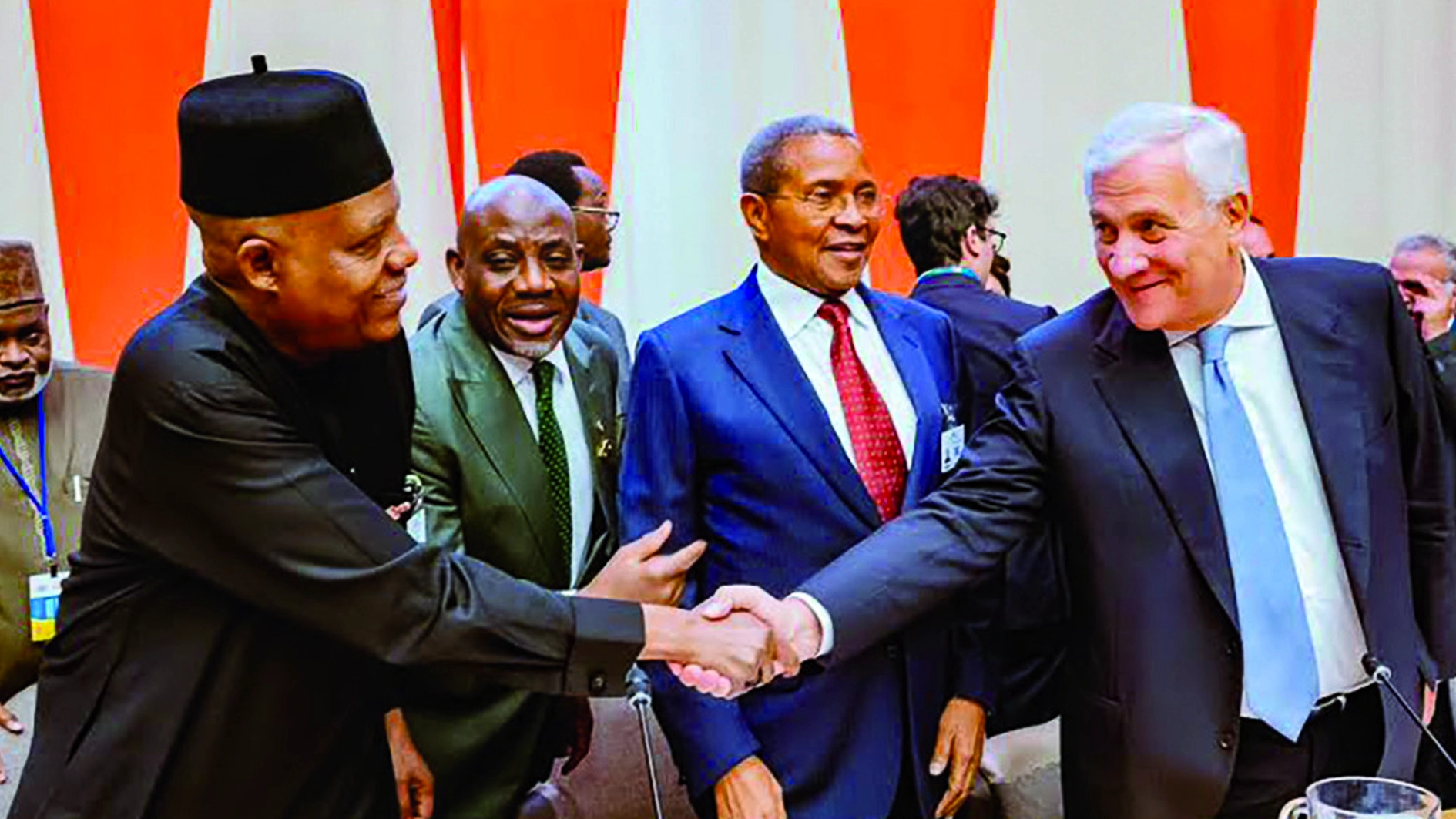
In a remarkable departure from last year’s address at the United Nations General Assembly, Nigeria yesterday joined the United Nations’ Secretary-General and other African leaders to protest the continent’s continued absence from the world body’s permanent membership of its Security Council.
Delivering Nigeria’s address to delegates and attendees at the 81st United Nations General Assembly at the United Nations Headquarters in New York last night, Vice President Kashim Shettima, who spoke on behalf of President Bola Tinubu, called for the reconstitution of the UN Security Council with the inclusion of an African representative.
The Security Council presently consists of 15 members: five permanent members – Russia, China, the United States, the United Kingdom, and France – and 10 non-permanent members elected by the General Assembly for two-year terms. The five permanent members each hold veto power over substantive resolutions, enabling any one of them to block adoption of a draft resolution regardless of the level of support among other members. African Union (AU), as a body, is a representative non-permanent member.
The influence of the veto was visible in June 2025 when the U.S. blocked a Security Council resolution calling for an immediate and permanent ceasefire in Gaza. The resolution received 14 votes in favour, including support from all 10 elected members of the council, but failed after the U.S. cast the only vote against it.
Speaking yesterday, President Tinubu, through Shettima, renewed calls for a radical shake-up of the UN, insisting that reforms must start with reconstituting the Security Council to grant Africa permanent seats. He warned that the continent can no longer afford to fill the Council’s agenda from the margins, pointing out that the world of 2026 cannot remain captive to the distribution of power in 1945.
Specifically, he demanded at least two permanent seats for the continent—including full rights, responsibilities, and veto power—along with a total of five non-permanent seats. “The reform of this institution must begin with the reconstitution of the Security Council, for the world of 2026 cannot remain captive to the distribution of power in 1945. Africa cannot continue to fill the Council’s agenda while remaining absent from its permanent membership.
“Nigeria demands, in accordance with the Ezulwini Consensus and the Sirte Declaration, at least two permanent seats for Africa, with all the rights and responsibilities of permanent membership, including the veto for as long as it exists, and five non-permanent seats in total. The authority to speak for humanity carries an obligation to represent it,” he stated.
Guterres, United Nations secretary-general, said Africa’s absence from its permanent membership is “unjust and indefensible”. Speaking earlier yesterday, he said: “We must reform the Council so that it reflects today’s world with the legitimacy and effectiveness that today’s challenges demand.”
The African Union has for years pushed for reform of the Security Council, saying the continent is under-represented in a body whose decisions have significant implications for global peace and security, including conflicts in Africa. The AU is also demanding at least two permanent seats on the Security Council, with full privileges including veto power if the veto is retained, as well as five non-permanent seats.
ALSO, Kenyan President William Ruto called for reform of the United Nations Security Council, urging permanent African representation on the body. In his address to the UN General Assembly, Ruto lamented Africa’s continued exclusion from permanent representation, despite accounting for more than a quarter of the assembly’s membership.
“Africa has 54 member states, more than a quarter of this assembly, yet no permanent voice in the body entrusted with the primary responsibility of international peace and security”, Ruto said. “We are frequently the subject of its decisions, permanently discussed, yet permanently excluded.”
President Tinubu further issued a wake-up call to world leaders, demanding an immediate end to global warfare and a total rejection of the rising tide of nationalism. With urgent moral clarity, he warned that the global order hangs in the balance, while fiercely rallying the international community to dismantle unilateral aggression, resurrect the foundational principles of the United Nations Charter, and forge an unyielding, unified front through a recommitted era of global multilateralism.
The Nigerian leader categorically told the global leaders not to pretend that distant or domestic conflicts do not exact a price from other nations, underscoring the UN’s urgent duty to restore trust in institutions built to reconcile differences and advance global common interests.
“The persistence of conflict across the world recalls the purpose for which the United Nations was founded: to spare succeeding generations the devastation of war. We must therefore return to the founding principles of dialogue, mutual respect and collective responsibility.
“Nigeria stands by the Charter and its promise of a world in which diplomacy prevails over coercion, cooperation over isolation and international law over the arbitrary exercise of power,” he declared.
The President framed Nigeria’s peacekeeping efforts in Africa as a model, noting that the nation stands ready to take on greater responsibility and sacrifice to restore peace across the continent—just as it did in Liberia, Sierra Leone, Darfur, Mali, and The Gambia, where it committed personnel and resources when global solidarity demanded action.
Last year’s remarks drew some flak across diplomatic and political circuits when the Vice President, who also represented President Tinubu at UNGA, chose to focus on the conflicts in Palestine/Israel, calling for a two-state permanent solution.
Shettima was heavily criticised for focusing on the plight of Palestinians during his address to the United Nations, while failing to draw the world’s attention to and seek global support for the worsening insecurity and economic hardship in Nigeria.
Yesterday, the Nigerian leader categorically told the global leaders not to pretend that distant or domestic conflicts do not exact a price from other nations, underscoring the UN’s urgent duty to restore trust in institutions built to reconcile differences and advance global common interests.
“The persistence of conflict across the world recalls the purpose for which the United Nations was founded: to spare succeeding generations the devastation of war. We must therefore return to the founding principles of dialogue, mutual respect and collective responsibility.
The President framed Nigeria’s peacekeeping efforts in Africa as a model, noting that the nation stands ready to take on greater responsibility and sacrifice to restore peace across the continent—just as it did in Liberia, Sierra Leone, Darfur, Mali, and The Gambia, where it committed personnel and resources when global solidarity demanded action.
Drawing lessons from Nigeria’s prolonged struggle against Boko Haram, ISWAP and other armed groups, the President said: “no nation, however formidable its defences, can secure itself completely against dangers sustained beyond its borders.”
He noted that while modern threats like terrorism and cyber-attacks exploit gaps in global action, lasting military victory requires a foundation of education, economic opportunity, accountable governance, and human rights.
As a founding member of ECOWAS, President Tinubu said Nigeria remains ready to uphold regional solidarity and African leadership in resolving security challenges, “reinforced by principled international partnerships.”
The Nigerian leader maintained that Nigeria is committed to the peaceful settlement of disputes under the United Nations Charter, as “the conflicts in Sudan and other war-torn countries demand urgent diplomacy to address their humanitarian, economic and geopolitical consequences.”
MEANWHILE, Vice President Shettima will later today lead a joint effort by the Federal Government and the private sector to market the country’s workforce to global employers on the margins of the United Nations General Assembly in New York.
This is according to a statement signed on Thursday by the Head of Communications, Hire From Nigeria, Oluwatoyin Ashipa, titled ‘Nigeria to Advance Services Exports and Job Creation through Hire from Nigeria Engagement at UNGA 81.’
The event, themed ‘Impact sourcing as a driver of global trade and inclusive job creation,’ will bring together senior government officials, state governors, and technology and private-sector leaders before an audience of international employers, investors and partners in New York for UNGA week.
Shettima is expected to speak on the theme ‘Setting the global trade and impact sourcing context; Nigeria’s positioning as the next outsourcing frontier.’ Ashipa described the forum as building directly on the national launch of Hire from Nigeria in Abuja on August 31, 2026, where government and private-sector leaders committed to connecting Nigerian talent across white- and blue-collar roles with global demand.
Speaking ahead of the meeting, the Minister of Industry, Trade and Investment, Jumoke Oduwole, said, “Our priority is to translate Nigeria’s talent into greater participation in global trade. “Through Hire from Nigeria, we are working with the private sector to connect Nigerian professionals and service providers with international demand.”
Other officials expected at the meeting include Lagos State Governor, Babajide Sanwo-Olu; Niger State Governor, Mohammed Bago; the Minister of Education, Tunji Alausa; the Director-General of the National Identity Management Commission, Bisoye Coker-Odusote; the Co-Founder and Executive Chairman of Itana, Luqman Edu; the Country Director of Mastercard Foundation Nigeria, Rosy Fynn; the Co-Founder and President of Tech4Dev, Joel Ogunsola; and the Chief Executive Officer of Semicolon Africa, Sam Immanuel.
Tech4Dev Chief, Ogunsola, said, “Nigeria has an opportunity to move from being recognised for the size of its talent pool to being recognised for the value that talent creates globally. “Hire From Nigeria is about making that value visible and connecting Nigerian capabilities to the businesses and markets that need them.”