
I grew up in Ijebu-Ode where my job was to join the other children in defending the hens of each family and their chicks from predators. We were led by a practical proverb: first you have to drive away the eagle, then you can count the chicks. That meant having rocks and slings on hand to intervene when the hens were under attack from an eagle overhead. If we were awake and ready, the predator had no chance.
The abduction of children and teachers by the Oriire in Oyo State is on my mind. It was good that our security forces, as it should be in a normal country, got involved and after 56 days rescued the victims.” I commend the excellent work of the security forces under the overall leadership of President Bola Ahmed Tinubu who worked behind the scenes, ostensibly, with the Governor of Oyo State, Seyi Makinde. Up to now, Nigerians have been told that the victims’ unharmed release was not negotiated for ransom or quid pro quo demands by the kidnappers.
There is so much we should push to know still. Now it’s time to count the chicks. The media has little snippets of information. Pidgin rendition of killing. There is need to substantiate claims that eight terrorists were captured alive as many were “unalived.” Interesting if true: that the security forces rounded up family members of the terrorists in different states in Northern Nigeria and delivered a clear message of killing those family members in retaliation for any further deaths among the victims beyond the dastardly slaughter of Michael Oyedokun and the killing of another teacher on the day of the kidnap.
Governor Seyi Makinde’s call for further investigation into the roots of this crisis would be a welcome development if it was not a major departure from established diplomatic protocols. Ideally, a subnational leader would have a basic understanding of the international system that would allow him or her to understand the specific, limited role of the UN. From the point of view of international relations and the legal environment of global interventions, this type of request seems misguided.
UN Secretary-General: A Secretary, Not A General
Governor Seyi Makinde may have been misled by the Yoruba translation of United Nations as “Ijoba Agb’aiye”, literally World Government, and in which case the UN Secretary-General as the President of the World. This could not be further from the truth. The UN is not a government. It has neither a police nor a military force.
The office of the Secretary-General is more for a Secretary and not a General, although the Secretary-General is one of the main organs of the UN system, as the British Permanent Representative to Prof. Ibrahim Agboola Gambari and I campaigned for General Olusegun Obasanjo to be the UN Secretary-General in 1991. The General Assembly has the power of the purse , but the power at the UN is more in the Security Council ( if the veto system allows decisions ) . The Secretary-General is to a large extent a secretary for a union of member states.
His profile as the media representation of the will of the union or if you like association of member states does not make him the boss. Of course, in theory he has power over the staff he appoints when the strong countries are not strongly interested in opposing him. He also has his “good offices role” with which he makes direct and indirect intervention pleas for peace, development and respect for human rights and humanitarianism around the world. These efforts offer him significant media visibility.
The Barrier of Sovereignty
The UN Secretariat and related agencies are not mandated to engage with sub nationals unless there is an express Security Council resolution calling for their involvement and/or a request for assistance by the national government concerned. This is what the agitators for the dismemberment of Nigeria never understood, while they deceived Nigerians by claiming that they wrote to the UN, requesting one sanction or the other for Nigeria. Of course, some demands could be included in the many reports the UN issues annually, but without an express resolution that could bite, it is only at best, for academic masturbation and that is if any of the five Permanent Members of the Security Council did not cast a negative vote.
Of course, the UN Secretariat and its Agencies and other International entities could be asked for all sorts of support, including sharing of material and knowledge, but not an investigation over kidnapping by terrorists. It was a big and very important development in the South-West of Nigeria, more so with the beheading of a teacher and the killing of another and keeping 42 children and seven teachers in the forest for 56 days.
Read Also: DHQ Kicks Off Capacity-Building Programme for Retired Armed Forces Personnel
But even more serious situations such as civil war would have to be handled with care to prevent the UN from violating the sovereignty of a member state, no matter how weak or comatose a situation such a state may be in. For the Security Council to investigate, it would have to adopt a resolution under Chapter 7. The general responsibility to protect cannot be invoked in such a situation, and not through an innocuous subnational utterance of a Governor.
If the situation was more serious than what was faced in Oyo, the Human Rights Council could have given Governor Makinde succour and PBAT has no objection to external intervention. If PBAT objects the investigation team would not be issued visas but the report could be prepared from outside.
But for a report like that to matter, it would need a Security Council intervention to use its power to impose sanctions, if the Nigerian government had no veto-wielding friend who would swap a veto for an interest that Nigeria could cultivate.
Now it’s time to count the chicks. Governor Makinde could have taken a more constructive lead by addressing his concerns/questions directly within the national framework with the 49 Nigerians safely outside the den of the terrorists. He could have sought clarity on the processes that led to the victims’ abduction and freedom by organising internal pressures through the Governors Forum, credible Civil Society Organisations and investigative journalism. In my opinion, a lost opportunity to take a more statecraft-oriented approach was going over Nigeria for an external appeal. This situation is not beyond Nigerias coping capacity . Therefore, it is not too late to seek accountability and draw lessons for use elsewhere especially in Northern Nigeria.
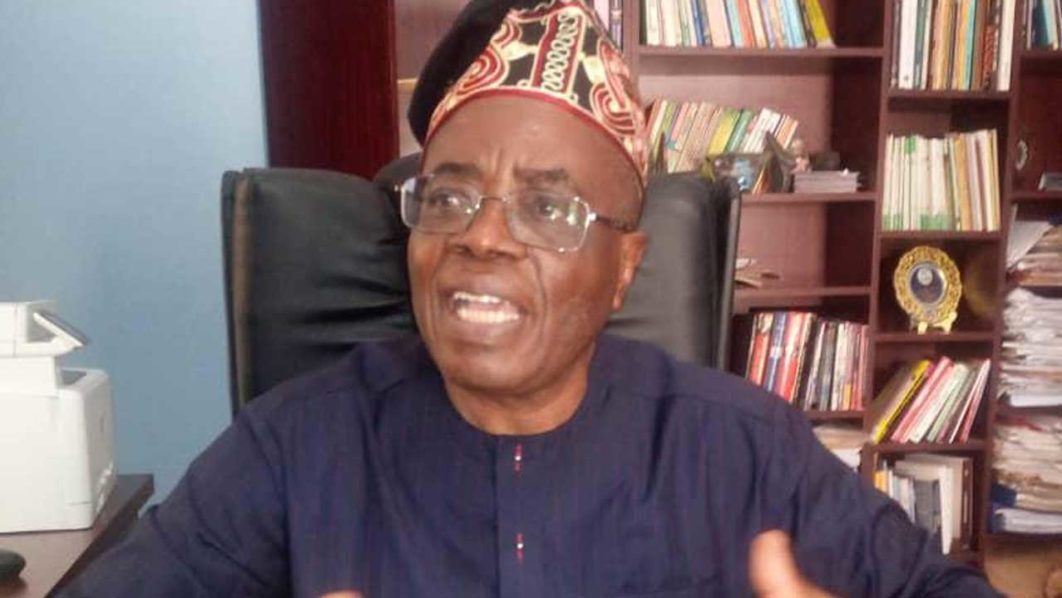
*Babafemi A. Badejo is a former Deputy Special Representative of the UN Secretary General for Somalia, a former Professor of Political Science and International Relations at Chrisland University, Abeokuta, and author of several books including a best seller on Politics In Kenya as well as Why Peace Has Been Elusive In Somalia. Currently a Legal Practitioner and Chairman of the national NBA Anti-Corruption Committee and a Consultant at Yintab Strategy Consults. He received the 2025 Nelson Mandela Distinguished Africanist Award at the Africa Annual Conference at the University of Texas at Austin. In November 2025, he was decorated with the Order 27 Juin 1977 by Djibouti.