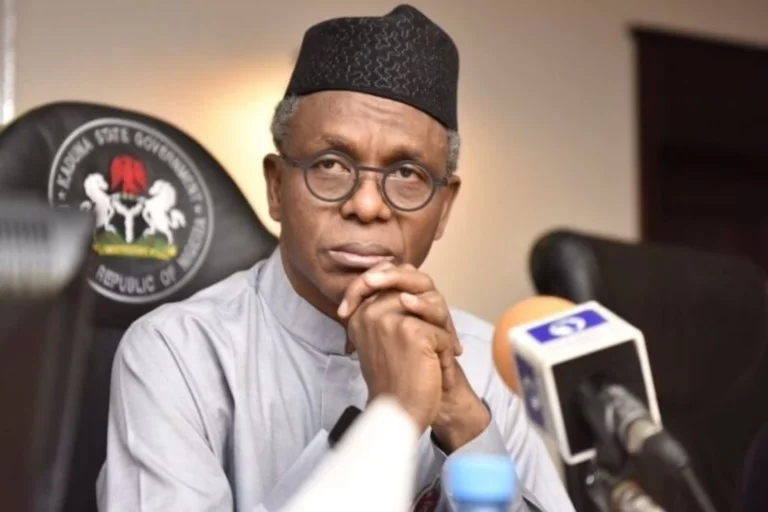
In an appeal, Nasir El-Rufai, a former governor of Kaduna State, asks the court to drop charges brought against him by the Department of State Services, calling the case an egregious abuse of the legal system and incompetence.
The application was submitted in response to the Federal High Court’s pending Charge No. FHC/ABJ/CR/99/2026. The hearing before Justice Joyce Abdulmalik is set for February 25, 2026.
El-Rufai is requesting in the move to have the charge dated February 16, 2026, quashed or struck out on the grounds that it reveals no crime that is known to law and is a misuse of the legal system.
Additionally, he is requesting that the court dismiss him on the grounds that there is insufficient evidence to support the charge.
In addition, the former governor is suing the DSS for N2 billion in fees, claiming that the criminal justice system was unconstitutionally used to harass and humiliate him and that there was “abuse and misuse of the court process.”
The application, which cites 17 reasons for dismissal, contests the accusations’ constitutionality on the basis that they cite crimes that are not known to the law and do not comply with statutory criteria, according to court documents. Alleged dishonesty, lack of proof, prosecution incompetence, and accusations of political persecution and ill faith are further grounds.
The application further argues that the prosecution violated El-Rufai’s fundamental rights by violating a number of constitutional provisions, including Section 36(5) of the 1999 Constitution, which guarantees the presumption of innocence; Section 36(11), which protects against self-incrimination; Section 36(12), which mandates that offenses be defined in written law; and Sections 39 and 40, which guarantee the freedom of expression and freedom of association, respectively.
In a letter dated February 18, El-Rufai’s legal team formally informed the Director-General of the DSS of the application, including the information about his attorney.
El-Rufai was scheduled to be arraigned by the DSS on February 25 for alleged cybercrime and national security breach, as we previously reported.
In a three-count criminal accusation, the DSS accused the former governor of illegally listening in on National Security Adviser Nuhu Ribadu’s phone conversation.
El-Rufai’s activities, according to the secret police, violated the Nigerian Communications Act of 2003 and the Cybercrimes (Prohibition, Prevention, etc.) Amendment Act of 2024.
In the first count, the DSS claimed that on February 13, 2026, the former governor stated in an interview with Arise TV’s Prime Time Program in Abuja that he and others illegally intercepted the NSA’s phone communications. This is a violation of Section 12(1) of the Cybercrimes (Prohibition, Prevention, etc.) Amendment Act, 2024, and is punishable by law.
In count two, El-Rufai was charged with saying in the same TV interview that he was acquainted with someone who illegally collected the NSA’s phone conversations without alerting the appropriate security services.
According to the DSS, the Cybercrimes (Prohibition, Prevention, etc.) Amendment Act, 2024’s Section 27(b) punishes the claimed offense.
El-Rufai had stated in the live Arise TV interview that he had heard Ribadu ordering security personnel to hold him. He connected the purported order to what he said was an attempted arrest at the Nnamdi Azikiwe International Airport on February 12 when he returned from Cairo, Egypt.